Bioenergy with Carbon Capture and Storage Market Size, Growth, Forecast 2026 to 2035
The global bioenergy with carbon capture and storage (BECCS) market size was valued at USD 3.74 billion in 2025 and is expected to be worth around USD 18.61 billion by 2035, exhibiting a compound annual growth rate (CAGR) of 17.4% over the forecast period from 2026 to 2035.
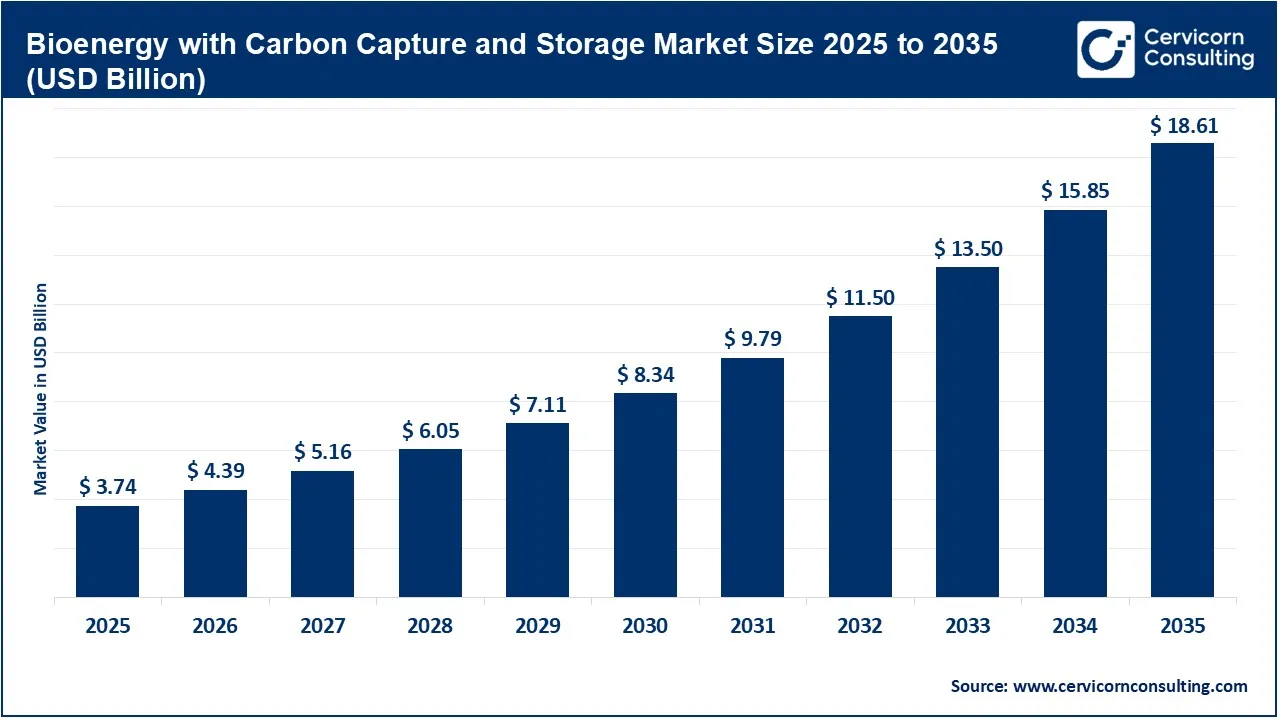
The bioenergy with carbon capture and storage market is primarily driven by the global push toward net-zero emissions and the increasing need for negative emissions technologies (NETs) to offset hard-to-abate sectors such as aviation, cement, steel, and chemicals. Unlike conventional carbon capture systems, BECCS permanently removes atmospheric CO₂ by combining sustainable biomass energy with carbon capture and geological storage, making it a critical pathway in long-term decarbonization strategies. The International Energy Agency (IEA) notes that the world's first commercial BECCS facility at a U.S. ethanol plant captures approximately 1 million tonnes of CO₂ annually, while several ethanol facilities collectively capture around 2 million tonnes of biogenic CO₂ per year. Additionally, nearly 40 ethanol plants are expected to incorporate carbon capture before 2030, representing more than 15 million tonnes of annual capture capacity, supported by government incentives, carbon pricing mechanisms, and expanding carbon removal credit markets.
Another major growth factor is the rapid expansion of CCS infrastructure, supportive climate policies, and corporate decarbonization commitments, particularly across North America and Europe. Governments are increasing funding for CO₂ transport and geological storage networks while introducing tax credits and carbon contracts that improve the commercial viability of BECCS projects. According to the IEA, more than 50 new BECCS facilities were announced between 2021 and 2022, with a combined planned capture capacity of approximately 20 million tonnes of CO₂ per year, reflecting strong project momentum. The IEA also highlights that BECCS-based carbon removal could reach around 40 million tonnes of CO₂ annually by 2030 under currently announced projects, although significantly higher deployment will be required to achieve global net-zero pathways. Growing investments in biomass power generation, sustainable aviation fuel (SAF), bioethanol production, and waste-to-energy plants are further expanding commercial opportunities for BECCS across the energy and industrial sectors.
Report Highlights
- North America led the market with a 37.8% share, driven by advanced CCS infrastructure, bioethanol production, supportive government incentives, and increasing carbon removal investments.
- Europe accounted for 33.9% of the market, supported by strong climate policies, carbon pricing mechanisms, large-scale commercial BECCS deployment, and renewable energy expansion.
- Post-combustion capture dominated the technology segment with a 49.1% share, owing to commercial maturity, retrofit capability, widespread biomass power plant adoption, and lower implementation risks.
- Forestry biomass held the largest feedstock share at 34.6%, supported by abundant sustainable resources, well-established biomass supply chains, expanding forestry operations, and reliable feedstock availability.
- Power generation captured a 38.7% application share, driven by large-scale biomass electricity production, integrated carbon capture technologies, increasing renewable power demand, and grid decarbonization efforts.
What is Bioenergy with Carbon Capture and Storage?
Bioenergy with Carbon Capture and Storage is a carbon removal technology that generates electricity, heat, or biofuels from sustainable biomass while capturing the carbon dioxide (CO₂) released during the conversion process and permanently storing it in deep geological formations. Because biomass absorbs atmospheric CO₂ during growth, capturing and storing these biogenic emissions results in net-negative emissions, making BECCS one of the few technologies capable of both producing renewable energy and removing carbon from the atmosphere. It is widely recognized as a key solution for achieving net-zero climate targets, particularly in hard-to-abate sectors such as aviation, heavy industry, and long-duration carbon removal.
Recent Milestones
| Date |
Company |
Title |
Milestone |
| June 2025 |
Stockholm Exergi |
Groundbreaking of Europe's Largest BECCS Facility |
Construction officially began on the Beccs Stockholm project following the investment decision, marking one of Europe's largest carbon removal projects with planned capacity of 800,000 tonnes of CO₂ annually. |
| March 2025 |
Stockholm Exergi |
Final Investment Decision for BECCS Stockholm |
The company approved a SEK 13 billion investment to build one of the world's largest BECCS facilities, with commercial operation targeted for 2028. |
| Early 2025 |
Swedish Energy Agency & Stockholm Exergi |
Government Funding Award |
Stockholm Exergi secured funding through Sweden's reverse auction for negative emissions, providing a major financial boost for large-scale BECCS deployment. |
| September 2024 |
Drax Group |
US BECCS Expansion Strategy |
Drax announced plans to invest up to USD 12.5 billion in developing BECCS-enabled biomass power plants across the United States through its Elimini business. |
Bioenergy with Carbon Capture and Storage Market Dynamics
Market Drivers
1. Stringent Net-Zero Emission Targets and Carbon Removal Policies
Governments worldwide are strengthening climate policies that recognize BECCS as one of the few scalable technologies capable of delivering permanent negative emissions. The technology is increasingly supported through carbon pricing mechanisms, tax incentives, and carbon removal procurement programmes. According to the International Energy Agency (IEA), nearly 40 bioethanol facilities are expected to integrate carbon capture before 2030, representing over 15 million tonnes of annual CO₂ capture capacity. These policy-driven initiatives are accelerating investments in BECCS across power generation, biofuel production, and industrial decarbonization projects.
2. Growing Demand for High-Quality Carbon Removal Credits
The rapid expansion of voluntary and compliance carbon markets is creating strong demand for durable carbon removal solutions, positioning BECCS as a preferred technology. Unlike conventional offset projects, BECCS delivers measurable and permanent carbon sequestration while generating renewable energy. According to the International Emissions Trading Association (IETA), BECCS carbon credit issuance increased by 348% year over year, while credit prices typically range between USD 150 and USD 430 per tonne of CO₂e, demonstrating rising commercial interest from corporations pursuing net-zero commitments.
Market Restraints
1. High Capital Investment and Project Financing Risks
Despite strong climate benefits, BECCS projects require substantial investment in biomass processing, carbon capture systems, transportation networks, and geological storage infrastructure. These high upfront costs often limit commercial deployment, particularly where carbon pricing is insufficient to ensure attractive returns. The IEA reports that several planned BECCS projects were cancelled or delayed during 2025 because developers struggled to secure long-term carbon removal offtake agreements and reliable financing, highlighting continued investment uncertainty across the sector.
2. Limited CO₂ Transport and Storage Infrastructure
The commercial success of BECCS depends on access to pipelines, shipping networks, and certified geological storage sites capable of permanently storing captured carbon. However, infrastructure remains concentrated in only a few regions, restricting wider deployment. According to the IEA, permitting delays for storage sites and community opposition to new CO₂ pipelines continue to postpone multiple projects, with several planned storage developments now expected only around 2035, slowing market expansion despite increasing capture demand.
Market Opportunities
1. Expansion of Sustainable Aviation Fuel (SAF) and Biofuel Production
The increasing adoption of sustainable aviation fuel and advanced biofuels presents a major opportunity for BECCS because ethanol and biofuel facilities generate high-purity biogenic CO₂ that can be captured at relatively low cost. The IEA estimates that announced BECCS projects could collectively capture approximately 40 million tonnes of CO₂ annually by 2030, with biofuel production expected to remain one of the fastest-growing deployment segments supported by clean fuel regulations and low-carbon fuel standards.
2. Corporate Carbon Removal Procurement and Long-Term Offtake Agreements
Large technology companies, airlines, and industrial manufacturers are increasingly purchasing long-term carbon removal credits to achieve science-based climate targets, creating new revenue streams for BECCS developers. According to IETA, operational BECCS projects have already issued approximately 596 thousand tonnes of carbon removal credits by March 2026, while the voluntary market continues expanding as companies seek durable, verifiable negative emissions solutions beyond traditional nature-based offsets.
Market Challenges
1. Sustainable Biomass Feedstock Availability
Large-scale BECCS deployment depends on reliable supplies of sustainably sourced biomass without competing with food production or causing deforestation. Feedstock shortages and sustainability concerns can increase costs and restrict project scalability. Research indicates that climate change could reduce the suitability of existing tropical bioenergy crop regions by up to 40% for oil palm and 13% for sugarcane by 2060, creating long-term supply chain and land-use challenges for future BECCS facilities.
2. Complex Integration Across the BECCS Value Chain
BECCS requires seamless integration of biomass supply, energy conversion, carbon capture, transportation, geological storage, and long-term monitoring. Technical inefficiencies at any stage can significantly affect project economics and carbon removal performance. Recent research highlights that feedstock variability, moisture content, transport impurities, and geological uncertainty remain major engineering challenges, requiring standardized supply chains, improved monitoring technologies, and stronger regulatory frameworks before BECCS can scale to gigatonne-level deployment.
Regional Analysis
The bioenergy with carbon capture and storage market is segmented by region into North America, Europe, Asia-Pacific, Latin America, and LAMEA. Here is a brief overview of each region:
Why does North America dominates the bioenergy with carbon capture and storage market?
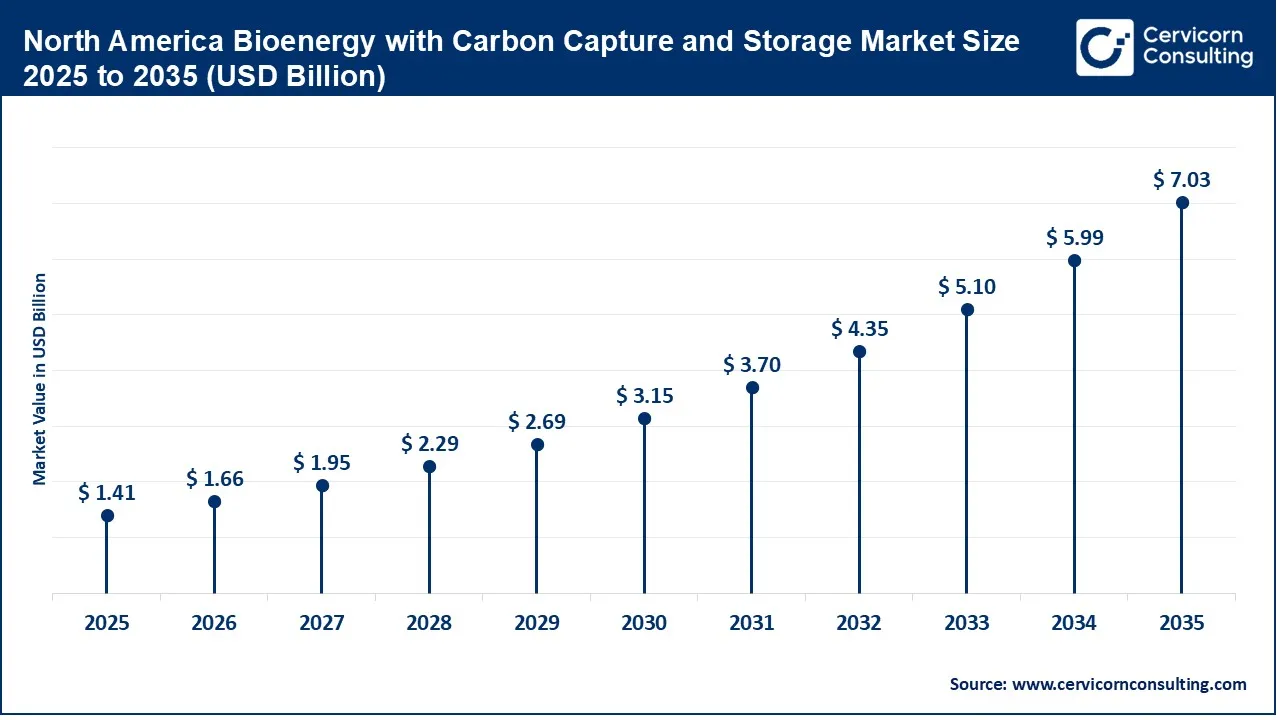
The North America bioenergy with carbon capture and storage (BECCS) market size was estimated at USD 1.41 billion in 2025 and is predicted to surpass USD 7.03 billion by 2035. North America dominates the market due to its advanced carbon capture and storage (CCS) infrastructure, abundant sustainable biomass resources, supportive government incentives, and rapidly expanding carbon removal ecosystem. The region leads in commercial-scale BECCS deployment through bioethanol plants, biomass power stations, and waste-to-energy facilities that integrate carbon capture technologies. Favorable policies such as the U.S. Inflation Reduction Act, enhanced 45Q tax credits, and increasing investments in CO₂ transport and geological storage networks are accelerating project development. Strong corporate demand for permanent carbon removal credits, coupled with extensive research activities and collaborations between energy companies, technology providers, and government agencies, continues to strengthen North America's leadership in the global BECCS market.
United States: Extensive Bioethanol Industry, Federal Incentives, and Carbon Capture Infrastructure Drive Market Leadership
- The United States is the world's largest producer of fuel ethanol, operating more than 190 ethanol plants, providing a substantial source of high-purity biogenic CO₂ suitable for BECCS deployment.
- The enhanced 45Q federal tax credit offers up to USD 85 per tonne for permanently stored CO₂ and up to USD 180 per tonne for qualifying direct air capture projects, significantly improving project economics for carbon capture investments.
Canada: Abundant Biomass Resources, Net-Zero Policies, and Expanding Carbon Storage Capacity Support Market Growth
- Canada possesses vast forestry resources and a well-established forest products industry, providing a reliable and sustainable biomass feedstock for BECCS facilities.
- Federal carbon pricing policies, investment tax credits for carbon capture projects, and the country's commitment to achieving net-zero emissions by 2050 are encouraging investment in negative emissions technologies.
Why is Asia-Pacific fastest-growing region for bioenergy with carbon capture and storage market?
The Asia-Pacific bioenergy with carbon capture and storage (BECCS) market size reached at USD 0.77 billion in 2025 and is projected to hit USD 3.83 billion by 2035. Asia-Pacific is expected to be the fastest-growing market, supported by abundant agricultural and forestry biomass resources, ambitious carbon neutrality targets, and increasing investments in carbon capture technologies. The region is witnessing rapid development of biomass power plants, biofuel production facilities, and waste-to-energy projects that provide ideal opportunities for integrating carbon capture systems. Governments across Japan, China, South Korea, Australia, and Southeast Asia are introducing supportive policies for carbon capture, clean energy, and circular economy initiatives while investing in carbon transport and storage infrastructure. Growing industrial emissions, expanding sustainable aviation fuel (SAF) production, and rising demand for permanent carbon removal solutions are further accelerating BECCS adoption across the region.
China: Carbon Neutrality Goals, Large Biomass Resources, and Expanding CCS Infrastructure Drive Market Leadership
- China has committed to achieving carbon neutrality by 2060, making carbon capture and negative emissions technologies essential components of its long-term climate strategy.
- The country possesses one of the world's largest supplies of agricultural residues, forestry waste, and municipal solid waste, providing abundant feedstock for biomass power generation and BECCS deployment.
Japan: Advanced Carbon Capture Technologies, Biomass Power Expansion, and Green Innovation Support Market Growth
- Japan's commitment to achieving net-zero greenhouse gas emissions by 2050 is driving investments in BECCS as part of its national Green Growth Strategy and GX (Green Transformation) programme.
- The country continues to expand biomass-fired power generation by utilizing imported wood pellets, agricultural biomass, and waste-derived fuels to reduce dependence on fossil energy.
What are the driving factors of Europe bioenergy with carbon capture and storage market?
The Europe bioenergy with carbon capture and storage market size is expanding from USD 1.27 billion in 2025 to over USD 6.31 billion by 2035. Europe is a leading market, supported by aggressive climate policies, a mature biomass energy sector, and well-established carbon capture and storage initiatives. The European Union's commitment to achieving climate neutrality by 2050, combined with the EU Emissions Trading System (EU ETS) and Carbon Removal Certification Framework (CRCF), is accelerating investments in permanent carbon removal technologies. Extensive use of biomass for district heating, power generation, and combined heat and power (CHP), along with growing investments in CO₂ transport and offshore geological storage, has positioned Europe at the forefront of commercial BECCS deployment. Strong collaboration between governments, utilities, research institutions, and technology providers continues to drive innovation and large-scale project development across the region.
Sweden: World-Leading Negative Emissions Projects and Strong Government Support Drive Market Leadership
- Sweden is home to some of the world's most advanced BECCS initiatives, including Stockholm Exergi's BECCS Stockholm project, designed to capture up to 800,000 tonnes of biogenic CO₂ annually.
- The Swedish government has introduced dedicated financial support through reverse auctions for negative emissions, encouraging commercial deployment of BECCS technologies.
United Kingdom: Advanced Biomass Power Generation, Carbon Capture Clusters, and Net-Zero Policies Accelerate Market Growth
- The United Kingdom has established one of Europe's most advanced BECCS ecosystems through biomass power generation, carbon capture infrastructure, and supportive decarbonization policies.
- Drax Power Station, one of the world's largest biomass-fired power plants, is developing BECCS technology to deliver millions of tonnes of permanent carbon removals annually while generating renewable electricity.
BECCS Market Share, By Region, 2025 (%)
| Region |
Revenue Share, 2025 (%) |
| North America |
37.8% |
| Europe |
33.9% |
| Asia-Pacific |
20.6% |
| LAMEA |
7.7% |
LAMEA Bioenergy with Carbon Capture and Storage Market Analysis
The LAMEA bioenergy with carbon capture and storage (BECCS) market was valued at USD 0.29 billion in 2025 and is anticipated to reach at USD 1.43 billion by 2035. The LAMEA market is emerging as a promising region due to abundant biomass availability, expanding biofuel industries, and increasing government focus on decarbonization. Latin America benefits from large-scale sugarcane ethanol production and agricultural residues, while the Middle East is investing in carbon capture infrastructure to diversify low-carbon energy portfolios. Africa offers significant biomass potential from forestry and agricultural waste, creating long-term opportunities for BECCS deployment. Growing investments in renewable energy, industrial carbon capture, and sustainable fuel production, together with international climate financing and carbon credit initiatives, are expected to accelerate BECCS adoption across the region.
Brazil: Large Bioethanol Industry, Sugarcane Biomass, and Carbon Capture Potential Drive Regional Leadership
- Brazil is the world's second-largest ethanol producer, with an extensive sugarcane industry that generates high-purity biogenic CO₂, making the country well suited for commercial BECCS deployment.
- Abundant sugarcane bagasse, agricultural residues, and biomass-fired cogeneration facilities provide a reliable feedstock base for integrating carbon capture technologies.
Saudi Arabia: Expanding Carbon Capture Infrastructure and Net-Zero Strategy Support Future Market Growth
- Saudi Arabia is investing heavily in carbon capture, utilization, and storage (CCUS) as part of its Saudi Green Initiative and national objective to achieve net-zero emissions by 2060.
- The country is developing large-scale CO₂ transport and storage infrastructure that can support future integration of biomass-based carbon capture projects as sustainable biomass supply expands.
Segmental Analysis
The bioenergy with carbon capture and storage market is segmented into technology, feedstock, application, and geography.
Technology Analysis
Post-combustion capture dominates the bioenergy with carbon capture and storage market because it can be retrofitted to existing biomass power plants, waste-to-energy facilities, and biofuel production sites with minimal process modifications. The technology is commercially mature, supported by extensive operational experience, and compatible with amine-based carbon capture systems. Its widespread deployment in biomass-fired power stations and ethanol plants, particularly across North America and Europe, has made post-combustion capture the preferred technology for large-scale BECCS projects.
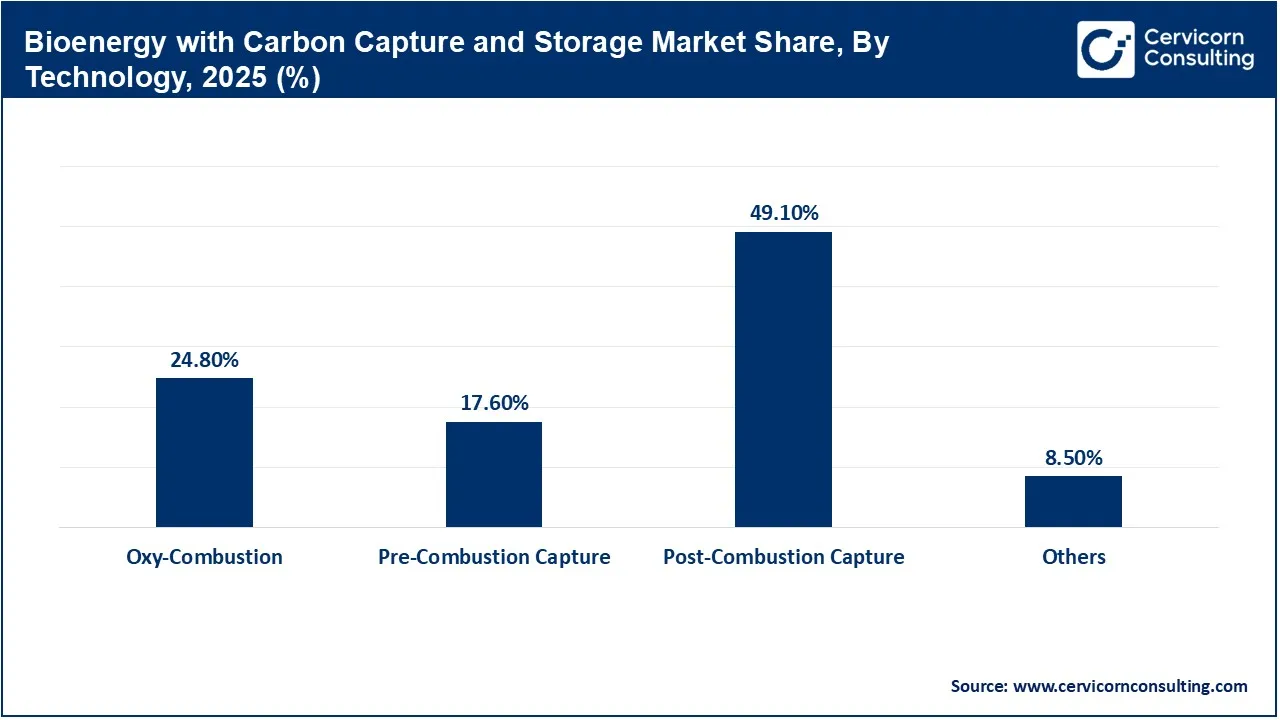
Oxy-combustion is expected to be the fastest-growing technology segment due to its ability to produce highly concentrated CO₂ streams, reducing purification costs and improving capture efficiency. Growing investments in next-generation biomass power plants and industrial decarbonization projects are accelerating its adoption. Government-funded demonstration projects and advances in air separation technologies are improving commercial feasibility, making oxy-combustion increasingly attractive for future large-scale BECCS facilities seeking higher carbon capture rates and improved energy efficiency.
Feedstock Analysis
Forestry biomass holds the largest share of the BECCS market owing to its abundant availability, well-established supply chains, and high energy density. Wood pellets, forest residues, sawmill by-products, and logging waste are extensively used by biomass power plants and district heating facilities, particularly in Europe and North America. Sustainable forest management practices and certification programmes further strengthen feedstock reliability, enabling continuous biomass supply for long-term BECCS operations while supporting renewable energy generation and permanent carbon removal.
BECCS Market, By Feedstock, 2025 (%)
| Feedstock |
Revenue Share, 2025 (%) |
| Forestry Biomass |
34.6% |
| Agricultural Residues |
23.8% |
| Energy Crops |
15.2% |
| Municipal Solid Waste (MSW) |
11.7% |
| Industrial Organic Waste |
7.1% |
| Algae & Aquatic Biomass |
3.2% |
| Others |
4.4% |
Municipal solid waste is projected to be the fastest-growing feedstock segment as governments increasingly promote waste-to-energy projects to reduce landfill dependence and methane emissions. Integrating carbon capture with MSW incineration enables simultaneous waste management, renewable energy production, and negative emissions. Rising urbanization, stricter landfill regulations, and expanding investments in circular economy infrastructure are driving rapid deployment of BECCS-equipped waste-to-energy plants, particularly across Europe, Japan, and several emerging Asian economies.
Application Analysis
Power generation represents the largest application segment because biomass-fired electricity plants provide continuous, large-scale CO₂ emission streams that are technically suitable for carbon capture. Existing biomass power infrastructure can be upgraded with CCS systems, allowing utilities to generate renewable electricity while achieving negative emissions. Strong government incentives, renewable energy policies, and decarbonization targets have encouraged utilities to integrate BECCS into power generation, making it the leading commercial application worldwide.
BECCS Market, By Application, 2025 (%)
| Application Segment |
Revenue Share, 2025 (%) |
| Power Generation |
38.7% |
| Biofuel Production (Ethanol, Biodiesel, SAF) |
24.9% |
| Combined Heat & Power (CHP) |
13.2% |
| Pulp & Paper Industry |
8.4% |
| Waste-to-Energy Plants |
7.3% |
| Carbon Dioxide Removal (CDR) & Carbon Credit Generation |
5.1% |
| Industrial Heat Production |
2.4% |
Carbon dioxide removal (CDR) and carbon credit generation is expected to witness the fastest growth due to increasing demand for durable carbon removal credits from corporations pursuing net-zero commitments. BECCS offers permanent atmospheric carbon removal with high verification standards, making it highly valuable in voluntary and compliance carbon markets. Growing long-term carbon removal purchasing agreements, favourable climate policies, and expanding carbon credit trading platforms are accelerating investments in dedicated BECCS facilities focused on negative emissions rather than energy production alone.
Bioenergy with Carbon Capture and Storage Market Top Companies
Recent Developments
- In March 2026, Stockholm Exergi AB announced that its Beccs Stockholm project will supply the first EU Carbon Removal Certification Framework (CRCF)-certified carbon removal units, enabling companies including Adyen and Nasdaq to procure verified permanent carbon removals and strengthening Europe's commercial BECCS ecosystem.
- In June 2026, Climeworks AG announced 14 new carbon removal partnerships totaling approximately 450,000 tonnes of CO₂ removal, expanding its portfolio across BECCS, direct air capture, biochar, enhanced rock weathering, and nature-based solutions to accelerate global carbon removal deployment.
- In September 2025, SLB announced that SLB Capturi completed its first year of operations, achieving multiple industrial carbon capture project milestones and expanding deployment of its modular carbon capture technology across hard-to-abate sectors, supporting large-scale CCUS and future BECCS applications.
Report Segmentation
By Technology
- Oxy-Combustion
- Pre-Combustion Capture
- Post-Combustion Capture
- Others
By Feedstock
- Forestry Biomass
- Agricultural Residues
- Energy Crops
- Municipal Solid Waste (MSW)
- Industrial Organic Waste
- Algae & Aquatic Biomass
- Others
By Application
- Power Generation
- Biofuel Production (Ethanol, Biodiesel, SAF)
- Combined Heat & Power (CHP)
- Pulp & Paper Industry
- Waste-to-Energy Plants
- Carbon Dioxide Removal (CDR) & Carbon Credit Generation
- Industrial Heat Production
By Geography
- North America
- Europe
- Asia-Pacific
- LAMEA