Automotive Battery Aftermarket Market Size and Growth Factors
The global automotive battery aftermarket market size was valued at USD 36.39 billion in 2025 and is expected to hit around USD 61.17 billion by 2035, exhibiting a compound annual growth rate (CAGR) of 5.3% over the forecast period 2026 to 2035. The aging global vehicle parc and rising vehicle utilization are major drivers of automotive battery aftermarket demand, as older vehicles require more frequent battery replacement and maintenance.
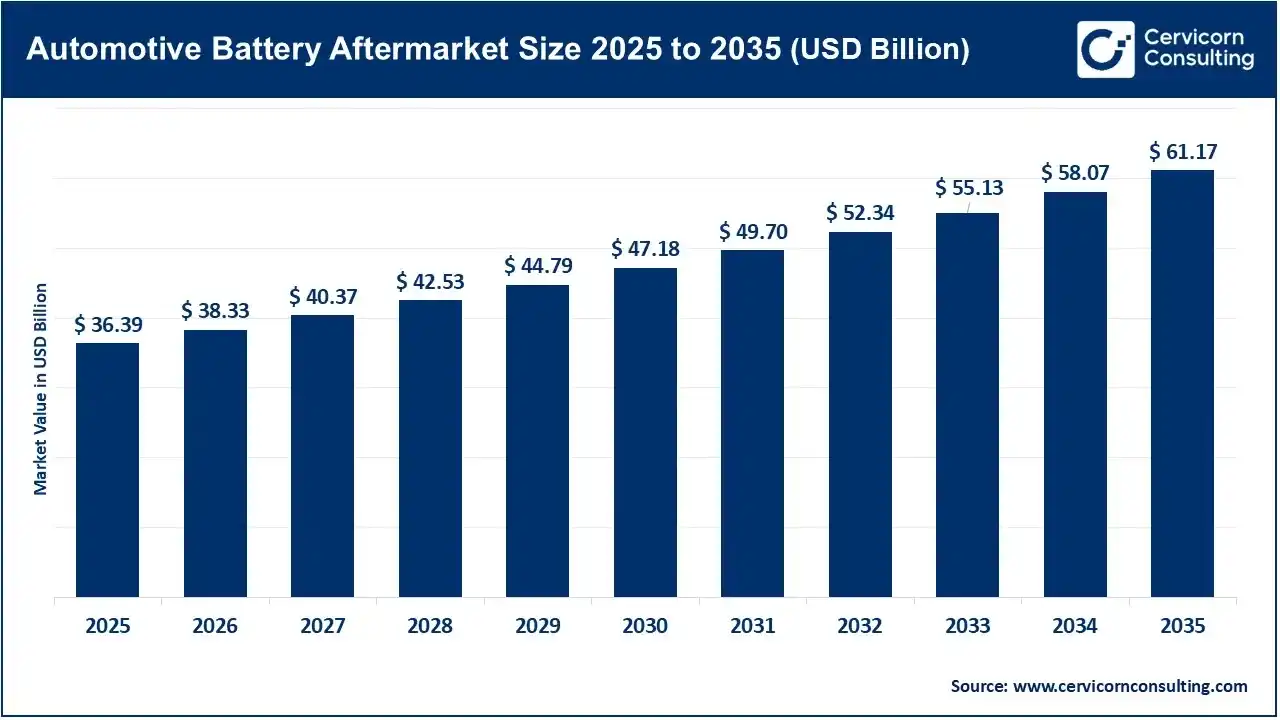
The average age of U.S. light vehicles reached a record 12.8 years in 2024, while the global vehicle-in-operation population is expected to reach 1.9 billion light vehicles by 2034, up from 1.6 billion in 2025. This expanding installed base creates a recurring replacement opportunity because automotive batteries typically require replacement several times during a vehicle's lifetime. In India, FY2024–25 domestic sales included 4.3 million passenger vehicles and 19.6 million two-wheelers, expanding the future replacement pool for starter and auxiliary batteries. Increasing commercial-vehicle utilization, urban traffic, extreme temperatures, and higher electrical loads further accelerate battery degradation and replacement frequency.
Technological upgrading and the increasing adoption of start-stop systems, AGM/EFB batteries, and electrified vehicles are also supporting aftermarket value growth. More than 50 million vehicles equipped with AGM batteries required aftermarket replacements in 2025, and this replacement pool is expected to expand as start-stop penetration increases. Start-stop systems are estimated to have increased from below 15% of new passenger vehicles in 2020 to around 40–45% in 2026 in India, creating a growing future replacement base for higher-performance batteries. At the same time, consumers are increasingly shifting toward maintenance-free and technologically advanced batteries, while e-commerce, organized workshops, battery-delivery services, and digital diagnostics are improving replacement convenience. India's automotive aftermarket reached approximately INR 99,500 crore in FY2025, with rising vehicle usage and an aging fleet supporting continued replacement demand.
Report Highlights
- Asia-Pacific dominates the global Automotive Battery Aftermarket with a 41.1% market share, supported by large vehicle populations, two-wheeler penetration, expanding automotive fleets, and replacement demand.
- Lead-acid batteries dominate the battery-type segment with an estimated 84.9% share, benefiting from their extensive installed base, affordability, mature recycling infrastructure, and widespread SLI applications.
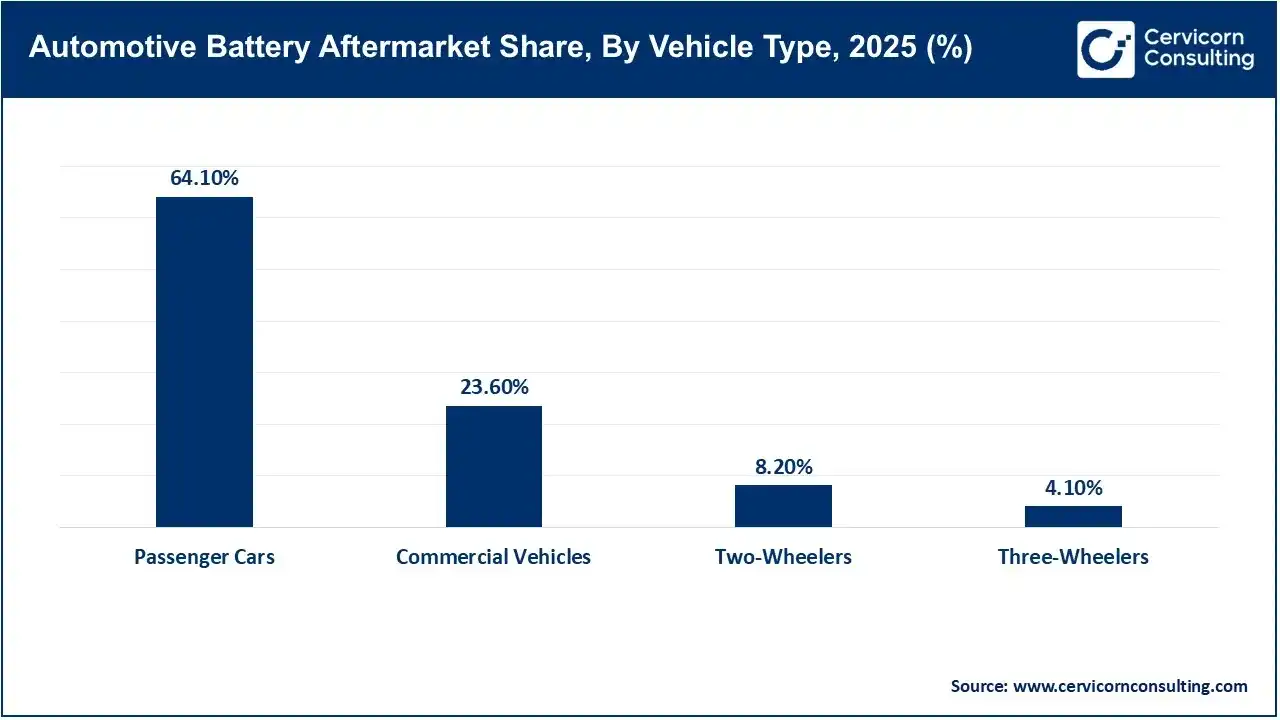
- Passenger cars represent the largest vehicle-type segment with approximately 64.1% share, supported by their large installed population and recurring replacement requirements.
- Flooded lead-acid batteries account for approximately 61.2% of the battery-technology segment, maintaining strong demand across conventional passenger vehicles, commercial vehicles, and two-wheelers.
- Independent automotive repair shops hold approximately 33.6% of sales-channel share, reflecting their broad geographic coverage, competitive pricing, and importance in servicing older vehicles.
What is Automotive Battery Aftermarket?
The automotive battery aftermarket refers to the market for replacement, maintenance, distribution, and servicing of batteries used in vehicles after their original installation by the vehicle manufacturer. It includes conventional lead-acid batteries as well as advanced AGM, EFB, and auxiliary 12V batteries used in passenger cars, commercial vehicles, hybrids, and electric vehicles. Demand is driven by battery replacement cycles, aging vehicle fleets, start-stop systems, increasing onboard electronics, and the growing need for low-voltage power in electrified vehicles. Recent product launches increasingly target these advanced applications; for example, Exide introduced a new AGM battery in 2025 covering more than 3 million European vehicles, while Clarios expanded its VARTA AGM and EFB aftermarket portfolio in 2025.
Recent Milestones
| Year |
Organization |
Recent Milestone |
| 2025 |
Exide Technologies |
Launched the EK013 12V AGM auxiliary battery, extending aftermarket coverage to an additional 5 million European vehicles. |
| 2025 |
Exide Technologies |
Introduced a new technology-based, color-coded labeling system for its automotive light-vehicle battery portfolio to simplify aftermarket battery selection. |
| 2025 |
Clarios / VARTA |
Expanded the VARTA aftermarket portfolio with new AGM and EFB batteries for passenger cars and heavy commercial vehicles. |
| 2025 |
Exide Technologies |
Added the EK500 L01 AGM battery, designed for modern xEV applications and compatible with more than 3 million vehicles in Europe. |
| 2025 |
Clarios |
Secured another U.S. automaker contract for its advanced hAGM battery technology, with production planned from Q4 2026 and annual production of up to 745,000 units. |
| 2026 |
Exide Technologies |
Launched its latest-generation 12V AGM batteries for the independent aftermarket, with investment in AGM engineering, production capacity, and xEV-oriented applications. |
Automotive Battery Aftermarket Market Dynamics
Market Drivers
1. Growing Vehicle Usage and Replacement Demand
Increasing vehicle utilization is strengthening demand for replacement batteries because frequent driving, short trips, traffic congestion, and higher electrical loads accelerate battery wear. In India, searches for car battery dealers increased 13% year-on-year between March 2025 and February 2026, indicating rising consumer demand for replacement services. Battery demand also benefits from the expanding installed vehicle base, as replacement purchases continue independently of new-vehicle sales cycles.
2. Expansion of Advanced Battery Applications
Growing adoption of start-stop systems, auxiliary electrical systems, and electrified powertrains is shifting aftermarket demand toward technologically advanced batteries such as AGM and EFB. The increasing complexity of automotive electrical architectures creates additional opportunities for specialized replacement products and diagnostic services. At the same time, India's Battery Waste Management Rules require 60% material recovery from automotive and industrial batteries by 2026–27, encouraging formal collection and recycling networks that can strengthen the organized aftermarket ecosystem.
Market Restraints
1. Competition from Low-Cost and Informal Batteries
Price-sensitive consumers and fragmented distribution networks can constrain sales of premium aftermarket batteries. Informal retailers and unorganized repair shops may offer lower-priced replacement products, making it difficult for branded manufacturers to maintain price premiums. The problem is particularly relevant in emerging markets where consumers frequently prioritize upfront replacement costs over battery lifespan, warranty coverage, and performance. Consequently, manufacturers face pressure to balance advanced battery technology with affordable product offerings while maintaining margins across multiple distribution channels.
2. Raw Material Price Volatility
Fluctuations in battery material prices can affect manufacturing economics and replacement battery pricing. Lithium carbonate prices, for example, declined from more than USD 70,000 per tonne in 2023 to below USD 10,000 per tonne in late 2025, demonstrating substantial commodity-price volatility. Such movements can complicate procurement planning, inventory management, and pricing strategies for manufacturers, particularly as aftermarket portfolios increasingly incorporate lithium-ion batteries alongside conventional lead-acid technologies.
Market Opportunities
1. Growth of Battery Recycling and Circularity
Increasing regulatory emphasis on battery collection and material recovery creates opportunities for manufacturers, recyclers, distributors, and service providers to develop closed-loop aftermarket models. India's battery-circularity ecosystem alone represents an estimated INR 75,500 crore (USD 9 billion) opportunity, spanning battery reuse, second-life applications, and recycling. Companies can capture additional value through take-back programs, refurbished batteries, recovered materials, and digital tracking systems while reducing dependence on virgin raw materials.
2. Digital Aftermarket and On-Demand Replacement Services
Online battery marketplaces, mobile installation, vehicle-health diagnostics, and digitally enabled service networks are creating new channels for aftermarket sales. Rising online search activity demonstrates this shift, with India's car battery dealer searches increasing 13% year-on-year during March 2025–February 2026. Businesses can combine e-commerce with doorstep testing, rapid delivery, installation, warranty registration, and old-battery collection to improve customer convenience and strengthen customer retention.
Market Challenges
1. Complexity of Emerging Battery Chemistries
The transition toward electrification is increasing the technical complexity of battery servicing, recycling, and replacement. A 2026 Nature Energy review notes that recycling systems must adapt to changing cell formats and chemistries, with future sodium-ion and solid-state batteries requiring process adaptations. Aftermarket companies therefore need specialized equipment, technician training, safety procedures, and chemistry-specific recycling capabilities, increasing operational complexity and investment requirements.
2. Reverse Logistics and Recycling Infrastructure
Collecting, transporting, sorting, and processing used automotive batteries across fragmented aftermarket networks remains a major operational challenge. Recycling systems must handle increasingly diverse battery designs while meeting environmental and regulatory requirements. India's framework, for example, requires producers to ensure collected batteries are sent for recycling or refurbishment rather than landfill or incineration. Building efficient reverse-logistics networks across urban and rural markets can therefore require substantial coordination among manufacturers, dealers, workshops, collection agents, and certified recyclers.
Regional Analysis
The automotive battery aftermarket is segmented by region into North America, Europe, Asia-Pacific, Latin America, and LAMEA. Here is a brief overview of each region:
North America Automotive Battery Aftermarket: Driven by High Vehicle Ownership, Strong Replacement Cycles, Advanced Vehicle Electronics, Cold-Weather Battery Demand, and Expanding Aftermarket Services
The North America automotive battery aftermarket market size was estimated at USD 8.30 billion in 2025 and is expected to exceed USD 13.95 billion by 2035. North America is a mature market characterized by high vehicle ownership, extensive road transportation, strong vehicle utilization, and a well-established network of repair shops, retailers, distributors, and mobile battery services. The region benefits from a large population of vehicles requiring periodic battery replacement as well as increasing electrical loads from connected technologies, infotainment, safety systems, and start-stop functionality. The United States remains the principal regional market, while Canada and Mexico provide additional opportunities through vehicle parc expansion and replacement demand. Growing consumer preference for maintenance-free batteries, longer warranties, mobile installation, and online purchasing is also reshaping aftermarket distribution.
United States: High Vehicle Utilization, Strong Replacement Cycles, Start-Stop Adoption, and Advanced Battery Demand Support Market Growth
- U.S. motorists collectively traveled approximately 3.29 trillion vehicle-miles in 2024, sustaining intensive vehicle usage and recurring demand for maintenance and replacement components.
- The U.S. light-vehicle aftermarket benefits from approximately 268 million vehicles in operation, creating a substantial recurring customer base for battery replacement and related services.
- Start-stop technology has expanded significantly across new U.S. vehicles, increasing demand for AGM and EFB batteries capable of handling frequent engine cycling.
Canada: Seasonal Operating Conditions, High Vehicle Dependence, Electrification, and Independent Repair Networks Support Aftermarket Demand
- Canada's passenger vehicle market is strongly influenced by severe winter conditions, which can increase battery stress and create seasonal replacement demand, particularly in colder provinces.
- Canada recorded approximately 1.86 million new motor vehicle registrations in 2024, expanding the future population of vehicles that will eventually enter aftermarket replacement cycles.
Asia-Pacific (APAC) Automotive Battery Aftermarket: Driven by Expanding Vehicle Ownership, Two-Wheeler Penetration, Urban Mobility, Commercial Fleets, Electrification, and Growing Battery Replacement Networks
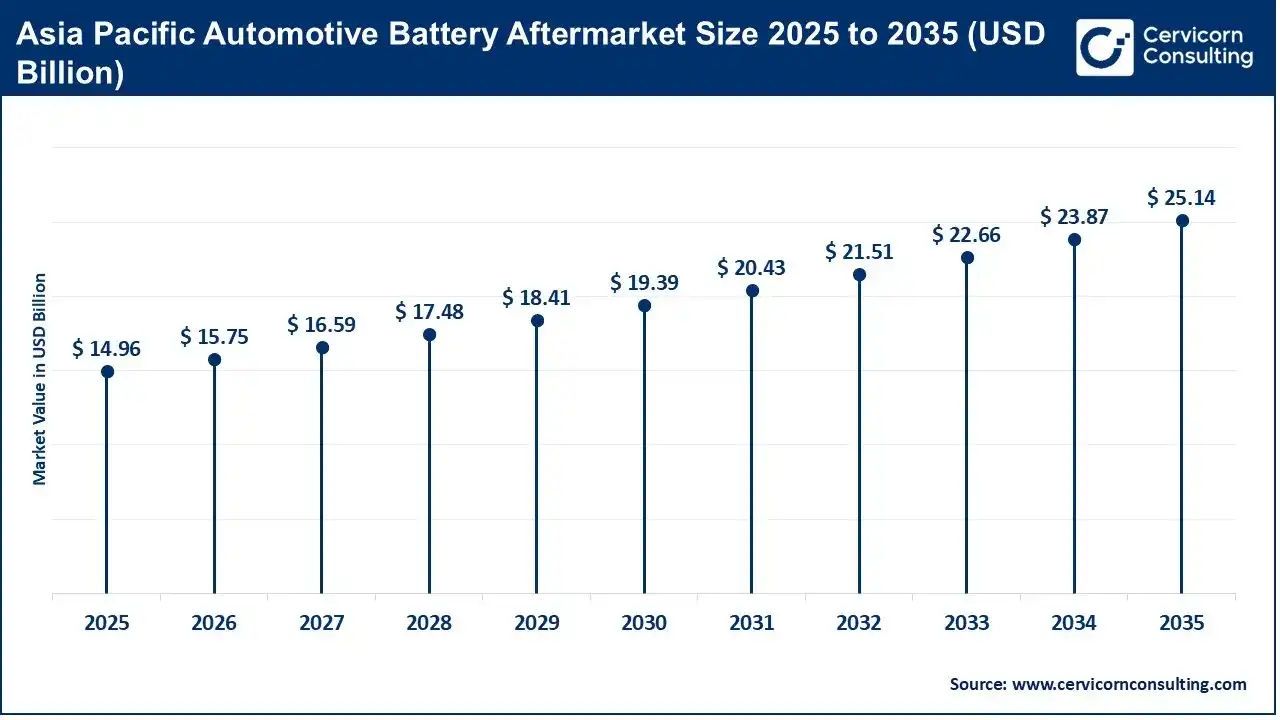
The Asia-Pacific automotive battery aftermarket market size was valued at USD 14.96 billion in 2025 and is predicted to reach around USD 25.14 billion by 2035. Asia-Pacific is a highly diverse and rapidly developing market, supported by expanding vehicle ownership, large two-wheeler populations, increasing commercial transportation, urbanization, and the continued growth of organized automotive service networks. China, India, Japan, South Korea, and Southeast Asian economies represent important demand centers, while the region's extensive automotive manufacturing ecosystem strengthens battery availability, distribution, and technical capabilities. The aftermarket is also evolving as consumers increasingly adopt maintenance-free batteries, AGM and EFB technologies, and digitally enabled replacement services. Electrification is creating an additional long-term opportunity for traction-battery diagnostics, refurbishment, auxiliary-battery replacement, and recycling.
China: Large Vehicle Population, New-Energy Vehicle Expansion, Commercial Mobility, and Extensive Battery Manufacturing Support Market Demand
- China recorded approximately 31.44 million vehicle sales in 2025, maintaining its position as one of the world's largest automotive markets and continuously expanding the addressable vehicle population for future aftermarket services.
- New-energy vehicle sales reached approximately 16.49 million units in 2025, significantly expanding the installed base of electrified vehicles that will progressively require battery diagnostics, auxiliary-battery servicing, and eventually traction-battery aftermarket solutions.
India: Expanding Vehicle Ownership, Two-Wheeler Dominance, Commercial Mobility, and Organized Aftermarket Development Drive Growth
- India recorded approximately 26.0 million vehicle registrations in FY2024–25, demonstrating continued expansion of the country's vehicle population and creating a growing future replacement base.
- Two-wheelers accounted for roughly 78% of India's total vehicle registrations in FY2024–25, making motorcycles and scooters an important source of recurring battery aftermarket demand.
- Electric two-wheeler registrations exceeded 1.1 million units in FY2024–25, expanding opportunities for lithium-ion battery diagnostics, replacement, refurbishment, and recycling services.
Europe Automotive Battery Aftermarket: Driven by an Aging Vehicle Parc, Strong Independent Aftermarket Networks, Start-Stop Adoption, Premium Battery Technologies, and Expanding Electrification
The Europe automotive battery aftermarket market size was accounted for USD 9.53 billion in 2025 and is forecasted to surpass USD 16.03 billion by 2035. Europe region growth is driven by a large installed vehicle base, prolonged vehicle ownership, extensive independent repair networks, and recurring replacement cycles. The region is transitioning from conventional flooded batteries toward AGM and EFB technologies, while the growing electrified fleet is creating new requirements for auxiliary batteries, diagnostics, refurbishment, and recycling. Europe's independent aftermarket is particularly important, with independent service outlets reaching approximately 250,000, while OEM dealership numbers have declined to around 54,000. The replacement market remains resilient because ICE, mild-hybrid, and start-stop vehicles continue to represent a substantial share of vehicles on European roads.
Germany: Large Vehicle Parc, Premium Vehicle Mix, Start-Stop Penetration, and Advanced Battery Adoption Support Market Demand
- Germany remains one of Europe's most important automotive battery markets, with its vehicle parc exceeding 48 million units, providing a substantial replacement base.
- Germany accounted for approximately 20.5% of Europe's automotive start-stop battery market in 2024, reflecting strong adoption of vehicles requiring higher-performance battery technologies.
- The country's strong premium-vehicle presence supports demand for AGM batteries, which provide higher cycling capability for vehicles with advanced electrical systems.
France: Large Passenger-Vehicle Base, Aging Vehicles, Start-Stop Systems, and Independent Workshops Drive Replacement Demand
- France represents one of Europe's largest passenger-vehicle markets, creating a substantial installed base for recurring battery replacement.
- Passenger vehicles represented approximately 82.9% of Europe's automotive start-stop battery market in 2024, highlighting the importance of passenger-car applications to regional battery demand.
Automotive Battery Aftermarket Market Share, By Region, 2025 (%)
| Region |
Revenue Share, 2025 (%) |
| Asia-Pacific |
41.1% |
| Europe |
26.2% |
| North America |
22.8% |
| LAMEA |
9.9% |
LAMEA (Latin America, Middle East & Africa) Automotive Battery Aftermarket: Driven by Vehicle Fleet Expansion, Aging Vehicles, Harsh Operating Conditions, Commercial Transportation, and Emerging Electrification
The LAMEA automotive battery aftermarket market was valued at USD 3.60 billion in 2025 and is anticipated to reach around USD 6.06 billion by 2035. LAMEA represents a diverse market comprising Latin America, the Middle East, and Africa, with demand supported by vehicle fleet expansion, prolonged vehicle ownership, commercial transportation, and recurring replacement requirements. Brazil is the largest market within the region, supported by its extensive vehicle base and established automotive-parts ecosystem, while Mexico and Argentina contribute significant Latin American demand. In the Middle East, high temperatures place additional stress on automotive batteries, while Africa offers opportunities associated with expanding motorization, logistics, mining, and commercial fleets. Recent industry analysis identifies Brazil as the leading LAMEA SLI battery market, supported by its large automotive base, localized manufacturing, recycling infrastructure, and replacement demand.
Brazil: Large Vehicle Base, Aging Fleet, Domestic Battery Manufacturing, and Strong Replacement Demand Support Market Expansion
- Brazil's light-vehicle fleet reached approximately 51.5 million units at the end of 2025, providing one of the region's largest installed bases for automotive battery replacement.
- Vehicles aged 11–20 years represented approximately 45% of Brazil's light-vehicle fleet, creating a substantial pool requiring recurring maintenance and replacement components.
Middle East: Harsh Climate Conditions, High Vehicle Utilization, Premium Vehicles, and Commercial Fleets Drive Battery Replacement Demand
- Gulf markets such as Saudi Arabia and the UAE generate strong battery-replacement requirements because prolonged exposure to extreme heat can accelerate battery deterioration and reduce service life.
- Premium passenger vehicles and SUVs with extensive electronic equipment create demand for higher-performance batteries, including AGM products.
- Commercial fleets, logistics vehicles, taxis, and construction-related transportation provide recurring replacement opportunities because of intensive vehicle utilization.
Segmental Analysis
The automotive battery aftermarket is segmented into battery type, vehicle type, battery technology, sales channel, and geography.
Battery Type Analysis
Lead-acid batteries remain the dominant battery type in the automotive aftermarket because of their extensive installed base, low replacement cost, mature recycling infrastructure, and compatibility with conventional ICE vehicles. In 2025, lead-acid batteries are estimated to account for approximately 84.9% of global aftermarket revenue. Their established SLI applications across passenger cars, commercial vehicles, and two-wheelers continue generating recurring replacement demand.
Automotive Battery Aftermarket Market Share, By Deployment Type, 2025 (%)
| Deployment Type |
Revenue Share, 2025 (%) |
| Lead-Acid Batteries |
84.9% |
| Lithium-Ion Batteries |
13.6% |
| Nickel-Metal Hydride (NiMH) Batteries |
0.8% |
| Other Battery Types |
0.7% |
Lithium-ion batteries represent the fastest-growing battery-type segment as EVs, hybrids, auxiliary systems, and advanced low-voltage architectures expand. Their higher energy density, lower weight, and ability to support sophisticated electrical systems are increasing adoption in newer vehicles. Although lithium-ion batteries currently represent a smaller aftermarket base than lead-acid batteries, their replacement opportunity is expected to accelerate as early EV fleets age and enter secondary ownership. Industry estimates identify lithium-ion as the fastest-growing major battery chemistry in the automotive aftermarket.
Vehicle Type Analysis
Passenger cars are the largest vehicle category in the automotive battery aftermarket due to their enormous installed base, frequent urban use, extensive electrical content, and recurring replacement needs. The segment is estimated to hold approximately 64.1% of global aftermarket demand in 2025. Start-stop systems, infotainment, ADAS, connected features, and auxiliary electrical loads are also increasing battery requirements in newer passenger vehicles.
Electric vehicles are the fastest-growing vehicle category in the automotive battery aftermarket as the installed EV population progressively moves beyond warranty periods and develops replacement requirements. Although EVs have fewer conventional starting-battery requirements, they create demand for high-voltage traction batteries, 12V/48V auxiliary batteries, battery diagnostics, refurbishment, and replacement services. Increasing EV penetration is therefore expanding the aftermarket beyond traditional lead-acid replacement. The growth of electrified vehicle fleets is also creating opportunities for specialized battery servicing and recycling networks.
Battery Technology Analysis
Flooded lead-acid batteries continue to dominate automotive aftermarket technology because they offer low acquisition costs, broad compatibility, simple servicing, and a deeply established distribution and recycling ecosystem. The technology is particularly prevalent in older passenger cars, commercial vehicles, two-wheelers, and price-sensitive replacement markets. India's automotive lead-acid market, for example, is estimated to have flooded batteries accounting for approximately 70–75% of shipments, illustrating their continued importance in high-volume replacement applications.
Automotive Battery Aftermarket Market, By Battery Technology, 2025 (%)
| Battery Technology |
Revenue Share, 2025 (%) |
| Flooded Lead-Acid Batteries |
61.2% |
| Enhanced Flooded Batteries (EFB) |
13.1% |
| Absorbent Glass Mat (AGM) Batteries |
15.8% |
| Gel Batteries |
3.0% |
| Lithium-Ion Batteries |
5.8% |
| Other Technologies |
1.1% |
Lithium-ion technology is expected to record the fastest growth as EV adoption expands and automotive electrical architectures become increasingly electrified. Compared with conventional lead-acid designs, lithium-ion batteries provide substantially higher energy density and lower weight, supporting traction and advanced auxiliary applications. The aftermarket opportunity will expand as more EVs reach the replacement stage, creating demand for diagnostics, battery-health assessment, refurbishment, module replacement, and recycling. Increasing battery chemistry diversity is also encouraging specialized aftermarket service capabilities and technician training.
Sales Channel Analysis
Independent automotive repair shops represent the largest aftermarket sales channel because they provide accessible battery testing, replacement, installation, and maintenance services across a wide range of vehicle brands. Their strong presence outside major dealership networks makes them particularly important for older vehicles and price-sensitive consumers. The independent aftermarket also benefits from broad product availability through distributors and retailers, allowing workshops to offer multiple battery brands and specifications. This channel is expected to remain central to replacement activity as the global vehicle parc continues aging.
Automotive Battery Aftermarket Market, By Organization Size, 2025 (%)
| Organization Size |
Revenue Share, 2025 (%) |
| Independent Automotive Repair Shops |
33.6% |
| Authorized Dealerships |
17.8% |
| Retail Stores |
20.1% |
| Online Platforms / E-Commerce |
8.2% |
| Automotive Parts Distributors |
11.9% |
| Service Centers |
8.4% |
Online platforms and e-commerce are the fastest-growing sales channel as consumers increasingly compare battery specifications, prices, warranties, and compatibility before purchasing. Digital channels are also integrating doorstep delivery, mobile installation, battery testing, warranty registration, and old-battery collection, creating a more complete replacement experience. Related automotive battery research identifies online purchasing as an important growth avenue, particularly for aftermarket products. The expansion of digital automotive marketplaces is therefore expected to gradually shift a portion of traditionally offline battery purchases online.
Top Companies
Segments Covered
By Battery Type
- Lead-Acid Batteries
- Lithium-Ion Batteries
- Nickel-Metal Hydride (NiMH) Batteries
- Other Battery Types
By Vehicle Type
- Passenger Cars
- Commercial Vehicles
- Light Commercial Vehicles
- Medium & Heavy Commercial Vehicles
- Two-Wheelers
- Three-Wheelers
By Battery Technology
- Flooded Lead-Acid Batteries
- Enhanced Flooded Batteries (EFB)
- Absorbent Glass Mat (AGM) Batteries
- Gel Batteries
- Lithium-Ion Batteries
- Other Technologies
By Sales Channel
- Independent Automotive Repair Shops
- Authorized Dealerships
- Retail Stores
- Online Platforms / E-Commerce
- Automotive Parts Distributors
- Service Centers
By Geography
- North America
- Europe
- Asia-Pacific
- LAMEA