AI Stack Market Size and Growth 2026 to 2035
The global AI stack market size was valued at USD 302.57 billion in 2025 and is expected to reach around USD 2,237.41 billion by 2035, exhibiting a compound annual growth rate (CAGR) of 22.1% over the forecast period from 2026 to 2035. The AI stack market is growing primarily due to the rapid acceleration of enterprise AI adoption and surging demand for generative AI infrastructure. Organizations are increasingly investing in AI models, orchestration platforms, vector databases, and MLOps tools to operationalize AI across workflows. According to Stanford’s 2025 AI Index, 78% of organizations reported using AI in at least one business function in 2024, up from 55% a year earlier, reflecting a sharp rise in demand for enterprise deployments. In parallel, private investment in generative AI reached USD 33.9 billion globally in 2024, highlighting strong capital inflows into foundation models, AI tooling, and infrastructure ecosystems.
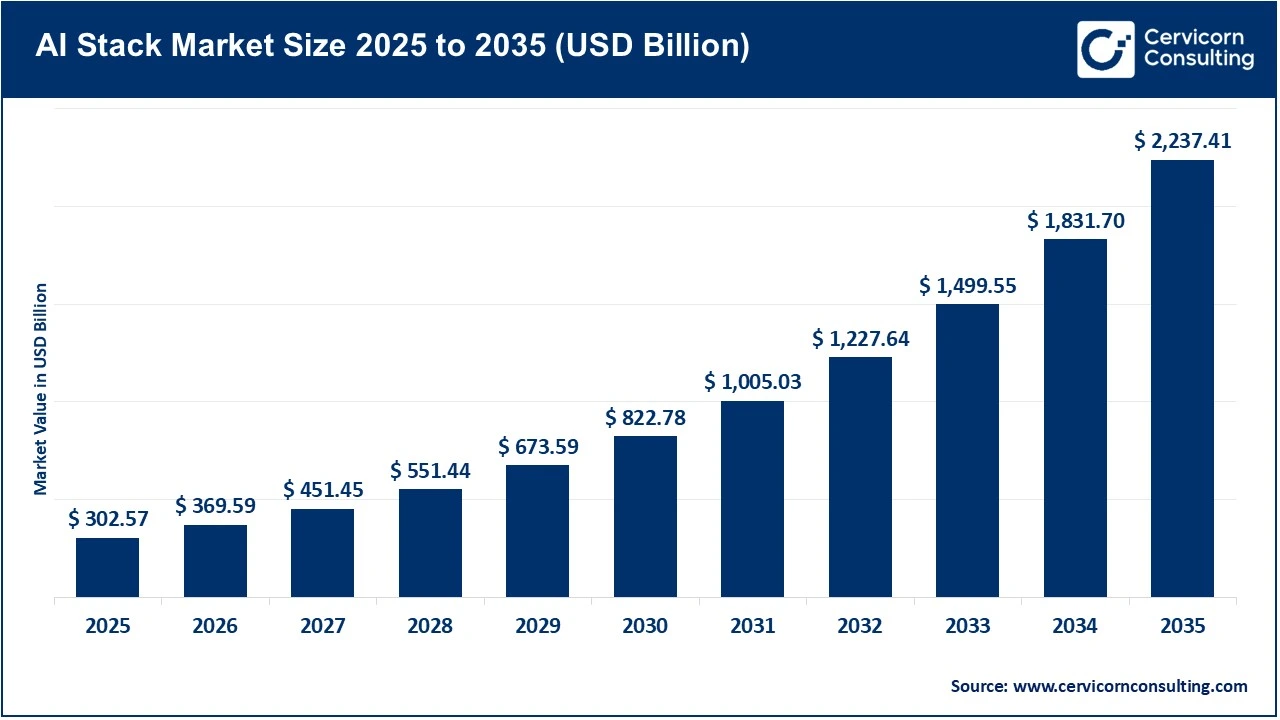
Another major growth factor is the massive expansion in AI compute and cloud infrastructure spending, alongside the rise of agentic AI systems. Enterprises are shifting from experimentation to production-grade AI, creating demand for scalable inference, observability, governance, and orchestration layers. IDC reported that AI-centric infrastructure spending grew by over 200% year-over-year in 2025, with accelerated servers accounting for the majority of deployments, signalling strong backend investment for AI workloads. At the same time, McKinsey’s 2025 AI survey found that around 78% of companies now use AI and over 70% are deploying generative AI, while many firms are redesigning workflows and governance structures to scale adoption. Recent developments, such as hyperscalers increasing AI capital expenditure and enterprises adopting autonomous AI agents, are further strengthening demand across the AI stack ecosystem.
Report Highlights
- By Region, North America leads with 42% share, driven by hyperscaler investments and strong enterprise AI adoption.
- By Region, Asia-Pacific holds 26% share, driven by sovereign AI programs and cloud expansion.
- By Component, Hardware / Infrastructure dominates with 49% share, supported by growing GPU and data center demand.
- By Deployment Mode, Cloud-Based leads with 52% share, due to scalability and lower deployment costs.
- By Stack Layer, Infrastructure Layer holds 34% share, fueled by rising AI compute requirements.
- By Technology Type, Machine Learning leads with 31% share, supported by predictive analytics and automation demand.
- By Application, Customer Service & Chatbots account for 24% share, driven by conversational AI adoption.
- By End-User Industry, IT & Telecommunications leads with 23% share, supported by network automation investments.
Structural AI Infrastructure Buildout Accelerating AI Stack Market Growth
The large-scale buildout of AI infrastructure is becoming a foundational growth engine for the AI stack market, as enterprises and hyperscalers rapidly expand compute, storage, networking, and model-serving capabilities to support generative AI and agentic systems. The shift from pilot projects to production-scale AI deployment is driving demand across every layer of the stack, from GPUs and cloud clusters to MLOps, orchestration, vector databases, and AI observability tools. As organizations deploy larger models and real-time inference systems, infrastructure spending is increasingly viewed as a long-term structural investment rather than short-term experimentation. IDC noted that global AI infrastructure spending reached record levels in 2025, signaling sustained demand for backend AI ecosystems that support training and inference workloads.
Some of the key factors of this growth
- Global AI infrastructure spending reached USD 318 billion in 2025, more than doubling from 2024, indicating accelerating investments in compute-intensive AI ecosystems.
- AI infrastructure spending grew 62.2% YoY in Q4 2025, with servers accounting for nearly 98% of total spending, highlighting the importance of compute infrastructure for AI stack expansion.
- Major hyperscalers including Amazon, Microsoft, Google, and Meta are expected to spend over USD 350 billion in capex during 2025, much of it directed toward AI data centers, GPUs, and networking infrastructure.
Report Scope
| Area of Focus |
Details |
| Market Size in 2026 |
USD 369.59 Billion |
| Market Size in 2035 |
USD 2,237.41 Billion |
| Market CAGR 2026 to 2035 |
22.10% |
| Dominant Region |
North America |
| Fastest Growing Region |
Asia-Pacific |
| Key Segments |
Component, Deployment Mode, Stack Layer, Technology Type, Application, End-User Industry, Region |
| Key Companies |
NVIDIA, Microsoft, Google, Amazon Web Services, OpenAI, Anthropic, Meta, IBM, Databricks, Snowflake, Palantir Technologies, Hugging Face |
Recent Major Milestones
1. OpenAI–SoftBank–Oracle Stargate Project (2025)
The launch of the Stargate Project in January 2025 marked one of the largest AI infrastructure commitments globally, with OpenAI, SoftBank, Oracle, and MGX announcing plans to invest up to USD 500 billion in AI compute infrastructure and hyperscale data centers in the U.S. This milestone is accelerating the AI stack market by massively expanding compute availability for model training and inference, which in turn increases demand for GPUs, cloud orchestration, MLOps, vector databases, model serving, and observability tools. The project also signals a long-term shift toward vertically integrated AI ecosystems where infrastructure and model providers co-develop stack capabilities.
Key recent developments:
- Up to USD 500 billion planned investment by 2029 for AI infrastructure.
- Initial rollout includes 10+ AI data centers in Texas, with expansion plans into multiple countries.
- Expected to support 100,000+ jobs, reinforcing long-term AI ecosystem expansion.
2. India’s IndiaAI Mission & Sovereign LLM Initiative (2025)
India’s government-backed IndiaAI Mission and approval of Sarvam AI’s sovereign LLM ecosystem in 2025 represent a major milestone in national AI infrastructure development. The initiative is driving the AI stack market by democratizing access to compute, encouraging indigenous model development, and increasing demand for cloud AI platforms, data pipelines, governance systems, and multilingual AI tooling. Government-led AI ecosystems also create downstream demand for enterprise deployment platforms and AI application infrastructure across sectors such as healthcare, governance, and financial services.
Key recent developments:
- IndiaAI Mission plans deployment of 38,000+ GPUs through a federated compute network.
- Sarvam AI approved in 2025 to build India’s sovereign LLM ecosystem.
- Focus on democratized compute access and indigenous AI infrastructure.
3. Hyperscaler AI Capex Expansion by Microsoft, Google, Amazon & Meta (2025–2026)
Large-scale AI capital expenditure by hyperscalers has become a structural milestone for the AI stack market, as cloud providers aggressively invest in AI-ready data centers, networking, and accelerated compute clusters. These investments are expanding infrastructure capacity while creating strong demand for middleware, orchestration frameworks, AI security, and inference optimization tools. The market is increasingly shifting toward full-stack AI platforms, where cloud vendors bundle compute, models, deployment, and governance capabilities into integrated ecosystems.
Key recent developments:
- Major hyperscalers projected to spend USD 350B+ in AI capex during 2025.
- Microsoft reported record quarterly AI/data infrastructure capex exceeding USD 30 billion.
- AI infrastructure spending globally grew sharply due to demand for inference and training capacity.
4. Government-Led AI Safety & Standards Programs (U.S., 2025–2026)
Recent U.S. government partnerships with major AI firms such as Microsoft, Google, and xAI to enable pre-release model testing represent an important governance milestone for the AI stack market. As governments increase oversight of advanced models, enterprises are investing more heavily in AI governance, observability, compliance, red teaming, and secure deployment frameworks. This is accelerating growth in the governance layer of the AI stack, especially for regulated sectors such as BFSI, healthcare, and public services.
Key recent developments:
- U.S. agencies have already conducted 40+ evaluations of advanced AI models.
- Microsoft, Google, and xAI agreed to provide early access to AI models for security reviews.
- Rising regulatory focus is increasing enterprise demand for AI governance and compliance tools.
AI Stack Market Regional Analysis
The AI Stack market is segmented by region into North America, Europe, Asia-Pacific, Latin America, and LAMEA. Here is a brief overview of each region:
North America AI Stack Market: Dominance Driven by Hyperscaler Investments and Enterprise AI Adoption
The North America AI stack market size was valued at USD 127.08 billion in 2025 and is predicted to reach around USD 939.71 billion by 2035.
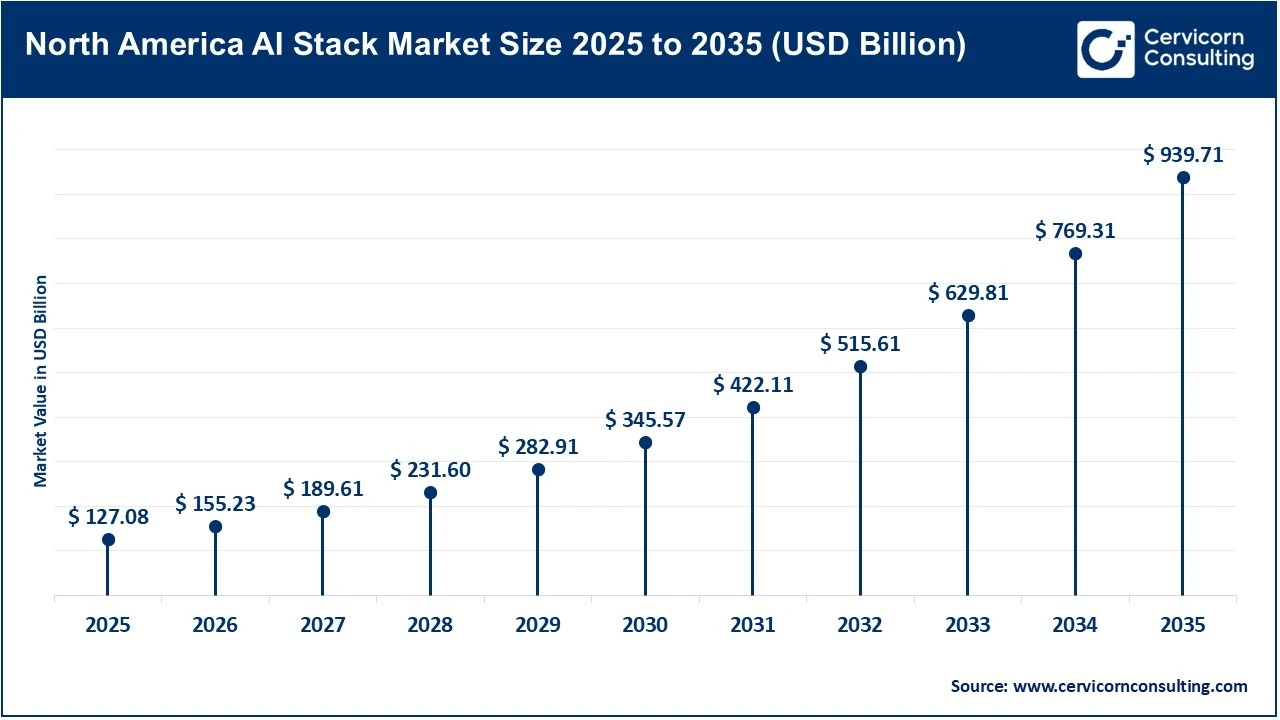
North America dominates the market due to strong technology infrastructure, early enterprise AI adoption, and the presence of leading AI ecosystem players. The region benefits from substantial investments by hyperscalers, advanced semiconductor capabilities, and strong venture capital funding supporting AI startups and platform providers. Enterprises across sectors such as BFSI, healthcare, retail, and IT are rapidly integrating generative AI, MLOps, and automation platforms into operations. In addition, government support for AI innovation, growing demand for AI governance frameworks, and large-scale data center expansion are reinforcing North America’s leadership in the global AI stack ecosystem.
United States: Strong presence of hyperscalers, AI model developers, and semiconductor leaders drives dominant market position.
- Major firms such as Microsoft, Google, Amazon, NVIDIA, OpenAI, and Meta collectively invest USD 300+ billion annually in AI infrastructure and cloud expansion
- The U.S. accounts for over 60% of global private AI investment, supporting rapid growth of foundation models and AI platforms
- Enterprise AI adoption exceeded 75% across large organizations, accelerating demand for orchestration, observability, and model deployment tools
Canada: Growing AI research ecosystem and government-backed innovation programs support expanding market opportunities.
- Canada remains a major hub for AI research, supported by institutes in Toronto, Montreal, and Edmonton
- Government AI funding programs are accelerating enterprise AI commercialization and infrastructure development
- Increasing adoption of generative AI across financial services, healthcare, and public administration is expanding software platform demand
Asia-Pacific (APAC) AI Stack Market: Fastest Growth Driven by Digital Transformation and Sovereign AI Investments
The Asia-Pacific AI stack market size was calculated at USD 78.67 billion in 2025 and is projected to surpass around USD 581.73 billion by 2035. Asia-Pacific is the fastest-growing region, driven by rapid digital transformation, expanding cloud infrastructure, and strong government-backed AI initiatives. Rising enterprise adoption of generative AI, automation platforms, and AI-enabled analytics is accelerating demand for compute infrastructure, foundation models, MLOps, and orchestration tools. Countries such as China, India, Japan, South Korea, and Singapore are investing heavily in sovereign AI ecosystems, semiconductor manufacturing, and hyperscale data centers. Increasing smartphone penetration, digital economy expansion, and supportive public policies are further strengthening APAC’s role as a major growth engine for the global AI stack market.
China: Strong AI industrial policy, hyperscaler expansion, and foundation model development drive regional leadership.
- China accounts for a significant share of global AI patents and enterprise AI deployments
- Major companies such as Alibaba, Tencent, Baidu, and Huawei are investing heavily in foundation models and AI cloud ecosystems
- Government-backed AI initiatives target global leadership in AI and semiconductor independence
India: Rapid enterprise AI adoption, sovereign AI initiatives, and digital public infrastructure accelerate market growth.
- The IndiaAI Mission aims to deploy 38,000+ GPUs to strengthen domestic AI compute infrastructure
- Rapid adoption of AI across BFSI, healthcare, IT services, and e-commerce is driving demand for cloud AI platforms
- India’s digital public infrastructure and growing startup ecosystem are accelerating AI software and orchestration adoption
Europe AI Stack Market: Growth Driven by AI Regulation, Industrial Automation, and Sovereign AI Investments
The Europe AI stack market size was estimated at USD 69.59 billion in 2025 and is expected to hit around USD 514.60 billion by 2035. Europe represents a significant market, driven by strong industrial automation capabilities, increasing enterprise AI adoption, and rising investments in sovereign AI infrastructure. The region is witnessing growing demand for AI governance platforms, MLOps, cloud-based AI deployment, and secure data architectures due to stringent regulatory frameworks such as the EU AI Act. Enterprises across manufacturing, automotive, BFSI, healthcare, and public administration are increasingly integrating generative AI and predictive analytics into workflows. In addition, Europe’s focus on ethical AI, digital sovereignty, and domestic semiconductor capacity is accelerating investments across infrastructure, model development, and enterprise AI ecosystems.
Germany: Strong manufacturing ecosystem and Industry 4.0 initiatives drive enterprise AI adoption.
- Germany leads Europe in industrial AI deployment, particularly across automotive, manufacturing, and smart factories
- Industry 4.0 initiatives are increasing demand for predictive maintenance, robotics AI, and edge deployment systems
- Major investments in AI research and cloud infrastructure support expansion of enterprise AI platforms
United Kingdom: Robust AI startup ecosystem and financial sector adoption strengthen market growth.
- The UK hosts one of Europe’s largest AI startup ecosystems, supported by strong venture capital activity
- BFSI institutions increasingly deploy AI for fraud detection, automation, and customer intelligence
- Government-backed AI strategies and compute investments are expanding infrastructure capabilities
AI Stack Market Share, By Region, 2025 (%)
| Region |
Revenue Share, 2025 (%) |
| North America |
42% |
| Europe |
23% |
| Asia-Pacific (APAC) |
26% |
| LAMEA |
9% |
LAMEA AI Stack Market: Emerging Growth Driven by Digital Transformation and Sovereign AI Investments
The LAMEA AI stack market was valued at USD 27.23 billion in 2025 and is anticipated to reach around USD 201.37 billion by 2035. The LAMEA region is emerging as a promising market, supported by rapid digital transformation, rising cloud adoption, and increasing government investments in AI ecosystems. Enterprises across BFSI, telecom, retail, oil & gas, and public services are adopting AI-powered automation, analytics, and generative AI tools to improve operational efficiency. In addition, sovereign AI strategies, hyperscale data center expansion, and digital economy initiatives are increasing demand for AI infrastructure, cloud platforms, MLOps, and governance solutions. Growing startup ecosystems and improving internet penetration are further strengthening long-term market potential.
Middle East: Sovereign AI ambitions and hyperscale infrastructure investments accelerate regional growth.
- Countries such as UAE and Saudi Arabia are investing heavily in sovereign AI ecosystems and national AI strategies
- The UAE-backed MGX fund and regional partnerships are supporting large-scale AI infrastructure and compute investments
- Expansion of AI-ready data centers and cloud zones is boosting demand for orchestration and deployment platforms
Latin America: Expanding cloud infrastructure and enterprise digitization support AI adoption.
- Brazil and Mexico lead regional AI adoption due to strong fintech, retail, and telecom sectors
- Rising cloud investments by hyperscalers are improving access to scalable AI infrastructure
- BFSI and e-commerce companies increasingly deploy AI for fraud detection, personalization, and automation
AI Stack Market Segmental Analysis
The AI stack market is segmented into component, deployment mode, stack layer, technology type, application, end-user industry, and geography.
Component Analysis
Hardware and infrastructure dominate the AI stack market due to the immense computational requirements of training and deploying advanced AI models. Demand for GPUs, AI accelerators, high-performance storage, and cloud data centers has surged as enterprises increasingly adopt generative AI and large language models. Hyperscalers such as cloud providers continue investing heavily in AI-ready infrastructure to support training and inference workloads. Since AI deployment fundamentally depends on compute availability, infrastructure spending accounts for the largest share of overall AI stack investments.
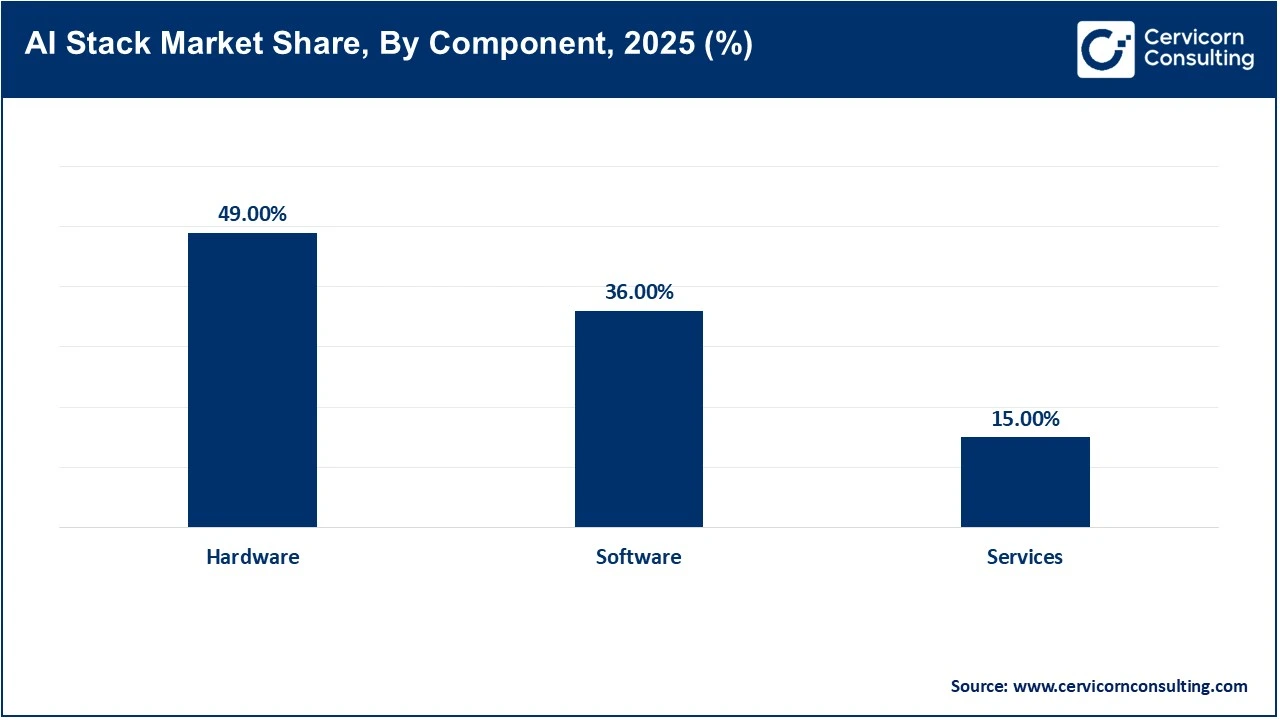
Software and platforms are expected to be the fastest-growing segment as enterprises move from experimentation to scalable AI deployment. Growing demand for MLOps, orchestration frameworks, vector databases, AI observability, and model deployment platforms is accelerating adoption. Businesses increasingly require integrated environments to manage model lifecycles, automate workflows, and optimize inference efficiency. The expansion of agentic AI and enterprise copilots is further increasing reliance on software platforms that simplify AI implementation and improve interoperability across diverse enterprise systems.
Deployment Mode Analysis
Cloud-based deployment dominates the AI stack market because organizations prefer scalable and cost-efficient infrastructure without significant upfront capital investment. Public cloud providers offer ready access to AI compute, foundation models, APIs, and deployment frameworks, allowing enterprises to accelerate implementation. Cloud environments also support faster experimentation and easier integration with enterprise workflows. The flexibility to scale compute resources on demand has made cloud deployment the preferred option for businesses adopting generative AI and large-scale machine learning solutions.
AI Stack Market, By Deployment Mode, 2025 (%)
| Deployment Mode |
Revenue Share, 2025 (%) |
| Cloud-Based |
52% |
| On-Premises |
20% |
| Hybrid Deployment |
18% |
| Edge Deployment |
10% |
Hybrid deployment is emerging as the fastest-growing segment due to rising concerns around data privacy, compliance, and performance optimization. Enterprises increasingly combine public cloud scalability with private infrastructure to maintain control over sensitive workloads while leveraging external compute capabilities. Industries such as BFSI, healthcare, and government favor hybrid architectures to meet regulatory standards and data sovereignty requirements. The growing need for secure AI deployments and low-latency inference is significantly boosting demand for hybrid AI stack environments.
Stack Layer Analysis
The infrastructure layer dominates the AI stack market because all AI workloads depend on high-performance computing resources, networking, and storage systems. The explosive growth of generative AI models has intensified demand for GPUs, TPUs, cloud servers, and data center capacity. Major technology companies continue expanding AI compute ecosystems to support enterprise AI adoption. Since infrastructure serves as the foundational layer enabling model training, deployment, and inference, it remains the largest contributor to market revenue.
AI Stack Market, By Stack Layer, 2025 (%)
| Stack Layer |
Revenue Share, 2025 (%) |
| Infrastructure Layer |
34% |
| Data Layer |
14% |
| Model Layer |
18% |
| MLOps & Orchestration Layer |
11% |
| Application Layer |
17% |
| Security & Governance Layer |
6% |
MLOps and orchestration are expected to witness the fastest growth as organizations increasingly operationalize AI across departments. Enterprises need tools for model versioning, deployment automation, monitoring, governance, and performance optimization to move beyond pilot projects. As AI systems become more complex and distributed, orchestration platforms are essential for ensuring scalability and reliability. The rise of multi-model workflows, autonomous agents, and continuous model updates is accelerating investment in MLOps capabilities across industries.
Technology Type Analysis
Machine learning currently dominates the AI stack market due to its widespread adoption across predictive analytics, recommendation systems, fraud detection, and automation use cases. Enterprises across industries have integrated ML models into operational systems for years, creating an established ecosystem of tools, platforms, and infrastructure. From financial forecasting to supply chain optimization, ML remains deeply embedded in enterprise decision-making. Its broad applicability across industries ensures continued dominance despite the rapid emergence of newer AI technologies.
AI Stack Market, By Technology Type, 2025 (%)
| Technology Type |
Revenue Share, 2025 (%) |
| Machine Learning (ML) |
31% |
| Generative AI |
27% |
| Natural Language Processing (NLP) |
14% |
| Computer Vision |
12% |
| Speech & Voice AI |
8% |
| Agentic AI / Autonomous Agents |
8% |
Generative AI is the fastest-growing technology segment, driven by rapid enterprise adoption of content generation, copilots, conversational AI, and automation tools. The widespread deployment of foundation models and multimodal systems is accelerating demand for model orchestration, vector databases, and inference optimization. Businesses are increasingly integrating generative AI into workflows to improve productivity and customer engagement. Rising investments by major technology firms and governments are further strengthening the expansion of this rapidly evolving segment.
Application Analysis
Customer service and chatbots dominate the application segment as enterprises increasingly deploy conversational AI to improve customer interactions and reduce operational costs. AI-powered virtual assistants provide 24/7 support, automate repetitive queries, and improve response times across industries such as retail, BFSI, and telecom. The growing adoption of multilingual conversational platforms and generative AI-driven support systems has significantly expanded deployment. Since customer engagement remains a priority for enterprises, chatbot solutions continue to account for the largest application demand.
AI Stack Market, By Application, 2025 (%)
| Application |
Revenue Share, 2025 (%) |
| Customer Service & Chatbots |
24% |
| Content Generation |
19% |
| Workflow Automation |
16% |
| Analytics & Decision Intelligence |
15% |
| Software Development Assistance |
11% |
| Recommendation & Personalization |
8% |
| Cybersecurity & Fraud Detection |
7% |
Software development assistance is expected to be the fastest-growing application segment as organizations increasingly adopt AI coding copilots to accelerate software engineering workflows. AI-powered development tools assist with code generation, debugging, testing, and documentation, significantly improving developer productivity. Enterprises are integrating coding assistants into DevOps environments to shorten development cycles and reduce costs. The increasing complexity of software ecosystems and rising demand for automation are driving rapid adoption of AI-powered development assistance tools.
End-User Industry Analysis
IT and telecommunications dominate the AI stack market due to their early adoption of AI technologies and substantial investments in cloud infrastructure, automation, and data analytics. Telecom providers utilize AI for network optimization, predictive maintenance, cybersecurity, and customer support automation. IT firms increasingly embed AI into enterprise software and cloud platforms to improve operational efficiency. Since these sectors possess extensive digital infrastructure and high technology spending, they remain the largest consumers of AI stack solutions.
AI Stack Market, By End-User Industry, 2025 (%)
| End-User Industry |
Revenue Share, 2025 (%) |
| IT & Telecommunications |
23% |
| BFSI |
19% |
| Healthcare & Life Sciences |
14% |
| Retail & E-commerce |
12% |
| Manufacturing |
11% |
| Government & Public Sector |
9% |
| Media & Entertainment |
5% |
| Others |
7% |
Healthcare and life sciences are expected to be the fastest-growing end-user segment as organizations increasingly adopt AI for diagnostics, drug discovery, personalized medicine, and clinical workflow automation. AI-powered imaging, predictive analytics, and virtual healthcare assistants are gaining traction to improve treatment outcomes and operational efficiency. Growing healthcare digitization and increasing demand for precision medicine are accelerating investments in AI platforms. Regulatory advancements and increasing availability of medical data are further driving rapid market growth.
AI Stack Market Top Companies
Recent Developments
- In March 2026, NVIDIA introduced next-generation AI infrastructure innovations at GTC 2026, expanding Blackwell-based GPU systems and AI networking technologies to improve large-scale model training and inference efficiency. The development strengthens the AI stack ecosystem by increasing compute availability for generative AI, autonomous agents, and enterprise AI deployments.
- In May 2026, Microsoft expanded enterprise AI adoption through advanced Copilot and secure AI infrastructure initiatives, including new government and enterprise-focused deployments. The company strengthened Azure AI capabilities, enabling businesses to deploy agentic AI workflows, enterprise orchestration systems, and secure model governance across industries.
- In February 2026, Google DeepMind launched Gemini 3.1 Pro, introducing improved multimodal reasoning, longer context windows, and enterprise-grade deployment features. This advancement strengthened Google’s AI stack positioning by improving model accessibility for developers and accelerating enterprise adoption of cloud-native AI solutions.
Market Segmentation
By Component
- Hardware / Infrastructure
- Software / Platforms
- Services
By Deployment Mode
- Cloud-Based
- On-Premises
- Hybrid Deployment
- Edge Deployment
By Stack Layer
- Infrastructure Layer
- Data Layer
- Model Layer
- MLOps & Orchestration Layer
- Application Layer
- Security & Governance Layer
By Technology Type
- Generative AI
- Machine Learning (ML)
- Natural Language Processing (NLP)
- Computer Vision
- Speech & Voice AI
- Agentic AI / Autonomous Agents
By Application
- Content Generation
- Customer Service & Chatbots
- Software Development Assistance
- Workflow Automation
- Analytics & Decision Intelligence
- Cybersecurity & Fraud Detection
- Recommendation & Personalization
By End-User Industry
- BFSI
- Healthcare & Life Sciences
- Retail & E-commerce
- IT & Telecommunications
- Manufacturing
- Government & Public Sector
- Media & Entertainment
- Others
By Geography
- North America
- Europe
- Asia-Pacific
- LAMEA