Active Transportation Market Size and Growth 2026 to 2035
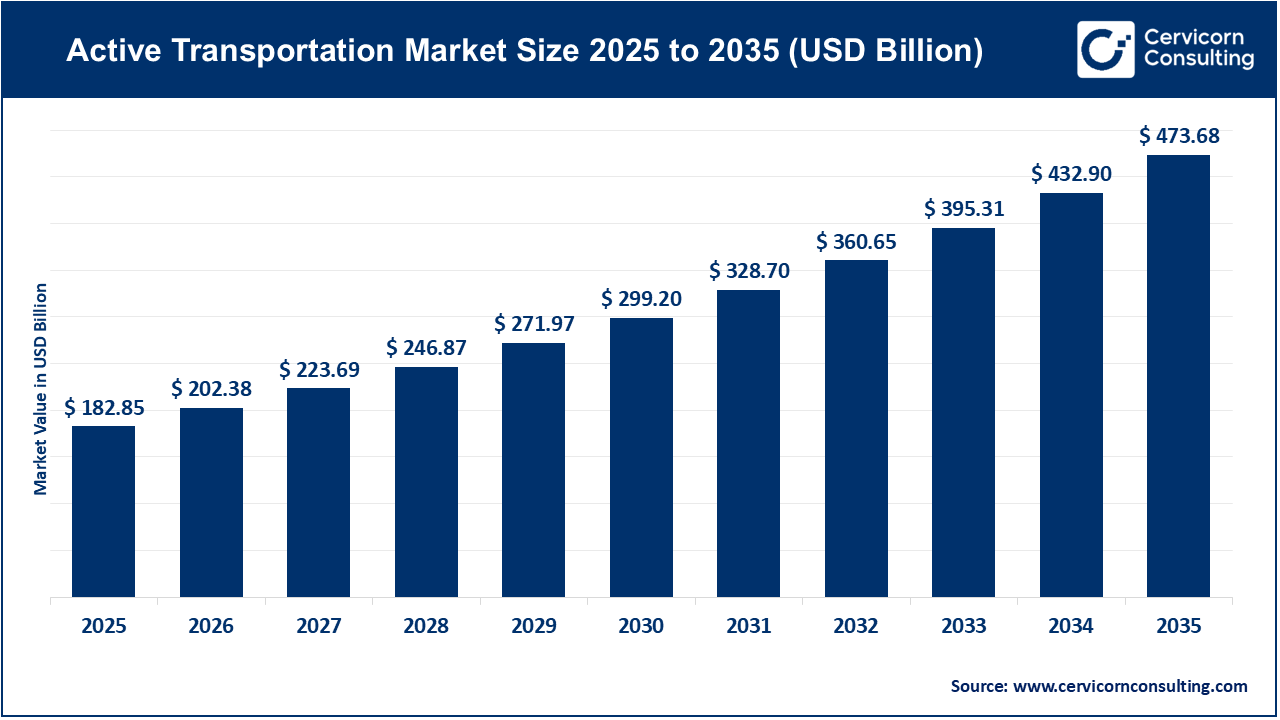
The global active transportation market size was valued at USD 182.85 billion in 2025 and is anticipated to hit around USD 473.68 billion by 2035, growing at a compound annual growth rate (CAGR) of 9.9% over the forecast period from 2026 to 2035. The market’s potential lies in rising awareness about health and environmental benefits and urban integration of bike-friendly infrastructure and associated solutions.
Report Highlights
- Europe dominated the market with revenue share of 33% in 2025 owing to the long-standing policy and public infrastructure for non-motorized mobility.
- Asia Pacific is seen to grow as a mature marketplace owing to China’s presence as a largest e-bike market across the globe.
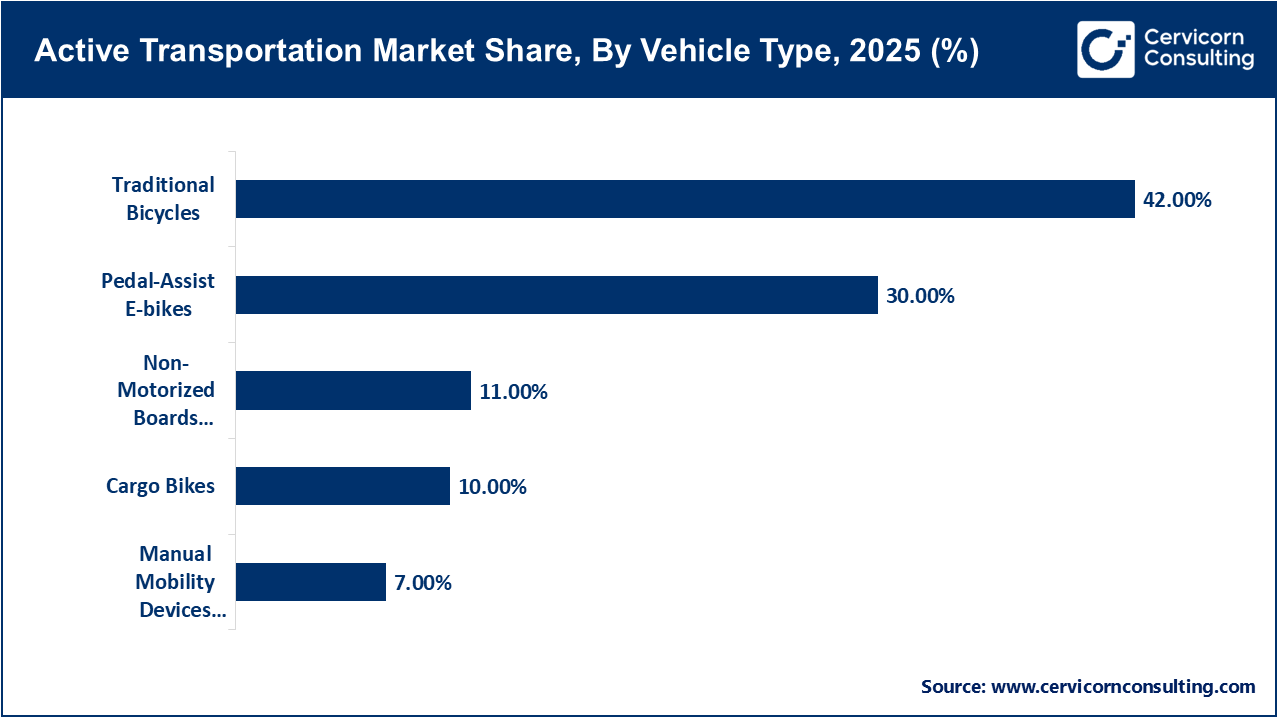
- By vehicle type, the traditional bicycles segment led the market with revenue share of 42%, owing to their affordability and low maintenance requirement.
- By vehicle type, the cargo bikes segment is seen to grow at the rapid pace due to its rising demand from retail and e-commerce sector.
- By propulsion type, the fully human-powered segment generated 63% revenue share in 2025 with its overall popularity and significance in the industry.
- By propulsion type, the pedal-assist electric segment is seen to grow notably owing to the rising prominence of electric bicycles across the globe.
- By application, the daily commuting segment dominated the market 36% in 2025 with the rise in urban mobility especially in developing countries.
- By application, the last-mile segment held the second-largest share in 2025.
- By end-user, the individual consumers segment accounted revenue share of 60% in 2025 with the rising focus on cycling and outdoor activities.
- By end-user, the commercial users segment is seen to grow at the fastest rate owing to the overall rise in short-mile mobility in institutional areas.
- By distribution channel, the online direct-to-customer segment held revenue share of 37% in 2025 owing to rising presence of bicycle companies on online platforms.
Active Transportation Market Overview
The term active transportation includes all kinds of human-powered transportation, from walking and biking to using an electric bicycle or electric scooter. Active transportation is often associated with health, sustainability, and urban transportation planning. The active transportation marketplace includes bicycle and electric bicycle manufacturing; shared active transportation platforms; equipment for use in active transportation, such as safety equipment and supporting infrastructure e.g., bike lanes and docking stations; digital mobility apps; and maintenance services for these activities.
Unlike the traditional transportation markets that are based on fuel-powered vehicles as their primary means of transportation, active transportation relies on the physical activity of individuals, promoting sustainability and access to urban areas. Due to the advancement of technology, the market for active transportation has now expanded to a larger audience. The growth of electric bicycles and app-based micro-mobility platforms has increased both range and convenience for riders and allows a wider range of users to consider using active modes of transportation, including commuters to the office and the elderly.
Top Policies for Promoting Active Transportation Globally
| Country |
Policy |
Significance |
| Netherlands |
Extensive Cycling Infrastructure |
The Netherlands has invested for decades in protected bike lanes and cycling highways, with more than 35,000 km of dedicated cycling paths nationwide. |
| United Kingdom |
National Cycling & Walking Investment Strategy |
The UK government launched multi-year funding programs under its national cycling and walking strategy to expand protected bike lanes. |
| Germany |
E-Bike Purchase Subsidies |
Germany provides financial incentives and corporate leasing tax benefits for e-bike adoption. E-bikes now represent over 40% of new bicycle sales in the country, demonstrating the effectiveness of incentive-backed policy support. |
| China |
Public Bike-Sharing Systems |
China pioneered large-scale dockless bike-sharing programs in cities like Beijing and Shanghai. At peak usage, Chinese bike-sharing platforms facilitated tens of millions of daily rides, significantly boosting short-distance active travel. |
| United States |
Active Travel & Safe Routes to School Programs |
Through federal and state-level transportation programs, the U.S. funds Safe Routes to School initiatives to encourage walking and cycling among students. |
| India |
National Smart City & Non-Motorized Transport Policies |
Under India’s Smart Cities Mission, multiple cities have developed dedicated cycling tracks and pedestrian-friendly corridors. |
Active Transportation Market Regional Analysis
- The North America active transportation market size was valued at USD 43.88 billion in 2025 and is anticipated to hit around USD 113.68 billion by 2035.
- The LAMEA active transportation market size was reached at USD 23.77 billion in 2025 and is predicted to hit around USD 61.58 billion by 2035.
Why is Europe holding the largest share in the active transportation market?
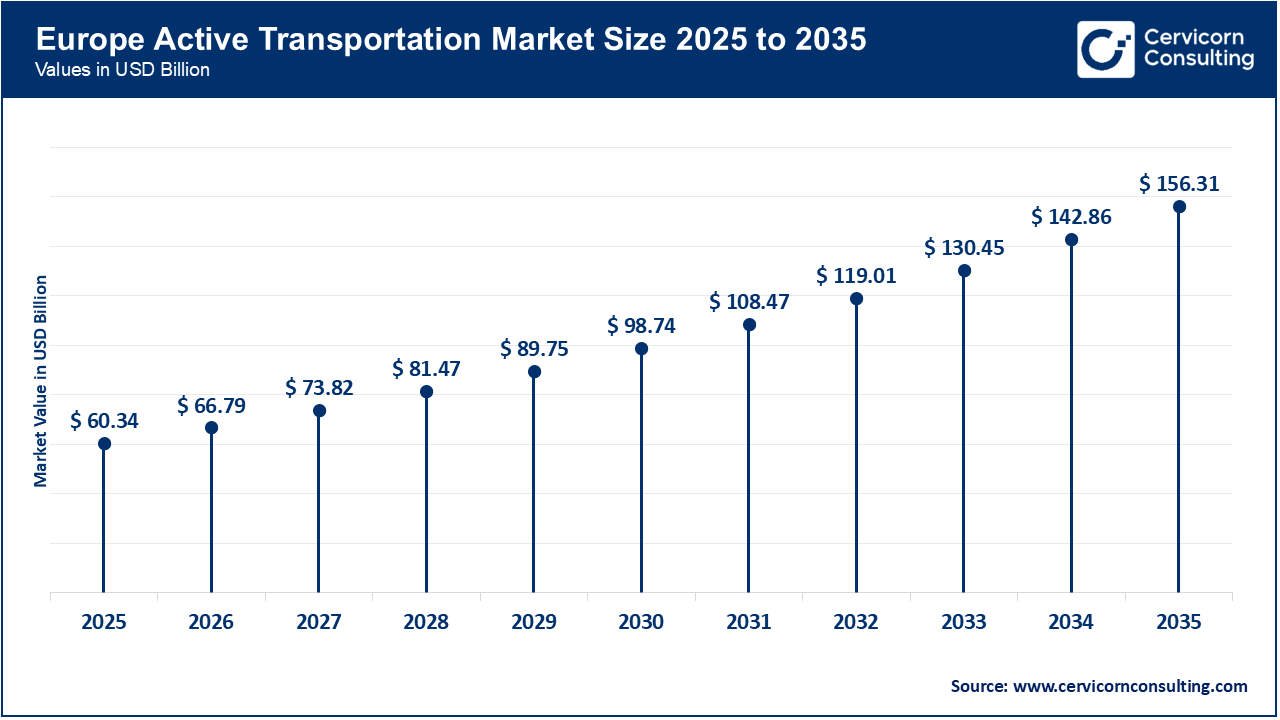
The Europe active transportation market size was estimated at USD 60.34 billion in 2025 and is projected to surpass around USD 156.31 billion by 2035.
Europe's leadership in active transportation is a result of years of intentional infrastructure development and policy commitment. This has allowed walking, cycling, and micro-mobility options to be considered mainstream modes of transport, rather than just minor alternatives. The cities of Europe systematically put human-powered mobility at the forefront of their infrastructure development.
They have created communities with protected bike lanes, bike lanes separated from car lanes, pedestrian-only zones, and transit systems that are integrated into the rest of the transportation network, resulting in safe, reliable networks that allow for the everyday use of active transportation. An example of one of the world's best bicycle infrastructures can be seen in the Netherlands.
Germany & Netherlands Active Transportation Market Overview
- In addition, Germany has made efforts over the course of decades toward investing in active transportation design and creating bicycle pathways. Because of this commitment, Germany continues to be an important European contributor to cycling. Federal and municipal Germany have funded additional cycling route developments through federally supported or city-sponsored cycling projects such as their hundreds of millions of euros spent to improve the cycling route network by more than 600 kilometers in its capital city (Berlin).
- The cities of the Netherlands have approximately 35,000+ km of dedicated bike paths, extensive bike navigation systems, and bicycle-first traffic engineering. In cities like Copenhagen and Amsterdam, between 40–50% of all trips taken each day are done by bicycle.
Active Transportation Market Share, By Region, 2025 & 2035 (%)
| Region |
Revenue Share, 2025 (%) |
Revenue Share, 2035 (%) |
| North America |
24% |
24.70% |
| Europe |
33% |
30.90% |
| Asia-Pacific |
30% |
31.50% |
| LAMEA |
13% |
12.90% |
What to Expect from Major Asian Countries in Active Transportation Market?
The Asia-Pacific active transportation market size was accounted for USD 54.86 billion in 2025 and is expected to reach around USD 142.10 billion by 2035. Asia Pacific is expected to grow at the fastest rate during the forecast period. In the coming years, major Asian countries are poised to accelerate the adoption and evolution of active transportation, driven by rapid urbanization, rising environmental awareness, expanding infrastructure investments, and the widespread emergence of electric mobility alternatives. Unlike regions with historically entrenched cycling cultures, many Asian markets are transitioning active transport from necessity-based usage to a strategic mobility choice supported by policy, technology, and demographic shifts.
Bicycle parking facilities and multi-modal interchange stations are commonplace in cities like Tokyo, Osaka, and Kyoto, where first-mile and last-mile connections often rely on bikes and walking. India’s active transportation trajectory is shaped by its rapid urban expansion and efforts to modernize city mobility. Under national initiatives such as the Smart Cities Mission, Indian cities are developing dedicated cycle tracks, pedestrian plazas, and non-motorized transport corridors to address air quality, congestion, and fuel dependency.
China’s E-bike Industry to Support the Growth of Active Transportation
China is considered as a major contributer in active transportation market. With a massive population, high density of cities (urbanisation), and its early dominance of electric two-wheelers, China will be a major player in the active transportation industry. China has hundreds of millions of e-bikes operating across all parts of the country with e-bikes now outpacing traditional bicycle sales.
More and more cities are creating infrastructure (micromobility) and urban plans to support micromobility corridors/parking solutions. Bike share programs in Beijing, Shanghai, Guangzhou and other cities have reported millions of daily rides each day; this demonstrates how important active transportation networks are to improving urban traffic congestion and facilitating last mile connectivity.
Active Transportation Market Top Companies
| Company |
Headquarters |
Key Role in the Market |
| Trek Bicycle Corporation |
United States |
Known for a wide range of bikes from road to urban commuting; strong brand presence and dealer network. |
| Giant Manufacturing Co |
Taiwan |
One of the world’s largest bicycle producers; extensive scale, OEM capacity, and leadership in both conventional and e-bike segments. |
| Specialized Bicycle Components |
United States |
High-end performance and innovation focus; strong presence in premium urban and sport cycling categories. |
| Accell Group NV |
Netherlands |
European leader in bicycles and e-bikes through brands like Haibike and Raleigh; instrumental in advancing e-mobility adoption. |
| Pedego Electric Bikes |
United States |
Fast-growing e-bike brand focused on comfort and consumer adoption in North America; significant post-sale service ecosystem. |
| Yadea Group Holdings |
China |
One of the largest electric two-wheeler manufacturers globally; dominant in China and expanding in international e-mobility markets. |
| Hero Cycles |
India |
Leading bicycle manufacturer in South Asia with a broad portfolio; strong volume play in urban and rural commuting segments. |
Active Transportation Market Segmental Analysis
Vehicle Type Analysis
Traditional bicycles maintained their place as the leading form of active transport during 2025 because they have a low purchase price, do not require fuel, cost little to maintain, and fit well into urban transport systems around the world. Currently there are over 1 billion bicycles in use, according to the World Health Organization (WHO), which demonstrates that they are used widely and accepted by many different cultures, especially in Europe and Asia.
In some parts of the Netherlands, bicycles account for approximately 27% of all trips made; while over 60% of the residents in cities such as Copenhagen commute to work by bicycle every day. The use of bicycles is further supported by governments through the development of dedicated cycling facilities; there are now over 250,000 km of cycling paths developed by cities across Europe. Because of their ease of design, low cost, and universal access, traditional bicycles will continue to be one of the most popular modes of active transportation.
The cargo bikes segment is expected to grow the fastest during the forecast period as urban logistics transform and as more low-emission delivery mandates come into play. According to the European Cyclists’ Federation, sales of cargo bikes in Europe have grown by over 60% from 2021 through to 2023, significantly outpacing sales of traditional bicycles. To encourage the purchase of cargo bikes, numerous cities (including Paris and Berlin) are providing financial incentives through subsidies that range from €500 to €2,000 per vehicle.
Last-mile delivery accounts for approximately 50% of total urban freight trips, and logistics operators are increasingly adopting the use of cargo bikes to avoid paying congestion fees and to avoid paying low-emission zone fines. In addition, cargo bikes are now being utilized in some urban settings to replace light duty commercial vans for short-distance deliveries. As a result, cargo bike adoption by commercial users is on the rise.
Propulsion Type Analysis
The trend toward fully human-powered vehicles continued strong share throughout the world in 2025 because of their health promotion, lack of emissions, and regulation-free nature. According to the World Health Organization, lack of physical activity is associated with about 5 million deaths worldwide every year; therefore, many governments are investing in infrastructure that promotes cycling or walking as part of their preventive health care initiatives. Traditional bicycles are expected to remain the most popular type of human-powered vehicle due to their low operating costs and long life spans.
In addition, manual mobility devices will play a vital role in planning accessibility in urban areas, with the World Bank estimating that 15% of the global population has some sort of disability; this means that there is a need for continued non-motorized transportation options.
Active Transportation Market Share, By Propulsion Type, 2025 & 2035 (%)
| Propulsion Type |
Revenue Share, 2025 (%) |
Revenue Share, 2035 (%) |
| Fully Human-Powered |
63% |
46% |
| Pedal-Assist Electric (Pedelec Only) |
37% |
54% |
The pedal-assist electric propulsion is rapidly growing due to advancements in battery technology and an increasing preference among commuters to use assisted transportation for greater distances. According to the International Energy Agency (IEA), More than 40 million e-bikes are sold a year, more than e-cars sold in various markets. Pedal-assist systems allow users to commute 40–100 km on one charge, an attribute that makes this product appealing to users who commute from suburbia. Since almost 60% of all city-based trips globally are less than 10 km in length, pedal-assist systems contribute to the reduction of urban vehicle trips and are poised to achieve continued growth.
Application Analysis
Daily commuting segment led the market, because of the combination of rising gas prices, traffic congestion, and sustainability goals, has also become an increasingly popular use case. According to the United Nations, the proportion of people living in urban environments is expected to grow from 56% to 68% by 2050, putting further emphasis on the need for efficient mobility alternatives over short distances. Results of numerous studies have shown that 50% to 60% of urban trips taken by car cover distances of 8 km or less, a distance that is ideal for use with bicycles and e-bikes. Similarly, cycling-to-work programs as developed in both Germany and the UK are further facilitating commuter adoption of bicycles/e-bikes for daily commutes, as well as investments in infrastructure such as the addition of protected bike lanes in over 1000 cities worldwide since 2020, have also helped make this segment the most widely used to date.
Active Transportation Market Share, By Application, 2025 (%)
| Application |
Revenue Share, 2025 (%) |
| Daily Commuting |
36% |
| Last-Mile Connectivity |
24% |
| Commercial Delivery & Logistics |
17% |
| Recreational Transportation |
13% |
| Campus / Institutional Mobility |
10% |
Because of a combination of improved public transportation and increased mobility options, last mile connectivity has become the fastest growing segment of the transportation industry. Between 30% and 40% of users of public transportation in large metropolitan areas need some sort of first/last mile solution in order to get to and from their final destination from the train or bus station. One of the most common solutions that is being implemented to help mitigate this issue is bike sharing. In China, for example, there are over 10 million bike shares available, with the majority of locating happening adjacent to subway systems.
End-user Analysis
The individual consumers segment dominated the market within the transition to healthier lifestyles, as well as sustainability and economy of scale. Studies on worldwide participation in fitness show us that over thirty percent of the adult population regularly cycle or participate in outdoor sports, such as running. Rising fuel prices and vehicle ownership costsex, penses for an average vehicle can exceed several thousand dollars per year in OECD countries, have forced customers into alternative transportation methods at lower prices (such as bicycles).
Active Transportation Market Share, By End-User, 2025 (%)
| End-User |
Revenue Share, 2025 (%) |
| Individual Consumers |
60% |
| Commercial Users |
27% |
| Government & Institutional Buyers |
13% |
Commercial users are projected to grow at the fastest rate, primarily driven by e-commerce expansion. Global parcel volumes exceeded 160 billion parcels annually, with urban last-mile delivery constituting the majority. Delivery riders using cargo bikes are increasingly replacing vans in congested city cores due to emission restrictions and operational cost advantages. Several European cities report that cargo bikes can deliver parcels 25% faster than vans in dense urban areas, reinforcing their efficiency advantage. Corporate mobility fleets are also expanding as organizations adopt sustainable commuting benefits for employees.
Distribution Channel Analysis
The online Direct-to-Consumer (DTC) channel has gained market share because of the availability of transparent pricing, broader model range, and digitized supply chain. Bicycle manufacturers are increasingly creating their own e-commerce sites and providing customization and shipping directly to customers. Surveys show that 40% or more of all bicycle purchases in developed regions are completed through online research and sales, especially with electric bicycles. Consumers are now more likely to research specifications, battery ranges, and pricing before making a purchase decision digitally; therefore, this has resulted in shifting consumer behavior toward making purchases through digital channels.
Active Transportation Market Share, By Distribution Channel, 2025 (%)
| Distribution Channel |
Revenue Share, 2025 (%) |
| Online Direct-to-Consumer |
37% |
| Offline Retail Stores |
45% |
| Direct Fleet/Institutional Sales |
18% |
Offline retail is expected to grow notably in the forecast period. The growth of offline retail peaks due to the demand for physical trialing, serviceability, and after-sales support, particularly for electric and cargo bikes. Electric bikes require assembly by a professional technician and battery maintenance, resulting in an increased need for specialist retailers to provide these services. More and more top brands are implementing hybrid retailing by allowing customers to order products online and receive them at their local store along with the option of purchasing an in store maintenance plan. The technical requirements involved in pedal assist systems and cargo configurations will ultimately lead to a surge in demand for physical retailing experience.
Recent News
- Exelmoto, in October 2025 unveiled its new business-to-business division in collaboration with logistics provider Delhivery India, introducing the Scoot electric cycle, a pedal-assist micro-mobility solution aimed at inclusive urban transport and last-mile delivery expansion.
- Shared micromobility operator Dott in October 2025, partnered with Segway to launch an all-new e-bike model in Paris as part of a long-term fleet contract, enhancing options for sustainable urban mobility in the French capital.
- Micromobility provider Bolt in February 2026 expanded its service in Liverpool through a partnership with city authorities to deploy new shared scooters and e-bikes, further strengthening shared active transportation infrastructure in the UK.
Market Segmentation
By Vehicle Type
- Traditional Bicycle
- Pedal-assist E-bikes
- Cargo Bikes
- Non-motorized Boards (Skateboards, Longboards)
- Manual Mobility Devices (wheelchairs)
By Propulsion Type
- Fully Human-powered
- Traditional Bicycles
- Skateboards
- Manual Wheelchairs
- Pedal-assist Electric
By Application
- Daily Commuting
- Last-Mile Connectivity
- Commercial Delivery & Logistics
- Recreational Transportations
- Campus/Institutional Mobility
By End-User
- Individual Consumers
- Commercial Users
- Delivery Riders (Cargo)
- Corporate Mobility Fleet
- Government & Institutional Buyers
- Public Bike-shared Pedal Fleets
- Urban Mobility Programs
By Distribution
- Online Direct-to-Consumer
- Offline Retail Stores
- Direct Fleet/Institutional Sales
By Region
- North America
- Asia Pacific
- Europe
- Latin America
- Middle East and Africa