xEV Power Chip Market Size and Growth Factors
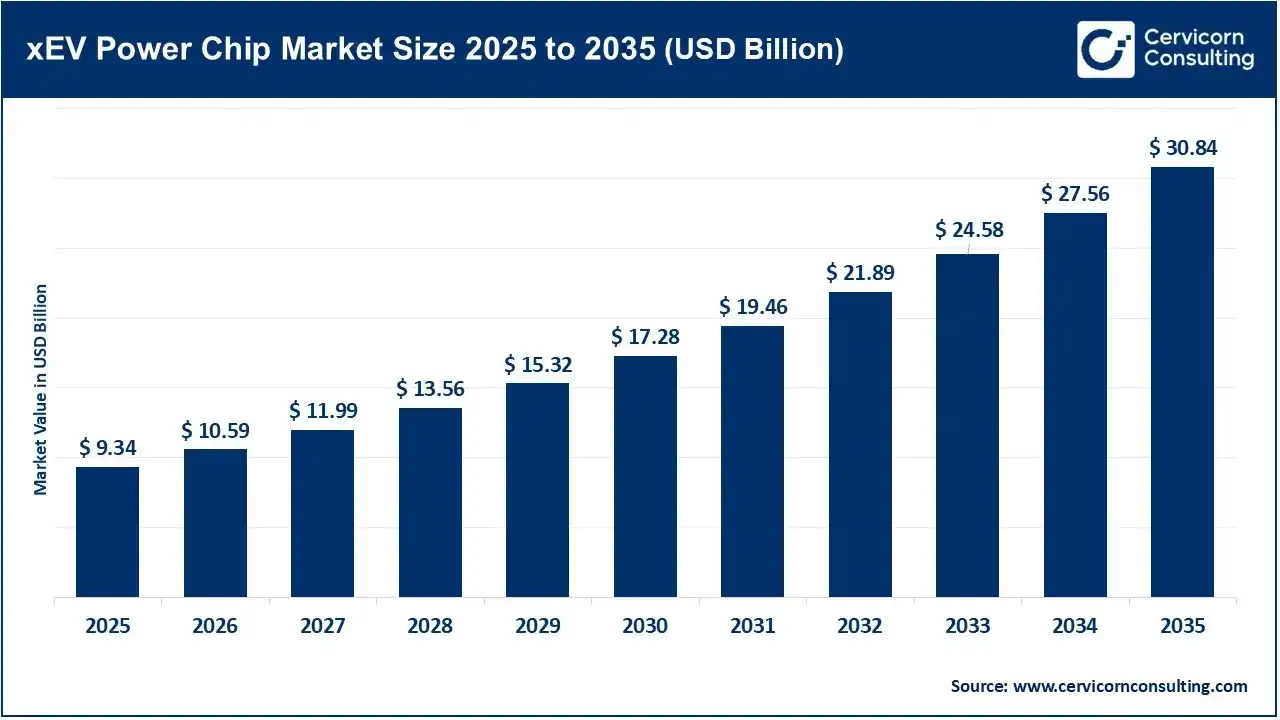
The global xEV power chip market size was estimated at USD 9.34 billion in 2025 and is projected to grow from USD 10.59 billion in 2026 to nearly USD 30.84 billion by 2035, registering a CAGR of 12.6% over the forecast period 2026 to 2035.
The xEV power chip market is expanding since sophisticated semiconductor components are necessary for electric and hybrid cars to effectively control power conversion, energy flow, and thermal performance. The demand for power chips used in traction inverters, onboard chargers, DC-DC converters, and battery management systems is rising as EV platforms move toward higher voltages. Additionally, automakers are pushing for increased integration of cutting-edge semiconductor technologies in order to increase driving range, charging efficiency, vehicle efficiency, and power density.
Smaller, faster, and more efficient power electronics are becoming more and more possible with the use of silicon carbide and gallium nitride devices. Major automotive markets are seeing an increase in demand for xEV power chips due to rising investments in EV manufacturing, charging infrastructure, and domestic semiconductor production.
In June 2025, Infineon Technologies AG announced the expansion of its automotive power semiconductor portfolio with new silicon carbide and silicon power devices for electric vehicles. The company highlighted applications including traction inverters, onboard chargers, and DC-DC converters, reflecting the growing demand for high-efficiency power chips in xEV powertrains.
Key Takeaways
- By region: Asia-Pacific dominated the xEV power chip market with a 42.0% share in 2025, supported by strong semiconductor manufacturing capabilities, rapid electric vehicle production, and rising investments in EV technologies and charging infrastructure across China, Japan, South Korea, and India.
- By device type: IGBTs dominated the device type segment with a 28.0% share in 2025, driven by their established use in high-power automotive applications, including traction inverters and electric motor control systems, along with mature manufacturing capabilities, affordability, and proven performance.
- By semiconductor material: Silicon dominated the semiconductor material segment with a 56.0% share in 2025, supported by mature manufacturing processes, widespread availability, established supply chains, and comparatively lower production costs across hybrid and electric vehicle power electronics.
- By xEV type: Battery electric vehicles (BEVs) dominated the xEV type segment with a 52.0% share in 2025, driven by increasing BEV adoption, expanding charging infrastructure, and automaker investments in dedicated electric platforms and advanced powertrain technologies.
- By application: Traction inverters dominated the application segment with a 32.0% share in 2025, owing to their critical role in converting battery power for electric motor operation and the growing need for efficient voltage, current, and switching control in advanced xEV powertrains.
- By vehicle class: Passenger cars dominated the vehicle class segment with a 55.0% share in 2025, supported by expanding hybrid and electric passenger vehicle portfolios, increasing consumer demand for driving range and charging efficiency, and the large global passenger vehicle production base.
- By voltage architecture: 400 V to <600 V dominated the voltage architecture segment with a 49.0% share in 2025, supported by its widespread deployment across established xEV platforms and its balance between vehicle performance, charging capability, powertrain complexity, and system cost.
xEV Power Chip Market Size & Forecast
- Base Year Market Size (2025): $9.34 billion
- Current Year Market Size (2026): $10.59 billion
- Estimated Year Market Size (2035): $30.84 billion
- Forecast Period CAGR (2026-2035): 12.6%
Recent Trends
- Growing Adoption of SiC Power Chips: Automakers are increasingly adopting silicon carbide chips in traction inverters and other high-voltage EV applications to improve efficiency and reduce energy losses.
- Expansion of GaN Technology: Gallium nitride power devices are gaining attention in onboard chargers and DC-DC converters because of their high switching speed, compact size, and efficiency.
- Higher-Voltage EV Architectures: The shift toward higher-voltage EV platforms is increasing demand for power chips capable of handling higher voltage and power levels while maintaining thermal efficiency.
- Increasing Power Density: Chip manufacturers are developing smaller and more powerful semiconductor solutions to reduce the size and weight of EV power-electronic systems.
- Integration of Multiple Power Functions: Power semiconductor solutions are increasingly being designed to support multiple functions, including inverter, charging, and voltage-conversion applications within integrated architectures.
- Advanced Thermal Management: Growing power density is encouraging the development of improved chip packaging, cooling technologies, and thermal-management solutions to maintain reliable EV operation.
- Rising Demand for Fast Charging: The expansion of fast-charging technologies is increasing demand for power chips that can support higher switching performance and efficient power conversion.
Market Dynamics
Drivers
- Traction Inverter Demand: Traction inverters convert battery DC power into the AC power required by electric motors, making them one of the most important power-chip applications in xEVs. Growing vehicle electrification and demand for higher efficiency are encouraging automakers to adopt advanced MOSFETs, IGBTs, SiC MOSFETs, and integrated power modules in next-generation drivetrain architectures.
- SiC Adoption: Silicon carbide is gaining importance in high-voltage EV applications because its wide-bandgap characteristics support high-temperature operation, high switching efficiency, and increased power density. Automotive suppliers are also securing long-term SiC supply, with onsemi and Magna establishing agreements and investments to expand SiC capacity for electric-drive systems.
- Vehicle Electrification: EV adoption is expanding across passenger cars, commercial vehicles, buses, and two- and three-wheelers, increasing the addressable applications for power semiconductors. In 2025, electric cars represented 25% of global new-car sales, while electric-car sales outside China, Europe, and the United States approached 2 million units, demonstrating broader geographic adoption.
Restraints
- High SiC Costs: Silicon carbide power devices generally require more complex manufacturing processes and specialized materials than conventional silicon devices, increasing component costs. The manufacturing challenge is significant enough that automotive companies have pursued long-term supply agreements and direct investments in SiC production capacity to secure reliable access to future volumes.
- Manufacturing Complexity: Producing advanced power chips involves demanding wafer processing, epitaxy, device fabrication, packaging, testing, and thermal-management requirements. SiC manufacturing is particularly challenging, while automotive qualification adds stringent reliability requirements. These factors can lengthen development cycles and limit rapid capacity expansion when EV demand accelerates.
- Supply Chain Concentration: xEV power-chip production depends on specialized semiconductor materials, wafers, fabrication capacity, packaging technologies, and automotive-grade manufacturing ecosystems. The broader EV supply chain remains geographically concentrated, with China producing nearly 75% of electric cars in 2025, reinforcing the importance of supply-chain diversification for automakers and semiconductor suppliers.
Opportunities
- 800 V and 1,000 V Platforms: Higher-voltage EV architectures create opportunities for advanced SiC MOSFETs, power modules, gate drivers, and related protection components. Higher voltage enables faster charging and can reduce current requirements for a given power level, while the emergence of 1,000 V models in 2025 indicates that high-voltage architectures are moving into commercial vehicle platforms.
- Commercial Vehicle Electrification: Electric buses, trucks, delivery vehicles, and other commercial platforms require high-power propulsion and charging systems, creating opportunities for high-current and high-voltage power chips. Increasing electrification in these vehicle categories can expand demand for SiC-based traction inverters, onboard charging, DC-DC conversion, and power-distribution systems beyond passenger vehicles.
- Domestic Semiconductor Capacity: Government and industry investments in semiconductor manufacturing are creating opportunities to localize automotive power-chip production and strengthen regional supply chains. In July 2026, Infineon opened its €5 billion Smart Power Fab in Dresden, designed to expand manufacturing of advanced power semiconductors for automotive and industrial applications.
Challenges
- Thermal Management: High-power switching devices generate heat during vehicle operation, particularly in traction inverters, fast chargers, and high-voltage power-conversion systems. Maintaining semiconductor junction temperatures within safe limits requires advanced packaging, cooling systems, thermal interfaces, and system-level design, adding engineering complexity as EV power density increases.
- Automotive Reliability: xEV power chips must operate reliably across wide temperature ranges, vibration conditions, electrical loads, and long vehicle lifecycles. Automotive qualification requirements make component validation more demanding than many industrial applications, increasing testing requirements and extending development timelines for new semiconductor materials, devices, and packaging technologies.
- Technology Transition: Power-chip suppliers must balance established silicon technologies with rapidly developing SiC and GaN solutions while automakers simultaneously redesign vehicle electrical architectures. This transition creates compatibility, qualification, manufacturing, and cost challenges because semiconductor selection affects inverter design, thermal systems, charging performance, control electronics, and the overall vehicle platform.
Regional Analysis
- The North America xEV power chip market size was estimated at USD 2.34 billion in 2025 and is projected to reach USD 6.79 billion by 2035, registering a CAGR of 11% over the forecast period 2026 to 2035.
- The Europe xEV power chip market size was valued at USD 2.15 billion in 2025 and is expected to hit USD 6.48 billion by 2035, registering a CAGR of 11.5% over the forecast period 2026 to 2035.
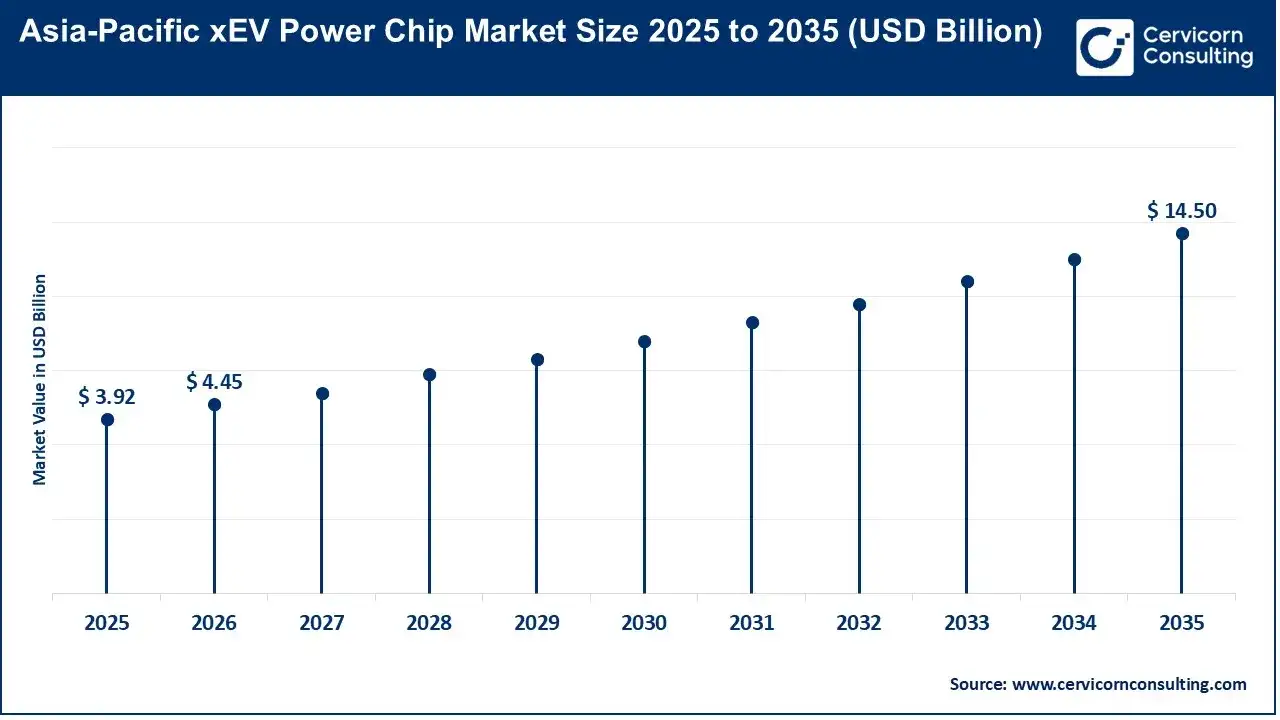
- The Asia-Pacific xEV power chip market size was accounted for USD 3.92 billion in 2025 and is forecasted to grow USD 14.50 billion by 2035, registering a CAGR of 14% from 2026 to 2035.
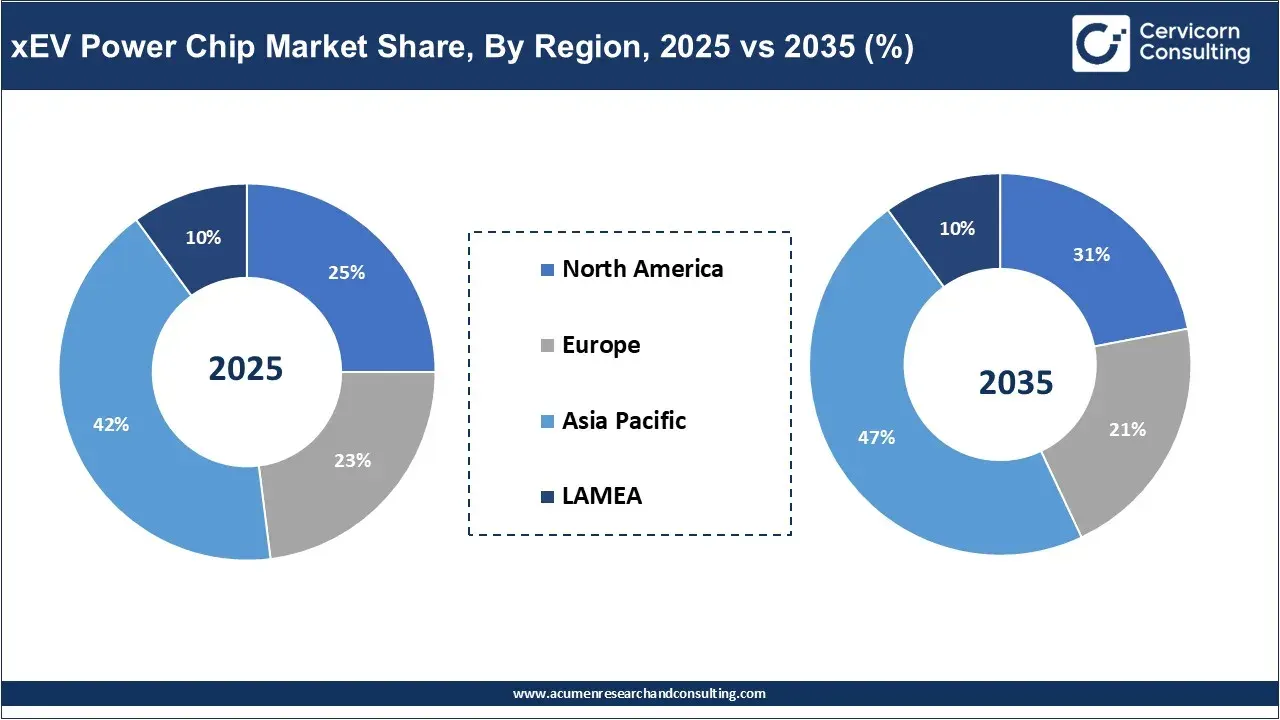
The Asia-Pacific region dominated the xEV power chip market with a market share of 42% in 2025, driven by robust semiconductor manufacturing capabilities and the swift growth of electric car production. Investments in EV technologies and power electronics are rising in nations including China, Japan, South Korea, and India. Regional demand is additionally supported by the presence of significant semiconductor and automobile manufacturers. The region's dominant market position is anticipated to be sustained by growing EV adoption and investments in charging infrastructure.
The Middle East & Africa region is growing rapidly in the xEV power chip market with a CAGR of 13.2% from 2026 to 2035, encouraged by rising investments in sustainable transportation and electric mobility. Cleaner transportation options are being promoted and EV infrastructure is progressively being expanded by governments and automakers. Power semiconductor technologies are becoming more and more in demand as interest in electric busses, commercial cars, and charging networks grows. Future market expansion is anticipated to be supported by the region's increasing emphasis on transportation electrification.
Segmental Analysis
Device Type Analysis
IGBTs: IGBTs dominated the xEV power chip market with 28.0% share in 2025, motivated by their well-established use in high-power automotive applications such as electric motor control systems and traction inverters. Their ability to manage high voltage and current makes them suitable for demanding EV powertrain applications, while established manufacturing capabilities, affordability, and demonstrated performance continue to support their use across xEV platforms.
xEV Power Chip Market Share, By Device Type, 2025 (%)
| Device Type |
Revenue Share, 2025 (%) |
Revenue Share, 2025 (%) |
| Power MOSFETs |
25% |
30% |
| IGBTs |
28% |
20% |
| Power Diodes & Rectifiers |
10% |
8% |
| Power Management ICs |
16% |
17% |
| Integrated Power Modules |
17% |
22% |
| Other Power Semiconductor Devices |
4% |
3% |
Integrated Power Modules: Integrated power modules are growing rapidly in the xEV power chip market, increasing from 17.0% share in 2025 to 22.0% by 2035, motivated by demand for compact and efficient power electronics. By combining multiple power semiconductor functions into a single package, these modules can reduce system size and increase power density. Growing emphasis on thermal performance and streamlined powertrain architectures is encouraging their adoption in next-generation xEVs.
Semiconductor Material Analysis
Silicon (Si): Silicon dominated the xEV power chip market with 56.0% share in 2025, backed by its proven application across vehicle power electronics. Mature manufacturing processes, widespread availability, comparatively low production costs, and an established supply chain continue to support silicon devices in hybrid and electric vehicle power management and conversion applications.
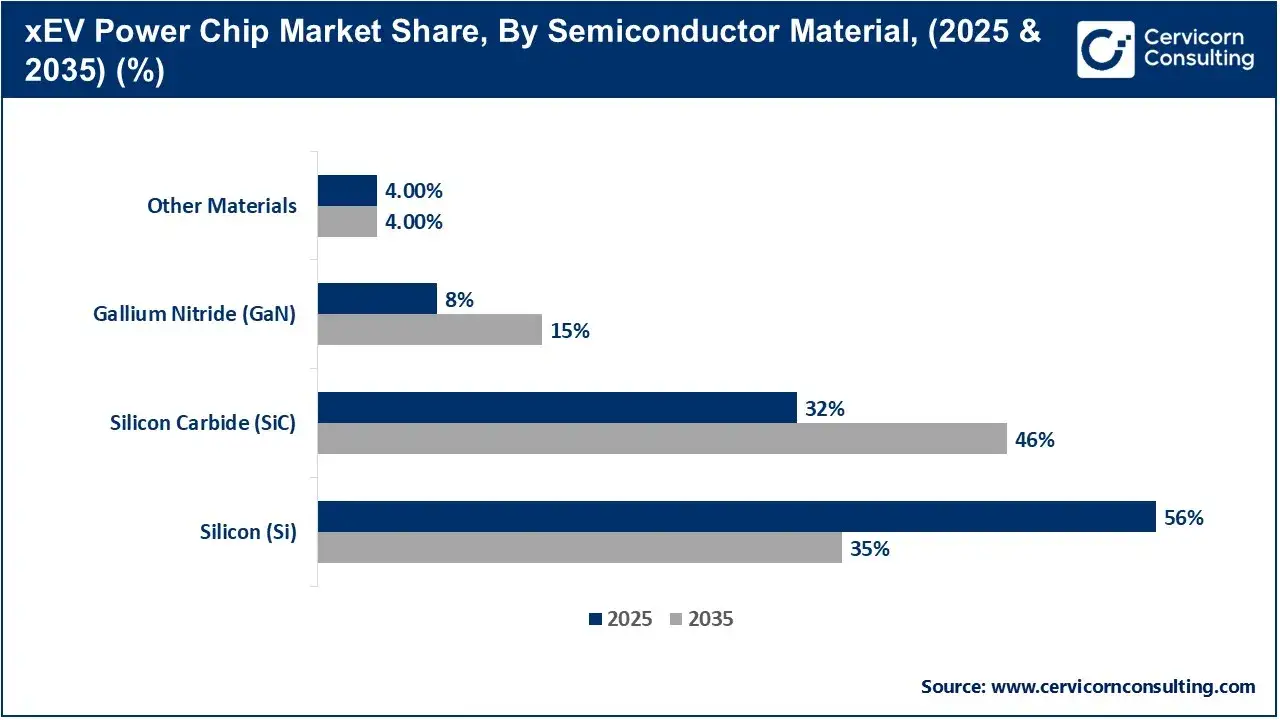
Silicon Carbide (SiC): Silicon carbide is growing rapidly in the xEV power chip market, increasing from 32.0% share in 2025 to 46.0% by 2035, driven by the increasing need for high-voltage and energy-efficient vehicle systems. SiC power chips can operate at higher voltages and temperatures while reducing energy losses, supporting their growing application in fast-charging systems, onboard chargers, and traction inverters. The transition toward higher-voltage EV architectures is further accelerating SiC adoption.
xEV Type Analysis
Battery Electric Vehicles (BEVs): BEVs dominated the xEV power chip market with 52.0% share in 2025, driven by expanding charging infrastructure and rising consumer acceptance of fully electric vehicles. BEVs require multiple power semiconductor components for energy conversion, motor control, charging, and power management. Increasing automaker investments in advanced powertrain technologies and dedicated EV platforms are further supporting demand for xEV power chips in this vehicle category.
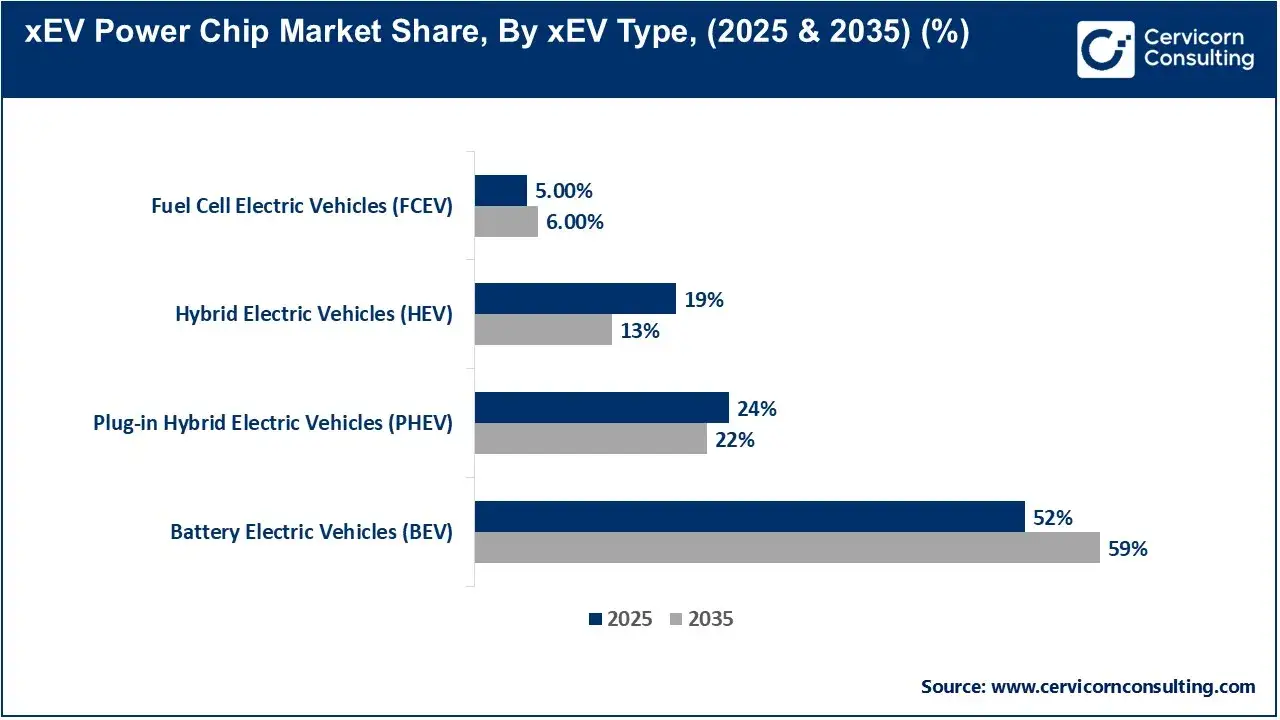
Fuel Cell Electric Vehicles (FCEVs): FCEVs are growing rapidly in the xEV power chip market at 14.9% CAGR from 2026 to 2035, motivated by growing interest in zero-emission mobility and hydrogen-powered transportation. Fuel cell electric vehicles require efficient power conversion and energy management systems to regulate electricity generated by the fuel cell. Growing adoption in heavy-duty mobility and commercial transportation, alongside investments in hydrogen infrastructure, is creating additional opportunities for power chip manufacturers.
Application Analysis
Traction Inverters: Traction inverters dominated the xEV power chip market with 32.0% share in 2025, motivated by their critical function of converting electrical energy from the vehicle battery into power for the electric motor. High-performance power semiconductor devices are required to efficiently control voltage, current, and switching. Increasing emphasis on driving range, powertrain efficiency, and higher-voltage EV platforms is supporting demand for advanced power chips in traction inverter systems.
On-Board Chargers (OBCs): On-board chargers are growing rapidly in the xEV power chip market with 15.0% share in 2025, motivated by the growing demand for faster and more efficient vehicle charging. Advanced power chips support higher charging power and help OBC systems improve conversion efficiency. Expansion of public, workplace, and residential charging infrastructure is increasing the importance of efficient onboard charging solutions and supporting demand for advanced semiconductor technologies.
Vehicle Class Analysis
Passenger Cars: Passenger cars dominated the xEV power chip market with 55.0% share in 2025, propelled by the growing adoption of hybrid and electric passenger vehicles. Automakers are expanding EV portfolios across vehicle segments and price points, while consumer demand for greater driving range, charging efficiency, and vehicle performance is supporting the deployment of advanced power semiconductor technologies. The large global passenger vehicle base further contributes to demand for xEV power chips.
Electric Buses: Electric buses are growing rapidly in the xEV power chip market with 10.0% share in 2025, motivated by the shift toward greener public transportation and increasing fleet electrification. Electric buses require high-power semiconductor devices for propulsion, energy management, and charging. Government-backed public transportation electrification and investments in charging infrastructure are supporting adoption and increasing demand for high-performance power chips.
Voltage Architecture Analysis
400 V to <600 V: 400 V to <600 V dominated the xEV power chip market with 49.0% share in 2025, motivated by its extensive use across established electric and hybrid vehicle platforms. This voltage range provides a balance between vehicle performance, charging capacity, system complexity, and cost. Its established ecosystem of power electronics and charging components continues to support demand across modern xEV powertrains.
600 V to <800 V: 600 V to <800 V is growing rapidly in the xEV power chip market with 8.0% share in 2025, motivated by the increasing adoption of higher-voltage automotive architectures. Higher-voltage systems can reduce current-related losses while supporting faster charging and improved power transmission efficiency. Automakers are increasingly evaluating higher-voltage platforms for next-generation EVs, benefiting advanced silicon carbide and other high-performance power semiconductor technologies.
Government Insights
- In June 2026, European Commission proposed the Chips Act 2.0, introducing measures to strengthen semiconductor manufacturing, reduce strategic dependencies, and support advanced chip production in Europe. Since semiconductors are critical to automotive applications, the initiative is expected to support the development of a more resilient supply chain for xEV power chips.
- In March 2026, Government of India advanced the India Semiconductor Mission through the commercial production of intelligent power modules at the Kaynes Semicon facility in Gujarat. These power modules have applications in automotive and industrial power systems, supporting the development of India's domestic power semiconductor ecosystem.
- In September 2025, European Commission began the evaluation and review of the European Chips Act, with a focus on strengthening Europe's semiconductor ecosystem, supply-chain resilience, and technological capabilities. The initiative is relevant to automotive semiconductor applications, including chips used in electrified vehicles.
- In May 2025, Government of India reported continued implementation of the semiconductor and display manufacturing ecosystem, including fiscal support for semiconductor fabs, ATMP and OSAT facilities, and chip-design companies under the Design Linked Incentive scheme. These measures support domestic semiconductor manufacturing and design capabilities relevant to automotive power electronics.
Recent Developments
- In September 2026, L&T Semiconductor Technologies unveiled its first 1200V silicon carbide MOSFET platform and SiC power modules, supporting next-generation power conversion applications and strengthening India's domestic power semiconductor capabilities. The development is expected to support high-voltage applications in electric mobility, renewable energy, and other power-electronics systems.
- In June 2026, Nexperia and IAV introduced the ONE Inverter concept, combining Nexperia's GaN and SiC technologies with a software-defined high-voltage architecture for electric mobility. The concept focuses on improving power density and efficiency while simplifying the architecture of future electric vehicle powertrains.
- In August 2026, DB HiTek announced its expansion into the Indian market with SiC and GaN power semiconductor process technologies, including a qualified 1,200V SiC MOSFET process and plans for a 650V GaN process. The expansion strengthens the availability of advanced wide-bandgap semiconductor technologies for automotive and industrial power applications.
Key Companies
Segments Covered
By Device Type
- Power MOSFETs
- IGBTs
- Power Diodes & Rectifiers
- Power Management ICs
- Integrated Power Modules
- Other Power Semiconductor Devices
By Semiconductor Material
- Silicon (Si)
- Silicon Carbide (SiC)
- Gallium Nitride (GaN)
- Other Materials
By xEV Type
- Battery Electric Vehicles (BEV)
- Plug-in Hybrid Electric Vehicles (PHEV)
- Hybrid Electric Vehicles (HEV)
- Fuel Cell Electric Vehicles (FCEV)
By Application
- Traction Inverter
- On-Board Charger (OBC)
- DC-DC Converter
- Battery Management & Power Distribution
- Electric Motor Control
- Thermal Management & HVAC
- Auxiliary Power Systems
- Other xEV Applications
By Vehicle Class
- Passenger Cars
- Light Commercial Vehicles (LCV)
- Heavy Commercial Vehicles (HCV)
- Electric Buses
- Two-Wheelers & Three-Wheelers
By Voltage Architecture
- Below 400 V
- 400 V to <600 V
- 600 V to <800 V
- 800 V and Above
By Region
- North America
- Europe
- Asia-Pacific
- Latin America
- Middle East & Africa