U.S. Physical AI Market Size, Growth, Forecast 2026 to 2035
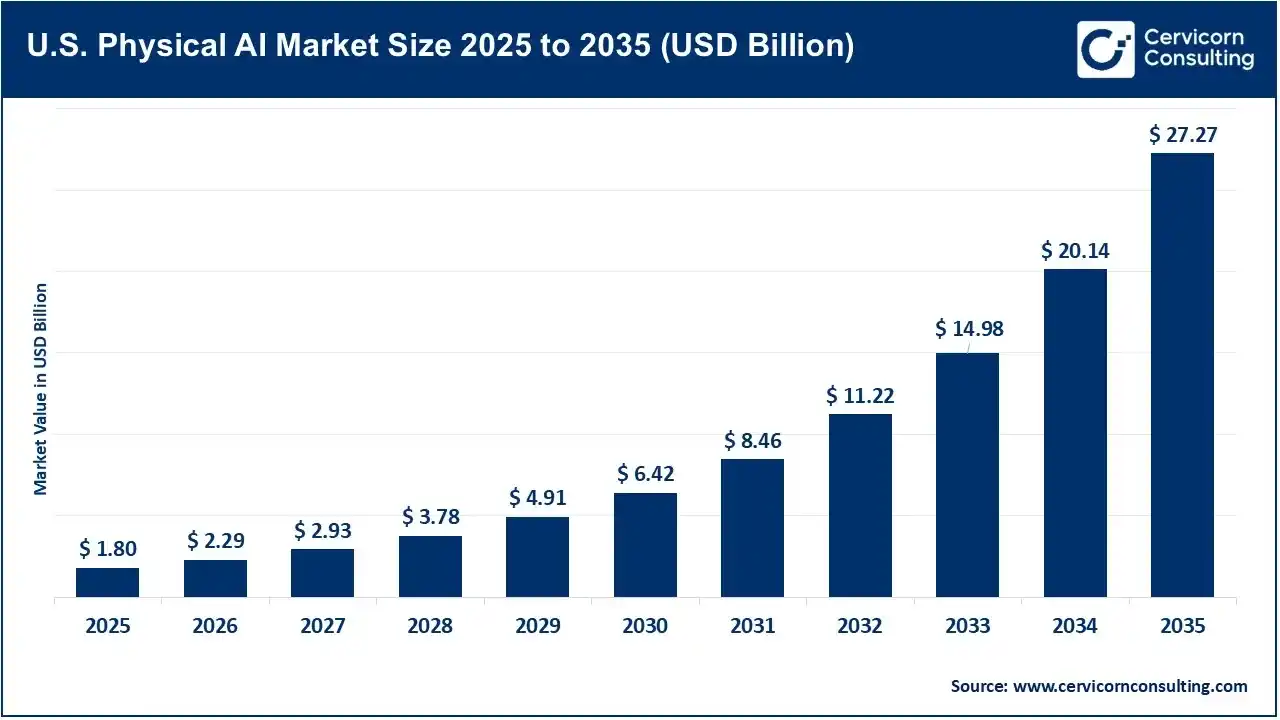
The U.S. physical AI market size was valued at USD 1,809 million in 2025; the market is estimated to reach at USD 27,275 million by 2035. The market is seen to grow at a promising CAGR of 31.7% during the forecast period of 2026-2035. The United States installed approximately 34,200 industrial robots in 2024, accounting for 68% of all industrial robot installations across the Americas, while federal agencies and private companies continue to invest billions of dollars in artificial intelligence, advanced semiconductors, robotics, and high-performance computing infrastructure. This strong industrial and technological foundation is positioning the country at the forefront of physical AI innovation and commercialization.
Report Highlights
- By deployment, the on-device AI segment dominated the physical AI market in 2025 with a 51.5% share, driven by the growing need for real-time decision-making, low-latency processing, enhanced data privacy, and reliable autonomous operation across robotics and intelligent machines.
- By deployment, the cloud-based AI segment is expected to witness significant growth during the forecast period, supported by rising demand for large-scale AI model training, centralized robot management, simulation platforms, and cloud-based computing infrastructure.
- By component, the hardware segment dominated the physical AI market in 2025 with a 56.8% share, owing to increasing investments in sensors, AI processors, robotic components, actuators, and advanced computing hardware required for intelligent physical systems.
- By component, the software segment emerged as the second-largest segment in 2025 with a 29.6% share, driven by growing demand for AI models, perception algorithms, autonomous control platforms, and intelligent software systems that enhance robotic capabilities.
- By technology, the computer vision segment dominated the physical AI market in 2025 with a 42.1% share, supported by its critical role in enabling object recognition, navigation, environment understanding, and autonomous decision-making in physical AI systems.
- By technology, the speech / NLP segment accounted for a 22.1% share in 2025, fueled by increasing adoption of natural human-machine interaction technologies across service robots, healthcare assistants, and collaborative robotic applications.
- By robot type / form factor, the industrial robots segment dominated the physical AI market in 2025 with a 38.3% share, attributed to strong adoption of AI-enabled automation solutions across manufacturing, automotive production, assembly, and industrial operations.
- By robot type / form factor, the service robots segment held the second-largest share of 14.4% in 2025, supported by rising demand for intelligent robotic solutions in healthcare, hospitality, retail, logistics, and commercial service environments.
- By application, the manufacturing & automotive segment dominated the physical AI market in 2025 with a 23.0% share, driven by increasing implementation of smart factories, automated production systems, AI-powered inspection, and advanced industrial robotics.
- By application, the healthcare segment emerged as the second-largest application segment with an 18.0% share in 2025, supported by growing adoption of surgical robots, rehabilitation systems, medical automation, and AI-enabled healthcare assistance technologies.
How Is the United States Growing the Physical AI?
The U.S. physical AI market continues to grow as artificial intelligence innovations become more entrenched within robots, autonomous systems, intelligent manufacturing tools, intelligent machinery and transportation, drones, and other devices and appliances that can engage with physical reality. Physical AI leverages key technologies-including computer vision, multimodal foundation models, reinforcement learning, edge AI and computing, digital twins, and AI chips or accelerators-to empower machines to see, reason about, learn, and accomplish intricate real-world tasks and operations automatically.
Physical AI innovators benefit from a vibrant innovation ecosystem, including world-renowned tech tech giants, some of the top semiconductor providers in the world, nimble robotics innovators, vast cloud capabilities, and significant government support for AI research initiatives.
As businesses across industries-such as manufacturing, warehousing, healthcare, aerospace, and construction-accelerate the use of physical AI technology in the field, the United States remains on the cutting edge of advanced new physical AI technologies, like humanoid robots and intelligent automated solutions.
How Are Federal AI Policies Accelerating Physical AI Innovation?
| Policy / Initiative |
Agency |
Relevance to Physical AI |
| National AI Initiative Act |
U.S. Congress / National AI Initiative Office |
Coordinates federal AI research, workforce development, standards, and public-private collaboration that supports robotics, autonomous systems, and embodied intelligence. |
| CHIPS and Science Act |
U.S. Department of Commerce |
Expands domestic semiconductor manufacturing and AI hardware production, strengthening the supply chain for AI processors, sensors, and advanced computing used in physical AI systems. |
| National Robotics Initiative (NRI) |
National Science Foundation (NSF) |
Funds collaborative robotics, human-robot interaction, autonomous systems, and intelligent robotics research for manufacturing, healthcare, and public sector applications. |
| DARPA AI and Robotics Programs |
Defense Advanced Research Projects Agency (DARPA) |
Supports development of autonomous robots, AI-enabled defense platforms, intelligent navigation, perception systems, and resilient autonomous operations. |
| Department of Energy AI for Science Initiative |
U.S. Department of Energy (DOE) |
Advances AI models, high-performance computing, robotics, and digital engineering that accelerate industrial automation and scientific robotics. |
| Executive Order on the Safe, Secure, and Trustworthy Development and Use of Artificial Intelligence |
The White House |
Establishes standards for responsible AI development, safety testing, cybersecurity, and trustworthy deployment of autonomous and AI-enabled physical systems. |
| Manufacturing USA Institutes |
U.S. Department of Commerce and Department of Defense |
Supports smart manufacturing, advanced robotics, industrial AI, digital manufacturing, and workforce development through public-private partnerships. |
| NIST AI Risk Management Framework |
National Institute of Standards and Technology (NIST) |
Provides voluntary frameworks for trustworthy AI, safety, reliability, transparency, and risk management applicable to physical AI and autonomous machines. |
| Advanced Research Projects Agency for Health (ARPA-H) |
U.S. Department of Health and Human Services |
Supports AI-enabled medical technologies, robotic surgery, intelligent healthcare devices, and advanced automation for clinical applications. |
| National Artificial Intelligence Research Resource (NAIRR) Pilot |
National Science Foundation (NSF) and Federal Partners |
Expands researcher access to computing resources, datasets, AI models, and cloud infrastructure, accelerating innovation in robotics, physical AI, and autonomous systems. |
Which industries are driving Physical AI adoption in the United States?
- Manufacturing and Automotive: As one of the largest segments of early physical AI adopters, the manufacturing industry is applying intelligent robots, autonomous production systems, AI inspection, and digital twin technologies to boost productivity, reduce downtimes and tackle labor shortages.
- Automotive and Autonomous Mobility: Automotive manufacturers are integrating physical AI into autonomous vehicles, intelligent manufacturing systems, driver assistance technologies, and robotic production lines to improve mobility and manufacturing efficiency.
- Logistics and Warehousing: Driven by the surging growth in e-commerce and automated supply chains, an array of physical AI-autonomous mobile robots, robot picking systems and AI-managed warehouse management platforms.
- Healthcare and Medical Robotics: Healthcare facilities are employing various physical AI from robotic aids for patient treatment and care, to rehab robots for patient therapy and robotic assistances for medical staff as well as automatic logistics in the facility-to enhance the standard of service, help the workforce and resolve human resource issues.
- Aerospace and Military: These industries utilize smart technologies ranging from drone systems, self-driving land vehicles and AI assistance devices for surveilliance to intelligent and autonomous systems that operate effectively in a harsh and complicated setting to conduct field tasks.
U.S. Physical AI Startup Ecosystem
| Startup |
Focus Area |
Contribution to Physical AI Development |
| Agility Robotics |
Humanoid robots and warehouse automation |
Develops Digit, a bipedal humanoid robot designed for logistics, material handling, and workplace automation applications. |
| Apptronik |
Humanoid robotics and industrial automation |
Develops Apollo humanoid robots focused on manufacturing, supply chain, and human-robot collaboration applications. |
| Physical Intelligence |
General-purpose robotics foundation models |
Builds AI models that allow robots to learn multiple tasks across different environments rather than being limited to single-purpose applications. |
| Skild AI |
Robotics foundation models |
Develops scalable AI models that enable robots to understand environments, perform manipulation tasks, and adapt across different robotic platforms. |
| Sanctuary AI |
General-purpose humanoid robots |
Develops cognitive robotic systems focused on creating human-like intelligence and adaptable robotic workers. |
| Covariant |
AI-powered warehouse robotics |
Develops AI systems that enable robots to perceive, reason, and perform diverse warehouse automation tasks. |
| Mentee Robotics |
Humanoid robots and AI systems |
Develops autonomous humanoid robots designed for household, industrial, and service applications. |
| Skydio |
Autonomous drones and AI navigation |
Develops AI-powered autonomous drones using computer vision and machine learning for defense, industrial inspection, and commercial applications. |
Market Dynamics
Driver
Rising Industrial Automation and Robotics Investments Are Accelerating Physical AI Adoption
Physical AI market continues on path for impressive year fueled by accelerating industrial automation growth fueled by accelerating industrial automation. Increased capital in automation across the automobile, electronics, logistics, aviation and food and beverage sectors contributes to the overall demand.
The CHIPS and Science Act, a federal mandate promising $52.7 billion to build out a domestic supply chain for semiconductors. Combined with additional federal government and private investments to build up AI infrastructure, these build-outs of high-performance computing are building out technology stacks that could see smart factories, robotic applications, and autonomous system deployments.
Restraint
High Development Costs and Computing Requirements Limit Large-Scale Commercialization
Despite rapid technological progress, the deployment of physical AI remains constrained by the high costs associated with robotics hardware, AI accelerators, advanced sensors, and large-scale computing infrastructure. Developing intelligent robots requires extensive investments in GPUs, vision systems, LiDAR, edge processors, simulation platforms, and foundation model training. Training state-of-the-art robotics foundation models often requires thousands of GPUs and millions of dollars in computing resources, creating high entry barriers for startups and smaller manufacturers. Long development cycles, complex system integration, and evolving AI safety requirements further slow large-scale commercialization across several industries.
Opportunity
Humanoid Robotics and AI-Native Manufacturing Are Creating New Growth Opportunities
The commercialization of humanoid robots and AI-native manufacturing systems is forecast to provide substantial opportunities for growth within the U.S. physical AI market over the next decade. Several American companies (including Tesla, Figure AI, Agility Robotics, Apptronik, and Boston Dynamics, among others) are increasing investment into the manufacturing of general purpose robots to work alongside human operators and assist with processes within manufacturing, logistics, warehousing, medicine, and commercial businesses. Growing labor shortages in manufacturing and logistics are expected to see intelligent, autonomous perception-based reasoning physical robots moving from early pilot stages to mass commercialization within the U.S.
Segmental Analysis
Deployment Analysis
On-device AI held largest share in the U.S. physical AI market in 2025 with 51.5%, driven by increasing needs for low-latency real-time processing, autonomous, and responsive operations. The on-device AI computing process enables industrial robots, humanoids, robots, and vehicles to quickly respond to rapidly changing and volatile physical environments through better reliability, reduced downtime, real-time feedback, and the improved data privacy.
U.S. Physical AI Market Share, By Deployment, 2025 (%)
| Deployment |
Revenue Share, 2025 (%) |
| Cloud-based AI |
48.50% |
| On-device |
51.50% |
Cloud-based AI captured 48.5% portion in the market in 2025, due to booming needs for robot-fleet managment, large scale AI model training, cloud simulation technologies, and real-time robot diagnostics. Cloud computing is used to access centralized massive data of multiple physical AI to continuously train and fine tune robot's performance with large compute capacity for complex tasks, leading to better simulation-based prototyping and efficient robot-fleet management across enterprises and other industries.
Component Analysis
The hardware segment captured the largest share of the U.S. physical AI market with 56.8% revenue share in 2025, driven by the essential role of physical components required to build intelligent machines. Physical AI systems depend on advanced hardware including sensors, cameras, LiDAR systems, robotic arms, actuators, AI processors, edge computing chips, and high-performance controllers to perceive and interact with real-world environments.
The increasing deployment of industrial robots, humanoid robots, autonomous systems, and smart manufacturing equipment is generating strong demand for advanced robotic hardware. Continuous innovation in semiconductor technology, sensor miniaturization, and robotic components is further supporting hardware market dominance.
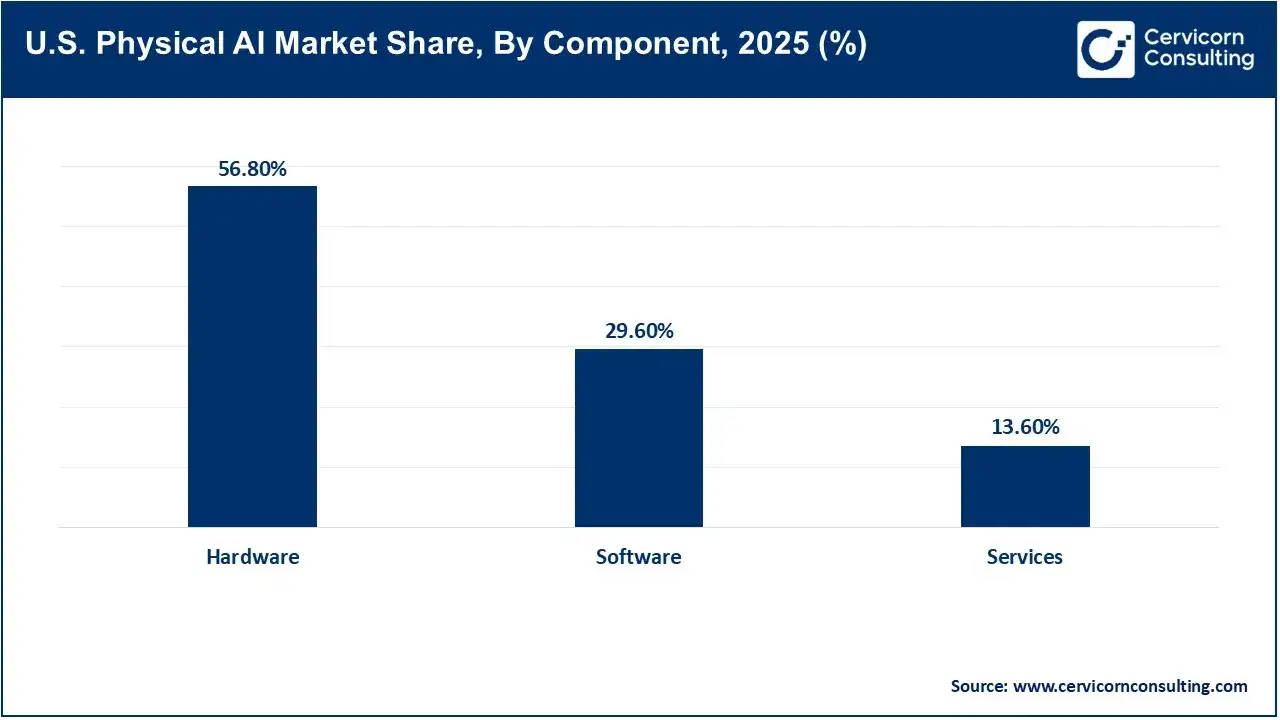
The software segment accounted for 29.6% share of the market in 2025, supported by increasing demand for AI models, perception algorithms, autonomous control systems, and robotic intelligence platforms. Software enables machines to understand surroundings, process information, make decisions, and adapt their actions through technologies such as computer vision, machine learning, reinforcement learning, and digital twins.
As physical AI systems become more autonomous, software is becoming increasingly important in improving robot intelligence and operational flexibility. Companies are developing advanced robotics platforms and AI models that allow machines to perform complex tasks across industrial, healthcare, and service environments.
Technology Analysis
The computer vision segment captured a commanding 42.1% revenue share within the technology segment in 2025, as this technology is the cornerstone of intelligent perception for physical AI systems to interact meaningfully with their physical surroundings. This capability, for physical AI, essentially translates into the recognition of objects and their environments and autonomous action by robots which utilizes AI-powered vision technology for object detection, navigation and decision making.
The widespread application of these functionalities in autonomous cars, warehouse robots and service robots significantly adds to its demand on this market for cameras with imaging processing for the vision analysis needed.
U.S. Physical AI Market Share, By Technology, 2025 (%)
| Technology |
Revenue Share, 2025 (%) |
| Computer Vision |
41.1% |
| Speech / NLP |
22.1% |
| Gesture / Movement Recognition |
16.6% |
| Reinforcement Learning & Control Systems |
15.1% |
| Others |
4.1% |
In 2025, the speech and Natural Language Processing (NLP) technology segment held a 22.1% market share in the physical AI ecosystem; growing by the adoption for a natural interactive between human and machine.
They make robots understand what is the speech of a human being or what is the human intention through that, to then interact in a natural language conversation. They allow robots and intelligent assistants to perceive verbal instruction.
Speech and NLP technologies are indispensable for the expansion of physical AI into fields such as service robotics, assisted living, conversational and customer-focused robotic systems, and collaborative robot workflows.
Robot Type Analysis
The industrial robots registered the highest market share with 38.3% revenue share in 2025 due to the massive uptake in manufacturing, automobile, consumer electronics and industrial automation sector. The adoption of this type of robot by industry can be mainly attributed to their mature platform and the ability to seamlessly integrate the physical AI capabilities.
The rise of smart factories, and Industry 4.0 is pushing the demand to robotic automation that leverage the power of AI to drive a variety of industrial process such as manufacturing, productivity efficiency and flexibility.
U.S. Physical AI Market Share, By Robot Type, 2025 (%)
| Robot Type |
Revenue Share, 2025 (%) |
| Industrial Robots |
38.3% |
| Service Robots |
14.4% |
| Humanoids/Social Robots |
13.7% |
| Cobots |
12.2% |
| Exoskeletons/Prosthetics |
8.9% |
| Mobile Robots/Drones |
12.5% |
The service robots segment accounted for 14.4% share of the market in 2025, driven by increasing adoption across healthcare, hospitality, retail, logistics, and commercial services. Unlike traditional industrial robots, service robots operate in dynamic environments alongside humans and require advanced perception, navigation, and communication capabilities.
Physical AI enables these robots to understand surroundings, interact naturally with users, and perform adaptive tasks. Growing demand for automation in customer services, elderly care, professional cleaning, and delivery applications is expected to support continued expansion of service robots during the forecast period.
Application Analysis
The manufacturing and automotive segment represented the largest application share with 23.0% revenue share in 2025, driven by increasing adoption of intelligent automation, smart factories, and AI-powered production systems. Manufacturers are integrating physical AI into robotic assembly, automated inspection, predictive maintenance, digital twins, and autonomous production workflows to improve efficiency and reduce operational costs.
The strong global manufacturing presence of automotive and industrial companies is creating significant demand for advanced robotic systems. Increasing labor shortages and the need for flexible production systems are further accelerating physical AI adoption across manufacturing environments.
U.S. Physical AI Market Share, By Application, 2025 (%)
| Application |
Revenue Share, 2025 (%) |
| Healthcare |
18% |
| Manufacturing & Automotive |
23% |
| Logistics & Warehousing |
13.6% |
| Retail & Hospitality |
12.4% |
| Defense & Security |
9.5% |
| Agriculture |
7.9% |
| Education & Research |
8.9% |
| Others |
6.7% |
The healthcare segment accounted for 18.0% share of the physical AI market in 2025, supported by growing adoption of surgical robots, rehabilitation systems, robotic assistants, and intelligent medical devices. Physical AI is enabling healthcare systems to improve precision, enhance patient care, and support medical professionals through advanced automation.
AI-powered robotic systems are being developed for minimally invasive procedures, elderly assistance, therapy support, and hospital logistics. Rising healthcare automation requirements, aging populations, and advancements in medical robotics are expected to continue driving demand for physical AI applications in the healthcare sector.
Competitive Landscape
- NVIDIA Corporation- An AI tech provider for physical AI using its AI GPUs, Isaac robotics platform, Omniverse simulation tools, and GR00T foundational models that support humanoid robotics and autonomous machines.
- Tesla, Inc.-The tech company develops Optimus humanoid robot by integrating its AI and computer vision with its existing autonomous driving tech, bringing versatile robotic systems with general-purpose applications.
- Google DeepMind- A major player to drive advances in physical AI via foundation models in robotics like Gemini Robotics, thus creating machines capable of reasoning, planning and interacting with physical environment.
- Microsoft Corporation- The tech giant enhances physical AI development with its Azure AI infrastructure, cloud computing power, AI models, and partners in a wide spectrum of enterprise automation.
- Amazon Robotics- The company adopts its AI-powered automation technology across its warehouse operations with mobile robots, robot fulfillment systems and intelligent logistics solutions.
- Boston Dynamics- The company has created a range of mobile robots like Atlas and Spot for industrial inspection, logistics, scientific research, and all kinds of automated physical tasks.
- Figure AI- Figure AI has been focusing on developing humanoid robots for the commercial sphere, especially for manufacturing, logistics and general tasks.
- Rockwell Automation- Rockwell Automation integrates its AI, automation technologies, and robotics solutions to enable smart manufacturing and intelligent factories.
Recent Product Launches and Strategic Partnerships
- In March 2026, NVIDIA introduced new physical AI development technologies, including NVIDIA Cosmos world models, Isaac simulation frameworks, and Isaac GR00T N models, while collaborating with robotics companies such as Agility Robotics, Figure, Skild AI, Medtronic, and Universal Robots to accelerate the development and deployment of intelligent robots. The initiative focuses on improving robot training, simulation, data generation, and real-world deployment across manufacturing, healthcare, and industrial applications.
- In March 2026, NVIDIA and ABB Robotics announced an integration of NVIDIA Omniverse libraries into ABB’s RobotStudio platform to improve industrial robot simulation and deployment. The collaboration focuses on reducing engineering time, improving simulation accuracy, and accelerating adoption of AI-enabled automation in manufacturing environments.
Segments Covered
By Deployment
- Cloud-based AI
- On-device AI
By Component
- Hardware
- Software
- Services
By Technology
- Computer Vision
- Speech / Natural Language Processing (NLP)
- Gesture / Movement Recognition
- Reinforcement Learning & Control Systems
- Others
By Robot Type / Form Factor
- Industrial Robots
- Service Robots
- Humanoids / Social Robots
- Cobots
- Exoskeletons / Prosthetics
- Mobile Robots / Drones
By Application
- Manufacturing & Automotive
- Healthcare
- Logistics & Warehousing
- Retail & Hospitality
- Defense & Security
- Agriculture
- Education & Research
- Others