U.S. Hospital Services Market Size and Growth Factors 2026 To 2035
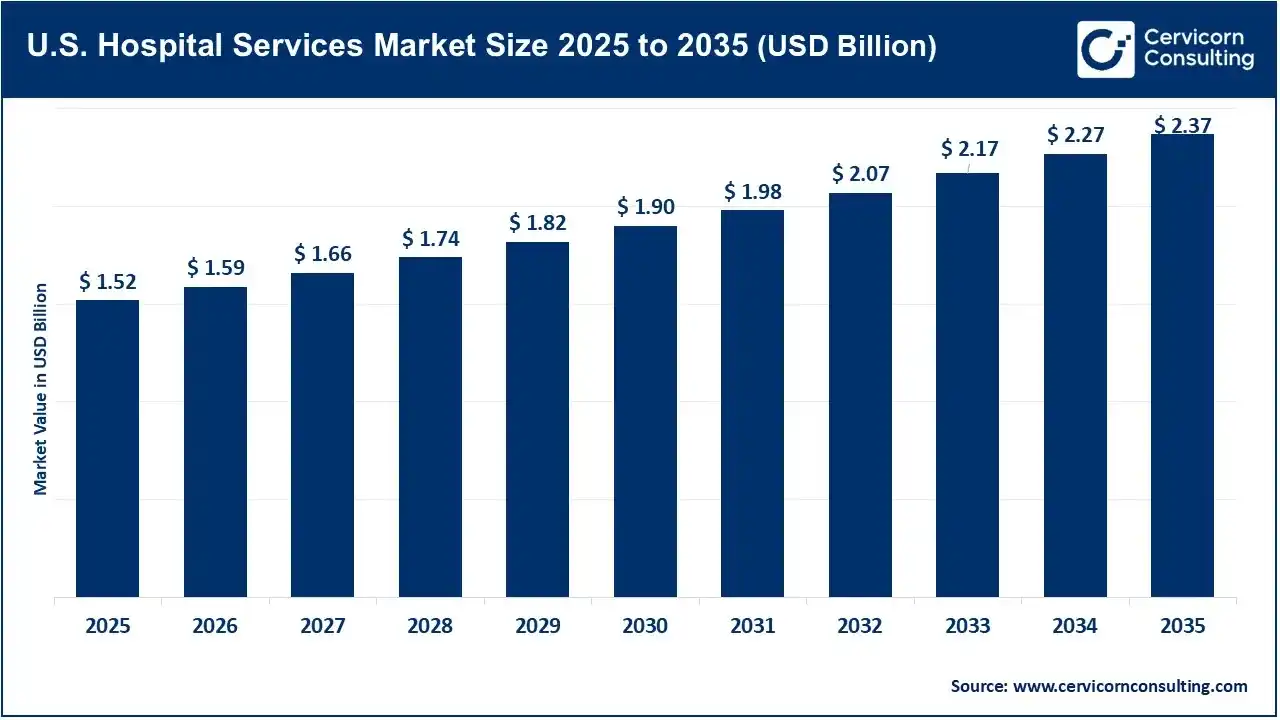
The U.S. hospital services market size was estimated at USD 1.52 trillion in 2025 and is predicted to increase from USD 1.59 trillion in 2026 to approximately USD 2.37 trillion by 2035, expanding at a CAGR of 4.54% from 2026 to 2035. The market is driven by the expansion of outpatient and specialized healthcare services, the growing burden of chronic illnesses, the growing demand for better patient care, and technological advancement.
Key Takeaways
- By hospital setting, acute-care hospitals dominated the market in 2025 (46% Revenue Share) owing to high demand for emergency surgery and critical care.
- By hospital setting, the specialty hospitals & centers segment is expected to grow at the fastest CAGR, driven by rising demand for specialized treatments.
- By the care delivery model, the inpatient care segment dominated the market in 2025 (Revenue Share 34%) owing to the need for hospitalization for complex and critical conditions.
- By the care delivery model, the outpatient & ambulatory care segment is expected to grow at the fastest CAGR, driven by minimally invasive procedures and shorter recovery times.
- By clinical service, cardiovascular care represents a significant area of hospital service demand (Revenue Share 18%), supported by the high prevalence of cardiovascular diseases and the ongoing need for cardiac diagnosis, treatment, surgery, and long-term disease management.
- By clinical service, the oncology segment is expected to grow at the fastest CAGR, driven by the rising cancer incidence and advanced cancer treatments.
- By technology adoption, EHRs dominated the market in 2025 (Revenue Share 27%), owing to widespread adoption of digital patient records and healthcare data management.
- By technology adoption, AI is expected to grow at the fastest CAGR, driven by increasing use in diagnostic imaging, monitoring, and clinical decision-making.
Market Overview
The U.S. hospital services market is undergoing significant transformation as healthcare providers adapt to the growing need for medical care, an aging population, the prevalence of chronic diseases, workforce demands, growing operating expenses, and technological advancements. Inpatient care, outpatient procedures, emergency care, surgery, cardiovascular care, cancer care, diagnostics, imaging, rehabilitation, psychiatric services, and obstetrics and gynecology are just a few of the many services that hospitals offer.
- In April 2026, Tenet Healthcare declared the opening of Goodyear, Arizona's 24-bed, 46,000-square-foot Abrazo Health Litchfield Medical Building. The facility treats patients recovering from traumatic injuries, neurological disorders, heart conditions, and strokes by combining inpatient rehabilitation with outpatient medical services. The development shows how inpatient rehabilitation and outpatient services are becoming more integrated into a single healthcare ecosystem.
Recent Trends
- Shift toward outpatient care: Appropriate procedures are increasingly being transferred from inpatient to outpatient settings in hospitals. This shift is being supported by developments in minimally invasive procedures, imaging, anesthesia, and patient monitoring.
- Expansion of specialized care: Hospitals are being encouraged to build specialized treatment facilities due to the rising demand for cardiovascular, oncology, neurological, psychiatric, and rehabilitation services.
- Digital healthcare integration: Hospital operations are increasingly incorporating telemedicine, remote monitoring, mobile health applications, electronic health records, and linked medical devices.
- Community-based care: Improving healthcare accessibility still requires community and regional hospitals, especially in rural and quickly expanding communities.
Market Dynamics
Driver
The U.S. market for hospital services is fueled by a number of factors, including the growing incidence of chronic illnesses, an aging population, rising healthcare costs, an increase in the need for specialized medical care, and the use of cutting-edge technologies like robotic systems, artificial intelligence, and digital health solutions.
- Instance: HCA Healthcare demonstrates the scale of demand for hospital services in the U.S. The company operated 190 hospitals and approximately 2,500 ambulatory sites of care as of December 31, 2025, with more than 47 million patient encounters during the year.
Restraint
High hospital operating costs, growing labor costs, a shortage of healthcare workers, reimbursement pressures, complicated insurance procedures, and the high cost of implementing cutting-edge medical infrastructure and technologies all limit the market. In order to maintain their facilities, medical equipment, digital systems, and patient-care capabilities, hospitals also need to make ongoing investments.
- Instance: The operations of HCA Healthcare serve as an example of the substantial capital needs related to expanding and maintaining hospital infrastructure. Excluding acquisitions, the company spent about $4. 9 billion on capital expenditures in 2025; planned capital expenditures for 2026 are anticipated to be between $5.0 and $5.5 billion. Hospital operators may face financial strain because of such high investment requirements, especially smaller healthcare providers.
Opportunity
The expansion of outpatient and ambulatory care, rising adoption of AI-enabled healthcare, growth in specialty services like cardiovascular and oncology care, expansion of remote patient monitoring, and investments in advanced hospital infrastructure and digital transformation all offer substantial opportunities for the market. Healthcare providers are being encouraged to extend their services outside of traditional inpatient settings by the trend toward convenient and economical care.
Key Technological Shifts
Technology is growing in importance within U.S. healthcare services. Advanced imaging, telehealth, robotic surgery, electronic health records, AI-based tools, remote patient monitoring, and digitally connected medical equipment are all being adopted by hospitals.
Medical imaging, patient scheduling, coding, billing, clinical decision support, and clinical documentation can all benefit from artificial intelligence. Hospitals can use it to examine vast amounts of operational and patient data.
Regulatory Framework
| Regulatory/Framework |
Impact on Hospital Services |
| HIPAA |
Protects patient health information and establishes privacy and security requirements. |
| EMTALA |
Requires participating hospitals with emergency departments to provide appropriate medical screening and stabilizing treatment for emergency medical conditions. |
| CMS Conditions of Participation |
Establishes requirements hospitals must meet to participate in Medicare and Medicaid |
| HITECH Act |
Supports electronic health information adoption and strengthens privacy and security requirements. |
| Medicare & Medicaid Requirements |
Influence reimbursement, eligibility, reporting, and hospital service delivery. |
Segmental Analysis
Hospital Setting Analysis
The acute-care hospitals segment dominated the U.S. hospital services market in 2025, owing to the ongoing need for trauma management, emergency care, major surgery, intensive care, and the treatment of serious and complicated medical conditions. Patients who need immediate medical attention and ongoing clinical supervision are primarily treated at acute-care hospitals.
The need for acute hospital services is still being driven by the rising incidence of cancer, heart disease, infections, respiratory conditions, and other acute illnesses. In the U.S., the significance of acute-care infrastructure is highlighted by HCA Healthcare's extensive network of hospitals that offer emergency, surgical, critical, and specialized medical services.
U.S. Hospital Services Market Share, By Hospital Setting, 2025 (%)
| Hospital Setting |
Revenue Share, 2025 (%) |
| Acute-Care Hospitals |
46% |
| Specialty Hospitals & Centers |
12% |
| Community Hospitals |
21% |
| Academic & Teaching Hospitals |
10% |
| Rehabilitation Hospitals |
4% |
| Behavioral Health Hospitals |
7% |
The specialty hospitals & centers segment is expected to register the fastest growth during the forecast period, driven by the rising demand for specialized diagnosis and treatment as well as the rising incidence of complex diseases. Dedicated centers for neurology, orthopedics, cardiovascular disease, oncology, women's health, and other clinical specialties are being established by healthcare providers more frequently. Hospitals can focus doctors, cutting-edge equipment, and clinical knowledge on diseases by using specialty facilities. The U.S.-based institutions like the Cleveland Clinic and Mayo Clinic have created comprehensive specialty programs that address complicated neurological, surgical, cancer, and cardiovascular disorders.
Care Delivery Model Analysis
The inpatient care segment dominated the market in 2025, because patients undergoing major surgeries, complicated medical procedures, intensive treatment, and ongoing monitoring continue to need to be hospitalized. For conditions that cannot be safely treated in outpatient or virtual settings, inpatient services are still crucial. To meet the needs of critically ill and complex patients, hospitals continue to invest in surgical units, intensive care units, specialty wards, and sophisticated monitoring systems.
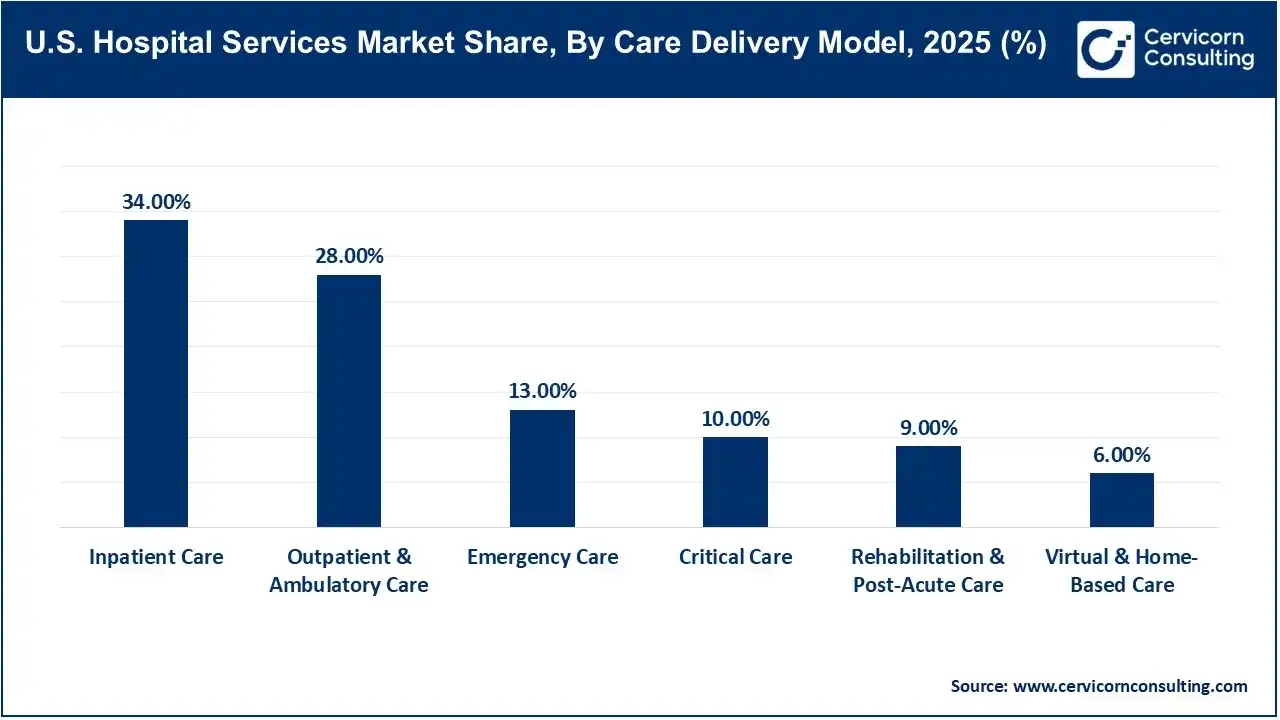
The outpatient & ambulatory care segment is expected to grow at the fastest rate during the forecast period, driven by the increasing adoption of minimally invasive procedures, shorter recovery periods, lower treatment costs, and growing patient preference for convenient healthcare services. Advances in surgical technology and anesthesia are enabling healthcare providers to shift selected procedures from inpatient hospitals to ambulatory facilities.
Clinical Service Analysis
The cardiovascular care segment dominated the market in 2025 due to the high incidence of cardiovascular illnesses and the ongoing need for cardiac diagnosis, treatment, surgery, critical care, and long-term disease management. Screening, diagnostic imaging, specialist consultation, surgery, rehabilitation, and follow-up care are just a few of the stages of healthcare that are often necessary for cardiovascular conditions. The need for cardiovascular services is being exacerbated by an aging population.
U.S. Hospital Services Market Share, By Clinical Service, 2025 (%)
| Clinical Service |
Revenue Share, 2025 (%) |
| Cardiovascular Care |
18% |
| Oncology |
11% |
| Orthopedics |
9% |
| Neurology |
6% |
| Women’s Health |
5% |
| General Surgery |
10% |
| Emergency Medicine |
13% |
| Behavioral Health |
8% |
| Diagnostics & Imaging |
15% |
| Other Specialty Services |
5% |
The oncology segment is expected to register the fastest growth during the forecast period, driven by the rising prevalence of cancer, the need for early diagnosis, improvements in precision medicine, and the growing use of cutting-edge cancer treatment technologies. To deliver more individualized cancer care, hospitals are increasingly combining pathology, molecular diagnostics, imaging, radiation therapy, surgery, and targeted treatment.
Technology Adoption Analysis
The Electronic Health Records (EHRs) segment dominated technology adoption in 2025 because hospitals and healthcare networks are using digital patient records on a large scale. EHRs facilitate the management of patient data, clinical documentation, departmental coordination, billing, prescription management, data sharing, and administrative tasks. Additionally, they supply the digital infrastructure that hospitals need to implement AI and advanced analytics.
U.S. Hospital Services Market Share, By Technology Adoption, 2025 (%)
| Technology Adoption |
Revenue Share, 2025 (%) |
| Electronic Health Records (EHRs) |
27% |
| Artificial Intelligence (AI) |
16% |
| Robotic-Assisted Surgery |
7% |
| Telemedicine |
13% |
| Remote Patient Monitoring |
8% |
| Advanced Diagnostic Technologies |
19% |
| Healthcare Automation |
10% |
The artificial intelligence segment is expected to grow at the fastest CAGR during the forecast period, motivated by the growing use of AI in research, workflow automation, medical imaging, disease prediction, clinical documentation, patient triage, risk assessment, and individualized treatment.
Government Initiatives
How Federal Action Is Reshaping U.S. Hospital Services: CMS Announces $50 Billion to Strengthen Rural Healthcare
In September 2025, CMS launched the $50 billion Rural Health Transformation Program to strengthen rural healthcare across the U.S. The program provides up to $50 billion over five years, with $10 billion available each year from fiscal year 2026 through fiscal year 2030. The program is designed to expand access to care, strengthen the rural healthcare workforce, modernize infrastructure and technology, and support innovative care-delivery models.
Market Impact: The investment is anticipated to support the expansion of healthcare access in underserved rural areas, workforce development, technology adoption, and hospital infrastructure modernization. Community hospitals, critical-access hospitals, telemedicine providers, and technology-enabled care models can all particularly profit from it.
CMS Expands Accountable Care Initiatives for Medicare Patients
In Feb 2026, CMS kept growing its Medicare Accountable Care Organization (ACO) programs, emphasizing better health outcomes for Medicare recipients and coordinated, whole-person healthcare. In order to increase the effectiveness and quality of care, the program encourages healthcare providers to coordinate services.
Market Impact: Hospitals may be motivated to transition from traditional fee-for-service models to value-based care, preventive services, coordinated treatment, chronic disease management, and better patient outcomes by the growth of accountable care models.
Recent Developments
- In June 2026, Mayo Clinic announced a collaboration with Microsoft to develop and deploy a healthcare-specific frontier AI model aimed at improving patient and clinician experiences and expanding access to Mayo Clinic's healthcare expertise.
- In July 2026, Mayo Clinic Platform announced a milestone in its collaboration with Einstein Hospital Israelita involving the availability of de-identified clinical data through Mayo Clinic Platform's secure healthcare innovation ecosystem to support responsible AI-enabled healthcare innovation.
Top Companies
Segments Covered
By Hospital Setting
- Acute-Care Hospitals
- Specialty Hospitals & Centers
- Community Hospitals
- Academic & Teaching Hospitals
- Rehabilitation Hospitals
- Behavioral Health Hospitals
By Care Delivery Model
- Inpatient Care
- Outpatient & Ambulatory Care
- Emergency Care
- Critical Care
- Rehabilitation & Post-Acute Care
- Virtual & Home-Based Care
By Clinical Service
- Cardiovascular Care
- Oncology
- Orthopedics
- Neurology
- Women’s Health
- General Surgery
- Emergency Medicine
- Behavioral Health
- Diagnostics & Imaging
- Other Specialty Services
By Technology Adoption
- Electronic Health Records (EHRs)
- Artificial Intelligence (AI)
- Robotic-Assisted Surgery
- Telemedicine
- Remote Patient Monitoring
- Advanced Diagnostic Technologies
- Healthcare Automation