
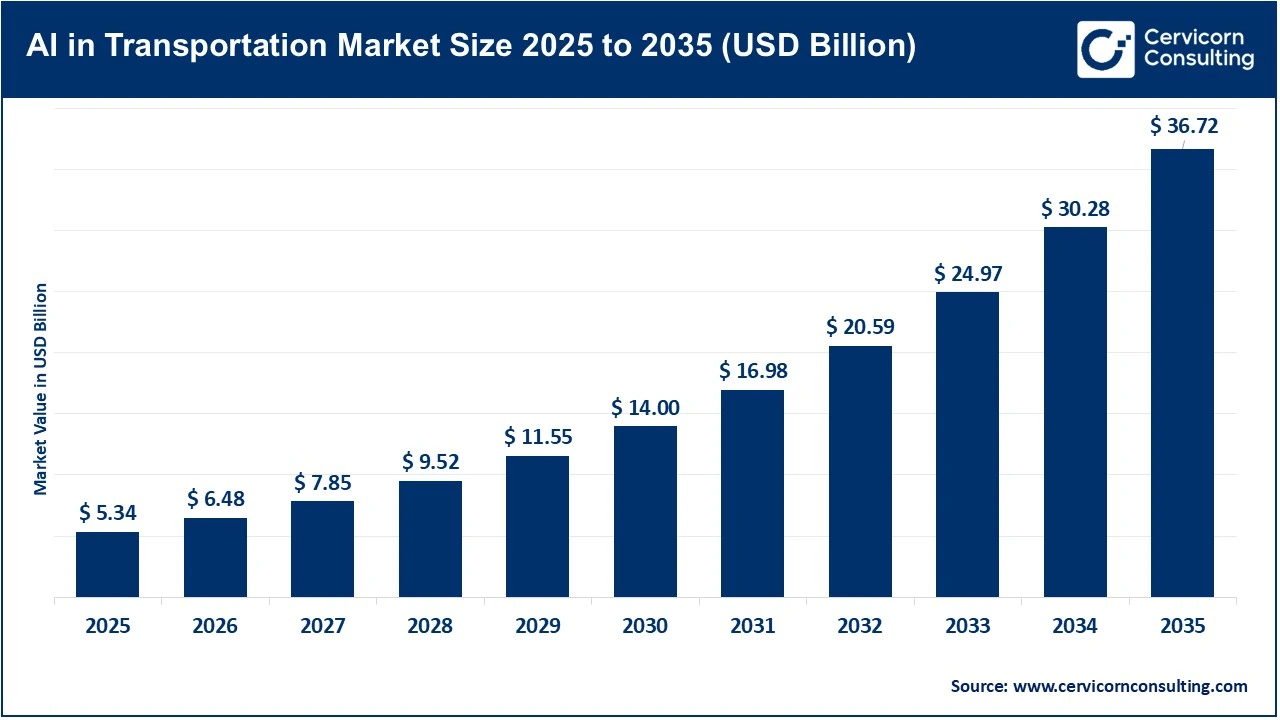
The global AI in transportation market size was valued at USD 5.34 billion in 2025 and is expected to reach around USD 36.72 billion by 2035, exhibiting a compound annual growth rate (CAGR) of 21.3% over the forecast period from 2026 to 2035. The growth of the AI in transportation market is primarily driven by the increasing need to improve traffic efficiency, reduce congestion, and enhance road safety. Urbanization and rising vehicle ownership have intensified traffic challenges worldwide, encouraging governments and transportation authorities to invest in AI-powered intelligent transportation systems (ITS). AI technologies such as machine learning, computer vision, and predictive analytics enable real-time traffic monitoring, dynamic route optimization, and smart traffic signal management. Studies on AI-enabled traffic management systems have demonstrated reductions in travel delays of up to 50% and significant improvements in overall traffic flow, highlighting the technology’s ability to optimize transportation networks and reduce fuel consumption.
Another major growth factor is the increasing adoption of autonomous vehicles, connected mobility solutions, and predictive maintenance systems across road, rail, air, and maritime transportation. AI-driven predictive analytics helps operators identify equipment failures before they occur, minimizing downtime and maintenance costs while improving operational reliability. In addition, AI-based traffic prediction models and intelligent decision-making systems are enhancing fleet management, logistics planning, and passenger transportation services. Recent research indicates that AI-enabled smart traffic systems can increase traffic flow rates by approximately 50% while reducing vehicle delays by nearly 70%, demonstrating the substantial efficiency gains achievable through AI integration in transportation infrastructure.
Artificial Intelligence (AI) in transportation refers to the use of machine learning, computer vision, natural language processing, and predictive analytics to improve the efficiency, safety, and sustainability of transportation systems. AI enables real-time traffic management, autonomous driving, predictive maintenance, fleet optimization, intelligent routing, and smart mobility services by analyzing large volumes of data from vehicles, infrastructure, sensors, and connected networks. The technology helps transportation providers reduce congestion, improve operational efficiency, enhance passenger experiences, and support the development of connected and autonomous transportation ecosystems.
Applications and Recent Developments in AI in Transportation
| Application | Description | Recent Development |
| Autonomous Vehicles | AI enables self-driving cars, trucks, and shuttles through sensor fusion, computer vision, and real-time decision-making. | In June 2025, authorities in Singapore announced autonomous shuttle trials in Punggol through partnerships involving autonomous vehicle providers such as WeRide and Pony.ai, accelerating the deployment of AI-powered public transportation services. |
| Intelligent Traffic Management | AI analyzes traffic patterns, predicts congestion, and optimizes traffic signals in real time. | AI-based smart traffic management systems demonstrated up to 34% better traffic flow efficiency than conventional traffic-light systems by using live CCTV data and adaptive signal control. |
| Predictive Maintenance | AI predicts equipment and vehicle failures before they occur, reducing downtime and maintenance costs. | Transportation operators are increasingly deploying AI-powered predictive maintenance platforms to monitor vehicle health and improve fleet reliability across rail, road, and logistics networks. |
| Fleet & Route Optimization | AI optimizes routes, schedules, fuel consumption, and delivery operations using real-time data. | Logistics companies are adopting AI-driven route optimization solutions that analyze traffic, weather, and delivery conditions to improve operational efficiency and reduce transportation costs. |
| Connected Mobility & V2X Communication | AI enhances vehicle-to-everything (V2X) communication for safer and more efficient transportation networks. | Research in 2025 highlighted AI-enabled 6G-V2X systems that improve intelligent traffic management, cooperative driving, network optimization, and connected autonomous vehicle performance. |
Rising Demand for Autonomous & Semi-Autonomous Vehicles Driving the AI in Transportation Market
The increasing demand for autonomous and semi-autonomous vehicles is one of the strongest growth drivers for the AI in transportation market, as these vehicles rely heavily on artificial intelligence for perception, decision-making, navigation, object detection, and real-time traffic analysis. Automakers are rapidly integrating Advanced Driver Assistance Systems (ADAS), autonomous parking, lane-keeping assistance, adaptive cruise control, and collision avoidance technologies to enhance vehicle safety and driving convenience. Governments are also encouraging the adoption of intelligent mobility solutions through stricter safety regulations and investments in smart transportation infrastructure. As consumers seek safer, more connected, and automated driving experiences, the deployment of AI-powered transportation systems continues to accelerate across passenger and commercial vehicles, creating significant demand for AI software, sensors, edge computing, and data analytics platforms.
Some of the key factors of this growth
1. Waymo's Large-Scale Robotaxi Expansion and Commercial Deployment
Waymo achieved a major milestone in autonomous transportation by significantly expanding its commercial robotaxi operations across multiple U.S. cities and reaching hundreds of thousands of paid rides per week. The company surpassed 100 million fully autonomous miles during 2025 and continued expanding its service footprint, demonstrating that AI-powered autonomous mobility is moving beyond pilot projects into large-scale commercial deployment. This milestone is accelerating the AI in Transportation market by increasing demand for AI perception systems, computer vision, sensor fusion, real-time decision-making software, and autonomous fleet management platforms. As successful robotaxi operations validate the safety and economic viability of autonomous transportation, transportation providers and investors are increasing investments in AI-driven mobility solutions.
2. NVIDIA and Uber Partnership to Scale Global Robotaxi Ecosystems
In 2025, NVIDIA strengthened its collaboration with Uber to support the global expansion of autonomous mobility services while launching the Halos Certified Program for AI safety validation in autonomous vehicles. The initiative supports multiple Level 4 autonomous vehicle developers, including companies deploying robotaxis and autonomous delivery vehicles. This milestone is driving market growth by creating a standardized AI ecosystem for autonomous transportation, reducing deployment risks, and accelerating commercialization. The partnership also increases adoption of AI chips, edge computing platforms, simulation software, and autonomous driving models, encouraging transportation companies to integrate advanced AI technologies into future mobility solutions.
3. European Commission Action Plan for Autonomous Vehicle Deployment
In March 2025, the European Commission introduced a new automotive action plan aimed at accelerating the deployment of connected and autonomous vehicles across Europe. The initiative includes large-scale pilot programs, regulatory support, and investments designed to speed up commercialization of AI-enabled transportation technologies. This milestone is fueling market growth by creating a favorable regulatory environment for AI-powered mobility solutions and encouraging automakers, technology providers, and transportation operators to invest in autonomous driving systems. Government-backed frameworks reduce uncertainty for industry participants and support the adoption of AI in traffic management, connected vehicles, and autonomous transportation networks.
4. China's Approval of the First Level 3 Autonomous Vehicles
China reached a significant transportation AI milestone by granting approval for its first Level 3 autonomous driving vehicles, allowing qualified vehicles to operate autonomously under specific conditions on public roads. The approval represents one of the most important regulatory breakthroughs for autonomous mobility in Asia and signals growing government support for AI-driven transportation technologies. This development is driving market expansion by accelerating commercialization of autonomous driving systems, increasing investments in AI software and sensors, and encouraging automakers to develop higher levels of vehicle automation. Regulatory approval also strengthens consumer confidence in autonomous technologies and creates new opportunities for AI solution providers throughout the transportation value chain.
The AI in transportation market is segmented into component, technology, application, transportation mode, and geography.
The hardware segment dominates the AI in transportation market due to the extensive deployment of sensors, cameras, LiDAR, radar, GPS modules, and edge computing devices across autonomous vehicles, smart traffic systems, and connected transportation networks. AI-powered transportation solutions rely on real-time data collection and processing, making advanced hardware infrastructure essential for system performance and safety. The growing adoption of autonomous driving technologies, intelligent traffic management systems, and vehicle-to-everything (V2X) communication continues to drive substantial investments in transportation hardware, supporting the segment’s leading market position.
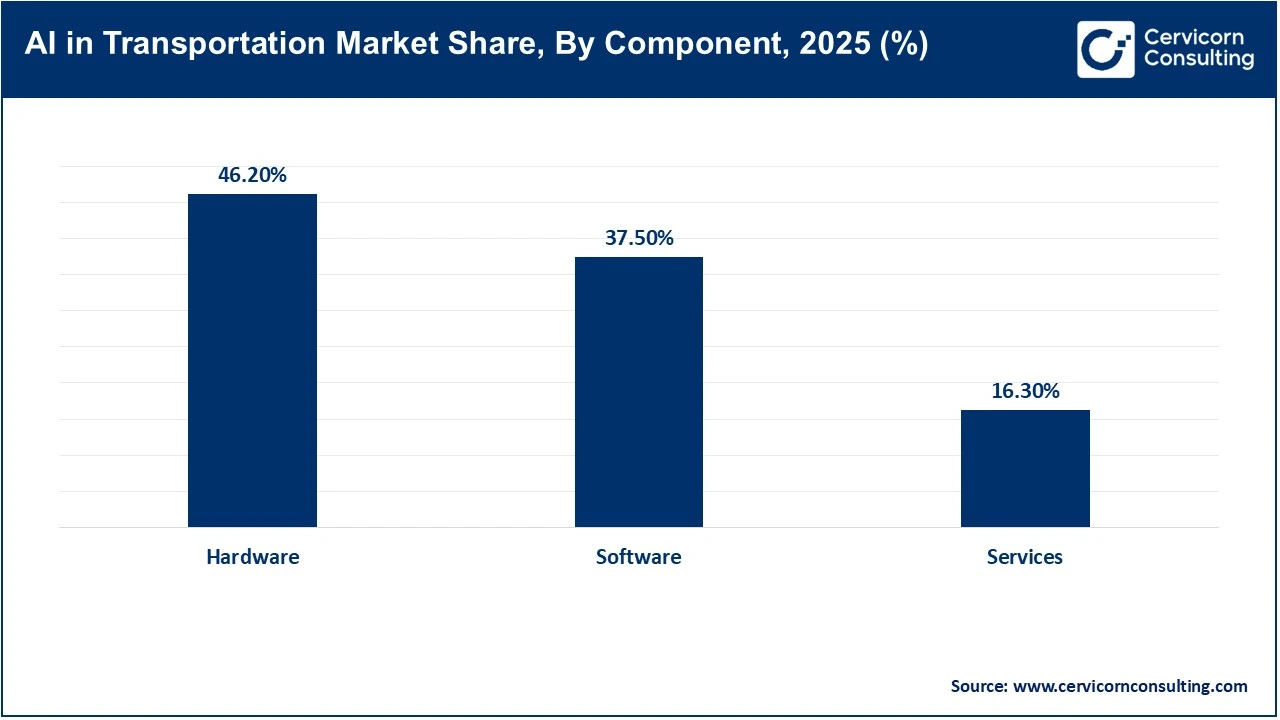
The software segment is expected to witness the fastest growth owing to rising demand for AI algorithms, predictive analytics, computer vision platforms, and fleet optimization solutions. Transportation operators are increasingly utilizing software-driven systems to improve route planning, traffic prediction, autonomous decision-making, and maintenance scheduling. The rapid advancement of cloud computing, generative AI, and machine learning technologies is further enhancing software capabilities. As organizations prioritize data-driven transportation management and automation, software solutions are becoming a critical component of modern mobility ecosystems.
Machine Learning currently dominates the AI in transportation market because it forms the foundation of most intelligent transportation applications, including traffic forecasting, predictive maintenance, route optimization, and fleet management. ML models analyze large volumes of transportation data to identify patterns, improve operational efficiency, and support automated decision-making. The technology’s versatility and proven effectiveness across multiple transportation use cases have led to widespread adoption among governments, logistics companies, and mobility providers, making it the most established AI technology segment in the market.
AI in Transportation Market, By Technology, 2025 (%)
| Technology | Revenue Share, 2025, (%) |
| Machine Learning (ML) | 31.8% |
| Deep Learning | 24.6% |
| Computer Vision | 20.4% |
| Natural Language Processing (NLP) | 9.8% |
| Context-Aware Computing | 7.1% |
| Generative AI | 6.3% |
Generative AI is emerging as the fastest-growing technology segment due to its ability to enhance transportation planning, simulation, autonomous vehicle training, and customer service operations. Transportation companies are increasingly leveraging generative AI to create synthetic driving data, optimize traffic scenarios, improve predictive modeling, and automate operational workflows. The technology also supports advanced mobility assistants and intelligent transportation analytics. As organizations explore innovative AI applications beyond traditional machine learning, generative AI is expected to experience rapid adoption across transportation ecosystems.
Autonomous vehicles represent the largest application segment in the AI in transportation market, driven by significant investments from automakers, technology companies, and governments. AI technologies such as machine learning, computer vision, and sensor fusion are essential for enabling self-driving capabilities, obstacle detection, navigation, and real-time decision-making. The increasing deployment of Advanced Driver Assistance Systems (ADAS), robotaxis, and autonomous delivery vehicles has further strengthened this segment’s dominance. Continued innovation in autonomous mobility is expected to sustain strong demand for AI-powered transportation solutions.
AI in Transportation Market, By Application, 2025 (%)
| Application | Revenue Share, 2025 (%) |
| Autonomous Vehicles | 28.7% |
| Traffic Management & Smart Mobility | 21.4% |
| Fleet Management | 13.8% |
| Predictive Maintenance | 10.9% |
| Route Optimization | 8.5% |
| Freight & Logistics Optimization | 9.6% |
| Safety & Security Systems | 5.2% |
| Others | 1.9% |
Traffic Management & Smart Mobility is projected to be the fastest-growing application segment due to increasing urbanization, traffic congestion, and smart city initiatives worldwide. AI-powered traffic systems help optimize signal timing, monitor road conditions, predict congestion, and improve transportation efficiency. Governments and municipalities are investing heavily in intelligent transportation infrastructure to reduce travel delays and enhance sustainability. The growing need for real-time traffic intelligence and connected mobility solutions is accelerating adoption of AI-driven traffic management technologies globally.
Road transportation dominates the AI in transportation market, accounting for the largest deployment of AI technologies across passenger vehicles, commercial fleets, logistics operations, and traffic management systems. The widespread adoption of ADAS, connected vehicles, route optimization software, and autonomous driving technologies has significantly increased AI integration within road networks. Additionally, government investments in smart roads and intelligent transportation infrastructure continue to support market expansion. The sheer scale of global road transportation activities ensures its leadership position within the market.
AI in Transportation Market, By Transportation Mode, 2025 (%)
| Transportation Mode | Revenue Share, 2025 (%) |
| Road Transportation | 67.5% |
| Rail Transportation | 12.8% |
| Air Transportation | 11.3% |
| Maritime Transportation | 8.4% |
Air transportation is expected to register the fastest growth during the forecast period as airlines and airports increasingly adopt AI for predictive maintenance, flight operations, passenger management, and air traffic control optimization. AI technologies are helping aviation stakeholders improve operational efficiency, reduce delays, enhance safety, and lower maintenance costs. Growing investments in digital aviation infrastructure, autonomous airport operations, and intelligent flight planning systems are further driving adoption. As the aviation industry accelerates digital transformation, AI implementation across air transportation continues to expand rapidly.
The AI in transportation market is segmented by region into North America, Europe, Asia-Pacific, Latin America, and LAMEA. Here is a brief overview of each region:
The North America AI in transportation market size was valued at USD 2.06 billion in 2025 and is predicted to surpass around USD 14.14 billion by 2035.
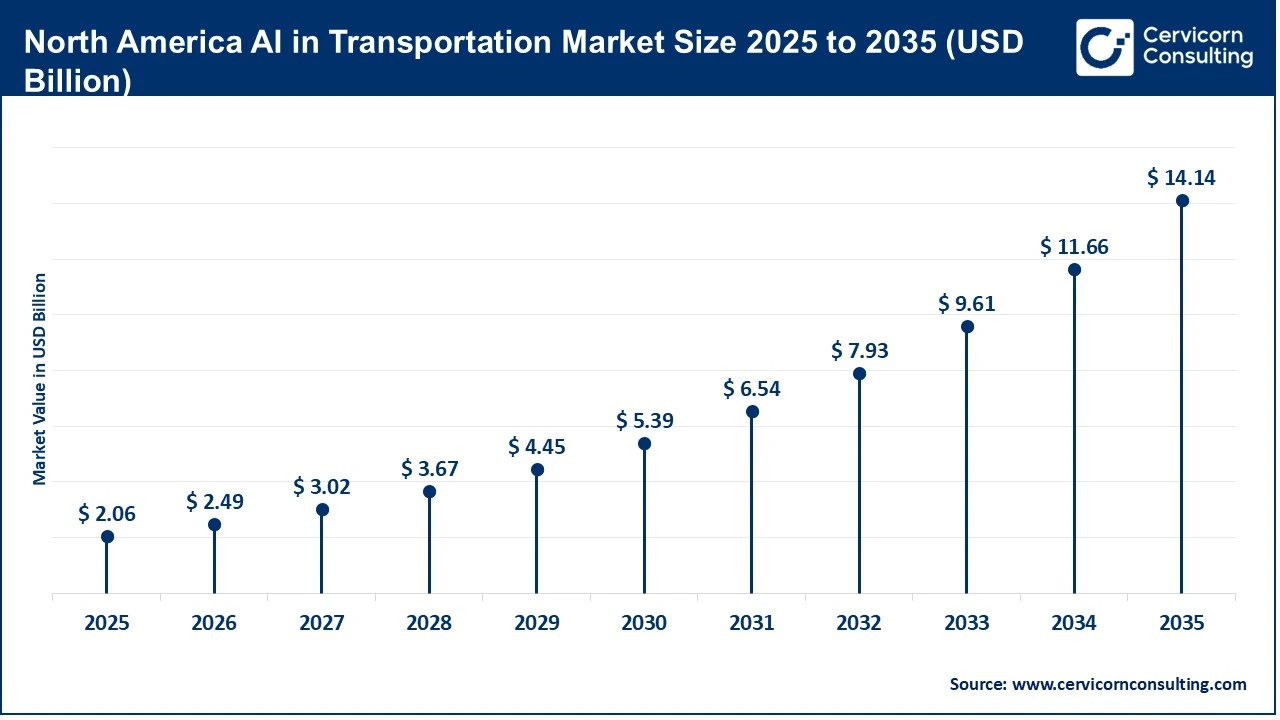
The North America market is highly developed, supported by advanced digital infrastructure, widespread adoption of connected and autonomous vehicles, and significant investments in intelligent transportation systems. The region is witnessing growing deployment of AI-powered traffic management platforms, predictive maintenance solutions, autonomous mobility services, and fleet optimization technologies across both public and private transportation networks. Strong government support for smart city initiatives, increasing investments in transportation automation, and the presence of leading AI and mobility technology companies are further accelerating market growth. The integration of AI with IoT, edge computing, and vehicle-to-everything (V2X) communication technologies continues to strengthen the region’s leadership in next-generation transportation solutions.
United States: Leadership in autonomous mobility, smart infrastructure development, and transportation AI innovation drives market expansion
Canada: Expanding smart mobility programs, AI research leadership, and connected transportation initiatives support market growth
The Asia-Pacific AI in transportation market size was estimated at USD 1.33 billion in 2025 and is projected to hit around USD 9.14 billion by 2035. The Asia-Pacific market is experiencing rapid growth due to increasing urbanization, rising vehicle ownership, and substantial government investments in smart transportation infrastructure. Countries across the region are leveraging artificial intelligence to address traffic congestion, improve road safety, optimize logistics operations, and support sustainable mobility initiatives. The expansion of smart city projects, deployment of intelligent traffic management systems, and growing adoption of connected and autonomous vehicles are creating significant opportunities for AI technologies. Additionally, strong investments in 5G networks, IoT-enabled transportation systems, and digital transformation initiatives are accelerating the integration of AI across road, rail, air, and maritime transportation sectors.
China: Government support for autonomous driving, smart infrastructure development, and AI leadership drive market expansion
India: Growing smart city investments, expanding logistics sector, and digital transportation initiatives accelerate adoption
The Europe AI in transportation market size was accounted for USD 1.48 billion in 2025 and is forecasted to grow around USD 10.21 billion by 2035. The Europe market is witnessing substantial growth due to strong government support for smart mobility, increasing investments in connected and autonomous vehicles, and ambitious sustainability goals aimed at reducing transportation emissions. The region is actively deploying AI-powered traffic management systems, predictive maintenance solutions, intelligent public transportation networks, and advanced logistics platforms to improve efficiency and safety. The expansion of smart city programs, adoption of vehicle-to-everything (V2X) technologies, and growing investments in digital transportation infrastructure are further accelerating market development. In addition, supportive regulatory frameworks and collaborative research initiatives are fostering innovation in AI-driven mobility solutions across the region.
Germany: Automotive leadership, autonomous driving innovation, and Industry 4.0 adoption drive market expansion
United Kingdom: Smart transportation programs, AI innovation ecosystem, and connected mobility investments support growth
AI in Transportation Market Share, By Region, 2025 (%)
| Region | Revenue Share, 2025 (%) |
| North America | 38.5% |
| Europe | 27.8% |
| Asia-Pacific | 24.9% |
| LAMEA | 8.8% |
The LAMEA AI in transportation market was valued at USD 0.47 billion in 2025 and is anticipated to reach around USD 3.23 billion by 2035. The LAMEA market is experiencing steady growth as governments and transportation authorities increasingly invest in smart mobility solutions, intelligent traffic management systems, and digital transportation infrastructure. Rapid urbanization, rising traffic congestion, and growing demand for efficient logistics networks are encouraging the adoption of AI-powered technologies across road, rail, air, and maritime transportation. The region is also benefiting from expanding smart city projects, investments in connected mobility, and the deployment of advanced analytics platforms to improve transportation efficiency, safety, and sustainability. As digital transformation accelerates across emerging economies, AI is becoming a key enabler of next-generation transportation systems.
Brazil: Expanding urban mobility programs, growing logistics sector, and smart transportation investments accelerate adoption
United Arab Emirates: Smart city leadership, autonomous mobility programs, and advanced digital infrastructure support growth
By Component
By Technology
By Application
By Transportation Mode
By Geography
Chapter 1. Market Introduction and Overview
1.1 Market Definition and Scope
1.1.1 Overview of AI in Transportation
1.1.2 Scope of the Study
1.1.3 Research Timeframe
1.2 Research Methodology and Approach
1.2.1 Methodology Overview
1.2.2 Data Sources and Validation
1.2.3 Key Assumptions and Limitations
Chapter 2. Executive Summary
2.1 Market Highlights and Snapshot
2.2 Key Insights by Segments
2.2.1 By Component Overview
2.2.2 By Technology Overview
2.2.3 By Application Overview
2.2.4 By Transportation Mode Overview
2.3 Competitive Overview
Chapter 3. Global Impact Analysis
3.1 Russia-Ukraine Conflict: Global Market Implications
3.2 Regulatory and Policy Changes Impacting Global Markets
Chapter 4. Market Dynamics and Trends
4.1 Market Dynamics
4.1.1 Market Drivers
4.1.2 Market Restraints
4.1.3 Market Opportunities
4.1.4 Market Challenges
4.2 Market Trends
Chapter 5. Premium Insights and Analysis
5.1 Global AI in Transportation Market Dynamics, Impact Analysis
5.2 Porter’s Five Forces Analysis
5.2.1 Bargaining Power of Suppliers
5.2.2 Bargaining Power of Buyers
5.2.3 Threat of Substitute Products
5.2.4 Rivalry among Existing Firms
5.2.5 Threat of New Entrants
5.3 PESTEL Analysis
5.4 Value Chain Analysis
5.5 Product Pricing Analysis
5.6 Vendor Landscape
5.6.1 List of Buyers
5.6.2 List of Suppliers
Chapter 6. AI in Transportation Market, By Component
6.1 Global AI in Transportation Market Snapshot, By Component
6.1.1 Market Revenue (($Billion) and Growth Rate (%), 2022-2035
6.1.1.1 Hardware
6.1.1.2 Software
6.1.1.3 Services
Chapter 7. AI in Transportation Market, By Technology
7.1 Global AI in Transportation Market Snapshot, By Technology
7.1.1 Market Revenue (($Billion) and Growth Rate (%), 2022-2035
7.1.1.1 Machine Learning (ML)
7.1.1.2 Deep Learning
7.1.1.3 Computer Vision
7.1.1.4 Natural Language Processing (NLP)
7.1.1.5 Context-Aware Computing
7.1.1.6 Generative AI
Chapter 8. AI in Transportation Market, By Application
8.1 Global AI in Transportation Market Snapshot, By Application
8.1.1 Market Revenue (($Billion) and Growth Rate (%), 2022-2035
8.1.1.1 Autonomous Vehicles
8.1.1.2 Traffic Management & Smart Mobility
8.1.1.3 Fleet Management
8.1.1.4 Predictive Maintenance
8.1.1.5 Route Optimization
8.1.1.6 Freight & Logistics Optimization
8.1.1.7 Safety & Security Systems
8.1.1.8 Others
Chapter 9. AI in Transportation Market, By Transportation Mode
9.1 Global AI in Transportation Market Snapshot, By Transportation Mode
9.1.1 Market Revenue (($Billion) and Growth Rate (%), 2022-2035
9.1.1.1 Road Transportation
9.1.1.2 Rail Transportation
9.1.1.3 Air Transportation
9.1.1.4 Maritime Transportation
Chapter 10. AI in Transportation Market, By Region
10.1 Overview
10.2 AI in Transportation Market Revenue Share, By Region 2024 (%)
10.3 Global AI in Transportation Market, By Region
10.3.1 Market Size and Forecast
10.4 North America
10.4.1 North America AI in Transportation Market Revenue, 2022-2035 ($Billion)
10.4.2 Market Size and Forecast
10.4.3 North America AI in Transportation Market, By Country
10.4.4 U.S.
10.4.4.1 U.S. AI in Transportation Market Revenue, 2022-2035 ($Billion)
10.4.4.2 Market Size and Forecast
10.4.4.3 U.S. Market Segmental Analysis
10.4.5 Canada
10.4.5.1 Canada AI in Transportation Market Revenue, 2022-2035 ($Billion)
10.4.5.2 Market Size and Forecast
10.4.5.3 Canada Market Segmental Analysis
10.4.6 Mexico
10.4.6.1 Mexico AI in Transportation Market Revenue, 2022-2035 ($Billion)
10.4.6.2 Market Size and Forecast
10.4.6.3 Mexico Market Segmental Analysis
10.5 Europe
10.5.1 Europe AI in Transportation Market Revenue, 2022-2035 ($Billion)
10.5.2 Market Size and Forecast
10.5.3 Europe AI in Transportation Market, By Country
10.5.4 UK
10.5.4.1 UK AI in Transportation Market Revenue, 2022-2035 ($Billion)
10.5.4.2 Market Size and Forecast
10.5.4.3 UK Market Segmental Analysis
10.5.5 France
10.5.5.1 France AI in Transportation Market Revenue, 2022-2035 ($Billion)
10.5.5.2 Market Size and Forecast
10.5.5.3 France Market Segmental Analysis
10.5.6 Germany
10.5.6.1 Germany AI in Transportation Market Revenue, 2022-2035 ($Billion)
10.5.6.2 Market Size and Forecast
10.5.6.3 Germany Market Segmental Analysis
10.5.7 Rest of Europe
10.5.7.1 Rest of Europe AI in Transportation Market Revenue, 2022-2035 ($Billion)
10.5.7.2 Market Size and Forecast
10.5.7.3 Rest of Europe Market Segmental Analysis
10.6 Asia Pacific
10.6.1 Asia Pacific AI in Transportation Market Revenue, 2022-2035 ($Billion)
10.6.2 Market Size and Forecast
10.6.3 Asia Pacific AI in Transportation Market, By Country
10.6.4 China
10.6.4.1 China AI in Transportation Market Revenue, 2022-2035 ($Billion)
10.6.4.2 Market Size and Forecast
10.6.4.3 China Market Segmental Analysis
10.6.5 Japan
10.6.5.1 Japan AI in Transportation Market Revenue, 2022-2035 ($Billion)
10.6.5.2 Market Size and Forecast
10.6.5.3 Japan Market Segmental Analysis
10.6.6 India
10.6.6.1 India AI in Transportation Market Revenue, 2022-2035 ($Billion)
10.6.6.2 Market Size and Forecast
10.6.6.3 India Market Segmental Analysis
10.6.7 Australia
10.6.7.1 Australia AI in Transportation Market Revenue, 2022-2035 ($Billion)
10.6.7.2 Market Size and Forecast
10.6.7.3 Australia Market Segmental Analysis
10.6.8 Rest of Asia Pacific
10.6.8.1 Rest of Asia Pacific AI in Transportation Market Revenue, 2022-2035 ($Billion)
10.6.8.2 Market Size and Forecast
10.6.8.3 Rest of Asia Pacific Market Segmental Analysis
10.7 LAMEA
10.7.1 LAMEA AI in Transportation Market Revenue, 2022-2035 ($Billion)
10.7.2 Market Size and Forecast
10.7.3 LAMEA AI in Transportation Market, By Country
10.7.4 GCC
10.7.4.1 GCC AI in Transportation Market Revenue, 2022-2035 ($Billion)
10.7.4.2 Market Size and Forecast
10.7.4.3 GCC Market Segmental Analysis
10.7.5 Africa
10.7.5.1 Africa AI in Transportation Market Revenue, 2022-2035 ($Billion)
10.7.5.2 Market Size and Forecast
10.7.5.3 Africa Market Segmental Analysis
10.7.6 Brazil
10.7.6.1 Brazil AI in Transportation Market Revenue, 2022-2035 ($Billion)
10.7.6.2 Market Size and Forecast
10.7.6.3 Brazil Market Segmental Analysis
10.7.7 Rest of LAMEA
10.7.7.1 Rest of LAMEA AI in Transportation Market Revenue, 2022-2035 ($Billion)
10.7.7.2 Market Size and Forecast
10.7.7.3 Rest of LAMEA Market Segmental Analysis
Chapter 11. Competitive Landscape
11.1 Competitor Strategic Analysis
11.1.1 Top Player Positioning/Market Share Analysis
11.1.2 Top Winning Strategies, By Company, 2022-2024
11.1.3 Competitive Analysis By Revenue, 2022-2024
11.2 Recent Developments by the Market Contributors (2024)
Chapter 12. Company Profiles
12.1 Tesla, Inc.
12.1.1 Company Snapshot
12.1.2 Company and Business Overview
12.1.3 Financial KPIs
12.1.4 Product/Service Portfolio
12.1.5 Strategic Growth
12.1.6 Global Footprints
12.1.7 Recent Development
12.1.8 SWOT Analysis
12.2 NVIDIA Corporation
12.3 Intel Corporation
12.4 Alphabet Inc.
12.5 Microsoft Corporation
12.6 IBM Corporation
12.7 Amazon Web Services, Inc.
12.8 Siemens AG
12.9 Robert Bosch GmbH
12.10 Continental AG
12.11 Uber Technologies, Inc.
12.12 Cisco Systems, Inc.