
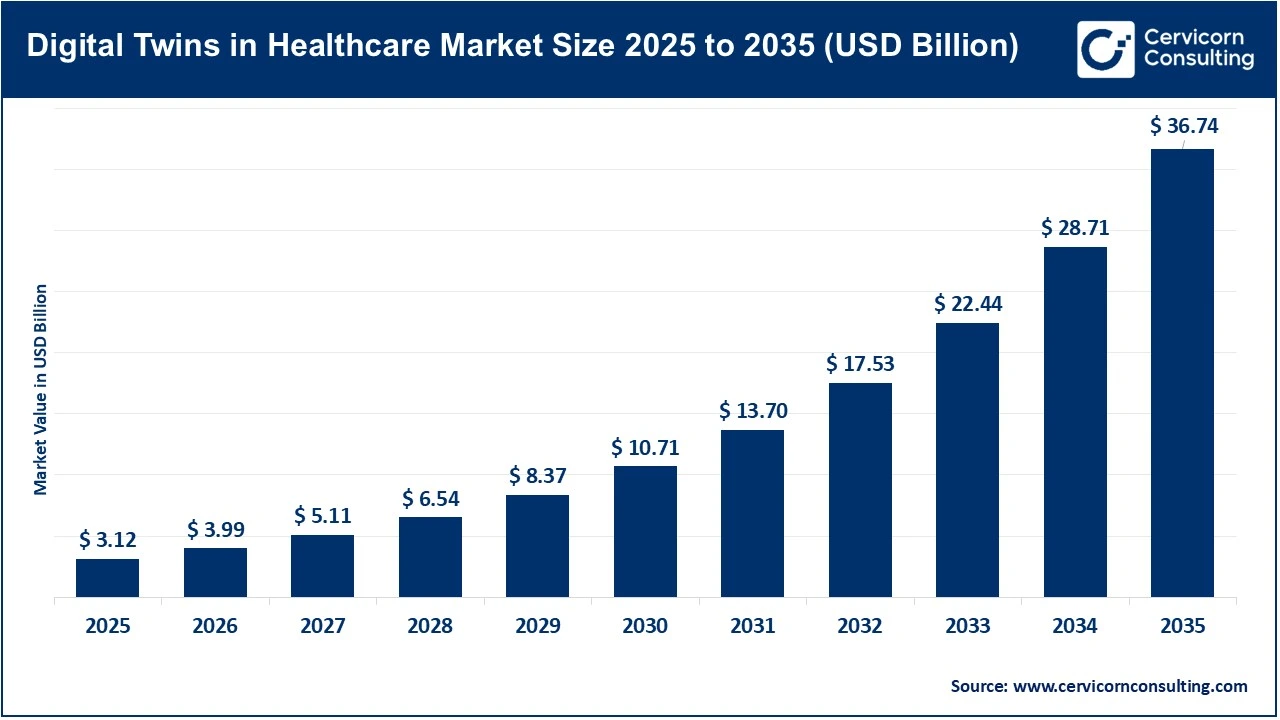
The global digital twins in healthcare market size was valued at USD 3.12 billion in 2025 and is expected to hit around USD 36.74 billion by 2035, exhibiting a compound annual growth rate (CAGR) of 28% over the forecast period from 2026 to 2035. The digital twins in healthcare market growth is primarily driven by the increasing adoption of personalized medicine and the growing need for predictive healthcare solutions. Digital twins enable the creation of virtual patient models that integrate clinical, genomic, physiological, and lifestyle data, allowing clinicians to simulate treatment responses before administering therapies. This capability is becoming increasingly important as chronic diseases continue to rise globally. According to the World Health Organization (WHO), chronic diseases account for approximately 74% of all deaths worldwide, creating significant demand for technologies that improve diagnosis, treatment planning, and patient outcomes. In addition, digital twin-based simulations are being used in cardiology, oncology, and surgical planning to optimize treatment strategies and reduce procedural risks. Research institutions and healthcare providers are increasingly investing in organ-specific and whole-body digital twins to support precision medicine initiatives.
Another major growth factor is the rapid advancement of artificial intelligence (AI), cloud computing, IoT-enabled medical devices, and real-time patient monitoring systems. The healthcare industry generates massive volumes of data from electronic health records, wearable devices, imaging systems, and connected medical equipment, creating a strong foundation for digital twin deployment. Studies indicate that wearable device usage has surpassed 1 billion connected devices globally, providing continuous streams of physiological data that can be integrated into digital twin platforms for real-time monitoring and predictive analytics.
Furthermore, AI-powered digital twins can model disease progression, predict adverse events, and support clinical decision-making, helping healthcare organizations improve operational efficiency and patient care. Growing investments from technology companies, healthcare providers, and research organizations in virtual human twin projects and next-generation digital health infrastructure are further accelerating market adoption.
Digital Twins in Healthcare are virtual replicas of patients, organs, medical devices, healthcare systems, or clinical processes that continuously integrate real-world data from electronic health records (EHRs), medical imaging, wearable devices, sensors, and laboratory results to simulate, monitor, and predict outcomes in real time. By combining artificial intelligence, machine learning, IoT, and advanced analytics, digital twins enable healthcare professionals to test treatment scenarios, optimize clinical decisions, personalize therapies, improve operational efficiency, and reduce risks before interventions are performed. The technology is increasingly being adopted across precision medicine, drug development, surgical planning, and hospital management to enhance patient outcomes and support data-driven healthcare delivery.
Applications of Digital Twins in Healthcare
| Application | Description | Key Benefits |
| Personalized Medicine | Creates a virtual model of an individual patient using clinical, genetic, and physiological data to predict treatment responses. | Tailored therapies, improved treatment effectiveness, reduced adverse effects. |
| Drug Discovery & Development | Simulates drug interactions and disease progression using virtual patient models and biological systems. | Faster drug development, lower R&D costs, improved success rates in clinical studies. |
| Surgical Planning | Generates digital replicas of organs or body parts to help surgeons evaluate procedures before surgery. | Reduced surgical risks, improved accuracy, shorter recovery times. |
| Medical Device Design & Testing | Tests medical devices in virtual environments before physical deployment or clinical use. | Reduced development costs, faster product validation, enhanced device safety. |
| Disease Progression Modeling | Simulates how diseases evolve over time based on patient-specific and population-level data. | Early intervention, better disease management, predictive healthcare. |
| Remote Patient Monitoring | Integrates data from wearables and connected devices to continuously monitor patient health. | Real-time health tracking, early detection of complications, reduced hospital visits. |
| Clinical Trials Optimization | Uses virtual patients and simulations to evaluate treatment outcomes and trial protocols. | Reduced trial duration, improved participant selection, lower operational costs. |
Explosive Growth of AI and Machine Learning, and Rising Demand for Personalized & Predictive Medicine Driving the Digital Twins in Healthcare Market
The rapid advancement of artificial intelligence (AI) and machine learning (ML), combined with the growing demand for personalized and predictive healthcare, is a major catalyst for the digital twins in healthcare market. Digital twins rely on AI and ML algorithms to process vast amounts of patient data from electronic health records, medical imaging, genomics, and wearable devices, enabling the creation of dynamic virtual patient models. These models can simulate disease progression, predict treatment outcomes, and support individualized care plans before clinical interventions are performed. As healthcare shifts from a reactive model to a predictive and preventive approach, providers are increasingly adopting digital twin technologies to improve diagnostic accuracy, optimize therapies, and reduce healthcare costs. The integration of AI-powered analytics with real-time patient monitoring is further enhancing the ability of digital twins to deliver continuous, data-driven insights, making them a critical tool for precision medicine and next-generation healthcare delivery.
1. Dassault Systèmes Launches AI-Powered Next-Generation Living Heart Virtual Twins (February 2025)
In February 2025, Dassault Systèmes announced a beta test of a new generation of its Living Heart virtual twin technology, integrating generative AI to create highly personalized heart models for individual patients and patient populations. The enhanced platform enables researchers, medical device manufacturers, and clinicians to simulate cardiovascular conditions and evaluate treatment outcomes before real-world interventions. This milestone is accelerating the adoption of digital twins in precision medicine by demonstrating how AI-powered organ replicas can improve treatment planning, reduce clinical risks, and shorten medical device development cycles. As healthcare providers increasingly seek patient-specific care models, this development strengthens confidence in digital twin technology as a clinically valuable decision-support tool.
2. Siemens Healthineers and Mayo Clinic Expand Strategic Collaboration for Advanced Patient Modeling (2026)
In February 2026, Siemens Healthineers and Mayo Clinic expanded their strategic partnership to develop advanced technologies for neurodegenerative diseases, prostate cancer, and liver tumor management. The collaboration leverages imaging, AI, and digital health technologies to create more precise patient-specific models and treatment pathways. This milestone is driving the digital twins market by accelerating the translation of virtual patient technologies from research environments into real-world clinical practice. Partnerships between leading healthcare providers and technology companies validate the commercial potential of digital twins and encourage broader investment across hospitals, research institutions, and healthcare systems.
3. Siemens Healthineers Introduces AI-Driven Operational Twins for Healthcare Systems (2025)
During 2025, Siemens Healthineers expanded its AI-enabled operational twin capabilities, creating virtual models of hospital departments that can simulate billions of operational scenarios and recommend real-time workflow improvements. These digital twins optimize patient flow, staffing, equipment utilization, and clinical operations before changes are implemented in the real world. This milestone is broadening the scope of digital twins beyond patient care into healthcare operations management, opening a large new addressable market. As hospitals face increasing pressure to improve efficiency and reduce costs, operational twins provide measurable value, accelerating enterprise-wide adoption of digital twin platforms.
4. Growing Government and Regulatory Support Through FDA-Linked Living Heart Ecosystem
A significant milestone for the market has been the continued expansion of the Living Heart ecosystem originally developed in collaboration with the U.S. Food and Drug Administration and industry partners. In 2025, Dassault Systèmes advanced the project with AI-powered virtual twins designed to support medical device testing, validation, and regulatory evidence generation. The initiative enables virtual clinical evaluations that can complement traditional testing methods and support faster regulatory decision-making. Government and regulatory involvement is a critical market driver because it increases trust in digital twin methodologies, encourages standardization, and reduces barriers to adoption. As regulators increasingly recognize simulation-based evidence, healthcare organizations and medical device companies are becoming more willing to invest in digital twin technologies.
The digital twins in healthcare market is segmented by region into North America, Europe, Asia-Pacific, Latin America, and LAMEA. Here is a brief overview of each region:
The North America digital twins in healthcare market size reached at USD 1.35 billion in 2025 and is expected to record USD 15.87 billion by 2035.
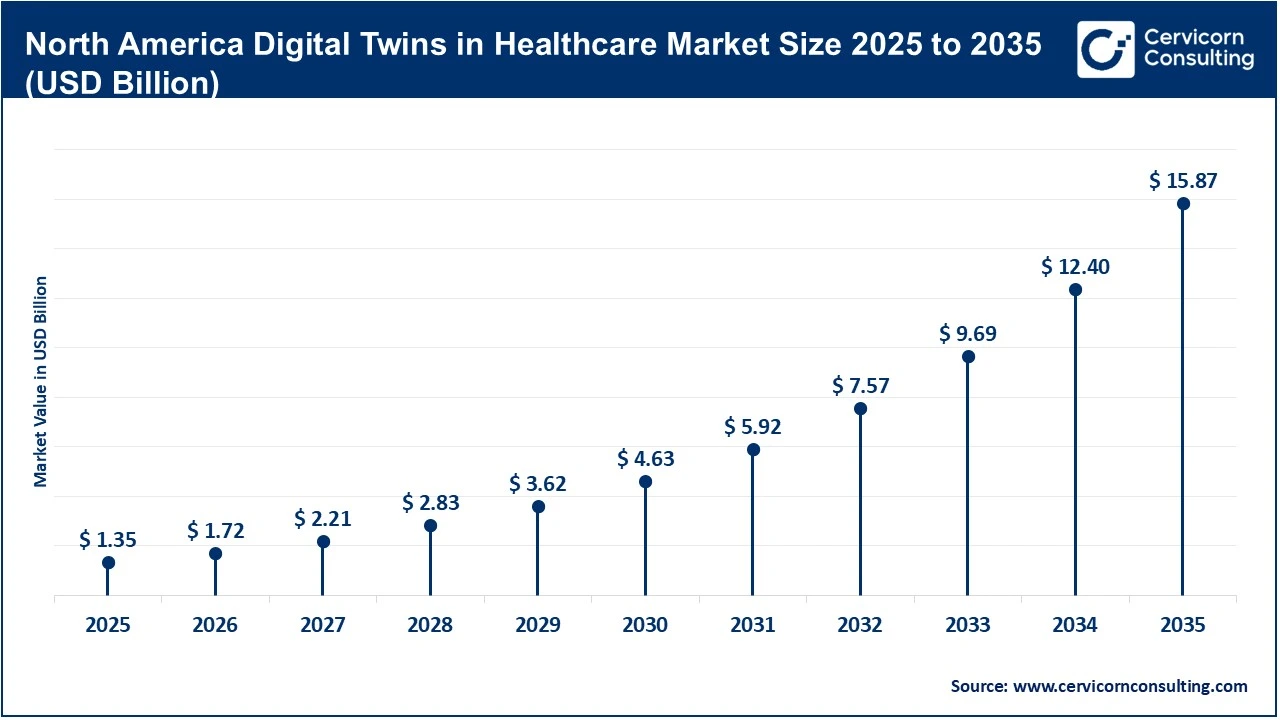
North America represents the leading market, supported by advanced healthcare infrastructure, widespread adoption of electronic health records (EHRs), strong investments in artificial intelligence, and an expanding focus on precision medicine. The region is witnessing growing deployment of digital twin technologies across personalized treatment planning, chronic disease management, surgical simulation, drug discovery, and hospital operations optimization. Increasing collaboration among healthcare providers, technology companies, pharmaceutical firms, and research institutions is accelerating innovation in virtual patient modeling and predictive healthcare.
United States: Leadership in Digital Health Innovation, Precision Medicine, and AI-Enabled Healthcare Drives Market Expansion
Canada: Growing Government Support for Digital Health, Strong Research Ecosystem, and Expanding AI Adoption Fuel Market Growth
The Asia-Pacific digital twins in healthcare market size was estimated at USD 0.67 billion in 2025 and is predicted to surpass around USD 7.86 billion by 2035. The Asia-Pacific market is experiencing significant growth due to accelerating healthcare digitalization, increasing adoption of artificial intelligence and IoT-enabled medical technologies, and rising investments in precision medicine initiatives. Governments across the region are actively promoting digital health transformation through national healthcare modernization programs, smart hospital projects, and AI-driven healthcare strategies. The growing burden of chronic diseases, large patient populations, and increasing demand for personalized treatment approaches are encouraging healthcare providers and life sciences companies to adopt digital twin technologies for disease modeling, patient monitoring, drug development, and healthcare operations optimization. Furthermore, the expansion of cloud infrastructure and connected healthcare ecosystems is creating a favorable environment for large-scale deployment of digital twin solutions.
China: Strong Government Support for AI Healthcare, Expanding Digital Health Infrastructure, and Large Patient Data Ecosystem Drive Market Growth
India: Expanding Digital Health Programs and Rapid Healthcare Technology Adoption Support Market Growth
The Europe digital twins in healthcare market size was accounted for USD 0.89 billion in 2025 and is forecasted to hit around USD 10.51 billion by 2035. Europe represents a significant market growth, supported by robust healthcare systems, increasing adoption of artificial intelligence, and strong government-backed digital health transformation programs. The region is witnessing growing implementation of digital twins for personalized medicine, chronic disease management, surgical planning, medical device development, and hospital workflow optimization. Initiatives such as the European Health Data Space (EHDS) and expanding investments in healthcare data interoperability are enabling healthcare providers and researchers to leverage large-scale patient datasets for virtual patient modeling. Furthermore, Europe's strong biomedical research ecosystem, aging population, and rising focus on value-based healthcare are accelerating the adoption of digital twin technologies across clinical and research environments.
Germany: Strong Medical Technology Industry, Healthcare Digitalization, and Industry 4.0 Leadership Drive Market Growth
United Kingdom: Expanding NHS Digital Transformation and AI Adoption Accelerate Market Expansion
Digital Twins in Healthcare Market Share, By Region, 2025 (%)
| Region | Revenue Share, 2025 (%) |
| North America | 43.2% |
| Europe | 28.6% |
| Asia Pacific | 21.4% |
| LAMEA | 6.8% |
The LAMEA digital twins in healthcare market was valued at USD 0.21 billion in 2025 and is anticipated to reach around USD 2.50 billion by 2035. The LAMEA market is gradually emerging as healthcare systems across the region invest in digital transformation, smart healthcare infrastructure, and AI-enabled medical technologies. Governments and healthcare organizations are increasingly adopting electronic health records, telemedicine platforms, connected medical devices, and cloud-based healthcare systems to improve patient outcomes and operational efficiency. Rising prevalence of chronic diseases, increasing healthcare expenditures, and growing awareness of precision medicine are creating favorable conditions for digital twin adoption. Furthermore, investments in smart hospitals, national healthcare digitization programs, and international collaborations are accelerating the deployment of virtual patient modeling, predictive analytics, and healthcare simulation technologies throughout the region.
Brazil: Expanding Healthcare Digitalization and Growing Health Technology Investments Support Market Growth
Saudi Arabia: Vision 2030 Healthcare Transformation Accelerates Adoption of Advanced Digital Health Technologies
The digital twins in healthcare market is segmented into component, application, end user, and geography.
The software segment dominates the digital twins in healthcare market due to its central role in creating, managing, and analyzing virtual replicas of patients, organs, medical devices, and healthcare systems. Digital twin platforms rely heavily on advanced software incorporating artificial intelligence, machine learning, simulation tools, and data analytics to process real-time clinical and operational data. Healthcare providers and life sciences companies are increasingly investing in software solutions to support predictive modeling, treatment optimization, and operational efficiency. Continuous advancements in cloud computing and AI-driven analytics further strengthen the segment’s leadership position.
Digital Twins in Healthcare Market Share, By Component, 2025 (%)
| Component | Revenue Share, 2025 (%) |
| Software | 58.1% |
| Services | 41.9% |
The services segment is expected to witness the fastest growth as healthcare organizations increasingly require consulting, integration, implementation, maintenance, and training support for digital twin deployments. Many hospitals and life sciences companies lack in-house expertise to develop and manage complex digital twin ecosystems, driving demand for specialized service providers. As digital twin applications expand across clinical, operational, and research environments, organizations are seeking external support to ensure regulatory compliance, interoperability, cybersecurity, and optimal system performance, thereby accelerating growth in professional and managed services.
Personalized treatment optimization represents the largest application segment due to the growing emphasis on precision medicine and patient-centered care. Digital twins enable clinicians to simulate treatment responses using patient-specific physiological, genetic, and clinical data before actual intervention. This capability improves treatment effectiveness, minimizes adverse events, and supports better clinical decision-making. Rising prevalence of chronic diseases, increasing adoption of AI-powered healthcare solutions, and expanding investments in precision medicine programs are driving widespread adoption of digital twins for individualized therapy planning across multiple therapeutic areas.
Digital Twins in Healthcare Market, By Application, 2025 (%)
| Application | Revenue Share, 2025 (%) |
| Personalized Treatment Optimisation | 27.8% |
| Chronic Disease Management | 19.4% |
| Drug Discovery & Pre-clinical Modelling | 17.3% |
| Hospital & Asset Workflow Optimisation | 14.8% |
| Surgical Planning & Simulation | 11.6% |
| Clinical Trial Virtualisation | 9.1% |
Clinical trial virtualisation is projected to be the fastest-growing application segment as pharmaceutical and biotechnology companies seek to reduce development costs and accelerate drug approvals. Digital twins allow researchers to simulate patient populations, predict treatment outcomes, and optimize trial designs before conducting physical studies. These capabilities improve participant selection, reduce trial failures, and enhance data quality. Growing pressure to improve R&D productivity, combined with increasing adoption of AI-driven drug development approaches, is significantly boosting demand for virtualized clinical trial solutions.
Healthcare providers constitute the largest end-user segment due to their extensive use of digital twins for patient monitoring, disease management, surgical planning, and operational optimization. Hospitals and healthcare systems generate vast amounts of clinical data from electronic health records, imaging systems, and connected medical devices, creating an ideal environment for digital twin implementation. The need to improve patient outcomes, reduce hospital readmissions, and enhance resource utilization is encouraging healthcare providers to invest in digital twin technologies, making them the leading adopters in the market.
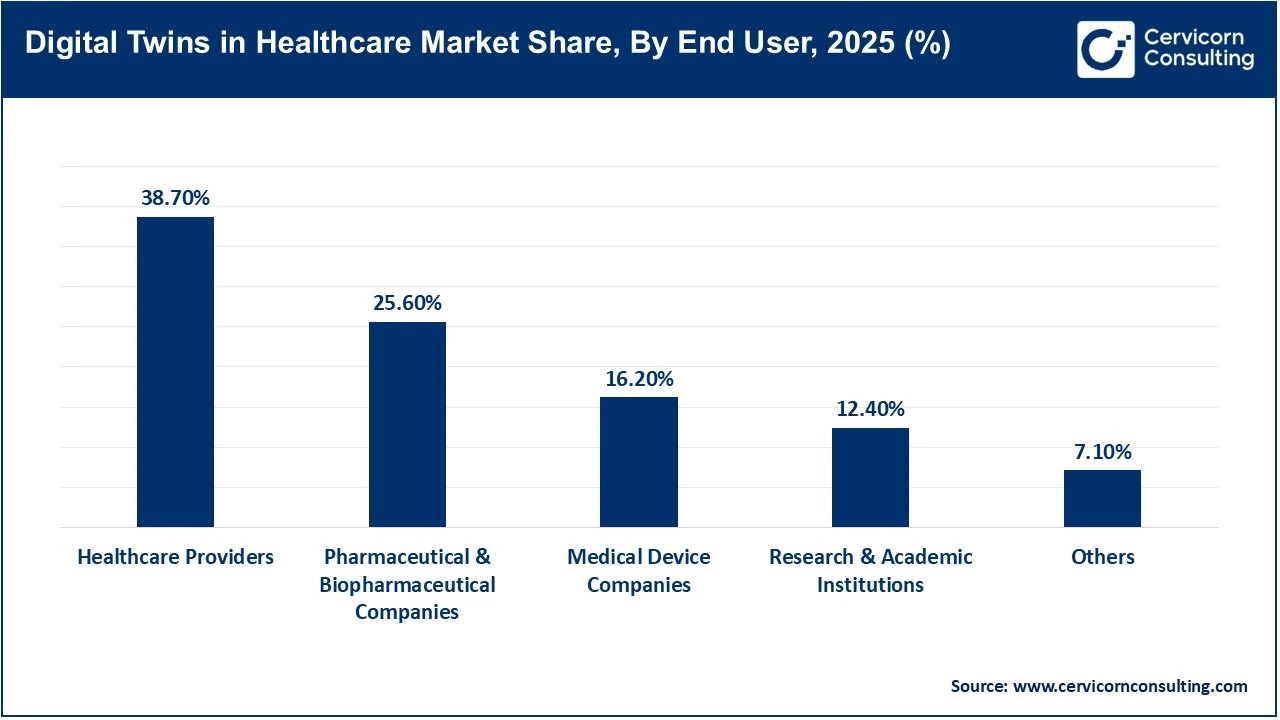
Pharmaceutical and biopharmaceutical companies are expected to register the fastest growth due to increasing use of digital twins in drug discovery, pre-clinical modeling, clinical trial optimization, and precision medicine development. These organizations are leveraging digital twin technologies to simulate biological processes, evaluate drug responses, and identify potential safety issues earlier in the development cycle. The growing integration of AI, computational biology, and advanced simulation tools into pharmaceutical R&D is enabling faster innovation and improving development efficiency, thereby driving rapid adoption across the sector.
By Component
By Application
By End User
By Geography
Chapter 1. Market Introduction and Overview
1.1 Market Definition and Scope
1.1.1 Overview of Digital Twins in Healthcare
1.1.2 Scope of the Study
1.1.3 Research Timeframe
1.2 Research Methodology and Approach
1.2.1 Methodology Overview
1.2.2 Data Sources and Validation
1.2.3 Key Assumptions and Limitations
Chapter 2. Executive Summary
2.1 Market Highlights and Snapshot
2.2 Key Insights by Segments
2.2.1 By Component Overview
2.2.2 By Application Overview
2.2.3 By End User Overview
2.3 Competitive Overview
Chapter 3. Global Impact Analysis
3.1 Russia-Ukraine Conflict: Global Market Implications
3.2 Regulatory and Policy Changes Impacting Global Markets
Chapter 4. Market Dynamics and Trends
4.1 Market Dynamics
4.1.1 Market Drivers
4.1.2 Market Restraints
4.1.3 Market Opportunities
4.1.4 Market Challenges
4.2 Market Trends
Chapter 5. Premium Insights and Analysis
5.1 Global Digital Twins in Healthcare Market Dynamics, Impact Analysis
5.2 Porter’s Five Forces Analysis
5.2.1 Bargaining Power of Suppliers
5.2.2 Bargaining Power of Buyers
5.2.3 Threat of Substitute Products
5.2.4 Rivalry among Existing Firms
5.2.5 Threat of New Entrants
5.3 PESTEL Analysis
5.4 Value Chain Analysis
5.5 Product Pricing Analysis
5.6 Vendor Landscape
5.6.1 List of Buyers
5.6.2 List of Suppliers
Chapter 6. Digital Twins in Healthcare Market, By Component
6.1 Global Digital Twins in Healthcare Market Snapshot, By Component
6.1.1 Market Revenue (($Billion) and Growth Rate (%), 2022-2035
6.1.1.1 Software
6.1.1.2 Services
Chapter 7. Digital Twins in Healthcare Market, By Application
7.1 Global Digital Twins in Healthcare Market Snapshot, By Application
7.1.1 Market Revenue (($Billion) and Growth Rate (%), 2022-2035
7.1.1.1 Drug Discovery & Pre-clinical Modelling
7.1.1.2 Surgical Planning & Simulation
7.1.1.3 Clinical Trial Virtualisation
7.1.1.4 Chronic Disease Management
7.1.1.5 Personalized Treatment Optimisation
7.1.1.6 Hospital & Asset Workflow Optimisation
Chapter 8. Digital Twins in Healthcare Market, By End User
8.1 Global Digital Twins in Healthcare Market Snapshot, By End User
8.1.1 Market Revenue (($Billion) and Growth Rate (%), 2022-2035
8.1.1.1 Healthcare Providers
8.1.1.2 Pharmaceutical & Biopharmaceutical Companies
8.1.1.3 Medical Device Companies
8.1.1.4 Research & Academic Institutions
8.1.1.5 Others
Chapter 9. Digital Twins in Healthcare Market, By Region
9.1 Overview
9.2 Digital Twins in Healthcare Market Revenue Share, By Region 2024 (%)
9.3 Global Digital Twins in Healthcare Market, By Region
9.3.1 Market Size and Forecast
9.4 North America
9.4.1 North America Digital Twins in Healthcare Market Revenue, 2022-2035 ($Billion)
9.4.2 Market Size and Forecast
9.4.3 North America Digital Twins in Healthcare Market, By Country
9.4.4 U.S.
9.4.4.1 U.S. Digital Twins in Healthcare Market Revenue, 2022-2035 ($Billion)
9.4.4.2 Market Size and Forecast
9.4.4.3 U.S. Market Segmental Analysis
9.4.5 Canada
9.4.5.1 Canada Digital Twins in Healthcare Market Revenue, 2022-2035 ($Billion)
9.4.5.2 Market Size and Forecast
9.4.5.3 Canada Market Segmental Analysis
9.4.6 Mexico
9.4.6.1 Mexico Digital Twins in Healthcare Market Revenue, 2022-2035 ($Billion)
9.4.6.2 Market Size and Forecast
9.4.6.3 Mexico Market Segmental Analysis
9.5 Europe
9.5.1 Europe Digital Twins in Healthcare Market Revenue, 2022-2035 ($Billion)
9.5.2 Market Size and Forecast
9.5.3 Europe Digital Twins in Healthcare Market, By Country
9.5.4 UK
9.5.4.1 UK Digital Twins in Healthcare Market Revenue, 2022-2035 ($Billion)
9.5.4.2 Market Size and Forecast
9.5.4.3 UK Market Segmental Analysis
9.5.5 France
9.5.5.1 France Digital Twins in Healthcare Market Revenue, 2022-2035 ($Billion)
9.5.5.2 Market Size and Forecast
9.5.5.3 France Market Segmental Analysis
9.5.6 Germany
9.5.6.1 Germany Digital Twins in Healthcare Market Revenue, 2022-2035 ($Billion)
9.5.6.2 Market Size and Forecast
9.5.6.3 Germany Market Segmental Analysis
9.5.7 Rest of Europe
9.5.7.1 Rest of Europe Digital Twins in Healthcare Market Revenue, 2022-2035 ($Billion)
9.5.7.2 Market Size and Forecast
9.5.7.3 Rest of Europe Market Segmental Analysis
9.6 Asia Pacific
9.6.1 Asia Pacific Digital Twins in Healthcare Market Revenue, 2022-2035 ($Billion)
9.6.2 Market Size and Forecast
9.6.3 Asia Pacific Digital Twins in Healthcare Market, By Country
9.6.4 China
9.6.4.1 China Digital Twins in Healthcare Market Revenue, 2022-2035 ($Billion)
9.6.4.2 Market Size and Forecast
9.6.4.3 China Market Segmental Analysis
9.6.5 Japan
9.6.5.1 Japan Digital Twins in Healthcare Market Revenue, 2022-2035 ($Billion)
9.6.5.2 Market Size and Forecast
9.6.5.3 Japan Market Segmental Analysis
9.6.6 India
9.6.6.1 India Digital Twins in Healthcare Market Revenue, 2022-2035 ($Billion)
9.6.6.2 Market Size and Forecast
9.6.6.3 India Market Segmental Analysis
9.6.7 Australia
9.6.7.1 Australia Digital Twins in Healthcare Market Revenue, 2022-2035 ($Billion)
9.6.7.2 Market Size and Forecast
9.6.7.3 Australia Market Segmental Analysis
9.6.8 Rest of Asia Pacific
9.6.8.1 Rest of Asia Pacific Digital Twins in Healthcare Market Revenue, 2022-2035 ($Billion)
9.6.8.2 Market Size and Forecast
9.6.8.3 Rest of Asia Pacific Market Segmental Analysis
9.7 LAMEA
9.7.1 LAMEA Digital Twins in Healthcare Market Revenue, 2022-2035 ($Billion)
9.7.2 Market Size and Forecast
9.7.3 LAMEA Digital Twins in Healthcare Market, By Country
9.7.4 GCC
9.7.4.1 GCC Digital Twins in Healthcare Market Revenue, 2022-2035 ($Billion)
9.7.4.2 Market Size and Forecast
9.7.4.3 GCC Market Segmental Analysis
9.7.5 Africa
9.7.5.1 Africa Digital Twins in Healthcare Market Revenue, 2022-2035 ($Billion)
9.7.5.2 Market Size and Forecast
9.7.5.3 Africa Market Segmental Analysis
9.7.6 Brazil
9.7.6.1 Brazil Digital Twins in Healthcare Market Revenue, 2022-2035 ($Billion)
9.7.6.2 Market Size and Forecast
9.7.6.3 Brazil Market Segmental Analysis
9.7.7 Rest of LAMEA
9.7.7.1 Rest of LAMEA Digital Twins in Healthcare Market Revenue, 2022-2035 ($Billion)
9.7.7.2 Market Size and Forecast
9.7.7.3 Rest of LAMEA Market Segmental Analysis
Chapter 10. Competitive Landscape
10.1 Competitor Strategic Analysis
10.1.1 Top Player Positioning/Market Share Analysis
10.1.2 Top Winning Strategies, By Company, 2022-2024
10.1.3 Competitive Analysis By Revenue, 2022-2024
10.2 Recent Developments by the Market Contributors (2024)
Chapter 11. Company Profiles
11.1 Microsoft Corporation
11.1.1 Company Snapshot
11.1.2 Company and Business Overview
11.1.3 Financial KPIs
11.1.4 Product/Service Portfolio
11.1.5 Strategic Growth
11.1.6 Global Footprints
11.1.7 Recent Development
11.1.8 SWOT Analysis
11.2 Siemens Healthineers AG.
11.3 Amazon Web Services (AWS)
11.4 Koninklijke Philips N.V.
11.5 Dassault Systèmes
11.6 GE HealthCare
11.7 IBM Corporation
11.8 NVIDIA Corporation
11.9 Oracle Corporation
11.10 PTC Inc.
11.11 SAP SE
11.12 Atos SE