
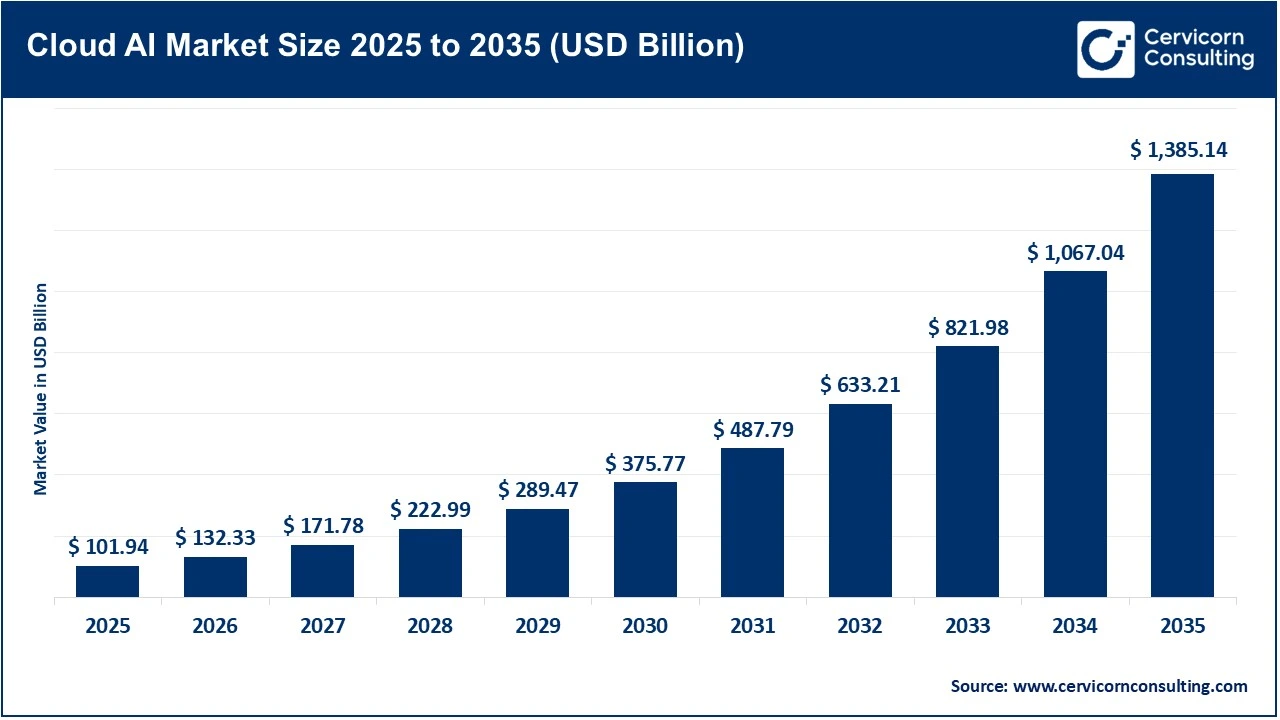
The global cloud AI market size was valued at USD 101.94 billion in 2025 and is estimated to surpass around USD 1,385.14 billion by 2035 growing at a CAGR of 29.8% from 2026 to 2035. The overall risen focus on AI infrastructure and generative AI integration in workload migration with strong demand for agentic AI services across multiple areas create strong potential for the cloud AI market to grow. Major investors and enterprises are heavily investing in next-gen infrastructure and automation solutions; which is seen as one of the major opportunities for the cloud AI market.
Cloud AI is the provision of AI technologies, machine learning models, data processing power and AI applications, through cloud computing infrastructure. Rather than purchasing high cost on-premises infrastructure organizations can access AI technologies like machine learning frameworks, Natural Language Processing (NLP) and computer vision tools, generative AI models, via the cloud using pay-per-use or subscription business models.
The revenue in the cloud AI market is generated from usage-based pricing and subscription models for cloud computing resources, AI software licenses, managed AI Services, consumption of cloud infrastructure, etc. The increasing use of digital transformation in enterprises have fueled the growth for cloud-based AI solutions for various sectors like banking, healthcare, retail, manufacturing, telecommunication and governments.
How Are Government AI Investments Supporting Cloud AI Growth?
| Country | Initiative | Year | Impact on Cloud AI Market |
| United States | National AI Initiative Act | 2021-Present | Supports AI R&D, cloud computing infrastructure expansion, and AI workforce development. |
| European Union | AI Continent Action Plan | 2025 | Accelerates AI innovation, cloud deployment, and AI infrastructure investments across member states. |
| Germany | AI Strategy Update | Ongoing | Expands AI innovation hubs and cloud-based AI research initiatives. |
| United Kingdom | National AI Strategy | Ongoing | Supports AI commercialization, cloud adoption, and AI startup ecosystems. |
| China | New Generation Artificial Intelligence Development Plan | Ongoing | Positions China as a global AI leader through massive investments in AI and cloud infrastructure. |
| India | Digital India Programme | Ongoing | Accelerates cloud adoption, digital transformation, and AI deployment across industries. |
| Japan | Society 5.0 Initiative | Ongoing | Encourages AI and cloud integration across healthcare, manufacturing, and smart cities. |
Rising Enterprise Adoption of Generative AI and AI-Powered Automation
The rise of generative AI, machine learning and intelligent automation in enterprises is one of the significant growth drivers in the cloud AI market. Enterprises are increasingly adopting cloud based AI solutions to automate processes, enhance customer engagement, improve decision making and optimize operations. The growing popularity of LLMs, AI copilots, virtual assistants and predictive analytics platforms has substantially escalated the need for flexible cloud based infrastructure to support AI workloads. Also, enterprises are focused on digital transformation efforts and significant investment is put on AI technologies to derive a competitive edge thus strengthening the demand for cloud AI platforms. The advantages such as scalability, flexibility, and affordability associated with cloud AI platforms further stimulate its adoption by organizations of all scales.
Data Privacy and Regulatory Compliance Challenges
Although market growth potential is very encouraging, data privacy, security and compliance issues are significant bottlenecks in the cloud AI market. Many AI applications would depend heavily on processing sensitive business and customer data. Consequently there is concern about possible unauthorized access, data breaches and misuse of this data. Companies operating in regulated industries, such as banking, healthcare, government, and defense are challenged by data sovereignty issues, compliance requirements such as GDPR, HIPAA, etc., and newer data regulations such as AI governance policies. The ethical aspects of AI including the transparency of AI models, fairness in AI and its ethical implementation, also delay implementation decisions, and raise compliance costs for the enterprises opting for cloud AI solution.
Expansion of AI-as-a-Service (AIaaS) and Industry-Specific AI Solutions
The rapid emergence of AI-as-a-Service (AIaaS) signifies an abundant market for the cloud AI industry. AIaaS has facilitated the adoption of advanced AI tools on a subscription basis without organizations needing to invest on infrastructure, software development or expertise. This has benefited SMEs enabling access to services like Machine Learning (ML), Natural Language Processing (NLP), Computer vision, and Generative AI applications at cheaper costs. Furthermore, proliferation of agentic AI, edge AI, sovereign cloud, and AI powered cybersecurity will drive opportunities for the market.
The North America cloud AI market size was valued at USD 42.81 billion in 2025 and is estimated to surpass around USD 581.76 billion by 2035.
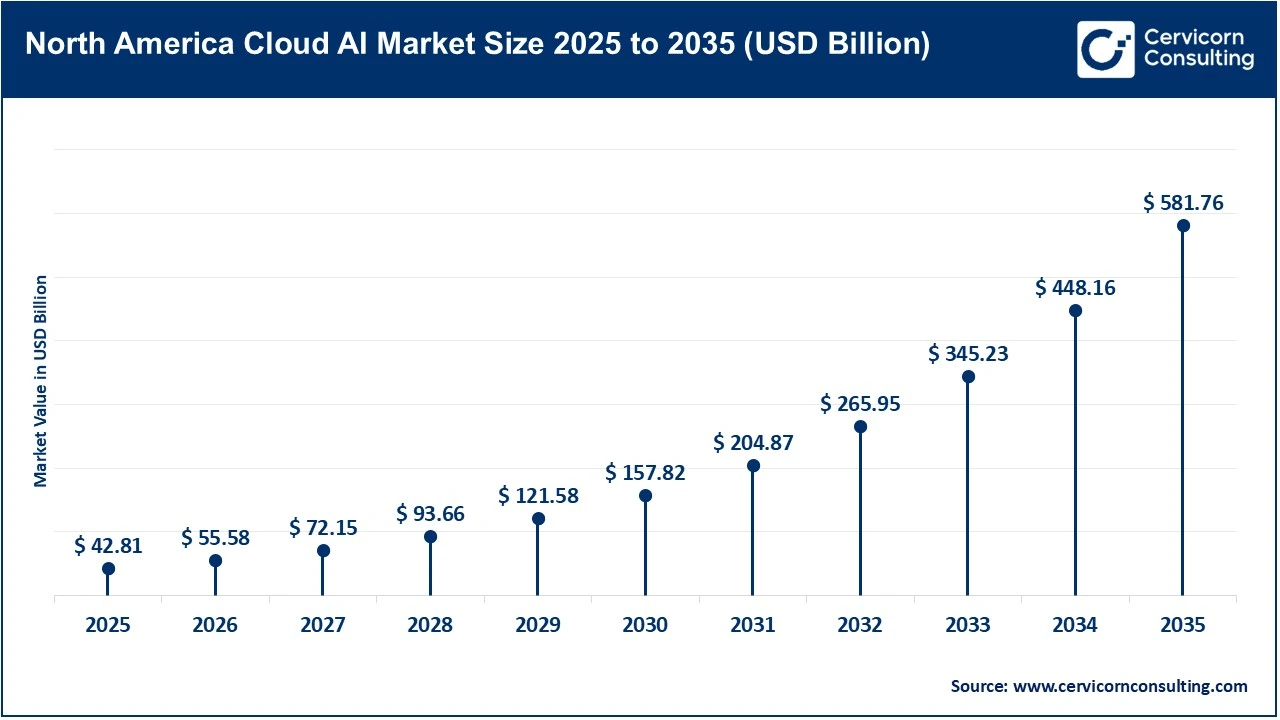
In 2025, North America held the majority market share and the region is expected to remain a dominant force in the cloud AI market throughout the forecast period. owing to a well-developed technology infrastructure, a high cloud adoption, huge investments in AI, and the dominance of leading cloud service providers (like Microsoft, Amazon Web Services, Google Cloud and Oracle) in the region. Being a stronghold of tech pioneers, such as Microsoft, Amazon Web Services, Google Cloud and Oracle, the region has a great potential to boom.
The U.S. is seen to be the largest growth driver in terms of AI investments and cloud spending across the region. A leading player in generative AI development, Venture Capital investments, AI startups activity, and hyperscale data centers expansion across the U.S. will continue to support the overall growth of the cloud AI market in the region through the ongoing investments in AI infrastructure and enterprise modernization programs.
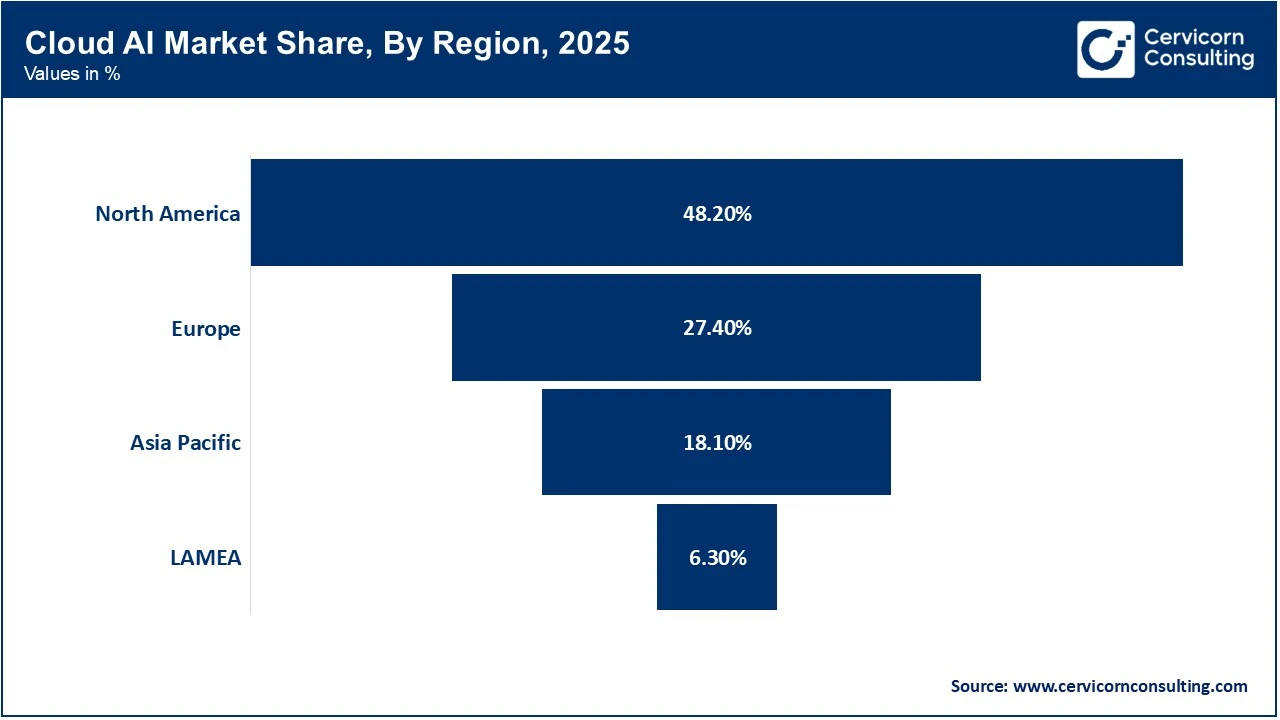
The Asia-Pacific cloud AI market size was estimated at USD 22.43 billion in 2025 and is anticipated to reach around USD 304.73 billion by 2035. It is estimated that the market will grow at the fastest pace in the Asia Pacific over the forecast period due to rising digital transformation initiatives, increasing investments in cloud infrastructure, growth of the Internet penetration and adoption of artificial intelligence in both the private enterprises and governments organizations in the region. Several countries namely China, India, Japan, South Korea, Singapore and Australia have initiated their respective National AI plans to support AI innovation, growth of cloud computing power and promote digital transformation across business and industrial sector. Adoption of cloud AI is rapid in healthcare, manufacturing, financial services, telecom and government industries.
Over 60% of world's population reside in Asia Pacific and over 2.9 billion users browse the web creating one of the largest digital worlds where cloud AI can be deployed. The proliferation of digital economy is contributing to the market growth. The region also consists of some of the fastest growing cloud markets in the world where enterprise cloud expenditure is growing at double digits rate every year across key nations.
How are India & China Accelerating Cloud AI Adoption?
The infrastructure segment led the cloud AI market in 2025 with tremendous demand for AI computing, huge data storage, networks and GPU enhanced cloud computing, fueled by rapid commercialization of foundational models and generative AI services. This has raised the demands of infrastructure by huge margin for large-scale data sets and computational needs for intensive training.
“Global cloud public services investment in 2025 is expected to reach more than $800 billion with increased investment in AI infrastructures. Leading public cloud providers like AWS, Azure and Google Cloud had invested billions in data centers capacity. Microsoft pledged over $80 billion in FY25 to invest in AI-enabled data centers.”
Cloud AI Market Revenue Share, By Offering, 2025 (%)
| Offering | Revenue Share, 2025 (%) |
| Infrastructure | 41% |
| AI-as-a-Service (AIaaS) | 59% |
AI-as-a-Service segment is anticipated to have rapid growth over the predicted time frame by catering to needs of Organizations seeking access to cutting edge AI services at less expense than the capital expenditure and specialized talents needed for AI infrastructure and expertise. AIaaS provides ready models to use, ML tools, NLP tools, predictive analytics services on cloud with subscription based services. A big growth driver is the growing democratization of artificial intelligence.
Nearly 70% of enterprises worldwide are investigating using generative AI and a huge chunk prefers cloud services due to reduced deployment time and complexity in the organization infrastructure and development work force and proliferation of no-code and low-code development tools.
The largest share of the market for cloud AI in 2025 was attributed to generative AI on the account of its pervasive role in various functions like content creation, software engineering, customer interactions and business processes automation. With the release and widespread commercialization of various sophisticated foundation models the enterprise AI investment has witnessed significant traction worldwide.
Cloud AI Market Revenue Share, By Technology, 2025 (%)
| Technology | Revenue Share, 2025 (%) |
| Generative AI | 55% |
| Other AI | 45% |
Latest surveys also indicate that about 75% of enterprises globally are either implementing or have been trialling generative AI solutions. Cloud has become the foremost place where generative AI services will be deployed, as it needs substantial computational infrastructure that will be hard to cope with using on-premise infrastructure.
In 2025, the managed hosting type accounted for the largest portion of the hosting market, driven by enterprises that required simpler operations, enhanced cybersecurity, regulatory compliance and constant system optimization. In this hosting model, cloud providers take responsibility for managing infrastructure, updating software, monitoring systems and ensuring security at all stages of operation.
The increasing complexity of AI-based environments also made managed hosting services more desirable. Companies adopting AI-based services require technical experts to optimize AI models, manage data governance, organize workloads, and scale infrastructure effectively, whereas they have an opportunity to do what matters the most, and that is the innovation aspect, while minimizing operational risks and workload.
Cloud AI Market Revenue Share, By Hosting Type, 2025 (%)
| Hosting Type | Revenue Share, 2025 (%) |
| Managed Hosting | 70% |
| Self-hosting | 30% |
The self-hosting type segment is seen to have a steady growth rate. This is primarily evident in organizations in strictly regulated industries, such as financial institutions, government, defense and health organizations, due to requirements of greater governance over their sensitive data, their security policy, and AI model adjustments. Because of increased concerns about data sovereignty and the privacy-related laws, there were enterprises choosing private cloud environments or hybrid cloud infrastructures.
Large enterprises dominated the market with the largest share of cloud AI market due to their high IT budget, immense volume of data and capacity to spend on enormous amount of digitally transforming projects. Large enterprises have been among the initial ones to use AI in customer engagement, cyber security, predictive analysis, operations management etc.
According to the expert panel at Cervicorn Consulting, large enterprises hold majority of AI expenditure around the world. Numerous organizations spend huge sum in a span of 1 year on the cloud AI. MNCs are integrating AI at large into the business for higher efficiency, productivity and benefits and increased profit and enhanced decision making.
Cloud AI Market Revenue Share, By Organization Size, 2025 (%)
| Organization Size | Revenue Share, 2025 (%) |
| Large Enterprises | 68% |
| Small & Medium Enterprises (SMEs) | 32% |
Small and medium enterprises segment carries the fastest growth rate due to decreasing cost of cloud service, wider availability of AI-as-a-Service, rise in the awareness of AI-driven benefits for the business. Earlier small scale businesses face hurdles for having the infrastructure cost and having knowledgeable technical expertise; but these hurdles have been over passed by the adoption of cloud based AI services and solutions. AI services for small businesses have led to better results in customer support, automated Marketing, inventory management and sales forecasting.
The sales segment represented the dominant portion in 2025, because of increased adoption of AI-based customer relationship management, sales forecasting, lead scoring and customer engagement solutions. Businesses use cloud AI solutions for consumer behavior analysis, identifying consumer purchase behavior and enhancing sales performance. With the help of sales tools using AI technology businesses can achieve high conversion rates, personalized interaction with their customers and can perform repetitive tasks with minimal human intervention.
Operation & supply chain management is anticipated to grow at the highest rate due to increasing demand in real-time visibility, predictive maintenance, inventory optimization and automation of logistics processes. Increasing number of events in global supply chain over the last two years emphasized the importance of AI-based operation management systems.
Businesses rely on cloud AI solutions for tracking fluctuating customer demands, optimizing warehouse processes, optimizing route planning and managing costs for supply chain management. Manufacturers, retailers, and logistics services utilize AI based analytics tools for supply chain resilience and operational efficiencies.
The BFSI segment had the largest market share for the cloud AI market, because they employ artificial intelligence for numerous applications like fraud detection, credit scoring, risk assessment, algorithmic trading and customer services management. Financial institutions manage enormous amount of transactional data daily, making the artificial intelligence technology suitable to gain insights and take effective decisions. Industry reports state that financial services sector is one of the leading spending sectors on the artificial intelligence technologies worldwide.
Healthcare & life sciences is expected to exhibit significant growth on account of adoption of AI for applications in diagnostics, drug development platforms, clinical decision support systems, and patient engagement technologies. Increasing use of data from patient’s Electronic Medical Records (EMR), genomic data and medical imaging are fueling the opportunities to deploy the cloud based artificial intelligence applications.
The IT & telecom segment had a good market share on account of its significant use of AI technologies in network optimization, predictive maintenance, customer services management, cybersecurity management and more. Telecom service providers are increasingly leveraging cloud artificial intelligence to deal with growing network complexities, support 5G networks deployment and to enhance the customer experience.
By Offering
By Technology
By Hosting Type
By Organization Size
By Business Function
By Vertical
By Region
Chapter 1. Market Introduction and Overview
1.1 Market Definition and Scope
1.1.1 Overview of Cloud AI
1.1.2 Scope of the Study
1.1.3 Research Timeframe
1.2 Research Methodology and Approach
1.2.1 Methodology Overview
1.2.2 Data Sources and Validation
1.2.3 Key Assumptions and Limitations
Chapter 2. Executive Summary
2.1 Market Highlights and Snapshot
2.2 Key Insights by Segments
2.2.1 By Offering Overview
2.2.2 By Technology Overview
2.2.3 By Hosting Type Overview
2.2.4 By Organization Size Overview
2.2.5 By Business Function Overview
2.2.6 By Vertical Overview
2.3 Competitive Overview
Chapter 3. Global Impact Analysis
3.1 Russia-Ukraine Conflict: Global Market Implications
3.2 Regulatory and Policy Changes Impacting Global Markets
Chapter 4. Market Dynamics and Trends
4.1 Market Dynamics
4.1.1 Market Drivers
4.1.2 Market Restraints
4.1.3 Market Opportunities
4.1.4 Market Challenges
4.1.4.1 Framework Gaps and Limited Domestic Raw Material Availability
4.2 Market Trends
Chapter 5. Premium Insights and Analysis
5.1 Global Cloud AI Market Dynamics, Impact Analysis
5.2 Porter’s Five Forces Analysis
5.2.1 Bargaining Power of Suppliers
5.2.2 Bargaining Power of Buyers
5.2.3 Threat of Substitute Products
5.2.4 Rivalry among Existing Firms
5.2.5 Threat of New Entrants
5.3 PESTEL Analysis
5.4 Value Chain Analysis
5.5 Product Pricing Analysis
5.6 Vendor Landscape
5.6.1 List of Buyers
5.6.2 List of Suppliers
Chapter 6. Cloud AI Market, By Offering
6.1 Global Cloud AI Market Snapshot, By Offering
6.1.1 Market Revenue (($Billion) and Growth Rate (%), 2022-2035
6.1.1.1 Infrastructure
6.1.1.2 AI-as-a-Service (AIaaS)
Chapter 7. Cloud AI Market, By Technology
7.1 Global Cloud AI Market Snapshot, By Technology
7.1.1 Market Revenue (($Billion) and Growth Rate (%), 2022-2035
7.1.1.1 Generative AI
7.1.1.2 Other AI
Chapter 8. Cloud AI Market, By Hosting Type
8.1 Global Cloud AI Market Snapshot, By Hosting Type
8.1.1 Market Revenue (($Billion) and Growth Rate (%), 2022-2035
8.1.1.1 Managed Hosting
8.1.1.2 Self-hosting
Chapter 9. Cloud AI Market, By Organization Size
9.1 Global Cloud AI Market Snapshot, By Organization Size
9.1.1 Market Revenue (($Billion) and Growth Rate (%), 2022-2035
9.1.1.1 Large Enterprises
9.1.1.2 Small & Medium Enterprises (SMEs)
Chapter 10. Cloud AI Market, By Business Function
10.1 Global Cloud AI Market Snapshot, By Business Function
10.1.1 Market Revenue (($Billion) and Growth Rate (%), 2022-2035
10.1.1.1 Marketing
10.1.1.2 Function
10.1.1.3 Sales
10.1.1.4 Human Resources
10.1.1.5 Finance & Accounting
10.1.1.6 Operations & Supply Chain
Chapter 11. Cloud AI Market, By Vertical
11.1 Global Cloud AI Market Snapshot, By Vertical
11.1.1 Market Revenue (($Billion) and Growth Rate (%), 2022-2035
11.1.1.1 BFSI
11.1.1.2 Retail & E-commerce
11.1.1.3 Manufacturing
11.1.1.4 Government & Defense
11.1.1.5 Healthcare & Life Sciences
11.1.1.6 Technology & Software Providers
11.1.1.7 IT & Telecom
11.1.1.8 Energy & Utilities
11.1.1.9 Media & Entertainment
11.1.1.10 Automotive, Transportation & Logistics
11.1.1.11 Others
Chapter 12. Cloud AI Market, By Region
12.1 Overview
12.2 Cloud AI Market Revenue Share, By Region 2024 (%)
12.3 Global Cloud AI Market, By Region
12.3.1 Market Size and Forecast
12.4 North America
12.4.1 North America Cloud AI Market Revenue, 2022-2035 ($Billion)
12.4.2 Market Size and Forecast
12.4.3 North America Cloud AI Market, By Country
12.4.4 U.S.
12.4.4.1 U.S. Cloud AI Market Revenue, 2022-2035 ($Billion)
12.4.4.2 Market Size and Forecast
12.4.4.3 U.S. Market Segmental Analysis
12.4.5 Canada
12.4.5.1 Canada Cloud AI Market Revenue, 2022-2035 ($Billion)
12.4.5.2 Market Size and Forecast
12.4.5.3 Canada Market Segmental Analysis
12.4.6 Mexico
12.4.6.1 Mexico Cloud AI Market Revenue, 2022-2035 ($Billion)
12.4.6.2 Market Size and Forecast
12.4.6.3 Mexico Market Segmental Analysis
12.5 Europe
12.5.1 Europe Cloud AI Market Revenue, 2022-2035 ($Billion)
12.5.2 Market Size and Forecast
12.5.3 Europe Cloud AI Market, By Country
12.5.4 UK
12.5.4.1 UK Cloud AI Market Revenue, 2022-2035 ($Billion)
12.5.4.2 Market Size and Forecast
12.5.4.3 UK Market Segmental Analysis
12.5.5 France
12.5.5.1 France Cloud AI Market Revenue, 2022-2035 ($Billion)
12.5.5.2 Market Size and Forecast
12.5.5.3 France Market Segmental Analysis
12.5.6 Germany
12.5.6.1 Germany Cloud AI Market Revenue, 2022-2035 ($Billion)
12.5.6.2 Market Size and Forecast
12.5.6.3 Germany Market Segmental Analysis
12.5.7 Rest of Europe
12.5.7.1 Rest of Europe Cloud AI Market Revenue, 2022-2035 ($Billion)
12.5.7.2 Market Size and Forecast
12.5.7.3 Rest of Europe Market Segmental Analysis
12.6 Asia Pacific
12.6.1 Asia Pacific Cloud AI Market Revenue, 2022-2035 ($Billion)
12.6.2 Market Size and Forecast
12.6.3 Asia Pacific Cloud AI Market, By Country
12.6.4 China
12.6.4.1 China Cloud AI Market Revenue, 2022-2035 ($Billion)
12.6.4.2 Market Size and Forecast
12.6.4.3 China Market Segmental Analysis
12.6.5 Japan
12.6.5.1 Japan Cloud AI Market Revenue, 2022-2035 ($Billion)
12.6.5.2 Market Size and Forecast
12.6.5.3 Japan Market Segmental Analysis
12.6.6 India
12.6.6.1 India Cloud AI Market Revenue, 2022-2035 ($Billion)
12.6.6.2 Market Size and Forecast
12.6.6.3 India Market Segmental Analysis
12.6.7 Australia
12.6.7.1 Australia Cloud AI Market Revenue, 2022-2035 ($Billion)
12.6.7.2 Market Size and Forecast
12.6.7.3 Australia Market Segmental Analysis
12.6.8 Rest of Asia Pacific
12.6.8.1 Rest of Asia Pacific Cloud AI Market Revenue, 2022-2035 ($Billion)
12.6.8.2 Market Size and Forecast
12.6.8.3 Rest of Asia Pacific Market Segmental Analysis
12.7 LAMEA
12.7.1 LAMEA Cloud AI Market Revenue, 2022-2035 ($Billion)
12.7.2 Market Size and Forecast
12.7.3 LAMEA Cloud AI Market, By Country
12.7.4 GCC
12.7.4.1 GCC Cloud AI Market Revenue, 2022-2035 ($Billion)
12.7.4.2 Market Size and Forecast
12.7.4.3 GCC Market Segmental Analysis
12.7.5 Africa
12.7.5.1 Africa Cloud AI Market Revenue, 2022-2035 ($Billion)
12.7.5.2 Market Size and Forecast
12.7.5.3 Africa Market Segmental Analysis
12.7.6 Brazil
12.7.6.1 Brazil Cloud AI Market Revenue, 2022-2035 ($Billion)
12.7.6.2 Market Size and Forecast
12.7.6.3 Brazil Market Segmental Analysis
12.7.7 Rest of LAMEA
12.7.7.1 Rest of LAMEA Cloud AI Market Revenue, 2022-2035 ($Billion)
12.7.7.2 Market Size and Forecast
12.7.7.3 Rest of LAMEA Market Segmental Analysis
Chapter 13. Competitive Landscape
13.1 Competitor Strategic Analysis
13.1.1 Top Player Positioning/Market Share Analysis
13.1.2 Top Winning Strategies, By Company, 2022-2024
13.1.3 Competitive Analysis By Revenue, 2022-2024
13.2 Recent Developments by the Market Contributors (2024)
Chapter 14. Company Profiles
14.1 Microsoft Corporation
14.1.1 Company Snapshot
14.1.2 Company and Business Overview
14.1.3 Financial KPIs
14.1.4 Product/Service Portfolio
14.1.5 Strategic Growth
14.1.6 Global Footprints
14.1.7 Recent Development
14.1.8 SWOT Analysis
14.2 Amazon Web Services
14.3 Google Cloud
14.4 Oracle Corporation
14.5 IBM Corporation
14.6 NVIDIA Corporation
14.7 Alibaba Cloud
14.8 ZTE Corp
14.9 Intel Corporation
14.10 MicroStrategy Inc.