
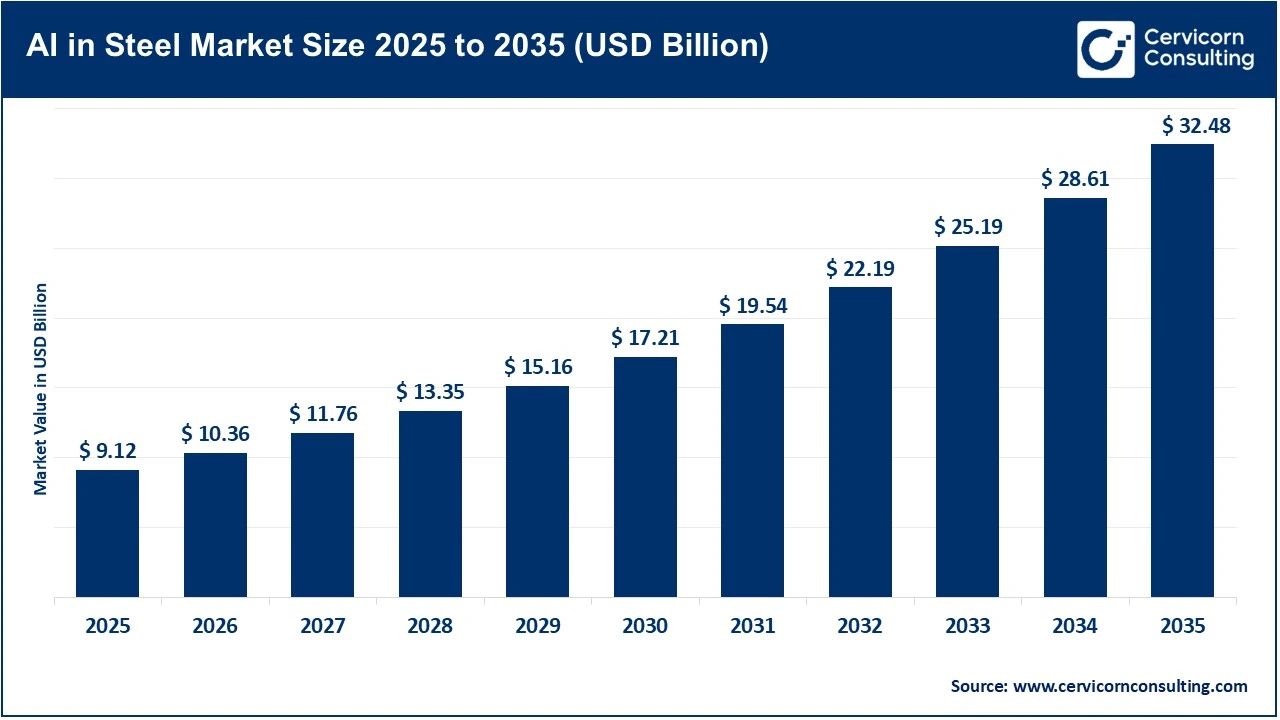
The global AI in steel market size was valued at USD 9.12 billion in 2025 and is expected to reach around USD 32.48 billion by 2035, exhibiting a compound annual growth rate (CAGR) of 13.5% over the forecast period from 2026 to 2035. The growth of AI in steel market is being driven primarily by the industry’s need to improve operational efficiency, reduce downtime, and optimize energy-intensive production processes. Steel manufacturing relies on high-value assets such as blast furnaces, rolling mills, and casting equipment, where even a few hours of unplanned downtime can lead to significant production losses. AI-powered predictive maintenance and process optimization systems are increasingly being adopted to prevent equipment failures and improve plant utilization. According to manufacturing benchmarks cited by McKinsey, AI-enabled predictive maintenance can reduce equipment breakdowns by 30–50%, while improving maintenance efficiency and asset reliability across heavy industries. Additionally, AI-driven manufacturing “lighthouse” facilities have reported up to 30% reductions in energy consumption, a major advantage in steelmaking where energy costs represent a substantial portion of operating expenses.
Another major growth factor is the increasing focus on quality control, waste reduction, and sustainability compliance. Steel producers are adopting computer vision and machine learning systems for real-time surface inspection, defect detection, and metallurgical process control to minimize rejects and improve yield. AI-based visual inspection systems have demonstrated up to 90% improvement in defect detection accuracy compared with conventional manual inspection methods, helping manufacturers reduce rework and scrap costs. At the same time, mounting pressure to reduce carbon emissions is accelerating the use of AI for furnace optimization, fuel mix planning, and emissions monitoring, particularly as steelmakers pursue decarbonization and “green steel” initiatives. These benefits are making AI a strategic investment area for steel producers seeking higher productivity, lower operating costs, and improved ESG performance.
Artificial Intelligence (AI) in the steel industry refers to the use of machine learning, computer vision, predictive analytics, industrial automation, and data-driven algorithms to optimize steel manufacturing processes, improve product quality, reduce operational costs, enhance equipment efficiency, and support sustainable production. AI systems analyze large volumes of plant, production, and operational data in real time to improve decision-making across the steel value chain from raw material handling to finished steel products.
Energy Optimization & Decarbonization as a Market Driver
Energy optimization and decarbonization are major growth drivers for the AI in steel market because steel manufacturing is one of the most energy-intensive and carbon-emitting industrial sectors globally. Steel production contributes approximately 7–8% of global CO2 emissions, creating significant pressure on manufacturers to reduce fuel consumption, improve furnace efficiency, and comply with stricter environmental regulations. AI enables real-time monitoring and optimization of blast furnaces, electric arc furnaces (EAFs), gas recovery systems, and power usage, helping steelmakers lower operating costs while achieving sustainability targets. As governments and industrial buyers increasingly demand “green steel,” companies are investing in AI-based systems to optimize energy use, reduce waste heat losses, improve raw material efficiency, and monitor emissions more accurately making decarbonization a strong catalyst for AI adoption in steel plants.
Report Scope
| Area of Focus | Details |
| Market Size in 2026 | USD 10.36 Billion |
| Market Size in 2035 | USD 32.48 Billion |
| CAGR 2026 to 2035 | 13.5% |
| Dominant Region | Asia-Pacific |
| Key Segments | Component, Deployment Type, Technology, Application, Region |
| Key Companies | Siemens, ABB, Honeywell, Rockwell Automation, Schneider Electric, IBM, Microsoft, NVIDIA, C3 AI, SAP, Fero Labs, Tata Consultancy Services |
1. Tata Steel–Google Cloud Partnership for Enterprise AI Expansion (2026)
A major recent milestone in the AI in steel market is the partnership between Tata Steel and Google Cloud to deploy 300+ specialized AI agents across Tata Steel’s global operations. The initiative focuses on autonomous plant operations, predictive maintenance, operational intelligence, and production optimization using agentic AI. This development is accelerating market growth by demonstrating how large steelmakers can scale AI from pilot projects to enterprise-wide implementation, encouraging competitors to increase investments in smart steelmaking and autonomous manufacturing technologies.
2. India Government’s Steel Decarbonization & Hydrogen Initiative (2025)
The Government of India launched a major steel-sector modernization push in 2025 through the Ministry of Steel by forming 14 task forces for steel decarbonization and funding pilot projects under the National Green Hydrogen Mission for cleaner steel production. These projects include the use of hydrogen in blast furnaces and in DRI-based steelmaking to reduce dependence on coal and coke. This initiative is driving AI adoption because decarbonization targets require advanced analytics, energy optimization, emissions monitoring, and intelligent process control systems, positioning AI as a core enabler of sustainable steel production.
3. Tata Steel’s Expansion of AI-Driven Digital Steelmaking (2025–2026)
Tata Steel significantly expanded its digital transformation strategy by deploying 250+ AI models and more than 260 operational algorithms across steel manufacturing, mining, logistics, and maintenance operations. The company has integrated AI into predictive maintenance, yield optimization, energy management, and quality inspection. This milestone is driving the broader AI in steel market by proving measurable ROI from industrial AI deployments, encouraging steel producers globally to move beyond experimentation and invest in scalable AI infrastructure.
4. Growth of AI-Powered Sustainable Steel Facilities & EAF Modernization (2025–2026)
Steel manufacturers are increasingly investing in smart, lower-emission steel plants supported by AI-driven energy and process optimization. A notable example is Tata Steel's inauguration of a scrap-based Electric Arc Furnace (EAF) facility aimed at low-carbon steel production with substantially reduced emissions intensity. This milestone is expanding the AI market because modern EAF facilities depend heavily on AI for furnace optimization, electricity demand forecasting, raw material blending, and emissions tracking, increasing demand for intelligent manufacturing systems in green steel projects.
The AI in steel market is segmented by region into North America, Europe, Asia-Pacific, Latin America, and LAMEA. Here is a brief overview of each region:
The North America AI in steel market size was estimated at USD 2.24 billion in 2025 and is predicted to exceed around USD 7.99 billion by 2035. The North America market is highly advanced, supported by increasing adoption of Industry 4.0 technologies, strong investments in industrial automation, and rising pressure to improve energy efficiency and reduce carbon emissions in steel manufacturing. Steel producers across the region are increasingly deploying AI for predictive maintenance, process optimization, quality inspection, and energy management to improve plant productivity and operational reliability. Growing investments in smart factories, industrial IoT, and low-carbon steel initiatives are further accelerating demand for AI-powered steelmaking technologies. In addition, supportive government initiatives for advanced manufacturing and industrial decarbonization are strengthening regional market growth.
United States: Strong industrial automation ecosystem, growing steel plant modernization, and increasing investments in low-carbon steel production continue driving market expansion.
Canada: Expanding green steel initiatives, strong industrial AI capabilities, and sustainability-focused steel modernization support market growth.
The Asia-Pacific AI in steel market size was valued at USD 3.90 billion in 2025 and is expected to surpass around USD 13.90 billion by 2035.
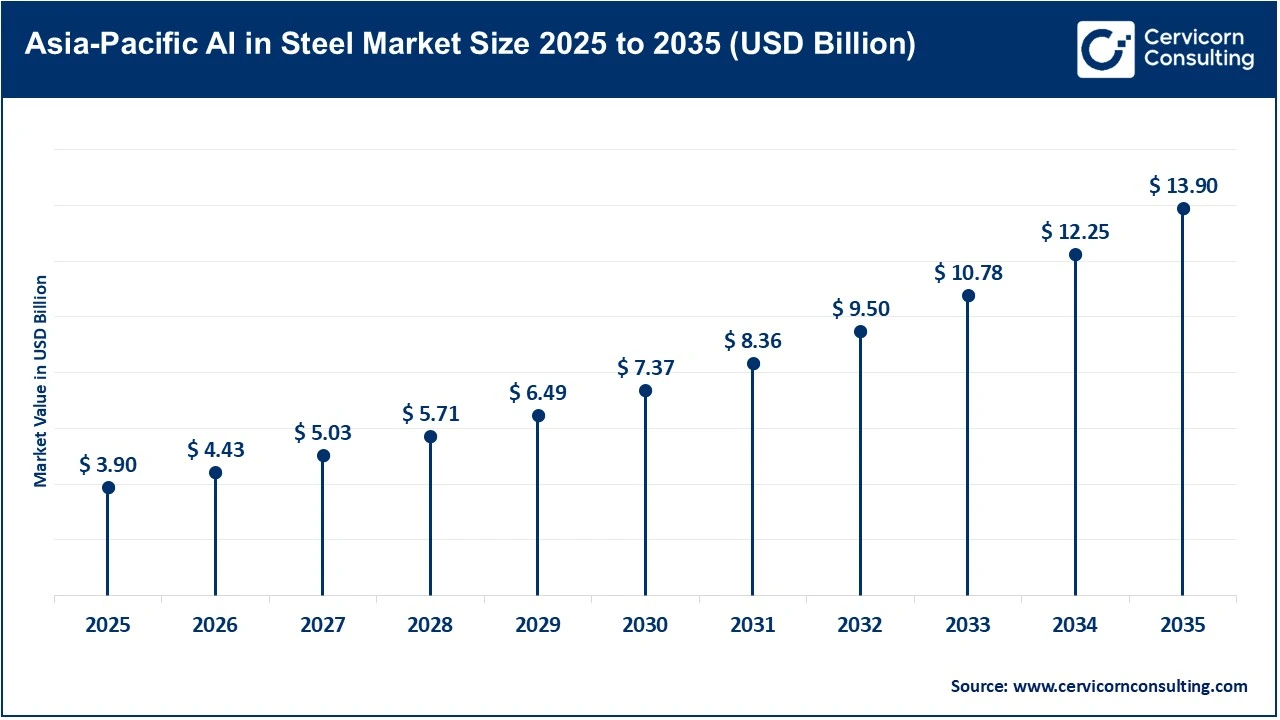
The Asia-Pacific market represents the largest and fastest-evolving region for AI in steel, supported by high steel production volumes, rapid industrial digitalization, and increasing investments in smart manufacturing technologies. The region is witnessing strong adoption of AI-driven predictive maintenance, process optimization, quality inspection, and energy management solutions as steelmakers focus on improving productivity and reducing operating costs. Rising government emphasis on industrial automation, carbon reduction, and intelligent manufacturing—particularly in China, India, Japan, and South Korea—is accelerating AI deployment across steel plants. Growing investments in Electric Arc Furnace (EAF) modernization, industrial robotics, and low-emission steel production are further supporting regional market expansion.
China: Dominance in global steel production, rapid smart factory deployment, and strong government-backed industrial AI initiatives continue driving market expansion.
India: Growing steel capacity expansion, digital manufacturing initiatives, and decarbonization goals support market growth.
The Europe AI in steel market size was accounted for USD 1.94 billion in 2025 and is forecasted to grow around USD 6.92 billion by 2035. The Europe market is witnessing strong growth, supported by stringent carbon reduction targets, increasing investments in Industry 4.0 technologies, and the region’s transition toward sustainable steel manufacturing. European steelmakers are increasingly deploying AI for predictive maintenance, process optimization, energy efficiency, and quality inspection to improve operational performance and comply with environmental regulations. The region’s strong emphasis on carbon neutrality, hydrogen-based steelmaking, and smart factory modernization is accelerating demand for AI-enabled industrial systems. In addition, supportive funding programs and industrial digitalization strategies across the European Union are strengthening market expansion.
Germany: Strong industrial automation ecosystem, advanced steel manufacturing capabilities, and Industry 4.0 leadership continue driving market expansion.
United Kingdom: Growing industrial digitalization, clean manufacturing initiatives, and smart factory investments support market growth.
AI in Steel Market Share, By Region, 2025 (%)
| Region | Revenue Share, 2025 (%) |
| Asia-Pacific | 42.8% |
| North America | 24.6% |
| Europe | 21.3% |
| LAMEA | 11.3% |
The LAMEA AI in steel market was valued at USD 1.03 billion in 2025 and is anticipated to reach around USD 3.67 billion by 2035. The LAMEA (Latin America, Middle East, and Africa) market is gradually expanding, supported by rising investments in industrial modernization, steel production capacity expansion, and increasing adoption of automation technologies in manufacturing. Steel producers across the region are increasingly exploring AI-driven predictive maintenance, process optimization, and energy management solutions to improve operational efficiency and reduce production costs. Government-led industrial diversification initiatives, infrastructure megaprojects, and sustainability goals, particularly in the Middle East, are accelerating the shift toward smart steel manufacturing. Growing investments in mining, construction, and industrial sectors are also strengthening demand for AI-enabled steel production technologies.
Brazil: Strong steel production base, industrial automation adoption, and mining integration continue driving market expansion.
Middle East (Saudi Arabia & UAE): Industrial diversification strategies and green steel ambitions accelerate market growth.
The AI in steel market is segmented into component, deployment type, technology, application, and geography.
The software segment dominates the AI in steel market due to its critical role in enabling predictive maintenance, process optimization, quality inspection, and production analytics across steel plants. Steel manufacturers increasingly invest in AI software platforms to analyze operational data from furnaces, rolling mills, and casting systems for improving productivity and reducing downtime. The flexibility, scalability, and integration capabilities of AI software with industrial automation systems have accelerated adoption, particularly among large steel producers seeking measurable efficiency gains and better operational decision-making.
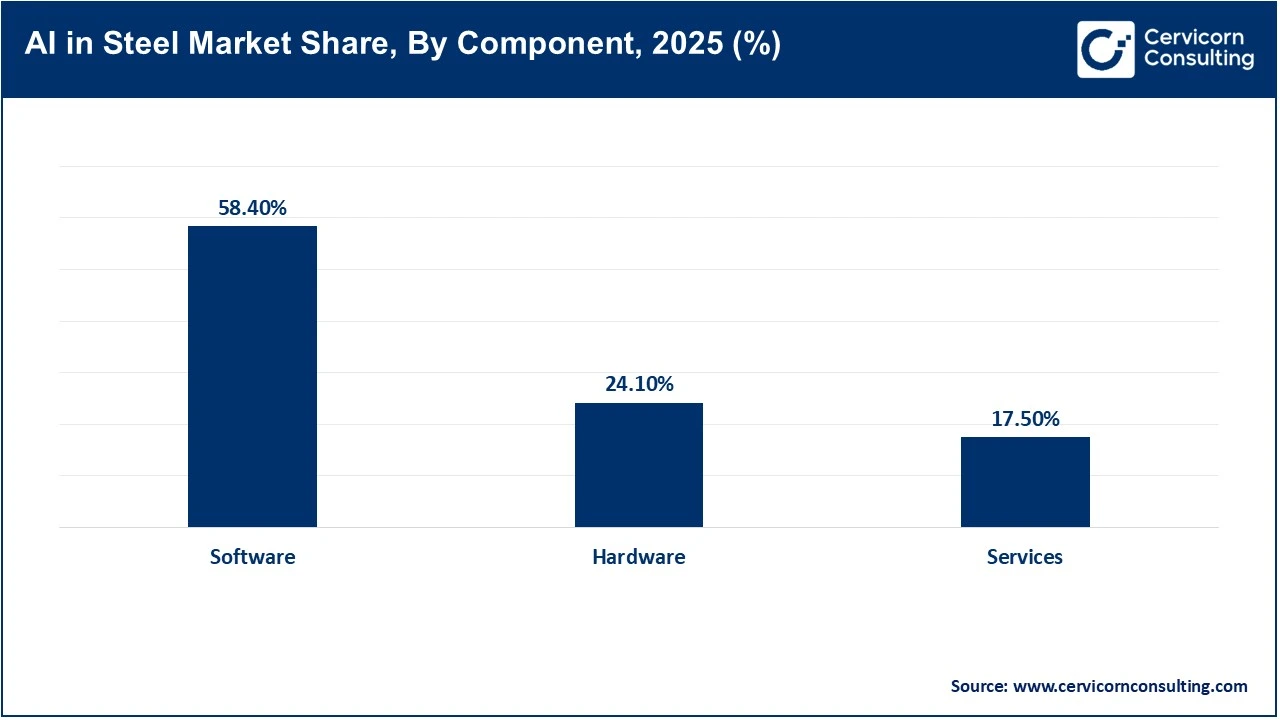
The services segment is expected to witness the fastest growth as steel manufacturers increasingly require consulting, deployment, integration, and maintenance support for AI implementation. Since many steel plants still operate on legacy infrastructure, companies rely on third-party expertise to integrate AI solutions with existing operational technology systems. Growing demand for customized AI models, workforce training, digital transformation strategies, and managed analytics services is accelerating the expansion of professional and support services across steel manufacturing ecosystems.
The on-premises segment dominates the AI in steel market because steel manufacturing facilities prioritize data security, operational reliability, and low-latency decision-making. Steel plants generate massive volumes of sensitive production data and often require real-time AI processing for furnace optimization, predictive maintenance, and automated quality control. On-premises deployment ensures stronger cybersecurity, uninterrupted operations, and seamless integration with industrial control systems, making it the preferred deployment model among integrated steel producers and large-scale manufacturing facilities.
AI in Steel Market, By Deployment Type, 2025 (%)
| Deployment Type | Revenue Share, 2025 (%) |
| On-Premises | 52.7% |
| Cloud-Based | 29.4% |
| Hybrid | 17.9% |
The cloud-based segment is projected to be the fastest growing due to rising digital transformation initiatives and the increasing need for scalable data analytics platforms. Cloud AI enables steel manufacturers to centralize production data, improve collaboration across facilities, and reduce upfront IT infrastructure costs. Additionally, growing adoption of industrial IoT, remote monitoring systems, and AI-powered enterprise analytics is encouraging steel companies to shift toward cloud environments for greater flexibility, advanced computing capabilities, and continuous software updates.
The machine learning (ML) segment dominates the AI in steel market owing to its extensive use in predictive maintenance, process optimization, defect prediction, and production planning. Steel manufacturers utilize ML algorithms to analyze historical and real-time plant data for identifying inefficiencies, predicting equipment failures, and optimizing furnace conditions. The technology’s proven ability to improve yield, reduce operational disruptions, and support intelligent decision-making has made machine learning the foundational technology across modern steel manufacturing operations.
AI in Steel Market, By Technology, 2025 (%)
| Technology | Revenue Share, 2025 (%) |
| Machine Learning (ML) | 26.3% |
| Computer Vision | 18.7% |
| Natural Language Processing (NLP) | 8.4% |
| Generative AI | 7.2% |
| Predictive Analytics | 19.6% |
| Robotics & Autonomous Systems | 13.1% |
| Others | 6.7% |
The generative AI segment is expected to grow at the fastest pace due to increasing demand for AI copilots, intelligent maintenance assistants, and automated operational knowledge systems in steel plants. Generative AI is helping manufacturers simplify complex technical workflows by providing real-time troubleshooting, maintenance guidance, and operational recommendations. As steel companies increasingly pursue smart factory initiatives and workforce digitization, generative AI is emerging as a transformative technology for improving productivity and reducing operational complexity.
The process optimization and production control segment dominates the AI in steel market because steel production is highly energy-intensive and operationally complex. AI solutions are widely adopted to optimize furnace temperature, chemical composition, rolling parameters, and throughput efficiency to reduce waste and improve product consistency. Since even small process improvements can significantly reduce costs and increase output quality, steel manufacturers prioritize AI investments in production optimization to maximize operational performance and profitability.
AI in Steel Market, By Application, 2025 (%)
| Application | Revenue Share, 2025 (%) |
| Predictive Maintenance | 19.2% |
| Process Optimization & Production Control | 24.8% |
| Quality Inspection & Defect Detection | 16.5% |
| Energy Optimization & Sustainability Management | 13.9% |
| Supply Chain & Demand Forecasting | 9.6% |
| Safety Monitoring & Workforce Analytics | 6.3% |
| Autonomous Operations & Robotics | 5.7% |
| Others | 4.0% |
The energy optimization and sustainability management segment is anticipated to be the fastest growing as steelmakers face increasing pressure to reduce carbon emissions and improve energy efficiency. AI technologies are being deployed to monitor furnace energy consumption, optimize fuel usage, and support carbon reduction strategies in response to stricter environmental regulations and green steel initiatives. Growing investments in low-carbon steel production and decarbonization programs are further accelerating adoption of AI-driven sustainability solutions across the industry.
By Component
By Deployment Type
By Technology
By Application
By Region
Chapter 1. Market Introduction and Overview
1.1 Market Definition and Scope
1.1.1 Overview of AI in Steel
1.1.2 Scope of the Study
1.1.3 Research Timeframe
1.2 Research Methodology and Approach
1.2.1 Methodology Overview
1.2.2 Data Sources and Validation
1.2.3 Key Assumptions and Limitations
Chapter 2. Executive Summary
2.1 Market Highlights and Snapshot
2.2 Key Insights by Segments
2.2.1 By Component Overview
2.2.2 By Deployment Type Overview
2.2.3 By Technology Overview
2.2.4 By Application Overview
2.3 Competitive Overview
Chapter 3. Global Impact Analysis
3.1 Russia-Ukraine Conflict: Global Market Implications
3.2 Regulatory and Policy Changes Impacting Global Markets
Chapter 4. Market Dynamics and Trends
4.1 Market Dynamics
4.1.1 Market Drivers
4.1.2 Market Restraints
4.1.3 Market Opportunities
4.1.4 Market Challenges
4.2 Market Trends
Chapter 5. Premium Insights and Analysis
5.1 Global AI in Steel Market Dynamics, Impact Analysis
5.2 Porter’s Five Forces Analysis
5.2.1 Bargaining Power of Suppliers
5.2.2 Bargaining Power of Buyers
5.2.3 Threat of Substitute Products
5.2.4 Rivalry among Existing Firms
5.2.5 Threat of New Entrants
5.3 PESTEL Analysis
5.4 Value Chain Analysis
5.5 Product Pricing Analysis
5.6 Vendor Landscape
5.6.1 List of Buyers
5.6.2 List of Suppliers
Chapter 6. AI in Steel Market, By Component
6.1 Global AI in Steel Market Snapshot, By Component
6.1.1 Market Revenue (($Billion) and Growth Rate (%), 2022-2035
6.1.1.1 Software
6.1.1.2 Hardware
6.1.1.3 Services
Chapter 7. AI in Steel Market, By Technology
7.1 Global AI in Steel Market Snapshot, By Technology
7.1.1 Market Revenue (($Billion) and Growth Rate (%), 2022-2035
7.1.1.1 Machine Learning (ML)
7.1.1.2 Computer Vision
7.1.1.3 Natural Language Processing (NLP)
7.1.1.4 Generative AI
7.1.1.5 Predictive Analytics
7.1.1.6 Robotics & Autonomous Systems
7.1.1.7 Others
Chapter 8. AI in Steel Market, By Deployment Type
8.1 Global AI in Steel Market Snapshot, By Deployment Type
8.1.1 Market Revenue (($Billion) and Growth Rate (%), 2022-2035
8.1.1.1 On-Premises
8.1.1.2 Cloud-Based
8.1.1.3 Hybrid
Chapter 9. AI in Steel Market, By Application
9.1 Global AI in Steel Market Snapshot, By Application
9.1.1 Market Revenue (($Billion) and Growth Rate (%), 2022-2035
9.1.1.1 Predictive Maintenance
9.1.1.2 Process Optimization & Production Control
9.1.1.3 Quality Inspection & Defect Detection
9.1.1.4 Energy Optimization & Sustainability Management
9.1.1.5 Supply Chain & Demand Forecasting
9.1.1.6 Safety Monitoring & Workforce Analytics
9.1.1.7 Autonomous Operations & Robotics
9.1.1.8 Others
Chapter 10. AI in Steel Market, By Region
10.1 Overview
10.2 AI in Steel Market Revenue Share, By Region 2024 (%)
10.3 Global AI in Steel Market, By Region
10.3.1 Market Size and Forecast
10.4 North America
10.4.1 North America AI in Steel Market Revenue, 2022-2035 ($Billion)
10.4.2 Market Size and Forecast
10.4.3 North America AI in Steel Market, By Country
10.4.4 U.S.
10.4.4.1 U.S. AI in Steel Market Revenue, 2022-2035 ($Billion)
10.4.4.2 Market Size and Forecast
10.4.4.3 U.S. Market Segmental Analysis
10.4.5 Canada
10.4.5.1 Canada AI in Steel Market Revenue, 2022-2035 ($Billion)
10.4.5.2 Market Size and Forecast
10.4.5.3 Canada Market Segmental Analysis
10.4.6 Mexico
10.4.6.1 Mexico AI in Steel Market Revenue, 2022-2035 ($Billion)
10.4.6.2 Market Size and Forecast
10.4.6.3 Mexico Market Segmental Analysis
10.5 Europe
10.5.1 Europe AI in Steel Market Revenue, 2022-2035 ($Billion)
10.5.2 Market Size and Forecast
10.5.3 Europe AI in Steel Market, By Country
10.5.4 UK
10.5.4.1 UK AI in Steel Market Revenue, 2022-2035 ($Billion)
10.5.4.2 Market Size and Forecast
10.5.4.3 UK Market Segmental Analysis
10.5.5 France
10.5.5.1 France AI in Steel Market Revenue, 2022-2035 ($Billion)
10.5.5.2 Market Size and Forecast
10.5.5.3 France Market Segmental Analysis
10.5.6 Germany
10.5.6.1 Germany AI in Steel Market Revenue, 2022-2035 ($Billion)
10.5.6.2 Market Size and Forecast
10.5.6.3 Germany Market Segmental Analysis
10.5.7 Rest of Europe
10.5.7.1 Rest of Europe AI in Steel Market Revenue, 2022-2035 ($Billion)
10.5.7.2 Market Size and Forecast
10.5.7.3 Rest of Europe Market Segmental Analysis
10.6 Asia Pacific
10.6.1 Asia Pacific AI in Steel Market Revenue, 2022-2035 ($Billion)
10.6.2 Market Size and Forecast
10.6.3 Asia Pacific AI in Steel Market, By Country
10.6.4 China
10.6.4.1 China AI in Steel Market Revenue, 2022-2035 ($Billion)
10.6.4.2 Market Size and Forecast
10.6.4.3 China Market Segmental Analysis
10.6.5 Japan
10.6.5.1 Japan AI in Steel Market Revenue, 2022-2035 ($Billion)
10.6.5.2 Market Size and Forecast
10.6.5.3 Japan Market Segmental Analysis
10.6.6 India
10.6.6.1 India AI in Steel Market Revenue, 2022-2035 ($Billion)
10.6.6.2 Market Size and Forecast
10.6.6.3 India Market Segmental Analysis
10.6.7 Australia
10.6.7.1 Australia AI in Steel Market Revenue, 2022-2035 ($Billion)
10.6.7.2 Market Size and Forecast
10.6.7.3 Australia Market Segmental Analysis
10.6.8 Rest of Asia Pacific
10.6.8.1 Rest of Asia Pacific AI in Steel Market Revenue, 2022-2035 ($Billion)
10.6.8.2 Market Size and Forecast
10.6.8.3 Rest of Asia Pacific Market Segmental Analysis
10.7 LAMEA
10.7.1 LAMEA AI in Steel Market Revenue, 2022-2035 ($Billion)
10.7.2 Market Size and Forecast
10.7.3 LAMEA AI in Steel Market, By Country
10.7.4 GCC
10.7.4.1 GCC AI in Steel Market Revenue, 2022-2035 ($Billion)
10.7.4.2 Market Size and Forecast
10.7.4.3 GCC Market Segmental Analysis
10.7.5 Africa
10.7.5.1 Africa AI in Steel Market Revenue, 2022-2035 ($Billion)
10.7.5.2 Market Size and Forecast
10.7.5.3 Africa Market Segmental Analysis
10.7.6 Brazil
10.7.6.1 Brazil AI in Steel Market Revenue, 2022-2035 ($Billion)
10.7.6.2 Market Size and Forecast
10.7.6.3 Brazil Market Segmental Analysis
10.7.7 Rest of LAMEA
10.7.7.1 Rest of LAMEA AI in Steel Market Revenue, 2022-2035 ($Billion)
10.7.7.2 Market Size and Forecast
10.7.7.3 Rest of LAMEA Market Segmental Analysis
Chapter 11. Competitive Landscape
11.1 Competitor Strategic Analysis
11.1.1 Top Player Positioning/Market Share Analysis
11.1.2 Top Winning Strategies, By Company, 2022-2024
11.1.3 Competitive Analysis By Revenue, 2022-2024
11.2 Recent Developments by the Market Contributors (2024)
Chapter 12. Company Profiles
12.1 Siemens
12.1.1 Company Snapshot
12.1.2 Company and Business Overview
12.1.3 Financial KPIs
12.1.4 Product/Service Portfolio
12.1.5 Strategic Growth
12.1.6 Global Footprints
12.1.7 Recent Development
12.1.8 SWOT Analysis
12.2 ABB
12.3 Honeywell
12.4 Rockwell Automation
12.5 Schneider Electric
12.6 IBM
12.7 Microsoft
12.8 NVIDIA
12.9 C3 AI
12.10 SAP
12.11 Fero Labs
12.12 Tata Consultancy Services