
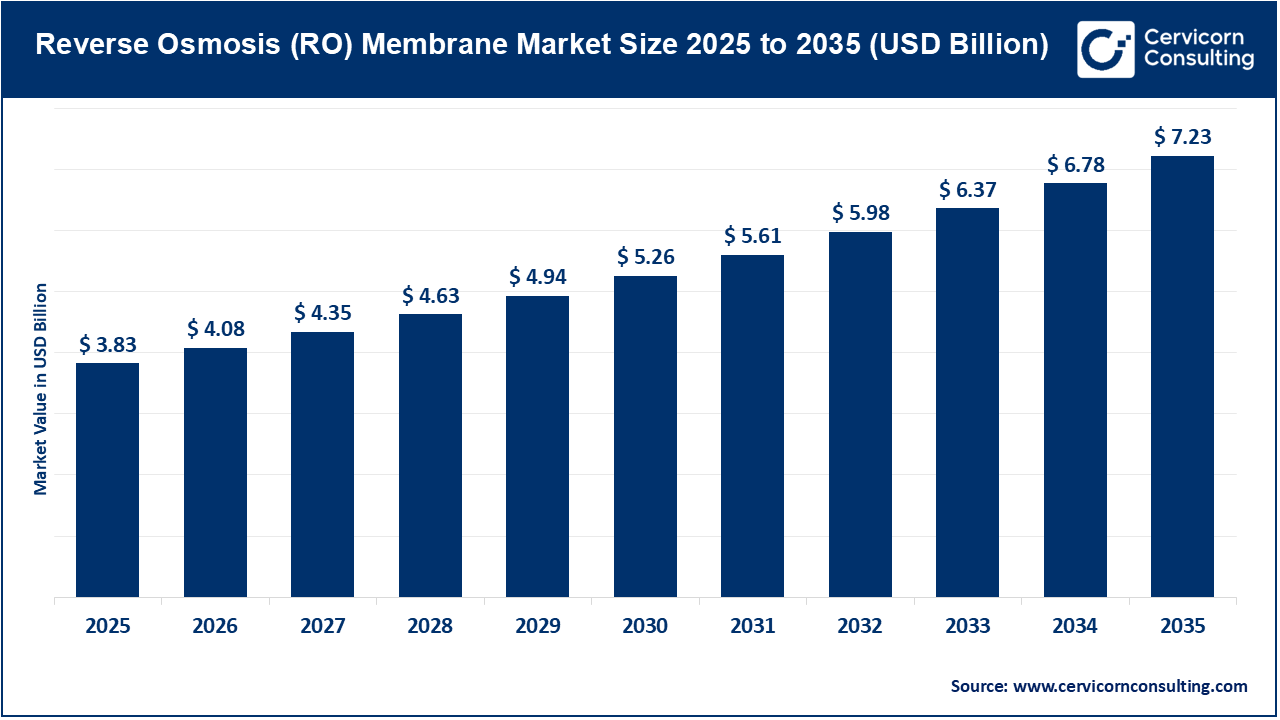
The global reverse osmosis (RO) membrane market size was estimated at USD 3.83 billion in 2025 and is expected to surpass around USD 7.23 billion by 2035, expanding at a compound annual growth rate (CAGR) of 6.6% over the forecast period from 2026 to 2035. The growth driver of the RO membrane market is the severe global water crisis, which has shifted from regional and environmental concerns to a systemic economic risk. In early 2025, international water agencies reported that 2.3 billion people lived in water-stressed regions, a figure expected to rise as the climate environment becomes more unpredictable. The impact of the water crisis is particularly pronounced in urban markets, where population density exceeds the underlying basin's capacity to sustain traditional ground and surface water resources. The scarcity of fresh water supplies has led municipal authorities to increasingly adopt RO-based desalination and potable water reuse systems.
Strict global environmental regulations on industrial discharge and wastewater reuse are another major growth factor in the market. Governments across major industrial economies, particularly China and India, have established "Zero Liquid Discharge" (ZLD) regulations that require industries to treat, recycle, and reuse process water within their facilities. Since 2025, these regulations have driven a 15% annual increase in demand for high-pressure RO membranes used to handle concentrated brine streams. Similarly, the European Union has introduced the Urban Wastewater Treatment Directive (UWWTD) for micropollutant removal during wastewater treatment.
Utilization of Nanotechnology in the Production of Advanced Membranes for the RO Membrane Market
A significant trend in the reverse osmosis membrane market is the growing adoption of nanotechnology-enabled advanced membranes, particularly the shift from conventional polyamide layers to thin-film nanocomposite (TFN) membranes. These advanced membranes integrate nanomaterials such as carbon nanotubes, graphene oxide, and metal-organic frameworks (MOFs) to enhance membrane performance. This shift is mainly driven by the need to overcome the “permeability-selectivity trade-off”, which increases water flux at the expense of salt rejection. As a result, test trials in 2025 indicate that TFN membranes can achieve 30-50% higher water flux than typical TFC membranes at similar salt-rejection values. Consequently, advances in TFN membranes enable desalination plants to operate at lower pressure, equivalent to a 10-15% reduction in energy costs. Furthermore, silver nanoparticles and titanium dioxide (TiOâ‚‚) introduced to the membrane surface have significantly increased biofilm formation, which is a major contributor to operational downtime.
Which Factors Affect Reverse Osmosis Membrane Performance?
1. Temperature and pressure influences
2. Chemical compatibility and fouling prevention
What is the Importance of reverse osmosis membranes in water treatment?
The importance of the RO membrane in water treatment stems from several factors.
Highlights the differences between reverse osmosis membranes and other water treatment methods:
Comparison of reverse osmosis membranes with other water treatment methods, such as activated carbon filtration or UV disinfection, shows their superiority in removing a wide range of contaminants.
| Water Treatment Method | Contaminants Removed | Efficiency | Maintenance | Cost |
| Reverse osmosis membranes | Bacteria, viruses, heavy metals, pesticides, pharmaceutical residues, dissolved solids | High | Minimal | Medium to high |
| Activated carbon filtration | Chlorine, organic compounds, odors | Medium | Frequent replacement of filters | Low to medium |
| UV disinfection | Bacteria, viruses | High | Regular bulb replacement | Low to medium |
Global Water Access Gaps and Accelerating RO Desalination Capacity in Saudi Arabia
The figure presents a clear difference in global access to safe drinking water and highlights the rapid growth of RO desalination capacity in Saudi Arabia. Developed regions such as North America and Europe have achieved near-universal access to safely managed water, while many developing areas, including Sub-Saharan Africa and parts of Asia, continue to depend on basic or unimproved sources. This situation indicates a persistent need for advanced water treatment technologies. At the same time, the expansion of RO capacity in Saudi Arabia demonstrates significant investment in desalination infrastructure to address water scarcity. These trends suggest that demand for RO membranes will likely remain strong, supported by infrastructure development in water-scarce regions and ongoing efforts to improve water quality globally.
1. National Initiatives for Sustainability, Desalination, and Water Security
Government-led sustainability and water security initiatives are playing a crucial role in the growth of the reverse osmosis membrane market. In early 2025, the Saudi national government successfully commissioned the Saline Water Conversion Corporation (SWCC) to build a solar-powered RO desalination plant. These initiatives are shifting towards "Green Desalination", with a massive 400 MW solar array enabling large-scale water production while reducing dependence on fossil fuels. Additionally, the project is expected to reduce the carbon footprint by 300,000 tons of CO2 annually, setting a new global benchmark for sustainable municipal water supply.
2. Corporate Innovations in High-Flux Membrane Technology
Continuous innovation in membrane technology is a significant growth driver for the reverse osmosis membrane market. In 2024, a leading global chemical manufacturer commercialised its new generation of "High-Flux membranes", designed using an advanced interfacial polymerisation process that creates a thinner, more uniform active layer. These innovations deliver 20% higher water output without increasing the system footprint. These advanced membranes have already been adopted by several major microchip fabrication plants in Taiwan and South Korea, where ultra-pure water (UPW) is an important input to the manufacturing process.
3. Strategic Mergers and Acquisitions in the Water Treatment Industry
Strategic mergers and acquisitions in the water treatment industry mark a significant milestone in the market. In 2025, the water treatment sector's consolidation saw a multi-billion-dollar merger between two Tier-1 technology providers, creating a larger global player with an integrated portfolio of RO membranes, pre-treatment chemicals, and digital monitoring solutions. As a result, the merger shifted the focus to "Total Water Management" solutions, where the end user prefers a single partner to manage the entire treatment process.
4. Regulatory Developments in Global Standards for Water Reuse
Regulatory developments in water reuse standards are emerging as a major growth driver for the reverse osmosis membrane market. In 2025, the European Union implemented the "Water Reuse Regulation," which establishes harmonised minimum water quality requirements for the safe reuse of treated urban wastewater in agricultural irrigation. The Water Reuse Regulation has been a significant catalyst for the RO market, as RO is the only technology capable of meeting the stringent "Class A" water quality requirement for high-value crops. As a result, more than 200 new water reclamation projects have begun in Southern Europe, representing a projected demand for over 500,000 RO membrane elements by 2027. This regulation is expected to significantly expand the role of reverse osmosis in sustainable water reuse applications.
The RO membrane market is segmented by region into North America, Europe, Asia-Pacific, and LAMEA. Here is a brief overview of each region:
The Asia-Pacific reverse osmosis (RO) membrane market size was estimated at USD 1.46 billion in 2025 and is projected to reach around USD 2.75 billion by 2035.
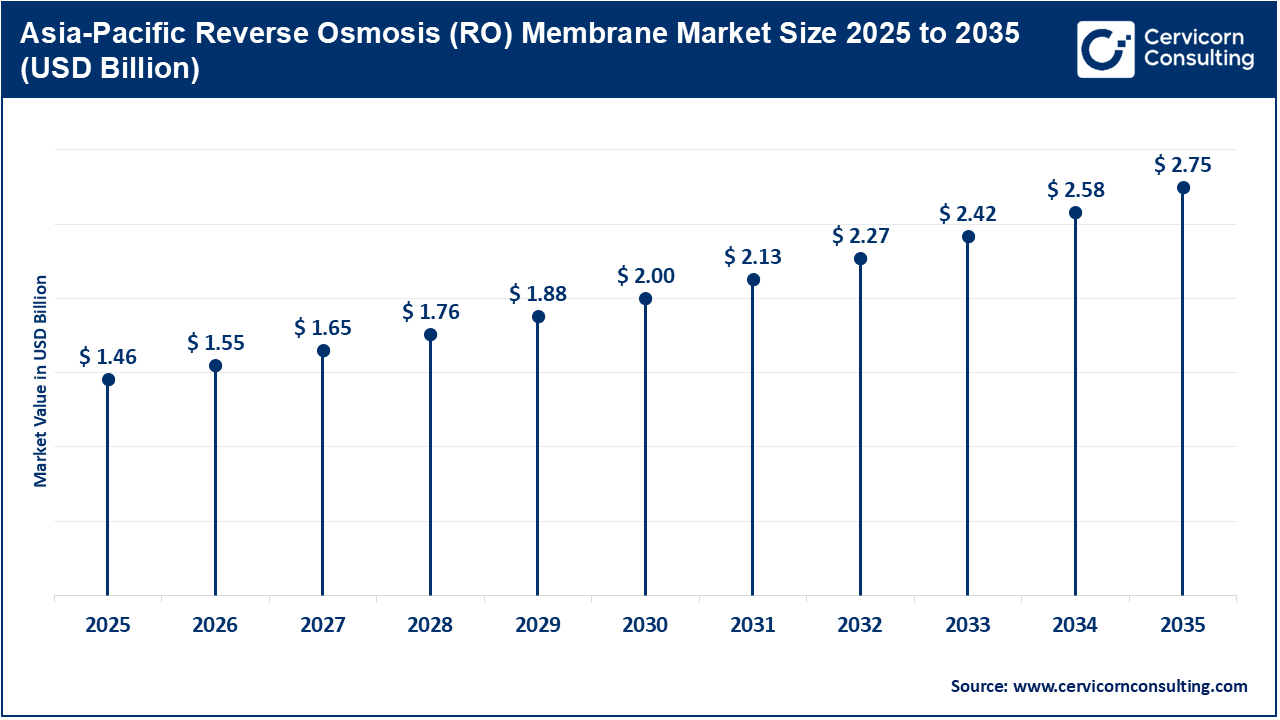
The Asia Pacific region dominates the global RO membrane market, driven by rapid infrastructure development and urban expansion in major countries such as China and India. Rapid urbanisation has strained traditional groundwater sources, prompting municipalities to invest heavily in large-scale desalination and wastewater recycling facilities. For instance, China is expected to increase its seawater desalination capacity to nearly 3 million cubic metres per day by 2025. In India, strict compliance with Zero Liquid Discharge (ZLD) regulations in the industrial sector has increased demand for RO membranes.
China: Becoming the Global Leader in Capacity Expansion in the Industrial Sector
China is a global leader in scaling up domestic membrane manufacturing capabilities to reduce dependence on foreign technology and to fulfil its own ambitious water conservation goals.
India: Government Missions and Clean Water Infrastructure
India's RO market is driven by large-scale government missions that aim to provide piped water to every home and to clean up river systems across the country.
Japan: R&D Focused on High-Performance Membrane Materials
Japan is a major global hub for membrane innovation, supporting leading materials science companies that have set industry standards.
The North America reverse osmosis (RO) membrane market size reached at USD 0.92 billion in 2025 and is expected to surpass around USD 1.74 billion by 2035. In North America, the RO membrane market is primarily driven by the modernization of ageing water infrastructure and regulations on emerging contaminants. Regulatory bodies such as the Environmental Protection Agency (EPA) have introduced stringent limits on PFAS (per- and polyfluoroalkyl substances) in drinking water, prompting the installation of reverse osmosis (RO) systems, which are home-based technologies that can effectively remove these substances, often referred to as "forever chemicals". Additionally, rapid expansion of the semiconductor and pharmaceutical industries has increased demand for more robust membranes for high-performance ultra-pure water (UPW) used in advanced manufacturing processes.
United States: Trends in Municipal Infrastructure Replacement and the Desalination Sector
The United States market is entering a replacement cycle, with aging filtration systems being upgraded to advanced RO technologies to comply with safety standards.
Canada: Resource Extraction Industries and Industrial Water Recycling
Canada’s RO market is closely linked to its resource extraction industries, where water recycling supports environmental compliance and operational efficiency.
The Europe reverse osmosis (RO) membrane market size was accounted for USD 0.69 billion in 2025 and is projected to hit around USD 1.30 billion by 2035. The European RO membrane market is characterized by sustainability and energy efficiency, aligning with the EU Green Deal and the Circular Economy Action Plan. Countries such as Spain and Greece are expanding seawater desalination capacity, with many facilities increasingly integrated with renewable energy sources to reduce operational carbon emissions. Moreover, strict regulations to limit the environmental impacts of brine discharge are driving innovation in "Brine-to-Value" technologies, in which RO is combined with electrodialysis to recover minerals from treated brine. Additionally, the production of green hydrogen in Europe is growing because it requires high-purity water to be viable for electrolysis.
United Kingdom: Utility Sector Upgrades and Sustainable Water Management
The United Kingdom water sector is essential for long-term resilience, reduction, and pollution control, and is increasing the use of RO for advanced water treatment.
Germany: Excellence in Chemical Processing and Filtration Engineering.
Germany is Europe's largest industrial RO user, driven by strong demand from its chemical and automotive industries.
Reverse Osmosis (RO) Membrane Market Share, By Region, 2025 (%)
| Region | Revenue Share, 2025 (%) |
| Asia Pacific | 38% |
| North America | 24% |
| Europe | 18% |
| LAMEA | 20% |
The LAMEA reverse osmosis (RO) membrane market was valued at USD 0.77 billion in 2025 and is anticipated to reach around USD 1.45 billion by 2035. The LAMEA region, particularly the Middle East, is one of the most significant markets for seawater desalination. Market shifts are moving from energy-intensive thermal desalination technologies such as multi-stage flash (MSF) and multi-effect distillation (MED) towards reverse osmosis systems, which offer significantly lower energy consumption. RO technology consumes approximately 3-4 kWh/m³ of energy, significantly lower than thermal desalination processes, which typically require more than 10 kWh/m³. This improved energy efficiency is supported by countries such as Saudi Arabia and the UAE, which are expanding "Independent Water Projects" (IWPs) to attract private investment in desalination infrastructure development.
Brazil: Agricultural Needs and New Industrial Water Use
Brazil’s RO market is expanding into agricultural and municipal applications, supported by efforts to address recurring regional droughts.
Middle East (UAE and Saudi Arabia): Mega-Scale Seawater Desalination Projects
The Middle East remains the global hub of RO market growth as countries shift away from thermal desalination systems to meet sustainability goals.
The reverse osmosis membrane market is segmented into type, filter module, application, end-use industry, and region.
The Thin Film Composite (TFC) membrane segment is the primary market segment, owing to its high salt rejection and water flux across a wide range of salinity conditions. These membranes consist of a thin polyamide active layer supported by a porous polysulfone layer, enabling molecular-level engineering for applications such as seawater desalination and brackish water treatment. Their high adoption is driven by continuous incremental improvements in energy efficiency and durability, making them the default membrane for municipal utilities and large-scale industrial applications.
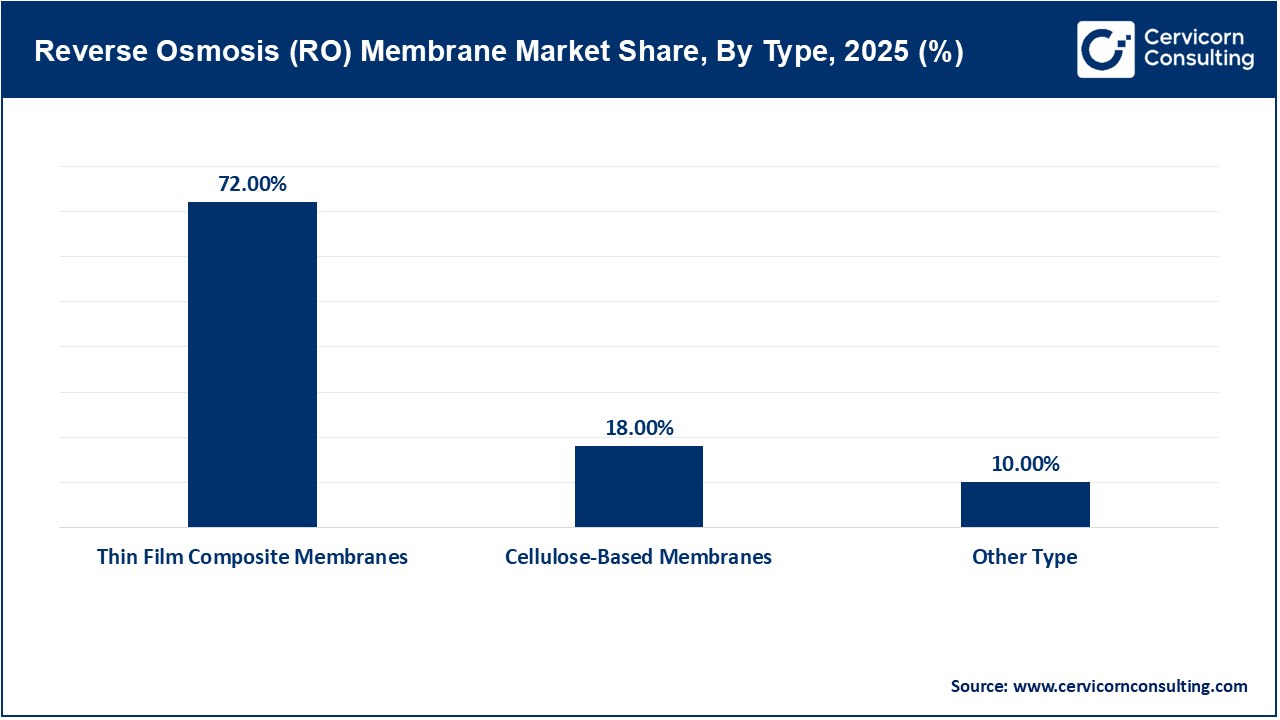
The cellulose-based membranes segment is projected to experience the fastest growth during the forecast period, mainly due to its strong performance in high-fouling and chlorine-intensive environments. Unlike polyamide-based TFC membranes, cellulose-based membranes offer inherent resistance to oxidant degradation, making them particularly suitable for wastewater treatment processes where disinfectants such as chlorine are commonly present. These benefits have made cellulose-based membranes increasingly popular for treating municipal secondary effluent and challenging industrial wastewater.
Spiral Wound modules are the leading filter module type due to their high packing density, ease of operation, and effective fouling resistance. These modules, containing flat membrane sheets wound around a central permeate-collection tube, provide a high surface area for treatment while enabling effective cleaning through high-velocity cross-flow operation. In addition, the availability of standardized sizes for spiral wound modules, such as 4 and 8 inch diameters, has improved affordability and availability.
Reverse Osmosis (RO) Membrane Market Share, By Filter Module, 2025 (%)
| Filter Module | Revenue Share, 2025 (%) |
| Spiral Wound | 61% |
| Hollow Fiber | 17% |
| Tubular | 12% |
| Plate & Frame | 10% |
Hollow Fiber Modules are the fastest-growing segment of the market, primarily driven by increasing deployment in large-scale seawater desalination plants and specialized gas separation applications. These systems consist of thousands of tiny fibers that provide a very high surface-area-to-volume ratio, much higher than conventional modules, enabling greater water production in a smaller footprint. As a result, the adoption of hollow fiber systems has expanded in new mega-projects across the Middle East and East Asia.
Wastewater Treatment & Refuse is the leading application in the RO membranes market, supported by the growing global focus on water recycling and sustainable wastewater management. As freshwater supplies gradually decline, wastewater is increasingly seen as a valuable resource that can be purified to potable or high-quality standards for industrial use. In addition, industries such as textiles, chemicals, and food processing are increasingly adopting RO membrane systems to comply with strict environmental regulations and reduce their overall water footprint.
Reverse Osmosis (RO) Membrane Market Share, By Application, 2025 (%)
| Application | Revenue Share, 2025 (%) |
| Wastewater Treatment & Refuse | 34% |
| Desalination | 27% |
| Utility Water Treatment | 16% |
| Process Water | 11% |
| Potable Water | 8% |
| Other | 4% |
Desalination is expected to be the fastest-growing application in the market, primarily to secure the national water supply in arid and coastal areas. Factors such as climate change-related droughts and the depletion of groundwater supplies have shifted seawater RO (SWRO) from a luxury to an essential solution in countries such as Australia, Israel, and Saudi Arabia. The rapid growth of this segment has also been enhanced by technology that has reduced the cost of providing potable water from desalination facilities by more than 50% over the last 20 years.
The water & wastewater treatment is the largest end-use segment in the market because it plays an essential role in municipal governments and public utility systems, which manage the large majority of the global water infrastructure. These entities operate large facilities that use thousands of membrane elements to supply drinking water to expanding urban populations. However, high levels of public-sector investment and long-term infrastructure planning create a stable and predictable market environment for membrane manufacturers.
Reverse Osmosis (RO) Membrane Market Share, By End-Use Industry, 2025 (%)
| End-Use Industry | Revenue Share, 2025 (%) |
| Water & Wastewater Treatment | 68% |
| Industrial Processing | 32% |
Industrial Processing is the fastest-growing end user, driven by rising demand from industries such as semiconductors, pharmaceuticals, and power generation. Within these industries, reverse osmosis (RO) is not simply a waste treatment tool but more of a "process tool" used to produce ultra-pure water (UPW), which is essential for product quality. For example, the semiconductor industry requires water with extremely low impurity levels, and advanced RO membrane systems are designed to deliver it.
By Type
By Filter Module
By Application
By End-Use Industry
By Region
Chapter 1. Market Introduction and Overview
1.1 Market Definition and Scope
1.1.1 Overview of Reverse Osmosis (RO) Membrane
1.1.2 Scope of the Study
1.1.3 Research Timeframe
1.2 Research Methodology and Approach
1.2.1 Methodology Overview
1.2.2 Data Sources and Validation
1.2.3 Key Assumptions and Limitations
Chapter 2. Executive Summary
2.1 Market Highlights and Snapshot
2.2 Key Insights by Segments
2.2.1 By Type Overview
2.2.2 By Filter Module Overview
2.2.3 By Application Overview
2.2.4 By End-Use Industry Overview
2.3 Competitive Overview
Chapter 3. Global Impact Analysis
3.1 Russia-Ukraine Conflict: Global Market Implications
3.2 Regulatory and Policy Changes Impacting Global Markets
Chapter 4. Market Dynamics and Trends
4.1 Market Dynamics
4.1.1 Market Drivers
4.1.2 Market Restraints
4.1.3 Market Opportunities
4.1.4 Market Challenges
4.2 Market Trends
Chapter 5. Premium Insights and Analysis
5.1 Global Reverse Osmosis (RO) Membrane Market Dynamics, Impact Analysis
5.2 Porter’s Five Forces Analysis
5.2.1 Bargaining Power of Suppliers
5.2.2 Bargaining Power of Buyers
5.2.3 Threat of Substitute Products
5.2.4 Rivalry among Existing Firms
5.2.5 Threat of New Entrants
5.3 PESTEL Analysis
5.4 Value Chain Analysis
5.5 Product Pricing Analysis
5.6 Vendor Landscape
5.6.1 List of Buyers
5.6.2 List of Suppliers
Chapter 6. Reverse Osmosis (RO) Membrane Market, By Type
6.1 Global Reverse Osmosis (RO) Membrane Market Snapshot, By Type
6.1.1 Market Revenue (($Billion) and Growth Rate (%), 2022-2035
6.1.1.1 Thin Film Composite Membranes
6.1.1.2 Cellulose-Based Membranes
6.1.1.3 Others
Chapter 7. Reverse Osmosis (RO) Membrane Market, By Filter Module
7.1 Global Reverse Osmosis (RO) Membrane Market Snapshot, By Filter Module
7.1.1 Market Revenue (($Billion) and Growth Rate (%), 2022-2035
7.1.1.1 Spiral Wound
7.1.1.2 Hollow Fiber
7.1.1.3 Tubular
7.1.1.4 Plate & Frame
Chapter 8. Reverse Osmosis (RO) Membrane Market, By Application
8.1 Global Reverse Osmosis (RO) Membrane Market Snapshot, By Application
8.1.1 Market Revenue (($Billion) and Growth Rate (%), 2022-2035
8.1.1.1 Wastewater Treatment & Refuse
8.1.1.2 Desalination
8.1.1.3 Utility Water Treatment
8.1.1.4 Process Water
8.1.1.5 Potable Water
8.1.1.6 Others
Chapter 9. Reverse Osmosis (RO) Membrane Market, By End-Use Industry
9.1 Global Reverse Osmosis (RO) Membrane Market Snapshot, By End-Use Industry
9.1.1 Market Revenue (($Billion) and Growth Rate (%), 2022-2035
9.1.1.1 Water & Wastewater Treatment
9.1.1.2 Industrial Processing
Chapter 10. Reverse Osmosis (RO) Membrane Market, By Region
10.1 Overview
10.2 Reverse Osmosis (RO) Membrane Market Revenue Share, By Region 2024 (%)
10.3 Global Reverse Osmosis (RO) Membrane Market, By Region
10.3.1 Market Size and Forecast
10.4 North America
10.4.1 North America Reverse Osmosis (RO) Membrane Market Revenue, 2022-2035 ($Billion)
10.4.2 Market Size and Forecast
10.4.3 North America Reverse Osmosis (RO) Membrane Market, By Country
10.4.4 U.S.
10.4.4.1 U.S. Reverse Osmosis (RO) Membrane Market Revenue, 2022-2035 ($Billion)
10.4.4.2 Market Size and Forecast
10.4.4.3 U.S. Market Segmental Analysis
10.4.5 Canada
10.4.5.1 Canada Reverse Osmosis (RO) Membrane Market Revenue, 2022-2035 ($Billion)
10.4.5.2 Market Size and Forecast
10.4.5.3 Canada Market Segmental Analysis
10.4.6 Mexico
10.4.6.1 Mexico Reverse Osmosis (RO) Membrane Market Revenue, 2022-2035 ($Billion)
10.4.6.2 Market Size and Forecast
10.4.6.3 Mexico Market Segmental Analysis
10.5 Europe
10.5.1 Europe Reverse Osmosis (RO) Membrane Market Revenue, 2022-2035 ($Billion)
10.5.2 Market Size and Forecast
10.5.3 Europe Reverse Osmosis (RO) Membrane Market, By Country
10.5.4 UK
10.5.4.1 UK Reverse Osmosis (RO) Membrane Market Revenue, 2022-2035 ($Billion)
10.5.4.2 Market Size and Forecast
10.5.4.3 UK Market Segmental Analysis
10.5.5 France
10.5.5.1 France Reverse Osmosis (RO) Membrane Market Revenue, 2022-2035 ($Billion)
10.5.5.2 Market Size and Forecast
10.5.5.3 France Market Segmental Analysis
10.5.6 Germany
10.5.6.1 Germany Reverse Osmosis (RO) Membrane Market Revenue, 2022-2035 ($Billion)
10.5.6.2 Market Size and Forecast
10.5.6.3 Germany Market Segmental Analysis
10.5.7 Rest of Europe
10.5.7.1 Rest of Europe Reverse Osmosis (RO) Membrane Market Revenue, 2022-2035 ($Billion)
10.5.7.2 Market Size and Forecast
10.5.7.3 Rest of Europe Market Segmental Analysis
10.6 Asia Pacific
10.6.1 Asia Pacific Reverse Osmosis (RO) Membrane Market Revenue, 2022-2035 ($Billion)
10.6.2 Market Size and Forecast
10.6.3 Asia Pacific Reverse Osmosis (RO) Membrane Market, By Country
10.6.4 China
10.6.4.1 China Reverse Osmosis (RO) Membrane Market Revenue, 2022-2035 ($Billion)
10.6.4.2 Market Size and Forecast
10.6.4.3 China Market Segmental Analysis
10.6.5 Japan
10.6.5.1 Japan Reverse Osmosis (RO) Membrane Market Revenue, 2022-2035 ($Billion)
10.6.5.2 Market Size and Forecast
10.6.5.3 Japan Market Segmental Analysis
10.6.6 India
10.6.6.1 India Reverse Osmosis (RO) Membrane Market Revenue, 2022-2035 ($Billion)
10.6.6.2 Market Size and Forecast
10.6.6.3 India Market Segmental Analysis
10.6.7 Australia
10.6.7.1 Australia Reverse Osmosis (RO) Membrane Market Revenue, 2022-2035 ($Billion)
10.6.7.2 Market Size and Forecast
10.6.7.3 Australia Market Segmental Analysis
10.6.8 Rest of Asia Pacific
10.6.8.1 Rest of Asia Pacific Reverse Osmosis (RO) Membrane Market Revenue, 2022-2035 ($Billion)
10.6.8.2 Market Size and Forecast
10.6.8.3 Rest of Asia Pacific Market Segmental Analysis
10.7 LAMEA
10.7.1 LAMEA Reverse Osmosis (RO) Membrane Market Revenue, 2022-2035 ($Billion)
10.7.2 Market Size and Forecast
10.7.3 LAMEA Reverse Osmosis (RO) Membrane Market, By Country
10.7.4 GCC
10.7.4.1 GCC Reverse Osmosis (RO) Membrane Market Revenue, 2022-2035 ($Billion)
10.7.4.2 Market Size and Forecast
10.7.4.3 GCC Market Segmental Analysis
10.7.5 Africa
10.7.5.1 Africa Reverse Osmosis (RO) Membrane Market Revenue, 2022-2035 ($Billion)
10.7.5.2 Market Size and Forecast
10.7.5.3 Africa Market Segmental Analysis
10.7.6 Brazil
10.7.6.1 Brazil Reverse Osmosis (RO) Membrane Market Revenue, 2022-2035 ($Billion)
10.7.6.2 Market Size and Forecast
10.7.6.3 Brazil Market Segmental Analysis
10.7.7 Rest of LAMEA
10.7.7.1 Rest of LAMEA Reverse Osmosis (RO) Membrane Market Revenue, 2022-2035 ($Billion)
10.7.7.2 Market Size and Forecast
10.7.7.3 Rest of LAMEA Market Segmental Analysis
Chapter 11. Competitive Landscape
11.1 Competitor Strategic Analysis
11.1.1 Top Player Positioning/Market Share Analysis
11.1.2 Top Winning Strategies, By Company, 2022-2024
11.1.3 Competitive Analysis By Revenue, 2022-2024
11.2 Recent Developments by the Market Contributors (2024)
Chapter 12. Company Profiles
12.1 DuPont Water Solutions
12.1.1 Company Snapshot
12.1.2 Company and Business Overview
12.1.3 Financial KPIs
12.1.4 Product/Service Portfolio
12.1.5 Strategic Growth
12.1.6 Global Footprints
12.1.7 Recent Development
12.1.8 SWOT Analysis
12.2 Toray Industries, Inc.
12.3 Hydranautics
12.4 LG Chem
12.5 SUEZ Water Technologies & Solutions
12.6 Koch Separation Solutions
12.7 Pentair plc
12.8 LANXESS AG
12.9 Toyobo Co., Ltd.
12.10 Veolia Water Technologies
12.11 Parker Hannifin Corporation
12.12 Membranium
12.13 AXEON Water Technologies
12.14 Evoqua Water Technologies
12.15 Applied Membranes Inc.