
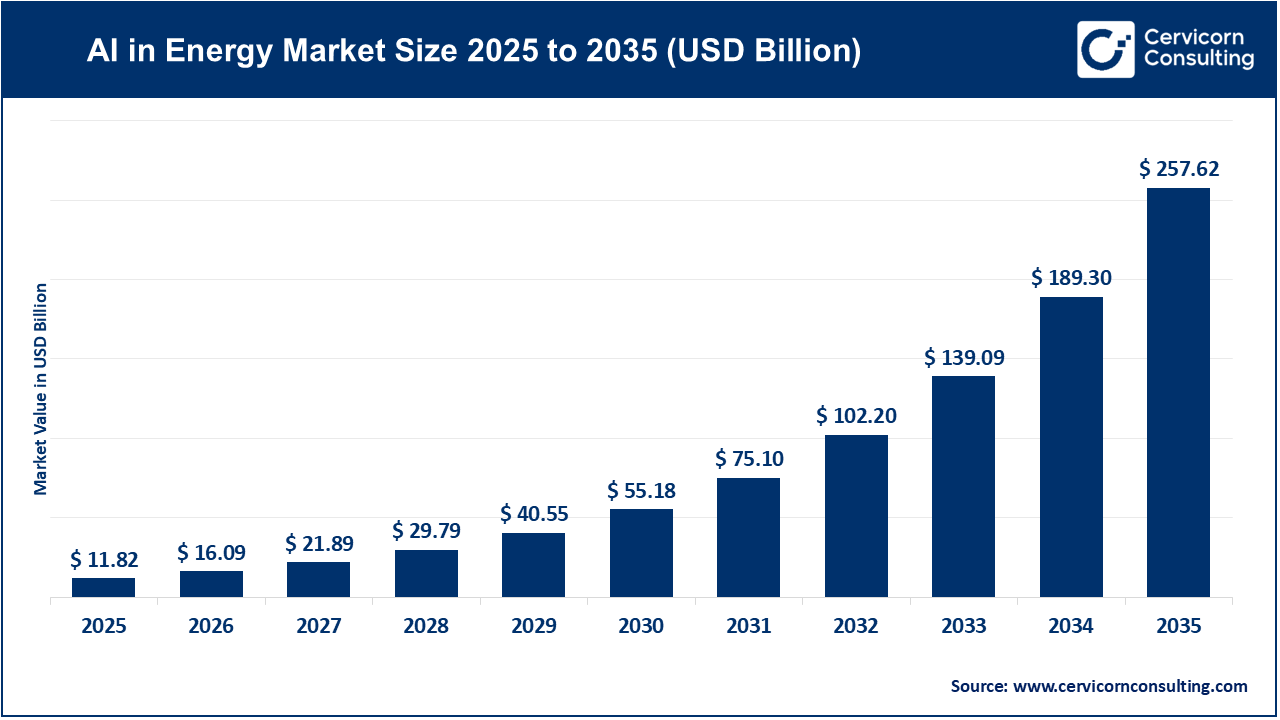
The global AI in energy market size was valued at USD 11.82 billion in 2025 and is expected to be worth around USD 257.62 billion by 2035, exhibiting at a compound annual growth rate (CAGR) of 36.1% over the forecast period from 2026 to 2035. The artificial intelligence in the energy market is primarily driven by the increasing need for grid efficiency and the global shift toward sustainable energy systems. To achieve the Fit for 55 and REPowerEU targets for renewables and energy efficiency, it is estimated that approximately USD 584 billion in electricity infrastructure investments are required between 2020 and 2030, especially in the distribution grid. As the worldwide energy crisis persists, AI will serve as a vital mechanism to enhance how electricity is generated, transmitted, and distributed. AI technologies enable the analysis of large volumes of operational data and help make decisions faster, balancing electricity supply with demand. In fact, integrating artificial intelligence with smart grid analytics can cut overall energy consumption by 10% to 40% across the industrial, residential, and transportation sectors. Additionally, employing advanced techniques such as deep neural networks can reduce building energy use by 18.97% to 42.60%, underscoring AI's significant potential in optimizing energy use and advancing sustainability goals.
The rapid growth of data-generating infrastructure, coupled with the evolution of Internet of Things (IoT) devices, is another key factor driving market expansion. According to IoT Analytics, the number of connected IoT devices reached 18.5 billion in 2024, reflecting a 12% increase from 2023. These devices include smart meters, grid sensors, and monitoring systems that continuously track and analyse energy production, consumption, and equipment performance. In September 2024, approximately 300 million connections fell short of the forecast from IoT Analytics, mainly due to ongoing capital expenditure deferrals and lower-than-expected demand in China. The combination of IoT and artificial intelligence creates a powerful, decisive framework for improving operational efficiency, procurement, and health and resource monitoring in energy systems.
The Ascendance of Generative AI for Power System Resiliency and Cyber security
The introduction of Generative AI (GenAI) marks a significant trend in power systems and cybersecurity within the AI in energy market. Traditionally, utilities relied on limited historical data to test the power grid and prepare for disasters. GenAI addresses this data scarcity by generating synthetic weather scenarios and cyber-attack simulations based on physical principles, even if they have not yet occurred in reality. This creates new opportunities for grid operators to train their control systems on extensive libraries of hypothetical disasters, greatly enhancing the system's resilience. GenAI produces synthetic datasets that improve response time to abnormal frequency deviations by 35%. This is especially important because frequency deviations can cause cascading failures within milliseconds if not promptly addressed.
Adoption and Implementation of AI in Energy Systems
| Pointers | Value | Description |
| Energy companies adopting AI | 66% | Majority of energy firms are implementing AI for predictive maintenance, monitoring, and optimization of energy systems. |
| Utility control rooms expected to use AI by 2027 | 40% | AI is increasingly used in utility control rooms to support grid monitoring and decision-making. |
| Grid operators using AI for power distribution optimization | 42% | AI tools help operators manage electricity distribution and balance load during peak demand periods. |
| Electrical project planners using AI simulations | 58% | AI is used to simulate electrical system performance before infrastructure installation. |
Artificial intelligence adoption in the energy sector is rapidly increasing as companies aim to improve operational efficiency and grid reliability. Approximately 66% of energy firms already deploy AI technologies to enhance predictive maintenance and real-time monitoring of power systems. In addition, 42% of electrical grid operators use AI to optimize power distribution, enabling utilities to manage peak electricity demand more effectively. These tools also allow planners to simulate system behavior before deployment, which explains why 58% of electrical project planners rely on AI-based simulations during project design and development.
Digital Infrastructure Supporting AI in Energy
| Statistic | Value | Description |
| Global smart meters installed | 1.06 billion | Smart meters generate real-time consumption data used by AI analytics platforms. |
| Data center electricity demand growth by 2030 | More than double | AI computing workloads are increasing electricity consumption globally. |
| Share of electricity demand growth from data centers (advanced economies) | Over 20% by 2030 | AI and digital services are major drivers of new electricity demand. |
The deployment of digital infrastructure is crucial for enabling AI applications in the energy sector. By 2023, more than 1.06 billion smart meters had been installed worldwide, providing granular data that AI systems use to monitor consumption and optimize grid performance. Meanwhile, the rapid growth of AI technologies is increasing electricity demand, particularly from data centers. Reports suggest that data center electricity consumption could more than double by 2030, and in advanced economies they may account for over 20% of electricity demand growth during this period.
1. Corporate Innovation and Market Statistics
Corporate innovation drives market growth. The rapid expansion of the DeepTech ecosystem has led to 340 venture-backed start-ups in the Latin America and Caribbean (LAC) region. Many of these start-ups focus on scientific and engineering solutions to address global challenges. These companies are increasingly integrating AI into their technologies to boost productivity, optimize industrial processes, and develop new energy solutions. The steady increase in start-ups reflects growing investor confidence in technology-driven solutions for the energy and manufacturing sectors.
Corporate Innovation and Statistical Milestones in the AI in Energy Market
| Company | Innovation Area | Key Statistics | Market Significance |
| International Energy Agency | AI for energy optimization and grid management | AI adoption in power systems could generate up to USD 110 billion annual cost savings by 2035. | Demonstrates strong economic benefits of AI adoption in energy infrastructure. |
| AI-based data center energy efficiency | AI-powered cooling systems reduced data center energy consumption by about 40% | Shows how AI significantly improves operational efficiency in energy-intensive facilities. | |
| Schneider Electric | Smart grid and energy management systems | AI-enabled energy management solutions help reduce energy consumption by 10–30% in industrial facilities. | Supports industrial digitalization and efficient energy usage. |
| Siemens Energy | AI-driven predictive maintenance for power plants | Predictive analytics helps reduce unplanned downtime by up to 20–25% | Improves reliability and lifespan of energy infrastructure |
2. Government Decarbonization Initiatives
Government initiatives for decarbonization are a key growth factor in the AI in energy market. Initiative programs like "Digital India" by the Indian government focus on economic growth and equity through digital innovation. Similarly, the United Arab Emirates (UAE) has established a regulatory environment to manage renewable energy systems. Both are significant milestones within the energy transition policy domain. These government policies aim not only to increase the shift toward low-carbon energy but also to ensure that the broader community benefits from advancing technologies and related economic development.
3. International Research and Development Breakthroughs
Progress in international research and development signifies a major growth factor in the AI energy sector. The development reflects a shift toward a multidisciplinary approach, which enhances the integration of knowledge from social sciences, traditional engineering, and natural sciences to tackle complex global challenges. This collaborative approach has become especially evident in green hydrogen technologies, where scientific institutions and businesses work together to reduce technical challenges related to production, storage, and distribution. Additionally, technology transfer—powered by international collaboration, business warrants, and digital innovation—serves as a foundation for examining coordination.
4. AI-Energy Collaboration Innovations and Statistical Instances
The growing collaboration between AI and energy marks a major milestone for the market. Innovations in "Green Hydrogen" represent a new frontier for AI integration. AI is directly responsible for optimising the sizing of renewable hydrogen systems and managing the controllable nature of electrolyzers as smart loads. European hydrogen projects indicate a trend toward repurposing gas grid pipeline infrastructure for hydrogen transport systems, requiring AI for leak detection and optimized flow. Furthermore, nuclear energy is experiencing a resurgence through innovative reactor designs and manufacturing systems. These reactors aim to provide stable baseload power to supplement fluctuating renewables and depend on AI for safety analysis and technical implementation.
The AI in energy market is segmented into energy type, offering, technology, application, end-user, and region.
Conventional energy holds the largest share of the market because AI technology in these sectors leverages technology to deliver profitable solutions, and environmental legislation becomes more stringent. This segment's dominance is framed under a "defensive AI strategy", whereby hydrocarbon behemoths will use AI to reduce extraction costs, streamline refinery activities, and reduce methane leaks to progress toward Environmental, Social, and Governance (ESG) objectives.
AI in Energy Market Share, By Energy Type, 2025 (%)
| Energy Type | Revenue Share, 2025 (%) |
| Conventional Energy | 58% |
| Renewable Energy | 42% |
Renewable energy is the fastest-growing energy type in the market, mainly due to the fact that AI is no longer an optimization technique, but a prerequisite for system operation. AI is offering a "digital glue" to bring together these heterogeneous resources into a single virtual power plant (VPP) for intelligent demand-side response management, enabling a more resilient and flexible grid. The rapid growth of this segment is enabled by government subsidy schemes and international climate agreements that have heightened the digital transformation of green energy infrastructure and operations as a precondition for achieving net-zero carbon.
Solution is the leading segment of the AI in energy market, mainly due to its integration with digital platforms designed to optimize energy usage and operational performance. Integrated platform application such as Building Energy Management Systems (BEMS), which is use for adaptive edge computing to make recommendations for energy savings. These solutions often integrated with other digital technologies such as 5G connectivity, blockchain, and digital twins to create comprehensive platforms that help organizations track and achieve their energy goals.
AI in Energy Market Share, By Offering, 2025 (%)
| Offering | Revenue Share, 2025 (%) |
| Solutions | 60% |
| Services | 40% |
Services is the fastest growing segment in the market because of the increasing "AI skills gap" in the energy sector, where utilities require specialized consulting, custom implementation, and ongoing maintenance to integrate complex AI models into aging, heterogeneous infrastructure. While software solutions provide the framework, the actual deployment often requires bespoke adjustments to account for local regulatory requirements, unique grid topologies, and legacy hardware constraints. In addition, 25% year-over-year increase in professional service contracts as energy firms realize that "plug-and-play" AI often fails to deliver optimal results without deep domain expertise.
Machine Learning (ML) is the dominant technology in the AI in energy market, mainly because of its capabilities in pattern recognition, which are essential for load forecasting and fault detection. In these applications, power system operations are used to resolve system frequency changes, maintain the voltage profile, and minimize transmission losses. Additionally, ML techniques can process large amounts of data at a faster speed, relative to traditional numerical optimization models, while providing the computational results for real-time control and planning.
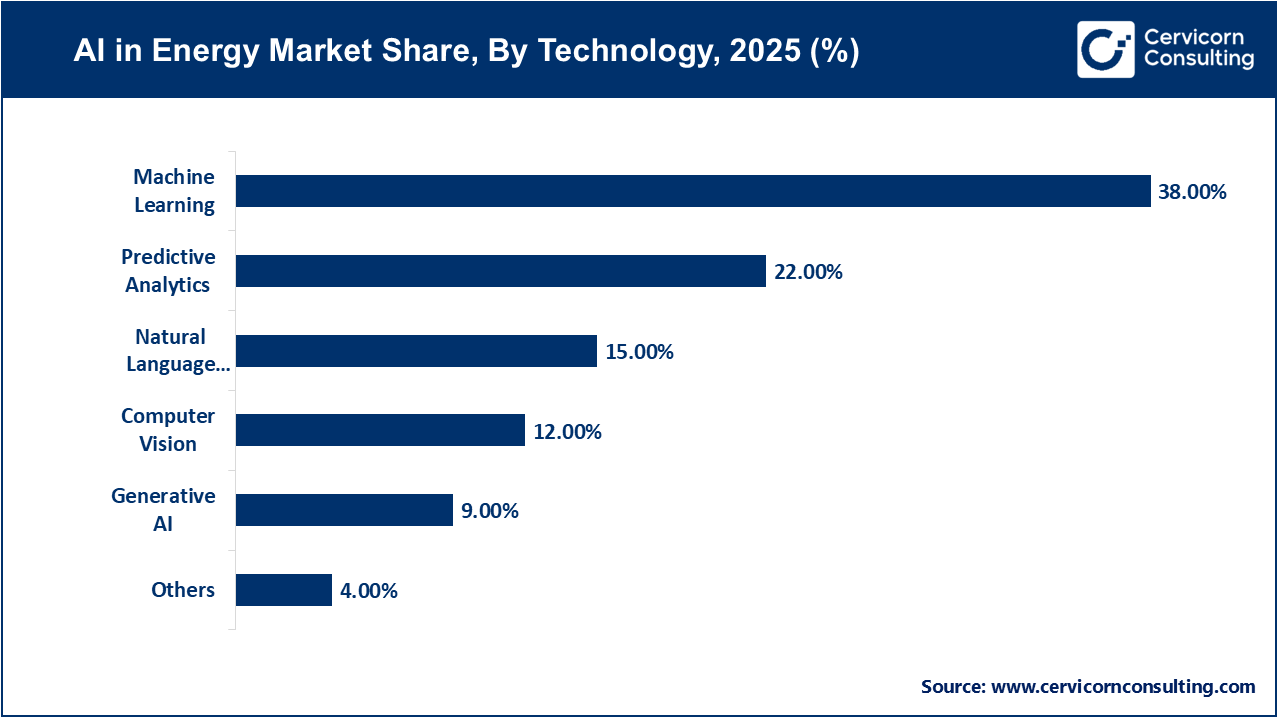
Generative AI is the fastest-growing technology in the market, primarily due to its focus on simulating complex scenarios and generating synthetic data to stress-test the grid. GenAI is also being used to humanize interactions, recognizing the complexity of the energy systems, utilizing natural language interfaces, and vastly lowering the barrier to entry for advanced data analytics. In the energy sector, these applications are used for the anomaly detection process and the development of synthetic weather or synthetic load patterns to optimize the training process for more resilient models.
Grid Optimization and Management segment is dominant in the market mainly because it represents the "central nervous system" of the energy sector, where AI is critical for managing bi-directional power flows and preventing blackouts in increasingly complex distribution networks. Advanced Distribution Management Systems (ADMS) utilize real-time data to automate switching, manage voltage levels, and isolate faults. This application is the highest priority for regulators and utilities alike, as grid stability is important for all other energy services and national security.
AI in Energy Market Share, By Application, 2025 (%)
| Application | Revenue Share, 2025 (%) |
| Grid Optimization & Management | 28% |
| Energy Demand Forecasting | 22% |
| Renewables Integration | 17% |
| Energy Storage Optimization | 12% |
| Energy Trading | 8% |
| Energy Sustainability | 7% |
| Disaster Resilience & Recovery | 6% |
Energy Storage Optimization application is the fastest-growing in the market due to the increasing need for AI to manage complex charge-discharge cycles that maximize battery life and capture arbitrage opportunities. As renewable penetration increases, storage becomes the primary tool for "shifting" energy from times of high production to times of high demand. AI algorithms are essential for determining the optimal time to charge or discharge a battery based on real-time market prices, weather forecasts, and battery health metrics.
Utilities users are dominant in the market because they are mandated to ensure public energy reliability, making them the primary purchasers of AI for large-scale operations. Utilities manage the entire value chain from generation to customer billing, providing a vast surface area for AI applications. This dominance user is further supported by regulatory frameworks that often allow utilities to recover investments in digital grid modernization through rate-based pricing.
AI in Energy Market Share, By End-user, 2025 (%)
| End-user | Revenue Share, 2025 (%) |
| Utilities | 30% |
| Energy Generation | 28% |
| Energy Distribution | 22% |
| Energy Transmission | 20% |
Energy Transmission segment is the fastest growing in the market, primarily due to increasing global need to upgrade "middle-mile" infrastructure to connect remote renewable energy farms to urban load centers. Transmission networks are currently the primary bottleneck for the energy transition, with thousands of gigawatts of renewable projects waiting in interconnection queues. Moreover, AI is being rapidly adopted as a "virtual transmission expansion" tool, using Dynamic Line Rating (DLR) to increase the capacity of existing lines based on real-time cooling conditions (wind and temperature) rather than conservative static limits.
The AI in energy market is segmented into various regions, including North America, Europe, Asia-Pacific, and LAMEA. Here is a brief overview of each region:
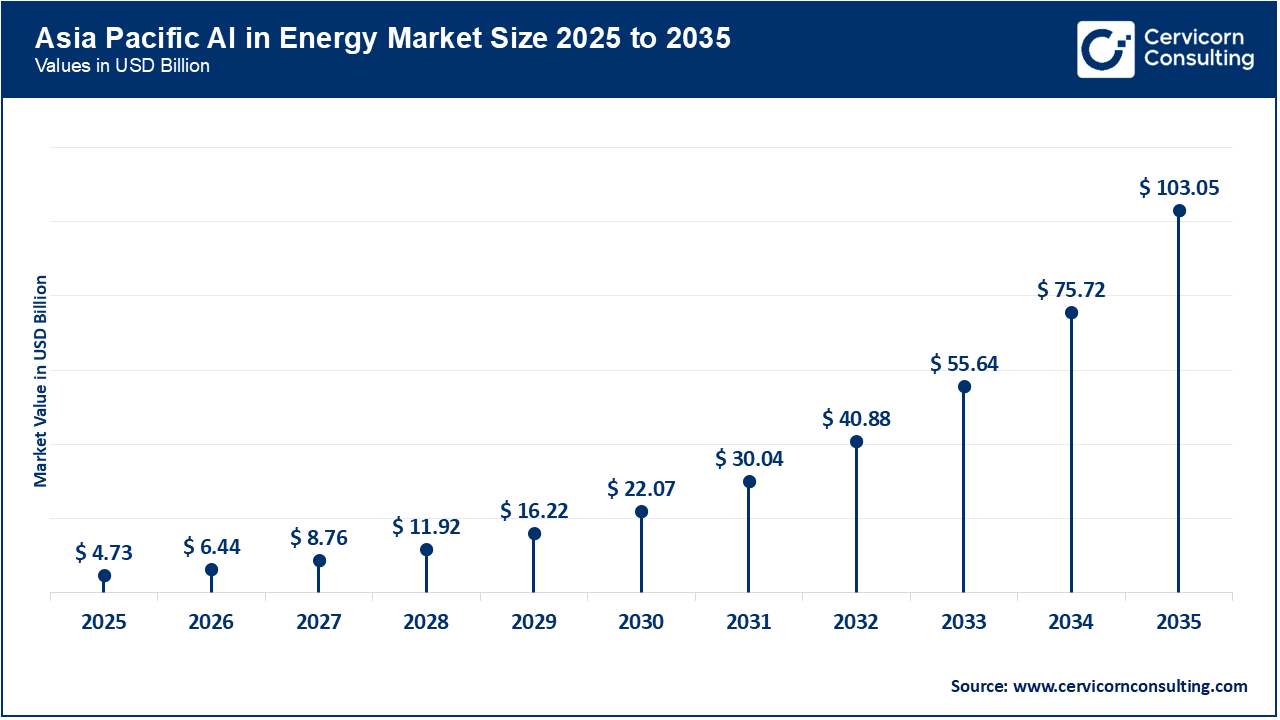
The Asia-Pacific AI in energy market size was valued at USD 4.73 billion in 2025 and is forecasted to grow around USD 103.05 billion by 2035. The Asia Pacific (APAC) region is the highest-growth market for AI in energy, driven by rising demand for rapid urban electrification and ambitious net-zero targets. This regional group of countries is trying to stabilize and regulate the grid to support their significant industrial demand. The expansion of AI technology is a necessity for navigating these energy transition commitments in countries like China and India, where traditional infrastructure is being quickly leapfrogged by smart technologies.
China and India key data points:
The North America AI in energy market size was estimated at USD 3.19 billion in 2025 and is predicted to surpass around USD 69.56 billion by 2035. In North America, the primary driver of growth in the market is the high need to secure an aging infrastructure against weather variability and to integrate the enormous load of EV charging stations. North American regions have a comparatively high density of technology providers and government funding for energy technologies. There is a strategic priority to stabilize the grid and the introduction of more advanced AI software to manage the distributed energy systems complex in the United States and Canada.
In the United States, the Inflation Reduction Act (IRA) has allocated billions of dollars towards "Smart Grids" and clean energy manufacturing on U.S. soil. In January 2025, a USD 2 billion investment in AI-managed microgrids for southern California areas threatened by wildfire, where able to autonomously shut off power and change direction during wildfire situations for public safety.
Canada is investing in AI development tools for its hydroelectric resources. From 2024, Hydro-Québec highlighted that it is deploying predictive AI at the water-basin level and at turbine level, achieving a 7% lift in output during winter peak load without increasing water consumption.
The Europe AI in energy market size reached at USD 2.96 billion in 2025 and is projected to hit around USD 64.41 billion by 2035. Europe in the market is mainly driven by the REPowerEU program and the "Digitalization of Energy" action plan, which focuses on quickly reducing fossil fuel dependency while also ensuring energy security across borders. The European market is characterized by a high level of stringency related to environmental regulation, and mandates that AI must be used for carbon accounting and optimization of volatile inputs related to renewable energy generation. Europe is leading the way in the use of AI to manage decentralized energy and "Heat-as-a-Service" mode.
Germany's "Energiewende" policy relies heavily on AI to manage the volatility of North Sea wind power. In 2025, the country's first AI-hub for 'Heat-as-a-Service' optimization using machine learning to balance the heat demand of district heating networks with available renewable electricity.
In the United Kingdom, Demand Side Response (DSR) is the focus of discussion. In 2024, over 1 million British households participated in an AI-managed, "flexibility events" where consumers were incentivized to move their energy load to non-peak times by using AI-driven platforms to assist in balancing the National Grid during the time of supply shortages.
AI in Energy Market Share, By Region, 2025 (%)
| Region | Revenue Share, 2025 (%) |
| Asia Pacific | 40% |
| North America | 27% |
| Europe | 25% |
| LAMEA | 8% |
The LAMEA AI in energy market was valued at USD 0.95 billion in 2025 and is anticipated to reach around USD 20.61 billion by 2035. The LAMEA (Latin America, Middle East, and Africa) region is undergoing infrastructure modernization and resource distribution optimization. In the Middle East, for instance, advances in AI are being utilized to diversify energy exports and manage 100% renewable microgrids for new smart cities. In Latin America, energy generated from existing hydroelectric and wind power plants is more efficient.
Brazil and Africa Recent Developments
By Energy Type
By Offering
By Technology
By Application
By End-user
By Region
Chapter 1. Market Introduction and Overview
1.1 Market Definition and Scope
1.1.1 Overview of AI in Energy
1.1.2 Scope of the Study
1.1.3 Research Timeframe
1.2 Research Methodology and Approach
1.2.1 Methodology Overview
1.2.2 Data Sources and Validation
1.2.3 Key Assumptions and Limitations
Chapter 2. Executive Summary
2.1 Market Highlights and Snapshot
2.2 Key Insights by Segments
2.2.1 By Energy Type Overview
2.2.2 By Offering Overview
2.2.3 By Technology Overview
2.2.4 By End User Overview
2.2.5 By Application Overview
2.3 Competitive Overview
Chapter 3. Global Impact Analysis
3.1 Russia-Ukraine Conflict: Global Market Implications
3.2 Regulatory and Policy Changes Impacting Global Markets
Chapter 4 Market Dynamics and Trends
4.1 Market Dynamics
4.1.1 Market Drivers
4.1.2 Market Restraints
4.1.3 Market Opportunities
4.1.4 Market Challenges
4.2 Market Trends
Chapter 5. Premium Insights and Analysis
5.1 Global AI in Energy Market Dynamics, Impact Analysis
5.2 Porter’s Five Forces Analysis
5.2.1 Bargaining Power of Suppliers
5.2.2 Bargaining Power of Buyers
5.2.3 Threat of Substitute Products
5.2.4 Rivalry among Existing Firms
5.2.5 Threat of New Entrants
5.3 PESTEL Analysis
5.4 Value Chain Analysis
5.5 Product Pricing Analysis
5.6 Vendor Landscape
5.6.1 List of Buyers
5.6.2 List of Suppliers
Chapter 6. AI in Energy Market, By Energy Type
6.1 Global AI in Energy Market Snapshot, By Energy Type
6.1.1 Market Revenue (($Billion) and Growth Rate (%), 2022-2035
6.1.1.1 Conventional Energy
6.1.1.2 Renewable Energy
Chapter 7. AI in Energy Market, By Technology
7.1 Global AI in Energy Market Snapshot, By Technology
7.1.1 Market Revenue (($Billion) and Growth Rate (%), 2022-2035
7.1.1.1 Machine Learning
7.1.1.2 Predictive Analytics
7.1.1.3 Natural Language Processing
7.1.1.4 Computer Vision
7.1.1.5 Generative AI
7.1.1.6 Others
Chapter 8. AI in Energy Market, By Offering
8.1 Global AI in Energy Market Snapshot, By Offering
8.1.1 Market Revenue (($Billion) and Growth Rate (%), 2022-2035
8.1.1.1 Solution
8.1.1.2 Services
Chapter 9. AI in Energy Market, By End-user
9.1 Global AI in Energy Market Snapshot, By End-user
9.1.1 Market Revenue (($Billion) and Growth Rate (%), 2022-2035
9.1.1.1 Utilities
9.1.1.2 Energy Generation
9.1.1.3 Energy Distribution
9.1.1.4 Energy Transmission
Chapter 10. AI in Energy Market, By Application
10.1 Global AI in Energy Market Snapshot, By Application
10.1.1 Market Revenue (($Billion) and Growth Rate (%), 2022-2035
10.1.1.1 Grid Optimization & Management
10.1.1.2 Energy Demand Forecasting
10.1.1.3 Renewables Integration
10.1.1.4 Energy Storage Optimization
10.1.1.5 Energy Trading
10.1.1.6 Energy Sustainability
10.1.1.7 Disaster Resilience & Recovery
Chapter 11. AI in Energy Market, By Region
11.1 Overview
11.2 AI in Energy Market Revenue Share, By Region 2024 (%)
11.3 Global AI in Energy Market, By Region
11.3.1 Market Size and Forecast
11.4 North America
11.4.1 North America AI in Energy Market Revenue, 2022-2035 ($Billion)
11.4.2 Market Size and Forecast
11.4.3 North America AI in Energy Market, By Country
11.4.4 U.S.
11.4.4.1 U.S. AI in Energy Market Revenue, 2022-2035 ($Billion)
11.4.4.2 Market Size and Forecast
11.4.4.3 U.S. Market Segmental Analysis
11.4.5 Canada
11.4.5.1 Canada AI in Energy Market Revenue, 2022-2035 ($Billion)
11.4.5.2 Market Size and Forecast
11.4.5.3 Canada Market Segmental Analysis
11.4.6 Mexico
11.4.6.1 Mexico AI in Energy Market Revenue, 2022-2035 ($Billion)
11.4.6.2 Market Size and Forecast
11.4.6.3 Mexico Market Segmental Analysis
11.5 Europe
11.5.1 Europe AI in Energy Market Revenue, 2022-2035 ($Billion)
11.5.2 Market Size and Forecast
11.5.3 Europe AI in Energy Market, By Country
11.5.4 UK
11.5.4.1 UK AI in Energy Market Revenue, 2022-2035 ($Billion)
11.5.4.2 Market Size and Forecast
11.5.4.3 UK Market Segmental Analysis
11.5.5 France
11.5.5.1 France AI in Energy Market Revenue, 2022-2035 ($Billion)
11.5.5.2 Market Size and Forecast
11.5.5.3 France Market Segmental Analysis
11.5.6 Germany
11.5.6.1 Germany AI in Energy Market Revenue, 2022-2035 ($Billion)
11.5.6.2 Market Size and Forecast
11.5.6.3 Germany Market Segmental Analysis
11.5.7 Rest of Europe
11.5.7.1 Rest of Europe AI in Energy Market Revenue, 2022-2035 ($Billion)
11.5.7.2 Market Size and Forecast
11.5.7.3 Rest of Europe Market Segmental Analysis
11.6 Asia Pacific
11.6.1 Asia Pacific AI in Energy Market Revenue, 2022-2035 ($Billion)
11.6.2 Market Size and Forecast
11.6.3 Asia Pacific AI in Energy Market, By Country
11.6.4 China
11.6.4.1 China AI in Energy Market Revenue, 2022-2035 ($Billion)
11.6.4.2 Market Size and Forecast
11.6.4.3 China Market Segmental Analysis
11.6.5 Japan
11.6.5.1 Japan AI in Energy Market Revenue, 2022-2035 ($Billion)
11.6.5.2 Market Size and Forecast
11.6.5.3 Japan Market Segmental Analysis
11.6.6 India
11.6.6.1 India AI in Energy Market Revenue, 2022-2035 ($Billion)
11.6.6.2 Market Size and Forecast
11.6.6.3 India Market Segmental Analysis
11.6.7 Australia
11.6.7.1 Australia AI in Energy Market Revenue, 2022-2035 ($Billion)
11.6.7.2 Market Size and Forecast
11.6.7.3 Australia Market Segmental Analysis
11.6.8 Rest of Asia Pacific
11.6.8.1 Rest of Asia Pacific AI in Energy Market Revenue, 2022-2035 ($Billion)
11.6.8.2 Market Size and Forecast
11.6.8.3 Rest of Asia Pacific Market Segmental Analysis
11.7 LAMEA
11.7.1 LAMEA AI in Energy Market Revenue, 2022-2035 ($Billion)
11.7.2 Market Size and Forecast
11.7.3 LAMEA AI in Energy Market, By Country
11.7.4 GCC
11.7.4.1 GCC AI in Energy Market Revenue, 2022-2035 ($Billion)
11.7.4.2 Market Size and Forecast
11.7.4.3 GCC Market Segmental Analysis
11.7.5 Africa
11.7.5.1 Africa AI in Energy Market Revenue, 2022-2035 ($Billion)
11.7.5.2 Market Size and Forecast
11.7.5.3 Africa Market Segmental Analysis
11.7.6 Brazil
11.7.6.1 Brazil AI in Energy Market Revenue, 2022-2035 ($Billion)
11.7.6.2 Market Size and Forecast
11.7.6.3 Brazil Market Segmental Analysis
11.7.7 Rest of LAMEA
11.7.7.1 Rest of LAMEA AI in Energy Market Revenue, 2022-2035 ($Billion)
11.7.7.2 Market Size and Forecast
11.7.7.3 Rest of LAMEA Market Segmental Analysis
Chapter 12. Competitive Landscape
12.1 Competitor Strategic Analysis
12.1.1 Top Player Positioning/Market Share Analysis
12.1.2 Top Winning Strategies, By Company, 2022-2024
12.1.3 Competitive Analysis By Revenue, 2022-2024
12.2 Recent Developments by the Market Contributors (2024)
Chapter 13. Company Profiles
13.1 Siemens AG
13.1.1 Company Snapshot
13.1.2 Company and Business Overview
13.1.3 Financial KPIs
13.1.4 Product/Service Portfolio
13.1.5 Strategic Growth
13.1.6 Global Footprints
13.1.7 Recent Development
13.1.8 SWOT Analysis
13.2 Schneider Electric SE
13.3 General Electric (GE)
13.4 ABB Ltd.
13.5 IBM Corporation
13.6 Microsoft Corporation
13.7 Honeywell International Inc.
13.8 Amazon Web Services (AWS)
13.9 Oracle Corporation
13.10 C3.ai Inc.
13.11 AutoGrid Systems Inc.
13.12 DataRobot Inc.
13.13 SparkCognition Inc.
13.14 Hitachi Energy
13.15 Uplight Inc.