
The global AI agents market size was reached at USD 7.13 billion in 2024 and is expected to be worth around USD 89.87 billion by 2034, growing at a compound annual growth rate (CAGR) of 43.98% over the forecast period from 2025 to 2034. The AI agents market is concerned with the design and use of intelligent software systems which are capable of performing tasks, making decisions, and using user or system interfaces for communication, automation, intelligent interaction, and decision making through the means of machine learning, computer vision, and natural language processing. Artificial intelligence agents can enhance efficiency and automation in customer service, healthcare, finance, and industrial operations while also improving personalization and real-time decision making.
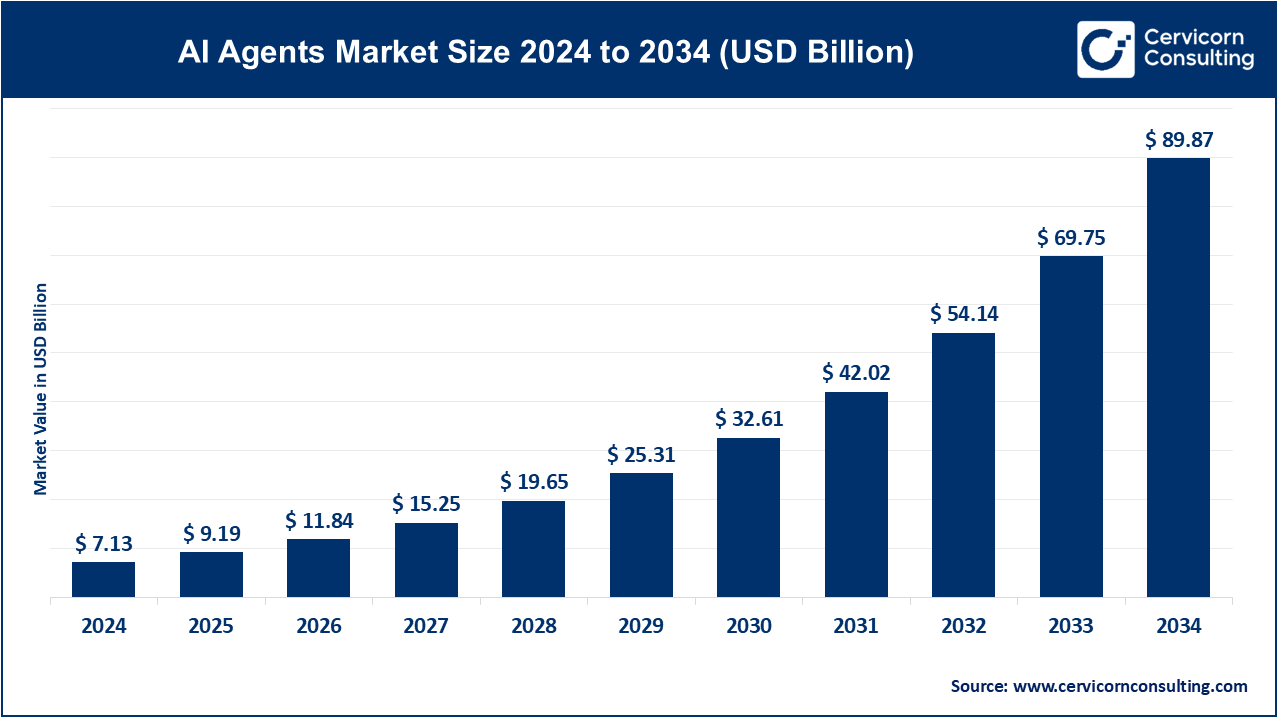
The need for digital transformation, enhancement of AI models, especially generative AI and large language models, and increasing enterprise spending on automation are some of the factors fostering growth in the market. The combined efforts of cloud service providers and technology companies are also regulatory interest in ethically framed AI is further advancing this market. With increased sophistication, AI agents will greatly enhance context awareness transforming organizational and individual workflows in an automated environment. From the perspective of an intelligent digital ecosystem, the role of AI is expected to be fundamentally transformative.
Report Scope
| Area of Focus | Details |
| Market Size in 2025 | USD 9.19 Billion |
| Expected Market Size in 2033 | USD 69.75 Billion |
| Projected Market CAGR 2025 to 2034 | 43.98% |
| Prime Region | North America |
| Leading Growth Region | Asia-Pacific |
| Key Segments | Technology, Agent System, Agent Type, Application, End-User, Region |
| Key Companies | Google LLC, IBM Corporation, Microsoft Corporation, Salesforce, Inc., SAP SE, UiPath, Amazon Web Services, Inc., Oracle Corporation, Zendesk, Inc., ServiceNow, Inc. |
The AI agents market is segmented into several key regions: North America, Europe, Asia-Pacific, and LAMEA (Latin America, Middle East, and Africa). Here’s an in-depth look at each region
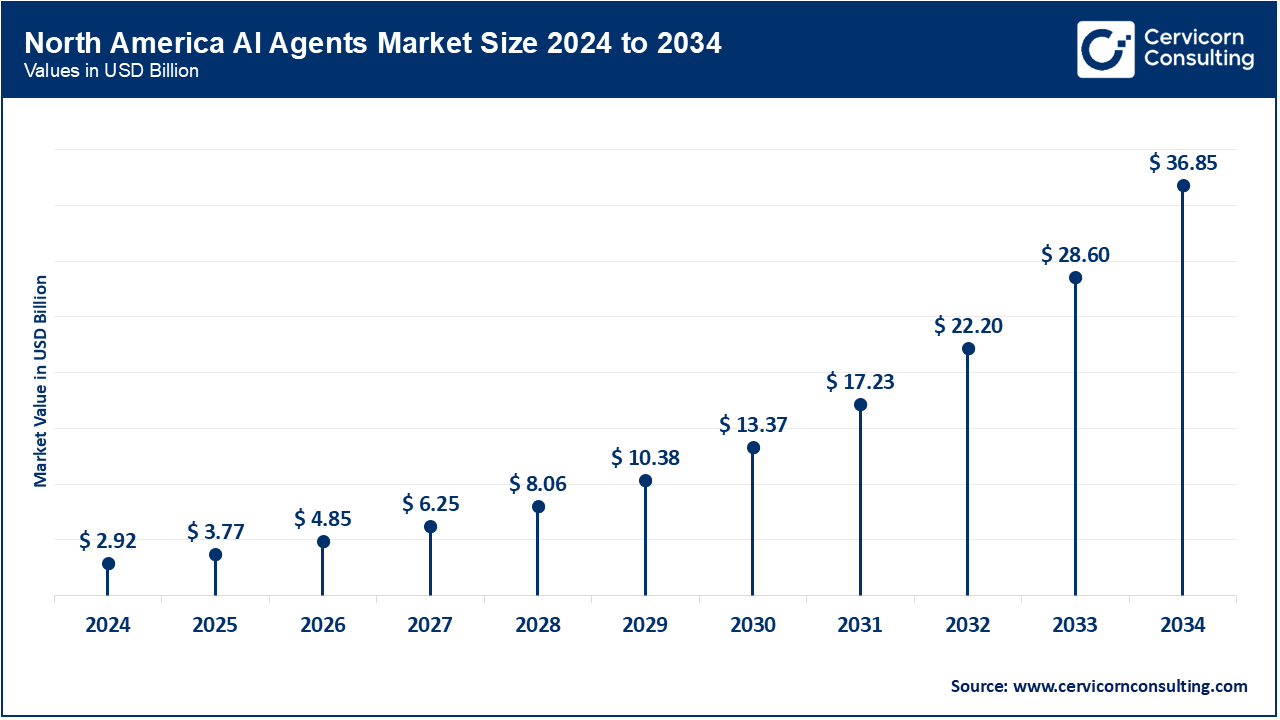
The North America AI agents market size was valued at USD 2.92 billion in 2024 and is expected to reach around USD 36.85 billion by 2034. This region is still embracing AI agents at an unmatched rate as the U.S. significantly increases investment in AI technology in finance, healthcare, and logistics, among other sectors. The recent rebranding AI Safety Institute to Centre for AI Standards and Innovation by the US Department of Commerce captures the intent focus of turning around national security issues related to AI. Canada is also moving forward with the use of AI in public services and other areas. In Mexico, there is growing use of AI in logistics, especially in optimizing freight and supply chain management. This clearly demonstrates the North American efforts aimed at the development of AI in the region.
The Europe AI agents market size was estimated at USD 1.43 billion in 2024 and is projected to hit around USD 17.97 billion by 2034. The market is growing exponentially in Europe and France is one of the frontrunners. The EU commissioned InvestAI at the AI Action Summit in 2025 which aims to enhance AI across Europe with an investment of USD 228.2 billion. This includes building AI gigafactories with an investment of €20 billion. France itself has received close to USD 125.5 billion in private investments toward AI. Meanwhile, Germany’s Mistral AI is collaborating with Helsing from the UK to build military AI technologies. The UK is ensuring regulation on artificial intelligence with strong public demand for supervision on ethical use. All these strategies are aimed towards the advancement of AI technologies in the continent and show Europe’s dedication to responsible development of AI.
The Asia-Pacific AI agents market size was accounted for USD 2.42 billion in 2024 and is predicted to surpass around USD 30.56 billion by 2034. The use of AI agents is particularly acute in the Asia Pacific region with the strong adoption from China, India, and Japan. As per the 2023 Interim Measures for the Management of Generative AI Services, China controls AI technology. India ranks number one in global consumption of ChatGPT at 13.5% of users, and also founded the India AI Safety Institute for responsible AI use. Japan leads the region with AI utilization at 82%. Australia and South Korea are also increasing AI usage across the board in many sectors. These actions signal greater efforts towards strengthening policies and governance frameworks around AI technology in the region.
AI Agents Market Revenue Share, By Region, 2024 (%)
| Region | Revenue Share, 2024 (%) |
| North America | 41% |
| Europe | 20% |
| Asia-Pacific | 34% |
| LAMEA | 5% |
The LAMEA AI agents market size was reached at USD 0.36 billion in 2024 and is expected to be worth around USD 4.49 billion by 2034. Brazil is emerging as a key adopter of AI agents in public services, healthcare, and agriculture in the Latin America region driven by national AI programs and international technology partnerships. In the Middle East and Africa, the UAE has set a strategy to become a world leader in artificial intelligence by 2031 and is executing its Strategy for Artificial Intelligence, Abu Dhabi is constructing the world’s largest AI data centre in partnership with Microsoft and G42. Saudi Arabia is intent on AI’s contribution of $135.2 billion to its economy by 2030, with investment focusing on finance, healthcare, and smart cities. Also, South Africa is adopting AI in the provision of public services and infrastructure. These countries are all using AI agents to advance innovation, governance, and sustainable economic growth.
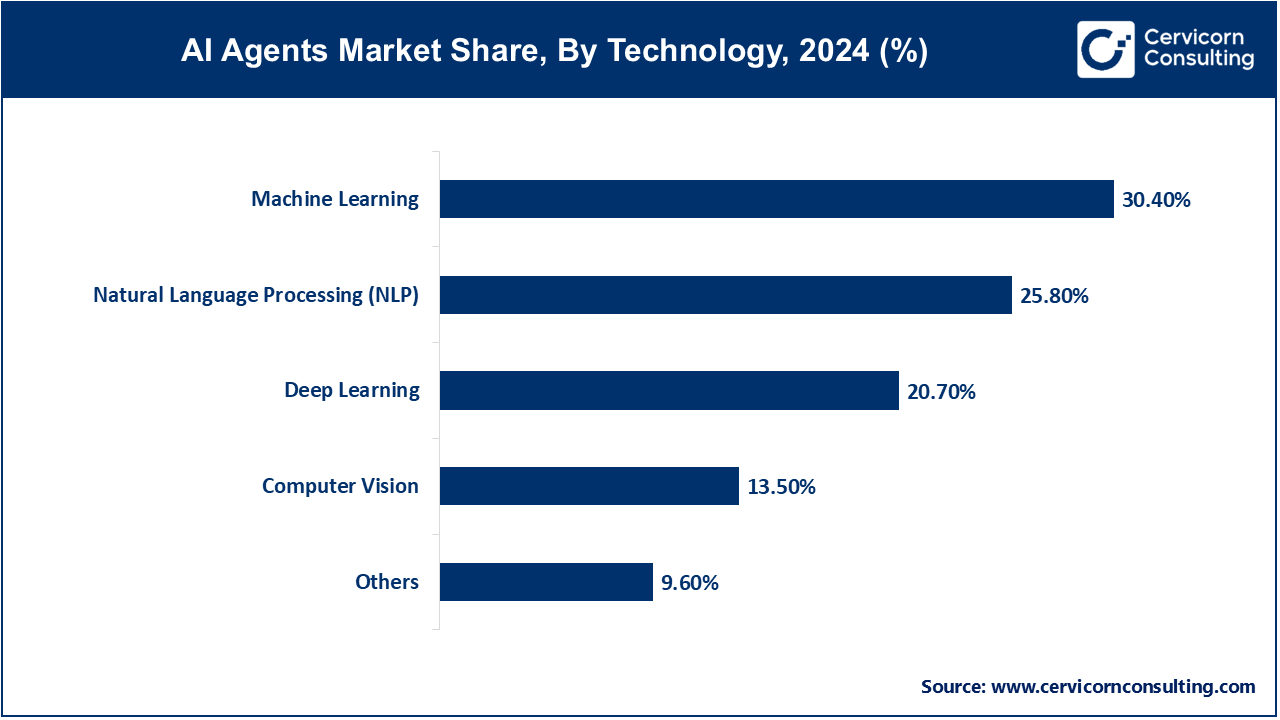
Based on technology, the market is classified into machine learning, natural language processing (NLP), deep learning, computer vision and others.
The machine learning segment led the market in 2024, accounting for over 30.5% of the global revenue, reflecting its foundational role in powering intelligent agent behavior, personalization, and predictive capabilities. The deep learning segment is expected to witness highest CAGR over the forecast period.
Build-Your-Own Agents: The specialized Build-Your-Own Agents solutions allow companies to build AI agents tailored precisely to their requirements. One such agent, Operator, developed by OpenAI, enabled in January 2025 for automated online appointment scheduling and form filling. Such empowerment enables firms to create AI agents that they can seamlessly embed into their processes. The remarkable versatility provided by Build-Your-Own Agents is particular appealing to businesses seeking tailored AI systems.
Ready-to-Deploy Agents: Ready-to-Deploy Agents are complete all-in-one AI systems with every single configuration pre-prepared, which can be directly plugged into the business processes. The agents possess a set of predefined use cases which cuts down the required effort and expenditure of deploying these solutions. An illustration of this is Gupshup's AI Agent Library, launched in 2024, which offers conversational agents trained for different industries to enhance business revenues. Such off-the-shelf solutions are targeted towards businesses that require swift execution without tailor made features. The availability of Ready-to-Deploy Agents enables AI to be incorporated in many industries faster.
Multi-Agent Systems: These systems consist of several AI agents that interact and cooperate to achieve intricate goals. Multi-Agent Systems are excellent for dealing with problems that are either hierarchical or need to be tackled with a Distributed Approach. For example, Siemens AG uses agentic AI to interpret real-time sensor data from industrial machines to enable predictive maintenance, thus averting unplanned downtimes by 25 percent. The collaborative approach of Multi Agent Systems makes them more effective in multi-faceted tasks in different industries.
Single-Agent Systems: Within Single-Agent Systems, an individual AI agent works alone to accomplish certain tasks such as an agent. These systems are appropriate for applications with specific goals that are not very detailed or complicated. Open AI’s Operator, an internet-based task completion agent, is set to launch in 2025 and will exemplify a Single Agent System. Operators do not require much supervision hence single agent systems are appealing to businesses in need of uncomplicated AI support. The operational simplicity of Single-Agent Systems makes them adaptable to various overhead conditions.
Customer Service and Virtual Assistants: Customer service and virtual assistance AI agents improve the ease of service delivery by responding quickly and accurately. For instance, Walmart employs AI chatbots that automatically manage 80% of customer inquiries, including returns and inventory questions. The incorporation of AI agents into the CRM and other communication systems improves AI personal assistance and automation of systems. They are of great use in marketing and sales automation as productivity is increased tremendously.
Sales and Marketing: AI agents undertake automated precision work in lead allocation, campaign analysis, and meeting scheduling. Customer engagement increased significantly with the deployment of Salesforce's Agentforce in September 2024, with retailers noting chatbot traffic surges of 13-fold during the 2024 holiday season. These agents operate across CRM systems and other communication channels, aiding in efficiency and personalization. In respect of sales and marketing, AI agents optimize workflows further and augment organizational performance.
Human Resources: AI agents in Human Resource Services are streamlining recruitment, onboarding, and employee engagement processes. They streamline document collecting and interview scheduling through candidacy screening, improving HR Processes. AI is evolving HR by driving efficiency and enhancing candidate experiences. In relieving HR professionals of monotonous activities, AI agents allow human resources strategists to devote time to meaningful work. These shifts in practice provide rich examples of how transformatively AI is changing human resource management. Examples like this clearly indicate the adoption of AI applications in human resource management practices.
Sales and Marketing: AI agents also perform more complex roles in sales and marketing by automating several tasks such as lead qualification, meeting scheduling, and campaign analytics. Customer engagement increased significantly with the deployment of Salesforce's Agent force in September 2024, with retailers noting chatbot traffic surges of 13 fold during the 2024 holiday season. These agents operate across CRM systems and other communication channels, aiding in efficiency and personalization. AI agents in sales and marketing perform tasks at organizational operational levels.
Finance Services: AI agents support clients in the financial services industry with customer relations, fraud prevention, and risk assessment. LOXM, an AI at JPMorgan & Chase, executes high-frequency trades and responds to real-time trading stimuli more rapidly than human traders. Armed with these AI agents, decision making and productivity at financial institutions is greatly improved. With real time analysis and automated customer interactions, these examples show the functioning of AI agents in the finance industry.
Other Applications: AI agents are used in many other fields apart from the ones discussed above. In healthcare, for instance, AI agents help with diagnostics and patient care management. These applications illustrate the extensive range of AI agents across sectors. The versatility of AI agents is exemplified in the reduction of unplanned downtime using agentic AI for predictive maintenance performed by Siemens AG. Their further advancement is bound to happen due to enhancing technologies.
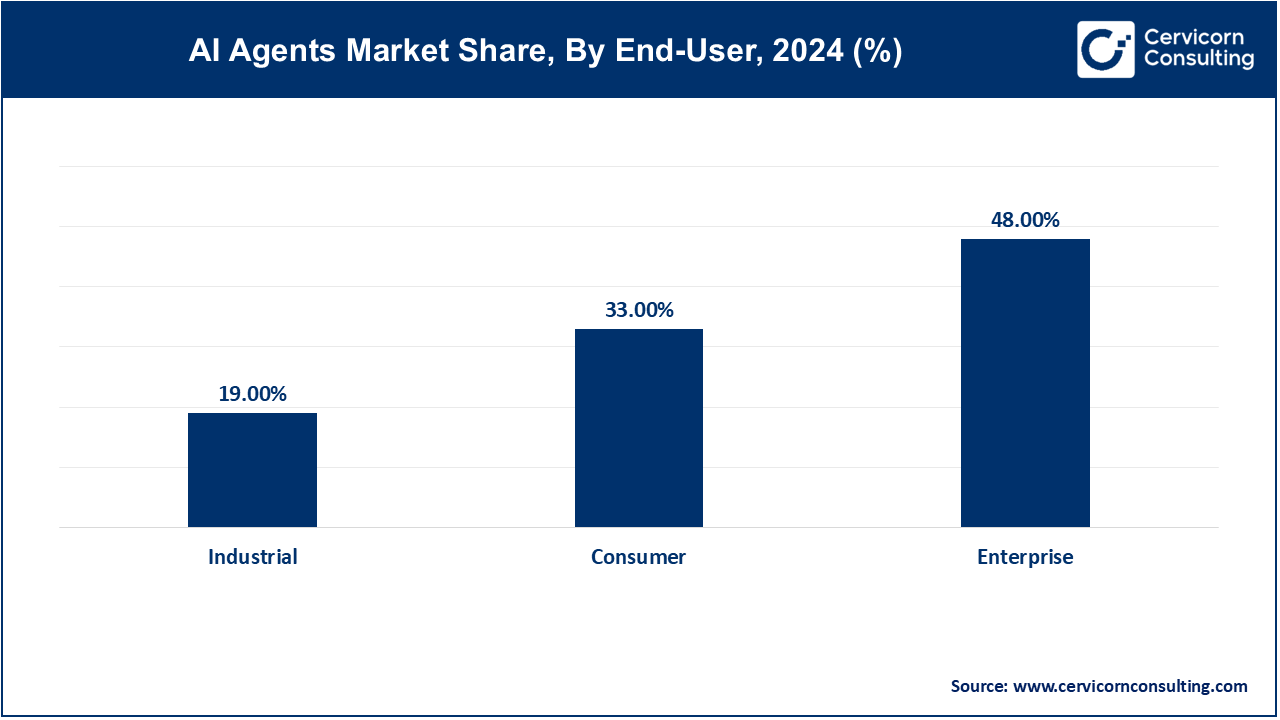
Based on end user, the markey is classified into enterprise, consumer, and industrial. The enterprise segment has dominated the market in 2024, , as companies continue to adopt AI agents for operational efficiency, customer engagement, and digital transformation initiatives. The industrial segment is expected to witness highest CAGR over the forecast period.
Recent partnerships in the AI agents market emphasize innovation and cross-industry integration. Microsoft collaborates with OpenAI to enhance AI agent capabilities in productivity and cloud services. Google teams up with Salesforce to embed advanced conversational agents in CRM platforms. IBM partners with SAP to deploy AI agents for enterprise automation and compliance. Salesforce joins forces with AWS to scale AI-driven customer service solutions. These collaborations focus on improving automation, enhancing user experience, and accelerating AI adoption across sectors. Together, they drive the global shift toward intelligent, scalable AI agent technologies.
These developments highlight major progress in the AI agents market, with industry leaders like Google, Microsoft, IBM, Salesforce, Amazon, and OpenAI driving innovation in intelligent automation and AI integration. These companies are advancing AI agent capabilities across sectors including customer service, finance, healthcare, and enterprise solutions. Their investments in natural language processing, multi-agent systems, and AI orchestration platforms are accelerating digital transformation worldwide. By focusing on scalable, secure, and explainable AI technologies, they support improved productivity and decision-making. These pioneers align closely with global digitalization trends, enabling businesses to enhance efficiency and customer engagement while shaping the future of work.
Market Segmentation
By Technology
By Agent System
By Agent Type
By Application
By End-User
By Region
Chapter 1. Market Introduction and Overview
1.1 Market Definition and Scope
1.1.1 Overview of AI Agents
1.1.2 Scope of the Study
1.1.3 Research Timeframe
1.2 Research Methodology and Approach
1.2.1 Methodology Overview
1.2.2 Data Sources and Validation
1.2.3 Key Assumptions and Limitations
Chapter 2. Executive Summary
2.1 Market Highlights and Snapshot
2.2 Key Insights by Segments
2.2.1 By Technology Overview
2.2.2 By Agent System Overview
2.2.3 By Agent Type Overview
2.2.4 By Application Overview
2.2.5 By End User Overview
2.3 Competitive Overview
Chapter 3. Global Impact Analysis
3.1 Russia-Ukraine Conflict: Global Market Implications
3.2 Regulatory and Policy Changes Impacting Global Markets
Chapter 4. Market Dynamics and Trends
4.1 Market Dynamics
4.1.1 Market Drivers
4.1.1.1 Surge in Remote Work and Digital Interactions
4.1.1.2 Growing Usage of AI Agents for Fraud Detection and Cybersecurity
4.1.1.3 Consumer Preference for Voice-Based and Chat-Based Interactions
4.1.2 Market Restraints
4.1.2.1 Data Privacy and Regulatory Compliance
4.1.2.2 High Initial Setup and Integration Costs
4.1.2.3 Dependence on Quality and Availability of Data
4.1.3 Market Challenges
4.1.3.1 Ensuring AI Transparency and Explainability
4.1.3.2 Reducing AI Bias and Fairness Issues
4.1.4 Market Opportunities
4.1.4.1 Expansion in Healthcare Applications
4.1.4.2 Adoption in Government and Public Services
4.1.4.3 Growth in Education and E-Learning Platforms
4.1.4.4 Increased Investment in AI Ethics and Transparency
4.2 Market Trends
Chapter 5. Premium Insights and Analysis
5.1 Global AI Agents Market Dynamics, Impact Analysis
5.2 Porter’s Five Forces Analysis
5.2.1 Bargaining Power of Suppliers
5.2.2 Bargaining Power of Buyers
5.2.3 Threat of Substitute Products
5.2.4 Rivalry among Existing Firms
5.2.5 Threat of New Entrants
5.3 PESTEL Analysis
5.4 Value Chain Analysis
5.5 Product Pricing Analysis
5.6 Vendor Landscape
5.6.1 List of Buyers
5.6.2 List of Suppliers
Chapter 6. AI Agents Market, By Technology
6.1 Global AI Agents Market Snapshot, By Technology
6.1.1 Market Revenue (($Billion) and Growth Rate (%), 2022-2034
6.1.1.1 Machine Learning
6.1.1.2 Natural Language Processing (NLP)
6.1.1.3 Deep Learning
6.1.1.4 Computer Vision
6.1.1.5 Others
Chapter 7. AI Agents Market, By Agent System
7.1 Global AI Agents Market Snapshot, By Agent System
7.1.1 Market Revenue (($Billion) and Growth Rate (%), 2022-2034
7.1.1.1 Single Agent Systems
7.1.1.2 Multi Agent Systems
Chapter 8. AI Agents Market, By Agent Type
8.1 Global AI Agents Market Snapshot, By Agent Type
8.1.1 Market Revenue (($Billion) and Growth Rate (%), 2022-2034
8.1.1.1 Build-Your-Own Agents
8.1.1.2 Ready-to-Deploy Agents
Chapter 9. AI Agents Market, By Application
9.1 Global AI Agents Market Snapshot, By Application
9.1.1 Market Revenue (($Billion) and Growth Rate (%), 2022-2034
9.1.1.1 Customer Service and Virtual Assistants
9.1.1.2 Robotics and Automation
9.1.1.3 Financial Services
9.1.1.4 Security and Surveillance
9.1.1.5 Healthcare
9.1.1.6 Marketing and Sales
9.1.1.7 Human Resources
9.1.1.8 Gaming and Entertainment
9.1.1.9 Legal and Compliance
9.1.1.10 Others
Chapter 10. AI Agents Market, By End-User
10.1 Global AI Agents Market Snapshot, By End-User
10.1.1 Market Revenue (($Billion) and Growth Rate (%), 2022-2034
10.1.1.1 Enterprise
10.1.1.2 Consumer
10.1.1.3 Industrial
Chapter 11. AI Agents Market, By Region
11.1 Overview
11.2 AI Agents Market Revenue Share, By Region 2024 (%)
11.3 Global AI Agents Market, By Region
11.3.1 Market Size and Forecast
11.4 North America
11.4.1 North America AI Agents Market Revenue, 2022-2034 ($Billion)
11.4.2 Market Size and Forecast
11.4.3 North America AI Agents Market, By Country
11.4.4 U.S.
11.4.4.1 U.S. AI Agents Market Revenue, 2022-2034 ($Billion)
11.4.4.2 Market Size and Forecast
11.4.4.3 U.S. Market Segmental Analysis
11.4.5 Canada
11.4.5.1 Canada AI Agents Market Revenue, 2022-2034 ($Billion)
11.4.5.2 Market Size and Forecast
11.4.5.3 Canada Market Segmental Analysis
11.4.6 Mexico
11.4.6.1 Mexico AI Agents Market Revenue, 2022-2034 ($Billion)
11.4.6.2 Market Size and Forecast
11.4.6.3 Mexico Market Segmental Analysis
11.5 Europe
11.5.1 Europe AI Agents Market Revenue, 2022-2034 ($Billion)
11.5.2 Market Size and Forecast
11.5.3 Europe AI Agents Market, By Country
11.5.4 UK
11.5.4.1 UK AI Agents Market Revenue, 2022-2034 ($Billion)
11.5.4.2 Market Size and Forecast
11.5.4.3 UKMarket Segmental Analysis
11.5.5 France
11.5.5.1 France AI Agents Market Revenue, 2022-2034 ($Billion)
11.5.5.2 Market Size and Forecast
11.5.5.3 FranceMarket Segmental Analysis
11.5.6 Germany
11.5.6.1 Germany AI Agents Market Revenue, 2022-2034 ($Billion)
11.5.6.2 Market Size and Forecast
11.5.6.3 GermanyMarket Segmental Analysis
11.5.7 Rest of Europe
11.5.7.1 Rest of Europe AI Agents Market Revenue, 2022-2034 ($Billion)
11.5.7.2 Market Size and Forecast
11.5.7.3 Rest of EuropeMarket Segmental Analysis
11.6 Asia Pacific
11.6.1 Asia Pacific AI Agents Market Revenue, 2022-2034 ($Billion)
11.6.2 Market Size and Forecast
11.6.3 Asia Pacific AI Agents Market, By Country
11.6.4 China
11.6.4.1 China AI Agents Market Revenue, 2022-2034 ($Billion)
11.6.4.2 Market Size and Forecast
11.6.4.3 ChinaMarket Segmental Analysis
11.6.5 Japan
11.6.5.1 Japan AI Agents Market Revenue, 2022-2034 ($Billion)
11.6.5.2 Market Size and Forecast
11.6.5.3 JapanMarket Segmental Analysis
11.6.6 India
11.6.6.1 India AI Agents Market Revenue, 2022-2034 ($Billion)
11.6.6.2 Market Size and Forecast
11.6.6.3 IndiaMarket Segmental Analysis
11.6.7 Australia
11.6.7.1 Australia AI Agents Market Revenue, 2022-2034 ($Billion)
11.6.7.2 Market Size and Forecast
11.6.7.3 AustraliaMarket Segmental Analysis
11.6.8 Rest of Asia Pacific
11.6.8.1 Rest of Asia Pacific AI Agents Market Revenue, 2022-2034 ($Billion)
11.6.8.2 Market Size and Forecast
11.6.8.3 Rest of Asia PacificMarket Segmental Analysis
11.7 LAMEA
11.7.1 LAMEA AI Agents Market Revenue, 2022-2034 ($Billion)
11.7.2 Market Size and Forecast
11.7.3 LAMEA AI Agents Market, By Country
11.7.4 GCC
11.7.4.1 GCC AI Agents Market Revenue, 2022-2034 ($Billion)
11.7.4.2 Market Size and Forecast
11.7.4.3 GCCMarket Segmental Analysis
11.7.5 Africa
11.7.5.1 Africa AI Agents Market Revenue, 2022-2034 ($Billion)
11.7.5.2 Market Size and Forecast
11.7.5.3 AfricaMarket Segmental Analysis
11.7.6 Brazil
11.7.6.1 Brazil AI Agents Market Revenue, 2022-2034 ($Billion)
11.7.6.2 Market Size and Forecast
11.7.6.3 BrazilMarket Segmental Analysis
11.7.7 Rest of LAMEA
11.7.7.1 Rest of LAMEA AI Agents Market Revenue, 2022-2034 ($Billion)
11.7.7.2 Market Size and Forecast
11.7.7.3 Rest of LAMEAMarket Segmental Analysis
Chapter 12. Competitive Landscape
12.1 Competitor Strategic Analysis
12.1.1 Top Player Positioning/Market Share Analysis
12.1.2 Top Winning Strategies, By Company, 2022-2024
12.1.3 Competitive Analysis By Revenue, 2022-2024
12.2 Recent Developments by the Market Contributors (2024)
Chapter 13 Company Profiles
13.1 Google LLC
13.1.1 Company Snapshot
13.1.2 Company and Business Overview
13.1.3 Financial KPIs
13.1.4 Product/Service Portfolio
13.1.5 Strategic Growth
13.1.6 Global Footprints
13.1.7 Recent Development
13.1.8 SWOT Analysis
13.2 IBM Corporation
13.3 Microsoft Corporation
13.4 Salesforce, Inc.
13.5 SAP SE
13.6 UiPath
13.7 Amazon Web Services, Inc.
13.8 Oracle Corporation
13.9 Zendesk, Inc.
13.10 ServiceNow, Inc.