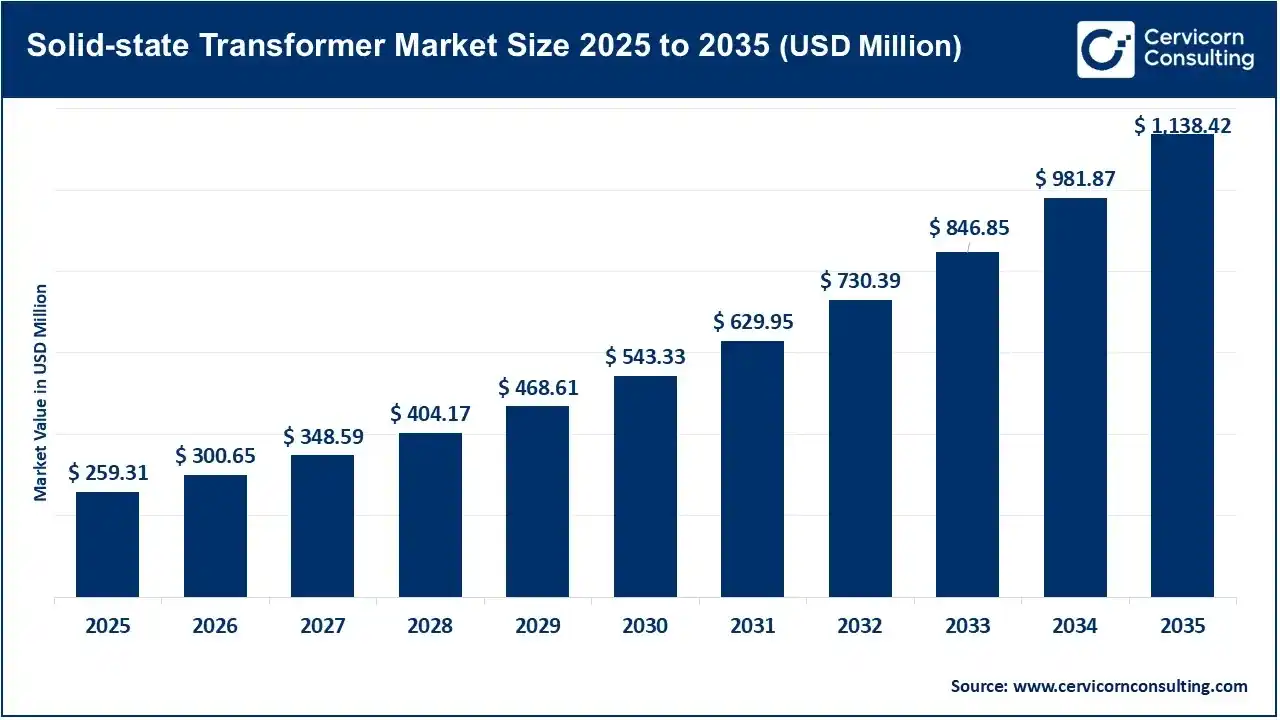
The global solid-state transformer market size was valued at USD 259.31 million in 2025 and is expected to reach around USD 1,138.42 million by 2035, exhibiting a compound annual growth rate (CAGR) of 15.9% over the forecast period from 2026 to 2035.
The solid-state transformer (SST) market is being driven primarily by grid modernization, renewable-energy integration, and the electrification of transportation. Utilities are increasingly seeking power-conversion technologies capable of bidirectional power flow, dynamic voltage regulation, improved power quality, and integration of distributed energy resources capabilities that conventional transformers provide only to a limited extent. Renewable generation is also creating more variable and bidirectional power flows, increasing the need for digitally controlled distribution equipment. In 2025, electricity demand from EVs increased 38% globally, while electricity consumption from data centers increased 17%, strengthening the requirement for flexible and high-density power infrastructure.
Another major growth factor is the rapid expansion of EV fast-charging networks, energy storage, microgrids, and AI-oriented data centers, where SSTs can reduce conversion stages, improve power density, and enable direct interfaces between medium-voltage grids and DC systems. The EV charging application is particularly attractive because SST architectures can support high-power charging while providing active voltage and power-flow control. Meanwhile, data-center electricity demand is expected to double globally by 2030, with AI focused data center consumption potentially tripling, increasing pressure on grid-connected power infrastructure. Technological advances in silicon-carbide (SiC) and gallium-nitride (GaN) semiconductors are further improving switching performance, efficiency, compactness, and power density, helping overcome some traditional SST limitations and supporting broader commercialization.
Report Highlights
- Asia-Pacific held the largest regional share at approximately 40.1% in 2025, driven by rapid grid modernization, renewable-energy deployment, railway electrification, and strong power-electronics manufacturing capabilities.
- Distribution Solid-State Transformers dominated the product segment with a 43.7% share in 2025, supported by increasing deployment across smart distribution networks and grid-edge applications.
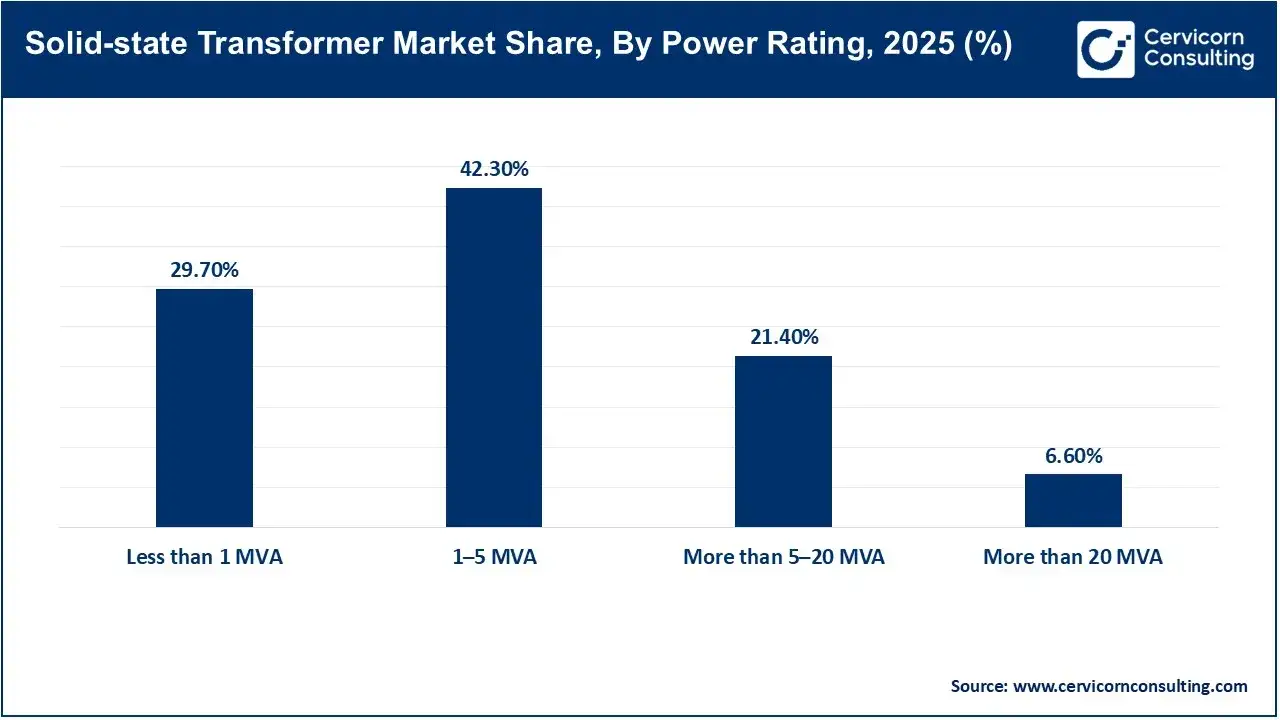
- The 1–5 MVA power-rating segment accounted for approximately 42.3% of the market, reflecting its suitability for distribution networks, renewable-energy integration, and microgrid applications.
- Silicon Carbide (SiC)-based SSTs represented the leading semiconductor technology, benefiting from high-voltage switching capability, lower losses, higher operating temperatures, and improved power density.
- Smart Grid & Distribution Networks captured approximately 39.7% of application revenue in 2025, making it the largest application segment because of increasing demand for controllable and flexible distribution infrastructure.
- Electric utilities remain a key end-user segment, as SSTs enable bidirectional power flow, real-time voltage regulation, improved power quality, and integration of distributed energy resources.
What is a Solid-state Transformer?
A Solid-State Transformer (SST) is an advanced power-electronic transformer that uses semiconductor switches, high-frequency transformers, and power-conversion circuits to transform voltage while providing active control of power flow, voltage, current, and power quality. Unlike conventional 50/60-Hz transformers, SSTs typically operate through high-frequency conversion stages, allowing significantly smaller magnetic components and enabling functions such as bidirectional power flow, AC/DC conversion, voltage regulation, renewable energy integration, and direct DC connections. These characteristics make SSTs particularly relevant for smart grids, EV charging, renewable-energy systems, microgrids, data centers, and railway electrification.
| Year |
Organization |
Milestone |
| 2024 |
NC State University / IEEE research community |
A 100 kVA, 4.16 kV medium-voltage SST pilot using 10 kV SiC MOSFETs was highlighted for DC-grid applications including EV charging and data centers. |
| 2024 |
Research institutions |
A new high-voltage-gain SST topology integrating DC-DC and dual-active-bridge converters was published, targeting renewable-energy and AC-source integration. |
| 2024 |
CSA Catapult |
Development of an SST evaluation module using an NPC dual-active-bridge converter, with hardware testing conducted up to 16 kW and plans to scale toward 100 kW. |
| 2025 |
TIGON Project / CIEMAT |
A solid-state transformer was installed at a Spanish demonstration facility to create a 3 kV DC network from a low-voltage AC network for hybrid microgrid testing. |
| 2025 |
Research institutions |
A 20 kV/500 kVA hybrid SST prototype achieved demonstrated efficiency of up to 98.4%, highlighting advances in medium-voltage power conversion. |
| 2025 |
Railway research |
Researchers demonstrated a reduced-scale SST design for 25 kV railway applications, providing a 3 kV DC output for traction inverters. |
| 2025 |
Eaton / Resilient Power Systems |
Eaton acquired Resilient Power Systems, expanding its capabilities in medium-voltage solid-state transformer technology. |
| 2026 |
NC State / NYPA / EPRI |
A 1 MW-class SST was tested under real-world conditions and connected to a live utility distribution feeder, representing a major step toward utility-scale deployment. |
| 2026 |
U.S. Department of Energy / GE Vernova |
DOE advanced a USD 1.99 million FASST project to develop and deploy a 1 MVA, three-winding SST at a utility-owned substation. |
| 2026 |
U.S. Department of Energy |
DOE announced a full-scale AC SST demonstration for a water-pumping application, supporting further real-world validation of SST technology. |
Market Drivers
1. Smart-grid modernization and distributed-energy integration
Aging distribution infrastructure is increasing demand for intelligent transformers capable of voltage regulation, bidirectional power flow, reactive-power support, and power-quality management. SSTs are particularly suited to networks integrating distributed solar, storage, and flexible loads because their power-electronic architecture enables rapid control of changing grid conditions. Research shows SSTs can provide reactive-power support to both loads and the grid, helping reduce power losses and improve voltage profiles. Conventional distribution transformers already achieve more than 99% efficiency, creating pressure for SSTs to demonstrate additional system-level value beyond basic transformation.
2. Electrification of high-power applications
Growing deployment of fast EV charging, data centers, renewable generation, and industrial DC loads is creating demand for compact medium-voltage-to-DC power conversion. SSTs can combine voltage transformation, isolation, AC/DC conversion, and digital power management within one platform, potentially reducing equipment footprint and conversion stages. A 2025 IEEE study of a 1,200 kW SST demonstrator reported approximately 40% of the mass and about two-thirds of the embodied carbon footprint of an equivalently rated conventional transformer-based solution. Such performance advantages strengthen SST adoption in space-constrained, high-power applications.
Market Restraints
1. High upfront system cost
Cost remains one of the strongest barriers to commercial deployment because SSTs require expensive wide-bandgap semiconductors, high-frequency magnetic materials, sophisticated control systems, and extensive protection circuitry. Unlike mature conventional transformers, SST architectures incorporate numerous switching devices and electronic components, increasing manufacturing complexity and potential failure points. Current multiport SST designs can reportedly cost five to ten times the upfront cost of conventional line-frequency transformer solutions, making them difficult to justify for applications where conventional equipment already provides adequate performance and reliability.
2. Reliability and thermal-management limitations
SSTs contain substantially more active electronic components than conventional transformers, exposing them to greater thermal, electrical, and control-related stresses. High-frequency switching can generate significant losses and localized hotspots, while medium- and high-voltage designs may require dozens or even hundreds of semiconductor devices. Consequently, a failure in an individual component can potentially interrupt system operation or create cascading faults. These concerns remain important because conventional transformers are highly mature, with established designs capable of operating reliably for decades, creating a demanding benchmark for SST commercialization.
Market Opportunities
1. EV fast charging and DC infrastructure
The rapid expansion of high-power EV charging creates an attractive opportunity for SST deployment because charging stations require efficient conversion between medium-voltage AC grids and low-voltage DC batteries. SSTs can provide direct medium-voltage conversion, multiple independently controlled outputs, and integration with local storage or renewable generation. Their compact architecture can also reduce site requirements compared with conventional transformer-plus-converter configurations. Demonstrated SST platforms are already reaching 400 kW and 1,200 kW power levels, indicating increasing technical readiness for high-power charging and other DC-intensive applications.
2. Data centers, microgrids, and renewable-energy hubs
Growing adoption of DC loads and distributed energy resources creates opportunities for SSTs to become intelligent power-interface platforms rather than simple voltage-conversion devices. Their bidirectional operation and grid-forming capabilities can support batteries, photovoltaics, microgrids, and sensitive digital loads while improving power-quality management. Recent research specifically identifies data centers, smart grids, and charging stations as representative SST applications, while grid studies highlight their ability to transition between grid-connected and islanded operation. This creates opportunities for integrated power-management systems across increasingly decentralized electricity networks.
Market Challenges
1. Scaling from prototypes to mass commercial deployment
A key challenge is transitioning SST technology from demonstrations and pilot projects into standardized, utility-scale products with predictable lifetime, maintenance requirements, and lifecycle economics. Although individual components such as power converters and semiconductor switches are technologically mature, integrating them into medium- and high-voltage SST architectures introduces additional complexity. The technology currently has a Technology Readiness Level (TRL) of 9 for its underlying components and overall technology platform, yet widespread adoption remains constrained by cost, reliability, and longevity concerns under real grid stresses.
2. Semiconductor, thermal, and supply-chain complexity
SST performance depends heavily on SiC and GaN power devices, high-frequency transformers, advanced magnetic materials, capacitors, and sophisticated cooling systems. Managing switching losses and heat becomes increasingly difficult as power ratings rise, while high-voltage systems require complex insulation and protection arrangements. The use of numerous semiconductor devices also increases the number of potential failure points. Consequently, manufacturers must simultaneously improve efficiency, thermal performance, component reliability, protection coordination, and supply-chain availability while reducing system complexity enough to compete economically with well-established conventional transformers.
The solid-state transformer market is segmented by region into North America, Europe, Asia-Pacific, Latin America, and LAMEA. Here is a brief overview of each region:
Asia-Pacific (APAC) Solid-state Transformer Market: Driven by Grid Modernization, Renewable Integration, EV Infrastructure, Railway Electrification, and Advanced Semiconductor Manufacturing
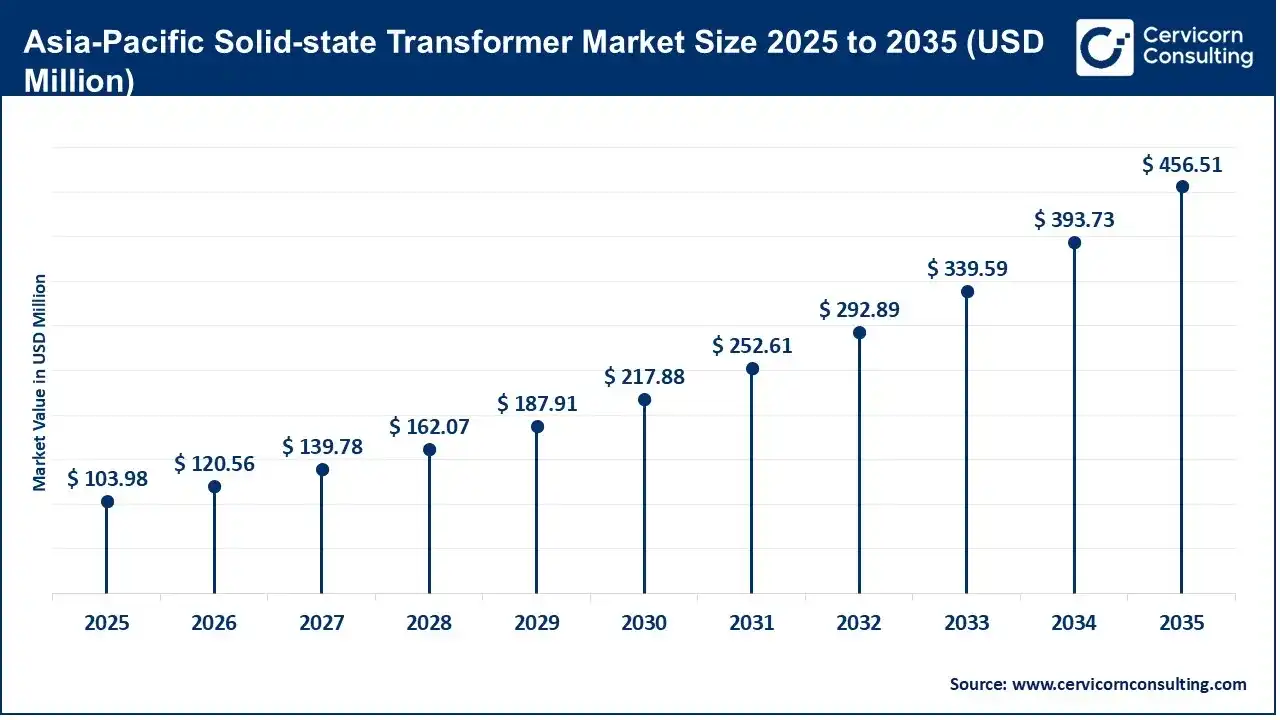
The Asia-Pacific solid-state transformer market size was valued at USD 103.98 million in 2025 and is expected to hit around USD 456.51 million by 2035. Asia-Pacific is the largest and fastest-expanding regional market, supported by rapid electricity-demand growth, smart-grid investments, renewable-energy integration, EV charging infrastructure, railway electrification, and a strong regional power electronics supply chain. The region accounted for approximately 40.1% of global SST revenue in 2025, according to recent market estimates. China, Japan, India, and South Korea represent the principal demand centers, while Taiwan and Southeast Asia strengthen the region's semiconductor and electronics manufacturing ecosystem. Regional growth is further supported by increasing adoption of SiC power electronics and digitally controlled distribution networks.
China: Massive Grid Expansion, Renewable Integration, EV Infrastructure, and Domestic Power-Electronics Manufacturing Drive SST Adoption
- The country is expanding smart-grid infrastructure and renewable-energy capacity, creating demand for SSTs capable of managing bidirectional power flows and variable generation.
- China's extensive EV ecosystem and rapid charging-infrastructure deployment provide an important opportunity for medium-voltage SSTs supporting compact, high-power charging stations.
India: Grid Modernization, Renewable Expansion, Railway Electrification, and EV Adoption Accelerate SST Opportunities
- Rapid expansion of solar and wind generation is increasing the requirement for advanced grid-interconnection equipment capable of voltage regulation and bidirectional power management.
- India's railway electrification program provides significant potential for traction SSTs, particularly because SST technology can reduce equipment weight while enabling advanced power conversion and energy recovery.
North America Solid-state Transformer Market: Driven by Grid Modernization, Renewable Integration, EV Charging, Data Centers, and Advanced Power Electronics
The North America solid-state transformer market size was estimated at USD 78.31 million in 2025 and is predicted to surpass around USD 243.80 million by 2035. North America is a leading region, supported by extensive grid modernization, rapid renewable-energy deployment, EV charging expansion, data-center electrification, and strong semiconductor research capabilities. The region accounted for approximately 30.2% of the global SST market in 2025, reflecting strong early adoption and investment in advanced power-conversion technologies. The United States represents the primary demand center, supported by utility modernization programs and technology-development initiatives, while Canada provides additional opportunities through renewable integration, electrification, and grid-resilience investments.
United States: Grid Modernization, Renewable Expansion, EV Charging, Data Centers, and Utility Investments Drive SST Adoption
- U.S. utilities increased distribution-infrastructure capital spending by 160% between 2003 and 2023, reaching USD 50.9 billion in 2023, highlighting substantial modernization requirements for transformers and distribution equipment.
- The U.S. added a record 50,344 MW of utility-scale solar, wind, and energy storage capacity in 2025, with these technologies accounting for 90.5% of total new power capacity, strengthening demand for flexible grid-interconnection technologies such as SSTs.
- U.S. distributed electricity-generation and storage investment reached nearly USD 12 billion in Q2 2026, more than doubling from the previous quarter, creating additional opportunities for bidirectional and digitally controlled SST systems.
Canada: Renewable-Energy Integration, Grid Resilience, Electrification, and Clean-Power Development Support Market Opportunities
- Canada's electricity system provides a strong application environment for SSTs because of its high reliance on clean electricity and growing requirements for flexible grid infrastructure.
- Increasing integration of renewable generation, distributed energy resources, battery storage, and electrified transportation is creating demand for advanced transformers capable of bidirectional power flow and real-time voltage management.
Europe Solid-state Transformer Market: Driven by Grid Modernization, Renewable Integration, EV Electrification, Smart Grids, and Advanced Power Electronics
The Europe solid-state transformer market size was accounted for USD 65.09 million in 2025 and is forecasted to hit USD 285.74 million by 2035. Europe is a major and rapidly developing market, supported by aggressive grid modernization, renewable-energy integration, transportation electrification, energy-storage deployment, and digitalization of electricity networks. Europe accounted for approximately 25.1% of global SST market revenue in 2025 according to recent estimates, while Germany represents the leading country market. The European Union's Action Plan for Grids estimates that EUR 584 billion in grid investments will be required by 2030, creating substantial opportunities for intelligent, power-electronic-based equipment such as SSTs.
Germany: Grid Modernization, Renewable Integration, Industrial Electrification, and Advanced Manufacturing Drive SST Demand
- Germany's extensive investment in electricity transmission and distribution modernization is creating opportunities for digitally controlled transformers capable of supporting bidirectional power flows and distributed energy resources.
- Rapid expansion of wind and solar generation is increasing requirements for advanced voltage regulation, grid balancing, and renewable-energy interconnection technologies.
United Kingdom: Smart-Grid Development, EV Charging, Renewable Integration, and Distribution-Network Modernization Support SST Adoption
- Distribution-grid modernization is becoming increasingly important as the country accommodates growing renewable generation, electrified transportation, heat pumps, and distributed energy resources.
- Expansion of EV charging infrastructure is creating opportunities for SSTs capable of directly interfacing medium-voltage networks with high-power DC charging systems.
Solid-state Transformer Market Share, By Region, 2025 (%)
| Region |
Revenue Share, 2025 (%) |
| Asia-Pacific |
40.1% |
| North America |
30.2% |
| Europe |
25.1% |
| LAMEA |
4.6% |
LAMEA (Latin America, Middle East & Africa) Solid-state Transformer Market: Driven by Renewable-Energy Expansion, Grid Modernization, Electrification, Urbanization, and Smart-Power Infrastructure
The LAMEA solid-state transformer market was valued at USD 11.93 million in 2025 and is anticipated to reach USD 52.37 million by 2035. LAMEA represents an emerging but high-potential market, supported by renewable-energy development, electricity-grid modernization, urbanization, electrification initiatives, EV infrastructure, and increasing adoption of smart-grid technologies. Latin America is particularly attractive because of its large solar and wind potential, while the Middle East is investing heavily in renewable-energy projects, smart cities, and advanced electricity infrastructure. Africa offers long-term opportunities through grid expansion, distributed renewable generation, and electrification. Recent estimates indicate that Latin America accounted for approximately 4.6% of the global SST market in 2025, demonstrating its growing contribution to the emerging regional opportunity.
Latin America: Renewable-Energy Expansion, Grid Modernization, Urbanization, and EV Infrastructure Drive SST Opportunities
- Brazil, Mexico, Chile, Argentina, and Colombia represent important markets as utilities expand transmission and distribution infrastructure and integrate increasing volumes of renewable generation.
- Brazil is expected to register the highest growth among Latin American countries, supported by renewable-energy development, electricity-network modernization, and increasing electrification.
Middle East: Renewable-Energy Projects, Smart Cities, Data Centers, and Grid Digitalization Strengthen SST Adoption
- The Middle East is emerging as an important SST opportunity as countries such as Saudi Arabia and the UAE invest in renewable generation, smart cities, electrification, and advanced electricity networks.
- The UAE's power-generation capacity is projected to reach approximately 79.1 GW by 2035, indicating substantial requirements for modern distribution and power-management infrastructure.
The solid-state transformer market is segmented into product type, power rating, semiconductor device type, application, end user, and geography.
Product Type Analysis
Distribution Solid-State Transformers are the dominating segment, supported by their suitability for distribution-grid modernization, distributed energy resources, voltage management, and EV charging infrastructure. Distribution SSTs accounted for approximately 43.7% of the market in 2026, according to recent industry estimates. Their relatively broad applicability across utility feeders, commercial facilities, renewable installations, and charging hubs gives them a larger near-term addressable market than specialized power or traction SSTs. Utilities are increasingly evaluating distribution-level SSTs for controllable, bidirectional power-flow capabilities and improved grid flexibility.
Solid-state Transformer Market Share, By Product Type, 2025 (%)
| Product Type |
Revenue Share, 2025 (%) |
| Distribution Solid-State Transformers |
43.7% |
| Power Solid-State Transformers |
31.8% |
| Traction Solid-State Transformers |
18.1% |
| Others |
6.4% |
Power Rating Analysis
The Less than 1 MVA segment is expected to dominate near-term deployments because SST commercialization is concentrated around distribution-level, commercial, and smaller renewable-energy applications. Recent industry analysis identifies the 100 kVA–1 MVA range as the most commercially active power-rating category, covering typical smart-grid nodes, EV charging hubs, and distributed-energy installations. This segment benefits from comparatively manageable system complexity and easier integration into existing distribution infrastructure. Demand is also supported by modular SST designs that allow capacity to be expanded according to individual site requirements.
Semiconductor Device Type Analysis
Silicon Carbide (SiC)-Based SSTs are the dominating semiconductor technology, benefiting from SiC's ability to support high-voltage switching, higher operating temperatures, lower switching losses, and greater power density than conventional silicon devices. SiC technology is particularly suitable for medium-voltage SSTs where high-frequency switching and compact converter architectures are essential. Recent industry developments include 3.3-kV SiC power modules specifically targeting solid-state transformers and grid-scale converters. Growing commercialization of SiC power modules is therefore strengthening their position in utility, EV charging, renewable-energy, and industrial SST applications.
Solid-state Transformer Market, By Semiconductor Device Type, 2025 (%)
| Semiconductor Device Type |
Revenue Share, 2025 (%) |
| Silicon Carbide (SiC)-Based SST |
61.7% |
| Gallium Nitride (GaN)-Based SST |
24.8% |
| Hybrid SiC + GaN SST |
13.5% |
Application Analysis
Smart Grid & Distribution Networks represent the dominating application segment, accounting for approximately 39.7% of market revenue in 2025 according to recent estimates. SSTs provide utilities with capabilities beyond conventional voltage transformation, including bidirectional power flow, voltage regulation, power-quality management, and integration of distributed energy resources. These functions are increasingly valuable as electricity networks become more decentralized and digitally controlled. Distribution-level SSTs can also support energy storage and flexible loads, making them particularly relevant to grid-edge modernization programs and increasingly congested distribution networks.
Solid-state Transformer Market, By Application, 2025 (%)
| Application |
Revenue Share, 2025 (%) |
| Smart Grid & Distribution Networks |
39.7% |
| Renewable Energy Integration |
22.8% |
| Electric Vehicle Charging Infrastructure |
14.3% |
| Railway & Traction Systems |
9.6% |
| Data Centers |
5.9% |
| Industrial & Commercial Facilities |
5.2% |
| Others |
2.5% |
End User Analysis
Electric Utilities are the dominating end-user segment, as SST technology directly addresses utility requirements for grid modernization, distributed-energy integration, voltage control, and improved distribution flexibility. Utilities also represent the largest potential deployment base because SSTs can eventually be integrated at substations, feeders, and grid-edge locations. Recent market analysis indicates that distribution SSTs are being incorporated into utility asset-replacement cycles, while pilot projects increasingly focus on load-serving circuits and distribution networks. Utility adoption is therefore expected to remain central to SST commercialization as technical validation progresses.
Solid-state Transformer Market, By End User, 2025 (%)
| End User |
Revenue Share, 2025 (%) |
| Electric Utilities |
32.7% |
| Renewable Energy Developers |
21.8% |
| Transportation Authorities |
19.6% |
| Industrial Enterprises |
12.7% |
| Commercial & Institutional Operators |
8.1% |
| Others |
5.1% |
Segments Covered
By Product Type
- Distribution Solid-State Transformers
- Power Solid-State Transformers
- Traction Solid-State Transformers
- Others
By Power Rating
- Less than 1 MVA
- 1–5 MVA
- More than 5–20 MVA
- More than 20 MVA
By Semiconductor Device Type
- Silicon Carbide (SiC)-Based SST
- Gallium Nitride (GaN)-Based SST
- Hybrid SiC + GaN SST
By Application
- Smart Grid & Distribution Networks
- Renewable Energy Integration
- Electric Vehicle Charging Infrastructure
- Railway & Traction Systems
- Data Centers
- Industrial & Commercial Facilities
- Others
By End User
- Electric Utilities
- Renewable Energy Developers
- Transportation Authorities
- Industrial Enterprises
- Commercial & Institutional Operators
- Others
By Geography
- North America
- Europe
- Asia-Pacific
- LAMEA