Small Molecule CDMO Market Size, Growth, Forecast 2026 to 2035
The global small molecule CDMO market size was valued at USD 75.83 billion in 2025 and is expected to be worth around USD 135.75 billion by 2035. The market is also seen to grow at a CAGR of 6% over the forecast period from 2026 to 2035. The small molecule CDMO market is experiencing strong growth due to increasing pharmaceutical outsourcing, rising drug development activities, and growing demand for cost-efficient manufacturing solutions.
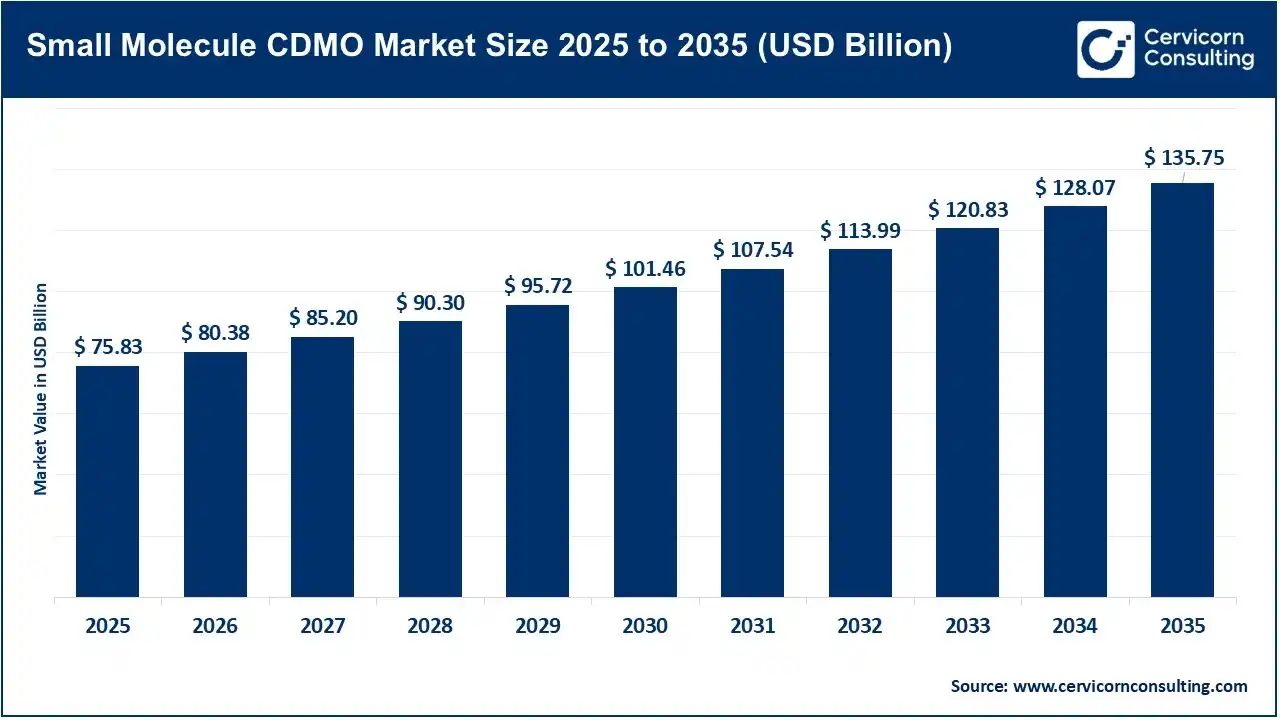
Report Highlights
- By region, North America dominated the market in 2025 with 40.60% share, attributed to its advanced pharmaceutical ecosystem, strong biotechnology industry, high R&D expenditure, presence of leading CDMO companies, and increasing outsourcing of drug development and manufacturing activities.
- By region, Asia Pacific is anticipated to grow at the fastest rate during the forecast period, supported by expanding pharmaceutical manufacturing infrastructure, cost-effective production capabilities, increasing global outsourcing activities, and the growing presence of CDMO hubs in countries such as China and India.
- By product type, the Active Pharmaceutical Ingredients (API) segment accounted for a revenue share of 63% in 2025, driven by increasing outsourcing of API development and manufacturing activities by pharmaceutical and biotechnology companies, along with rising demand for complex APIs, high-potency APIs (HPAPIs), and specialty small molecules requiring advanced manufacturing capabilities.
- By product type, the finished drug products segment is expected to witness the fastest growth during the forecast period, supported by increasing demand for integrated CDMO solutions, including formulation development, clinical supply, packaging, and commercial manufacturing services that enable faster drug commercialization.
- By drug type, the innovator drugs segment accounted for the largest market share of 57% in 2025, owing to increasing pharmaceutical R&D investments, expanding clinical pipelines, and growing demand for CDMO support in process development, analytical testing, regulatory compliance, and commercial-scale manufacturing of novel therapies.
- By drug type, the generic drugs segment is projected to grow at the fastest rate, fueled by rising patent expirations, increasing demand for affordable medicines, and growing outsourcing activities among generic drug manufacturers seeking cost-efficient small molecule production capabilities.
- By application, the oncology segment leading the market with a share of 35% in 2025, due to significant pharmaceutical investment in cancer therapeutics, rising development of targeted therapies and kinase inhibitors, and increasing demand for high-potency API manufacturing capabilities for complex oncology drugs.
- By application, the autoimmune and inflammatory diseases segment is expected to register the fastest growth during the forecast period, driven by increasing disease prevalence, rising development of targeted immune-modulating therapies, and growing demand for flexible CDMO solutions supporting specialty drug manufacturing.
What is Small Molecule CDMO Market?
The small molecule CDMO market encompasses organizations engaged in providing contracted development and manufacturing services related to the manufacturing of small molecule products such as finished dosage forms, intermediates and APIs. CDMOs provide various services to the pharmaceutical and biotechnology organizations throughout a multitude of stages of the product life cycle-process development, analytical testing, clinical trial manufacturing, scale-up manufacturing and commercial scale manufacturing.
Small molecule CDMO market is a vital part of the entire supply chain due to escalating outsourcing of the manufacturing segment by the drug manufacturers to curb down the expenses, enhance maneuverability, and fast-track the approval process, especially for the innovation and generic drugs in different categories such as oncology, cardiovascular, nervous system disorders and specialty pharmaceutical products.
How Are AI and Digital Technologies Improving Small Molecule Manufacturing?
The combination of AI, automation and digital technologies is revolutionizing small molecule manufacturing by enhancing process efficiency, shortening development timelines and creating predictive and data-driven production systems. Unlike traditional methods relying on experimental optimization, AI-powered platforms enable CDMOs to analyze huge amounts of data, optimize chemistries and predict equipment capabilities and quality in the manufacturing lifecycle.
For example, Bristol Myers Squibb entered into an agreement with providers of quantum computing and AI technologies to test advanced solutions to optimize drug discovery and manufacturing, an example of how computational technologies are increasingly embedded within all pharmaceutical manufacturing activities.
Several leading CDMOs are utilizing digital twins, machine learning algorithms and process analytical technologies (PAT) to simulate manufacturing ahead of physical production thereby minimizing development risks and ensuring scalability.
Manufacturing Expansion and Capacity Investments
| Company |
Recent Capacity Expansion / Investment Activity |
Strategic Impact |
| Lonza Group AG |
Lonza has continued investing in its global pharmaceutical manufacturing network, including expansion of advanced manufacturing capabilities for complex small molecules and HPAPIs. The company operates more than 30 manufacturing sites globally and reported CHF 6.6 billion in sales in 2023, reflecting its strong position across pharmaceutical development and manufacturing services. |
Strengthens Lonza’s position in high-value small molecule manufacturing, particularly for complex APIs, HPAPIs, and specialty pharmaceutical applications requiring advanced containment capabilities. |
| Thermo Fisher Scientific (Patheon) |
Thermo Fisher Scientific continues expanding its global CDMO infrastructure through investments in pharmaceutical development and manufacturing facilities. Through its Patheon business, the company operates approximately 65+ manufacturing and development sites globally and generated more than $1 billion in revenue from its Pharma Services Group in 2023. |
Enhances its integrated CDMO capabilities across drug development, clinical manufacturing, commercial production, and supply chain services for pharmaceutical innovators. |
| WuXi AppTec |
WuXi AppTec has significantly expanded its integrated CRDMO platform, with investments across research, process development, and commercial manufacturing facilities. The company operates 30+ manufacturing facilities globally and reported approximately RMB 40 billion ($5.5 billion) in revenue in 2023, supported by strong demand for outsourced pharmaceutical services. |
Supports global pharmaceutical outsourcing demand by providing integrated small molecule development, API manufacturing, and commercial production capabilities. |
| Piramal Pharma Solutions |
Piramal Pharma Solutions has expanded its global manufacturing footprint with investments in API, HPAPI, and specialized pharmaceutical manufacturing facilities across India, North America, and Europe. The company operates 15+ manufacturing and development facilities across multiple countries, supporting global pharmaceutical customers. |
Improves its ability to support oncology products, complex APIs, high-potency compounds, and regulated-market manufacturing requirements. |
| Cambrex |
Cambrex has continued strengthening its small molecule CDMO capabilities through facility expansions and technology investments. The company operates 12+ manufacturing and R&D facilities globally and supports more than 70 active pharmaceutical ingredients (APIs) across clinical and commercial programs. |
Strengthens its position as a specialized small molecule CDMO by expanding API development, analytical testing, and commercial manufacturing capabilities for pharmaceutical innovators. |
Market Dynamics
Driver
Increasing Pharmaceutical Outsourcing and Growing Drug Development Activities
Increased adoption of outsourcing models among pharma and biotech companies is an important factor fueling the growth of the small molecule CDMO market. Drug developers are opting for CDMOs due to their in-depth manufacturing knowledge, decreasing reliance on in-house development, and a reduction in capital investment for facility construction, which significantly helps accelerate the time to market.
Growing number of small biotech organizations has given rise to dependency on CDMOs since these firms often do not have manufacturing facilities. Rise in spending in pharma R&D further results in increase in drug candidates with small molecule as their active ingredient, hence increasing the need for development and production. As a result, focus on oncology, specialty products and advanced complex drugs continues to rise, thereby triggering need for qualified CDMOs in the space with expanded API manufacturing competencies.
Restraint
Complex Regulatory Requirements and High Manufacturing Costs
The pharmaceutical manufacturing sector has a stringently governed landscape. In conjunction, with rising trends of developing more complicated pharmaceutical molecules, including High Potency Active Pharmaceutical Ingredients (HPAPIs), it’s becoming increasingly arduous and cost-intensive for small-scale CDMOs to thrive. Regulatory authorities including the FDA, EMA, and more global bodies set specific standards, which necessitate considerable funding for the upgradation of facility infrastructure, facility regulations compliance, and expert manpower.
Moreover, HPAPIs come with special containment prerequisites that necessitate additional specialized manufacturing equipment and, most significantly, a high level of skilled manpower-which thereby increases overheads for manufacturers of such complexes.
Opportunity
Growth in Complex Molecules, HPAPIs, and Integrated CDMO Services
The growing commercial pipeline of highly complex small molecule therapies offers substantial scope for the market growth. Investment in targeted therapy and specialized medicines, with high-concentration drug substance and specialized formulation technology, as well as oncology applications, has driven the increasing commercial pipeline from major pharma players.
Expanding the trend towards end-to-end partnership As pharma companies favor to CDMOs to undertake complete drug lifecycle from process development, clinical manufacturing and regulatory support, through to commercial supply; new market opportunities are arising with greater adoption of technology-driven integrated business models, flexible manufacturing options, drug innovation pipeline and personalized medicine trend.
Regional Analysis
Why has North America dominated the small molecule CDMO market?
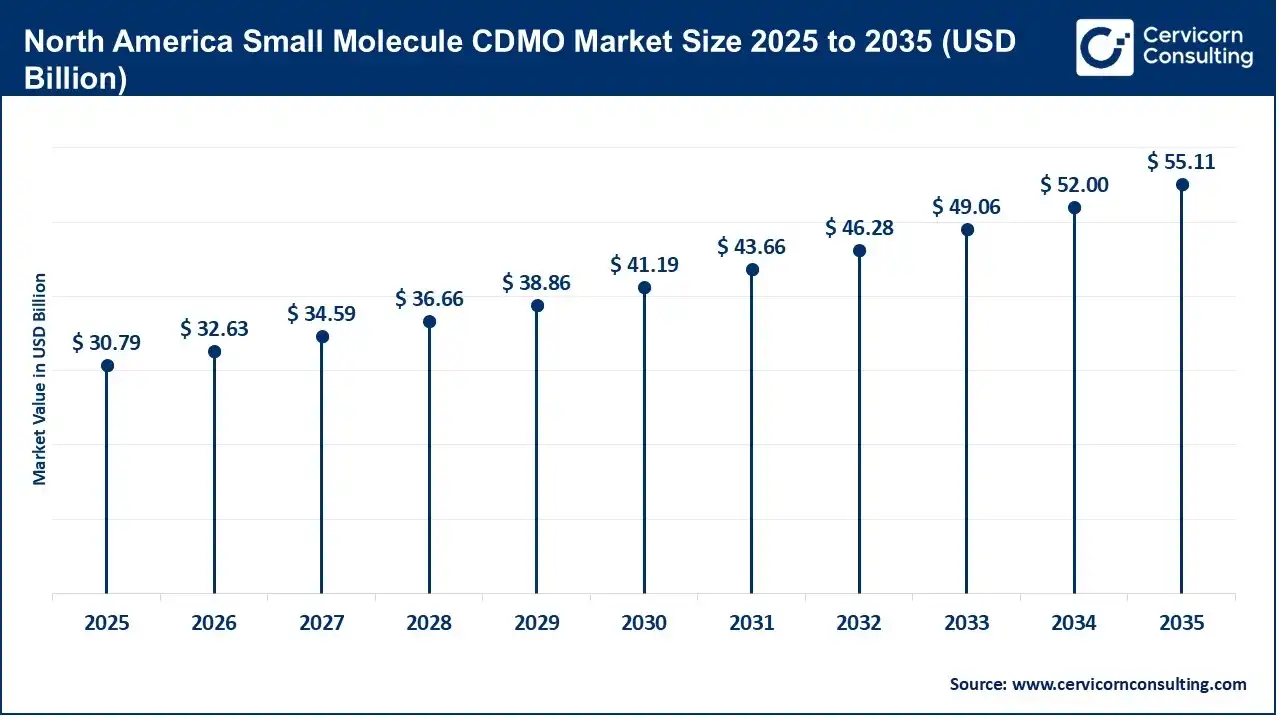
The North America small molecule CDMO market size was estimated at USD 30.79 billion in 2025 and is projected to hit around USD 55.11 billion by 2035. North America has dominated the market in 2025, driven by the highly developed pharmaceutical ecosystem, the flourishing biotechnology industry, a robust R&D infrastructure, and the presence of internationally acclaimed CDMO enterprises in the region. The U.S. is one of the major drivers of demand, propelled by pharmaceutical high innovation and the vast extent of research activities including clinical development as well as by the rising outsourcing trend from biotechnology companies.
This region is known to host one of the biggest pharmaceutical market sizes worldwide, with the U.S. accounting for a big portion of the world's pharmaceutical sales and R&D spending. Industry estimations hold that U.S. pharmaceutical industry spends about $100 billion more per year on R&D activities, thus developing a substantial drug development pipeline and necessitating outsourcing manufacturing partners. Simultaneously, thousands of biotech companies located in the U.S. are dependent on CDMO relationships and are thereby major demand generators for the small molecule CDMO market in the region.
How is Asia Pacific Growing in the small molecule CDMO market?
The Asia-Pacific small molecule CDMO market size was valued at USD 16.30 billion in 2025 and is expected to surpass around USD 29.19 billion by 2035. The APAC market is expected to record a rapid growth owing to augmented pharmaceutical manufacturing facilities, reduced manufacturing costs, growing outsourcing trends and the ongoing enhancement of regulatory standards in the region. Especially China, India, Japan and South Korea are emerging as a major pharmaceutical outsourcing hubs in the world as there exists a comprehensive chemistry manufacturing infrastructure and a qualified pool of talent within the region.
China has a continued role as a major contributor because of the strong existing API manufacturing system and the increasing capabilities as a CRDMO. India is gaining a preferential outsourcing status for the global pharmaceutical sector due to the abundance of facilities, cost efficiencies along with a stronghold on generic drug manufacturing and manufacturing capability.
Which Countries Are Leading the Small Molecule CDMO Market?
United States: The United States’ presence as a dominant market for small molecule CDMO is strongly driven by its significant pharmaceutical research & development, high healthcare expenditure, and the presence of leading pharmaceutical and biotechnology organizations on the global level. Their large portfolio of promising new therapies across several areas including oncology, rare diseases, and specialized treatments drives a steady pipeline of demands to be outsourced by contract manufacturing and development organizations.
China: China’s emergence as the lead international market in providing small molecule contract development services has primarily been driven by the solid chemical industry that exists there. There are ample resources in regard to raw materials and strong manufacturing capacity due to which pharmaceutical and biotech outsourcing firms utilize the production process of China to procure economically feasible solutions.
India: As more pharmaceutical products are developed within global limits of manufacturing capability, India’s position at the most prominent country for development services in small molecule CDMO has escalated rapidly. Their manufacturing efficiencies make their low cost product a favorable option; a large proportion of drug development is catered towards Europe and the United States market especially the generic and API development segment of this market.
Germany: Germany, the center of the most successful pharmaceutical industries in the continent, remains among the most successful small molecule CDMO markets for the small to mid size pharmaceutical firms. German small molecule development companies have an advanced understanding in API manufacturing, chemical development, in turn creating good will from top global pharmaceutical producers in the U.S. To Germany.
Switzerland: With the country offering excellent small molecule CDMO expertise, the region stands out for manufacturing in complex drug development stages with its comprehensive expertise, focus on pharmaceutical and advanced API development, it truly makesSwitzerlandamong the key markets for some of the major U.S. Firms looking for complex manufacturing and highly precise products development stages.
Segmental Analysis
Product Type Analysis
The Active Pharmaceutical Ingredients (API) segment contributed the highest revenue to the small molecule CDMO market in 2025, driven by the increasing outsourcing of both API development and manufacturing functions by pharmaceutical and biotechnology organizations. APIs form the main medicinal entity in a drug; their production requires specialized process development, regulatory compliance expertise, significant quality control infrastructure, and capacity for large-scale production.
As pharmaceutical companies aim to curb capital expenditures and optimize manufacturing operations through increased flexibility, they are largely entrusting CDMOs with API production instead of investing in or expanding in-house facilities.
The growing demand for complex APIs, HPAPIs, and specialty small molecules further boosts the largest segment of the market. Targeted therapies for cancer, precision medicines, and other complex drugs necessitate considerable expertise in API manufacturing which involves highly specialized manufacturing techniques like sophisticated containment measures, and controlled manufacturing environments.
Small Molecule CDMO Market Share, By Product Type, 2025 (%)
| Product Type |
Revenue Share, 2025 (%) |
| Active Pharmaceutical Ingredients (API) |
63% |
| Finished Drug Products |
37% |
The finished drug products segment is projected to grow at the fastest pace over the forecast period owing to increasing need for end-to-end CDMO solutions. Services like formulation development, clinical supply, packaging and commercial manufacturing comprise of finished drug products segment.
Pharmaceutical companies tend to rely on consolidated and integrated partners that can handle their entire supply chain including sourcing of API and the development of finished drug products, thereby optimizing supply chain management as well as enhancing speed to market.
Rising prevalence of specialty drugs, personalized medicines, and drugs catering to minority populations continue to augment need for more adaptable finished dosage drug product manufacturing. CDMOs providing services such as tablet, capsule and injectable based products and innovative dosage forms remain critical for pharmaceutical firms striving to achieve efficiency in commercialization strategies.
Drug Type Analysis
The innovator drugs segment occupied the largest market share within the small molecule CDMO industry in 2025, mainly due to the rising investment in pharmaceutical R&D, the significant growth in clinical trials and an increase in the complexity of newly developed drug candidates. The development of innovative small molecule drugs require increased R&D support in terms of process improvement, analytical testing, clinical manufacturing and regulatory support, which generates massive opportunities for CDMOs.
Growing pharmaceutical pipeline, especially in indications such as cancer, orphan diseases and specialty therapeutics is creating a growing demand for collaboration with CDMOs among innovator companies. A lot of biotechnology companies lack efficient internal production capabilities and thus depend on manufacturing partnerships for the accelerating clinical development process.
Small Molecule CDMO Market Share, By Drug Type, 2025 (%)
| Drug Type |
Revenue Share, 2025 (%) |
| Innovator Drugs |
63% |
| Generic Drugs |
37% |
The fastest growing segment is expected to be the generic drugs segment, owing to the expiration of various patents and rising demand of affordable drugs, coupled with the overall expansion of the generic drug manufacturing across the globe. The expiry of exclusivity of blockbuster drugs creates opportunities for manufacturers and suppliers and CDMOs that provide low cost and efficient manufacturing support in small molecules.
Expanding healthcare expenditure, supportive government policies aimed at improving drug affordability and access, coupled with increased demand from developing economies are spurring the production of generic drugs across several nations. Countries such as India and China continue to reinforce their position as leading global manufacturing hubs for generic drugs on account of their cost benefits, availability of skilled pharmaceutical workforce and expanding regulatory capabilities.
Application Analysis
Oncology was the leading application segment in 2025 owing to the sustained high pharmaceutical investment in oncology drugs and rapid development of small molecule targeted therapy drug substances. Oncology is one of the dominant fields of drug research, with thousands of ongoing clinical trials across the world seeking newer therapies.
Rising application of the targeted therapies, kinase inhibitors and potent oncology drugs are driving CDMOs towards expanding their advanced manufacturing capabilities for oncology. A large number of the oncology compounds are need to be manufactured with stringent containment capabilities in relation to their potency, thus resulting in the rising demand for HPAPI manufacturing capabilities. Leading CDMOs are developing their own capabilities in this application to offer the high demand for clinical and commercial manufacturing.
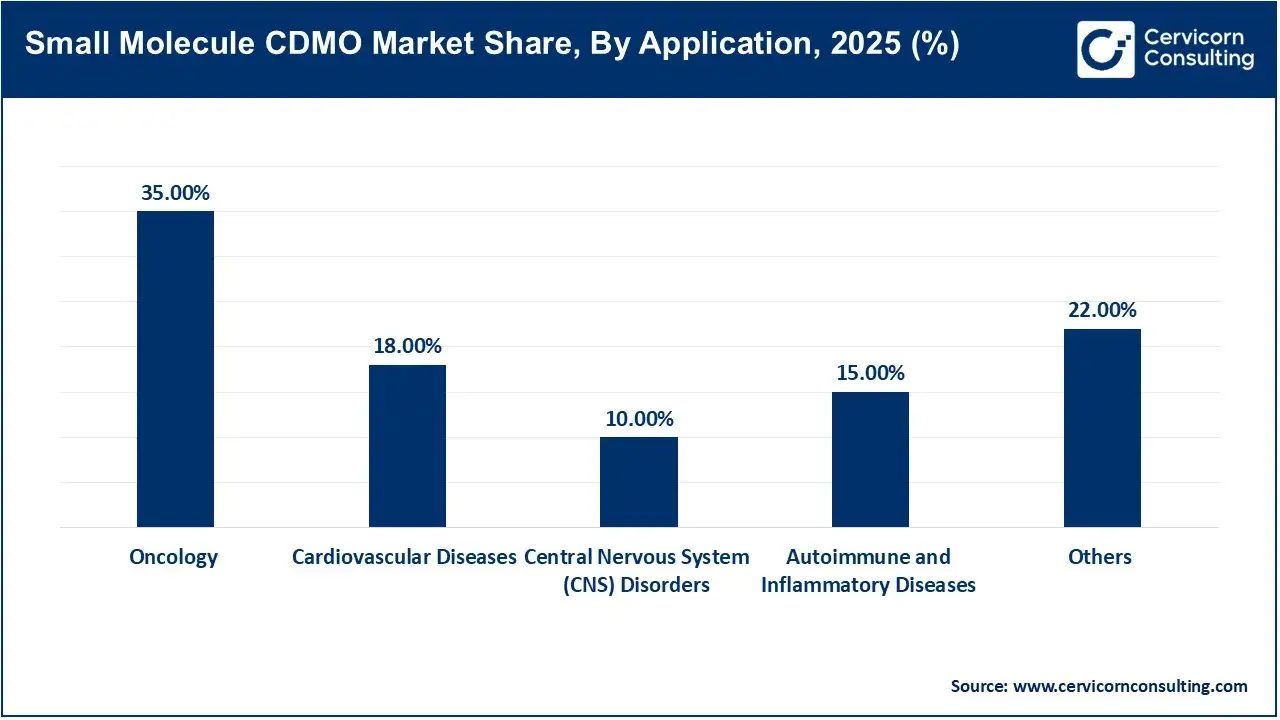
Autoimmune and inflammatory diseases segment will witness the highest growth during the forecast period owing to ever increasing prevalence of diseases, high awareness over healthcare and proliferation of novel therapy development. Rheumatoid arthritis, psoriasis, inflammatory bowel disease and other immunological conditions continue to drive high investment from pharmaceutical companies to find the new small molecule drugs.
Targeted immune-modulating drugs represent a growing arena offering numerous opportunities for CDMOs proficient in complex molecule development and scalable manufacturing. Furthermore, rise of precision medicine is fueling demand for flexible manufacturing solutions in order to meet the demand for specialty drugs in small cohorts.
Small Molecule CDMO Market Competitive Landscape
| Company |
Significance in the Small Molecule CDMO Market |
| Lonza Group AG |
A leading global CDMO offering end-to-end services for small molecule development, API manufacturing, and commercial-scale production with strong expertise in HPAPIs. |
| Thermo Fisher Scientific Inc. (Patheon) |
Provides integrated CDMO solutions spanning drug development, clinical manufacturing, commercial production, and regulatory support through its global manufacturing network. |
| WuXi AppTec |
Recognized for its comprehensive CRDMO platform, offering discovery, development, and manufacturing services for innovative small molecule therapeutics worldwide. |
| Catalent, Inc. |
Delivers formulation development, clinical supply, and commercial manufacturing services, helping pharmaceutical companies accelerate product commercialization. |
| Cambrex Corporation |
Specializes in small molecule API development and manufacturing with strong capabilities in process development, analytical testing, and commercialization. |
| Piramal Pharma Solutions |
Provides integrated CDMO services with expertise in API manufacturing, high-potency compounds, and global supply chain support for pharmaceutical innovators. |
| CordenPharma International |
Offers customized small molecule development and manufacturing services, with strengths in complex APIs, peptide technologies, and commercial-scale production. |
| Recipharm AB |
Supports pharmaceutical and biotechnology companies through end-to-end development, manufacturing, formulation, and packaging solutions for small molecule drugs. |
| Siegfried Holding AG |
A global CDMO known for its expertise in API manufacturing, pharmaceutical intermediates, and finished dosage production for regulated markets. |
| Almac Group |
Provides integrated pharmaceutical development, analytical testing, clinical manufacturing, and commercial production services with a strong focus on innovation and quality. |
Recent Strategic Developments
- June 2026: Lonza expanded its small molecule manufacturing capabilities by launching additional commercial-scale production capacity at its Visp, Switzerland site. The expansion is designed to support growing demand for complex APIs and high-potency active pharmaceutical ingredients (HPAPIs), strengthening the company's end-to-end CDMO offerings.
- April 2026: Cambrex Corporation announced the expansion of its analytical testing and development services to support accelerated small molecule drug development. The investment enhances the company's ability to provide integrated development, manufacturing, and regulatory support for pharmaceutical customers.
- February 2026: CordenPharma entered a strategic partnership with a biotechnology company to provide process development and commercial manufacturing services for innovative small molecule therapeutics. The collaboration is aimed at accelerating clinical development while ensuring scalable manufacturing capabilities.
Segments Covered
By Product Type
- Active Pharmaceutical Ingredients (API)
- Finished Drug Products
By Drug Type
- Innovator Drugs
- Generic Drugs
By Application
- Oncology
- Cardiovascular Diseases
- Central Nervous System (CNS) Disorders
- Autoimmune and Inflammatory Diseases
- Others
By Region
- North America
- Europe
- Asia Pacific
- Latin America
- Middle East and Africa (MEA)