Small Molecule API Market Size and Growth 2026 to 2035
The global small molecule API market size was valued at USD 218.47 billion in 2025 and is projected to grow from USD 230.66 billion in 2026 to nearly USD 376.01 billion by 2035, registering a CAGR of 5.6% over the 2026 to 2035 period.
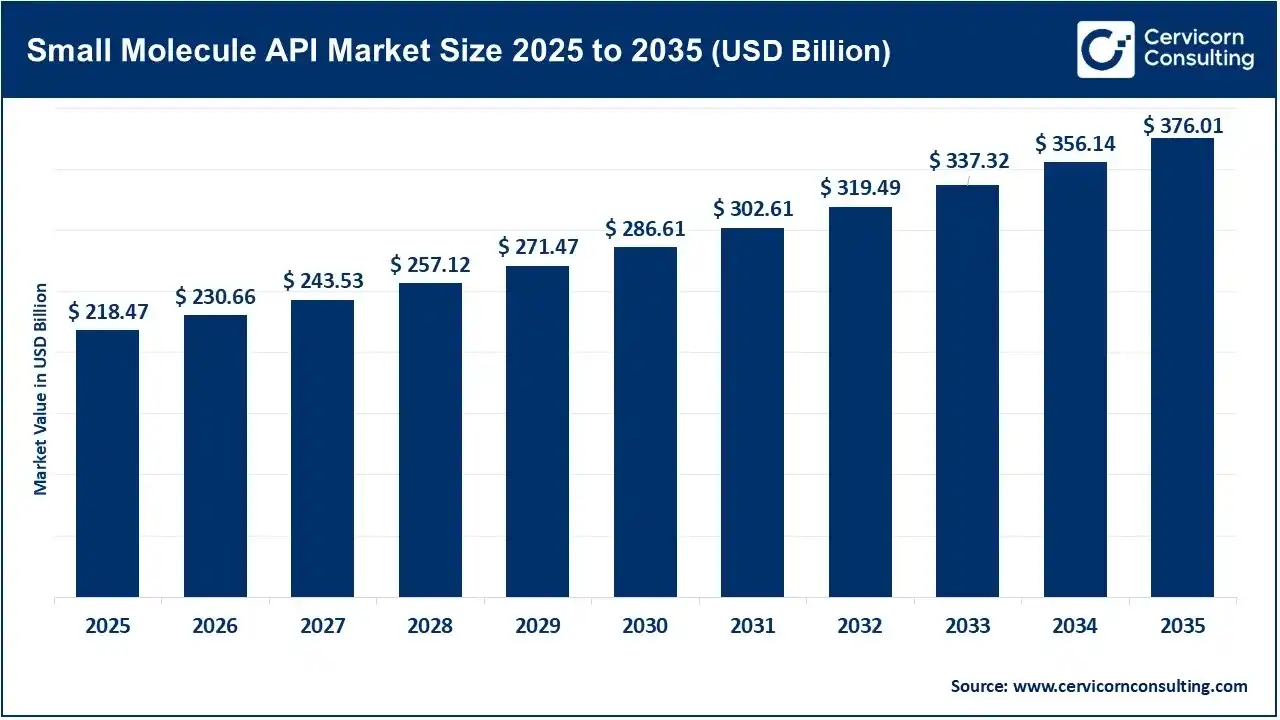
The small molecule API market is growing because the prevalence of chronic illnesses is rising, pharmaceutical production is expanding, and the demand for novel and generic medications is rising. The need for affordable pharmaceutical production, rising API manufacturing outsourcing, and growing investments in drug development are all contributing factors to market expansion. Technological developments in manufacturing are enhancing the scalability, quality, and efficiency of production. New growth prospects are also being created by the growing demand from developing pharmaceutical markets for high-quality APIs.
- 23 February 2026, AbbVie announced a $380 million investment to construct two new active pharmaceutical ingredient (API) manufacturing facilities at its North Chicago campus. The facilities are expected to expand domestic API production for neuroscience and obesity treatments, highlighting the growing investment in advanced small molecule API manufacturing capacity.
Report Highlights
- By region, North America led the small molecule API market in 2025, supported by strong pharmaceutical manufacturing, advanced infrastructure, and drug development activities.
- By region, Asia Pacific is expected to grow rapidly, driven by expanding pharmaceutical production, API manufacturing, and outsourcing activities.
- By API type, synthetic APIs led the market in 2025, driven by their widespread use in generic and innovative medicines.
- By API type, biocatalytic APIs are expected to grow rapidly, supported by sustainable manufacturing and improved production efficiency.
- By molecule category, generic APIs led the market in 2025, driven by strong demand for affordable medicines and increasing generic drug production.
- By molecule category, complex small molecule APIs are expected to grow rapidly, supported by rising demand for specialized therapies and advanced drug development.
- By manufacturing type, captive / in-house manufacturing led the market in 2025, supported by quality control, supply reliability, and production flexibility.
- By manufacturing type, contract manufacturing / CDMO is expected to grow rapidly, driven by increasing outsourcing and demand for specialized manufacturing capabilities.
- By therapeutic area, oncology led the market in 2025, driven by rising cancer prevalence and increasing development of small molecule cancer therapies.
- By therapeutic area, metabolic diseases are expected to grow rapidly, supported by rising demand for treatments targeting diabetes, obesity, and related conditions.
- By application, commercial pharmaceutical manufacturing led the market in 2025, driven by continuous production of generic and branded medicines.
- By application, clinical applications are expected to grow rapidly, supported by expanding drug development pipelines and clinical research activities.
- By end user, pharmaceutical companies led the market in 2025, driven by extensive API requirements across drug development and commercial manufacturing.
- By end user, biotechnology companies are expected to grow rapidly, supported by expanding drug discovery activities and innovative therapy development.
Recent Trends
- Increasing demand for generic drugs: Growing adoption of cost-effective generic medicines is increasing demand for small molecule APIs.
- Rise in outsourced API manufacturing: Pharmaceutical companies are increasingly outsourcing API production to specialized manufacturers to reduce costs and improve production efficiency.
- Growing adoption of continuous manufacturing: Advanced manufacturing technologies are being adopted to improve process efficiency, product quality, and scalability.
- Expansion of high-potency APIs: Rising demand for targeted therapies is supporting the development and production of high-potency small molecule APIs.
- Increasing focus on sustainable production: API manufacturers are adopting greener processes, energy-efficient technologies, and waste-reduction practices.
- Growth of emerging pharmaceutical markets: Expanding pharmaceutical industries in Asia Pacific and other emerging regions are creating new opportunities for small molecule API manufacturers.
Government Initiatives
- In February 2026, the Government of India continued the implementation of the Scheme for Promotion of Bulk Drug Parks, supporting the development of common infrastructure such as power, water, waste management, testing laboratories, and logistics for API manufacturers. The initiative aims to reduce manufacturing costs and strengthen the domestic pharmaceutical supply chain.
- In March 2026, the Government of India highlighted the PLI Scheme for Bulk Drugs, which promotes domestic manufacturing of critical key starting materials, drug intermediates, and APIs. The scheme is intended to reduce import dependence and strengthen self-reliance in critical pharmaceutical ingredients.
- In March 2026, the Government reported progress under the PLI Scheme for Bulk Drugs, with approved projects supporting the establishment of new domestic manufacturing capacity for critical APIs, KSMs, and drug intermediates. The initiative continues to support investment in domestic API production and reduce supply-chain risks.
- In August 2026, the Government of India reported that 48 projects had been approved under the PLI Scheme for Bulk Drugs, supporting domestic manufacturing of critical KSMs, drug intermediates, and APIs. The initiative continues to support investment in domestic API production and reduce supply-chain risks.
Market Dynamics
Driver- Rising Demand for Generic and Innovative Medicines
The market for small molecule APIs is mostly driven by the rising need for new and generic medications. Manufacturers are being encouraged to increase API manufacturing due to growing pharmaceutical output, the increasing frequency of chronic diseases, and the need for reasonably priced treatment choices. The need for premium small molecule APIs is also being supported by rising investments in contract manufacturing and drug development.
- In July 2026, Evonik announced a USD 100 million investment to upgrade its Tippecanoe, Indiana site and expand integrated drug substance development and manufacturing for small molecule APIs. The expansion includes additional production trains, advanced equipment, and laboratories to support oral and injectable APIs, reflecting growing demand for flexible and reliable small molecule API manufacturing capabilities.
Restraint – Stringent Regulatory Requirements and Manufacturing Complexity
Strict regulatory constraints, intricate manufacturing procedures, and the expensive expense of maintaining compliant production facilities all limit the market for small molecule APIs. Manufacturers must spend in cutting-edge machinery, testing, and quality-control systems in addition to adhering to stringent quality standards. Production schedules may be impacted by supply chain interruptions, regulatory inspections, and shifting compliance requirements.
- In June 2026, Lonza announced developments related to its small molecule manufacturing capabilities, highlighting the increasing complexity of producing pharmaceutical ingredients under stringent quality and regulatory requirements.
Opportunity – Growing Demand for High-Potency APIs
Opportunities for high-potency small molecule APIs are being created by the growing development of targeted therapeutics, cancer medications, and other specialty treatments. Pharmaceutical firms are looking for manufacturing partners with particular skills in managing complicated substances and cutting-edge containment technology. Opportunities to increase specialized production capabilities and meet new drug-development needs are being created by this trend for API manufacturers. Manufacturers are being encouraged to invest in specialized facilities and cutting-edge production technology due to the growing demand for complicated medicinal compounds. Opportunities for contract API producers with particular skills are also being created by an increase in pharmaceutical outsourcing.
- In September 2026, CordenPharma announced an expansion of its small molecule API capabilities, supporting the growing demand for complex and high-potency pharmaceutical ingredients.
Regional Analysis
North America region dominated the small molecule API market
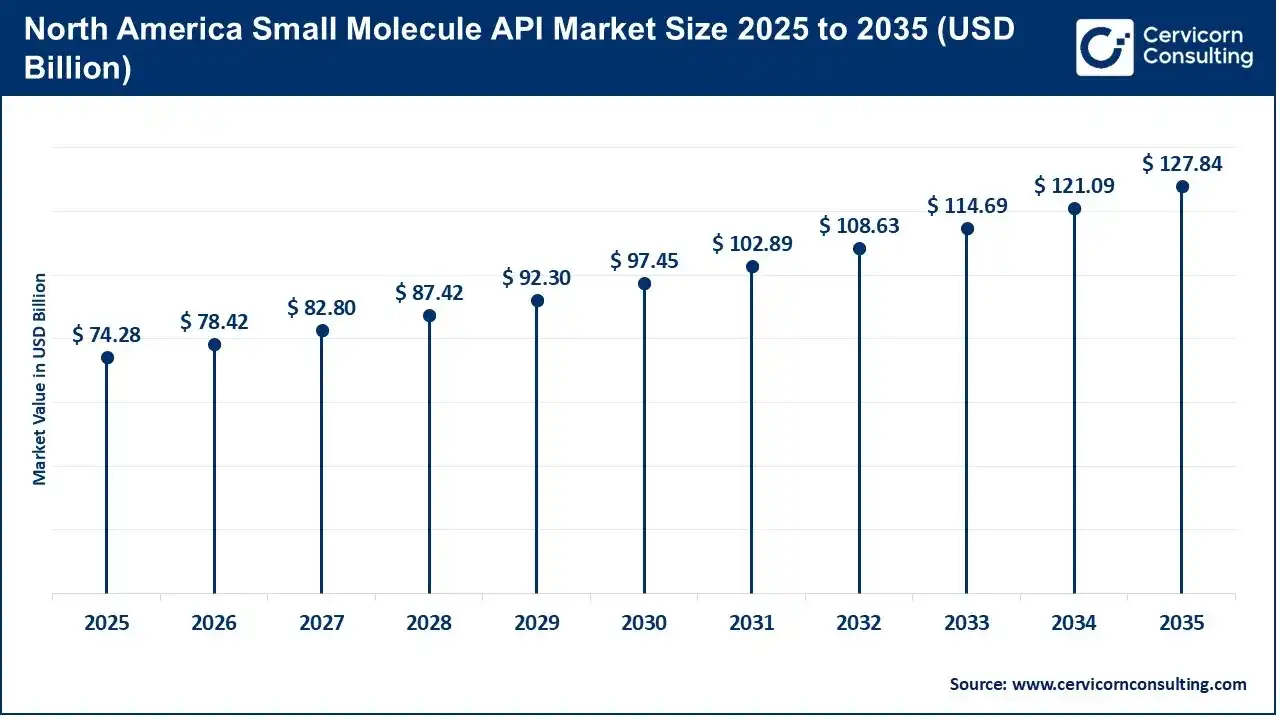
The North America small molecule API market size calculated at USD 78.42 billion in 2026 and is projected to hit USD 127.84 billion by 2035. North America region dominated the market in 2025, propelled by its well-established pharmaceutical sector, robust drug development initiatives, cutting-edge manufacturing facilities, and presence of significant pharmaceutical firms. Strong investments in pharmaceutical production and research technology also benefit the area. Regional API production is being supported by increasing initiatives to fortify domestic pharmaceutical supply chains.
Asia Pacific region is expected to witness the fastest growth
The Asia-Pacific small molecule API market size calculated at USD 66.89 billion in 2026 and is expected to reach USD 109.04 billion by 2035. Asia Pacific region is expected to witness the fastest growth during 2026–2035, driven by growing outsourcing operations, rising investments in API production, expanding pharmaceutical manufacturing, and the growth of pharmaceutical industries in emerging economies. The region's growing production capacity is drawing investments from contract manufacturing and pharmaceutical companies. The industry is expanding due to rising healthcare infrastructure and growing need for reasonably priced medications.
Segmental Analysis
API Type Analysis
Synthetic APIs segment dominated the small molecule API market in 2025, driven by their numerous pharmaceutical uses, established production procedures, and widespread use in the creation of novel and generic drugs. Their superior position is further reinforced by their reliable availability and sophisticated manufacturing infrastructure. The usage of synthetic APIs is also sustained by rising demand for well-established small molecule medications.
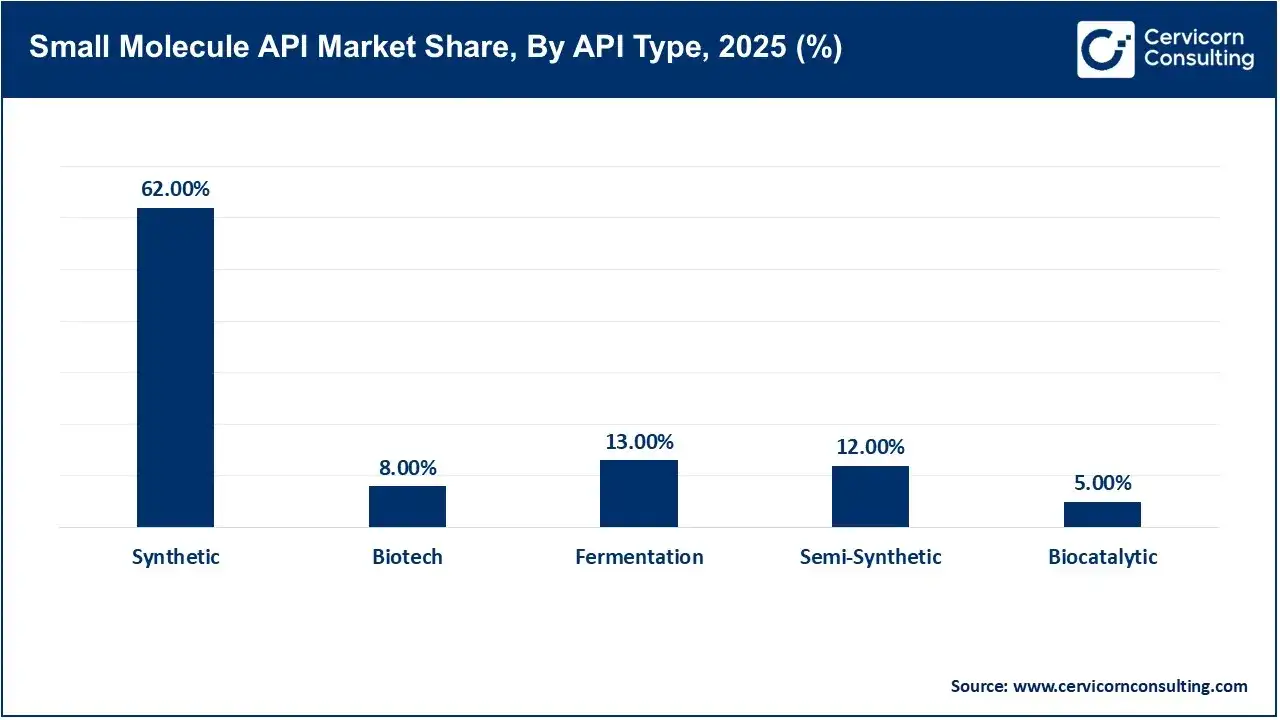
Biocatalytic APIs segment is expected to witness the fastest growth during 2026–2035, driven by rising demand for sustainable API production techniques, increased use of enzyme-based synthesis, and enhanced process efficiency. Complex compounds can be manufactured more effectively and selectively with the help of biocatalytic processes. Manufacturers are also able to create more effective production processes for complex small compounds thanks to increased research into enzyme technology.
Molecule Category Analysis
Generic APIs segment dominated the small molecule API market in 2025, driven by the widespread use of proven small molecule therapeutics, rising generic drug manufacture, and a high demand for reasonably priced medications. The continuous usage of off-patent medications and expanding healthcare needs are fueling the market for generic APIs. The need for generic APIs is being further supported by the expanding availability of generic medications in developing healthcare markets.
Complex small molecule APIs segment is expected to witness the fastest growth during 2026–2035 caused by a rise in the demand for specialty treatments that call for sophisticated manufacturing capabilities and an increase in drug research activities. Manufacturers are being encouraged to create specialized production technologies by expanding research into complicated medicinal compounds. Manufacturers with sophisticated API capabilities are also benefiting from increased pharmaceutical outsourcing.
Manufacturing Type Analysis
Captive / In-house manufacturing segment dominated the small molecule API market in 2025, driven by major pharmaceutical corporations' need for manufacturing flexibility, supply dependability, and quality control. Increased control over manufacturing procedures and product quality is another benefit of in-house production. Pharmaceutical businesses are further encouraged to keep some API manufacturing processes in-house by having control over production schedules and supply planning.
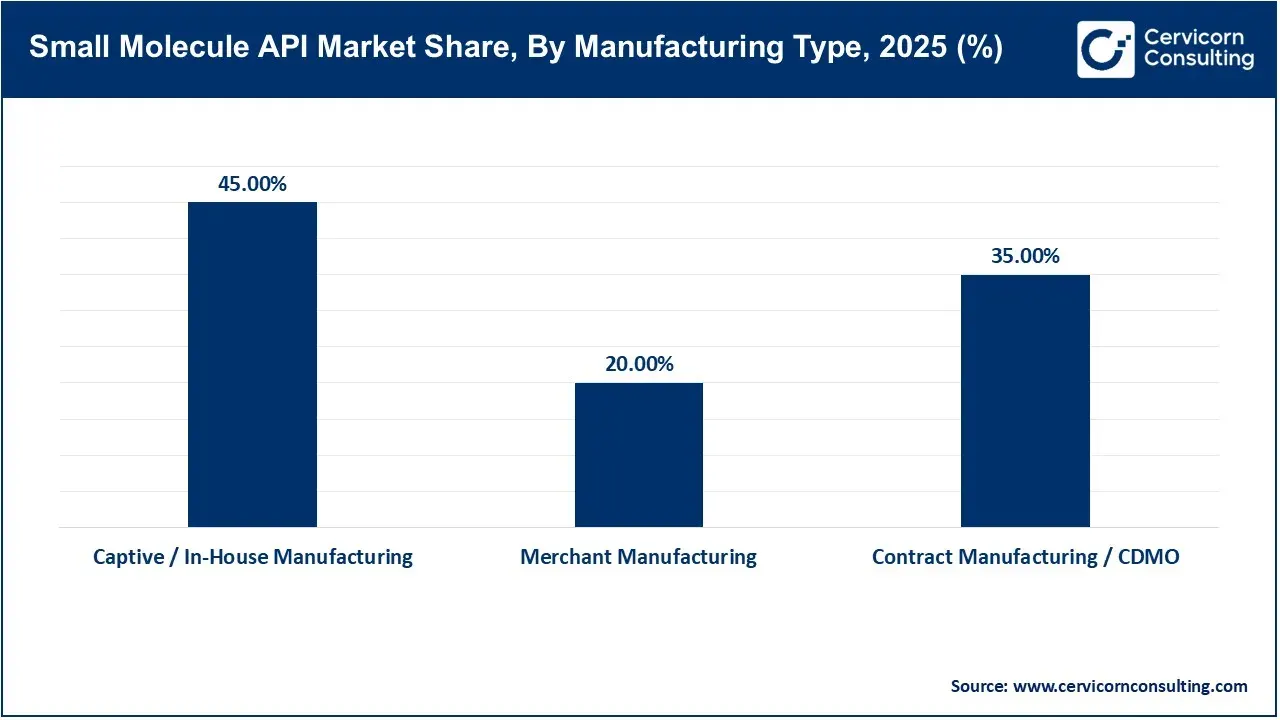
Contract manufacturing / CDMO segment is expected to witness the fastest growth during 2026–2035, driven by the expanding complexity of pharmaceutical development, specialized production needs, cost optimization, and outsourcing. In order to gain access to specialized technology and industrial experience, pharmaceutical companies are increasingly collaborating with CDMOs. Flexible external manufacturing capacity is becoming more necessary as drug development pipelines grow.
Therapeutic Area Analysis
Oncology segment dominated the small molecule API market in 2025, motivated by the rising incidence of cancer and the expanding field of small molecule treatments. New pharmaceutical products are being developed thanks to increased funding for cancer research. The necessity for specific APIs is being further supported by the growth of oncology medication pipelines and ongoing research into novel therapeutic strategies.
Metabolic diseases segment is expected to witness the fastest growth during 2026–2035, driven by the growing investment in cutting-edge treatments as well as the rising incidence of diabetes, obesity, and related metabolic disorders. The development pipelines of pharmaceutical companies are growing to include treatments for metabolic diseases. Manufacturers of small molecule APIs are finding more prospects as pharmaceutical research on metabolic illnesses increases.
Application Analysis
Commercial pharmaceutical manufacturing segment dominated the small molecule API market in 2025, driven by the ongoing need for APIs from pharmaceutical makers and the massive production of well-known medications. Consistent API consumption is supported by the continuous creation of both branded and generic medications. The segment's dominant position is partly a result of well-established pharmaceutical supply chains.
Clinical applications segment is expected to witness the fastest growth during 2026–2035, driven by expanding drug development pipelines, growing clinical research activities, and growing demand for APIs used in pharmaceutical products in the clinical stage. Specialized API supplies are becoming more and more necessary as early-stage and clinical development programs grow. This market is being further supported by rising investments in cutting-edge medication discovery.
End User Analysis
Pharmaceutical companies segment dominated the small molecule API market in 2025, motivated by their wide-ranging needs for APIs in the creation of generic medications, commercial manufacturing, and drug discovery. Their wide range of products generates ongoing demand for various kinds of short molecule APIs. Their dominant position is further reinforced by well-established pharmaceutical manufacturing networks.
Biotechnology companies segment is expected to witness the fastest growth during 2026–2035, driven by expanded development pipelines, a rise in the need for specialist small molecule manufacturing capabilities, and an increase in drug discovery efforts. More biotech firms are creating novel treatments that call for the manufacturing of specific APIs. New small molecule treatments and manufacturing needs are being further stimulated by increased funding for biotechnology research.
Key Companies
Recent Developments
- In March 2026, Wilmington PharmaTech announced a $50 million expansion of its Delaware facility to double its small molecule API production capacity. The expansion includes new commercial-scale reactor suites designed to support the growing demand for small molecule drug ingredients and strengthen U.S.-based API manufacturing capabilities.
- In June 2026, Lonza announced plans to expand its highly potent API and payload-linker manufacturing capacity at its Visp, Switzerland site. The expansion will add commercial-scale manufacturing and purification capabilities for complex and highly potent molecules, supporting the growing demand for advanced small molecule APIs.
- In July 2026, Evonik announced a $100 million investment to upgrade its Tippecanoe site in Indiana and expand integrated drug substance development and manufacturing for small molecule APIs. The investment includes new production trains, advanced equipment, and laboratories to support oral and injectable APIs.
- In July 2026, BeOne Medicines announced a $300 million expansion of its New Jersey manufacturing and R&D campus to add small molecule manufacturing capabilities. The development is expected to strengthen the company’s U.S. production capacity and support future pharmaceutical manufacturing requirements.
Segments Covered
By API Type
- Synthetic
- Biotech
- Fermentation
- Semi-Synthetic
- Biocatalytic
By Molecule Category
- Generic APIs
- Innovative / Branded APIs
- High-Potency APIs (HPAPIs)
- Controlled-Substance APIs
- Complex Small Molecule APIs
- Specialty APIs
- Other APIs
By Manufacturing Type
- Captive / In-House Manufacturing
- Merchant Manufacturing
- Contract Manufacturing / CDMO
By Therapeutic Area
- Oncology
- Cardiovascular Diseases
- CNS & Neurology
- Metabolic Diseases
- Endocrinology
- Infectious Diseases
- Respiratory Diseases
- Gastroenterology
- Nephrology
- Ophthalmology
- Orthopedics
- Dermatology
- Urology
- Others
By Application
- Clinical Applications
- Commercial Pharmaceutical Manufacturing
- Drug Discovery & Development
- Research & Development
- Formulation Development
- Generic Drug Manufacturing
- Innovative Drug Manufacturing
By End User
- Pharmaceutical Companies
- Biotechnology Companies
- Contract Development & Manufacturing Organizations
- Generic Drug Manufacturers
- Specialty Pharmaceutical Companies
- Research Institutes
- Academic Institutions
- Others
By Region
- North America
- Europe
- Asia Pacific
- Latin America
- Middle East & Africa