Primary Care Market Size, Growth, Forecast 2026 to 2035
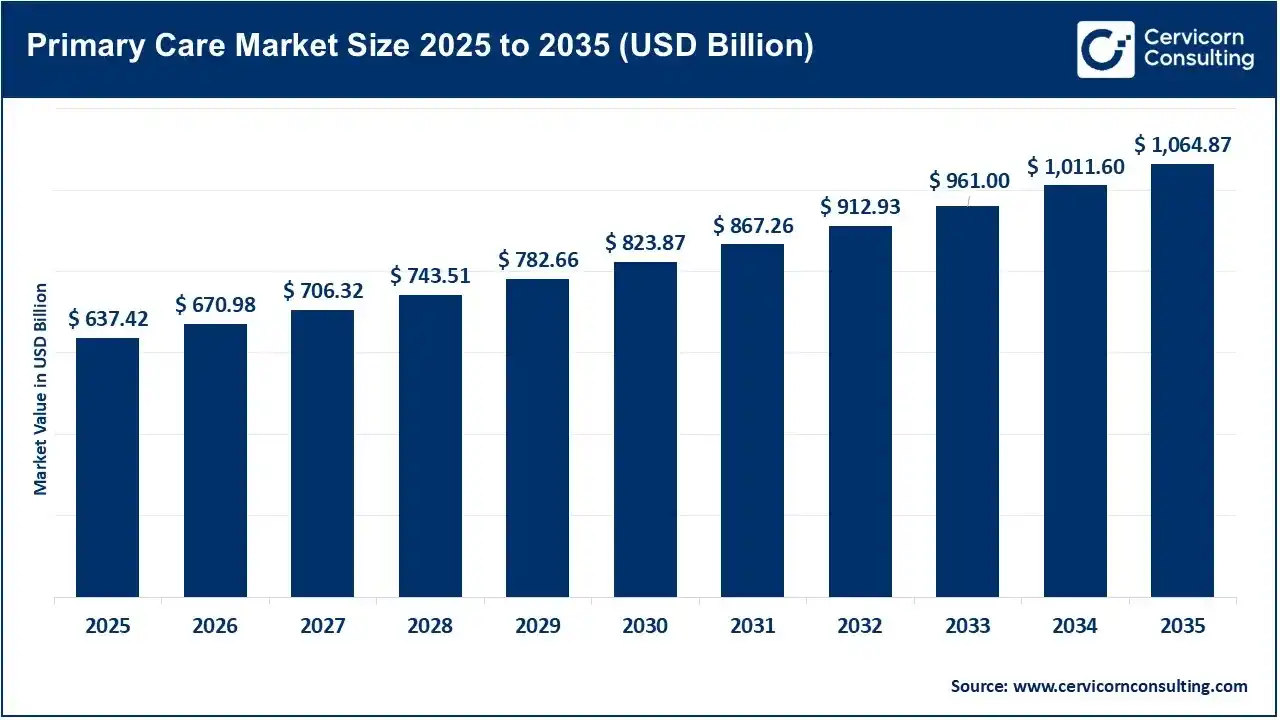
The global primary care market size was valued at USD 637.42 billion in 2025 and is expected to reach around USD 1,064.87 billion by 2035, exhibiting a compound annual growth rate (CAGR) of 5.3% over the forecast period from 2026 to 2035. The rising prevalence of chronic and noncommunicable diseases is a major driver of primary care utilization, increasing demand for preventive screening, diagnosis, routine monitoring, and long-term disease management.
The WHO estimates that 2 billion people globally live with noncommunicable diseases, including cardiovascular diseases, cancer, diabetes, and chronic respiratory diseases, while nearly 1 billion people live with mental, neurological, or substance-use disorders. Population ageing is further strengthening demand because older adults generally require more frequent and coordinated healthcare services; globally, the population aged 60 years and above is projected to reach 1.4 billion by 2030, compared with 1 billion in 2020. These trends are encouraging healthcare systems to prioritize early intervention, preventive care, chronic disease management, and community-based primary care.
Expansion of healthcare access, shortages of primary care professionals, increasing adoption of telehealth, and the shift toward value-based and preventive healthcare are also supporting market growth. In the U.S., 92.3 million people were living in designated primary-care health professional shortage areas at the end of 2025, with only 48.2% of identified need met, highlighting substantial unmet demand for primary care services. A 2025 workforce study projects that the U.S. will need 57,559 additional primary care clinicians by 2040, driven primarily by population growth and ageing. Additionally, digital consultations, remote monitoring, AI-supported diagnostics, nurse-led care, and home-based services are expanding access while helping providers manage growing patient volumes more efficiently.
Report Highlights
- North America dominated the primary care market with 38.5% share in 2025, supported by advanced infrastructure and strong healthcare utilization.
- Asia-Pacific accounted for 27.1% market share in 2025, driven by expanding healthcare infrastructure, digitalization, and increasing healthcare accessibility.
- Chronic Disease Management held the largest service-type share at 21.9%, supported by rising demand for continuous disease monitoring.
- Primary Care Clinics dominated care settings with a 31.8% share, benefiting from comprehensive preventive, diagnostic, and treatment services.
- General Practitioners represented the largest provider segment with 32.6% share, reflecting their importance as primary healthcare entry points.
What is Primary Care?
Primary care is the first point of contact within the healthcare system, providing accessible, continuous, comprehensive, and coordinated services for individuals and families. It includes health promotion, disease prevention, routine diagnosis and treatment, vaccination, screening, chronic disease management, mental health support, and referrals to specialists when required. The WHO considers primary care a foundation for universal health coverage because strong primary-care systems can improve health outcomes, equity, and healthcare efficiency.
Recent Milestones
| Year |
Organization |
Recent Milestone |
Market Relevance |
| 2026 |
U.S. HHS / CMS |
CMS announced USD 50 billion in awards to strengthen rural healthcare, including workforce, facilities, technology, and access to care. |
Supports expansion of primary care services in underserved and rural communities. |
| 2026 |
U.S. HHS |
HHS announced an investment expected to bring primary care access to nearly 1 million additional Americans through expansion of the Health Center Program. |
Expands community-based primary care capacity and healthcare accessibility. |
| 2026 |
U.S. HHS |
Federal legislation extended many Medicare telehealth flexibilities through December 31, 2027. |
Strengthens virtual primary care and remote access, particularly for rural populations. |
| 2026 |
WHO |
WHO continued implementation of its Global Strategy on Digital Health 2020–2027, supporting digital transformation across health systems. |
Accelerates adoption of digital platforms, electronic records, remote care, and technology-enabled primary care. |
| 2025 |
WHO Europe |
WHO published a framework for scaling mental health services within primary care, emphasizing integrated and people-centred care. |
Encourages primary-care providers to integrate behavioral and mental health services. |
| 2025 |
American Medical Association |
In 2024, 71.4% of physicians reported using telehealth weekly, compared with 25.1% in 2018. |
Demonstrates the growing integration of telehealth into routine primary-care delivery. |
| 2025 |
WHO |
WHO released updated implementation guidance for the primary healthcare approach, emphasizing stronger, integrated and people-centred health systems. |
Reinforces global policy support for primary-care-led healthcare models. |
Primary Care Market Dynamics
Market Drivers
1. Rising Demand for Accessible, Preventive, and Integrated Healthcare
Growing emphasis on prevention, early diagnosis, chronic disease management, and affordable community-based care is increasing primary-care utilization. The WHO estimates that scaling primary healthcare interventions in low- and middle-income countries could save 60 million lives and add 3.7 years to average life expectancy by 2030. Governments are therefore strengthening primary-care networks to reduce avoidable hospitalizations and improve continuity of care. OECD data also show that primary healthcare accounted for approximately 14% of total health spending across OECD countries in 2023, highlighting its substantial role in healthcare delivery.
2. Digitalization and Expansion of Technology-Enabled Primary Care
Telemedicine, electronic health records, remote monitoring, digital referrals, and AI-supported clinical decision-making are expanding primary-care accessibility, particularly in underserved locations. India’s Ayushman Bharat Digital Mission had created more than 79.9 crore digital health accounts and registered over 4.18 lakh health facilities by August 2025, supporting interoperability and continuity across healthcare levels. Meanwhile, eSanjeevani had served more than 344 million patients by March 2025, demonstrating substantial demand for technology-enabled remote consultations.
Market Restraints
1. Shortage of Healthcare Professionals and Uneven Geographic Distribution
Insufficient availability of physicians, nurses, and allied healthcare professionals remains a major constraint, particularly across rural and economically disadvantaged regions. Workforce shortages can increase appointment waiting times, reduce consultation capacity, and place greater pressure on existing providers. The World Bank reported in 2025 that approximately 45 countries were working on reforms to strengthen primary-care workforces, reflecting the scale of the global challenge. Limited staffing also makes it difficult for healthcare systems to expand comprehensive preventive and chronic-care services.
2. High Out-of-Pocket Costs and Unequal Healthcare Access
Financial barriers can discourage patients from seeking routine consultations, preventive screening, and early treatment, particularly in lower-income populations. According to the 2025 WHO–World Bank monitoring report, 2.1 billion people worldwide experienced financial hardship from healthcare expenses, while 1.6 billion people were pushed into or further into poverty because of health spending. Such affordability challenges can delay primary-care visits and increase dependence on emergency or hospital-based services, restricting equitable market expansion.
Market Opportunities
1. Expansion of Telehealth and Home-Based Primary Care
Hybrid healthcare models combining physical consultations with telemedicine, remote monitoring, and home visits offer significant opportunities to extend primary-care coverage without requiring patients to travel long distances. India’s Ayushman Arogya Mandirs delivered 41.14 crore teleconsultations by October 2025, while 1,80,906 centers had been operationalized nationwide. Similar digital health investments across emerging economies can help providers reach rural populations, improve follow-up for chronic conditions, and increase healthcare accessibility.
2. Government Investment in Universal Health Coverage and Primary-Care Infrastructure
Increasing government focus on universal health coverage creates opportunities for new clinics, community health centers, workforce programs, digital platforms, and integrated care models. In 2025, the World Bank reported that its programs had already reached 375 million people with quality, affordable healthcare, while approximately 15 countries introduced National Health Compacts targeting stronger primary care and financial protection. These initiatives can stimulate infrastructure development, public-private partnerships, insurance coverage, and technology adoption throughout the primary-care ecosystem.
Market Challenges
1. Digital Infrastructure Gaps and Interoperability Problems
Although digital health creates major opportunities, unreliable connectivity, fragmented systems, insufficient training, and poor interoperability can prevent technology from delivering its full value. A 2025 study of primary healthcare workers in rural Meghalaya identified 49 participants and found persistent issues involving duplicate data entry, inadequate training, unreliable internet connectivity, and limited offline functionality. Such barriers can increase administrative workloads and potentially divert healthcare workers' time away from direct patient care, particularly in resource-constrained primary-care environments.
2. Maintaining Quality, Continuity, and Patient Trust During Rapid Transformation
Primary-care providers must balance increasing patient volumes with quality, privacy, continuity, and coordinated care across physical and digital channels. Telehealth adoption illustrates this challenge: primary-care telehealth encounters declined from slightly above 8% in July 2022 to below 6% in October 2025, suggesting that virtual care is stabilizing as a complement rather than a complete substitute for in-person services. Providers therefore need sustainable hybrid models, appropriate clinical protocols, digital literacy, and patient-centered workflows.
Primary Care Market Regional Analysis
The primary care market is segmented by region into North America, Europe, Asia-Pacific, Latin America, and LAMEA. Here is a brief overview of each region:
Why is North America leading the primary care market?
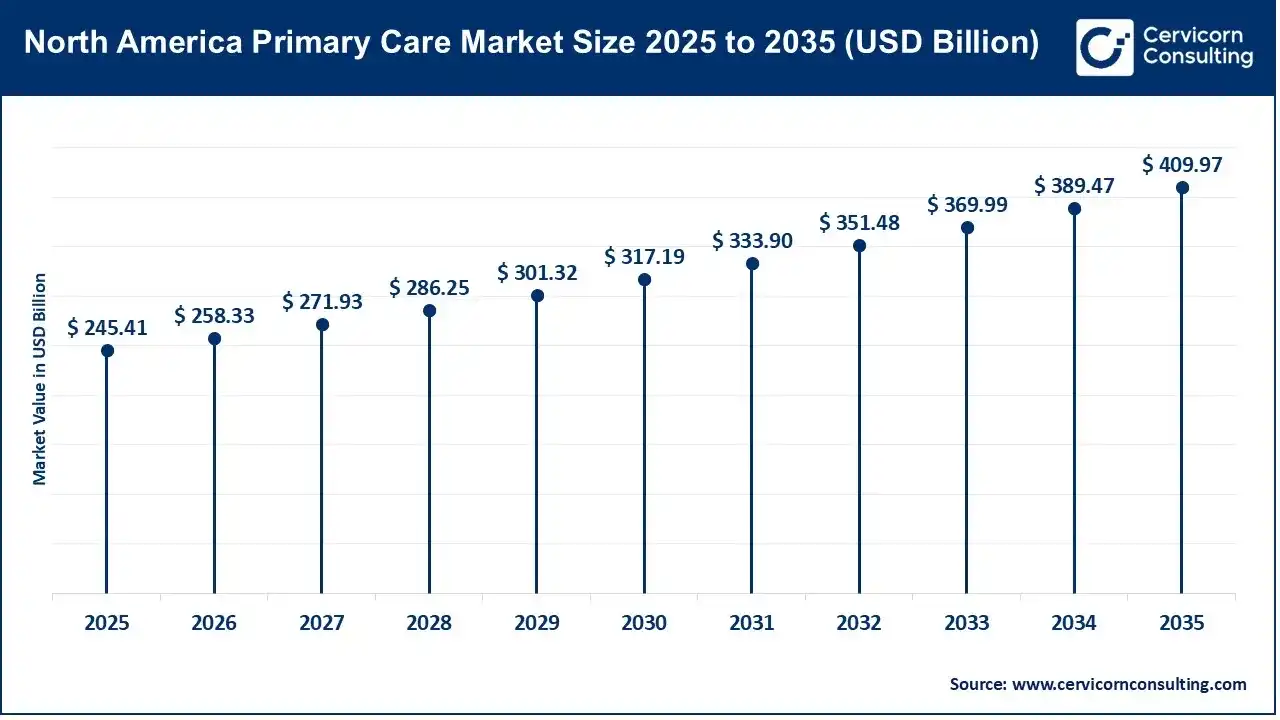
The North America primary care market size was valued at USD 245.41 billion in 2025 and is predicted to grow around USD 409.97 billion by 2035. North America represents a leading region, owing to its well-established healthcare infrastructure, high healthcare utilization, substantial primary care expenditure, increasing prevalence of chronic conditions, and strong adoption of digital healthcare technologies. The region benefits from extensive networks of physician practices, community health centers, outpatient facilities, nurse practitioners, and virtual-care platforms. In the United States, 9 in 10 adults had a usual source of healthcare in 2024, while 77.5% used a doctor’s office or health center as their usual source of care. At the same time, provider shortages are creating substantial unmet demand, with approximately 20% of the U.S. population residing in primary medical-care Health Professional Shortage Areas (HPSAs).
United States: High Healthcare Utilization, Extensive Primary Care Infrastructure, and Persistent Provider Shortages Drive Market Growth
- According to the U.S. CDC, 85.2% of adults and 95.1% of children reported visiting a doctor or other healthcare professional during 2024, demonstrating consistently high demand for routine and primary healthcare services.
- According to HRSA, as of March 2026, the United States had 8,789 designated primary-care HPSAs, covering approximately 101.7 million people, highlighting significant unmet demand and opportunities for additional primary-care capacity.
Canada: Unmet Primary Care Demand, Family Physician Shortages, and Growing Focus on Accessible Community Care Support Market Expansion
- According to the Canadian Institute for Health Information (CIHI), 83% of Canadian adults reported having access to a regular healthcare provider in 2024, leaving approximately 5.7 million adults without a regular provider.
- Canada faces significant primary-care workforce pressure, with CIHI estimating that a 49% increase in family physicians would be required to meet current demand, creating opportunities for expanded clinics, multidisciplinary care teams, and virtual primary-care services.
Why is Asia-Pacific expected to witness strong growth in the primary care market?
The Asia-Pacific primary care market size was estimated at USD 172.74 billion in 2025 and is projected to surpass around USD 288.58 billion by 2035. Asia-Pacific is expected to witness strong growth, owing to its large and ageing population, increasing prevalence of chronic diseases, expanding healthcare infrastructure, government initiatives to improve universal health coverage, and rapid adoption of telemedicine and digital health platforms. Emerging economies such as India, China, Indonesia, and Southeast Asian countries are increasing investments in community-based and preventive healthcare to reduce pressure on secondary and tertiary facilities. India, for example, had more than 186,700 functional Ayushman Arogya Mandirs as of August 2026, providing preventive, promotive, curative, rehabilitative, and palliative primary healthcare services.
India: Government-Led Primary Healthcare Expansion, Digital Health Adoption, and Rising Chronic Disease Screening Drive Market Growth
- India is rapidly expanding community-level primary care through Ayushman Arogya Mandirs, with 1,82,944 centers operationalized by December 2025, including facilities serving rural, tribal, and aspirational districts.
- These centers provide 12 comprehensive primary healthcare service packages, covering reproductive and child healthcare, infectious diseases, noncommunicable diseases, mental health, elderly care, oral health, ENT care, and basic emergency services.
Australia: High Primary Care Utilization, Strong Public Funding, and Growing Demand for Integrated Healthcare Support Market Expansion
- Australia recorded approximately 200.3 million Medicare-subsidized non-hospital primary care services in 2024–25, including 167.2 million GP attendances, demonstrating high utilization of primary healthcare services.
- More than 8 in 10 Australians received at least one Medicare-subsidized GP attendance in 2024–25, while people aged 80 and above recorded approximately 18 GP services per person, reflecting strong demand from ageing populations.
Europe Primary Care Market: Driven by Ageing Populations, Rising Chronic Disease Burden, Healthcare Workforce Reforms, Digital Health Adoption, and Strong Government Focus on Integrated Care
The Europe primary care market size was accounted for USD 145.33 billion in 2025 and is forecasted to hit around USD 242.79 billion by 2035. Europe represents a significant growth, owing to its established universal healthcare systems, ageing population, increasing prevalence of chronic diseases, and growing emphasis on prevention and integrated, community-based healthcare. European governments are increasingly strengthening primary care to reduce avoidable hospital utilization and improve care coordination. In 2024, 35% of European adults reported having a long-standing illness or health problem, rising to 60% among people aged over 65, creating sustained demand for primary care and chronic disease management. Additionally, EU countries allocated an average of 13% of health budgets to primary healthcare in 2022, highlighting the sector's importance within regional healthcare systems.
Germany: Ageing Population, High Healthcare Utilization, and Growing Primary Care Workforce Requirements Support Market Expansion
- Germany has a well-developed primary healthcare system supported by extensive physician networks, statutory health insurance coverage, and strong demand for outpatient medical services. However, workforce ageing and regional shortages are increasing the need for new primary-care delivery models.
- Across the EU, only one in five doctors was a general practitioner in 2023, down from 22% in 2013, highlighting the growing pressure to strengthen primary-care recruitment and multidisciplinary teams.
United Kingdom: NHS Primary Care Modernization, GP Workforce Pressures, and Digital Healthcare Adoption Drive Market Development
- The United Kingdom's NHS continues to prioritize primary care as a mechanism for improving prevention, chronic disease management, and reducing pressure on hospitals, while multidisciplinary community teams increasingly complement traditional GP practices.
- Digital healthcare is becoming increasingly integrated into primary care, including online consultations, electronic prescriptions, remote monitoring, and digital access to medical records, improving convenience and supporting continuous disease management.
Primary Care Market Share, By Region, 2025 (%)
| Region |
Revenue Share, 2025 (%) |
| North America |
38.5% |
| Asia-Pacific |
27.1% |
| Europe |
22.8% |
| LAMEA |
11.6% |
LAMEA Primary Care Market: Driven by Expanding Universal Health Coverage, Growing Chronic Disease Burden, Government Healthcare Investments, and Increasing Demand for Accessible Community-Based Care
The LAMEA primary care market was valued at USD 73.94 billion in 2025 and is anticipated to reach USD 123.52 billion by 2035. LAMEA is expected to witness significant growth in the market as governments increasingly focus on universal health coverage, healthcare accessibility, preventive services, and strengthening community-level healthcare infrastructure. Latin America is supported by growing investments in primary healthcare, while Middle Eastern countries are modernizing healthcare systems through digital transformation and integrated care initiatives. Africa represents substantial long-term potential because of underserved rural populations and limited healthcare access. The World Bank is currently investing more than USD 2 billion to strengthen primary healthcare across Latin America and the Caribbean, while its broader initiatives are working with approximately 45 countries to scale primary-care approaches.
Latin America: Expanding Primary Healthcare Investment, Unmet Care Needs, and Digital Transformation Drive Market Growth
- Latin America and the Caribbean continue to face substantial healthcare-access gaps, with 35.2% of the regional population reporting unmet healthcare needs, creating significant opportunities for primary-care expansion.
- The World Bank has committed more than USD 2 billion toward strengthening primary healthcare across Latin America and the Caribbean, focusing on rural communities, digital health, infrastructure, and workforce development.
Middle East: Healthcare Modernization, Digital Health Adoption, and Preventive Care Initiatives Support Market Expansion
- Middle Eastern countries are increasingly transitioning toward integrated, prevention-oriented healthcare systems, with primary care positioned as an important mechanism for managing chronic diseases and reducing dependence on hospital-based services.
- Countries such as Saudi Arabia, the UAE, and Oman are investing in digital health, electronic medical records, telemedicine, and integrated healthcare networks, creating opportunities for technology-enabled primary-care delivery.
Primary Care Market Segmental Analysis
The primary care market is segmented into service type, care setting, provider type, and geography.
Service Type Analysis
Chronic disease management is expected to dominate the primary care market because diabetes, cardiovascular diseases, respiratory disorders, and other long-term conditions require continuous monitoring, medication management, and regular physician interactions. The WHO reports that noncommunicable diseases account for approximately 41 million deaths annually, creating sustained demand for coordinated primary-care services.
Primary Care Market Share, By Service Type, 2025 (%)
| Service Type |
Revenue Share, 2025 (%) |
| Preventive Care |
13.8% |
| Diagnostic Services |
10.6% |
| Treatment & Management of Acute Conditions |
14.7% |
| Chronic Disease Management |
21.9% |
| Maternal & Child Healthcare |
10.2% |
| Vaccination & Immunization |
6.8% |
| Mental Health Services |
7.1% |
| Geriatric Care |
5.4% |
| Rehabilitation & Follow-up Care |
5.3% |
| Others |
4.2% |
Meanwhile, mental health services is projected to be the fastest-growing segment as primary-care systems increasingly integrate behavioral healthcare, screening, counseling, and referral services. Rising recognition of mental health conditions and demand for accessible, community-based support are accelerating this integration.
Care Setting Analysis
Primary care clinics are expected to maintain dominance because they provide broad services including preventive consultations, diagnosis, chronic disease management, vaccinations, and routine treatment through established healthcare infrastructure. Their accessibility and ability to accommodate multidisciplinary teams support high patient volumes.
Primary Care Market, By Care Setting, 2025 (%)
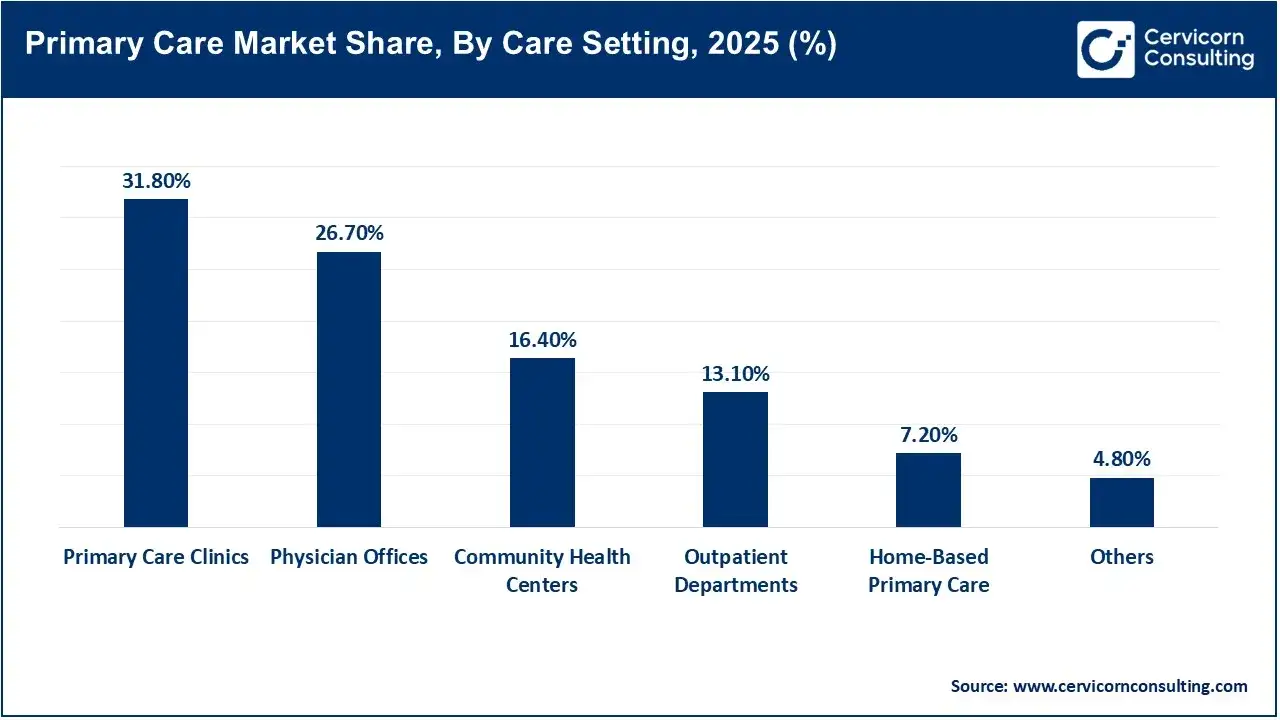
Home-based primary care is projected to be the fastest-growing segment as ageing populations, mobility limitations, chronic illnesses, and patient preference for convenient care increase demand for services delivered at home. In the United States, primary-care practices numbered approximately 94,489, demonstrating the extensive established infrastructure supporting clinic-based care.
Provider Type Analysis
General Practitioners are expected to dominate the provider segment because they remain a principal entry point for diagnosis, preventive services, routine treatment, referrals, and ongoing patient management across healthcare systems.
Primary Care Market, By Provider Type, 2025 (%)
| Provider Type Segment |
Revenue Share, 2025 (%) |
| General Practitioners |
32.6% |
| Family Physicians |
27.4% |
| Nurse Practitioners |
17.8% |
| Physician Assistants |
10.3% |
| Community Health Workers |
7.1% |
| Others |
4.8% |
However, Nurse Practitioners are projected to be the fastest-growing provider category because they can expand access amid physician shortages while delivering diagnosis, treatment, prescribing, and chronic-care services. In the U.S., approximately 374,970 nurse practitioners were estimated to be practicing in primary care in 2024, compared with 340,319 primary-care physicians in 2023, demonstrating the expanding role of NPs.
Primary Care Market Top Companies
Segments Covered
By Service Type
- Preventive Care
- Diagnostic Services
- Treatment & Management of Acute Conditions
- Chronic Disease Management
- Maternal & Child Healthcare
- Vaccination & Immunization
- Mental Health Services
- Geriatric Care
- Rehabilitation & Follow-up Care
- Others
By Care Setting
- Primary Care Clinics
- Physician Offices
- Community Health Centers
- Outpatient Departments
- Home-Based Primary Care
- Others
By Provider Type
- General Practitioners
- Family Physicians
- Nurse Practitioners
- Physician Assistants
- Community Health Workers
- Others
By Geography
- North America
- Europe
- Asia-Pacific
- LAMEA