
Content
Single Cell Sequencing Market Size to Reach USD 12.54 Billion by 2035


Single Cell Sequencing Market Overview
The global single cell sequencing market size was accounted at $1.98 billion in 2025 and is estimated to reach at $12.54 billion by 2035. The market is expected to witness a promising growth with a CAGR of 20.3% during the forecast period of 2026-2035. The single cell sequencing market is witnessing significant growth due to the increasing adoption of precision medicine, rising demand for high-resolution cellular analysis, and continuous advancements in next-generation sequencing technologies.
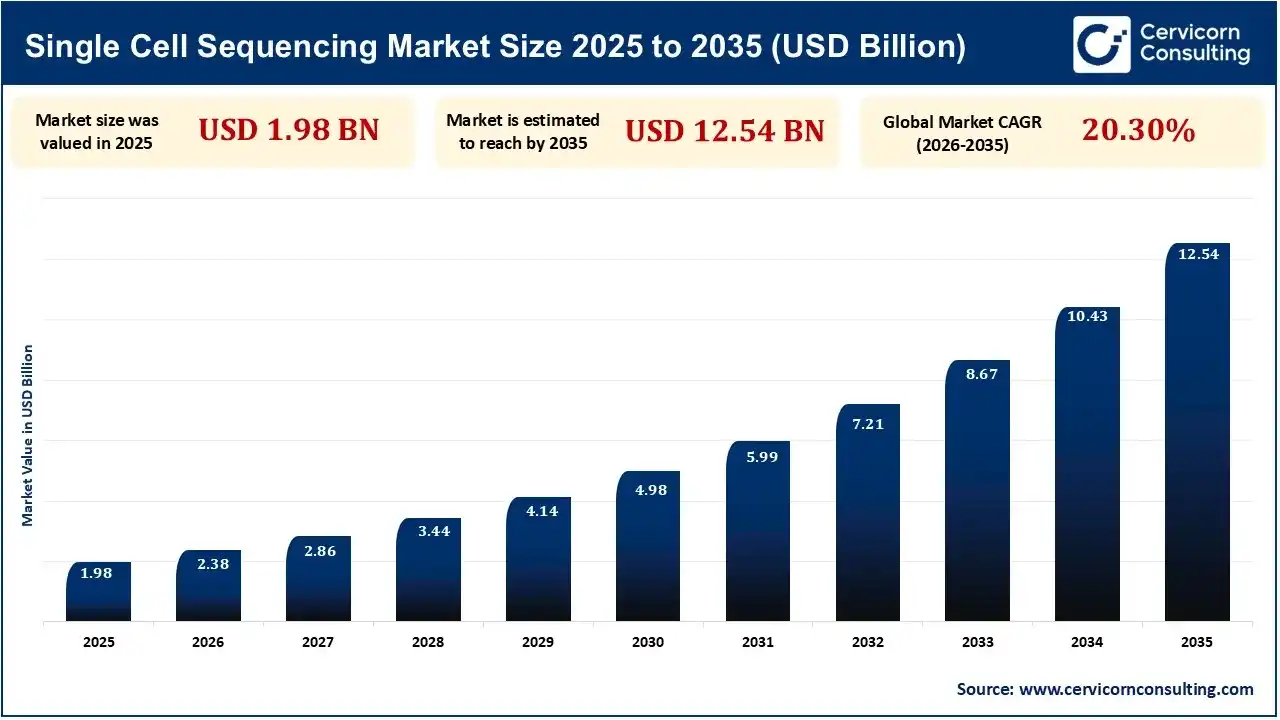
The single cell sequencing market comprises technology tools, service providers, products, and other components that enable genetic analysis of single cells. It focuses on studying the differences between cells at an unprecedented level, as individual cells can be sorted and sequenced independently from cell populations that consist of multiple types of cells.
This includes single cell sequencing technologies that analyse transcriptomic, genomic, and proteomic data of individual cells. Applications include the study of tumours as well as their potential targeting through new forms of immunotherapies. New sequencing technologies are also opening new possibilities for neurobiology as well as regenerative medicine.
Why Is Single Cell Sequencing Becoming a Breakthrough Technology in Precision Medicine?
Single-cell sequencing technology is gaining prominence as the latest disruptive technology for precision medicine because it enables researchers to map differences to the individual cell level, compared to the traditional bulk sequencing methods. When using bulk sequencing technology, genetic information from millions of individual cells is merged together to find disease signatures; but rare cell populations with clinical significance in disease progression can be obscured by majority cell populations.
- Single-cell sequencing helps to overcome these limitations by detecting a particular cellular characteristic, molecular difference, and cell-cell interaction in various diseased tissues and facilitating more precise and individualized treatment strategies for targeted medicine.
- The technology is currently advancing precision medicine by transforming disease classification, identifying biomarkers, selecting best therapy, and tracking treatment outcomes in an array of diseases.
The technology has made a remarkable effect in cancer field particularly because it allows researchers to study tumor heterogeneity, isolate unique cancer cells contributing treatment resistance and disease progression, and is being used in the single-cell RNA sequencing of tumor microenvironment to study interactions between cancer and immune cells and promote development of better immunotherapies. Pharmaceutical companies also take advantages of this information to screen potential targets and identify suitable patients for clinical trial of targeted drugs and immunotherapies.
Where are the Biggest Commercial Opportunities in the Single Cell Sequencing Ecosystem?
- Expansion of Precision Oncology Applications: Oncology represents one of the largest commercial opportunities for single cell sequencing due to increasing cancer incidence and growing demand for personalized therapies.
- Growth of Pharmaceutical Drug Discovery Applications: single cell sequencing is becoming an essential tool throughout the drug development pipeline by improving understanding of disease pathways and cellular responses.
- Rising Demand for Single Cell Multiomics Platforms: Combining single cell genomics, transcriptomics, epigenomics, and proteomics provides a more comprehensive understanding of cellular behavior.
- AI-Powered Single Cell Data Analysis Solutions: The rapid increase in sequencing datasets is creating strong demand for artificial intelligence and machine learning-based analytical platforms.
Single Cell Sequencing Market Latest Trends
| Trends | Market Impact |
| Integration of Artificial Intelligence and Machine Learning | AI-based platforms are improving automated cell classification, genomic data interpretation, and predictive analytics, enabling faster biological discoveries. |
| Rise of Single Cell Multiomics Technologies | Researchers are increasingly combining genomic, transcriptomic, epigenomic, and proteomic information to achieve comprehensive cellular profiling. |
| Growing Adoption of Spatial Transcriptomics | Spatial technologies are gaining importance by allowing researchers to analyze gene expression while preserving the location of cells within tissues. |
| Expansion of Cloud-Based Bioinformatics Platforms | Cloud solutions are helping organizations manage large sequencing datasets and improve collaboration among global research teams. |
| Increasing Pharmaceutical Partnerships | Drug manufacturers are collaborating with sequencing companies to accelerate biomarker discovery and therapeutic development. |
| Growing Focus on Single Cell Proteomics | Protein-level analysis is gaining attention as researchers seek deeper insights into cellular functions beyond genomic information. |
| Emergence of Long-Read Single Cell Sequencing | Long-read sequencing technologies are enabling improved detection of complex genomic structures and transcript variants. |
Single Cell Sequencing Market Regional Outlook
North America: Leading Region Due to Advanced Genomics Ecosystem and Strong Research Investments
North America captured the highest revenue share of the single cell sequencing market globally in 2025 owing to a robust existing ecosystem for biotechnology, presence of major sequencing companies, developed healthcare sector and increased investment in research of personalized medicine. The region had strong support for research and development via substantial funding from government agencies for genomics, cancer research and translational medicine programs. Major market players such as 10x Genomics, Illumina, Thermo Fisher Scientific, bio-rad laboratories are also contributing significantly to drive technology innovation and commercialization.
Increased acceptance of single cell sequencing within pharmaceutical companies for drug development, research conducted in clinical trials and universities contribute to the growth in North America.
The U.S. led North America in contribution to the single cell sequencing market due to its flourishing biotechnology industry, substantial research funding, and advancement in the field of personalized medicine. Government-backed programs for genomics-related research such as cancer biology, rare disease and so forth have accelerated adoption among universities, research institutes and hospitals.
Asia Pacific: Fastest-Growing Region Due to Expanding Biotechnology Infrastructure
The Asia Pacific is expected to witness a notable growth in single cell sequencing market during the forecast period, owing to growing healthcare expenditure, rising size of the biotechnology industry, increasing efforts in genomic research, and pro-adoption policies promoted by various governments for precision medicine. Nations are seen to boost investments into sequencing infrastructure, national genomics projects and biotechnology innovation at a rapid pace. Increasing disease burden from cancer, rising research and development activities in the pharmaceuticals sector and growing acceptance of advanced molecular technologies is the impetus driving the demand of single cell sequencing solutions.
China is expected to be a strong contender in the Asia Pacific for single cell sequencing market, owing to immense investments in genomics research, biotechnology development and precision healthcare programs, also. Rising activities in cancer research and the growth of its pharmaceutical sector in the country are encouraging for the adoption of single cell sequencing technologies. Also, government funded genome projects, growing sequencing capability in the country, and numerous emerging biotechnology enterprises located in China are fueling the market.
Which Companies are Shaping the Future of Single Cell Sequencing?
The global single cell sequencing market is fiercely competitive with both the traditional sequencing powerhouses, burgeoning biotechnology companies and single cell technology pioneers competing to elevate throughput, precision, automation, and data analysis. Established and nascent competitors are all striving to win greater market share through the introduction of new technologies, alliances, market expansion and the bolstering of their single cell sequencing pipelines.
Some key players include 10x Genomics, Illumina, Thermo Fisher Scientific, QIAGEN, Bio-Rad Laboratories, Standard BioTools, Parse Biosciences, Mission Bio, Singular Genomics, and Oxford Nanopore Technologies. The trend toward leveraging single-cell sequencing combined with spatial transcriptomics, multi-omics approaches, artificial intelligence and cloud bioinformatics pipelines to provide ever deeper and richer insights into living systems is on the rise.
Leading organizations like 10x Genomics and Illumina are setting standards with robust single cell and spatial analysis technologies, and many startup players are making considerable strides in their ability to create cost-effective and specialized solutions. Likewise, strategic partnerships and investments between all key stakeholders of the single cell market; sequencing technology providers (e.g. Illumina and Oxford Nanopore), life sciences organizations and pharmaceutical enterprises, are a major influence of the industry. Single-cell sequencing will see a significant increase in use as it progresses from the realm of academic research into precision healthcare, drug discovery and biomarker detection due to ongoing research across immunology, neuroscience and oncology.
Segments Covered
By Technology Type
- Single Cell RNA Sequencing
- Single Cell DNA Sequencing
- Single Cell Epigenomic Sequencing
- Single Cell Proteomics
By Product Category
- Instruments
- Reagents & Consumables
- Software & Bioinformatics Platforms
By Application
- Oncology
- Immunology
- Neuroscience
- Drug Discovery & Development
- Stem Cell & Developmental Biology
- Infectious Disease Research
By End User
- Academic Research Institutions
- Pharmaceutical Companies
- Biotechnology Companies
- Contract Research Organizations
- Hospital & Clinical Laboratories
By Region
- North America
- Europe
- Asia Pacific
- Latin America
- Middle East & Africa
Empower your strategy with expert insights, purchase this premium research@ https://www.cervicornconsulting.com/buy-now/2997
Ask here for more details@ sales@cervicornconsulting.com