
Content
Service Robotics Market Size to Reach USD 235.78 Billion by 2035 | CAGR of 13.8%


Service Robotics Market Size and Growth Outlook 2026 To 2035
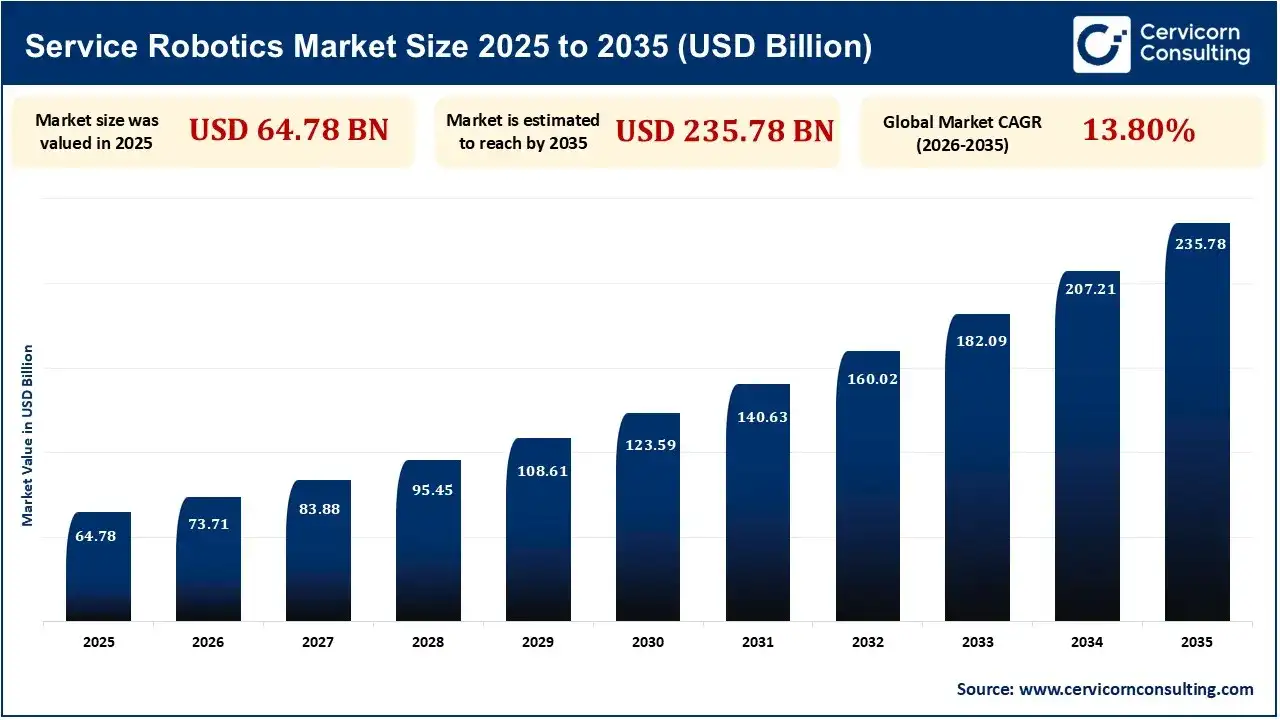
The global service robotics market size reached at USD 64.78 billion in 2025 and is estimated to reach around USD 235.78 billion by 2035, growing at a CAGR of 13.8% during the forecast period from 202 to 2035. The future of the service robotics market is expected to be shaped by the transition from automated machines to autonomous intelligent systems capable of learning, adapting, and performing complex tasks with minimal human intervention.
AI Transformation in Service Robotics: How is the industry growing in 2026?
Artificial intelligence (AI) has become a crucial driver for the service robotics market's expansion and change; it is enabling robots to go beyond specific task-driven functionalities to intelligent systems that can perceive, learn, make choices, and autonomously navigate their surroundings. The utilization of core AI technologies including machine learning, computer vision, natural language processing (NLP), and numerous modern sensing capabilities will accelerate the capabilities of many service robot applications, across various segments such as healthcare, logistics, hospitality, retail, domestic help, and industrial support services.
The demand for improvements in efficiency of operations, human resource allocation, and the improvement in customer experiences in varied applications are responsible for the development of artificial intelligence-empowered service robotics products; it will empower the next-generation service robots to make informed decisions, sense and interact with their environments and support humans more readily.
Latest Trends
- Humanoid Robots Move from Research Labs Toward Commercial Application: Humanoid robots have become one of the most important trends in the service robots sector and various companies are using investment to build robots that can move and behave like humans.
- Robotics-as-a-Service (RaaS) Model Expands Market Accessibility: The development of an RaaS (Robotics-as-a-service) platform means firms don’t need significant expenditure on robotics solutions, which is expected to expand the scope of usage.
- AI-Powered Autonomous Navigation Enhances Robot Capabilities: The next stage for the enhancement of robots would be the ability to navigate autonomously in environments, including using AI techniques such as combining vision, LiDar, machine learning with sensor technology for their function.
- Healthcare Robotics Gains Momentum Due to Rising Demand for Automation: The shortage of caregivers and nurses along with a greater need for robot technology to support patient-care and alleviate strain are driving a wave of adoption for medical/health services robots.
- Human-Robot Collaboration Becomes a Key Development Area: Human-robot interaction (HRI) has an interesting development potential given the increasing recognition of collaborative robots to build flexible working systems where humans and robots integrate as partners for a particular purpose.
- Cloud Robotics and Edge AI Improve Scalability and Performance: Integration of robotic features that use both on-edge computing, via a microcomputer or chip on robots, alongside cloud computing capabilities which enable data sharing and remote updates, is making scalable, powerful, and adaptive robots available.
Regional Outlook
Asia Pacific: Leading Hub for Service Robotics Innovation and Deployment
As of 2025, Asia Pacific had a leading position for service robotic innovation as well as adoption owing to strong technological investment and production capabilities supported by adoption across various sectors. China plays a significant role within the expansion as it boasts massive robot production capacity and thriving an ecosystem driven by government focus on AI and intelligent production that leads to wider adoption of intelligent robots. Some of the most influential and innovative robotics players hail from countries within Asia-Pacific with growing automation initiatives.
China continues to be a major contributor to regional growth due to its large-scale robotics manufacturing capabilities, expanding AI ecosystem, and increasing deployment of robots in logistics, retail, healthcare, and industrial service applications. The country’s focus on intelligent manufacturing and automation-driven production is accelerating the adoption of service robots across commercial and industrial environments.
North America: AI-Driven Robotics Development Accelerates Market Expansion
Being one of the most advanced technological markets for service robotics, North America thrives through its sophisticated artificial intelligence services, robust expenditure on research and development and substantial investments from technology companies and venture capital firms. This has enabled North America to develop to be one of the leading innovation hubs for autonomous systems, humanoid robots, robotics in healthcare and logistics.
Dominant player in North America is the United States with its advanced AI services, numerous robotics companies and extensive research capabilities in research institutions and universities across the state. Adoption of robotics system for different application including warehouse operations, healthcare services, manufacturing sectors and defense operations are gaining momentum in the U.S.
Service robotic application for industrial purposes and medical services have gained traction in Canada due to its enhanced investments and research and development for AI, utomation and robotics in healthcare sectors. The adoption of robotics in Canada has fueled through increased investments in upgrading its operational efficiency and automation efforts across its commercial and industrial sector.
Europe: Strong Industrial Foundation Supports Robotics Adoption
The service robotics market in Europe is constantly on the rise. The continent has well-established capabilities when it comes to industrial automation, is home to supportive government policies, and has a growing number of digital transformation investments. Focusing on Industry 4.0, smart manufacturing, and sustainable automation practices provides a fertile ground for expanding the reach of robots to healthcare, logistics, retail, and commercial sectors.
As Europe’s robotic revolution gets under way Germany has been found to be at forefront being well equipped to meet the demands of the evolving digital landscapes, engineering potential, industrial automation facilities and an increasing reliance on more advanced manufacturing techniques. Investment in robots, intelligent, collaborative autonomous robots etc continues to increase within Germany. Other European markets include Germany, United Kingdom, France and Italy are making considerable strides in service robotics, research projects, robotic medical-related solutions, commercial robotics applications are being heavily funded and developed. The growth has been fueled largely on solving labour related problems for industries.
Key Countries Supporting the Growth of Service Robotics Industry
China
- Leading contributor to the Asia Pacific service robotics market due to its large-scale robotics manufacturing ecosystem.
- Strong adoption of logistics robots, autonomous mobile robots, and warehouse automation solutions.
- Government initiatives supporting intelligent manufacturing and AI development are accelerating robotics deployment.
- Increasing use of service robots across healthcare, retail, hospitality, and industrial applications.
Japan
- One of the global leaders in robotics innovation with strong expertise in humanoid and healthcare robots.
- Aging population and workforce shortages are increasing demand for robotic assistance solutions.
- Strong presence of robotics manufacturers supporting advancements in automation and human-robot interaction.
- Expanding applications in elderly care, hospitality, domestic assistance, and industrial services.
South Korea
- Rapidly developing robotics ecosystem supported by AI investments and smart manufacturing initiatives.
- Increasing adoption of collaborative robots, healthcare robots, and intelligent automation systems.
- Strong technology infrastructure and electronics industry support robotics innovation.
- Government-backed programs are promoting next-generation robotic technologies.
United States
- Largest robotics innovation hub in North America due to strong AI capabilities and research infrastructure.
- Major contributor to humanoid robotics, autonomous systems, healthcare robotics, and warehouse automation.
- Presence of leading robotics companies and significant venture capital investment supports market growth.
- Increasing adoption of robots across logistics, defense, healthcare, and commercial sectors.
Germany
- Europe’s strongest robotics market due to advanced engineering capabilities and industrial automation expertise.
- High adoption of robotics in manufacturing, logistics, and industrial service applications.
- Industry 4.0 initiatives are accelerating integration of AI-enabled robotic systems.
- Strong ecosystem of robotics manufacturers, technology suppliers, and research institutions.
India
- Emerging as a high-growth market due to increasing investments in AI, automation, and robotics startups.
- Growing adoption of service robots in healthcare, logistics, defense, and commercial sectors.
- Expanding digital infrastructure and smart manufacturing initiatives support robotics development.
- Rising demand for automation solutions to improve productivity across industries.
Top Companies in the Service Robotics Industry: By Application Area
| Application Segment | Leading Companies | Key Developments |
| Logistics & Warehouse Robotics | Amazon Robotics, ABB, KUKA, FANUC | Autonomous mobile robots, warehouse automation, inventory management |
| Healthcare Robotics | Intuitive Surgical, ABB, KUKA | Surgical robots, rehabilitation systems, healthcare automation |
| Industrial Service Robotics | Boston Dynamics, ABB, Yaskawa | Inspection robots, maintenance assistance, complex environment navigation |
| Domestic Robotics | iRobot, SoftBank Robotics | Smart home robots, cleaning automation, interactive assistants |
| Humanoid Robotics | Tesla, Boston Dynamics | General-purpose robots, AI-driven mobility, human-like interaction |
Segments Covered
| Segment | Details |
| By Field of Application |
|
| By Component |
|
| By Operating Environment |
|
| By Mobility |
|
| By End-User Industry |
|
| By Region |
|
Empower your strategy with expert insights, purchase this premium research@ https://www.cervicornconsulting.com/buy-now/2992
Ask here for more details@ sales@cervicornconsulting.com