Service Robotics Market Size, Share, Growth, Report 2026 To 2035
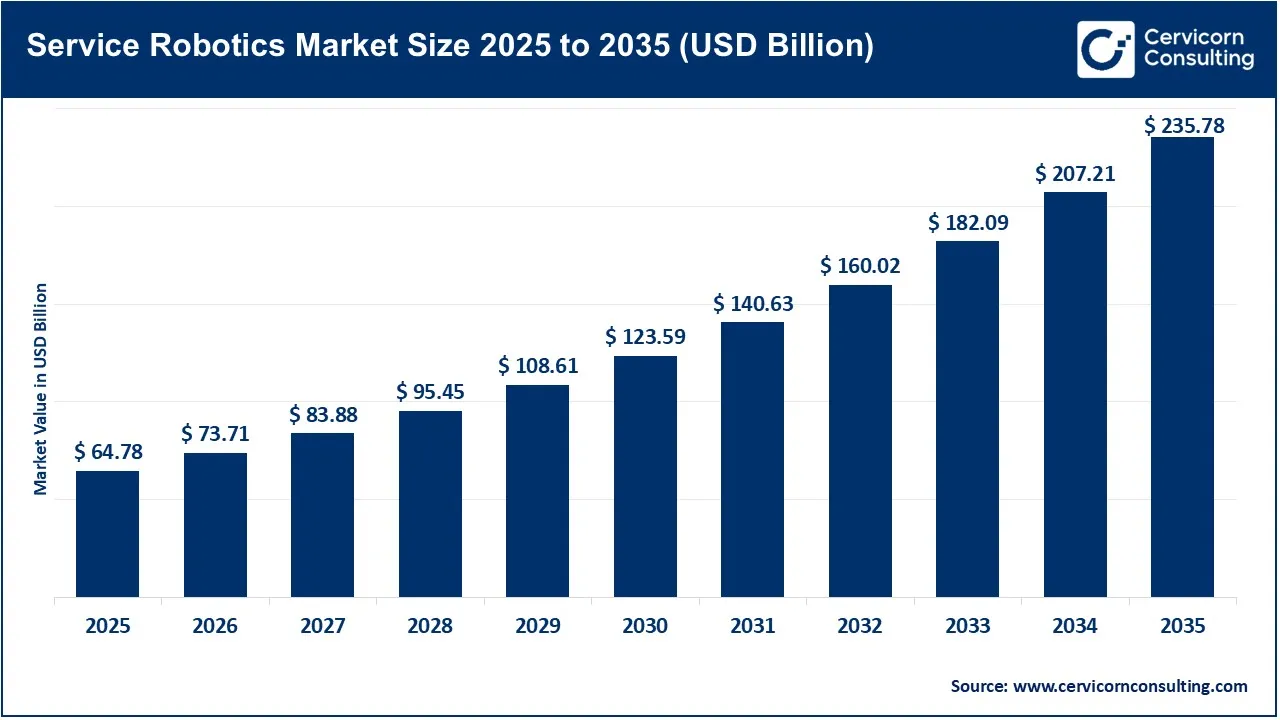
The global service robotics market size was valued at USD 64.78 billion in 2025 and is expected to be worth around USD 235.78 billion by 2035, growing at a notable CAGR of 13.8% during the forecast period of 2026-2035. The global service robotics market is driven by increasing automation demand, rapid advancements in artificial intelligence and autonomous technologies, rising labor shortages, growing adoption of warehouse and healthcare robotics, and expanding investments in smart automation across industries.
Report Highlights
- By region, the Asia-Pacific region dominated the market with revenue share of 38.60% in 2025, supported by robotics manufacturing leadership, government initiatives, and high automation adoption in China, Japan, and South Korea.
- By region, North America is expected to witness rapid growth, driven by AI innovation, venture capital investments, and strong adoption of autonomous robotics solutions.
- By region, Europe is notably growing in the service robotics market, supported by Industry 4.0 initiatives, healthcare automation, and government-backed robotics research programs.
- By application, the professional service robots segment accounted for a revenue share of 54.40% in 2025, owing to extensive adoption across logistics, healthcare, agriculture, defense, and commercial applications requiring advanced automation solutions.
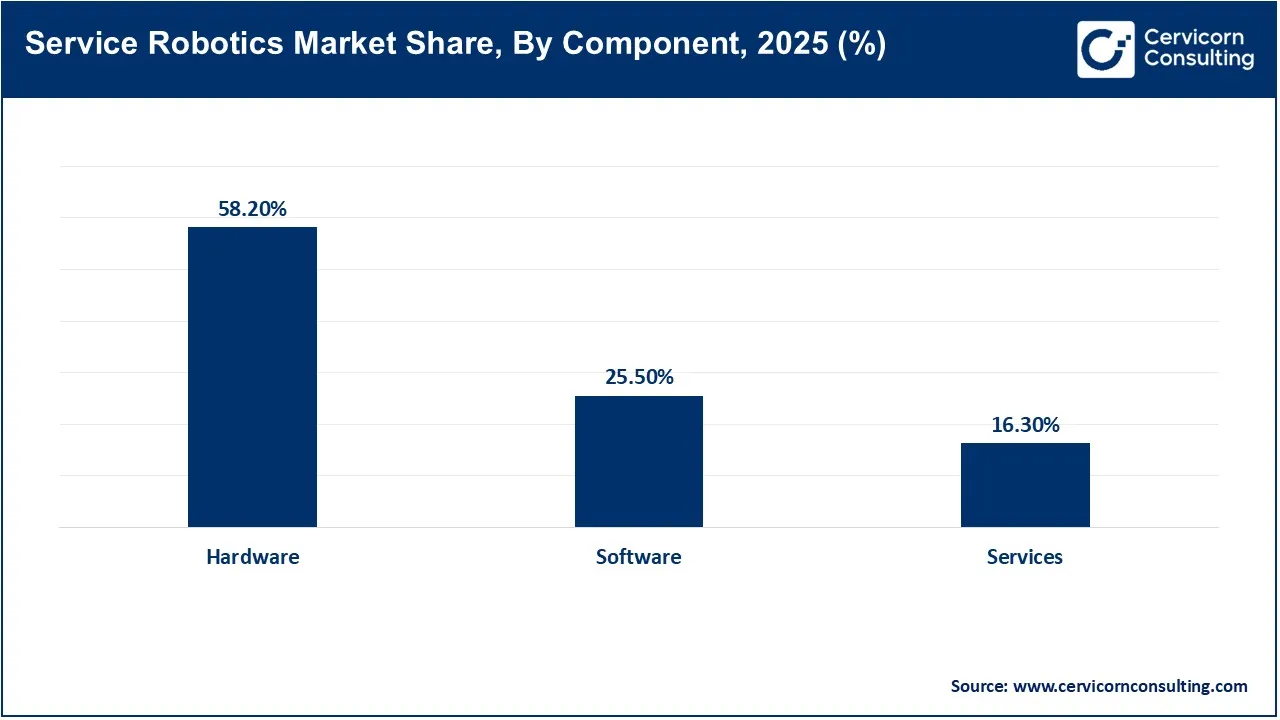
- By component, the hardware segment dominated the market share of 58.20% in 2025, due to high demand for essential robotic components including sensors, processors, actuators, and mobility systems.
- By component, the services segment is expected to grow at the fastest rate, driven by rising adoption of Robotics-as-a-Service (RaaS), maintenance solutions, and software-based robotics services.
- By operating environment, the ground robots segment dominated the market share of 64.40% in 2025, supported by widespread deployment in warehouses, hospitals, retail facilities, and industrial environments.
- By operating environment, the aerial robots (UAVs) segment is notably growing, due to increasing applications in agriculture, surveillance, inspection, defense, and delivery services.
- By mobility, the mobile/autonomous robots segment dominated the market share of 81.70% in 2025, owing to growing demand for flexible robotic systems capable of operating independently across multiple industries.
- By end-user industry, the logistics and warehousing segment dominated the market with revenue share of 21% in 2025, driven by e-commerce expansion and increasing warehouse automation requirements.
- By end-user industry, the healthcare segment is expected to grow at the fastest rate, due to increasing adoption of surgical robots, rehabilitation systems, elderly care robots, and hospital automation solutions.
What Is Driving the Growth of the Global Service Robotics Market?
Driven by an increased adoption of intelligent automated systems across various industries aiming to eliminate repetitive tasks, increase operational efficiency and cope with staff shortages, the global service robotics market is poised for significant growth. Service robots refer to autonomous or semi-autonomous machines capable of delivering useful work on behalf of humans or equipment other than within environments traditionally involved in manufacturing operations.
Service robots are found in applications such as healthcare, warehousing & logistics, agriculture, hotel and lodging, retail trade, defense, and household purposes where it enhances their productive output, offers more precise functionalities, cut down the operational expenses, and offer reduced exposure of human effort to monotonous or treacherous activities.
AI, machine learning, computer vision, sensor technologies, autonomous navigation, and cloud-based robotics are technologies that facilitate the rapid growth of new services robots that have higher accuracy, are highly capable and resourceful, make effective decisions and can perform operations in a highly flexible manner. In warehouse automation market, it drives demand for warehouse automation, for surgical machines, and also leads to increased use of autonomous moving robots.
Some significant factors supporting the rise of the sector include rising investments in warehouse robots, military systems, service robotics in the hospitality sector as well as increase of robotic surgical systems. Also, the growth of robotics-as-a-service (RaaS), expanding contactless automaton, rising deployment of smart factories and health facilities, offer significant growth opportunities in the industry.
| Technology |
Key Applications |
Companies Developing / Implementing the Technology |
| Artificial Intelligence (AI) & Machine Learning |
Autonomous robots, healthcare robots, warehouse automation, smart assistants, predictive maintenance |
NVIDIA, Google DeepMind, Microsoft, Amazon Robotics, IBM, OpenAI |
| Computer Vision & Advanced Sensor Technology |
Autonomous mobile robots, surgical robots, security robots, agricultural robots, delivery robots |
Intel, SICK AG, Ouster, Sony, Bosch, Cognex |
| Autonomous Navigation, SLAM & Mobility Technologies |
Warehouse robots, hospital delivery robots, cleaning robots, inspection robots, last-mile delivery robots |
ABB, KUKA, Mobile Industrial Robots, iRobot, Clearpath Robotics, Locus Robotics |
| Cloud Robotics & Edge Computing |
Robotics-as-a-Service (RaaS), connected robots, industrial automation, remote operations |
Amazon Web Services, Google Cloud, Microsoft Azure, Siemens, Oracle |
| Generative AI, Large Language Models (LLMs) & Humanoid Robotics |
Humanoid robots, elderly care robots, customer service robots, industrial assistants |
Tesla, Figure AI, Agility Robotics, Boston Dynamics, Sanctuary AI, Apptronik |
Industry Statistics & Investment Landscape
- Professional service robot sales reached 196,000 in 2024, up 9% YoY.
- The transport and logistics sector accounted for the largest number of sales within the professional service robots, with nearly 103,000 units were expected to be sold in 2024, a 14% growth.
- 19,500 units sold in agricultural category robots, supported by automation of operations, high-tech crop growing, soil monitoring & automatic yield management solutions.
- Medical robots achieved strong expansion, sales grew up 91% in 2024 amounting close to 17,000 units.
- Surgery robots are also see impressive progress of 41% expansion YoY to reach close to 4300 units as hospitals are using robots.
- Retail and hospitality, which includes assistance services like delivery and concierge jobs in hotels, sold around 42k units in 2024.
Government Initiatives & Funding Programs for Service Robotics
| Country |
Major Government Initiative / Program |
Funding & Support Mechanism |
Focus Areas for Service Robotics |
| United States |
National Robotics Initiative (NRI), CHIPS and Science Act, National AI Initiative |
Federal support through agencies including NSF, NASA, NIH, USDA, DOE, and DoD for collaborative robotics research and commercialization. |
AI-enabled robots, collaborative robots (cobots), healthcare robotics, agricultural robotics, autonomous systems, human-robot interaction |
| China |
Robot Industry Development Plan, Made in China 2025, & Artificial Intelligence Development Strategy |
Government funding, industrial subsidies, local innovation funds, and support for domestic robotics manufacturers |
Service robots, humanoid robots, logistics robots, healthcare robots, AI-powered automation |
| Japan |
Society 5.0, Moonshot Research and Development Program and Robot Revolution Initiative |
Government-backed R&D funding through ministries including METI and partnerships between universities and industry |
Elderly care robots, healthcare assistants, humanoid robots, disaster-response robots, AI robotics |
| Germany |
Industrie 4.0, High-Tech Strategy 2025, Horizon Europe & Digital Europe Programme |
Federal R&D grants, EU innovation funding, research partnerships through institutions such as Fraunhofer and German universities |
Industrial service robots, logistics automation, healthcare robotics, smart factories, AI-based robotics |
| South Korea |
Intelligent Robot Development and Supply Promotion Act and Intelligent Robot Basic Plan |
Government grants, commercialization programs, automation incentives, and robotics demonstration projects |
Healthcare robots, logistics robots, service robots, AI robots, smart manufacturing |
| India |
National Mission on Interdisciplinary Cyber-Physical Systems (NM-ICPS), IndiaAI Mission and Digital India |
Government-supported research centers, startup funding, AI infrastructure investment, academic-industry collaboration |
Healthcare robots, agricultural robots, autonomous systems, defense robotics, industrial service robots |
Market Dynamics
Driver
Rising Adoption of Artificial Intelligence and Autonomous Technologies
The growing incorporation of numerous enabling technologies such as AI, Machine Learning (ML), computer vision, advanced sensors, and autonomous navigation has been significantly contributing to the demand for service robots. Modern service robots are advancing from simple, task-specific equipment toward advanced systems that utilize AI for learning, adapting to changes, and even interacting socially with human companions.
Enhanced machine perception and sophisticated artificial intelligence algorithms enable service robots to undertake complicated duties in warehouse guidance, patient care, agriculture efficiency, and security applications.
Examples of this include the implementation of autonomous mobile robots (AMRs) by e-commerce enterprises to assist with warehousing while also reducing reliance on labor. It helps increase accuracy and the movement of products among consumers. For better patient outcomes, AI-enabled robots in healthcare are being utilized to assist the elderly with everyday tasks. Medical and other health centers are deploying service robots to streamline healthcare operations.
Restraint
High Initial Investment and Maintenance Costs
One major problem hindering widespread use of service robots is the high initial investment in acquiring, setting up and servicing the robots. The use of sophisticated hardware (sensors, processors, cameras, actuators, software etc.) in advanced robots further raises costs.
It is problematic for smaller and medium sized industries, especially those in developing countries to adopt service robots. The financial problem is mainly that SMEs do not have sufficient funds in addition to unknown terms and conditions in receiving return on investment. Besides, expenditures on software updates, maintenance, cyber security, technical support, etc. contribute to the overall costs.
For instance, whereas large logistics companies can easily afford the initial costs of warehouse robots owing to the high throughput it handles, smaller warehouses might refrain from using them as their capital is insufficient and they lack technical expertise to run such robots.
Opportunity
Increasing Adoption of Robotics-as-a-Service (RaaS)
The emergence of Robotics-as-a-Service (RaaS) models is creating new growth opportunities by reducing the financial barriers associated with robotic adoption. Instead of purchasing expensive robotic systems, businesses can access robots through subscription-based models that include hardware, software, maintenance, and updates.
RaaS enables small and medium enterprises to implement automation with lower upfront costs and greater flexibility. This model is gaining popularity in logistics, hospitality, cleaning services, and retail applications.
For example, warehouse operators can deploy autonomous mobile robots through monthly subscription models, allowing them to scale automation capacity based on seasonal demand without significant capital investment.
Regional Analysis
Which Region Dominated the Service Robotics Market in 2025?
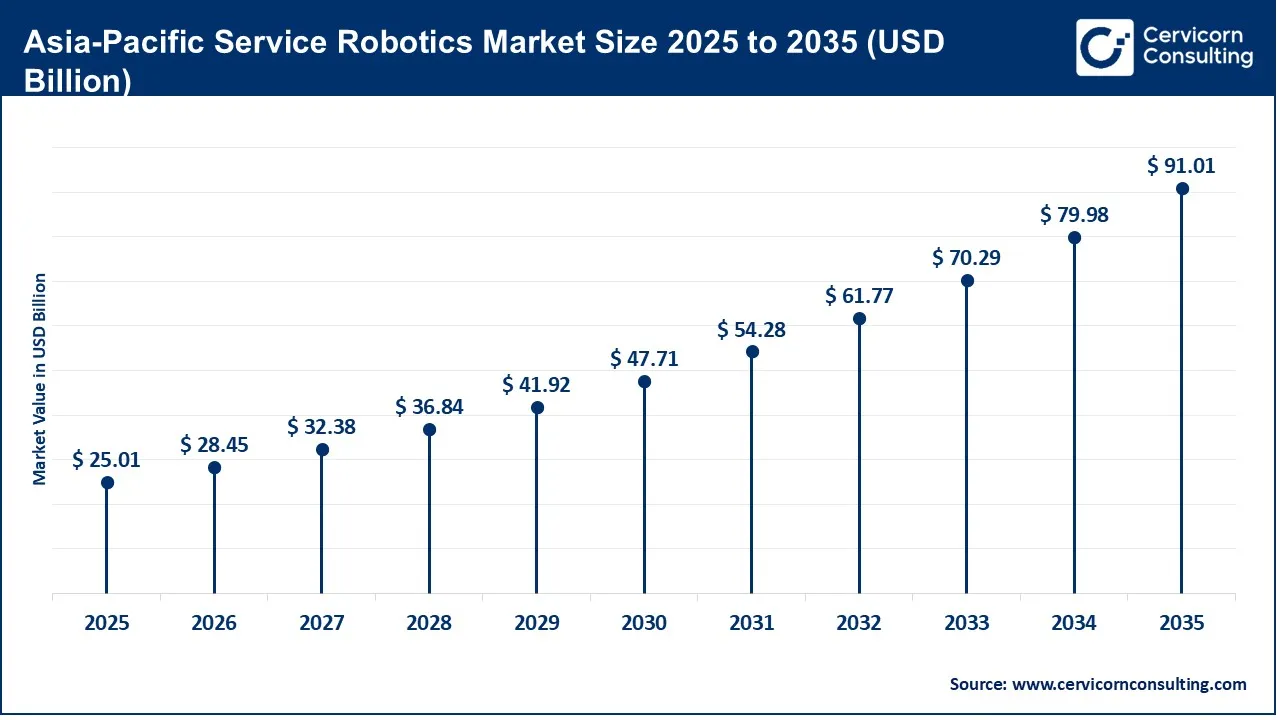
The Asia Pacific service robotics market size was valued at USD 25.01 billion in 2025 and is expected to surpass around USD 91.01 billion by 2035. Asia Pacific led the market in 2025 driven by its robust robotics manufacturing capacity, rapid adoption in the region, government support and high investment in AI and cutting edge technology. China, Japan, and South Korea are among the leading countries contributing to regional growth through large-scale robotics production, research initiatives, and industrial automation programs. China is the major country driven by advanced manufacturing ecosystem and increased application of logistics robots, making it a top hub.
Japan and South Korea are at the forefront of innovation in healthcare robots, humanoid robots and automation in various service applications.
With increased investment in AI and Robotics start-ups and its use in smart manufacturing and automation in healthcare, logistics & other sectors India is anticipated to be a fast-growing market.
North America Service Robotics Market Analysis
The North America service robotics market size was estimated at USD 19.50 billion in 2025 and is projected to hit around USD 70.97 billion by 2035. North America is witnessing rapid growth in the service robotics market due to its strong investment in AI, Autonomous systems, healthcare robots, warehouse automation across region. U.S. plays a significant role as a major hub with significant innovation in humanoid robots and AI led robotics, logistics, defense and manufacturing robotics on account of key technology companies, venture funding and advanced research & academic institutions pushing the growth of robotics across region.
Moreover, there is an accelerated increase in the adoption of robotics across manufacturing, logistics and commercial applications in Canada and Mexico, pushing their overall growth in service robotics market.
Europe Service Robotics Market Analysis
The Europe service robotics market was valued at USD 16.07 billion in 2025 and is anticipated to reach around USD 58.47 billion by 2035. Europe has witnessed remarkable growth across service robotics market on account of robust adoption across different industries and strong government support across Europe in industry 4.0, robotics development scheme and in digital transformation in the sectors like healthcare, logistics and commercial space on account of increase in smart manufacturing. Germany being one of the most robust market for robotics due to its strong engineering capacity and robotic industrialization ecosystem. Countries like UK, France, and Italy are expanding their use of robotics in healthcare, logistics and commercial sector driven by increasing investments in advanced robotics research and development programs.
Segmental Analysis
Field of Application Analysis
The professional service robots segment held the largest share of the global service robotics market in 2025, mainly due to high adoption of professional service robots in commercial, industrial, and institutional sectors requiring automation solutions to enhance productivity, operational efficiency, and safety. Professional service robots are developed and implemented at all levels of the logistics and warehousing industry, healthcare sector, agriculture, defense, hospitality, retail, inspection & public safety.
The significant growth of online commerce and the complexity of supply chain operations has enabled the faster and wider deployment of AMRs, AGVs, robotic picking systems, and inventory management robots. Professional service robots are increasingly used for offerings such as surgical assistance, hotel delivery, hospital disinfection & patient care, and repositioning applications in healthcare.
The market for personal/domestic service robots is experiencing consistent growth. Increased consumer interest in smart home devices and the emergence of the domestic services robots market segment such as robotic vacuum cleaners, lawn mowing robots, robotic security devices, etc, are some of the key factors enabling steady market growth. This market will continue to develop and grow on the back of developments in AI, voice commands, smart home connected ecosystems and in sensor technology, which in turn, will increase functionality and ease of consumer robotics.
Component Analysis
Hardware segment represented a dominant share in the service robotics market in 2025 as physical elements of operations including sensors, processors, actuators, motors, cameras, controllers, batteries, robotic mechanical systems were highly significant for a robot to function and hardware is one of the most pivotal category, due to the growing need of robots for intelligent sensing, locomotion, computation and communication for autonomous tasks.
Demand in AI based robots have enhanced investment in smart processors, edge computers, LiDAR sensors, cameras with better vision while growth in humanoid robot and mobile robot design have been enhancing demand of lightweight robotics elements, precision actuators and power efficient components.
Services segment is expected to exhibit a significant growth rate throughout the forecast period due to growing demand for robot installation, maintenance, updates, system integration, fleet management, Robotics-as-a-Service (RaaS) and others while businesses are moving towards service models to cut initial capital expense and avail smart solutions with subscription.
Robotics service providers will also increase by customizing robot solutions for specific industry needs, providing smooth operation of robotics by seamless integration with existing infrastructure, offering continuous technical support.
Operating Environment Analysis
Ground robots dominated the service robotics market in 2025 because they have a significant application in warehouse management, healthcare, retail industry, hotels, manufacturing plants, restaurants and many of other public places, such as banks, airports, parks, libraries, museums, offices etc. Ground robots can offer dependable and affordable automation for transportation, material handling, delivery, sweeping, cleaning and inspection, security as well as customer service purposes in most circumstances.
This sector growth is expected to be due to widespread deployment of autonomous guided robots (AGV’s) and intelligent autonomous mobile robots (AMR’s) in logistics facilities with companies increasingly looking towards faster and more agile fulfillment.
Aerial robots segment will grow strongly supported by Increasing use of unmanned aerial systems for inspections, agriculture, monitoring, delivery as well as in defence and security related operations. Advances made in technology in terms of the sensors, batteries, autonomy features for UAVs or drones will have a direct impetus on the market growth.
Mobility Analysis
Mobile and autonomous service robots was largest in 2025, given there is high interest in modular robotic systems which move in free space and operate in different spaces to undertake diverse tasks. The growth in this segment, has due in part, to: the growth in deployment of AMRs in logistics, healthcare, agriculture, retail and hospitality; the adoption of AI algorithms and artificial intelligence; enhanced autonomous guidance and navigation systems; as well as the deployment of advanced sensors in robots.
Stationary / fixed-base robots while growing at a somewhat moderate pace in the predicted timeframe. These machines typically provide specific functions or undertake precise, repeatable operations, often indoors. They're deployed primarily in laboratories, health and science, inspection, security and healthcare support roles and where accuracy and reliability are important elements of robot functionality.
End-use Industry Analysis
In 2025, the logistics and warehousing sector had the largest share of the global service robots market, driven by strong e-commerce penetration, automation demand in warehouses and the increasing requirement for same-day delivery. Market vendors such as, Amazon, Fetch Robotics Inc. and Waypoint Robotics are offering autonomous mobile robots, robotic picking systems, sorting robots and warehouse management systems.
In 2025, healthcare sector is projected to witness robust growth owing to growing demand for robot assistance for surgical procedures, aged person care systems, robotic assistance for physical therapies and hospitals automation systems. Moreover, demand for medical robotics system is anticipated to register significant development during the forecast period 2025-2030.
Healthcare automation technologies are gaining the prominence owing to aging populations, global shortages of qualified healthcare professionals and growing demand for robotic-assisted surgeries in minimally invasive procedures.
Competitive Landscape
- ABB Ltd.- A premier company in the Robotics and Automation field. ABB has been consistently developing A.I driven robotic applications used across various sectors like logistics, healthcare, industrial service, and human- robot collaboration.
- Amazon Robotics- This technology provides a fully automated robot solution for warehouse management with advanced capabilities for optimized inventory management and supply chain fulfillment operations.
- Boston Dynamics- An advanced technology provider with highly articulated and versatile robots capable of walking and maneuvering in rugged and complex terrains. It is developing robots for industrial inspection, logistics, and as support for research & development.
- Intuitive Surgical Inc.- This medical device company specializes in robot-assisted surgical procedures with systems that offer greater precision and minimally invasive surgical services.
- KUKA AG- It is involved in the provision of robots and automation solutions used in healthcare, industrial automation, robotics systems, and services.
- IRobot Corporation- A well known provider of home robots specifically focusing on a range of robotic cleaning systems powered by cutting-edge navigation systems.
- FANUC Corporation- This company is leading the robotic technology ecosystem in China through its development of industrial, service, and collaborative robotic applications.
- Yaskawa Electric Corporation- This company is contributing to advancements in the robotics sector by developing sophisticated robotic technologies integrated with A.I and also by bolstering its motion control system capabilities.
- SoftBank Robotics- SoftBank Robotics is working with interactive service robots that find their use cases in a variety of fields like research and development, hospitality, and human interaction environments.
- Tesla Inc.- Although primarily a company known for its electric vehicles and energy solutions, Tesla is heavily investing into creating an AI-driven general-purpose humanoid robot named Optimus for use in various service applications.
Recent News
- March 2026 – Serve Robotics expanded its autonomous delivery robot ecosystem through a partnership with White Castle and Uber Eats, enabling autonomous food delivery operations and strengthening the adoption of sidewalk delivery robots in urban environments.
- March 2025 – KEENON Robotics launched the XMAN-R1 humanoid robot along with new KLEENBOT cleaning robot models, expanding its service robotics portfolio across hospitality, commercial cleaning, and human-interaction applications.
Segments Covered
By Component
- Hardware
- Airframes
- Sensors
- Cameras
- Actuators
- Control System
- Navigation Systems
- Others
- Software
- Services
By Application
- Professional
- Personal & Domestic
By Operating Environment
- Ground Robots
- Automated Guided Vehicles
- Cleaning Robots
- Agriculture Robots
- Surgical Robots
- Humanoid Robots
- Others
- Aerial Robots (UAVs)
- Commercial Drones
- Consumer Drones
- Marine/Underwater Robots
- Unmanned Surface Vehicles
- Autonomous Underwater Vehicles
- Remotely Operated Vehicles
By Mobility
- Mobile/Autonomous Robots
- Stationary/Fixed-Base Robots
By End-User Industry
- Logistics & Warehousing
- Healthcare
- Agriculture
- Defense & Security
- Hospitality & Retail
- Manufacturing
- Construction
- Education
- Inspection & Maintenance
- Public Safety & Emergency Response
- Domestic & Household
- Others
By Region
- North America
- Europe
- Germany
- United Kingdom
- France
- Italy
- Spain
- Russia
- Rest of Europe
- Asia-Pacific
- China
- Japan
- India
- South Korea
- Australia
- Southeast Asia
- Rest of Asia-Pacific
- South America
- Brazil
- Argentina
- Rest of South America
- Middle East & Africa
- Saudi Arabia
- UAE
- South Africa
- Rest of Middle East & Africa
- South Africa
- Rest of Middle East & Africa