
Content
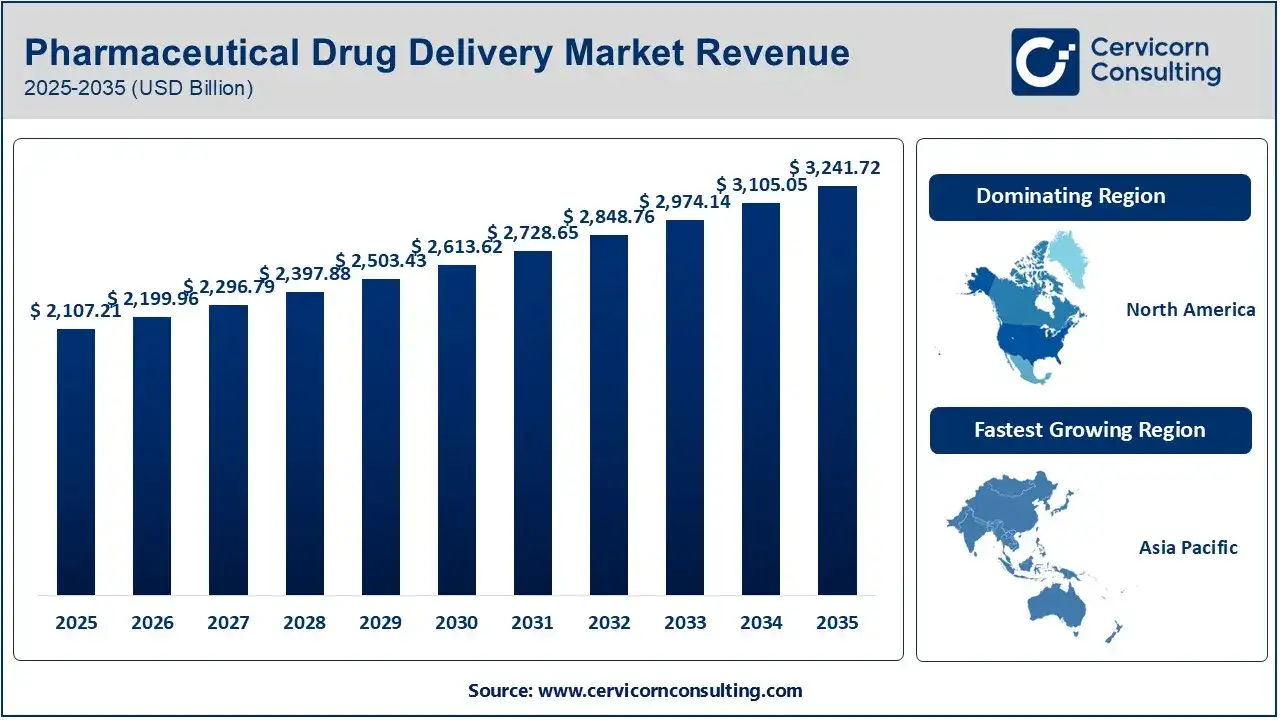
Pharmaceutical Drug Delivery Market Size to Hit USD 3,241.72 billion by 2035


Pharmaceutical Drug Delivery Market Size and Forecast 2026 to 2035
The global pharmaceutical drug delivery market size calculated at USD 2,199.96 billion in 2026 and is expected to garner around USD 3,241.72 billion by 2035, registering a CAGR of 4.5% over the forecast period 2026 to 2035.
North America dominated the market in 2025 because of well-established healthcare infrastructure and robust R&D, whereas Asia Pacific is anticipated to expand rapidly in the market due to surging pharmaceutical production capabilities and a rise in chronic disease cases.
Industry Outlook
The inclusion of an approach, process, or technology to administer a pharmaceutical entity or API into the human or animal body to gain an intended therapeutic result is referred to as pharmaceutical drug delivery. The overall market expansion is primarily fueled by a rise in candidates with poor water solubility and bioavailability, requiring novelty in delivery technologies, like spray drying, hot-melt extrusion, etc. Designing a new drug molecule demands expensive and challenging methods; this drives improvements or reformulation in delivery systems, which are often more affordable and rapid than identifying a novel chemical entity. Besides this, many research activities are promoting technologies that change the release kinetics of a drug and facilitate sustained, extended, or pulsatile release to keep drug concentrations within a safe therapeutic index for a prolonged period.
How is AI Supporting the Pharmaceutical Drug Delivery Market?
In 2026, AI algorithms have massive significance across the industry, such as improving intricate delivery carriers, like nanoparticles, liposomes, and transdermal patches, to deliver drugs directly to particular cells or tissues. In terms of projections, AI models are assisting in estimating Absorption, Distribution, Metabolism, Excretion, and Toxicity (ADMET) parameters as early as possible in the development pipeline and enable scientists to exclude infeasible delivery structures. Alongside this, a combination of AI with the Internet of Things (IoT) is widely facilitating pH-responsive nanocarriers, wearable sensors, and virtual healthcare assistants to customise administration protocols as per each patient's needs.
Regional Overview
North America Registered Dominance in the Market in 2025
North America captured the largest share of 38% of the pharmaceutical drug delivery market in 2025, driven by the growth in chronic diseases and the progression across biologics and biosimilars. Specifically, in 2025, the US FDA approved new therapies, like monoclonal antibodies and many more with N-acetylgalactosamine (GalNAc), especially engineered for liver-targeted delivery. Along with a focus on cancer and oncology therapeutics, Evonik invested in a new GMP drug product manufacturing facility for lipid-based drug delivery in Canada and will support vaccines, therapeutics, and other advanced drugs from development through commercial scale.
Asia Pacific is projected to witness rapid expansion
However, Asia Pacific held a 25% share of the market in 2025 and is projected to witness rapid expansion during 2026-2035, due to a booming burden of geriatric populations and expansive demand for innovative and cost-effective delivery solutions. Recently, China’s most efficient strategy has demonstrated the translation of AI-enabled delivery evaluations, organ-on-a-chip (O&OOC) technologies, and smart production across the pharmaceutical chain. Other key programs of 2026 include the Controlled Release Society Indian Chapter (CRSIC) pre-symposium workshop, which addressed substantial landmarks in inhalation drug delivery.
Segmental Glimpse
| Market Segment | Dominant Segment | Key Growth Driver |
| By Route of Administration | Injectable Drug Delivery | Propelled by broader use of vaccinations, biologics, biosimilars, and continuous transformation in wearable injectors, autoinjectors, infusion systems, and prefilled syringes. |
| By Drug Delivery Technology | Conventional Drug Delivery | Because of its expanded use, widespread therapeutic applications, and its comprehensive availability and advanced production techniques. |
| By Dosage Form | Solid Oral Dosage Forms | Supported by broadened use of tablets and capsules in diverse medical applications, coupled with higher patient familiarity and ease of administration. |
| By Drug Type | Small Molecule Drugs | Fueled by a broad range of applications in major therapeutic domains and their expansive clinical applicability. |
| By Application | Cancer | Due to the growing usage of targeted therapies, biologics, and high-end medications, with an accelerating need for stronger cancer treatments. |
| By Delivery Mechanism | Immediate-Release Delivery | Led by its massive application in traditional pharmaceutical formulations and broader therapeutic uses. |
| By End User/Care Setting | Hospitals | Driven by the presence of well-qualified specialist personnel and administration of complex cancer, infusion, and injectable medicines. |
Emerging Breakthroughs
- Transitions in Subcutaneous & Other: One of the notable steps of the industry is a revolution in subcutaneous delivery alternatives, specifically for oncology and immunology. Additionally, leaders are bolstering advances in autoinjectors, high-power injectors, and dual-chamber liquid-liquid injection systems to enhance patient convenience and reduce hospital stress.
- Rapid AI-Optimized Cycles: In this era, artificial intelligence players are moving towards day-to-day operations, which shrink molecule design and lab testing loops down to a matter of weeks, like concentrated alliances between AI biotechs and pharma firms.
- Pushing Tailored Entities: Nowadays, many researchers are aiming at personalizing treatments based on genetic profiles, biomarkers, and lifestyle data, coupled with the enforcement of 3D-printed tablets and validated, versatile modular production units.
Future Outlook
Gradually rising demand for gene therapy across the globe is fostering substantial innovations in safe and targeted intracellular delivery of genetic payloads to unique tissues. However, the pharmaceutical drug delivery market has a future goal of revolutionising lipid nanoparticles (LNPs) and polymeric carriers to enhance stability and systemic availability of mRNA, siRNA, and other oligonucleotide interventions. Developing nations, like China and India, are facing a key concern called a boom in obesity cases, which pushes developments in oral dosage forms, like GLP-1. The prospective era will have pivotal opportunities in digitalized solutions, such as integrated digital health sensors and connected devices with drug delivery systems, allowing precision dosing, adherence tracking, and real-time patient review.
Empower your strategy with expert insights, purchase this premium research@ https://www.cervicornconsulting.com/buy-now/3059
Ask here for more details@ sales@cervicornconsulting.com