
Content
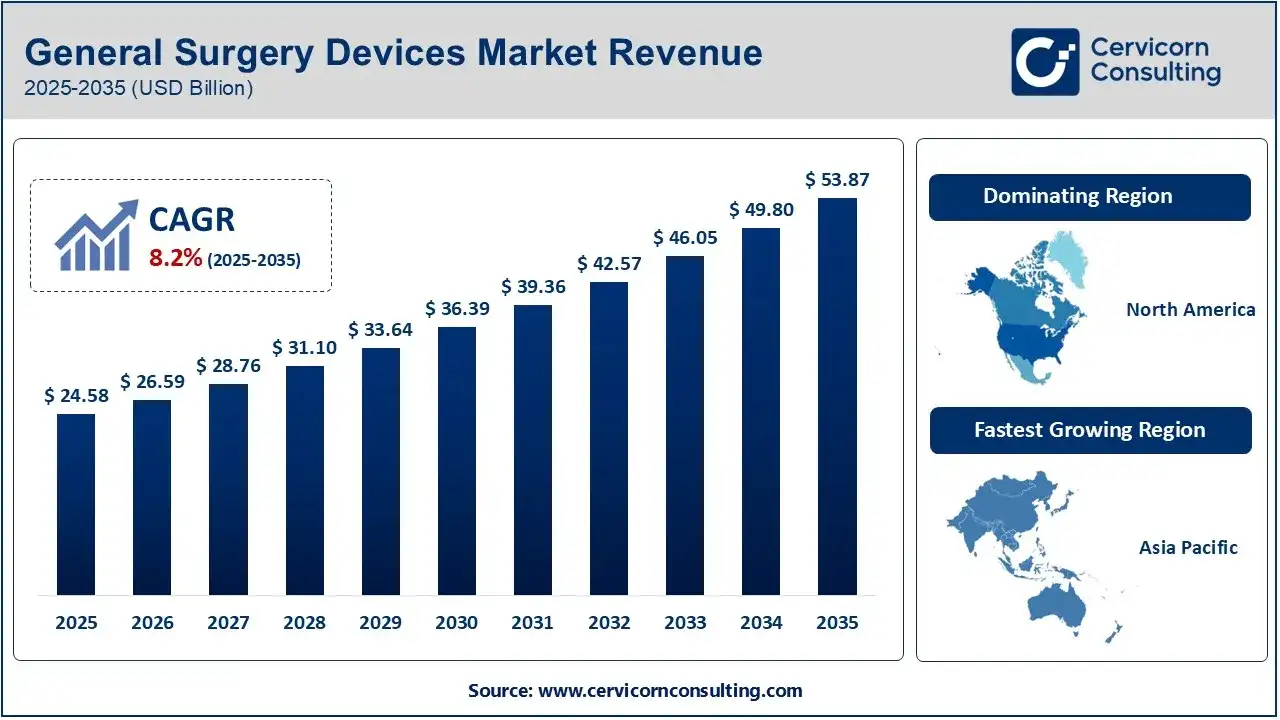
General Surgery Devices Market Size to Hit USD 53.87 Billion by 2035


General Surgery Devices Market Size and Outlook 2026 to 2035
The global general surgery devices market size calculated at $26.59 billion in 2026 and is expected to hit around $53.87 billion by 2035, growing at a CAGR of 8.2% during the forecast period of 2026-2035.
North America registered dominance in the market in 2025, motivated by a broader demand for MIS and the existence of well-established healthcare infrastructure, while Asia-Pacific is estimated to expand fastest in the predicted timeframe, due to growing volumes of surgeries and consistent growth in surgical suites.
These are advanced medical instruments, tools, and powered systems utilised by surgeons to cut, dissect, grasp, hold, clamp, retract, seal, or close tissues and organs during general surgical operations. The global market expansion is driven by surging adoption of laparoscopic tools, energy devices, staplers, and robotic or computer-assisted systems to enhance precision, reduce trauma, and speed recovery. Simultaneously, the global rise in chronic disease cases is forcing healthcare infrastructures to strengthen surgical capacity and efficiency. To overcome accelerating demographic changes, the latest devices are combining ultrasonic dissection with bipolar vessel sealing to remove and seal tissue with controlled thermal circulation.
Key AI Advances
Powerful breakthroughs across the industry are starting to roll out innovative robotic systems that unify machine learning and extreme onboard computing power to balance vision, filter physiological hand tremors, and assist improved force feedback. Meanwhile, implementation of AI-driven laparoscopic and robotic cameras allows the analysis of live video streams to identify anatomy, trace surgical instruments, and focus on safe versus hazardous dissection zones. Besides this, various modern digital surgical solutions connect operating room devices, video feeds, and AI software to automatically tag major procedural moments, develop operative reports, and foster surgical training and post-op review.
Regional Overview
North America Dominated the Market in 2025
North America accounted for a dominant share of the general surgery devices market in 2025, supported by surging efforts in infection control, substantial healthcare investments, and continuous launches of robust government reimbursement settings. Canada’s mature traceability standards pushed modern robotic platforms, while British Columbia strengthened robotic surgery access with new surgical robot programs and deployments at hospitals, including Victoria General Hospital and Kelowna General Hospital. Side by side, the U.S. market has started evaluating remote robotic surgery in clinical trial settings by employing high-definition 3D visualization and responsive controls.
Asia-Pacific is expected to grow rapidly in the market
Asia-Pacific is expected to grow rapidly in the market due to rising national health insurance initiatives, pivotal growth in chronic conditions, and advancing technology solutions. With a focus on accelerating the geriatric population, China’s NMPA included 104 innovative medical devices in its Special Review Procedure and issued measures (Announcement No. 63/2025) to enhance comprehensive life-cycle supervision and speed up review for premium devices. Recently, Medicaroid, NTT Communications, IRCAD, and the Japan Surgical Society completed a long-distance remote surgery presentation between Kobe, Japan, and Europe. Indian industry is spurring virtual reality and console-based training systems to support surgeons' training in hand-eye coordination and clinical cases without operating-room concerns.
General Surgery Devices Market Segmental Glimpse
| Market Segment | Dominated Segment | Key Growth Catalyst |
| By Product Type | Disposable Surgical Supplies | Fueled by their reduced cross-contamination risk, validated sterility, eliminated reprocessing, and simplified compliance. |
| By Surgery Type | Orthopedic Surgery | Supported by a globally accelerating ageing population and cases of joint disorders, arthritis, and sports injuries. |
| By Technology | Conventional Surgical Technology | Led by its direct access, expansive use in emergency incidents, and universal popularity. |
| By End User | Hospitals | Propelled by widespread rise in surgical volumes, surging geographical awareness, and the presence of multidisciplinary areas. |
Emerging Trends
- Encouraging AR & Other Modeling: Eminent tech giants are seeking the launch of wearable AR displays, 3D modeling, and fluorescence-guided imaging that guide surgeons to observe basic anatomy or critical structures during procedures.
- Strengthening Single-Use Approaches: Global transitions in ambulatory surgical centers (ASCs) and short-stay settings push market players to develop portable, inexpensive, and factory-sterile single-use kits to omit reprocessing challenges and improve infection control.
- Researching Closure & Biomaterials: Nowadays, many studies are promoting powered staplers, tissue sealants, hemostatic agents, and resorbable or biodegradable materials to expedite tissue approximation and lower postoperative leaks or adhesions.
Future Outlook
One of the key opportunities in the general surgery devices market is introducing real-time fluorescence imaging to elevate structure discovery and support leak reduction. Meanwhile, rising demand and advances in remote solutions are enabling the exploration of high-speed connectivity and remote consoles that transform telesurgery, specifically across regions with a lack of specialists. Moreover, the industry will have higher demand for consumables, such as energy-based devices, surgical staplers, trocars, and visualization tools customized for outpatient and short-stay activities. In addition, leading players are seeking advances in smart sutures embedded with sensors to monitor tissue healing or tension, coupled with 3D-printed patient-specific models and implants. Highly focused and prominent research has been shifting towards the unveiling of multi-specialty soft-tissue surgical robots with four robotic arms integrated directly into a standard surgical table to adapt to space-restricted operating rooms.
Empower your strategy with expert insights, purchase this premium research@ https://www.cervicornconsulting.com/buy-now/3092
Ask here for more details@ sales@cervicornconsulting.com