General Surgery Devices Market Overview and Forecast 2026 to 2035
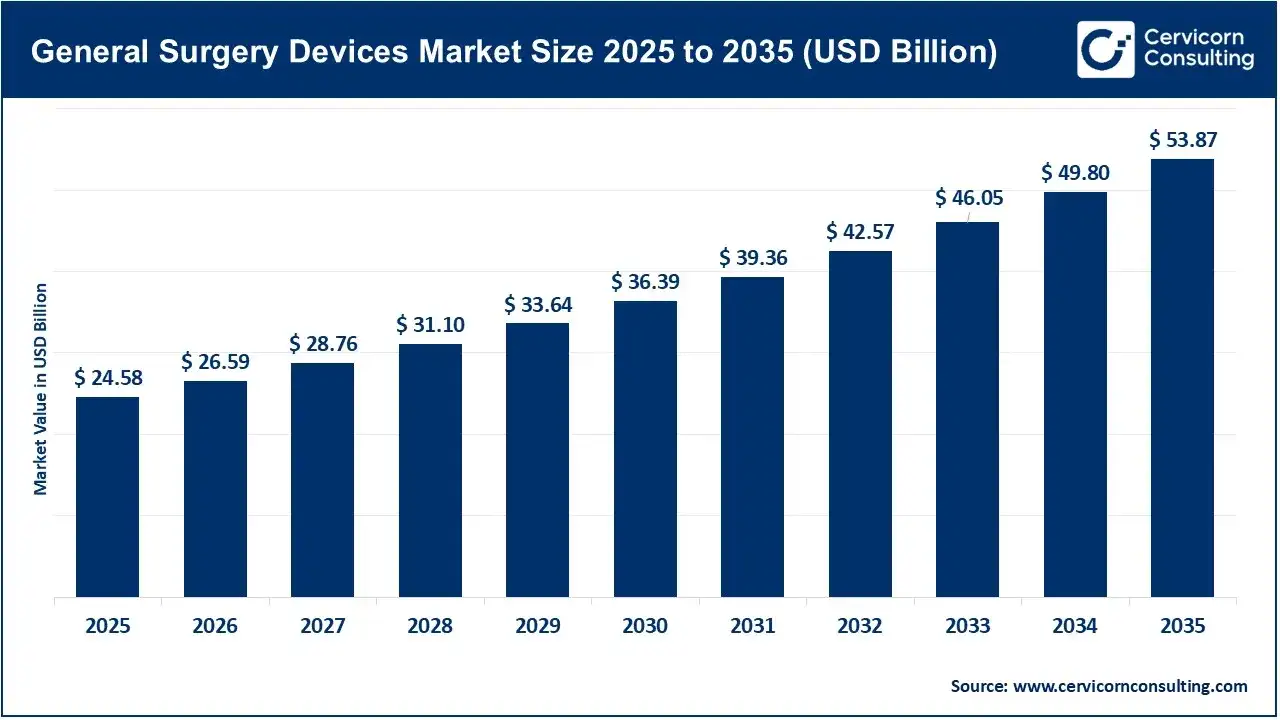
The global general surgery devices market size was valued at $24.58 billion in 2025. The market is expected to reach $53.87 billion by 2035, growing at a CAGR of 8.2% during the forecast period of 2026-2035. The globally surging geriatric population faces several chronic diseases, demanding advanced surgical procedures. Eventually, the worldwide breakthrough area fosters broader use of minimally invasive and robotic-assisted surgery procedures.
General Surgery Devices Market Size & Growth Snapshot
- Base Year Market Size (2025): $24.58 billion
- Current Year Market Size (2026): $26.59 billion
- Estimated Year Market Size (2035): $53.87 billion
- Forecast Period CAGR (2026-2035): 8.2%
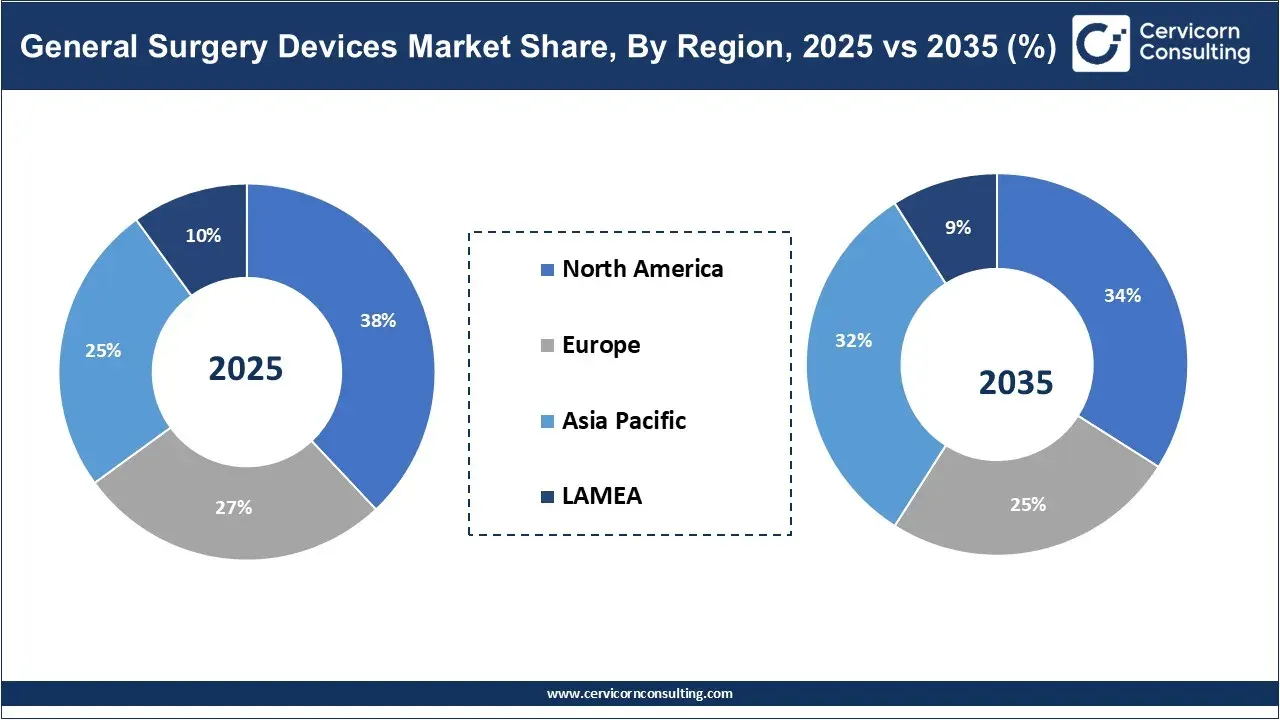
- Leading Region: North America (revenue share of 38%)
Report Highlights
- By region, North America dominated the market in 2025 with revenue share of 38%, driven by a massive preference for MIS, a robust healthcare system, and ongoing technological advancements.
- By product type, disposable surgical supplies led the market in 2025 accounted revenue share of 30%, supported by increasing efforts in infection prevention and growing regulatory & risk frameworks.
- By surgery type, orthopedic surgery was dominant in the market with revenue share of 27% in 2025 due to a rising ageing population, with vast modifications in active lifestyles and injury cases.
- By technology, conventional surgical technology registered dominance in the market in 2025, fueled by its affordability and a surge in clinical requirements.
- By end user, hospitals dominated the market in 2025 (revenue share of 59%), driven by their widespread accessibility to diverse departments and a global rise in surgical volumes.
What are the Major Shifts in the General Surgery Devices Market?
Primarily, the market covers different but specialised medical instruments and tools that perform particular physical actions during surgical operations, like cutting, dissecting, grasping, holding, clamping, retracting, and closing tissue. However, 2026 is increasingly seeking to explore highly sophisticated solutions, like integrated conventional handheld devices with accelerating robotic-assisted surgery platforms, smart sensors, and AI-enabled navigation tools.
To overcome the regional barriers and economic hurdles, industry has been promoting ambulatory surgical centers (ASCs), offering compact, inexpensive, and fast-turnaround surgical instrumentation. Additionally, leading firms are executing combined AI and data systems that support improving workflow and refining intraoperative decision-making.
Recent Steps Taken by Major Global Leaders
XRlabs
(October 2026) |
Raised $8.4 million in seed funding from Playground Global to speed development and clinical deployment of XRlabs’ device-agnostic platform, embedding real-time AI directly into the operating room. |
Phantom GI
(October 2026) |
Secured a $5 million seed round supported by Pitango Healthcare to advance and fund the first phase of U.S. clinical studies for PercStoma, a minimally invasive alternative to traditional ostomy surgery. |
Nvidia
(October 2026) |
Joined with Siemens Healthineers to employ artificial intelligence specifically across radiation cancer therapy. |
Nami Surgical
(October 2026) |
Secured £3.4m in additional funding to spur its ultrasonic technology for robotic-assisted surgery, which includes a £2m investment from the Scottish National Investment Bank. |
Johnson & Johnson
(October 2026) |
Collaborated with the Department of Health – Abu Dhabi (DOH) to strengthen surgical intelligence at the Abu Dhabi Future Health Summit 2026, joining players from healthcare, government, technology, research and investment to speed up transformative health innovation. |
Levee Medical
(September 2026) |
Received an NIH SBIR Phase II grant worth nearly $2 million from the National Cancer Institute to advance research encouraging its Voro® Urologic Scaffold. |
Market Dynamics
Growth Drivers
- Expanding Ageing & Surgical Burden: Nowadays, the globe is suffering from a huge growth in the geriatric population, chronic disease prevalence, along with a rising post-pandemic surgical backlog management, fueling the global market progression.
- Boosting MIS Demand: Most surgeons and patients widely prefer modern minimally invasive solutions, such as laparoscopic and energy-based powered instruments, to lower postoperative risks and enhance recovery times.
- Notable Shift Towards ASC: To eliminate hospital inpatient settings, well-established healthcare systems are looking to demonstrate Ambulatory Surgery Centers (ASCs) that are expedited via ongoing government and insurance reimbursement landscapes for same-day discharges.
Market Restraints
- Expensiveness of Equipment: Higher adoption of highly sophisticated general surgery tools, like single-port robotic systems, smart staplers, and many more, necessitates vast upfront investment to buy, coupled with the need for massive costs for maintenance and sterilization.
- Enforcement of Rigorous Regulations: To pass intricate and costly approval processes, worldwide pioneers are struggling with stricter regulatory and compliance burdens, like the U.S. FDA’s Quality Management System Regulation (QMSR) updates effective in February 2026, etc.
- Emerging Hospitals Yearly Caution & High-End Demands: Gradually rising economic uncertainty and increasing tariffs have pushed healthcare systems to be highly cautious about expensive innovations.
Key Opportunities
- Transformative AI-Driven Approach: In the coming era, the general surgery devices market will broadly facilitate real-time anatomical trajectories and predictive warnings for complications, including tissue perfusion deficits or hidden vascular structures, led by algorithms trained on comprehensive surgical footage.
- Impelling SaMD and Connected Settings: A transition from passive instruments to active platforms is opening revenue domains in cloud-based surgical data analytics, 3D patient-specific virtual planning, and digital workflow integration.
- Emphasizing New Implants & Telesurgery: Day by day, major producers are leveraging advanced materials that offer safe dissolution or integration into the body, lowering foreign-body concerns. Also, groundbreaking platforms now reinforce remote and disaster-zone surgical access across global healthcare systems.
Market Challenges
- Deficiency of Skilled Offerings: Globally accelerating progression of robotic-assisted surgery faces a lack of basic open and laparoscopic motor & cognitive skills among surgeons.
- Surging Investment Stress: Exploration and adoption of advanced robotic and image-guided systems often raise capital and maintenance expenses, which compress hospital margins and limit adoption in resource-limited or budget-restricted sectors.
- Limitations in Surgical Governance: The use of integrated cloud-connected cameras, AI analytics, and operating room black boxes has activated a governance gap related to who owns, manages, and monetizes sensitive patient anatomy and team performance data.
General Surgery Devices Market Segmentation Analysis
Product Type Analysis
Disposable Surgical Supplies: The disposable surgical supplies segment held the largest share of the market in 2025, as they provide lowered cross-contamination, ensured sterility, and removal of reprocessing. Along with their cost-effectiveness, they comply with stringent clinical rules to reduce HAIs, SSIs, and other risks, with enforcement of different regulatory benchmarks supporting these products, i.e., disposable, pre-sterilized implements.
General Surgery Devices Market Share, By Product Type, 2025 (%)
| Product Type |
Revenue Share, 2025 (%) |
| Disposable Surgical Supplies |
30% |
| Open Surgery Instruments |
22% |
| Minimally Invasive Surgery Instruments |
23% |
| Energy-Based and Powered Instruments |
16% |
| Robotic and Computer-Assisted Surgery Devices |
9% |
Robotic and Computer-Assisted Surgery Devices: The robotic and computer-assisted surgery devices segment is projected to be the fastest-growing during 2026-2035, propelled by surging technological breakthroughs, growing demand for streamlined clinical workflow, and macro-level healthcare transitions. With a goal of expansive use of MIS, the well-established healthcare setting is pushing the rollout of real-time AR overlays, 3D reconstructions, and optimized fluorescence imaging, facilitating surgeons with superior anatomical clarity and minimal procedural stress.
Surgery Type Analysis
Orthopedic Surgery: The orthopedic surgery segment accounted for a dominant share of the market in 2025, led by expanding cases of joint disorders, arthritis, and sports injuries and demand for personalised solutions to comply with the expanding elderly population. According to some studies, there were nearly 606.5 million cases of osteoarthritis, while roughly 18 million people were affected by rheumatoid arthritis in 2025 globally. These instances fostered modern 3D imaging, CT/MRI modeling, and computer-aided design, enabling custom implants customized to individual bone anatomy.
General Surgery Devices Market Share, By Surgery Type, 2025 (%)
| Surgery Type |
Revenue Share, 2025 (%) |
| Orthopedic Surgery |
27% |
| Cardiovascular Surgery |
21% |
| Neurosurgery |
13% |
| Gastrointestinal Surgery |
24% |
| Gynecological and Urological Surgery |
15% |
Cardiovascular Surgery: The cardiovascular surgery segment is estimated to grow rapidly in the upcoming years, led by rising risks of degenerative heart valve disease and coronary issues and innovation in Transcatheter Aortic Valve Replacement (TAVR) and percutaneous mitral valve repair. Moreover, NIH has declared there will be more than 22.2 million or 23.6 million heart cases per year by 2030. This is leading to substantial workforce pressure, thus impelling the demonstration of AI-powered clinical decision-making, 3D visualisation tools, etc.
Technology Analysis
Conventional Surgical Technology: The conventional surgical technology segment captured a major share of the general surgery devices market in 2025, because of accelerating chronic concerns, growing adoption of MIS, and the revolution of ‘Physical AI’ approaches. In 2025, the market strengthened AI-assisted copilots, wearable augmented reality (AR) navigation, hybrid multi-function instruments, and magnetic anastomosis devices.
General Surgery Devices Market Share, By Technology, 2025 (%)
| Technology |
Revenue Share, 2025 (%) |
| Conventional Surgical Technology |
20% |
| Minimally Invasive Surgical Technology |
26% |
| Robotic-Assisted Surgical Technology |
15% |
| Energy-Based Surgical Technology |
24% |
| Image-Guided Surgical Technology |
15% |
Robotic-Assisted Surgical Technology: The robotic-assisted surgical technology segment is anticipated to expand at the fastest rate in the predicted timeframe, driven by broadening healthcare shifts, upgrading software approaches, and increasing demand for telesurgery. Recently, worldwide key challengers received FDA clearances to promote robotics beyond traditional urology and gynaecology and surged efforts into advancing modular systems, single-port platforms, and latest console power.
End User Analysis
Hospitals: The hospitals segment was dominant in the market in 2026, supported by globally rising surgery rates and broader awareness of infection control & workflow efficiency. Alongside this, hospitals used bulk-buying agreements and group purchasing organizations (GPOs) to negotiate reduced unit expenses on high-ticket capital equipment, led surgical systems, and routine supplies. To enhance margin levels, they are continuously looking for robotic-assisted surgery systems, advanced energy devices, and image-guided tools.
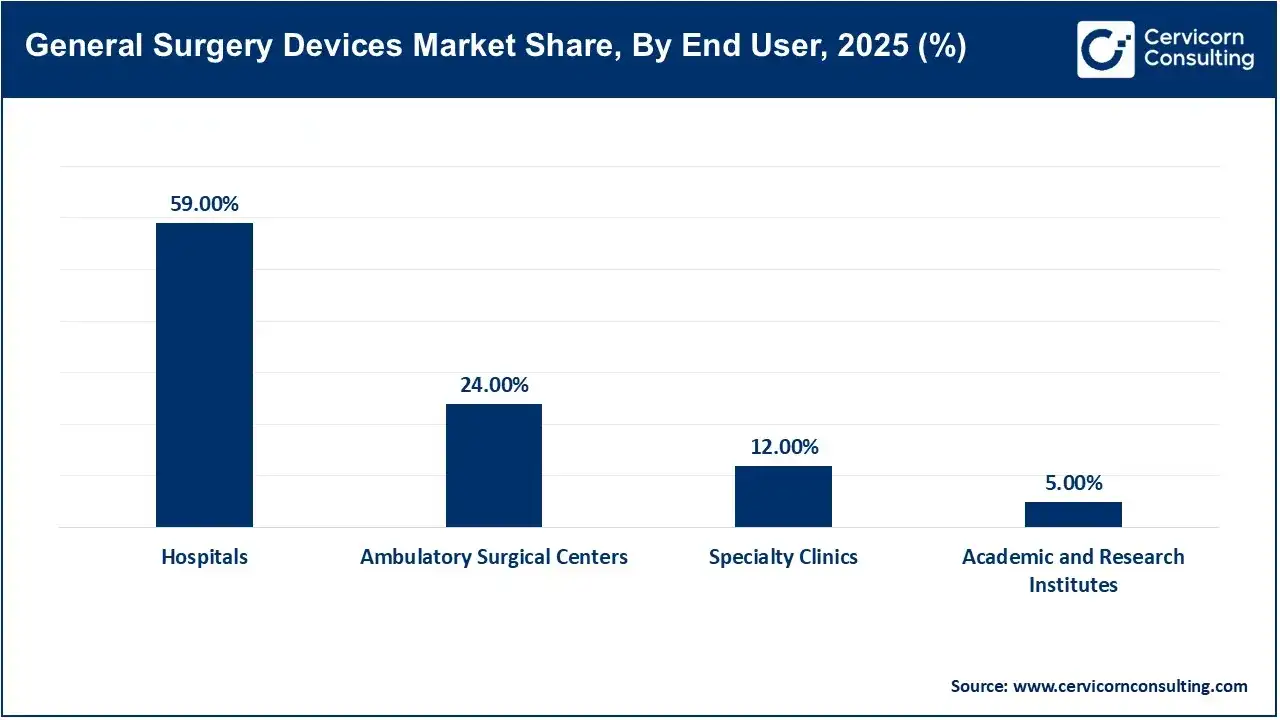
Ambulatory Surgical Centers: The ambulatory surgical centers segment is expected to witness rapid expansion during the forecast period, due to surging demand for specialized outpatient settings and their highly affordable ecosystems. Also, they provide spatial footprints and various sterilization or single-use preferences compared to huge tertiary hospitals, forcing device manufacturers to develop dense, ergonomic, and simplified general surgery systems.
General Surgery Devices Market Regional Analysis
Why did North America Dominate the Market in 2025?
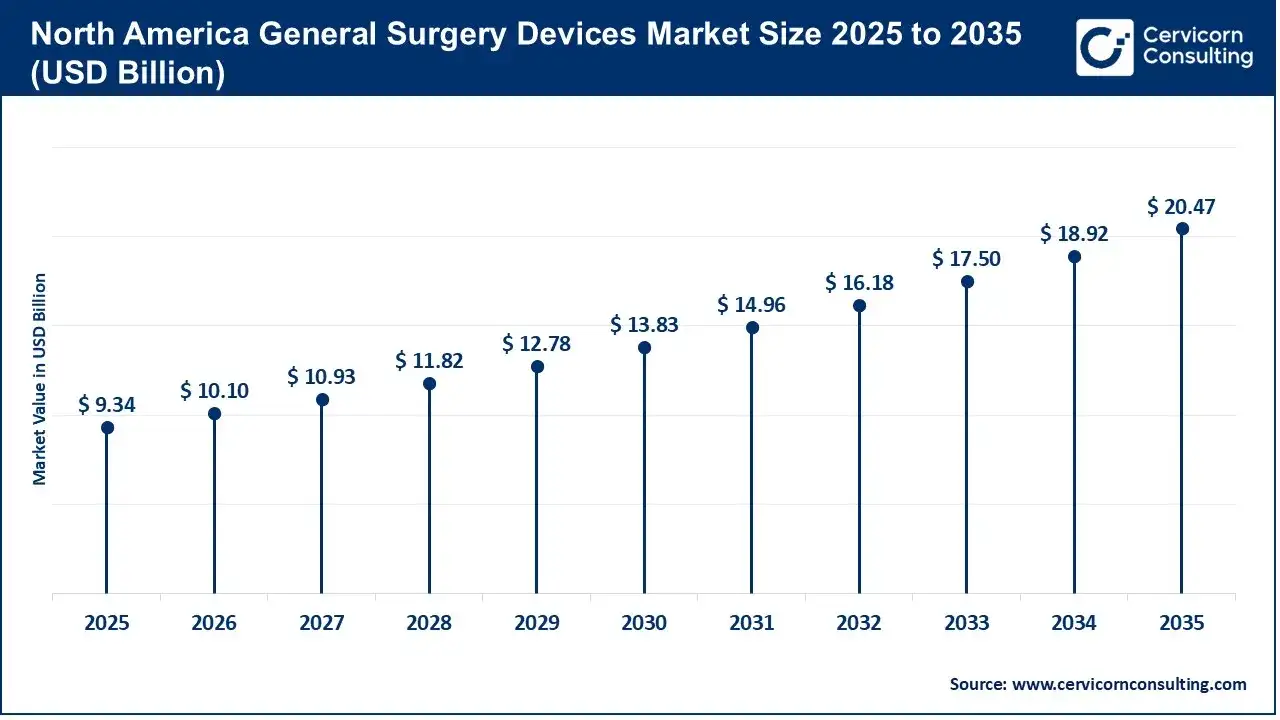
The global general surgery devices market size was estimated at $9.34 billion in 2025 and is expected to hit $20.47 billion by 2035. North America held the largest share of the market in 2025, driven by a rising focus on infection control, major healthcare investments, and coverage of suitable insurance and government reimbursement frameworks. Along with the presence of an advanced healthcare system and innovations in cutting-edge approaches, regional research surveys have addressed widespread use of wearable AR for live intraoperative imaging, stereotactic navigation, and projecting segmented pre-operative CT/MRI scans directly onto the surgical area.
United States Market Trends
- Significant catalysts of the U.S. market include growing pressure from chronic lifestyle and age-related health concerns and expanded expenditures in value-based care. Moreover, the nation has bolstered micro-incision solutions that increasingly aim at ultra-fine, cloud-connected surgical tools. In 2025, some academic entities, such as the University of Chicago, strengthened powerful techniques, like the Posterior Rectus Sheath Flap for Hiatal Augmentation (PoRSHA) for complex paraesophageal hernia repairs.
How is Asia Pacific Registering the Fastest Growth in the Market?
The Asia-Pacific general surgery devices market size was valued at $6.15 billion in 2025 and is projected to surpass $13.47 billion by 2035. Asia Pacific is predicted to grow rapidly in the market during 2026-2035, propelled by ongoing advances in hospital infrastructure and surgical suites, coupled with a higher rise in the geriatric population and severe health issues. However, certain nations, like Singapore, Australia, Japan, China, and India, are reporting substantial rises in disposable income and expansive health insurance or reimbursement system enhancements. In APAC, recently, China unveiled the first five-arm modular laparoscopic surgical robot, whereas Japan introduced its eight-axis arms, native 3D vision, and compact ergonomic design.
India Market Trends
- On the other hand, Indian healthcare hubs have pivoted towards prominent surgical robotics, with coverage of improved hardware and reduced local and imported systems. Furthermore, major Indian institutions, including Max Super Speciality Hospital and Nanavati Max Super Speciality Hospital, are seeking scale-up of precision in general and oncological surgeries, with the use of optimised computing and 3D visualisation solutions.
Ongoing Transitions and Technological Advances Drive Europe
The Europe general surgery devices market size was valued at $6.64 billion in 2025 and is forecasted to garner $14.54 billion by 2035. Europe is experiencing a lucrative growth because its healthcare systems are moving towards day-case models and ASCs to resolve hospital capacity challenges. At the same time, regional major firms are promoting AI-powered surgical navigation, improved imaging, and digital infrastructure that elevates clinical standards and modernises hospital networks.
UK Market Trends
- Across the UK, the NHS is forcing adoption of robotic systems, led by approvals from the National Institute for Health and Care Excellence (NICE) and aiming at massive scale-up of robotic-assisted operations. In addition, clinical staff at Guy’s and St Thomas’s NHS Foundation Trust have initiated the UK’s first deployment of the latest authenticated Force Feedback instruments integrated with the da Vinci 5 system.
Recent Launches
- November 2026: Farrer Park Hospital (FPH) introduced the Edge® Multi-Port Endoscopic Surgical Robot (MP1000) in Singapore, which makes advanced surgical care cost-effective for patients in Singapore and the region.
- October 2026: Wockhardt Hospitals Mumbai Central unveiled the Da Vinci X Robotic Surgical System, as a milestone approach in its efforts to broaden modern surgical capabilities and expand access to robotic-assisted minimally invasive procedures.
- October 2026: Sparsh Group of Hospitals at its facility in Kantabada rolled out an AI-enabled catheterisation laboratory (Cath Lab), a robotic surgical system and an advanced cardiothoracic operating theatre to empower advanced cardiac care and minimally invasive surgery in the state.
- October 2026: Fortis Escorts, New Delhi, launched the ARTIS pheno. vision, an advanced AI-enabled, robot-assisted hybrid catheterisation laboratory (Cath Lab) designed to foster complex cardiac, vascular and image-guided procedures.
Leading Players
Segments Covered
By Product Type
- Disposable Surgical Supplies
- Open Surgery Instruments
- Minimally Invasive Surgery Instruments
- Energy-Based and Powered Instruments
- Robotic and Computer-Assisted Surgery Devices
By Surgery Type
- Orthopedic Surgery
- Cardiovascular Surgery
- Neurosurgery
- Gastrointestinal Surgery
- Gynecological and Urological Surgery
By Technology
- Conventional Surgical Technology
- Minimally Invasive Surgical Technology
- Robotic-Assisted Surgical Technology
- Energy-Based Surgical Technology
- Image-Guided Surgical Technology
By End User
- Hospitals
- Ambulatory Surgical Centers
- Specialty Clinics
- Academic and Research Institutes
By Region
- North America
- Europe
- Asia-Pacific
- Latin America
- Middle East and Africa
