
Content
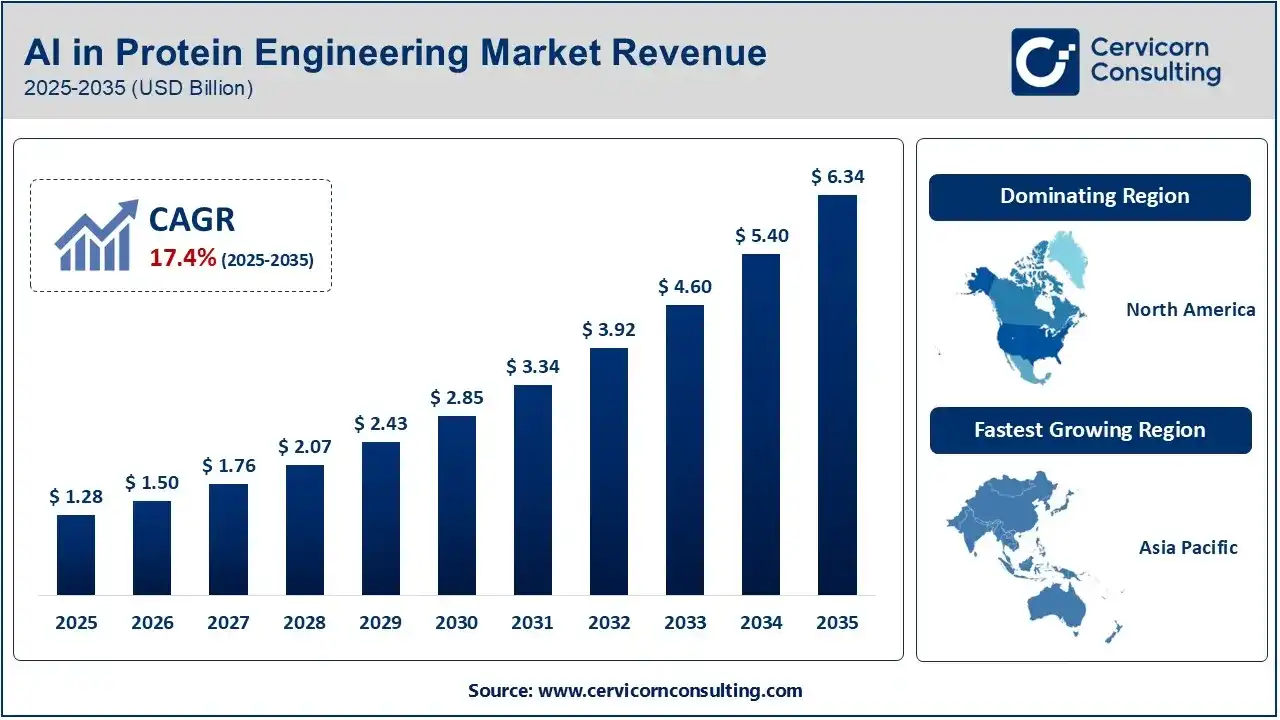
AI in Protein Engineering Market is Expected to Surpass $6.34 Billion by 2035


AI in Protein Engineering Market Insights
The global AI in protein engineering market size is calculated at $1.50 billion in 2026 and is expected to reach $6.34 billion by 2035, growing at a CAGR of 17.4% during the forecast period of 2026-2035.
North America registered dominance in the market in 2025, while Asia-Pacific is predicted to grow at a rapid rate during the forecast period, due to growth in biotechnology solutions and heavy research investment.
AI in Protein Engineering Market Outlook
The market is defined as the adoption of machine learning, deep learning, and generative AI models, decoding the relationships between amino acid sequences, three-dimensional structures, and biological functions. The global use of AI across protein engineering is primarily driven by the exploration of innovative and strong generative AI and basic models, such as de novo design. Moreover, other cutting-edge tools, like Google DeepMind’s AlphaFold3, are significantly broadening their capabilities from structure estimation to addressing complex interactions with small molecules, etc. However, ongoing integration of AI with automated, robotic wet labs supports consistent optimization loops. A subsidiary driver of the market is the presence of vast, open-access repositories, which consist of roughly 200 million predicted structures and offer an advanced training field for machine learning models.
Across recent trends, the industry has unveiled natural language protein design known as Promptina, enabling scientists to handle all-atom protein structure generation employing plain English text prompts. Also assists in the management of complex tasks, including fold classes, disulfide bonds, and de novo binders for specific targets directly from text.
Regional Snapshot
North America Dominated the Market in 2025
The AI in protein engineering market in North America captured a major share of 42% in 2025, supported by a well-established computational biology research hub and massive investment in biotechnology. In 2025, the United States contributed a prominent share, as its researchers re-engineered protein language models and structural tools to create innovative molecular structures that bind non-targeted disease proteins, cancer pathways, and neutralising agents. Alongside this, the regional dominance is fueled by immense revolutionary regional and national initiatives, like Seattle's AI Bioseeds project powered by substantial multi-million-dollar funding. This expedited open-source protein foundation models for vaccines, CAR-T cell enhancements, and oncology therapeutics. Recently, researchers at the University of Toronto unveiled combined AI training models with an open-access database for accurate prediction of how engineered peptides will bind to specific disease-causing target proteins and ultimately lower early-stage drug development timelines.
Asia-Pacific is estimated to witness the fastest growth
Asia-Pacific is estimated to witness the fastest growth in the upcoming years because of the widespread development of pharmaceuticals and continuous programs across biotechnology. Ongoing national policies across China, Japan, South Korea, India, and Australia are actively funding AI integration, biomanufacturing, and computational facilities. With a focus on designing new proteins, de novo enzymes, targeted therapeutic antibodies, and RNA-based molecules, the Department of Biotechnology (DBT) and the Biotechnology Industry Research Assistance Council (BIRAC) rolled out joint calls and offered proposals to develop Bio-AI Mulankur hubs under the BioE3 Policy. China’s key breakthrough in the AI in protein engineering industry is the Venus-Protein Outsize Database (Venus-Pod), developed by a Tsinghua University team and highlighted as the world’s largest protein sequence dataset, which covers roughly 9 billion pieces of protein sequence information.
AI in Protein Engineering Market Segmental Look
| Market Segment | Leading Segment | Key Growth Factor |
| By Technology | Machine Learning and Deep Learning | Due to its widespread applications in protein structure analysis, sequence optimization, and property prediction. |
| By Application | Protein Design and Optimization | Driven by growing demand for engineered proteins with improved activity, stability, and specificity. |
| By Protein Type | Enzymes | Propelled by their expansive applications across biotechnology, pharmaceuticals, industrial processing, and research. |
| By End User | Pharmaceutical and biotechnology companies | Led by broader investment in therapeutic discovery and protein-based drug development. |
Glimpse of Trends
- Emerging Combinations: Gradually surging advancements across the market foster integration of diverse tools, such as RFdiffusion, LigandMPNN, and PLACER, enabling researchers to expand protein backbones directly around particular active sites, developing crystal-validated enzymes with high catalytic efficiency.
- Seeking Inverse Folding: Unique implementation of ProteinMPNN and specialized variants, including SolubleMPNN for GPCR solubilisation, AntiFold/IgDesign for antibody-antigen complementarity-determining areas, and ThermoMPNN for scoring point mutations on stability/ddG, indicate leading sequence design and enhancement.
- Upcoming AI-Assisted Approach: Day by day, the trend is following the use of computational models to engineer non-natural or ‘redesigned' starting points for directed evolution, which omits wild-type concerns to establish expedited, higher-specificity enzymes, like proteases targeting ataxin-2.
Future Outlook
The AI in protein engineering market has been showing notable growth, which impels innovations across the latest therapeutics to overcome rising burden and urgency across the accelerating various chronic condition cases. With this specific consideration, the globe will push significant joint projects that deploy AI at commercial scale and engineer new proteins for cancer immunotherapies, targeted cell therapies, and mRNA or RNA vaccine platforms. Further opportunities will promote wet lab automation by integrating AI with automated chip technologies and enable faster, low-reagent synthesis, amplification, and cellular transfection of AI-developed sequences.
Certainly, the market could face static structure predictions failing, so to resolve this concern, players can unify physics-based molecular dynamics (MD) simulations, maximum-entropy reweighting, flow-matching settings, and all-atom diffusion models to address free-energy frameworks and transient states. Moreover, the prospective development will also spotlight hybrid physics-informed neural architectures that fix thermodynamic and folding-energy limitations directly into transformer and diffusion models. On the other hand, leading rollouts include implementation of lab-in-the-loop automated pipelines, miniaturized microfluidic or microvalve chips, and computational pre-filtering for a huge increase in experimental success rates.
Segments Covered
By Technology
- Machine Learning and Deep Learning
- Generative AI
- Protein Structure Prediction
- Protein Language Models
- Other AI Technologies
By Application
- Protein Design and Optimization
- Protein Structure Prediction
- Enzyme Engineering
- Antibody and Therapeutic Protein Engineering
- Protein Function and Stability Prediction
By Protein Type
- Enzymes
- Antibodies
- Peptides
- Vaccines and Antigens
- Other Therapeutic and Industrial Proteins
By End User
- Pharmaceutical and Biotechnology Companies
- Academic and Research Institutes
- Contract Research Organizations
- Industrial Biotechnology Companies
- Other End Users
By Region
- North America
- Europe
- Asia-Pacific
- Latin America
- Middle East and Africa
Empower your strategy with expert insights, purchase this premium research@ https://www.cervicornconsulting.com/buy-now/3068
Ask here for more details@ sales@cervicornconsulting.com