AI in Protein Engineering Market Size & Forecast
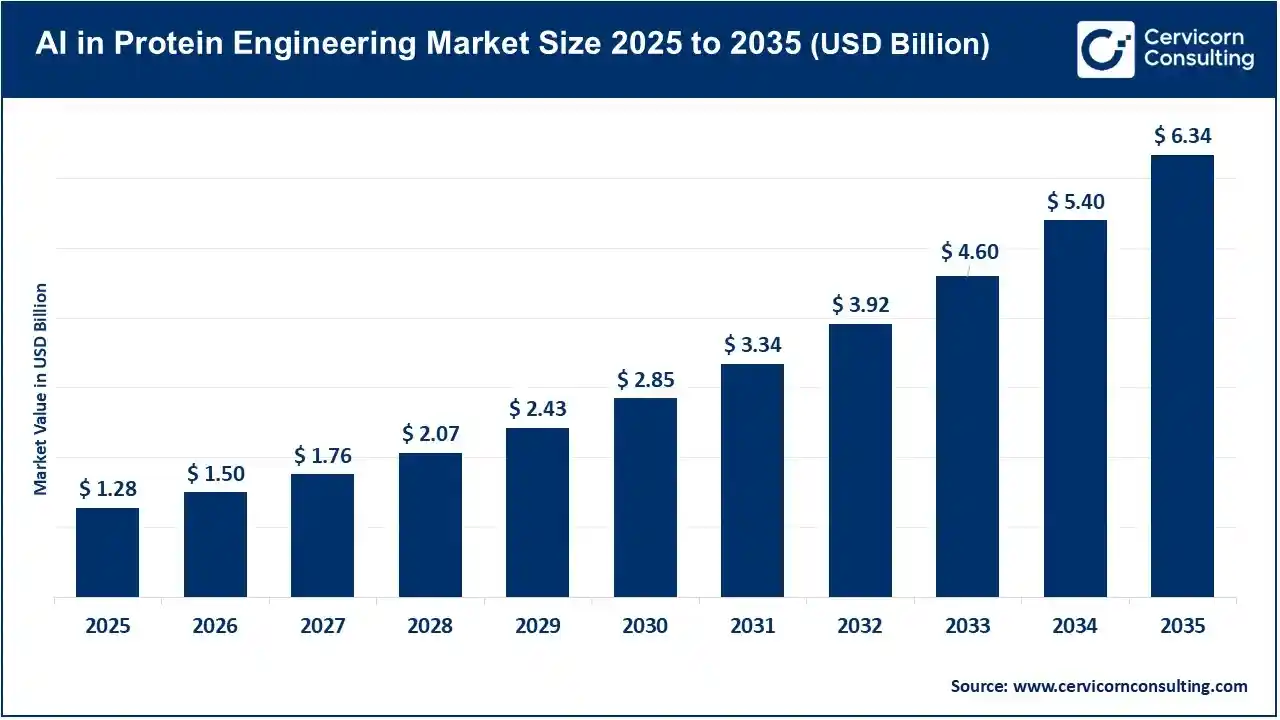
The global AI in protein engineering market size was valued at USD 1.28 billion in 2025 and is expected to reach around USD 6.34 billion by 2035, growing at a CAGR of 17.4% during the forecast period of 2026-2035.
- Base Year Market Size (2025): $1.28 billion
- Current Year Market Size (2026): $1.50 billion
- Estimated Year Market Size (2035): $6.34 billion
- Forecast Period CAGR (2026-2035): 17.4%
The global market refers to the use of machine learning, deep learning, and transformer-based language models that support decoding amino acid sequences, predicting 3D structures, and designing synthetic proteins with tailored functions. Along with eventual breakthroughs in AI solutions, the market has been looking for modern models to estimate spatial positions and dynamic movements of atoms, side chains, and receptors in hours or days rather than years. However, the execution of transformer-based protein language models and inverse folding tools that integrate evolutionary and structural constraints to guide precise point mutations and improve binding affinity.
Report Highlights
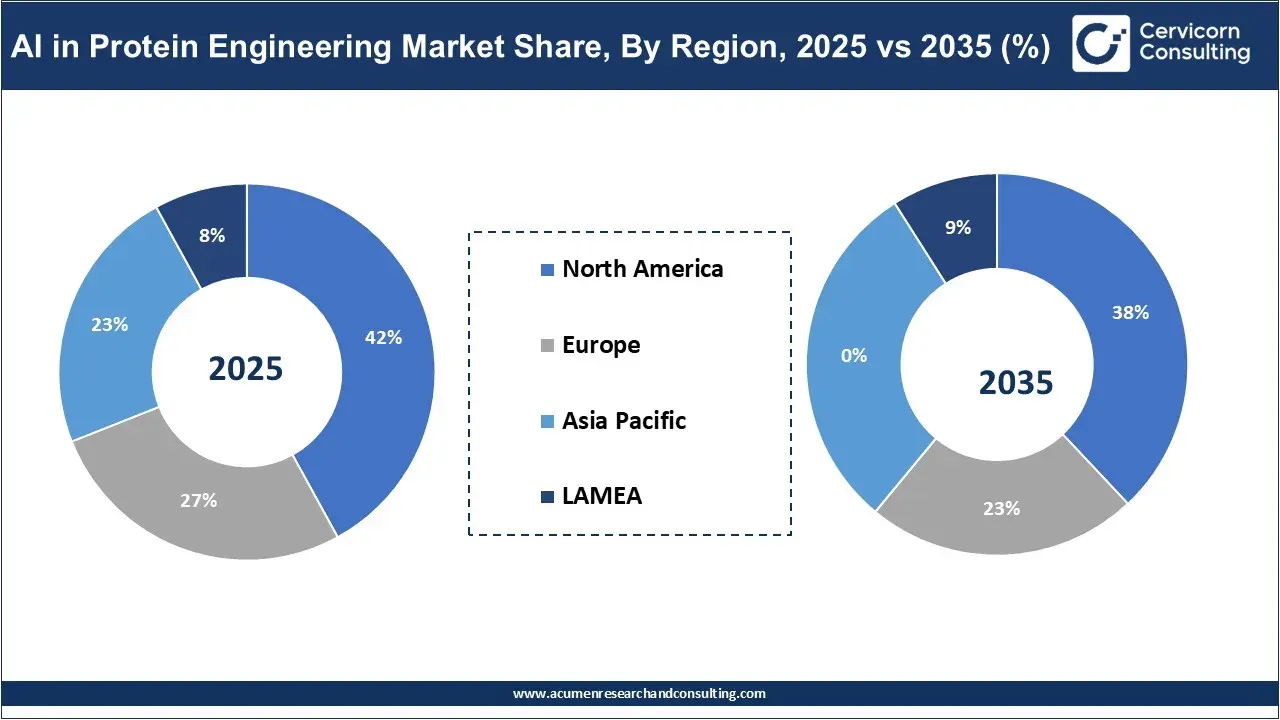
- By region: North America accounted highest revenue share of 42% in 2025, driven by biotechnology investment, computational biology research, and the presence of a robust pharmaceutical hub.
- By technology: Machine learning and deep learning registered highest revenue share of 32% in the market in 2025, as they have expansive applications in protein structure analysis, sequence optimization, and property prediction.
- By application: Protein design and optimization led the market with revenue share of 27% in 2025, due to surging demand for engineered proteins with enhanced activity, stability, and specificity.
- By protein type: Enzymes were dominant in the market in 2025 (revenue share 32%), driven by their broader applications across biotechnology, pharmaceuticals, industrial processing, and research.
- By end user: Pharmaceutical and biotechnology companies dominated the market in 2025 hit revenue share of 46%, supported by massive investment in therapeutic discovery and protein-based drug development.
Major Trends
- Transformative Generative AI: The industry has been experiencing broader adoption of generative AI models, and its dominance is shifting from simple structure estimation to developing new sequences, backbones, and atomic structures from scratch.
- Growth in De Novo Design: Day by day, growing developments across the protein sector fuel the enforcement of technologies such as RFdiffusion, allowing researchers to create custom proteins for earlier undruggable disease targets, cancer therapies, and snake venom neutralisation.
- Promoting AI-Powered Solutions: Another trend called integration of AI-assisted stable protein backbones with high-throughput laboratory evolution provides massively superior enzymes and antibodies compared to initiating from natural templates.
Spotlighting Key Funding and Collaborations
- October 2026: Hansa Biopharma partnered with Cradle to employ the latter’s AI-powered protein engineering platform to design new therapeutic candidates.
- September 2026: BigHat Biosciences completed a $75 million Series C financing to strengthen AI-enabled therapeutics and a major agentic data platform to expedite protein design.
- August 2026: Scala Biodesign raised $16 million in a Series A funding round led by Grove Ventures to foster global progression of ScalaOS, which enables rapid development and improvement of biologics, enzymes, antibodies, and vaccines.
- July 2026: The National Science Foundation (NSF) awarded Northwestern University $20 million for the next four years to develop the nation’s first publicly accessible, AI-driven cloud laboratory for protein engineering.
- June 2026: Protillion Biosciences signed a multi-target discovery alliance and license agreement with Merck to unify Protillion’s proprietary platform with Merck’s global expertise in the discovery of new therapeutic candidates.
Market Dynamics
Growth Drivers
- Accelerating Biopharmaceutical Development: Pharmaceutical and biotechnology companies are adopting AI-based protein engineering to improve the discovery and optimization of therapeutic proteins, antibodies, and other biologics, helping researchers prioritize promising candidates and reduce early-stage development timelines.
- Demand for Precision Protein Design: Growing demand for proteins with tailored biological activity, improved stability, and enhanced binding properties is encouraging the adoption of AI tools that can evaluate complex sequence and structure relationships more efficiently than conventional methods.
- Expansion of Computational Biology Infrastructure: Improvements in cloud computing, graphics processing units, biological datasets, and machine learning algorithms are strengthening the computational infrastructure required to train models and perform large-scale protein design and optimization.
Market Restraints
- Limited High-Quality Experimental Data: AI models require reliable protein sequences, structural information, and experimental measurements for effective training and validation. Inconsistent datasets, limited coverage of certain protein families, and incomplete functional annotations can reduce model accuracy.
- High Computational and Development Costs: Training advanced protein models and conducting repeated computational simulations can require substantial computing resources, specialized infrastructure, and technical expertise, creating cost barriers for smaller biotechnology companies and academic research teams.
- Uncertainty in Experimental Validation: AI-generated protein designs do not always translate into successful laboratory outcomes. Researchers must still verify protein expression, folding, stability, activity, and safety through experiments, which can limit the expected time and cost savings.
Market Opportunities
- Personalized Therapeutic Protein Development: AI-driven protein engineering creates opportunities to develop highly targeted biologics, engineered antibodies, and customized protein-based therapies by optimizing molecular properties for specific disease targets and therapeutic requirements.
- Industrial Enzyme Optimization: Manufacturers can use AI to design enzymes that perform efficiently under demanding industrial conditions, creating opportunities in biofuels, food processing, detergents, specialty chemicals, and other applications requiring improved catalytic performance.
- Closed-Loop Protein Engineering Platforms: Combining generative AI, robotic experimentation, and automated data analysis offers opportunities to establish self-improving research platforms that continuously refine protein designs using real-world experimental feedback.
Key Challenges
- Protein Design Generalization: Models trained on known protein families may perform less reliably when designing entirely new sequences, unusual structures, or proteins with limited training examples, making generalization a major technical challenge.
- Biological Complexity and Context Dependence: Protein behavior can vary with cellular environments, post-translational modifications, interacting molecules, and manufacturing conditions. Capturing these factors computationally remains difficult and can affect the practical performance of engineered proteins.
AI in Protein Engineering Market Regional Analysis
How did North America Dominate the Market in 2025?
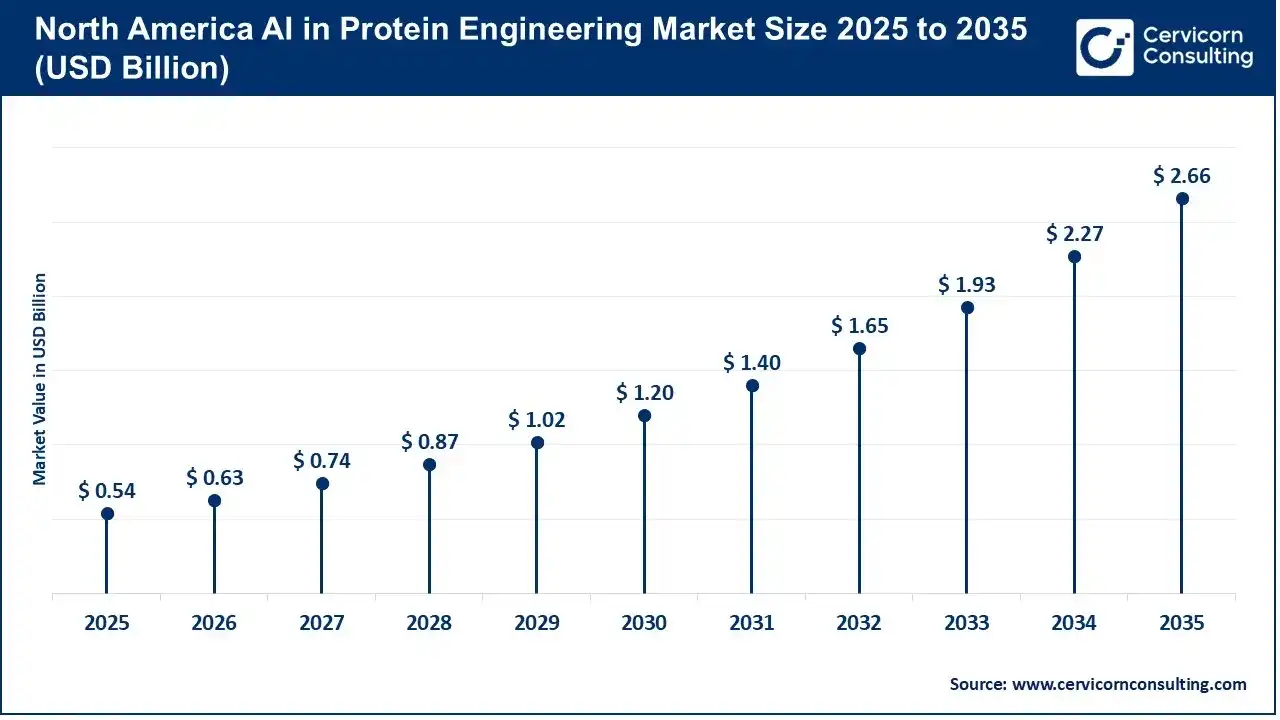
The North America AI in protein engineering market size was estimated at USD 0.54 billion in 2025 and is anticipated to hit USD 2.66 billion by 2035. North America accounted for the largest share in the market in 2025, as it has broader biotech investment, with a hub of computational biology research. Along with its robust pharma center, the regional players have stepped into joining AI design platforms with automated wet-lab synthesis and high-throughput screening. Besides this, Canadian institutions empowered translational pipelines by creating dedicated collaborative settings that provide joint structural biologists and machine learning engineers.
United States AI in Protein Engineering Market Trends
The U.S. served as a dominant contributor in the market in 2025, led by its heavy investment in pharmaceutical R&D and rapid technological advances. Alongside this, U.S. firms are bolstering high-performance computing (HPC) clusters and specialized deep learning architectures, enabling faster sequence-to-structure predictions. Additionally, prominent investment by federal agencies is continuously pushing the transformation of the U.S. bioeconomy ecosystem.
Why is the Asia Pacific Considered to Expand Fastest in the Future?
The Asia-Pacific AI in protein engineering market size was valued at USD 0.29 billion in 2025 and is expected to reach around USD 1.46 billion by 2035. The Asia Pacific is forecasted to grow at a rapid rate during the projected years, due to expansion of biotechnology capabilities, research investment, and pharmaceutical development. A surge in industrial and commercial infrastructure for synthetic biology, enzyme engineering, and precision medicine, and the development of indigenous sequence databases and local AI-enabled platform providers, support the entire APAC market growth.
China AI in Protein Engineering Market
Ongoing fastest progression and digitalization in protein engineering in China is mainly driven by key efforts from local research institutes to explore active redesign. Recently, in 2026, Chinese researchers rolled out a national automated platform established for sped-up conversion of AI-developed protein sequence designs into physical, testable samples, which reduces timelines.
AI in Protein Engineering Market Segmentation Analysis
Technology Analysis
Machine Learning and Deep Learning: The machine learning and deep learning segment captured a dominant share in 2025, as they provide widespread utilization in protein structure analysis, sequence optimization, and experimental integration. In 2025, models, including AlphaFold 3, have broadened predictive capabilities from single static chains to combined, multi-component biomolecular complexes by leveraging diffusion-based architectures.
The protein structure prediction segment registered notable growth in the market in 2025, supported by advances in de novo protein design and expansive use, with open-source democratisation of models. However, the industry has implemented certain systems for function-securing watermarking of AI-powered protein sequences and structures to track provenance and control biosecurity risks.
AI in Protein Engineering Market Share, By Technology, 2025 (%)
| Technology |
Revenue Share, 2025 (%) |
| Machine Learning and Deep Learning |
32% |
| Generative AI |
24% |
| Protein Structure Prediction |
20% |
| Protein Language Models |
17% |
| Others |
7% |
Generative AI: The generative AI segment is projected to expand rapidly during 2026-2035, led by its ability to design innovative protein sequences and uncover new protein structures. Alongside this, the market is fostering prominent funding programs, like the $95 million AI Bioseeds project based in Seattle, which leverages generative AI to generate custom proteins, vaccines, RNA therapies, and optimized CAR T-cells at unexpected scales.
Application Analysis
Protein Design and Optimization: The protein design and optimization segment dominated the market in 2025 because of a rise in demand for engineered proteins and diverse candidates with enhanced activity and stability. To elevate this application, the market leaders have used protein language models (pLMs) to study and develop candidate protein sequences directly from sequence data alone.
The enzyme engineering segment is expected to witness significant growth in the AI in protein engineering market during 2026-2035, driven by widespread adoption in distinct companies and the launch of precision fermentation techniques to allow customized, eco-friendly enzyme production at industry level. Ongoing collaborations are seeking deployment of AI-supported platforms to create thermostable enzymes.
AI in Protein Engineering Market Share, By Application, 2025 (%)
| Application |
Revenue Share, 2025 (%) |
| Protein Design and Optimization |
27% |
| Protein Structure Prediction |
20% |
| Enzyme Engineering |
19% |
| Antibody and Therapeutic Protein Engineering |
21% |
| Protein Function and Stability Prediction |
13% |
Antibody and Therapeutic Protein Engineering: The antibody and therapeutic protein engineering segment is anticipated to grow at a rapid rate in the upcoming years, supported by breakthroughs in biologics and targeted therapies. Continuous evolution across the global market is moving towards bispecific antibodies (BsAbs) and multispecific platforms that can include dual targets or deliver payloads.
Protein Type Analysis
Enzymes: The enzymes segment led the market in 2025, driven by their broader applications and promotion of the closed-loop Design-Build-Test-Learn (DBTL) paradigm. In addition, the era has explored conditioning enzyme development directly on chemical reaction inputs, pH, temperature, solvent, and cofactor availability.
Among these protein types, the vaccines and antigens segment is projected to register significant growth, supported by a global massive demand for a variety of vaccines and a surge in transition toward multi-omics-integrated vaccinology. Moreover, the global technological landscape has unveiled the latest AI frameworks, which permit researchers to create binders against zero-prior epitopes and expand targets to intricate proteins.
AI in Protein Engineering Market Share, By Protein Type, 2025 (%)
| Protein Type |
Revenue Share, 2025 (%) |
| Enzymes |
32% |
| Antibodies |
26% |
| Peptides |
16% |
| Vaccines and Antigens |
14% |
| Others |
12% |
Antibodies: The antibodies segment is expected to grow rapidly during the forecast period, due to rising development of biologics and AI-designed antibody candidates. The prospective era will have a spotlight on many emerging models, including CALM (Cross-attention Adaptive Immune Receptor–Antigen Language Model) that recognize directly from known antibody-antigen pairs and enable bidirectional searches.
End User Analysis
Pharmaceutical and Biotechnology Companies: The pharmaceutical and biotechnology companies segment held a dominant share of the market in 2025 because of increased investment in drug discovery and growing demand for diverse complex therapeutics. Several global pharma leaders consistently fund dedicated AI alliances, platform licensing, and internal co-development models. Also, they are looking to integrate model output, robotic lab automation, and high-throughput validation.
The contract research organizations segment is estimated to reach steady expansion during 2026-2035, driven by their substantial affordable outsourcing and unification of gen AI and de novo design. Furthermore, CROs are stepping into the consolidation of generative in silico design with autonomous, high-throughput robotic wet-lab validation.
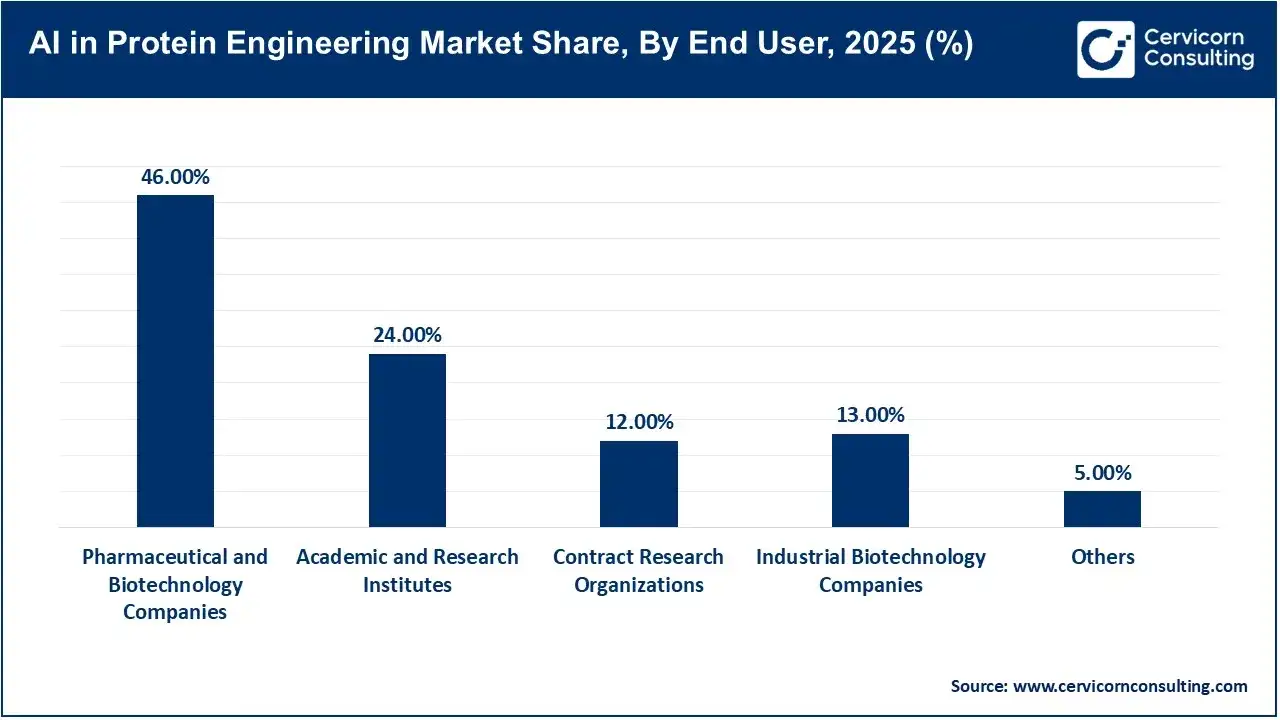
Industrial Biotechnology Companies: The industrial biotechnology companies segment is projected to witness rapid growth during 2026-2035, fueled by AI-powered enzyme engineering for sustainable chemicals, materials, and manufacturing. Along with a huge demand for next-generation biologics, companies are promoting the design and screening of millions of protein sequences and microbial strains per year by launching new platforms and highly lowering the reliance on vast physical screening libraries.
Latest Launches
- October 2026: DaltonTx strengthened its AI capabilities in antibody discovery and novel design, assisting multispecifics, biparatopics, antibody-drug conjugates (ADCs), and conventional IgGs.
- October 2026: Danaher Corporation launched its first AI-powered autonomous lab, designed to support researchers in developing custom antibodies and other molecular tools faster and more efficiently.
- June 2026: A South Korean research group rolled out K-FOLD, a bio AI model that estimated protein structures and protein-drug binding interactions.
- June 2026: Creative Enzymes unveiled an AI-unified biocatalysis platform that combines computational enzyme engineering with hands-on process development.
- April 2026: MIT-backed startup introduced a no-code AI platform that allows biologists to design proteins, foster drug discovery, reduce development intricacy, and expand access to modern computational biology tools across global labs.
Leading Players
Segments Covered
By Technology
- Machine Learning and Deep Learning
- Generative AI
- Protein Structure Prediction
- Protein Language Models
- Others
By Protein Type
- Enzymes
- Antibodies
- Peptides
- Vaccines and Antigens
- Other Therapeutic and Industrial Proteins
By Application
- Protein Design and Optimization
- Protein Structure Prediction
- Enzyme Engineering
- Antibody and Therapeutic Protein Engineering
- Protein Function and Stability Prediction
By End User
- Pharmaceutical and Biotechnology Companies
- Academic and Research Institutes
- Contract Research Organizations
- Industrial Biotechnology Companies
- Other End Users
By Region
- North America
- Europe
- Asia-Pacific
- Latin America
- Middle East and Africa
