Physical AI in Agriculture Market Size, Growth, Forecast 2026 to 2035
The global physical AI in agriculture market size was valued at USD 401.12 million in 2025 and is expected to be worth around USD 5,482.37 million by 2035, exhibiting a compound annual growth rate (CAGR) of 29.9% over the forecast period from 2026 to 2035.
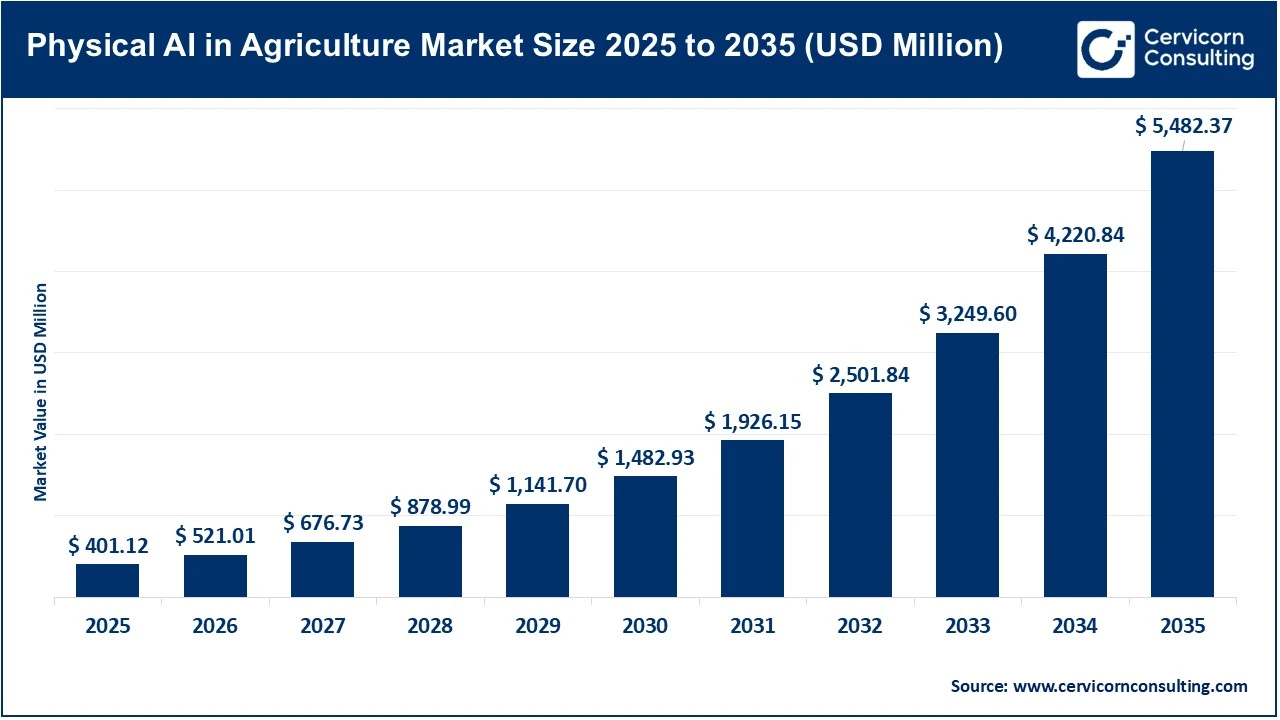
The growing adoption of autonomous machinery, AI-powered robotics, and computer vision technologies is a major driver of the physical AI in agriculture market. Farmers are increasingly deploying AI-enabled tractors, harvesting robots, drones, and autonomous sprayers to address persistent labor shortages, optimize field operations, and improve crop productivity. According to the U.S. Department of Agriculture (USDA), automated guidance systems were used by 70% of large-scale crop-producing farms and 52% of midsize farms in 2023, while yield monitors, yield maps, and soil maps were utilized by 68% of large-scale farms. The widespread adoption of these precision agriculture technologies demonstrates the increasing reliance on physical AI to automate repetitive tasks, reduce input costs, and enable real-time decision-making across farming operations.
The market is also benefiting from the increasing need for climate-resilient and resource-efficient agriculture. AI-powered robots equipped with edge computing, sensor fusion, and machine vision help optimize water usage, fertilizer application, weed control, and crop health monitoring while minimizing environmental impact. The U.S. Government Accountability Office (GAO) reported that 27% of U.S. farms and ranches used precision agriculture practices between 2022 and 2023, supported by nearly USD 200 million in federal AI and precision agriculture research funding from USDA and the National Science Foundation between 2017 and 2021. At the same time, advances in foundation AI models, autonomous field equipment, and agricultural robotics are accelerating the transition from digital farming to Physical AI-enabled autonomous farming systems, creating strong long-term growth opportunities for the market.
Report Highlights
- North America held approximately 37.8% market share, driven by precision agriculture leadership, autonomous machinery adoption, AI innovation, and advanced digital farming infrastructure.
- Hardware accounted for nearly 62.8% of the market, owing to high investments in autonomous tractors, drones, robotic harvesters, sensors, and AI-enabled equipment.
- Computer Vision captured about 38.6% market share, supported by its widespread use in crop monitoring, precision spraying, harvesting, and autonomous navigation systems.
- Large Commercial Farms represented approximately 43.5% of the market, benefiting from greater capital investment, large-scale operations, and rapid agricultural automation adoption.
- Agricultural Drones held around 22.1% market share, driven by increasing demand for aerial crop monitoring, precision spraying, field mapping, and multispectral imaging.
- Precision Farming dominated applications with approximately 24.6% market share, supported by growing deployment of AI-driven analytics, sensors, and autonomous agricultural equipment.
What is Physical AI in Agriculture?
Physical AI in agriculture refers to the integration of artificial intelligence with autonomous machines, robotics, drones, sensors, computer vision, and edge computing to enable farming equipment to perceive, analyze, decide, and perform physical tasks with minimal human intervention. Unlike conventional digital agriculture that primarily provides insights, Physical AI enables real-world actions such as autonomous planting, precision spraying, robotic harvesting, weed removal, crop monitoring, irrigation optimization, and livestock management. By combining real-time environmental sensing with AI-driven decision-making, Physical AI improves productivity, reduces labor dependency, optimizes resource utilization, and supports sustainable, data-driven farming practices.
Recent Developments
| Date |
Company or Organization |
Recent Development |
| June 2026 |
Niqo Robotics |
Introduced its India-developed Physical AI farming platform for European markets at Bharat Innovates 2026, expanding autonomous robotics for precision agriculture beyond India. |
| June 2026 |
Advanced Greenhouse Robotics Ecosystem |
Physical AI-powered autonomous greenhouse robots capable of operating up to 22 hours per day gained commercial attention for improving harvesting efficiency, labor productivity, and sustainable greenhouse operations. |
| April 2026 |
Bank of America Institute |
Reported that Physical AI and robotics companies raised approximately USD 41 billion in 2025, highlighting accelerating investment in AI foundation models, autonomous robots, and intelligent agricultural automation platforms. |
| February 2026 |
Government of India |
Released initiatives promoting AI-enabled agriculture through satellite data, drones, sensors, and intelligent advisory systems to improve productivity, sustainability, and climate resilience across farming operations. |
| July 2026 |
University of Texas at San Antonio (UTSA) & Southwest Research Institute |
Launched a USDA-supported program to train students in AI, robotics, and IoT for smart agriculture, addressing workforce shortages and accelerating adoption of Physical AI technologies in farming. |
Physical AI in Agriculture Market Dynamics
Market Drivers
1. Rising Labor Shortages Accelerating Agricultural Automation
The global shortage of skilled agricultural labor is significantly accelerating the adoption of Physical AI technologies such as autonomous tractors, robotic harvesters, and AI-powered field robots. According to the USDA, 70% of large-scale crop-producing farms and 52% of midsize farms in the U.S. had adopted automated guidance systems by 2023, while 68% of large farms used yield monitoring and mapping technologies. These trends demonstrate how producers are increasingly investing in AI-driven automation to reduce labor dependency, improve operational efficiency, and maintain productivity despite workforce shortages.
Rising Manufacturing Labor Costs Accelerate Physical AI Adoption
The continuous rise in manufacturing labor costs across Asia, particularly in China where labor costs reached approximately USD 8 per hour by 2022, is driving demand for Physical AI in agriculture. Farmers are increasingly adopting autonomous tractors, AI-powered robots, and drones to reduce labor dependency, improve productivity, and lower long-term operational costs.
Approximate Manufacturing Unit Labour Cost in Asia (USD per Hour)
| Country |
1990 |
2000 |
2010 |
2015 |
2020 |
2022 |
| China |
0.0 |
0.3 |
2.5 |
4.8 |
7.8 |
8.0 |
| Philippines |
0.5 |
0.6 |
1.8 |
1.9 |
1.9 |
2.0 |
| Malaysia |
1.4 |
1.5 |
2.4 |
2.1 |
2.3 |
2.2 |
| India |
0.3 |
0.4 |
1.2 |
1.5 |
1.8 |
1.9 |
| Thailand |
1.0 |
0.6 |
2.0 |
1.4 |
1.8 |
1.7 |
| Vietnam |
0.1 |
0.1 |
1.0 |
1.8 |
2.4 |
2.5 |
Low-Cost Manufacturing Hubs Strengthen Market Growth
Lower labor costs in countries such as India, Vietnam, Thailand, and the Philippines are encouraging manufacturers to establish production facilities for agricultural robotics and AI-enabled equipment. This reduces manufacturing costs, strengthens regional supply chains, and makes Physical AI solutions more affordable, supporting broader adoption across global agricultural markets.
2. Growing Adoption of Precision Agriculture Technologies
The increasing adoption of precision agriculture is driving strong demand for Physical AI solutions capable of real-time sensing, decision-making, and autonomous execution. AI-enabled robots, drones, and intelligent machinery optimize irrigation, fertilization, spraying, and crop monitoring while minimizing resource wastage. According to the U.S. Government Accountability Office (GAO), 27% of U.S. farms and ranches used precision agriculture practices during 2022–2023, while USDA and NSF invested nearly USD 200 million in precision agriculture research and AI development between 2017 and 2021. These investments continue to accelerate commercialization and adoption of Physical AI technologies.
Market Restraints
1. High Initial Investment and Ownership Costs
Physical AI deployment requires substantial investments in autonomous machinery, robotics, AI software, sensors, GPS infrastructure, and cloud-based analytics platforms. Beyond acquisition costs, farmers must also invest in maintenance, software subscriptions, connectivity, and workforce training. According to the GAO, high upfront investment remains one of the primary barriers preventing wider adoption of precision agriculture technologies, particularly among small and medium-sized farms with limited access to financing or government support, thereby restricting broader market expansion.
2. Limited Digital Infrastructure in Rural Areas
Many agricultural regions continue to face unreliable broadband connectivity, limited cloud infrastructure, and inconsistent access to advanced GPS correction services. Physical AI systems depend on continuous communication between sensors, autonomous machines, and cloud platforms for optimal performance. Research also indicates that many emerging agricultural AI solutions remain cloud-dependent, limiting deployment in connectivity-constrained environments. These infrastructure limitations reduce system efficiency and slow adoption across developing agricultural economies where digital transformation is still in its early stages.
Market Opportunities
1. Expansion of Fully Autonomous Farming Ecosystems
The emergence of integrated autonomous farming ecosystems presents significant opportunities for Physical AI providers. Farms are increasingly combining autonomous tractors, drones, robotic harvesters, computer vision, and edge AI into unified operational platforms. USDA reports continued growth in automated guidance adoption, with 70% of large crop farms already utilizing autonomous navigation technologies, indicating strong readiness for broader deployment of fully autonomous farming systems that can automate planting, monitoring, spraying, harvesting, and logistics with minimal human intervention
2. Increasing Government Investments in AI-Enabled Agriculture
Governments worldwide are expanding funding for AI, robotics, and precision agriculture to improve food security and climate resilience. In the United States alone, USDA and the National Science Foundation invested nearly USD 200 million in precision agriculture and AI research between 2017 and 2021, supporting AI institutes, smart farming technologies, and autonomous agricultural systems. These public investments encourage innovation, lower commercialization barriers, strengthen research collaborations, and accelerate the adoption of Physical AI solutions across the agricultural sector.
Market Challenges
1. Integration Complexity with Existing Farm Equipment
Many farms continue to operate machinery from multiple manufacturers using different communication protocols and data formats. Integrating autonomous tractors, drones, AI platforms, IoT sensors, and legacy farm equipment into a single operational ecosystem remains technically challenging. The GAO identifies interoperability and technology integration as major obstacles to precision agriculture adoption, increasing deployment costs, implementation timelines, and technical support requirements while reducing operational efficiency during digital transformation initiatives.
2. Data Security and Trust in AI-Based Decision Making
Physical AI systems continuously collect operational, environmental, machinery, and crop data through connected sensors and autonomous equipment, creating growing cybersecurity and privacy concerns. Farmers remain cautious about sharing operational data with technology providers due to ownership, security, and misuse risks. As AI adoption expands across agriculture, ensuring secure cloud infrastructure, encrypted communications, regulatory compliance, and transparent AI decision-making will be essential for building trust and encouraging wider deployment of autonomous agricultural systems.
Physical AI in Agriculture Market Regional Analysis
The physical AI in agriculture market is segmented by region into North America, Europe, Asia-Pacific, Latin America, and LAMEA. Here is a brief overview of each region:
Why does North America dominates the physical AI in agriculture market?
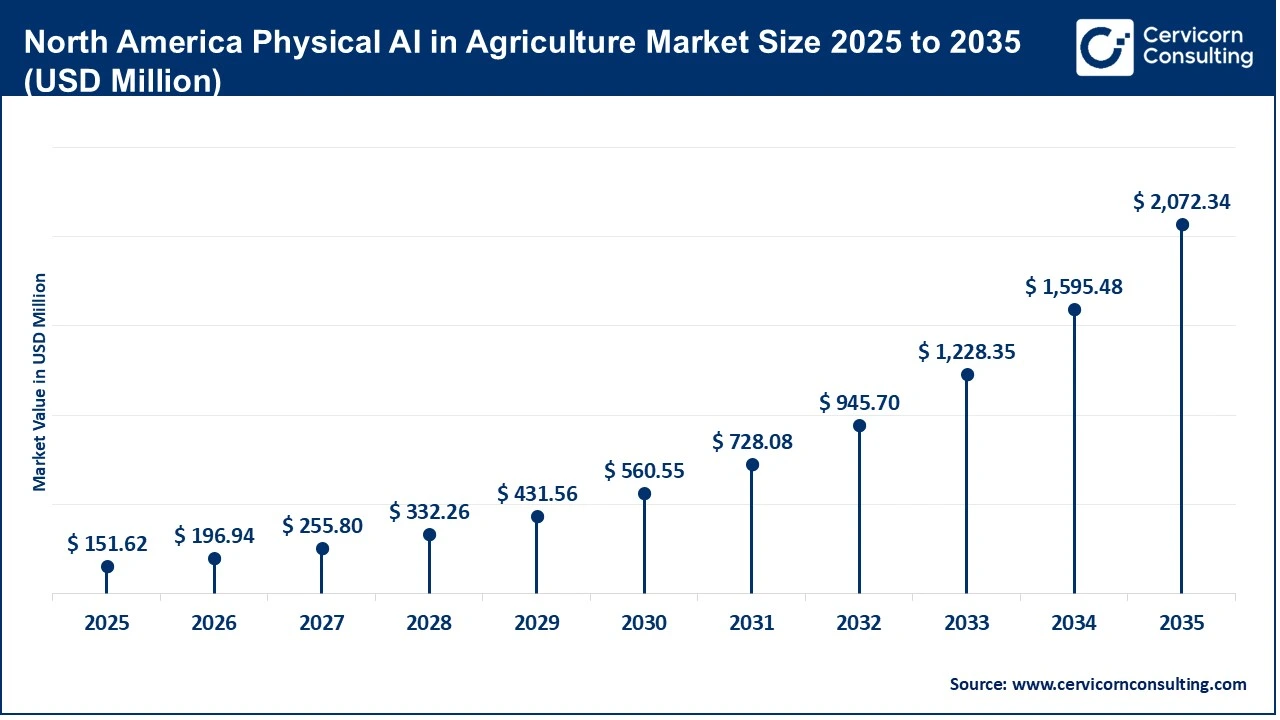
The North America physical AI in agriculture market size was estimated at USD 151.62 million in 2025 and is forecasted to surpass around USD 2,072.32 million by 2035. North America dominates the market due to its widespread adoption of precision agriculture, strong presence of agricultural equipment manufacturers, advanced AI and robotics ecosystem, and increasing investments in autonomous farming technologies. The region benefits from large-scale commercial farming, robust digital infrastructure, and early adoption of AI-powered tractors, drones, robotic harvesters, and autonomous spraying systems. Government support for precision agriculture, continuous innovation in computer vision, edge AI, and agricultural robotics, along with collaborations between technology providers and agribusinesses, are accelerating the commercialization of Physical AI solutions, reinforcing North America's leadership in intelligent and autonomous farming.
United States: Precision Agriculture Leadership, Autonomous Farm Equipment, and AI Innovation Drive Market Growth
- According to the USDA, 70% of large-scale crop farms and 52% of midsize farms had adopted automated guidance systems by 2023, while 68% of large farms used yield monitoring and mapping technologies, highlighting the country's leadership in precision agriculture adoption.
- The U.S. Government Accountability Office (GAO) reported that 27% of U.S. farms and ranches used precision agriculture technologies during 2022–2023, while the USDA and National Science Foundation invested nearly USD 200 million in AI and precision agriculture research between 2017 and 2021, accelerating innovation in autonomous farming.
Canada: Smart Agriculture Programs, AI Research, and Sustainable Farming Support Market Expansion
- Canada is strengthening its position through significant investments in artificial intelligence, agricultural robotics, and climate-smart farming technologies supported by world-class AI research centers and precision agriculture initiatives.
- Large commercial grain farms across Saskatchewan, Alberta, and Manitoba are increasingly adopting autonomous tractors, AI-powered drones, and precision spraying technologies to improve productivity while reducing labor requirements and environmental impact.
Why is Asia-Pacific fastest-growing region in the physical AI in agriculture market?
The Asia-Pacific physical AI in agriculture market size was accounted for USD 99.88 million in 2025 and is projected to reach around USD 1,365.11 million by 2035. Asia-Pacific is the fastest-growing region, due to rapid agricultural modernization, increasing labor shortages, expanding adoption of precision farming, and strong government support for smart agriculture. The region benefits from the presence of leading agricultural machinery manufacturers, robotics developers, and AI technology providers, particularly in China, Japan, South Korea, and India. Rising investments in autonomous tractors, AI-powered drones, robotic harvesting, and intelligent irrigation systems, coupled with growing food demand and digital agriculture initiatives, are accelerating the deployment of Physical AI technologies across both developed and emerging agricultural economies.
China: Agricultural Robotics Leadership, AI Innovation, and Government Modernization Programs Drive Market Growth
- China's crop cultivation, planting, and harvesting mechanization rate reached 76.7% in 2025, reflecting rapid adoption of intelligent agricultural equipment and autonomous farming technologies.
- The country has deployed more than 300,000 agricultural drones, covering over 460 million mu (approximately 30.7 million hectares) of farmland annually, making it the world's largest agricultural drone market.
- Scientific and technological innovation contributed more than 64% to China's agricultural output in 2025, highlighting the growing role of AI, robotics, and smart farming.
India: Precision Farming Expansion, Agri-Tech Startups, and Digital Agriculture Initiatives Support Market Growth
- Under the Sub-Mission on Agricultural Mechanisation (SMAM), India distributed 1,909,809 agricultural machines and established 26,637 Custom Hiring Centres (CHCs) and 609 Hi-Tech Hubs by November 2024.
- The government supported agricultural drone adoption by supplying 527 drones, establishing 1,595 Drone CHCs, and conducting 27,099 drone demonstrations benefiting more than 351,800 farmers.
- In Maharashtra alone, farmers purchased agricultural drones worth approximately INR 16 crore under government-supported schemes, with the number of operational drones expected to exceed 600, demonstrating rapid commercialization of AI-enabled farming.
What are the driving factors of Europe physical AI in agriculture market?
The Europe physical AI in agriculture market is expanding from USD 105.90 million in 2025 and to over USD 1,447.35 million by 2035. Europe is a major market, supported by strong sustainability regulations, advanced agricultural mechanization, and widespread adoption of precision farming technologies. The region benefits from leading manufacturers of agricultural machinery, robotics companies, AI software providers, and research institutions developing autonomous farming solutions. European Union initiatives promoting climate-smart agriculture, reduced pesticide usage, digital farming, and AI-driven automation are accelerating investments in autonomous tractors, robotic weeders, AI-powered drones, and precision spraying systems, strengthening Europe's position in intelligent agriculture.
Germany: Agricultural Machinery Leadership, Robotics Innovation, and Smart Farming Drive Market Growth
- Germany is Europe's leading market due to the presence of globally recognized agricultural equipment manufacturers, advanced engineering capabilities, and strong adoption of digital farming technologies.
- According to the German Farmers' Association (DBV), approximately 36% of German farms already use digital farming applications such as GPS guidance, sensor technologies, drones, and precision farming systems, creating a strong foundation for Physical AI deployment.
France: Precision Agriculture Expansion, Government Support, and Sustainable Farming Initiatives Boost Adoption
- France has over 437,000 agricultural holdings, making it one of Europe's largest agricultural producers and creating significant demand for AI-enabled automation across large farming operations.
- The country is among Europe's leading adopters of precision spraying, agricultural drones, and autonomous vineyard robots, particularly in the wine, cereal, and specialty crop sectors.
Physical AI in Agriculture Market Share, By Region, 2025 (%)
| Region |
Revenue Share, 2025 (%) |
| North America |
37.8% |
| Europe |
26.4% |
| Asia-Pacific |
24.9% |
| LAMEA |
10.9% |
Why LAMEA experiencing steady growth in the physical AI in agriculture market?
The LAMEA physical AI in agriculture market was valued at USD 43.72 million in 2025 and is anticipated to reach around USD 597.58 million by 2035. The LAMEA market is experiencing steady growth due to increasing investments in agricultural modernization, precision farming, autonomous machinery, and smart irrigation technologies. Governments across the region are promoting digital agriculture to improve food security, optimize water usage, and enhance farm productivity. Rising adoption of AI-powered drones, autonomous tractors, robotic sprayers, and intelligent irrigation systems, along with expanding agri-tech ecosystems and international investments, is accelerating the deployment of physical AI solutions across commercial farming operations.
Brazil: Large-Scale Commercial Agriculture and Precision Farming Drive Market Growth
- Brazil has more than 65 million hectares under grain cultivation, creating substantial demand for AI-powered tractors, autonomous sprayers, drones, and robotic farming equipment.
- According to EMBRAPA, approximately 45% of medium and large Brazilian farms have adopted at least one precision agriculture technology, including GPS guidance, variable-rate application, and remote sensing.
- Brazil is among the world's largest users of agricultural drones for crop monitoring and precision spraying, particularly across soybean, corn, sugarcane, and coffee plantations.
Saudi Arabia: Smart Agriculture Investments and Water-Efficient Farming Accelerate Adoption
- The Kingdom is investing heavily in controlled-environment agriculture, AI-powered greenhouses, and autonomous irrigation systems to improve food security while reducing water consumption.
- Government initiatives encourage the adoption of AI, IoT, robotics, and drone technologies for precision farming in desert environments where efficient resource management is essential.
Physical AI in Agriculture Market Segmental Analysis
The physical AI in agriculture market is segmented into component, technology, farm size, robot type, application, and geography.
Offering Analysis
Hardware dominates the physical AI in agriculture market because autonomous tractors, agricultural drones, robotic harvesters, sprayers, AI cameras, LiDAR, GPS systems, and edge sensors form the foundation of physical AI deployment. These capital-intensive assets account for the largest share of investment as farms prioritize automation of labor-intensive operations. Continuous advancements in robotic machinery, sensor accuracy, and autonomous navigation further strengthen hardware demand across commercial farming operations worldwide.
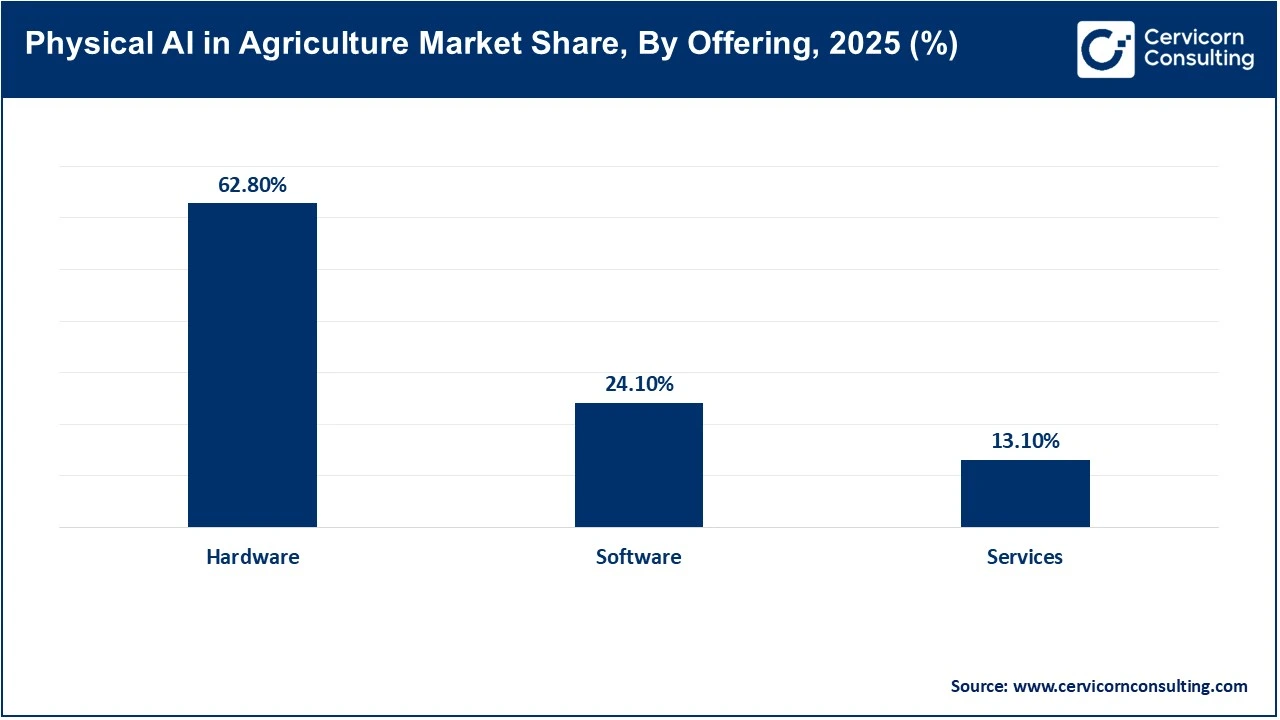
Software is expected to be the fastest-growing segment as AI algorithms, computer vision, digital twins, autonomous fleet management, and predictive analytics become increasingly important for intelligent farm operations. Cloud-based and edge AI software enables real-time decision-making, machine coordination, and precision farming while continuously improving through machine learning. Growing demand for subscription-based AI platforms and over-the-air software updates is accelerating software adoption across modern agricultural ecosystems.
Technology Analysis
Computer Vision dominates the market as it enables autonomous equipment to identify crops, weeds, pests, fruits, livestock, and field conditions with high accuracy. AI-powered cameras are widely deployed in harvesting robots, precision sprayers, agricultural drones, and crop monitoring systems to support real-time decision-making. Its versatility across nearly every agricultural application makes computer vision the most widely adopted Physical AI technology in commercial farming.
Physical AI in Agriculture Market, By Technology, 2025 (%)
| Technology |
Revenue Share, 2025 (%) |
| Computer Vision |
38.6% |
| Speech / NLP |
9.2% |
| Gesture / Movement Recognition |
11.8% |
| Reinforcement Learning & Control Systems |
28.4% |
| Others (Multi-modal AI, Biomimetic Robotics) |
12.0% |
Reinforcement Learning & Control Systems are expected to witness the fastest growth because they enable autonomous agricultural machines to continuously improve navigation, obstacle avoidance, harvesting precision, and operational efficiency through experience. These adaptive AI models support fully autonomous farming operations without requiring constant human intervention. As self-learning agricultural robots become increasingly commercialized, reinforcement learning technologies are expected to experience rapid adoption.
Farm Size Analysis
Large commercial farms account for the largest market share due to their substantial capital investments, extensive cultivated land, and higher labor requirements. These farms rapidly adopt autonomous tractors, robotic harvesters, AI-powered drones, and precision spraying systems to maximize operational efficiency and reduce production costs. Their strong financial capabilities and focus on large-scale automation make them the primary adopters of Physical AI technologies.
Physical AI in Agriculture Market, By Farm Size, 2025 (%)
| Farm Size |
Revenue Share, 2025 (%) |
| Small Farms |
24.7% |
| Medium Farms |
31.8% |
| Large Commercial Farms |
43.5% |
Medium farms are projected to register the fastest growth as declining technology costs, government incentives, and equipment leasing models improve affordability. Farmers are increasingly investing in AI-enabled drones, autonomous sprayers, and precision monitoring systems to improve productivity and optimize input usage. Expanding access to digital agriculture platforms and financing options is accelerating Physical AI adoption among medium-sized farming operations
Robot Type Analysis
Agricultural drones dominate the market because they provide cost-effective solutions for crop monitoring, field mapping, spraying, plant health assessment, and precision agriculture. Their ability to rapidly collect real-time field data over large areas makes them indispensable for modern farming. Continuous improvements in AI-powered imaging, flight automation, and multispectral sensing have strengthened drone adoption across commercial agriculture worldwide.
Physical AI in Agriculture Market, By Robot Type, 2025 (%)
| Robot Type |
Revenue Share, 2025 (%) |
| Autonomous Tractors |
18.2% |
| Harvesting Robots |
15.3% |
| Weeding Robots |
11.4% |
| Spraying Robots |
13.7% |
| Seeding & Planting Robots |
10.6% |
| Agricultural Drones |
22.1% |
| Livestock Robots |
8.7% |
Harvesting robots are expected to witness the fastest growth due to increasing labor shortages and rising harvesting costs worldwide. AI-powered robotic harvesters equipped with computer vision and robotic arms improve harvesting accuracy while minimizing crop damage. Growing commercialization of robotic harvesting technologies for fruits, vegetables, and specialty crops is accelerating adoption among labor-intensive agricultural sectors.
Application Analysis
Precision farming dominates the market because it integrates AI, sensors, autonomous machinery, drones, and satellite data to optimize irrigation, fertilization, pest control, and crop management. Farmers increasingly rely on precision farming to maximize yields while reducing water, fertilizer, and chemical consumption. Its broad applicability across diverse crop types and farming systems makes it the leading application of physical AI technologies.
Physical AI in Agriculture Market, By Application, 2025 (%)
| Application |
Revenue Share, 2025 (%) |
| Precision Farming |
24.6% |
| Crop Monitoring & Scouting |
17.5% |
| Autonomous Planting & Seeding |
11.6% |
| Precision Spraying & Fertilization |
14.3% |
| Autonomous Harvesting |
12.8% |
| Weed Detection & Control |
8.5% |
| Livestock Monitoring & Management |
5.7% |
| Greenhouse Automation |
3.6% |
| Others |
1.4% |
Autonomous harvesting is projected to be the fastest-growing application as labor shortages, rising wages, and demand for higher harvesting efficiency encourage investment in robotic harvesting systems. AI-powered harvesters operate continuously with minimal supervision while improving harvesting speed and consistency. Advances in computer vision, robotic manipulation, and machine learning are accelerating commercialization across fruit, vegetable, greenhouse, and specialty crop production.
Physical AI in Agriculture Market Top Companies
Recent Developments
- In February 2026, John Deere announced its 2026 Startup Collaborator Program, partnering with five startups specializing in AI-driven robotics, advanced sensing, digital crop intelligence, and foundation AI models to accelerate the development of autonomous farming equipment and Physical AI solutions for precision agriculture.
- In February 2025, John Deere introduced its Next Generation Perception System and expanded automation for Model Year 2026 combines, enabling autonomous tillage, AI-powered machine perception, and improved harvesting productivity across commercial farming operations.
- In February 2026, AGCO Corporation showcased new autonomous farming solutions at Commodity Classic 2026, while its PTx Trimble OutRun™ Tillage platform received the 2026 Davidson Prize, reinforcing AGCO's roadmap toward fully autonomous farming by 2030.
- In April 2026, DJI Agriculture announced that its agricultural drone ecosystem had expanded to more than 600,000 drones operating across over 100 countries, supporting AI-powered crop monitoring, precision spraying, and sustainable farming practices while saving significant water and reducing carbon emissions.
Market Segmentation
By Offering
- Hardware
- Software
- Services
By Technology
- Computer Vision
- Speech / NLP
- Gesture / Movement Recognition
- Reinforcement Learning & Control Systems
Others (multi-modal AI, biomimetic robotics)
By Farm Size
- Small Farms
- Medium Farms
- Large Commercial Farms
By Robot Type
- Autonomous Tractors
- Harvesting Robots
- Weeding Robots
- Spraying Robots
- Seeding & Planting Robots
- Agricultural Drones
- Livestock Robots
By Application
- Precision Farming
- Crop Monitoring & Scouting
- Autonomous Planting & Seeding
- Precision Spraying & Fertilization
- Autonomous Harvesting
- Weed Detection & Control
- Livestock Monitoring & Management
- Greenhouse Automation
- Others
By Geography
- North America
- Europe
- Asia-Pacific
- LAMEA