Healthcare Supply Chain Management Market Size, Growth, Forecast 2026 to 2035
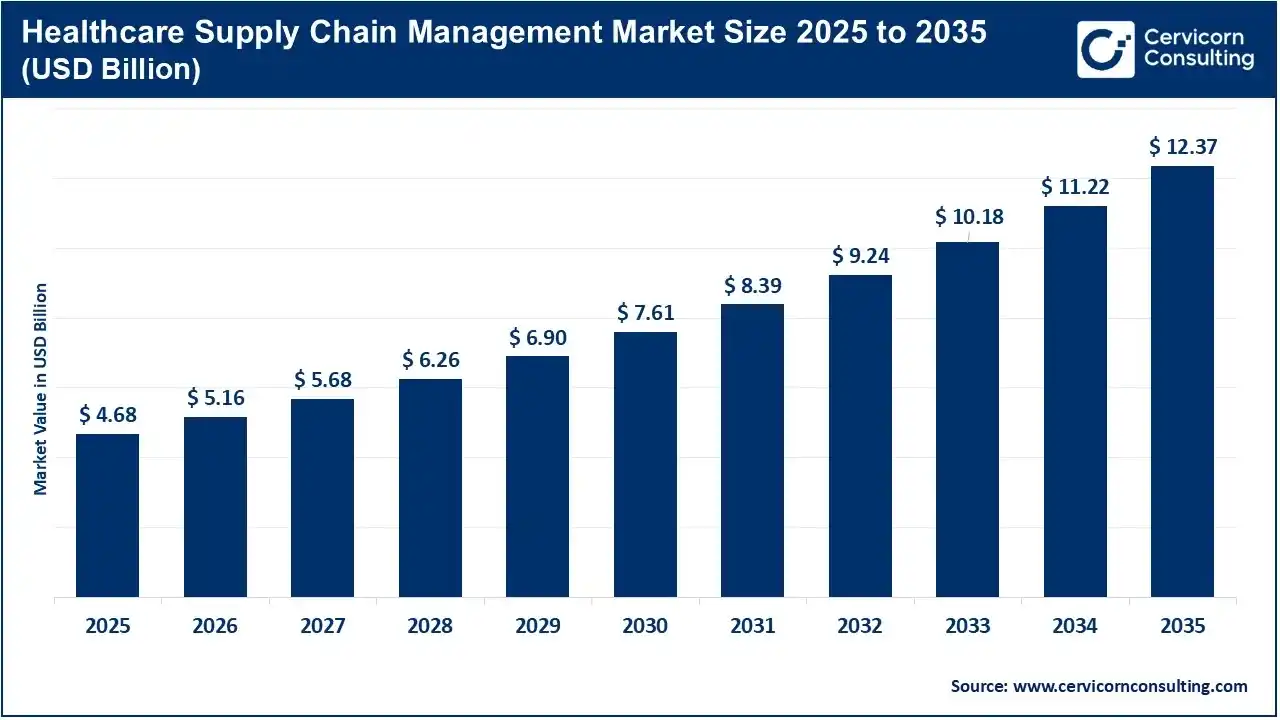
The global healthcare supply chain management market size was valued at USD 4.68 billion in 2025 and is expected to reach at USD 12.37 billion by 2035, growing at a CAGR of 10.2% during the forecast period from 2026 to 2035.
- Base Year Market Size (2025): $4.68 billion
- Current Year Market Size (2026): $5.16 billion
- Estimated Year Market Size (2035): $12.37 billion
- Forecast Period CAGR (2026-2035): 10.2%
Report Highlights
- By Region: North America registered dominance in the market in 2025 (revenue share 39%), due to advanced healthcare infrastructure and expansive adoption of digital supply chain technologies.
- By component: Software led the market in 2025 (revenue share 48%), supported by a surge in demand for procurement automation, inventory optimization, demand forecasting, and supply chain transparency.
- By function: Procurement and purchasing management dominated the market in 2025 (revenue share 28%), driven by a rise in emphasis on purchasing efficiency, supplier coordination, and cost control by healthcare organizations.
- By deployment mode: Cloud-based was dominant in the market in 2025 (revenue share 58%), because of a growing demand for scalable platforms, centralized data access, and coordination across healthcare networks.
- By end user: Healthcare providers held the largest share of the market in 2025 (revenue share 38%), due to immense procurement, inventory, and materials management requirements throughout hospitals and health systems.
What is the Healthcare Supply Chain Management Market?
Healthcare supply chain management is primarily defined as tracking the transfer of medical supplies, implants, and equipment from developers to patients. Alongside this, this market covers the evolution of vendor alliances and inventory control, especially across hospitals and medical supply settings. This era has been marked by a major movement towards elevating regional sourcing centers, multi-point backup suppliers, and planned inventory approaches. However, many key providers are seeking broader adoption of unified solutions, which integrate merged service centers, robust transportation, and high-end automation.
Recent Trends
- Promoting AI and Predictive Orchestration: Eventual advances across the market are fostering several healthcare firms to leverage scaled, ROI-driven enterprise adoption, aiming at sourcing, contracting, and procurement. Meanwhile, predictive orchestration supports finding temperature excursions and transport challenges before a shipment leaves the dock.
- Goal of Domestic Progression and Sustainability: Thousands of leaders are seeking to explore more localized and regionalised hubs and the rollout of eco-friendly materials, including recyclable medical packaging, energy-saving logistics solutions, and other biodegradable approaches.
- Forecasting Automation, with Raised Visibility: In the future, many healthcare systems will heavily invest in robotic process automation (RPA) and automate fulfilment, along with a rise in the transparency, security, and tracing of temperature-sensitive products and medical devices.
Healthcare Supply Chain Management Market Dynamics
Growth Drivers
- Aiming at Patient Safety and Accessibility: With a rise in global focus on patient safety, the healthcare supply chain management market ensures that critical drugs, surgical tools, and personal protective equipment are available to patients without any disturbances or delays.
- Rigorous Regulatory Framework: Day by day, regulatory bodies are declaring stringent mandates, requiring complete tracking, stricter inventory records, and tight verification.
- Surge in Pressure of Affordability & Technology: By implementing highly integrated technologies with automated data recording tools, healthcare providers are offering transparency and looking for reduction of operational costs.
Market Restraints
- Isolated Systems: Many of the hospitals' departments and facilities are often operating fragmented, ununified systems and multiple vendors, resulting in limitations in real-time tracking, communication, and inventory observation.
- Major Clinician Preferences: Many times, physicians and specialists elevate demand for unique, brand-name or expensive preference products, lowering group strength and leading to reductions in contract.
- Restricted Adoption and Product Expiry: Some of the healthcare institutions are still facing a shortage of sophisticated digital tools, coupled with product expiration from poor tracking, indicating a prospective challenge to the market.
Market Opportunities
- Closed-Loop Approach: In the future, buyers will bolster a closed-loop architecture, which combines materials management information systems (MMIS), Enterprise Resource Planning (ERP), unique device identification (UDI) data, and actual clinical point-of-use consumption into one workflow.
- Surging Diversity & Regional Resilience: A surge in the shift towards dual-sourcing programs and developing strategic geographic reserves, coupled with ensured les lead times for critical protective gear, surgical supplies, and APIs, highlights a transforming opportunity.
- Enhancement in Eco-friendliness: Accelerating execution of modern supply networks gives optimised routes, which also supports distributors and vendors with Scope 3 carbon tracking and medical device reprocessing directly into their service suites, with greater benefits.
Market Challenges
- Regulatory Hurdles: Many regulatory agencies are publishing rigorous standards, which necessitate comprehensive documentation, stricter drug safety and storage rules, and multi-region compliance are emerging as key risks.
- Inconsistency and Lacks in Demand: Gradually growing unexpected patient volumes, seasonal spikes and dependency on one developer often lead to activation of recurring limitations of critical PPE, pharmaceuticals, and medical devices.
- Interconnected System and Data: Highly varied data systems between hospital electronic health records (EHR) and procurement platforms restrict seamless alliance between healthcare providers and suppliers.
Healthcare Supply Chain Management Market Regional Analysis
Why did North America Dominate the Market in 2025?
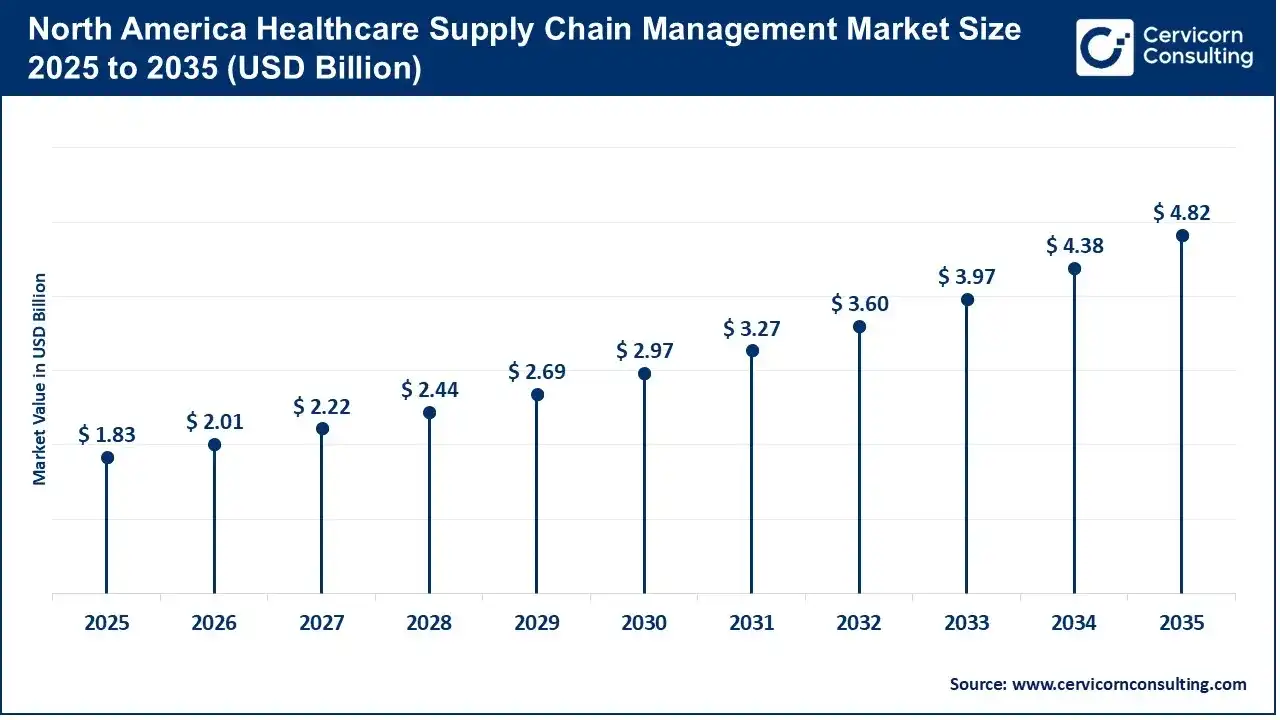
The North America healthcare supply chain management market size was valued at USD 1.83 billion in 2025 and is expected to reach USD 4.82 billion by 2035. In 2025, North America held a dominant share because of the presence of well-developed healthcare facilities and wider use of digital supply chain solutions. In addition, the Centers for Medicare & Medicaid Services (CMS) is actively offering financial incentives for hospitals that prefer purchasing personal protective equipment (PPE) and essential medications manufactured locally. Canadian organisations are advocating for tariff exemptions on pivotal medical supplies, devices, and medications to protect hospitals and long-term care facilities.
United States Market Trends
The U.S. was a major contributor to the regional market in 2025, as significant producers and the federal government are heavily advancing local production. Recently, Becton, Dickinson and Company (BD) and the U.S. government have emphasised boosting domestic medical technology production. Besides this, the U.S. market is actively transitioning towards smart cloud connectivity, intelligent automation, and immersive predictive analytics to raise compliance and real-time tracking.
Healthcare Supply Chain Management Market Share, By Region, 2025 (%)
| Region |
Revenue Share, 2025 (%) |
| North America |
39% |
| Europe |
27% |
| Asia-Pacific |
25% |
| LAMEA |
9% |
What are the Key Drivers Involved in Asia Pacific’s Rapid Growth?
The Asia-Pacific healthcare supply chain management market size was estimated at USD 1.17 billion in 2025 and is expected to surpass USD 3.09 billion by 2035. During the prospective period, the healthcare supply chain management market in Asia Pacific is projected to surge fastest, due to progressing healthcare systems, expanding digitalization, and increasing demand for robust medical supply distribution. Particularly, Southeast Asia's roughly 700+ million population are rising highly and moving into Tier-2 provincial hubs in Indonesia, Vietnam, the Philippines, and Thailand.
China Market Trends
China’s healthcare system is considered to expand rapidly in the predicted timeframe, powered by the recently recorded clearly developed biomedicine as an emerging pillar industry by the government. However, local Chinese players are reinforcing their domestic R&D activities, production footprint, and geographical supply chains to shield from spending pressures and regional transitions.
Healthcare Supply Chain Management Market Segmentation Analysis
Component Analysis
Software: The software segment held a dominant share of 48% of the market in 2025, due to a higher demand for procurement automation, inventory improvement, demand forecasting, and supply chain transparency. Numerous healthcare systems are facing massive financial strain, which requires software to monitor off-contract expenditure.
Hardware: Among these segments, hardware accounted for the second-largest share of the market in 2025, fueled by demand for real-time asset visibility and mitigation of expired medical devices. At the same time, hospitals and warehouses are widely placing Radio Frequency Identification (RFID) tags, readers, and Internet of Things (IoT) sensor nodes, which automate stock checks and omit manual logging errors.
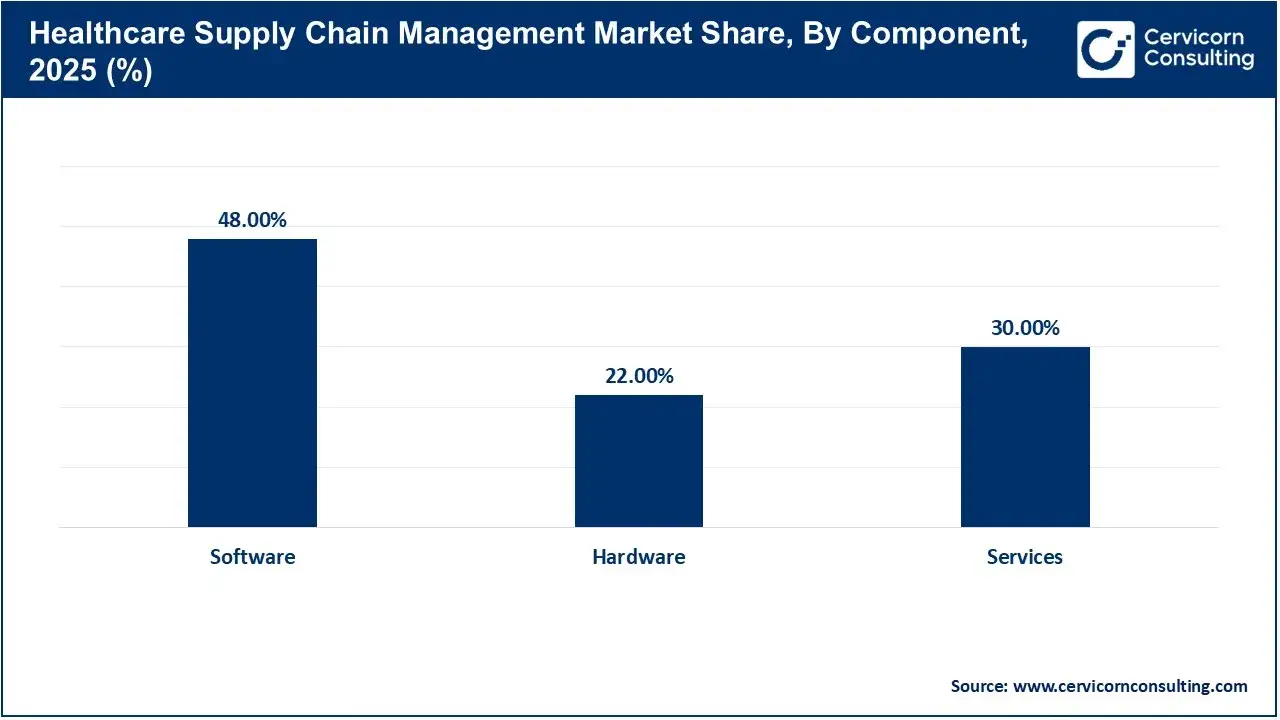
Services: The services segment is predicted to witness rapid expansion during 2026-2035 in the healthcare supply chain management market, followed by increasing demand for execution, system integration, consulting, and controlled assistance. Furthermore, the market is actively seeking cloud-enabled SCM, automated data capture, and combined ERP/EHR systems.
Function Analysis
Procurement and Purchasing Management: The procurement and purchasing management segment captured the 28% share of the market in 2025 because healthcare organizations emphasize purchasing effectiveness, supplier coordination, and spending control. The emergence of value-based care expansion and wider demand for proactive, long-term strategic sourcing, varied supplier networks, and Group Purchasing Organization (GPO) contract compliance.
In 2025, the inventory and materials management segment held the sub-largest share of 25% in the market, driven by massive capital pressure, technological breakthroughs, and regulatory stress. Along with this, the development of resilient approaches, integration of safety stock buffers, multi-sourcing, and cold-chain monitoring for temperature-sensitive pharmaceuticals is boosting innovation across the inventory and materials segment.
Healthcare Supply Chain Management Market Share, By Function, 2025 (%)
| Function |
Revenue Share, 2025 (%) |
| Procurement and Purchasing Management |
28% |
| Inventory and Materials Management |
25% |
| Order and Contract Management |
15% |
| Demand Planning and Forecasting |
16% |
| Logistics and Transportation Management |
16% |
Logistics and Transportation Management: The logistics and transportation management segment is anticipated to expand at the fastest rate in the upcoming years, supported by a rise in demand for shipment transparency, a stronger regulatory landscape, and temperature-controlled healthcare solutions. Along with emerging digitalised transportation, regulatory guidelines are mandating the requirement of entire lot tracking, with audit-ready proof of delivery, propelling new logistics solutions.
Deployment Mode Analysis
Cloud-Based: In 2025, the cloud-based segment dominated with a 58% share and is projected to grow rapidly in the healthcare supply chain management market, due to surging demand for scalable platforms, the digital revolution, and consistent connectivity. Another advantage of cloud architecture is minimal manual administrative and inventory workloads, which finally assists teams in operating efficiently rather than a lack of specialized healthcare logistics personnel.
Healthcare Supply Chain Management Market Share, By Deployment Mode, 2025 (%)
| Deployment Mode |
Revenue Share, 2025 (%) |
| Cloud-Based |
58% |
| On-Premises |
42% |
Along with this, the on-premises segment accounted for a notable share of the market in 2025, reflecting demand for robust security to handle confidential patient data, proprietary operational records, and rigorous healthcare compliance. This deployment also enables institutions to secure long-standing internal operational workflows, tailored patches, and stricter administrative security controls.
End User Analysis
Healthcare Providers: The healthcare providers segment captured a major share of 38% of the market in 2025, due to an expedited focus on controlled budgets, value-based care, and demand for digital tools for hospitals and clinics. By complying with strict regulations and broadening cloud-based steps, they demand more agile, shock-resistant inventory networks and robust alliances with group purchasing organizations (GPOs).
Medical Devices Manufacturers: In 2025, the medical devices manufacturers segment held the 15% share of the market, driven by the emergence of UDI (Unique Device Identification), FDA regulations, and EU MDR/IVDR pushes to establish real-time tracking, lot genealogy, and audit trails in their supply chains. Moreover, these developers are highly leveraging IoT sensors, RFID tags, and automated data exchange systems that offer live visibility into multi-tiered component and vendor networks.
Healthcare Supply Chain Management Market Share, By End User, 2025 (%)
| End User |
Revenue Share, 2025 (%) |
| Healthcare Providers |
38% |
| Pharmaceutical and Biotechnology Companies |
24% |
| Medical Device Manufacturers |
15% |
| Distributors and Logistics Providers |
17% |
| Others |
6% |
Pharmaceutical and Biotechnology Companies: The pharmaceutical and biotechnology companies segment is expected to grow fastest in the market, supported by huge demand for product traceability, advanced storage, and trustworthy distribution of temperature-sensitive medicines and biologics. Along with higher demand for various kinds of biologics, regulatory changes, and regional reliance, these firms depend on CMOs, CDMOs, and specialized third-party logistics (3PL) providers.
Recent Developments
- September 2026: DHL Supply Chain rolled out an innovative logistics solution for U.S. health systems designed to consolidate inventory and medical support activities.
- August 2026: The Medical Supply Organisation (MSO) launched the pilot phase of the ‘‘Sustainable Medical Supply Platform’’, according to global best practices, in alliance with and demonstrated by NSR International for Information Technology Company, a subsidiary of the Libyan Foreign Investment Company.
- August 2026, Hike Medical raised $22.5 million in seed and Series A funding to transform the complete supply chain for orthotics and prosthetics and durable medical equipment (DME).
Experts Opinion on Future Outlook
According to experts at Cervicorn Consulting, the healthcare supply chain management market will show massive expansion, led by the vast investments in AI solutions, warehouse automation, robotic process automation (RPA), and internal logistics. As per certain studies, global healthcare providers are seeking to explore digital control towers, including integrated Ultra-Wideband (UWB) beacon technology. This technology will offer precise, real-time tracking across consolidated service centers (CSCs) and warehouses.
Furthermore, the market will have a greater aim at the use of the Clinically Integrated Supply Outcomes Model (CISOM) to examine the impact of product modification on patient safety. Specifically, in thousands of hospitals, the future era will progress toward automated inventory management via smart shelves and IoT storage units.
Key Companies
Segments Covered
By Component
- Software
- Hardware
- Services
By Function
- Procurement and Purchasing Management
- Inventory and Materials Management
- Order and Contract Management
- Demand Planning and Forecasting
- Logistics and Transportation Management
By Deployment Mode
By End User
- Healthcare Providers, including Hospitals, Clinics, and Health Systems
- Pharmaceutical and Biotechnology Companies
- Medical Device Manufacturers
- Distributors and Logistics Providers
- Other Healthcare Organizations
By Region
- North America
- Europe
- Asia-Pacific
- Latin America
- Middle East and Africa