Fuel Cells for Data Centers Market Size, Growth, Forecast 2026 To 2035
The global fuel cells for data centers market size was valued at USD 357.21 million in 2025 and is expected to be worth around USD 1,941.67 million by 2035, exhibiting a compound annual growth rate (CAGR) of 18.4% over the forecast period from 2026 to 2035.
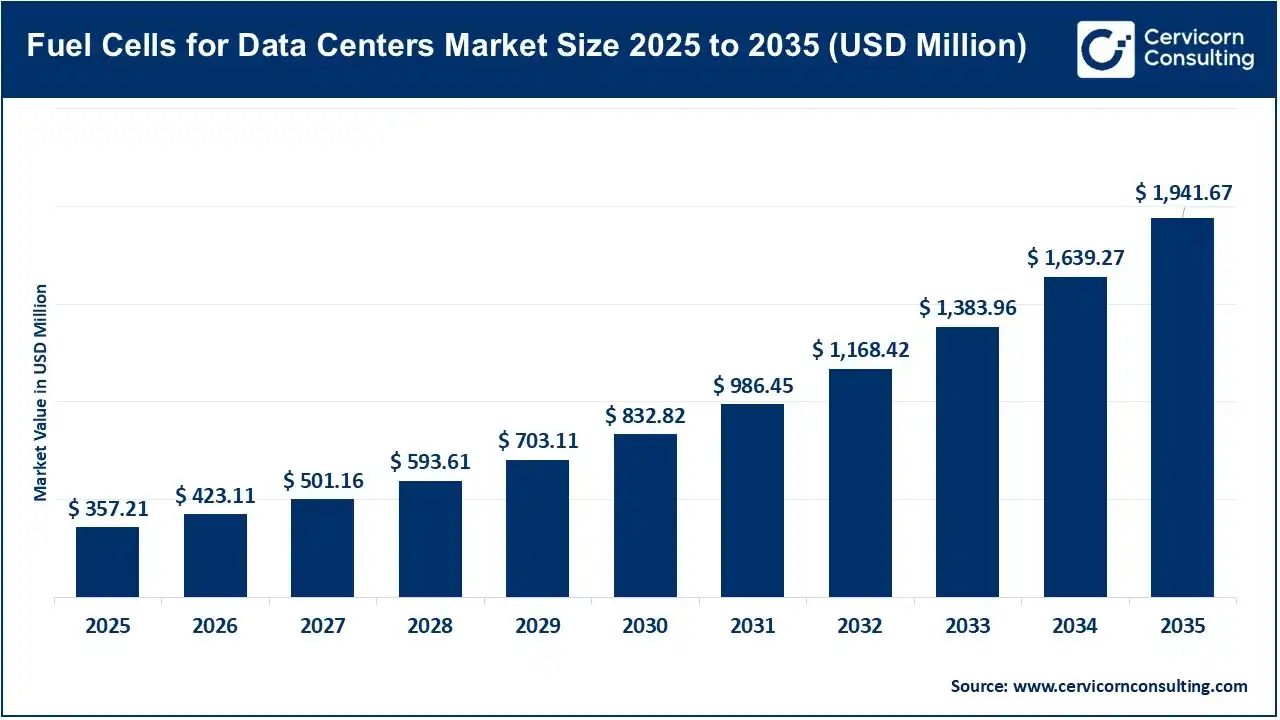
The fuel cells for data centers market is primarily driven by the rapid expansion of artificial intelligence (AI), cloud computing, and hyperscale data centres, which are creating unprecedented demand for reliable, continuous, and low-emission power. Traditional electricity grids are struggling to keep pace with rising power requirements and lengthy interconnection timelines, prompting operators to adopt on-site fuel cell systems that can be deployed faster while providing high availability. According to the International Energy Agency (IEA), global data centre electricity consumption is projected to reach around 945 TWh by 2030, growing at approximately 15% annually from 2024 to 2030, with AI-accelerated servers accounting for nearly half of the increase in electricity demand. Additionally, the U.S. Department of Energy estimates that domestic data centre electricity demand could double or even triple by 2028, reinforcing the need for resilient distributed power technologies such as solid oxide and proton exchange membrane fuel cells.
Another major growth factor is the increasing focus on sustainability, energy security, and grid independence among hyperscale and colocation data centre operators. Fuel cells offer high electrical efficiency, low emissions, modular scalability, and continuous power generation, making them an attractive alternative to diesel generators for both primary and backup power applications. Industry adoption is further supported by the growing strain on electrical infrastructure, as Bloom Energy estimates that AI-driven data centres will require an additional 35 GW of electricity over the next five years, encouraging operators to invest in behind-the-meter power solutions. Meanwhile, the IEA reports that data centres consumed 240–340 TWh of electricity globally in 2022, equivalent to 1–1.3% of global final electricity demand, and expects this share to continue rising as digital transformation accelerates, strengthening long-term demand for fuel cell-based power systems.
Report Highlights
- North America led the market with a 41.8% share, driven by AI data center expansion, hydrogen infrastructure, and strong distributed power investments
- Asia-Pacific captured 24.9% market share and is projected to grow fastest due to expanding cloud infrastructure, AI adoption, and government hydrogen investments.
- Solid Oxide Fuel Cells (SOFCs) dominated with a 49.6% share, owing to superior efficiency, fuel flexibility, and widespread hyperscale data center deployment.
- Above 5 MW systems held a 46.7% market share, reflecting increasing demand for reliable multi-megawatt power across hyperscale AI facilities.
- Primary Power represented 47.9% of the market, as operators increasingly replace conventional backup generators with continuous fuel cell-based energy systems.
- Hyperscale Data Centers captured a 45.8% share, driven by rising cloud computing, AI workloads, and large-scale digital infrastructure investments.
- IT & Telecommunications held the largest end-user share of 48.5%, supported by expanding cloud services, 5G networks, and enterprise digital transformation.
What are Fuel Cells for Data Centers?
Fuel cells for data centers are electrochemical power generation systems that convert hydrogen, natural gas, biogas, or other fuels directly into electricity without combustion, providing highly efficient, low-emission, and reliable power for mission-critical IT infrastructure. Unlike conventional diesel generators, fuel cells can operate continuously as primary power, backup power, or in combined heat and power (CHP) configurations, ensuring uninterrupted operations with minimal noise and reduced carbon emissions. Their modular design, rapid deployment, and ability to operate independently of the utility grid make them an increasingly attractive solution for hyperscale, colocation, enterprise, and AI-driven data centers facing rising electricity demand and grid capacity constraints.
Recent Technology Developments
| Company |
Technology Development |
Impact on Data Centers |
| Bloom Energy |
July 2025: Partnered with Oracle to deploy modular solid oxide fuel cell (SOFC) systems capable of supplying on-site power to Oracle Cloud Infrastructure (OCI) AI data centers within approximately 90 days. |
Accelerates AI data center deployment by reducing dependence on delayed grid interconnections while providing resilient, low-emission baseload power. |
| Bloom Energy |
June 2026: Expanded its partnership with Brookfield from USD 5 billion to USD 25 billion to accelerate global deployment of SOFC technology for AI infrastructure and hyperscale data centers. |
Enables rapid scaling of grid-independent power solutions for next-generation AI and cloud computing facilities. |
| FuelCell Energy |
2025: Formed strategic partnerships with Diversified Energy and TESIAC to develop up to 360 MW of fuel-cell-powered electricity for data centers using carbonate fuel cell technology with natural gas and captured methane. |
Enhances sustainable distributed generation while utilizing lower-carbon fuel sources for continuous data center operations. |
| FuelCell Energy |
July 2026: Secured an agreement with Fit Energy to supply up to 380 MW of fuel cell capacity for data center applications, expanding deployment of large-scale stationary fuel cell systems. |
Strengthens high-capacity, scalable power infrastructure for hyperscale and AI data centers requiring reliable on-site electricity. |
Fuel Cells for Data Centers Market Dynamics
Market Drivers
1. Rising AI and Hyperscale Data Center Power Demand
The explosive growth of artificial intelligence (AI), cloud computing, and hyperscale data centers is significantly increasing demand for continuous, high-density power, driving adoption of fuel cell systems. According to the International Energy Agency (IEA), global data center electricity consumption reached approximately 415 TWh in 2024 and is projected to exceed 945 TWh by 2030, more than doubling within six years. Fuel cells provide reliable on-site generation with lower emissions, enabling operators to overcome grid limitations while supporting uninterrupted AI workloads and mission-critical digital infrastructure.
2. Growing Focus on Grid Independence and Low-Carbon Energy
Power availability has become a decisive factor in data center development, encouraging operators to deploy on-site fuel cells instead of relying solely on utility grids. Bloom Energy's 2026 Data Center Power Report found that 61% of developers plan to install their own power generation if sufficient grid capacity is unavailable. Fuel cells offer high electrical efficiency, continuous operation, and significantly lower emissions than conventional diesel generators, making them an attractive solution for organizations pursuing decarbonization goals while improving operational resilience.
Market Restraints
1. High Initial Capital Investment
Despite long-term operational advantages, fuel cell systems require substantial upfront investment for equipment, installation, hydrogen infrastructure, and balance-of-plant components. Large-scale deployments often involve multi-million-pound equivalent capital expenditure, limiting adoption among small and medium-sized data center operators. In addition, specialized installation and maintenance requirements further increase project costs. These financial barriers continue to slow commercialization, particularly in regions where electricity prices remain relatively low and conventional backup generators offer lower initial investment requirements.
2. Limited Hydrogen Infrastructure and Fuel Availability
The availability of hydrogen production, storage, transportation, and refueling infrastructure remains uneven across global markets, restricting broader deployment of hydrogen-powered fuel cells. While natural gas-based fuel cells provide an alternative, many organizations aim to transition toward green hydrogen to achieve net-zero objectives. However, inadequate hydrogen supply networks and high green hydrogen production costs continue to constrain adoption, particularly outside North America, Europe, Japan, and South Korea, where hydrogen infrastructure is still developing.
Market Opportunities
1. Expansion of AI-Driven Edge and Hyperscale Data Centers
The rapid construction of AI-ready hyperscale and edge data centers presents a significant opportunity for fuel cell providers. The IEA estimates that AI-driven facilities will account for a major share of future electricity demand, with the United States alone expected to represent 45% of global data center electricity consumption in 2024. Fuel cells enable rapid deployment without waiting years for grid upgrades, creating substantial opportunities for distributed, modular, and scalable power solutions across emerging digital infrastructure projects.
2. Integration with Renewable Hydrogen and Microgrids
Growing investments in renewable hydrogen production and microgrid technologies are creating new opportunities for fuel cell deployment in sustainable data centers. Operators are increasingly combining fuel cells with solar, wind, battery storage, and hydrogen systems to build resilient, low-carbon power ecosystems. Such hybrid energy architectures improve energy security while supporting corporate ESG targets. As governments continue investing in hydrogen economies and clean energy infrastructure, adoption of fuel-cell-powered microgrids is expected to accelerate across next-generation data centers.
Market Challenges
1. Grid Interconnection Delays and Power Infrastructure Constraints
Although fuel cells reduce dependence on utility grids, developers still face challenges integrating distributed power systems with existing electrical infrastructure. The U.S. Department of Energy estimates that domestic data center electricity demand could double or triple by 2028, placing unprecedented pressure on transmission networks and interconnection processes. Delays in permitting, transmission upgrades, and utility approvals can postpone deployment schedules and increase overall project costs for large-scale fuel cell installations.
2. Supply Chain Constraints for Advanced Fuel Cell Components
The growing adoption of fuel cells in AI data centers is increasing demand for specialized materials, manufacturing capacity, and critical components such as ceramic stacks, catalysts, and power electronics. Limited production capacity and long procurement lead times can delay project execution as the market scales rapidly. Industry participants are expanding manufacturing capabilities, but maintaining a stable supply chain while meeting accelerating demand remains a significant challenge for fuel cell vendors serving hyperscale data center customers.
Regional Analysis
The fuel cells for data centers market is segmented by region into North America, Europe, Asia-Pacific, Latin America, and LAMEA. Here is a brief overview of each region:
Why does North America dominates the fuel cells for data centers market?
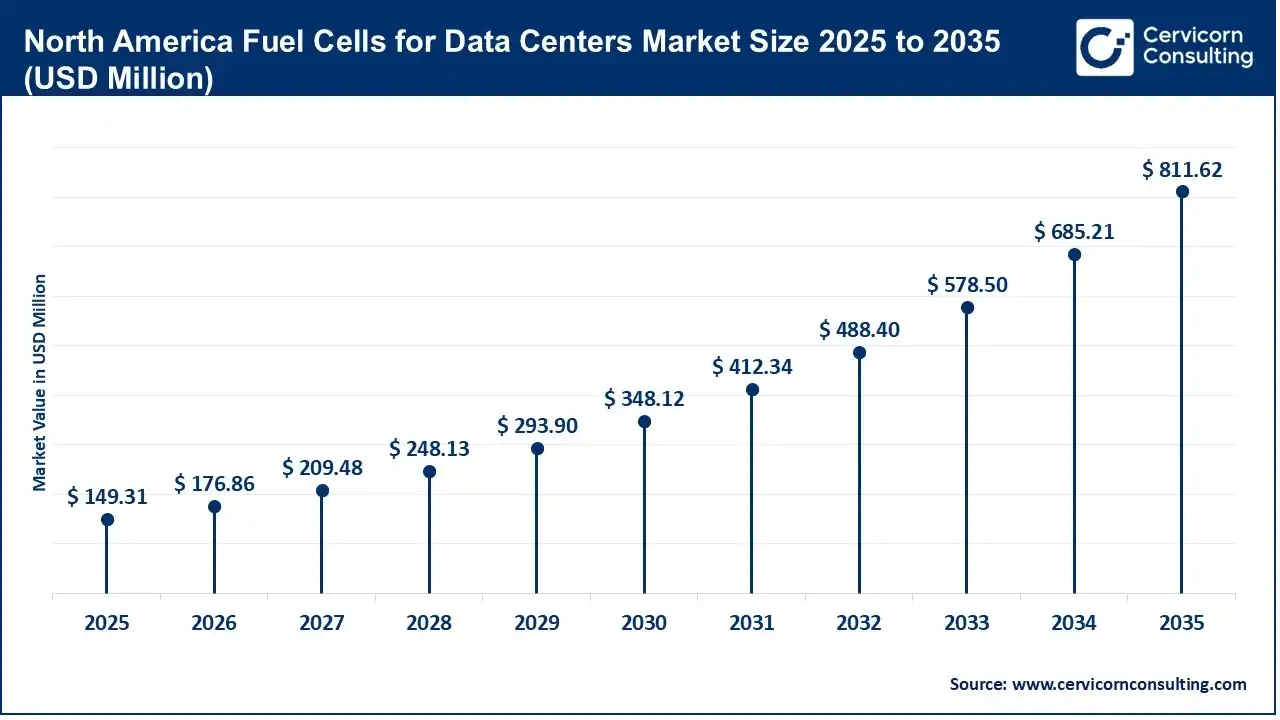
The North America fuel cells for data centers market size was valued at USD 149.31 million in 2025 and is projected to surge around USD 811.62 million by 2035. North America dominates the market, owing to its concentration of hyperscale cloud providers, rapid expansion of AI computing infrastructure, advanced hydrogen and fuel cell ecosystem, and increasing investments in resilient distributed energy systems. The region is experiencing unprecedented growth in data centre electricity demand, encouraging operators to deploy fuel cells as primary and backup power solutions to overcome grid congestion and lengthy utility interconnection timelines. Government incentives supporting hydrogen technologies, clean energy deployment, and decarbonization, coupled with increasing adoption of solid oxide fuel cells (SOFCs) by hyperscale operators, continue to strengthen regional market growth. Strong partnerships between technology companies and fuel cell manufacturers, along with investments in hydrogen production, microgrids, and on-site power generation, reinforce North America's leadership in next-generation data centre energy infrastructure.
United States: AI Infrastructure Expansion, Grid Modernization, and Hydrogen Innovation Drive Market Growth
- According to the International Energy Agency (IEA), the United States accounted for approximately 45% of global data centre electricity consumption in 2024, making it the world's largest market for digital infrastructure and distributed power solutions.
- The U.S. Department of Energy (DOE) estimates that domestic data centre electricity demand could double or triple by 2028, driven primarily by artificial intelligence, cloud computing, and high-performance computing workloads, significantly increasing demand for reliable on-site fuel cell systems.
- The Hydrogen and Fuel Cell Technologies Office (HFTO) continues supporting commercialization of advanced fuel cells through research funding, hydrogen infrastructure development, and clean hydrogen initiatives under the U.S. National Clean Hydrogen Strategy.
Canada: Clean Energy Leadership, Hydrogen Economy, and Sustainable Digital Infrastructure Support Market Expansion
- Canada continues strengthening its Fuel Cells for Data Centers Market through abundant clean electricity resources, expanding hydrogen economy initiatives, and growing investments in sustainable digital infrastructure. The country's low-carbon power mix, favourable climate for data centre operations, and increasing focus on distributed energy systems position it as an attractive location for hyperscale and colocation facilities seeking reliable, low-emission power solutions.
- According to the Government of Canada, approximately 82% of the country's electricity is generated from non-emitting sources, providing a strong foundation for integrating hydrogen and fuel cell technologies into critical infrastructure.
Why is Asia-Pacific fastest-growing region for the fuel cells for data centers market?
The Asia-Pacific fuel cells for data centers market size was estimated at USD 88.95 million in 2025 and is projected to surpass around USD 483.48 million by 2035. Asia-Pacific is the fastest-growing market, supported by rapid digital transformation, expanding hyperscale cloud infrastructure, rising AI adoption, and strong government initiatives promoting hydrogen technologies and carbon neutrality. Countries including China, Japan, South Korea, Singapore, India, and Australia are witnessing significant investments in hyperscale and edge data centers to meet growing demand for cloud services, digital payments, e-commerce, and artificial intelligence. Increasing pressure on urban power grids, coupled with ambitious net-zero targets, is accelerating the adoption of fuel cell systems as reliable, low-emission distributed power sources. Strong government funding for hydrogen production, fuel cell commercialization, smart grids, and renewable energy integration further strengthens the region's position as a major growth hub for next-generation data center power infrastructure.
China: AI Expansion, Hyperscale Data Centers, and Hydrogen Development Accelerate Market Growth
- China continues to lead the Asia-Pacific market through massive investments in AI infrastructure, cloud computing, and digital economy development. According to the Ministry of Industry and Information Technology (MIIT), China had more than 8.3 million data center racks by the end of 2024, making it one of the world's largest data center markets.
- China's "Eastern Data, Western Computing" initiative continues accelerating the construction of large-scale computing hubs while improving energy efficiency and balancing electricity demand across provinces.
Japan: Hydrogen Leadership, Advanced Fuel Cell Technologies, and Sustainable Data Centers Support Market Expansion
- Japan remains a global leader in hydrogen and fuel cell technologies through strong government support, advanced manufacturing capabilities, and long-term decarbonization policies. The country's Basic Hydrogen Strategy promotes widespread deployment of hydrogen across industrial, commercial, and digital infrastructure sectors, including mission-critical data centers.
- According to Japan's Ministry of Economy, Trade and Industry (METI), the government continues expanding investments in hydrogen supply chains and fuel cell technologies to achieve carbon neutrality by 2050.
Why Europe represents a significant share in the fuel cells for data centers market?
The Europe fuel cells for data centers market size was accounted for USD 90.73 million in 2025 and is expected to hit around USD 493.18 million by 2035. Europe represents a significant market, driven by stringent carbon reduction regulations, ambitious hydrogen economy strategies, expanding hyperscale and colocation data center investments, and increasing demand for resilient low-carbon power infrastructure. The region's commitment to achieving climate neutrality by 2050, coupled with rising electricity demand from AI and cloud computing, is accelerating the adoption of fuel cell technologies as an alternative to conventional diesel generators and grid-dependent power systems. Strong government funding through the European Union's hydrogen initiatives, renewable energy integration, and distributed energy projects continues to support commercialization of stationary fuel cells. Growing investments in green hydrogen production, microgrids, and energy-efficient digital infrastructure further strengthen Europe's position as a leading market for sustainable data center power solutions.
Germany: Hydrogen Innovation, Digital Infrastructure, and Industrial Decarbonization Drive Market Growth
- Germany leads the European fuel cells for data centers market through its advanced hydrogen strategy, expanding cloud infrastructure, and strong focus on industrial decarbonization. Under the National Hydrogen Strategy, the German government continues investing in hydrogen production, infrastructure, and fuel cell technologies to accelerate the transition toward a climate-neutral economy.
- According to the German Federal Ministry for Economic Affairs and Energy (BMWK), Germany aims to develop up to 10 GW of domestic hydrogen electrolysis capacity by 2030, supporting large-scale deployment of hydrogen across industrial and commercial applications.
United Kingdom: AI Data Center Expansion, Clean Energy Transition, and Hydrogen Investments Support Market Expansion
- The United Kingdom is strengthening its position in the Fuel Cells for Data Centers Market through growing AI infrastructure investments, ambitious net-zero targets, and continued expansion of the national hydrogen economy. Rising demand for cloud computing, financial services data centers, and high-performance computing is increasing the need for reliable, low-emission on-site power generation.
- Under the UK Hydrogen Strategy, the government targets up to 10 GW of low-carbon hydrogen production capacity by 2030, supporting commercialization of hydrogen-powered technologies across multiple industries, including digital infrastructure.
Fuel Cells for Data Centers Market Share, By Region, 2025 (%)
| Region |
Revenue Share, 2025 (%) |
| North America |
41.8% |
| Europe |
25.4% |
| Asia-Pacific |
24.9% |
| LAMEA (Latin America, Middle East & Africa) |
7.9% |
Why is LAMEA experiencing steady growth in the fuel cells for data centers market?
The LAMEA fuel cells for data centers market was valued at USD 28.22 million in 2025 and is anticipated to reach USD 153.39 million by 2035. The LAMEA market is experiencing steady growth, supported by increasing investments in hyperscale and colocation data centers, rapid digital transformation, expanding cloud services, and growing demand for resilient off-grid power solutions. Many countries in the region face grid reliability challenges, encouraging operators to adopt fuel cell technologies that provide continuous, low-emission electricity for mission-critical facilities. Government initiatives promoting hydrogen economies, renewable energy integration, and smart city development are further accelerating market adoption. Rising investments from global cloud providers and telecom companies, coupled with increasing deployment of AI and edge computing infrastructure, continue strengthening the region's long-term growth prospects.
United Arab Emirates: AI Infrastructure, Green Hydrogen, and Smart City Development Drive Market Growth
- The United Arab Emirates is emerging as a leading market for fuel cells for data centers through substantial investments in artificial intelligence, digital infrastructure, and clean energy technologies. The country continues expanding hyperscale and colocation data center capacity to support cloud computing, financial services, and government digital transformation initiatives.
- Under the UAE National Hydrogen Strategy 2050, the government aims to become one of the world's leading hydrogen producers, supporting commercialization of hydrogen-powered technologies and distributed clean energy systems.
Brazil: Expanding Cloud Infrastructure, Renewable Energy Leadership, and Digital Transformation Support Market Expansion
- Brazil leads the Latin American market through increasing investments in cloud computing, enterprise digitalization, and hyperscale data center development. Growing adoption of artificial intelligence, fintech services, e-commerce, and digital government platforms is significantly increasing demand for reliable and energy-efficient data center power infrastructure.
- According to the Brazilian Electricity Regulatory Agency (ANEEL), more than 85% of Brazil's electricity generation comes from renewable energy sources, providing a favorable environment for integrating hydrogen production and fuel cell technologies into low-carbon digital infrastructure.
Segmental Analysis
The fuel cells for data centers market is segmented into fuel cell type, power output, application, data center type, end user, and geography.
Fuel Cell Type Analysis
Solid Oxide Fuel Cells (SOFCs) dominate the fuel cells for data centers market due to their high electrical efficiency, continuous baseload operation, and ability to operate on multiple fuels such as natural gas, biogas, and hydrogen. SOFCs are widely adopted by hyperscale data center operators because they achieve electrical efficiencies exceeding 60%, while combined heat and power (CHP) configurations can exceed 85% overall efficiency. Companies including Bloom Energy have accelerated SOFC deployment to provide grid-independent power for AI-driven and cloud computing facilities.
Fuel Cells for Data Centers Market Share, By Fuel Cell Type, 2025 (%)
| Fuel Cell Type |
Revenue Share, 2025 (%) |
| Solid Oxide Fuel Cell (SOFC) |
49.6% |
| Proton Exchange Membrane Fuel Cell (PEMFC) |
28.4% |
| Molten Carbonate Fuel Cell (MCFC) |
10.8% |
| Phosphoric Acid Fuel Cell (PAFC) |
7.2% |
| Others |
4.0% |
Proton Exchange Membrane Fuel Cells (PEMFCs) are the fastest-growing segment owing to increasing investments in green hydrogen infrastructure and demand for zero-emission backup power. PEMFCs offer rapid start-up, compact system design, and excellent load-following capabilities, making them suitable for edge and enterprise data centers. Government hydrogen strategies across North America, Europe, Japan, and South Korea are accelerating PEMFC commercialization, while declining hydrogen production costs and expanding refueling infrastructure are expected to further boost adoption over the coming years.
Power Output Analysis
The Above 5 MW segment dominates the market as hyperscale data centers require multi-megawatt power systems to support AI training clusters, cloud platforms, and high-performance computing. Large facilities operated by global cloud providers increasingly deploy modular fuel cell installations capable of delivering continuous baseload electricity while reducing dependence on constrained utility grids. Multi-megawatt systems also improve operational efficiency through centralized energy management and lower lifecycle costs, making them the preferred solution for large-scale digital infrastructure projects.
Fuel Cells for Data Centers Market, By Power Output, 2025 (%)
| Power Output |
Revenue Share, 2025 (%) |
| Above 5 MW |
46.7% |
| 1 MW–5 MW |
30.5% |
| 200 kW–1 MW |
15.3% |
| Below 200 kW |
7.5% |
The 1 MW–5 MW segment is expected to witness the fastest growth due to rising investments in regional cloud facilities, colocation centers, and medium-sized AI computing hubs. This capacity range provides an ideal balance between scalability, installation cost, and operational flexibility, enabling operators to expand capacity incrementally as computing demand grows. Increasing adoption of modular fuel cell architectures and distributed energy systems is encouraging enterprises to install multiple megawatt-class units instead of relying solely on centralized grid electricity.
Application Analysis
Primary power represents the largest application segment because modern data centers increasingly require continuous, high-availability electricity independent of aging utility infrastructure. Fuel cells provide uninterrupted power with significantly lower emissions than diesel generators while operating continuously throughout the year. The growing number of AI and hyperscale facilities facing transmission delays has encouraged operators to deploy fuel cells as dedicated primary power sources, improving resilience while supporting sustainability commitments and reducing exposure to grid outages.
Combined Heat and Power (CHP) is emerging as the fastest-growing application due to its ability to utilize waste heat for cooling systems, district heating, or facility operations, significantly improving total energy efficiency. CHP fuel cell installations can achieve overall efficiencies exceeding 80–85%, reducing both operational costs and carbon emissions. Growing emphasis on energy optimization, environmental regulations, and sustainable infrastructure development is accelerating CHP adoption across enterprise and hyperscale data centers worldwide.
Data Center Type Analysis
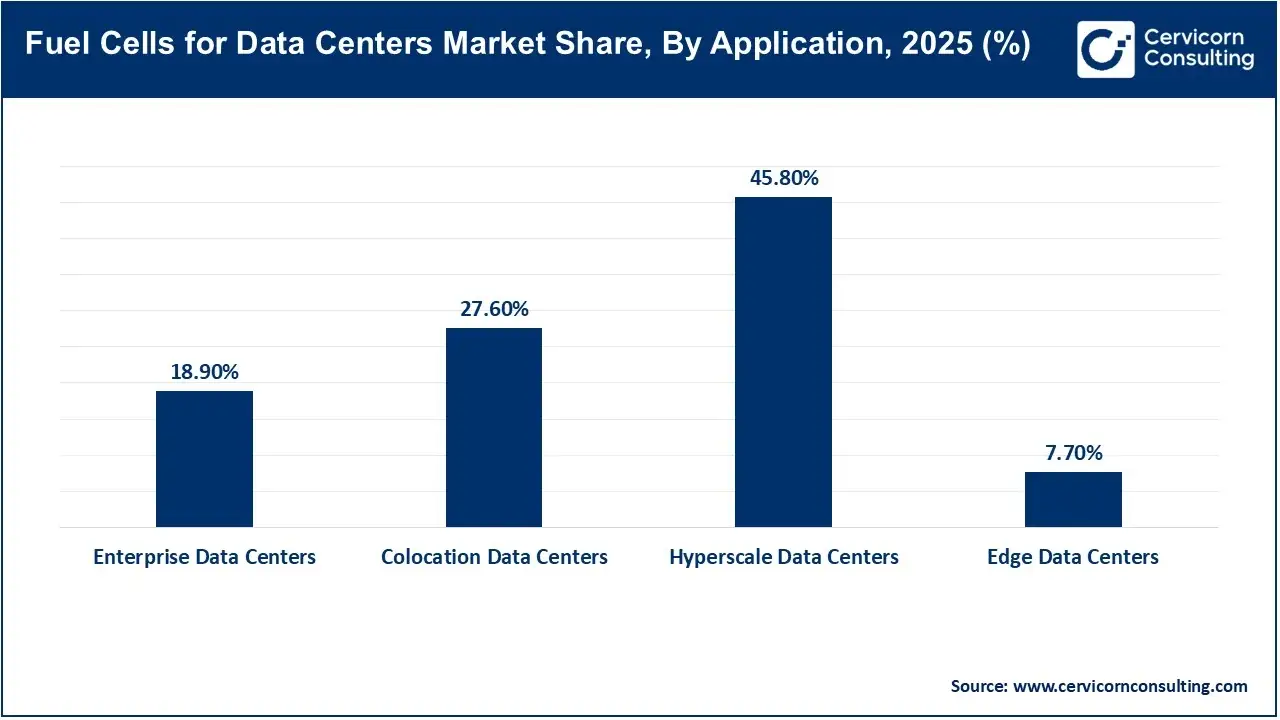
Hyperscale data centers account for the largest market share because they consume enormous amounts of electricity to support cloud computing, AI model training, video streaming, and digital services. Major cloud service providers continue investing in multi-gigawatt campuses requiring resilient on-site generation solutions. Fuel cells enable faster deployment than waiting for new grid connections while delivering reliable, low-emission power, making them an increasingly preferred technology for hyperscale operators expanding global digital infrastructure.
Fuel Cells for Data Centers Market, By Data Center Type, 2025 (%)
| Data Center Type |
Revenue Share, 2025 (%) |
| Hyperscale Data Centers |
45.8% |
| Colocation Data Centers |
27.6% |
| Enterprise Data Centers |
18.9% |
| Edge Data Centers |
7.7% |
Edge data centers are projected to be the fastest-growing segment due to increasing deployment of 5G networks, Internet of Things (IoT) devices, autonomous systems, and real-time AI applications. These smaller facilities require compact, reliable, and low-maintenance power systems capable of operating in remote or grid-constrained locations. Fuel cells provide silent operation, high reliability, and modular scalability, making them well suited for decentralized edge computing environments supporting latency-sensitive digital applications.
End User Analysis
The IT & Telecommunications sector dominates the Fuel Cells for Data Centers Market as cloud service providers, telecom operators, and internet companies continue expanding digital infrastructure to meet rapidly growing data traffic. Rising adoption of artificial intelligence, cloud computing, video streaming, and enterprise digital transformation has significantly increased electricity demand across this sector. Fuel cells provide reliable, high-efficiency, and low-carbon power, helping operators maintain continuous service availability while meeting sustainability objectives and reducing dependence on conventional backup generators.
Fuel Cells for Data Centers Market, By End User, 2025 (%)
| End User |
Revenue Share, 2025 (%) |
| IT & Telecommunications |
48.5% |
| Banking, Financial Services & Insurance (BFSI) |
15.1% |
| Government & Defence |
10.2% |
| Healthcare |
8.3% |
| Retail & E-commerce |
6.7% |
| Manufacturing |
5.4% |
| Energy & Utilities |
3.4% |
| Others |
2.4% |
The Banking, Financial Services & Insurance (BFSI) segment is expected to register the fastest growth due to increasing reliance on digital banking, electronic payments, real-time trading platforms, and financial data processing. Financial institutions require uninterrupted power to ensure business continuity and regulatory compliance while minimizing downtime risks. Growing investments in private data centers and disaster recovery facilities, coupled with stringent cybersecurity and operational resilience requirements, are accelerating the adoption of fuel cell-based power solutions in the BFSI sector.
Fuel Cells for Data Centers Market Top Companies
Recent Developments
- In April 2026, Bloom Energy Corporation expanded its strategic partnership with Oracle to deploy up to 2.8 GW of solid oxide fuel cell capacity across AI-powered data centers in the United States. The initiative accelerates grid-independent power deployment, supports rapid hyperscale data center expansion, enhances energy resilience, and strengthens Bloom Energy's leadership in delivering reliable, low-carbon power solutions for next-generation digital infrastructure.
- In July 2026, FuelCell Energy, Inc. signed an agreement with Fit Energy to deploy up to 380 MW of carbonate fuel cell capacity for large-scale AI and cloud data center projects. The development expands continuous on-site clean power generation, reduces dependence on constrained electricity grids, and strengthens FuelCell Energy's position in supplying sustainable energy solutions for mission-critical digital infrastructure.
- In June 2026, Ballard Power Systems Inc. secured a 15 MW order for stationary hydrogen fuel cell systems supporting critical infrastructure and distributed power applications. The project strengthens Ballard's stationary power portfolio, expands hydrogen fuel cell adoption in resilient energy systems, and creates new opportunities for reliable backup and primary power in data center environments.
Market Segmentation
By Fuel Cell Type
- Proton Exchange Membrane Fuel Cell (PEMFC)
- Solid Oxide Fuel Cell (SOFC)
- Phosphoric Acid Fuel Cell (PAFC)
- Molten Carbonate Fuel Cell (MCFC)
- Others
By Power Output
- Below 200 kW
- 200 kW–1 MW
- 1 MW–5 MW
- Above 5 MW
By Application
- Primary Power
- Backup Power
- Combined Heat and Power (CHP)
- Peak Shaving & Grid Support
By Data Center Type
- Enterprise Data Centers
- Colocation Data Centers
- Hyperscale Data Centers
- Edge Data Centers
By End User
- IT & Telecommunications
- Banking, Financial Services & Insurance (BFSI)
- Government & Defence
- Healthcare
- Retail & E-commerce
- Manufacturing
- Energy & Utilities
- Others
By Geography
- North America
- Europe
- Asia-Pacific
- LAMEA