The global footwear market size was valued at USD 481.02 billion in 2025 and is expected to be worth around USD 949.27 billion by 2035, exhibiting a compound annual growth rate (CAGR) of 7.1% over the forecast period from 2026 to 2035. The footwear market's growth is mainly fueled by the increasing popularity of athleisure, which has blurred the lines between performance and everyday footwear. This trend reflects a growing global focus on physical fitness and higher engagement in sports and outdoor activities. Consumers now favour footwear that offers comfort and versatility for work, casual outings, and outdoor recreation alike. At the same time, environmentally conscious consumers, especially Gen Z and Millennials, are prompting brands to adopt sustainable practices. These trends have also heightened health awareness worldwide and accelerated direct-to-consumer (DTC) strategies by key brands like Nike and Adidas, with rising DTC sales influencing the industry's current and future business models.
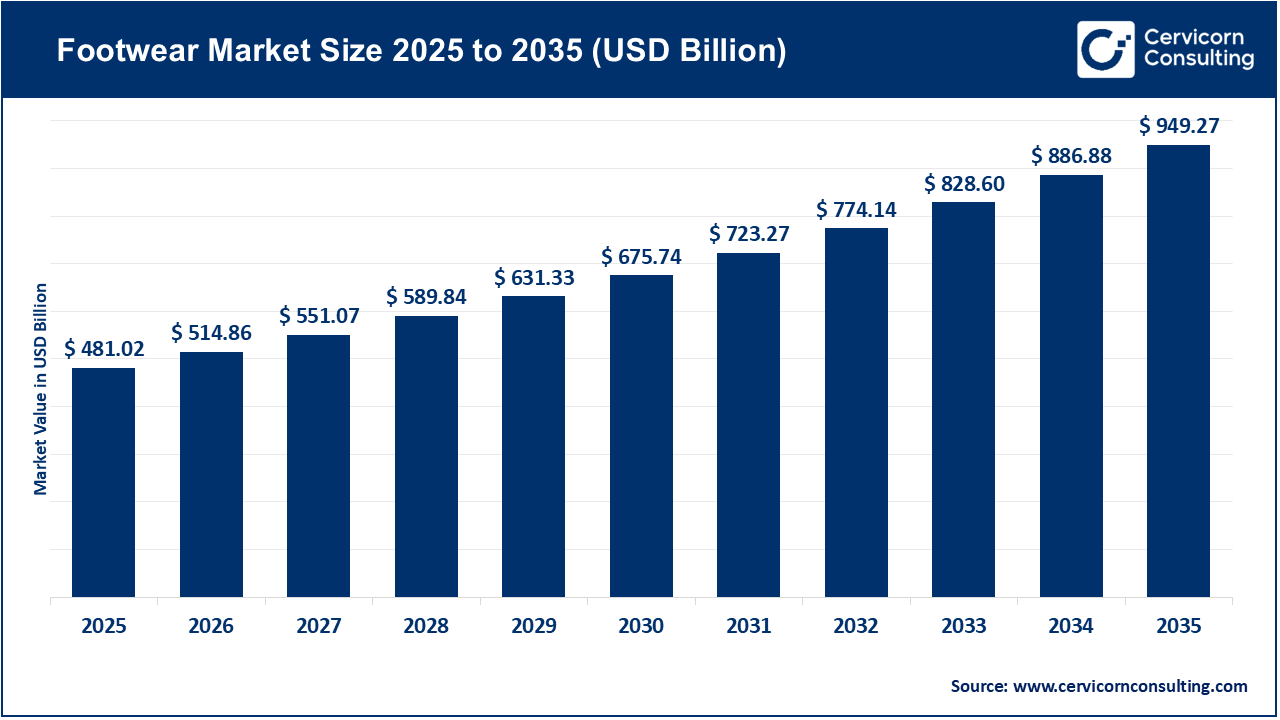
Sustainability has shifted from a niche marketing tactic to an integral part of footwear operations. Increasing demand for eco-friendly products and stricter environmental regulations are driving brands to adopt circular business models that incorporate recycled textiles, bio-based foams, and sustainable leather alternatives. This shift is expected to reduce environmental impacts associated with traditional manufacturing. Additionally, companies are investing in technologies that support the "right to repair" and improve end-of-life management for footwear. Financial incentives and tax breaks in certain regions further promote the adoption of green manufacturing practices.
Report Highlights
- Asia Pacific dominates the global footwear market with around 35% share, driven by its large population, improving purchasing power, rapid urban growth, and strong demand for affordable and sports footwear.
- Casual footwear continues to lead the market, accounting for nearly 46% share, as consumers increasingly prefer comfortable, everyday footwear influenced by evolving fashion trends across all age groups.
- Athletic and sports footwear is the fastest-growing category at share 28%, supported by rising health awareness, active lifestyles, and the growing popularity of athleisure wear.
- Men represent the largest consumer group, holding about 48% of total demand, due to higher usage of footwear for work, sports, and daily wear.
- Online and e-commerce channels are expanding the fastest with share 28%, fueled by broader product choices, attractive pricing, easy access, and increasing global internet adoption.
Digital Technologies and the Onset of Smart Shoe Technology
The integration of digital technologies is opening new opportunities for "smart" or "phygital" products in the footwear market. Specifically, technologies such as biometric sensors and microchips in shoe soles enable features like step counting. More advanced smart footwear can measure a person's steps, provide real-time coaching to prevent injury, and support remote patient monitoring, including integration with healthcare providers for mobility concerns. This technology is bridging the gap between the footwear and wearables industry, creating several high-margin opportunities for brands that can manage complex data ecosystems. Beyond product innovation, digital integration is also transforming footwear manufacturing through increased use of 3D printing and automated "micro-factories," which allow real-time hyper-personalization of footwear, enabling shoes to be custom-molded instantly.
Recent Major Milestones
1. Recent Corporate Disruption and Innovation Initiatives
A significant recent milestone in the footwear market is the disruption of Nike and Adidas's duopoly, with newer brands that are more flexible, innovation-driven, and focused on performance. For example, companies like AG and Hoka, which own proprietary cushioning technologies, follow a "niche to mass" commercialization strategy to directly compete with established market leaders in running shoes and lifestyle footwear categories. This expansion reflects a larger industry trend, where advancements in comfort, design, and performance technology increasingly drive product sales through brand loyalty.
2. Government Policy Mandates and Sustainability Framework
The European Union’s Ecodesign for Sustainable Products Regulation (ESPR) is a major growth driver for the market. This regulatory environment requires the use of “Digital Product Passports” for footwear, which provides detailed information about the product’s supply chain, material composition, and recyclability. This regulation aims to establish a global standard for encouraging manufacturers to adopt transparent, sustainable practices in order to sell into the European market. It also promotes the public narrative of environmental responsibility from consumer to producer.
3. Technological Advancements in Production Efficiency
Adidas made a significant breakthrough in the large footwear market by launching a 4D midsole created via digital light synthesis using 3d printing technology. This market is shifting from using 3D printing mainly for prototypes to transitioning toward large-scale production. The Adidas 4D midsole was created with a complex lattice structure that enables tuned cushioning technology and provides better energy return, which is not possible with traditional injection-molded construction. This allows for improved production efficiency and enables brands to respond more quickly to localized demand.
4. Consolidation Data Information through Mergers of Brands
Market consolidation through mergers and acquisitions is reshaping competition across the industry. The Tapestry-Capri business deal is a relevant example of how brand mergers or acquisitions influence footwear brands like Michael Kors and Coach, which are primarily interested in luxury fashion. Brand consolidations allow large fashion groups to accelerate and utilize their supply chain power, as well as share material and design innovation across multiple labels. This enables expansion of the high costs involved in developing sustainable or smart materials across their brand portfolios. As a result, from an independent brand perspective, however, this trend creates an additional level of competitive disadvantage.
Report Scope
| Area of Focus |
Details |
| Market Size in 2026 |
USD 514.86 Billion |
| Market Size in 2035 |
USD 949.27 Billion |
| CAGR from 2026 to 2035 |
7.10% |
| Dominant Region |
Asia-Pacific |
| Fastest Growing Region |
North America |
| Key Segments |
Type, End User, Distribution Channel, Region |
| Key Companies |
Nike, Inc., Adidas AG, Skechers USA, Inc., Puma SE, New Balance Athletics, Inc., ASICS Corporation, Under Armour, Inc., VF Corporation, Crocs, Inc., ANTA Sports Products Ltd., Li-Ning Company Limited, Deichmann SE, Bata Corporation, The ALDO Group, Fila Holdings Corp |
Market Dynamics
Market Drivers
- Increase in Health Awareness and Participation in Athletics: The rapid increase in health awareness and involvement in physical fitness activities has significantly driven the footwear market, due to a strong focus on athletic and performance footwear. Health priorities have shifted, with more consumers focused on active lifestyles and cardiovascular health, while government-led initiatives actively promote sports and physical activities. As a result, demand is rising for specialized athletic footwear for running, training, and outdoor activities, supporting market growth.
- Increased Demand for Sustainable and Eco-friendly Materials: Environmental sustainability has evolved from a niche initiative to a key factor shaping the market. Today's consumers, especially the younger generation, expect brands to take clear responsibility for their environmental impact. These trends have shifted towards the development and use of sustainable materials, such as recycled ocean plastics, biobased synthetics, and ethically sourced natural fibers, which are increasingly growing. This shift is driven by a combination of demand, particularly from younger consumers, and a strategic necessity to create long-term solutions to reduce associated risks.
Market Restraints
- Cost and Supply chain volatility for Raw Materials: The rising and unpredictable costs of raw materials such as leather, rubber, and many other petroleum-based synthetics are primary constraints in the footwear market. These cost fluctuations affect all market players, typically resulting in higher costs passed on to consumers. The situation is further complicated by ongoing global supply chain disruptions caused by geopolitical tensions and climate-related factors. Such disruptions can lead to production delays, stoppages, and inventory imbalances, including shortages of high-demand products or excess unsold seasonal stock.
- Stringent Environmental Regulations and Manufacturing Compliance: The regulatory framework for footwear manufacturing is becoming more complex and stringent, especially in developed economies like the European Union. New and upcoming regulations, such as the 2025 Omnibus Package, are driving change across the footwear industry by imposing stricter requirements for product durability, recyclability, and the elimination of hazardous chemicals like PFAS. As a result, manufacturers face costly compliance audits and are adopting new footwear production processes to meet growing environmental and sustainability standards.
Market Opportunities
- Utilization of Smart Technology & Wearable Performance Tracking: The integration of digital health technologies offers a great opportunity for footwear brands to stand out through "smart" products. By embedding sensor technology in the sole or midsole, which can track a wide range of biometric data such as gait analysis, step count, or pressure maps, and providing real-time insights on smartphones via online applications. This product technology supports serious athletes by helping improve performance, health, and recovery, while also appealing to a broader consumer base focused on prevention and injury avoidance.
- Strategic Collaborations with Luxury Fashion and Entertainment Brands: The strategic use of high-profile collaborations presents a significant growth opportunity for footwear brands, as it can attract audiences, boost engagement, and potentially reach new consumer groups. By focusing on collaborations with luxury fashion houses, influential cultural figures, artists, or important events and franchises, athletic and lifestyle brands can create notable "halo effects" across their product range. Limited-edition collaborations increase customer engagement both online and in physical stores, enhance brand visibility, and attract even consumers who do not purchase these products.
Market Challenges
- Market Shortening of Consumer Fashion Cycles and Trends: The rapid acceleration of fashion cycles driven by social media platforms like TikTok and Instagram is creating significant operational challenges for footwear manufacturers. Trends that once lasted for years now emerge and fade within a single season, forcing brands to respond much more quickly to changing consumer preferences. As a result, companies need highly responsive and flexible supply chains to produce items aligned with current trends. This shift is making the traditional 18-month product development cycle obsolete, as brands increasingly need to launch products to the market within a shorter timeframe.
- Ethical Labor Practices and Human Rights Compliance in Sourcing: The footwear market is highly reliant on a complex and globalized supply chain, which has raised growing concerns about labor ethics and human rights issues as part of corporate social responsibility (CSR). Consumers and regulators are increasingly demanding greater transparency about the conditions under which shoes are manufactured, especially in developing regions where labor regulations may be weaker. As a result, brands face serious legal and reputational risks if they are found to have exploited labor practices, including child labor or unsafe working environments.
The footwear market is segmented by region into North America, Europe, Asia-Pacific, and LAMEA. Here is a brief overview of each region:
Why does Asia-Pacific dominates the footwear market?
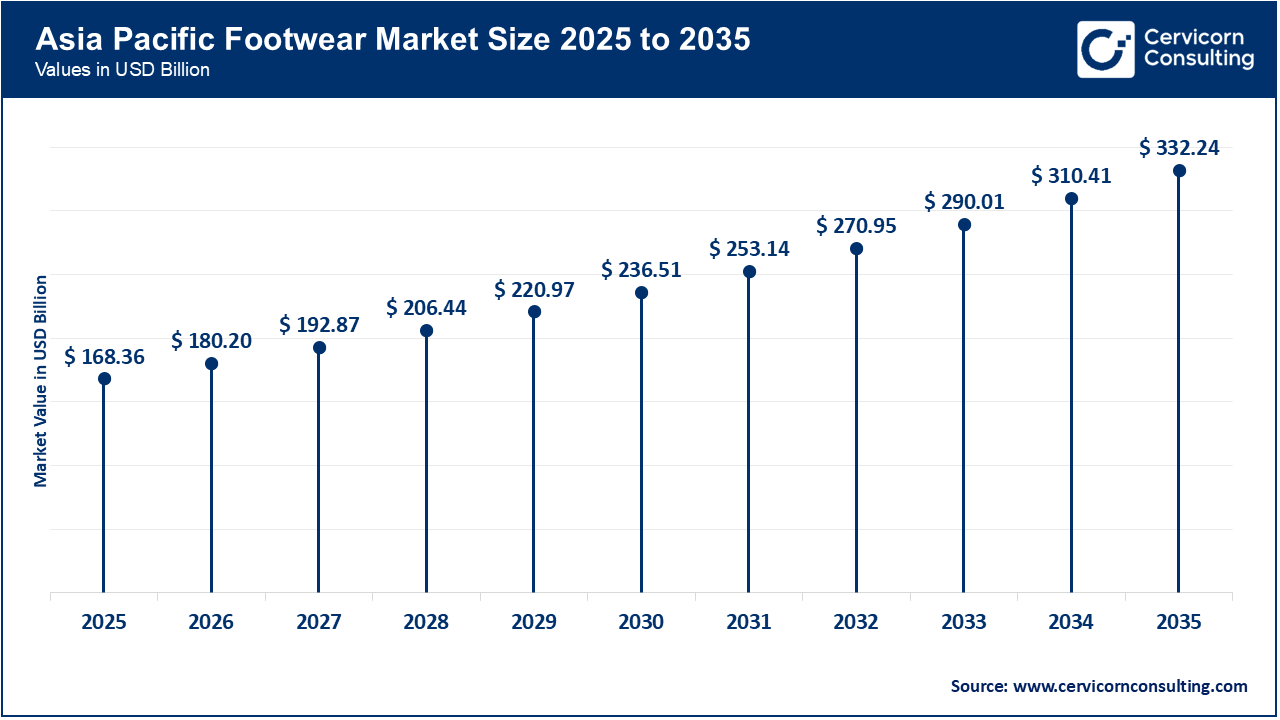
The global footwear market size was valued at USD 168.36 billion in 2025 and is expected to reach around USD 332.24 billion by 2035. The Asia-Pacific region continues to lead the market due to significant demographic and economic shifts. Rapid growth of the middle class across China, India, and Southeast Asia has shifted footwear from a basic need to an important symbol of lifestyle and identity. Increasing disposable income has enabled these countries to focus more on higher-end footwear categories, ranging from professional sports gear to luxury fashion. Besides economic growth, trends like China's "Guochao," or the "national tide," are becoming more popular. This trend reflects a growing preference for domestic brands among consumers, especially those that successfully combine modern technology with cultural heritage.
Recent Developments:
- ANTA and Li-Ning widened their retail presence across China to capture growing domestic demand.
- Online footwear purchases continue to rise, supported by major e-commerce platforms like Alibaba and Flipkart.
Why is North America region fastest-growing in the footwear market?
The North America footwear market size was estimated at USD 144.31 billion in 2025 and is forecasted to grow around USD 284.78 billion by 2035. North America is the fastest-growing region in the market mainly due to rapid digital transformation and the strong expansion of omnichannel retail strategies. The region has become a leader in direct-to-consumer (D2C) models, with major brands increasingly focusing on their digital platforms instead of traditional channels to gain greater control over brand positioning and consumer data. D2C has evolved beyond a sales channel, reshaping the traditional supply chain and enabling real-time data analytics to support inventory management and product development.
Recent Developments:
- Nike strengthened its direct-to-consumer model by expanding digital platforms and brand-owned stores across the U.S.
- Consumers are increasingly choosing sustainable and comfort-driven footwear, boosting demand for brands such as Skechers and New Balance.
Europe Footwear Market: Driven by Sustainability Policy Requirements and Eco-Conscious Consumerism
The Europe footwear market size was reached at USD 125.07 billion in 2025 and is projected to hit around USD 246.81 billion by 2035. Europe market growth is growth is driven by increasingly strict regulatory frameworks combined with a well-informed and eco-conscious consumer base. Policies such as the European Green Deal and the introduction of "Digital Product Passports" have required brands to support sustainability claims with clear, verifiable, and transparent supply chain policies. As a result, European consumers are increasingly demanding transparency concerning material sourcing, labor practices, and the environmental impact of products. This shift is transforming sustainability from just a feature into a core competitive advantage.
Recent Developments
- Adidas placed greater emphasis on recycled materials and lower-carbon footwear to meet sustainability goals.
- Demand for premium and designer footwear remains strong across Western European markets.
Footwear Market Share, By Region, 2025 (%)
| Region |
Revenue Share, 2025 (%) |
| Asia Pacific |
35% |
| North America |
30% |
| Europe |
26% |
| LAMEA |
9% |
LAMEA (Latin America, Middle East & Africa) Footwear Market: Driven by Urbanization and Retail Infrastructure
The LAMEA footwear market was valued at USD 43.29 billion in 2025 and is anticipated to reach around USD 85.43 billion by 2035. The LAMEA region presents a strong long-term growth opportunity due to rapid urbanization and organized retail infrastructure. The emergence of modern shopping malls is transforming a fragmented Middle Eastern and African market into a cohesive retail landscape for global brands. This infrastructure has notable implications for brand placement, as organized stores allow global brands to combine their presence with experiential retail environments that appeal to the young, brand-conscious consumer base, thereby accelerating overall market presence.
Recent Developments
- Bata expanded its store network across key markets in Africa and Latin America.
- Global footwear brands increased their presence in shopping malls and franchise-led outlets across the Middle East.
The footwear market is segmented into type, end user, distribution channel, and region.
Type Analysis
Casual footwear is the dominant segment of the footwear market because of its design for everyday comfort and regular use across work, education, and social activities. These shoes easily fit different lifestyles and occasions, making them a practical choice for daily wear. As professional dress codes have become more relaxed globally, the demand for versatile casual shoes has continued to grow. The casual footwear segment attracts a wide demographic, from budget-conscious consumers to those interested in entry-level luxury loafers or sneakers.
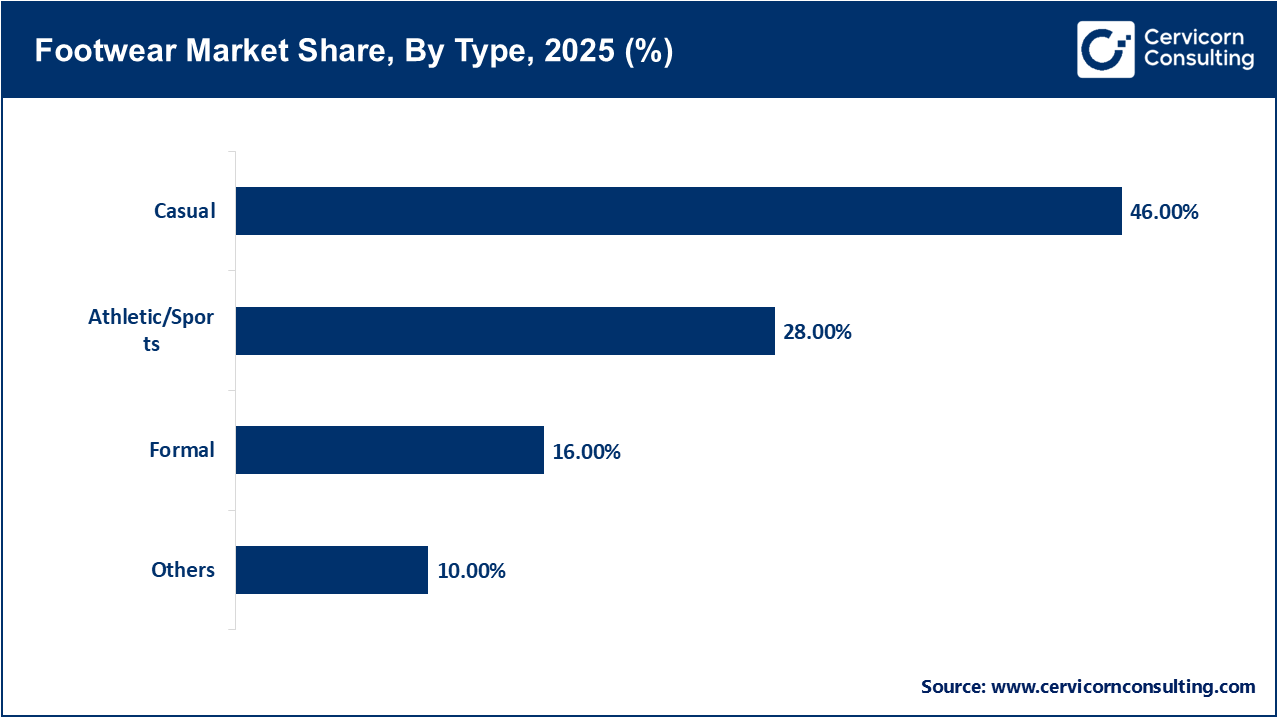
Athletic and sports footwear is the fastest-growing segment of the market, primarily because of the "aspirational" aspect of the products. Consumers buy athletic shoes not just for performance and comfort, but also to reflect their commitment to an active lifestyle. Previously, growth in athletic footwear came from limited-edition releases and collaborations with influencers or athletes, but now sneaker culture has become a major driver of growth in athletic footwear. This segment leads in technological innovation, with brands constantly developing the lightest foams, most responsive carbon plates, and highly breathable materials.
End User Analysis
The men's footwear segment holds a leadership position in the footwear market, especially in athletic footwear and the luxury formal category. This leadership has been developed through footwear inspired by the early stages of sneakerhead culture, as well as by integrating technical innovation focused on male athletes. For example, consumers are beginning to shift away from traditional formal shoes toward "hybrid" footwear that combines the aesthetics of a dress shoe with the comfort of an athletic sole. This reflects a change in the modern male consumer's attitudes toward footwear.
Footwear Market Share, By End User, 2025 (%)
| End User |
Revenue Share, 2025 (%) |
| Men |
48% |
| Women |
38% |
| Kids |
14% |
The women's segment is the fastest-growing user group in the market, mainly due to increasing women’s participation in the workforce across countries, which raises demand for both casual and formal footwear. The women’s footwear category is expanding rapidly and evolving as brands shift from generic designs to products specifically developed for female biomechanics, rather than simply resizing existing styles. Additionally, growth is further supported by strong demand for women-specific performance footwear, running shoes, yoga-inspired footwear, and the rapidly growing "power sneaker" segment for professional and everyday use.
Distribution Channel Analysis
Supermarkets and hypermarkets lead the segment because of their easy accessibility and one-stop shopping experience. These retailers capture a large share of essential footwear sales by offering high-volume, affordable footwear typically associated with basic trainers, flip-flops, and children's shoes. Consumers prefer purchasing footwear in "one-stop shops" because they can buy their daily essentials and footwear in the same trip. Additionally, for a large portion of the global population, traditional retail stores remain a necessary touchpoint, allowing customers to feel for fit, comfort, and perform immediate quality checks before purchase.
Footwear Market Share, By Distribution Channel, 2025 (%)
| Distribution Channel |
Revenue Share, 2025 (%) |
| Supermarket/Hypermarket |
38% |
| Online/E-Commerce |
28% |
| Specialty Store |
20% |
| Others |
14% |
Online and e-commerce are the fastest-growing distribution channels, primarily because they remove geographic barriers and enable brands and retailers to reach consumers directly across regions. Advanced technology such as AR for virtual try-on and improved sizing algorithms have reduced the traditional barriers that required in-store fitting. Furthermore, many large global brands are increasingly shifting toward a direct-to-consumer (DTC) model to eliminate wholesale distribution channels, improve profit margins, and gain direct access to consumer data.
Recent Developments
- In January 2025, Adidas AG introduced the Predator 25 football boot, showcasing improved grip and advanced material upgrades as part of its continued focus on product innovation.
- In February 2025, Nike partnered with SKIMS to launch NikeSKIMS, a new line designed to offer inclusive activewear, footwear, and accessories tailored for women.
- In March 2025, Nike unveiled the Air Max Dn8, a performance sneaker that blends enhanced cushioning with a bold design to meet the needs of both athletes and style-conscious consumers.
Market Segmentation
By Type
- Casual
- Athletic/Sports
- Formal
- Others
By End User
By Distribution Channel
- Supermarket/Hypermarket
- Online/E-Commerce
- Specialty Store
- Others
By Region
- North America
- APAC
- Europe
- LAMEA