E-commerce Packaging Market Size and Growth 2026 to 2035
The global e-commerce packaging market size reached at USD 103.85 billion in 2025 and is expected to be worth around USD 453.14 billion by 2035, exhibiting at a compound annual growth rate (CAGR) of 15.9% over the forecast period 2026 to 2035. The growth of the e-commerce packaging market is primarily attributed to the ongoing expansion of online shopping and the resulting increase in shipment volumes. Currently, global e-commerce sales represent over 20% of total retail sales, which has led to a notable rise in parcel shipments each year. This trend has significantly increased the demand for durable and protective packaging, particularly in sectors such as electronics, cosmetics, and food, where preventing product damage is essential. Recent studies indicate that product damage and returns may account for as much as 10–15% of the total order value for online retailers, highlighting the importance of optimized packaging solutions.
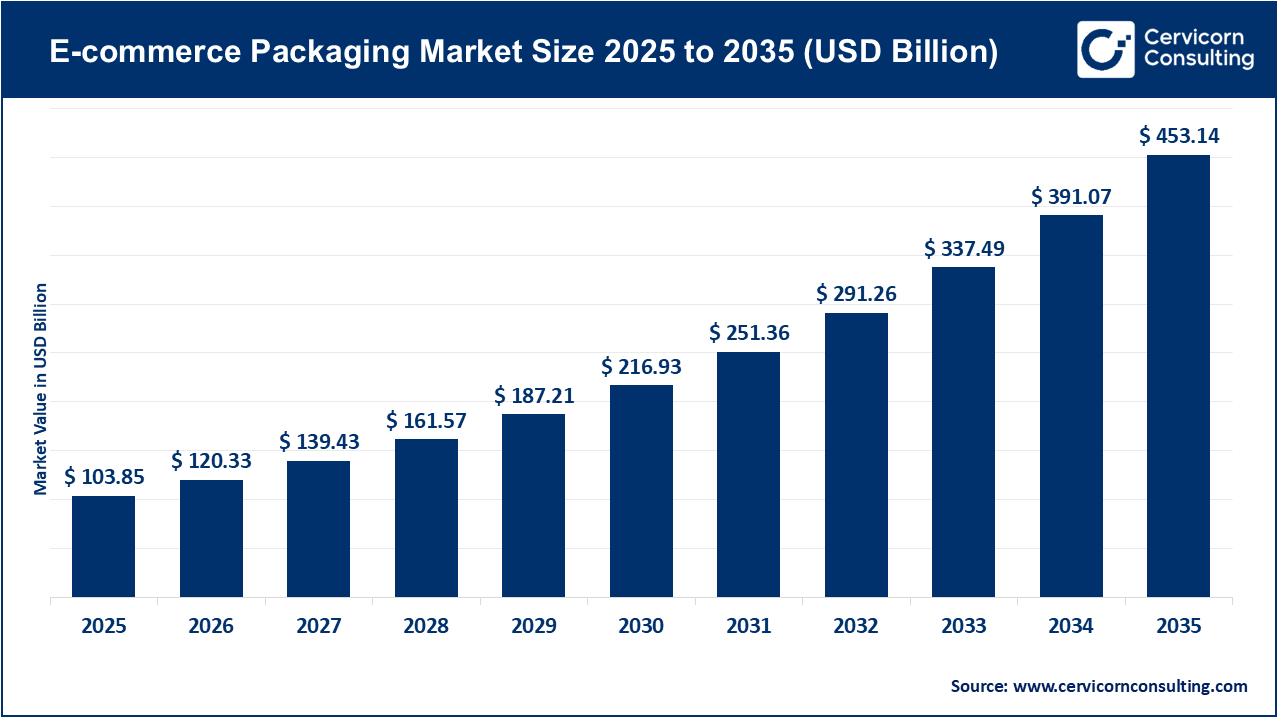
Additionally, there is a marked shift toward sustainable and lightweight packaging, as more than 60% of consumers now prefer brands that utilize recyclable or eco-friendly materials. This has encouraged companies to adopt paper-based and biodegradable packaging options. Corrugated boxes continue to dominate the market due to their recyclability and cost-effectiveness, making them the preferred choice for most e-commerce shipments. At the same time, the demand for customized and branded packaging is rising, with nearly 40% of consumers reporting that premium packaging influences their decision to make repeat purchases and shapes their perception of the brand. It can be deduced that these evolving consumer preferences and operational requirements are set to further drive the growth of the e-commerce packaging market.
Report Highlights
- Asia-Pacific leads the global market with 45.6% share, driven by massive e-commerce volumes in China, India, and Southeast Asia, supported by expanding logistics networks and government-led sustainability initiatives.
- Corrugated boxes dominate the product segment with 38.6% share, due to their strength, cost efficiency, recyclability, and compatibility with automated fulfillment and right-sizing technologies.
- Apparels and accessories represent the largest application segment at 26.9% share, supported by high shipment frequency, lightweight packaging needs, and rapid growth of online fashion platforms.
- Electronics and electrical packaging holds 18.7% share and is among the fastest-growing applications, driven by rising online sales of high-value and fragile products requiring advanced protective packaging.
Explosive Growth of Online Retail GMV Driving the Market
The rapid increase in online retail Gross Merchandise Value (GMV) is a major factor driving the e-commerce packaging market. As online sales grow, each transaction results in more parcels that require protective and delivery-ready packaging. Global e-commerce GMV is rising at double-digit rates each year, and international markets are handling millions of packages daily. The expansion of online transactions across various product categories, including electronics and groceries, is increasing the consumption of packaging materials worldwide. This growth in order volumes is directly raising the demand for corrugated boxes, mailers, and protective wraps. As a result, the need for innovative and efficient packaging solutions is expected to grow along with the continued rise in e-retail activity.
Rising E-commerce Penetration Fueling Sustained Growth in the E-commerce Packaging Market
The steady increase in global retail e-commerce sales is significantly contributing to the growth of the e-commerce packaging market. As recent data shows, the share of e-commerce in total retail is expected to rise from approximately 18.8% to 22.6% between 2021 and 2027. This ongoing expansion results in a greater number of individual shipments, even as growth rates stabilize. Consequently, there is a rising demand for corrugated boxes, protective packaging, mailers, and tapes to accommodate frequent and smaller-sized deliveries. The increasing penetration of online retail is also encouraging companies to adopt right-sized, automated, and sustainable packaging solutions. This trend is likely to strengthen long-term demand for advanced packaging across fulfillment and logistics sectors.
Recent Major Milestones
1. L’Oréal’s EUR 100 Mn Sustainability Accelerator for Packaging Innovation
In early 2026, L’Oréal introduced its first accelerator program focused on sustainability, committing EUR 100 million over five years to support startups working on recyclable, biodegradable, and circular packaging solutions. These include fiber-based caps, materials derived from seaweed, and biodegradable wood packaging alternatives. The program is designed to speed up the development and market entry of advanced sustainable packaging technologies. As a result, innovation is being integrated into e-commerce supply chains, where environmental performance and brand differentiation are increasingly important for purchasing decisions.
2. China’s National Green Packaging Mandate for E-Commerce
China’s government has launched a Green Packaging Initiative that requires major online retailers to switch to recyclable, reusable, or compostable packaging formats and to report on material use and recovery by 2030. Since China’s e-commerce platforms process over 100 billion parcels each year, this policy is changing how packaging materials are chosen, recovered, and reused throughout the logistics chain. This is expected to drive widespread adoption of sustainable solutions and increase demand for packaging technologies that meet these requirements.
3. EU Packaging and Packaging Waste Regulation (PPWR) Implementation
The European Union adopted the Packaging and Packaging Waste Regulation (PPWR) in late 2024, with important provisions starting in 2025. This regulation sets consistent packaging sustainability requirements across member states and focuses on reuse, recyclability, and reducing waste. For e-commerce brands selling in the EU, these rules provide a strong reason to redesign packaging portfolios. This is likely to encourage innovation, support the use of circular materials, and lead to more investment in recyclable and lightweight packaging that meets regulatory standards.
4. CMC Packaging Automation’s Advanced Automated Systems Rollout
CMC Packaging Automation, a leading packaging technology provider, introduced several advancements at industry events in 2024 and 2025, such as the CartonWrap DUO and the AI-enabled Genesys Prima system. These solutions optimize right-sized box production, reducing material usage by up to 50% and adhesive use by up to 70%. As a result, e-commerce fulfillment centers are able to reduce waste, increase throughput, and lower operational costs. These developments are expected to strengthen the case for automated, sustainable packaging and support wider adoption across logistics networks.
Market Dynamics
Market Drivers
- Rising Online Order Volumes and Parcel Shipments: The steady increase in online shopping is a key factor driving the demand for e-commerce packaging. Each online transaction requires both primary and secondary packaging to ensure products are shipped securely. As order frequency rises and models such as same-day delivery and cross-border e-commerce become more common, parcel volumes have grown considerably. This trend is encouraging retailers and logistics providers to invest in packaging solutions that are durable, scalable, and cost-effective in order to manage higher volumes efficiently.
- Demand for Product Protection and Brand Experience: Packaging plays a crucial role in e-commerce by protecting products from damage during transit and contributing to a positive customer experience. As concerns about returns, replacements, and overall customer satisfaction continue to grow, companies are increasingly adopting packaging that is protective, customized, and branded. These approaches help ensure products arrive safely and also reinforce brand perception, which in turn supports the ongoing growth in demand for e-commerce packaging.
Market Restraints
- Volatility in Raw Material Prices: Variations in the prices of key raw materials, including paper, corrugated board, plastics, and adhesives, present significant challenges for packaging manufacturers. When costs rise unexpectedly, profit margins are reduced and pricing becomes less predictable. This issue is particularly challenging for small and medium-sized suppliers who often operate under long-term contracts with major e-commerce platforms.
- High Cost of Sustainable Packaging Alternatives: While there is a growing demand for environmentally friendly packaging, sustainable materials typically have higher costs than traditional alternatives. This situation creates challenges for e-commerce sellers who are sensitive to costs, especially in emerging markets where affordability is often prioritized over investments in sustainability.
Market Opportunities
- Growth of Sustainable and Circular Packaging Solutions: The increasing global focus on sustainability is creating significant opportunities for recyclable, biodegradable, and reusable packaging in the e-commerce sector. Both brands and regulatory bodies are showing a preference for solutions that minimize waste, which is driving demand for paper-based packaging, molded fiber, mono-material designs, and reusable shipping systems that support circular economy objectives.
- Advancements in Packaging Automation and Right-Sizing: Advancements in automated and right-sized packaging systems represent a significant growth opportunity for the e-commerce packaging market. These technologies enable companies to reduce material waste, decrease shipping costs, and enhance fulfillment efficiency. As a result, there is increasing demand for smart packaging equipment and customized box-on-demand solutions.
Market Challenges
- Balancing Sustainability with Cost Efficiency: Achieving sustainability targets without raising overall packaging costs remains a major challenge for the e-commerce sector. Companies are required to balance their environmental commitments with the need to remain profitable. At the same time, consumers increasingly expect both sustainable packaging and affordable delivery, which places additional pressure on the entire supply chain.
- Complex Regulatory and Compliance Requirements: Suppliers of e-commerce packaging are encountering increasing challenges due to changing regulations on packaging waste, labeling, and recyclability in various regions. Ensuring compliance in multiple markets adds to operational complexity and often requires ongoing adjustments to packaging formats in order to meet both local and international requirements.
E-commerce Packaging Market Regional Analysis
The e-commerce packaging market is segmented into North America, Europe, Asia-Pacific, and LAMEA. Here is a brief overview of each region:
North America E-commerce Packaging Market: Driven by High Online Retail Penetration and Sustainability Investment
The North America e-commerce packaging market size was valued at USD 28.45 billion in 2025 and is predicted to grow around USD 124.16 billion by 2035. The North America is experiencing significant growth due to the widespread adoption of online retail, advanced logistics infrastructure, and an increasing focus among companies on sustainability and packaging efficiency. Major e-commerce platforms, including Amazon, are implementing right-sizing technologies and working to reduce single-use plastics. For example, Amazon has reported a 16% reduction in plastic packaging use by expanding the use of paper and recyclable materials. Rising consumer expectations for sustainability and convenience are further driving the adoption of recyclable boxes, mailers, and automated fulfillment systems across the region.
Recent Developments:
- Amazon’s reduction in single-use plastic packaging and expanded use of right-sized, recyclable solutions.
- Growth in reusable packaging pilots by major retailers driven by sustainability regulations and ESG commitments.
Asia-Pacific (APAC) E-commerce Packaging Market: Driven by Rapid E-Commerce Expansion and Digital Adoption
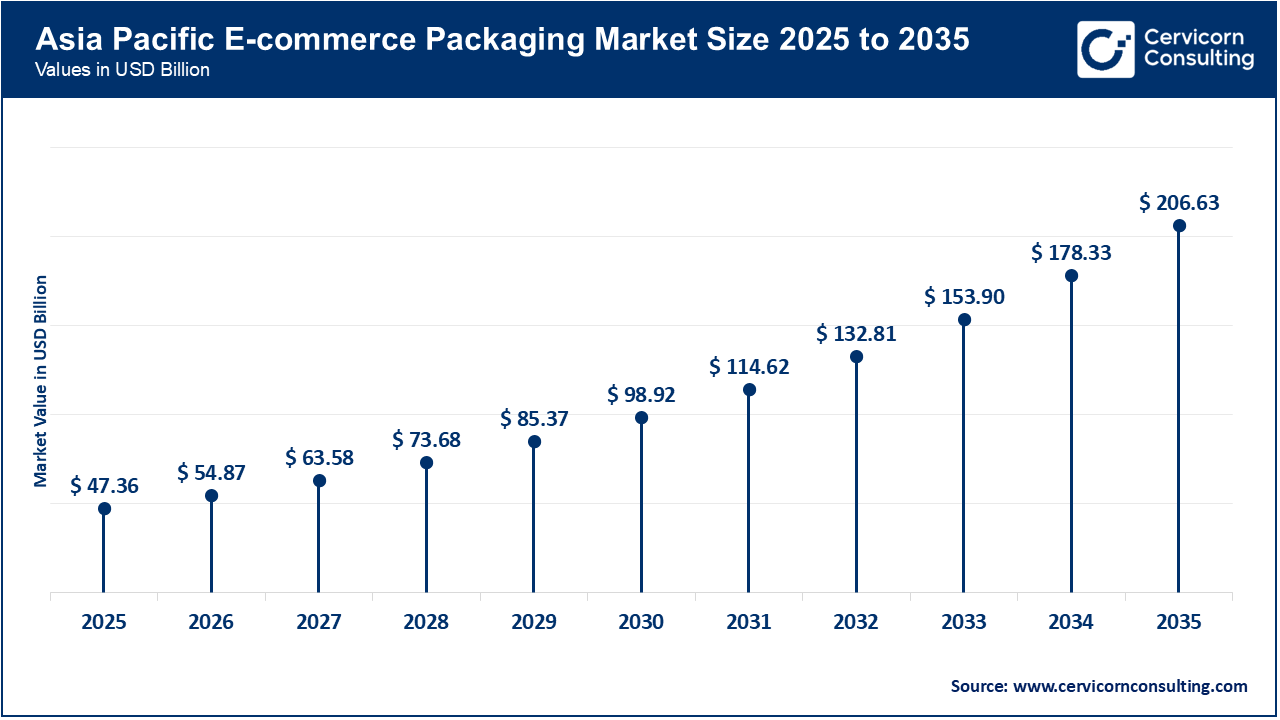
The Asia-Pacific e-commerce packaging market size was estimated at USD 47.36 billion in 2025 and is forecasted to surpass around USD 206.63 billion by 2035. The Asia-Pacific region is witnessing rapid expansion in the market, driven by strong growth in online retail, rising internet and smartphone usage, and a growing middle-class population in countries such as China, India, and those in Southeast Asia. Moreover, the regional growth is also supported by increasing demand for protective, branded, and sustainable delivery solutions. Regulatory measures encouraging the use of eco-friendly materials, along with significant investments in logistics and fulfillment infrastructure, are further supporting the market’s development.
Recent Developments:
- China’s green packaging regulations requiring biodegradable or recyclable mailers and tapes by 2025.
- Australia’s National Packaging Targets for 100% reusable/recyclable packaging by end-2025.
- India’s new e-commerce export hubs with standardized sustainable packaging support.
Europe E-commerce Packaging Market: Driven by Regulatory Push for Sustainable Packaging
The Europe e-commerce packaging market size was reached at USD 22.02 billion in 2025 and is projected to hit around USD 96.07 billion by 2035. Europe is being shaped by strict environmental regulations and a high level of consumer demand for sustainable packaging solutions. The EU Packaging and Packaging Waste Regulation, which will take effect in August 2026, sets higher standards for recyclability, requires minimum recycled content, and introduces harmonized sustainability requirements across EU member states. These regulations are directly influencing the design and materials used in e-commerce packaging. With packaging recycling rates reaching 75% in Europe, regulatory and consumer pressures are accelerating the shift toward circular and lighter packaging formats.
Recent Developments:
- EU Packaging & Packaging Waste Regulation (PPWR) rollout with new sustainability and labelling requirements.
- Proposed EU customs duty on low-value e-commerce parcels to address market distortion and environmental concerns.
- L’Oréal Group’s EUR 100 Mn sustainability accelerator impacting EU and global packaging innovations.
E-commerce Packaging Market Share, By Region, 2025 (%)
| Region |
Revenue Share, 2025 (%) |
| Asia-Pacific |
45.6% |
| North America |
27.4% |
| Europe |
21.2% |
| LAMEA |
5.8% |
LAMEA E-commerce Packaging Market: Driven by Rising Digital Commerce and Logistics Upgrades
The LAMEA e-commerce packaging market was valued at USD 6.02 billion in 2025 and is anticipated to reach around USD 26.28 billion by 2035. LAMEA region is expanding as a result of increased online shopping, higher internet penetration, and ongoing improvements in logistics and warehousing infrastructure. While the market size remains smaller compared to Western regions, countries such as Brazil, Mexico, and those in the Gulf are experiencing rapid growth as more consumers turn to digital retail platforms. There is a rising investment in secure and lightweight packaging solutions to ensure product protection during longer and more complex delivery routes. Modernization of infrastructure and growing competition are encouraging local packaging providers to adopt more efficient materials and designs.
Recent Developments:
- Expansion of last-mile logistics networks in GCC and South Africa to better support e-commerce flows.
- Increased smartphone and internet penetration boosting online purchases in Latin America.
E-commerce Packaging Market Segmental Analysis
The e-commerce packaging market is segmented into product, material, application, and region.
Product Analysis
The e-commerce packaging market is largely driven by the widespread adoption of corrugated boxes, which are favored for their strength, versatility, and cost efficiency. These boxes are extensively utilized across various product categories, including electronics, apparel, household goods, and food, as they provide reliable protection during extended shipping processes. The integration of automation, along with the ease of customization and high recyclability, has further contributed to the increased use of corrugated boxes. Moreover, the ability of these boxes to support right-sizing technologies enables e-commerce companies to minimize void fill and reduce logistics costs. As a result, corrugated boxes have become the preferred packaging solution for high-volume online shipments.
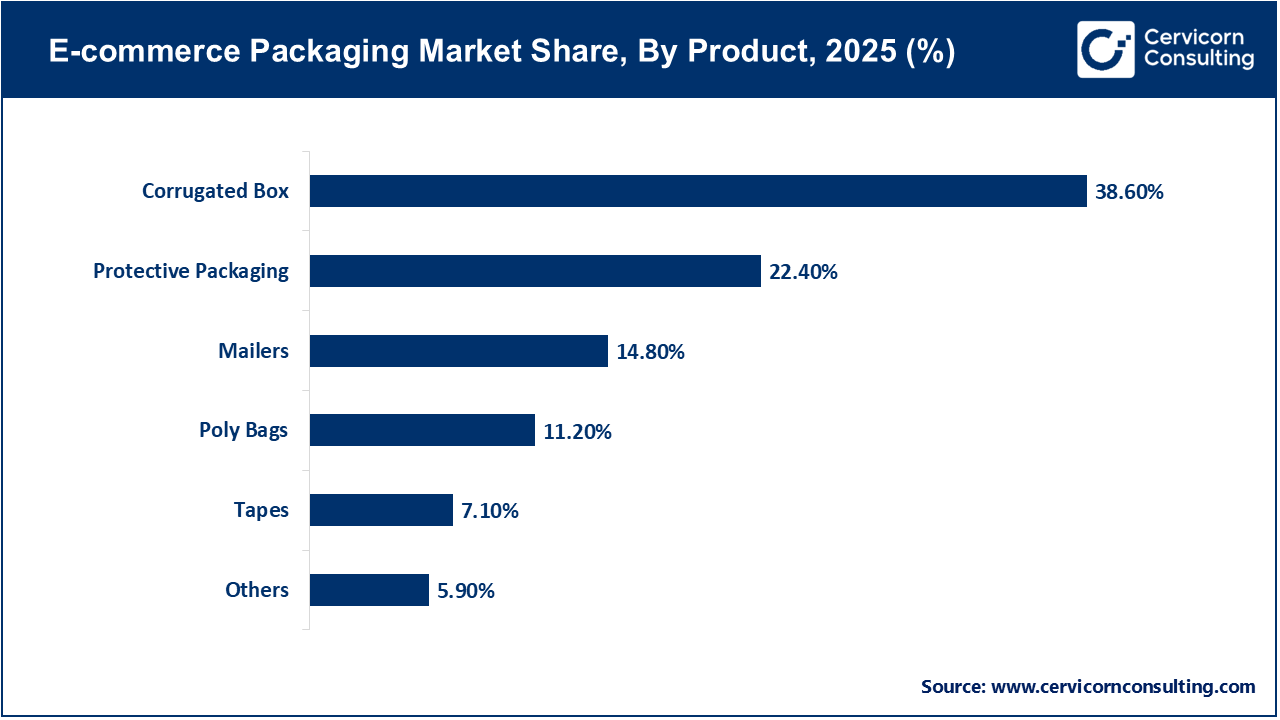
Protective packaging has emerged as the fastest-growing segment. This growth is primarily driven by the increasing volume of shipments containing fragile, high-value, and sensitive products such as electronics, cosmetics, and pharmaceuticals. As return rates due to transit damage continue to rise, there is a greater need for advanced cushioning solutions, including air pillows, molded pulp, bubble wraps, and paper-based fillers. Ongoing innovation in lightweight and sustainable materials is also contributing to the segment's expansion, as these materials help reduce product damage while addressing environmental concerns. As a result, protective packaging is becoming an essential part of e-commerce fulfillment strategies, enabling companies to ensure product safety and meet sustainability goals.
Material Analysis
Corrugated board is the leading material in the e-commerce packaging market due to its durability, lightweight properties, and high recyclability. This material provides a balance between protection and cost, which makes it suitable for various e-commerce uses. The widespread availability of raw materials, established recycling systems, and regulatory encouragement for paper-based packaging further strengthen its position. Corrugated board also supports sustainability initiatives, allowing brands to reduce plastic consumption and meet the growing demand for environmentally friendly packaging.
E-commerce Packaging Market Share, By Material, 2025 (%)
| Material |
Revenue Share, 2025 (%) |
| Corrugated Board |
52.3% |
| Paper and Paperboard |
21.6% |
| Plastic |
23.1% |
| Woods |
3.0% |
Paper and paperboard represent the fastest-growing segment in e-commerce packaging, mainly because of increasing awareness about sustainability and regulations aimed at reducing plastic waste. These materials are now widely used in mailers, void fillers, and secondary packaging, as their biodegradability and recyclability make them attractive options. Many brands are shifting to paper-based protective packaging to address consumer demand for environmentally responsible solutions. Recent improvements in paper strength and coating technologies are also contributing to the rapid adoption of these materials across e-commerce platforms.
Application Analysis
The apparel and accessories segment holds a leading position in the market, mainly because of the high frequency of online purchases and rapid inventory turnover. Clothing items are typically shipped in lightweight, flexible, and cost-effective packaging materials, including poly bags, mailers, and corrugated boxes, which are suitable for handling large shipment volumes. The ongoing growth of global fashion e-commerce, along with frequent promotional campaigns and easy return policies, continues to drive steady demand for packaging solutions. Furthermore, the importance of branding and the unboxing experience has led to a greater use of customized and premium packaging formats in this segment.
E-commerce Packaging Market Share, By Application, 2025 (%)
| Application |
Revenue Share, 2025 (%) |
| Apparels and Accessories |
26.9% |
| Electronics and Electrical |
18.7% |
| Food and Beverages |
16.4% |
| Personal Care |
12.1% |
| Household |
10.3% |
| Pharmaceutical |
7.6% |
| Pet Food |
4.2% |
| Others |
3.8% |
Electronics and electrical products represent the fastest-growing segment, primarily due to increasing online sales of smartphones, consumer electronics, and smart devices. These products require strong, multi-layer protective packaging to ensure safe delivery, which has led to higher demand for specialized materials and cushioning solutions. The segment's growth is also supported by higher average order values, the expansion of cross-border e-commerce, and the growing preference of consumers to purchase electronics online. As a result, packaging performance and reliability have become essential considerations for this market.
E-commerce Packaging Market Top Companies
Recent Developments by Major Companies
- In January 2026, Amcor presented its expanded range of rigid and flexible packaging at Packaging Innovations & Empack 2026, focusing on new solutions that support sustainability and e-commerce efficiency. This move responds to the increasing demand for lightweight and recyclable packaging, while also aiming to improve logistics for consumer goods brands. With these developments, Amcor is likely to enhance its position in important markets and drive the adoption of eco-friendly packaging throughout global e-commerce supply chains.
- In April 2025, Berry Global was acquired and merged with Amcor, forming a larger global packaging company with expanded material science and product capabilities. This strategic move increases Berry’s market reach and supports faster innovation in sustainable packaging for e-commerce customers. The combined company is expected to offer a wider product portfolio and better service to multinational brands.
- In December 2024, Gerresheimer acquired Blitz LuxCo Sarl, the parent company of Bormioli Pharma Group, which has significantly strengthened its pharmaceutical packaging portfolio in Europe. Through this acquisition, Gerresheimer can now provide a broader range of high-quality glass and plastic packaging for sensitive products. This supports the growing e-commerce distribution in pharmaceutical and healthcare sectors.
Market Segmentation
By Product
- Protective Packaging
- Tapes
- Poly Bags
- Mailers
- Corrugated Box
- Others
By Material
- Corrugated Board
- Paper And Paperboard
- Plastic
- Woods
By Application
- Food And Beverages
- Personal Care
- Apparels And Accessories
- Pharmaceutical
- Household
- Pet Food
- Electronics And Electrical
- Others
By Region
- North America
- APAC
- Europe
- LAMEA