Drug Discovery Services Market Size and Growth 2026 to 2035
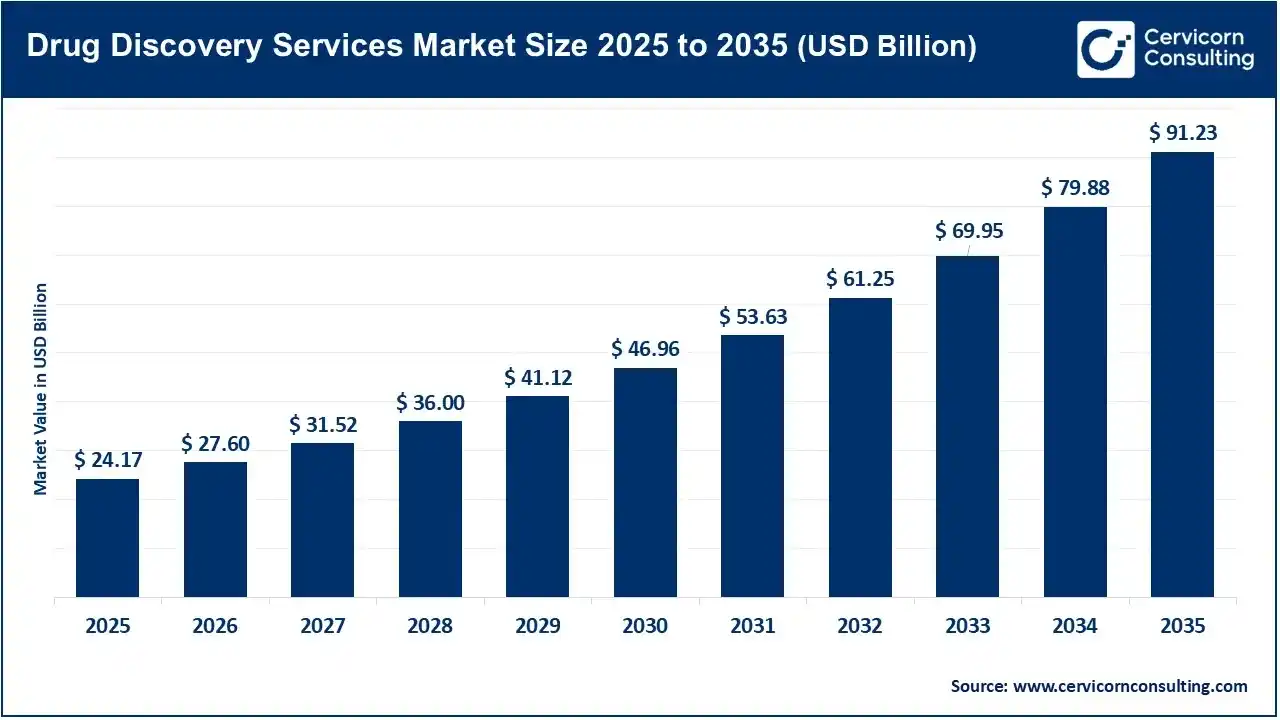
The global drug discovery services market size was valued at USD 24.17 billion in 2025 and is projected to grow from USD 27.60 billion in 2026 to nearly USD 91.23 billion by 2035, registering a CAGR of 14.21% over the forecast period 2026 to 2035. The drug discovery services market is growing due to rising R&D spending and increasing outsourcing.
Pharmaceutical and biotechnology businesses are increasingly outsourcing research activities to specialized service providers, which is driving the market for drug discovery services. This is due to the need to expedite drug development timelines, increase R&D efficiency, and meet the growing demand for new treatments. The efficiency of drug discovery is being further enhanced by developments in AI, genomics, and high-throughput screening. The expansion of the sector is also being aided by growing partnerships between pharmaceutical companies and contract research organizations.
- In July 2026, Mankind Pharma partnered with Denovo Sciences to launch an AI-led drug discovery program, combining AI-driven molecular generation with Mankind Pharma’s R&D and clinical development capabilities to accelerate the discovery of promising drug candidates.
Key Takeaways
- By region, North America dominated the market in 2025 with revenue share of 38%, supported by strong pharmaceutical research and advanced drug development infrastructure.
- By region, Asia Pacific is expected to register the fastest growth, driven by rising R&D investments and increasing outsourcing activities.
- By type, chemistry services accounted for highest revenue share of 55% in 2025, supported by extensive use in compound synthesis and lead optimization.
- By type, biology services are expected to register the fastest growth, driven by increasing demand for target validation and biological screening.
- By drug type, biologics drugs dominated the market in 2025, supported by the growing development of complex biological therapies.
- By drug type, small molecule drugs are expected to register the fastest growth, driven by demand for targeted and innovative therapies.
- By therapeutic area, cardiovascular diseases dominated the market in 2025, supported by continued research into cardiovascular treatments.
- By therapeutic area, oncology is expected to register the fastest growth, driven by rising cancer prevalence and investment in novel therapies.
- By end user, pharmaceutical & biotechnology companies generated revenue share of 76% in 2025, supported by extensive drug pipelines and outsourcing demand.
- By end user, academic institutes are expected to register the fastest growth, driven by growing research collaborations and commercialization of discoveries.
Government Initiatives
| Country |
Government initiative / program |
Key focus and relevance to drug discovery services |
| United States |
NIH drug development funding programs and ARPA-H |
Federal programs support drug discovery and development research, including translational research, therapeutic development, and movement of promising candidates toward clinical development. NIH programs can provide funding across stages of the small-molecule development pipeline, while ARPA-H supports high-impact biomedical innovation. |
| United Kingdom |
Life Sciences Sector Plan and Life Sciences Innovative Manufacturing Fund |
The UK government is strengthening its life sciences ecosystem through public funding and industry investment aimed at advancing medicines, vaccines, manufacturing capabilities, and innovation. In 2026, more than £80 million of new investment was announced under the Life Sciences Innovative Manufacturing Fund, supporting medicines-related projects and strengthening domestic life-science capabilities. |
| China |
National-level pharmaceutical R&D and biomedical innovation programs |
China continues to prioritize biomedical innovation and pharmaceutical R&D through government-supported research programs and investments in advanced life-science capabilities. These initiatives support development of innovative medicines and strengthen the country's domestic drug discovery and development ecosystem. |
| India |
Promotion of Research and Innovation in Pharma MedTech Sector (PRIP) |
The ₹5,000 crore PRIP scheme is designed to strengthen India's pharma and MedTech R&D ecosystem, with funding focused on new medicines, complex generics, biosimilars, and novel medical devices. The program includes seven Centres of Excellence at NIPERs and financial support for industry, startups, and academia engaged in R&D and commercialization. |
| Japan |
AMED Innovative Drug Discovery and Development programs |
Japan's AMED supports drug discovery from early-stage research through clinical research and trials, including platform technologies, drug-discovery seeds, and technologies for next-generation treatments. Its Medical Innovation Ecosystem programs also promote collaboration among government, academia, pharmaceutical companies, and investors to accelerate commercialization. |
Key Trends
- AI-Powered Drug Discovery: Increasing use of AI and machine learning for target identification, molecule generation, lead optimization, and candidate selection.
- Cloud-Based Research Platforms: Growing adoption of cloud technologies enables faster data analysis, secure collaboration, and scalable drug discovery workflows.
- Rising CRO Outsourcing: Pharmaceutical and biotechnology companies are increasingly outsourcing discovery activities to CROs to access specialized expertise and advanced technologies.
- Multi-Omics Integration: Integration of genomics, proteomics, and other omics data is improving target validation and supporting more precise drug development.
- Automation & High-Throughput Screening: Automated laboratory systems and high-throughput screening are accelerating the identification and evaluation of potential drug candidates.
Market Dynamics
Driver
Rising Pharmaceutical R&D Spending and Growing Drug Development Complexity
Growing pharmaceutical R&D expenditures and the increasing complexity of drug development are driving the market for drug discovery services. In order to have access to cutting-edge expertise, advanced technology, and faster development capabilities, pharmaceutical and biotechnology companies are increasingly contracting out specialized research to CROs. The need for drug discovery services is being further supported by the rising demand for novel and targeted treatments.
- In September 2026, Boehringer Ingelheim partnered with Owkin to use an AI research platform and patient data to accelerate drug discovery in cancer and immunology, demonstrating the increasing use of advanced technologies in pharmaceutical research.
Restraint
High Drug Discovery Costs and Regulatory Compliance Challenges
High research expenses, intricate development procedures, and strict regulatory requirements limit the market for drug discovery services. Significant investment is needed for advanced screening technologies, specialized laboratories, qualified personnel, and data infrastructure. Companies that outsource sensitive research tasks may also face difficulties related to regulatory compliance, data security, confidentiality, and intellectual property protection.
- In February 2026, IQVIA agreed to acquire selected drug discovery assets from Charles River Laboratories, including in-vitro discovery services and an AI platform. The transaction highlights the substantial technology, infrastructure, and scientific expertise required to provide advanced drug discovery services.
Opportunity
AI-Powered Drug Discovery and Automated Screening Technologies
Through automated screening, AI-powered discovery, and advanced computational technologies, the sector offers substantial opportunities. These techniques can enhance the integration of chemical and biological data and help researchers identify potential drug candidates more quickly. Pharmaceutical companies' growing use of these technologies is opening up new business opportunities for providers of specialized discovery services.
Regional Analysis
Why did North America dominate the drug discovery services market?
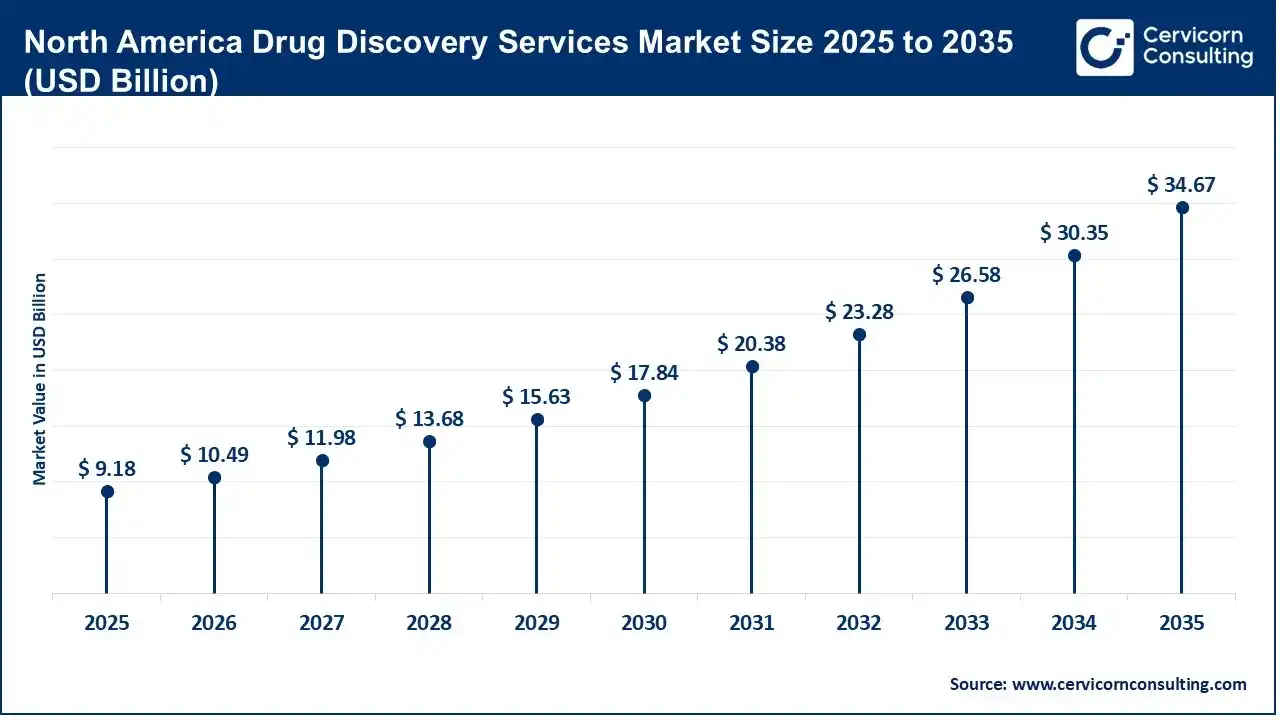
The North America drug discovery services market size was valued at USD 9.18 billion in 2025 and is projected to reach USD 34.67 billion by 2035. North America dominated the drug discovery services market, supported by its sophisticated research infrastructure and well-established biotechnology and pharmaceutical industries. Strong outsourcing activity is supported by the presence of leading drug developers and contract research organizations. The region's market position is further reinforced by significant investment in cutting-edge drug development technologies. It is anticipated that the region's dominance will be sustained by strong research capabilities and ongoing adoption of advanced discovery technologies.
Why is Asia Pacific expected to be the fastest-growing region in the drug discovery services market?
The Asia-Pacific drug discovery services market size was valued at USD 6.04 billion in 2025 and is projected to reach USD 22.81 billion by 2035. Asia Pacific is expected to be the fastest-growing region in the drug discovery services market, propelled by growing R&D investments and the expansion of the biotechnology and pharmaceutical industries. Outsourcing activities are being attracted by the availability of qualified scientists and cost-effective research capabilities. Regional growth is being further supported by expanding partnerships between international pharmaceutical companies and local service providers. Growing local research infrastructure and government support for life sciences are generating more growth prospects throughout the region.
Drug Discovery Services Market Share, By Region, 2025 (%)
| Region |
Revenue Share, 2025 (%) |
| North America |
38% |
| Europe |
27% |
| Asia-Pacific |
25% |
| LAMEA |
10% |
Segmental Analysis
Type Analysis
The chemistry services segment dominated the drug discovery services market, supported by its crucial role in lead optimization, compound synthesis, and hit identification. Pharmaceutical and biotechnology companies are being encouraged to outsource research due to the increasing demand for specialized medicinal chemistry expertise. Additional support for the segment comes from the need to expedite drug discovery timelines. The need for specialized service providers and advanced chemistry capabilities is also being driven by the growing complexity of drug candidates.
Drug Discovery Services Market Share, By Type, 2025 (%)
| Type |
Revenue Share, 2025 (%) |
| Chemistry Services |
55% |
| Biology Services |
45% |
The biology services segment is expected to be the fastest-growing segment in the drug discovery services market, propelled by the growing need for disease-model research, biological screening, and target validation. The use of biology services is increasing due to developments in proteomics, cell-based assays, and genomics. Growing adoption of precision medicine is contributing to the segment's expansion. It is anticipated that increased funding for cutting-edge biological research will open up new business opportunities for service providers.
Drug Type Analysis
The biologics drugs segment dominated the drug discovery services market, supported by growing advancements in recombinant proteins, vaccines, monoclonal antibodies, and other cutting-edge treatments. The intricate nature of biologics necessitates specialized testing and discovery capabilities. The demand for associated services is being further strengthened by pharmaceutical companies investing more in biologics research. Companies are being encouraged to work with specialized drug discovery providers due to the expanding pipeline of complex biological therapies.
Drug Discovery Services Market Share, By Drug Type, 2025 (%)
| Drug Type |
Revenue Share, 2025 (%) |
| Biologics Drugs |
42% |
| Small Molecule Drugs |
58% |
The small molecule drugs segment is expected to be the fastest-growing segment, fueled by the ongoing need for novel and targeted treatments. Drug development efforts are being supported by developments in lead optimization, medicinal chemistry, and compound screening. Growth is also being aided by the growing outsourcing of small molecule discovery initiatives. The widespread use of small molecule treatments across a variety of disease areas is also encouraging further research.
Therapeutic Area Analysis
The cardiovascular diseases segment dominated the drug discovery services market, supported by ongoing research into novel treatment options and the high prevalence of cardiovascular conditions. Treatments for heart failure, high blood pressure, and other cardiovascular conditions are being funded by pharmaceutical companies. Drug discovery efforts in this field are being supported by the growing demand for more effective treatments. Research investments in cardiovascular drug discovery are anticipated to be sustained by the need for innovative treatments and better disease management.
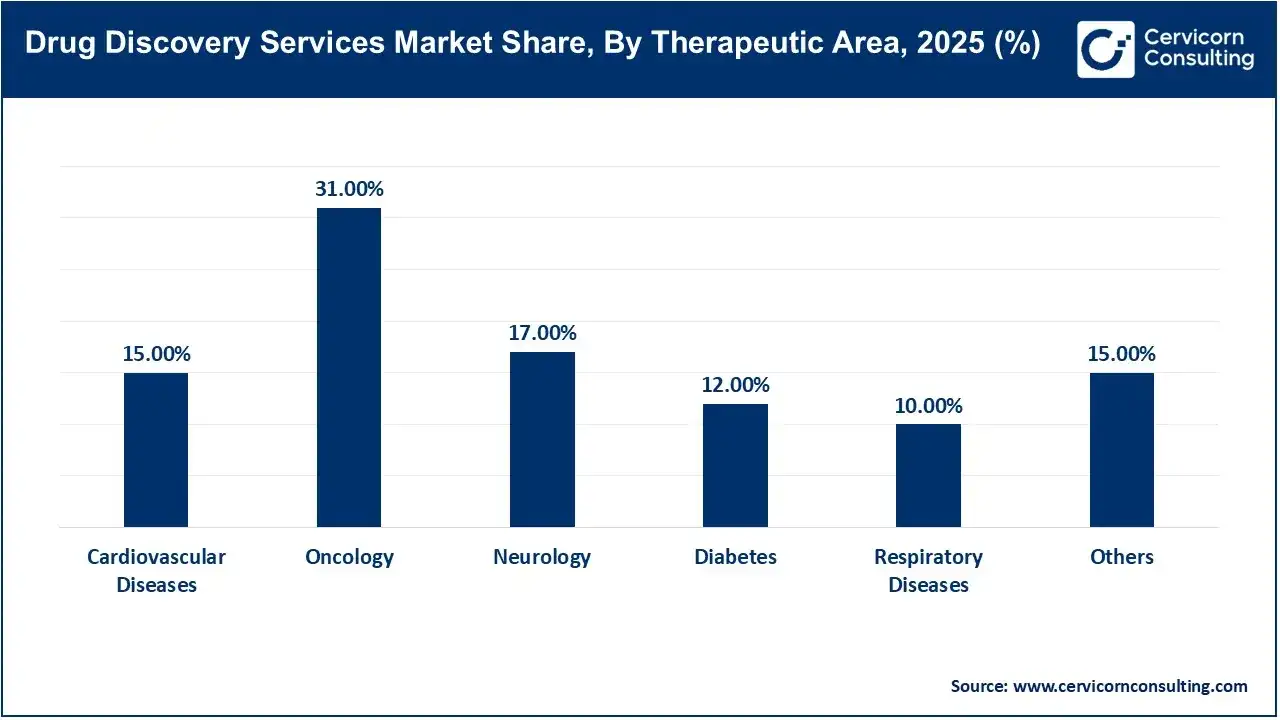
The oncology segment is expected to be the fastest-growing segment, driven by growing investment in cutting-edge cancer treatments and the increasing incidence of cancer. Opportunities are being created by expanding research in immuno-oncology, targeted therapy, and personalized medicine. Specialized oncology research is increasingly being outsourced by pharmaceutical companies. The demand for discovery services is being further accelerated by the development of biomarker-based therapies and next-generation cancer treatments.
End User Analysis
The pharmaceutical & biotechnology companies segment dominated the drug discovery services market, supported by sizable drug development pipelines and a growing dependence on external research resources. Access to cutting-edge technologies, specialized knowledge, and adaptable research capacity is made possible through outsourcing. Businesses are being encouraged to use drug discovery services by the need to shorten development timelines. It is anticipated that rising R&D spending and the increasing complexity of drug development initiatives will strengthen this segment's dominant position.
Drug Discovery Services Market Share, By End User, 2025 (%)
| End User |
Revenue Share, 2025 (%) |
| Pharmaceutical & Biotechnology Companies |
76% |
| Academic Institutes |
15% |
| Others |
9% |
The academic institutes segment is expected to be the fastest-growing segment, propelled by growing research partnerships between academic institutions and industry entities. Drug discovery efforts are being supported by increasing research funding and developments in biomedical sciences. Additionally, there is a growing need for specialized services as a result of the commercialization of academic research. Collaboration with service providers is growing as a result of a greater emphasis on converting laboratory research into viable drug candidates.
Recent Developments
- In July 2026, Mankind Pharma announced a strategic collaboration with Denovo Sciences to launch an AI-led drug discovery programme. The partnership combines Mankind Pharma’s R&D capabilities with Denovo’s AI-driven molecular generation and prioritization platform to improve the speed and quality of early drug discovery.
- In September 2026, Boehringer Ingelheim entered a licensing agreement with Owkin to access its AI research platform and patient data for drug discovery in cancer and immunology. The collaboration demonstrates the increasing use of AI and patient data to accelerate pharmaceutical research.
- In June 2026, SK Biopharmaceuticals entered into a research collaboration with Insilico Medicine to discover AI-enabled drug candidates for neuroimmune disorders, supporting the application of artificial intelligence in early-stage drug discovery. The partnership is expected to strengthen the use of AI-based approaches for identifying potential therapies for complex neurological conditions.
- In July 2026, Bora Pharmaceuticals announced a strategic alliance with Insilico Medicine to create an end-to-end AI-integrated drug development model using Insilico’s Pharma.AI platform. The alliance aims to integrate AI with formulation, CMC, scale-up, quality, regulatory, and manufacturing capabilities, supporting more efficient drug development.
- In June 2026, Bayer announced a drug discovery collaboration with Iambic Therapeutics to use Iambic’s AI-driven platform for small-molecule discovery and the identification of novel molecules for hard-to-drug targets. The collaboration highlights the growing use of AI platforms to improve early-stage drug discovery and expand pharmaceutical research pipelines.
Top Companies
Segments Covered
By Type
- Chemistry Services
- Biology Services
- By Drug Type
- Biologics Drugs
- Small Molecule Drugs
By Therapeutic Area
- Cardiovascular Diseases
- Oncology
- Neurology
- Diabetes
- Respiratory Diseases
- Other Therapeutic Areas
By End User
- Pharmaceutical & Biotechnology Companies
- Academic Institutes
- Other End Users
By Region
- North America
- Europe
- Asia Pacific
- Middle East & Africa
- South & Central America