Data Centre Certification Market Size and Growth 2026 to 2035
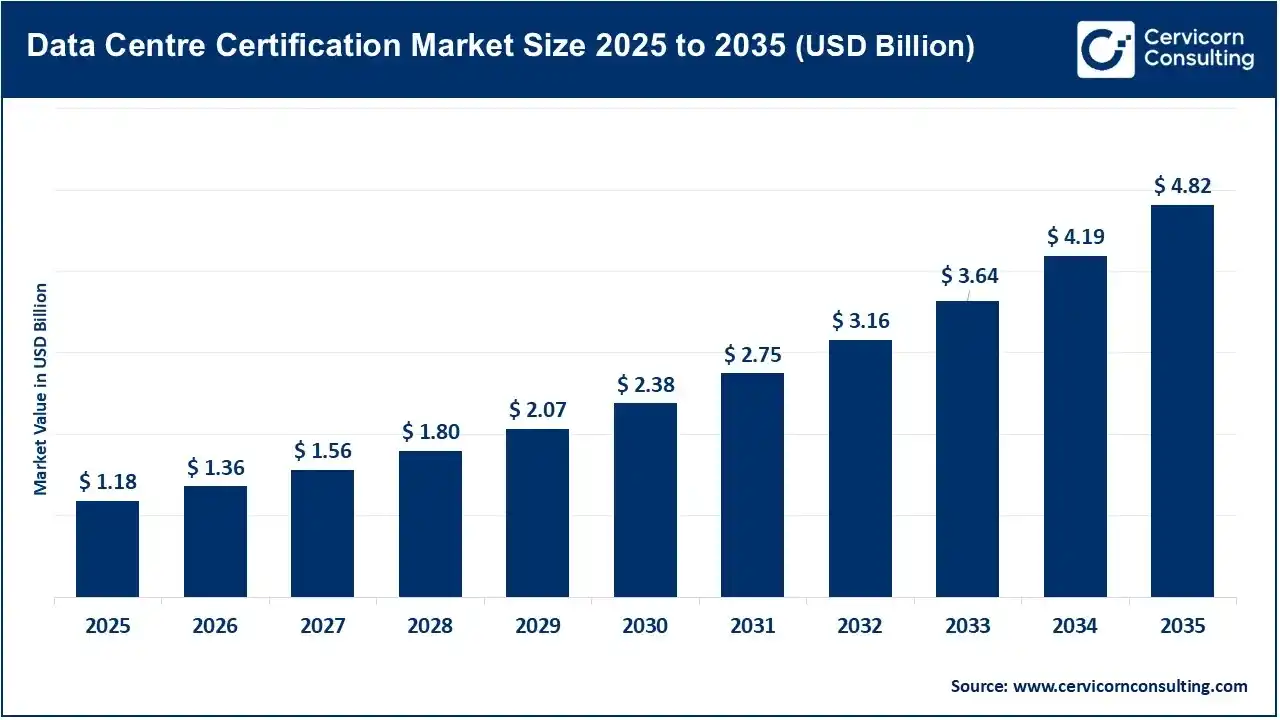
The global data centre certification market size was valued at USD 1.18 billion in 2025 and is projected to grow from USD 1.36 billion in 2026 to nearly USD 4.82 billion by 2035, registering a CAGR of 15.11% over the forecast period 2026 to 2035. The market is driven by the increasing need for reliable, secure, and energy-efficient data center infrastructure.
Key Takeaways
- By region, North America has generated highest revenue share of 36% in 2025, supported by its extensive adoption of industry standards, robust presence of hyperscale operators, and developed data center ecosystem.
- By region, Asia Pacific is expected to grow at the fastest rate, driven by rapid digital transformation, growing cloud use, AI implementation, and data center infrastructure expansion.
- By certification type, facility & reliability certifications dominated the market with revenue share of 30% due to the growing importance of data center uptime, resilience, redundancy, and operational dependability.
- By certification type, information security & cybersecurity certifications are expected to grow at the fastest rate, driven by growing cyberthreats, data breaches, and legal obligations.
- By infrastructure, power infrastructure dominated the market due to the need for steady and uninterrupted power to maintain data center availability.
- By infrastructure, cooling infrastructure is expected to grow at the fastest rate, driven by increased heat generation from high-density computing and AI workloads.
- By certification delivery model, construction phase certification dominated the market, supported by the need to confirm that facilities meet performance, safety, and reliability criteria.
- By certification delivery model, continuous monitoring & recertification is expected to grow at the fastest rate, driven by the need for ongoing compliance, energy efficiency, security, and dependability.
- By data center type, hyperscale data centers dominated the market with revenue share of 43% in 2025, due to the quick growth of large-scale digital platforms, cloud services, and AI applications.
- By data center type, colocation data centers are expected to grow at the fastest rate, driven by increasing outsourcing of data center requirements to specialized providers.
- By end user, cloud service providers has captured revenue share of 24% in 2025 because their services rely on data center infrastructure that is safe, dependable, scalable, and always available.
- By end user, BFSI is expected to grow at the fastest rate, driven by the growth of digital banking, online financial services, cloud usage, cybersecurity, and regulatory requirements.
Why Is the Data Center Certification Market Growing?
As more businesses concentrate on enhancing data center dependability, security, energy efficiency, and operational performance, the market for data center certification is expanding. The need for certified data center facilities that adhere to established standards and compliance requirements is growing as cloud computing, artificial intelligence, edge computing, and digital services become more widely used. Organizations can maintain business continuity, lower operational risks, and demonstrate infrastructure quality with the aid of certification. Additionally, as hyperscale and colocation data centers grow, there is an increasing need for uniform certification across facilities. Regulatory requirements and sustainability objectives are also encouraging operators to obtain certifications that demonstrate safe, efficient, and environmentally responsible data center operations.
- In February 2026, Khazna Data Centers was awarded Uptime Institute Tier III Certification of Design Documents for its new AI-optimized data center in Ajman, UAE. The certification validates that the facility’s design meets recognized standards for resilience, performance, and reliability, highlighting the growing importance of data center certification as AI workloads and high-density computing expand.
Recent Trends
- AI-Ready Certification: Growing demand for certifications that support high-density computing, advanced cooling, and AI workloads is becoming an important trend in the data center certification market. Data centers are adapting their infrastructure to handle increasing AI workloads, creating demand for certification frameworks that assess performance, power, cooling, and resilience.
- Sustainability Focus: Data center operators are placing greater emphasis on sustainability, energy efficiency, carbon reduction, and water management. This is increasing demand for certifications that evaluate environmental performance and help operators demonstrate progress toward sustainability objectives.
- Continuous Compliance: Continuous monitoring, regular assessments, and recertification are becoming increasingly important as data center infrastructure changes frequently. Operators are focusing on maintaining compliance throughout the operational lifecycle rather than relying only on certification at the construction stage.
- Security & Resilience: Growing cyberthreats, operational risks, and increasing dependence on digital infrastructure are strengthening the focus on security and resilience. Certification providers are increasingly addressing cybersecurity, business continuity, infrastructure reliability, and disaster preparedness.
Market Dynamics
Driver
Increasing Demand for Reliable Data Center Infrastructure
The increasing demand for dependable, safe, and high-performing data center infrastructure is driving the data center certification market. Organizations are being encouraged to use certified facilities that adhere to established standards due to the quick adoption of cloud computing, artificial intelligence, edge computing, and digital services. Certification increases operational dependability, lowers the risk of downtime, and shows adherence to industry standards. The need for standardized certification is rising due to the growth of hyperscale and colocation data centers.
The growth of cloud platforms, AI applications, and digital services is also increasing the importance of uninterrupted data center operations. Certification helps operators demonstrate that facilities meet recognized requirements for reliability, safety, and performance. This is supporting greater adoption of certification across new and existing data center facilities.
Restraint
High Certification and Compliance Costs
The market for data center certifications is constrained by the high expenses and complexity of earning and maintaining certifications. Data center operators may incur higher costs if certification calls for thorough evaluations, infrastructure upgrades, documentation, and frequent audits. For smaller providers with fewer financial and technical resources, these requirements may be especially difficult. The process may also be time-consuming and resource-intensive due to discrepancies between certification standards and ongoing compliance requirements.
- In August 2026, Netceed announced that it had entered the certification process with the International Data Center Authority (IDCA). The process involves assessment of its logistics and supply-chain capabilities against the certification framework, highlighting the organizational resources and compliance efforts that companies may need to dedicate to certification.
Opportunity
Growth of Sustainable and AI-Ready Data Centers
With the increasing development of sustainable, energy-efficient, and AI-ready data centers, the data center certification market offers significant opportunities. High-density computing's rising power consumption is pushing operators to concentrate on environmental performance, resilience, and energy efficiency. As a result, there is a growing need for certifications that attest to dependable and sustainable infrastructure. Additionally, the growth of digital infrastructure and edge data centers in emerging regions is creating further opportunities for certification providers.
- In January 2026, BSI launched its Data Centre Mark of Trust, a certification framework designed to address reliability, security, sustainability, energy, carbon, water management, and regulatory compliance. The initiative creates opportunities for data center operators to demonstrate operational excellence and sustainability as AI and cloud computing drive new infrastructure demand.
Segmental Analysis
Certification Type Analysis
Facility & reliability certifications dominated the data center certification market in 2025 because data center uptime, resilience, redundancy, and operational dependability are becoming increasingly important. Data center operators and businesses are prioritizing certifications that verify infrastructure performance and facility design. The growth of hyperscale and colocation facilities is further supporting demand for reliable facility certifications.
Data Centre Certification Market Share, By Certification Type, 2025 (%)
| Certification Type |
Revenue Share, 2025 (%) |
| Facility & Reliability Certifications |
30% |
| Operational Certifications |
21% |
| Information Security & Cybersecurity Certifications |
20% |
| Sustainability & Energy Certifications |
17% |
| Infrastructure Performance & System Certifications |
12% |
Information security & cybersecurity certifications are expected to grow at the fastest rate through 2035 as data centers face increasing cyberthreats, data breaches, and regulatory requirements. The growing use of cloud computing, artificial intelligence, and connected digital infrastructure is increasing the need to protect sensitive data and critical systems. Organizations are therefore placing greater focus on cybersecurity standards, secure infrastructure, access controls, and continuous security compliance.
Infrastructure Analysis
Power infrastructure dominated the data center certification market in 2025 because maintaining data center availability and avoiding service interruptions depend on steady and uninterrupted power. Power system certification helps verify electrical safety, redundancy, backup power, and overall reliability. The growing power requirements of AI, cloud computing, and high-performance workloads are further strengthening the importance of certified power infrastructure.
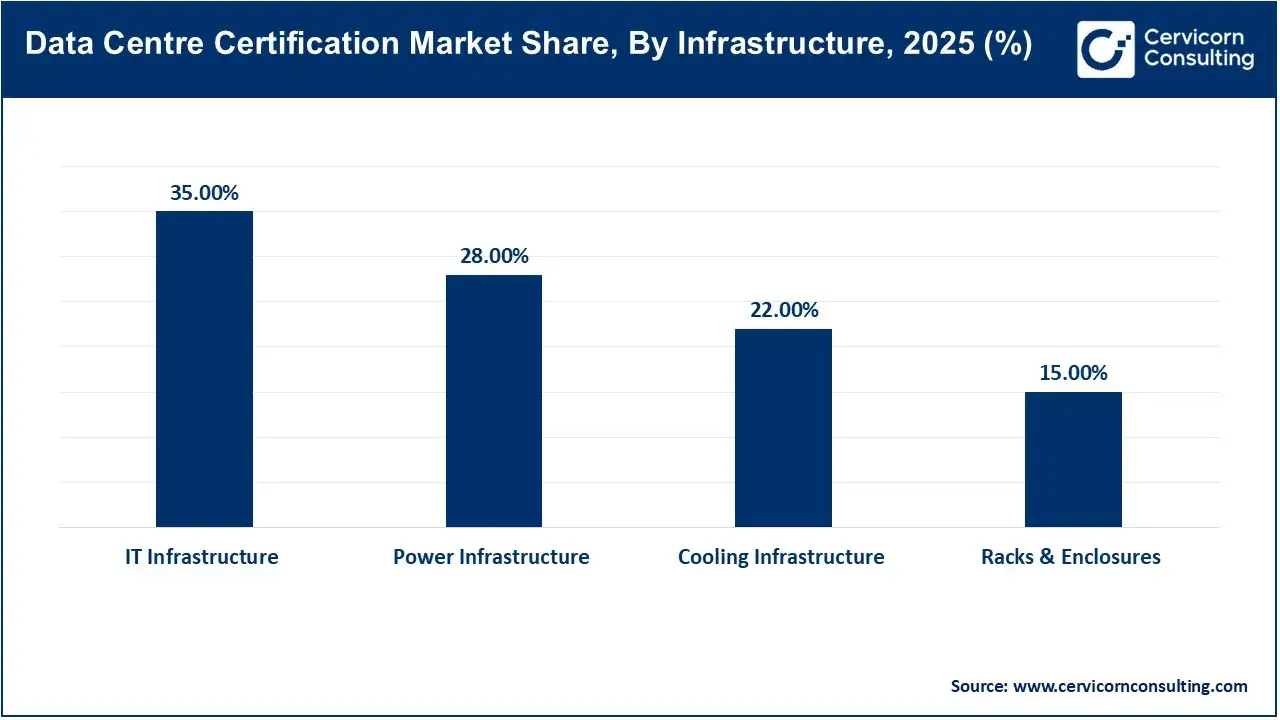
Cooling infrastructure is expected to be the fastest-growing segment. The demand for sophisticated cooling systems is rising due to increased heat generation from high-density computing and AI workloads. The use of water-saving technologies, liquid cooling, and efficient air cooling is increasing the need for certified cooling infrastructure. Data center operators are paying greater attention to heat management to improve equipment performance and operational reliability.
Certification Delivery Model Analysis
Construction phase certification dominated the data center certification market in 2025 as data center developers increasingly sought confirmation that facilities were being built according to required performance, safety, and reliability criteria. Certification during construction helps ensure compliance with technical specifications and assists in identifying infrastructure issues before operations begin. The rapid development of new data center facilities is further supporting demand for construction-phase certification.
Data Centre Certification Market Share, By Certification Delivery Model, 2025 (%)
| Certification Delivery Model |
Revenue Share, 2025 (%) |
| Design Phase Certification |
22% |
| Construction Phase Certification |
18% |
| Commissioning & Integrated Validation Certification |
25% |
| Operational Certification |
21% |
| Continuous Monitoring & Recertification |
14% |
Continuous monitoring & recertification is expected to be the fastest-growing segment. The increasing complexity of data center infrastructure requires ongoing verification of compliance, energy efficiency, security, and reliability. The adoption of automated monitoring and real-time infrastructure management is further supporting continuous evaluation and recertification. Regular validation allows operators to maintain compliance and identify performance issues as infrastructure evolves.
Data Center Type Analysis
Hyperscale data centers dominated the data center certification market in 2025 because of the rapid growth of large-scale digital platforms, cloud services, and AI applications. These facilities require high levels of reliability, scalability, security, and operational efficiency, increasing the importance of certified infrastructure. The continued investment by major cloud and technology providers is further supporting demand for certification.
Data Centre Certification Market Share, By Data Centre Type, 2025 (%)
| Data Centre Type |
Revenue Share, 2025 (%) |
| Hyperscale Data Centres |
43% |
| Enterprise Data Centres |
23% |
| Colocation Data Centres |
34% |
Colocation data centers are expected to be the fastest-growing segment. Businesses are increasingly outsourcing their data center requirements to specialized providers to reduce infrastructure and operational responsibilities. Certification allows colocation operators to demonstrate reliability, security, availability, and compliance to their customers. Growing cloud adoption and hybrid IT strategies are also creating additional opportunities for certified colocation facilities.
End User Analysis
Cloud service providers dominated the data center certification market in 2025 because their services depend on infrastructure that is secure, reliable, scalable, and continuously available. Certifications allow these providers to demonstrate compliance with operational, infrastructure, security, and reliability standards. The continued expansion of cloud services and AI-based applications is increasing the demand for certified data center facilities.
Data Centre Certification Market Share, By End User, 2025 (%)
| End User |
Revenue Share, 2025 (%) |
| Cloud Service Providers |
24% |
| BFSI |
13% |
| Telecom & Network Operators |
15% |
| Government & Defense |
9% |
| Healthcare & Life Sciences |
8% |
| Manufacturing |
7% |
| Retail & E-commerce |
6% |
| IT, Technology & Digital Infrastructure Providers |
12% |
| Others |
6% |
BFSI is expected to be the fastest-growing segment. The growth of digital banking, online financial services, and cloud adoption is increasing the need for highly secure and reliable infrastructure. Financial institutions manage sensitive customer and transaction data, making cybersecurity, business continuity, and regulatory compliance increasingly important. Growing digital payment activity and cyber risks are further supporting the adoption of advanced certification standards.
Regional Analysis
North America: Mature Infrastructure and Strong Certification Adoption
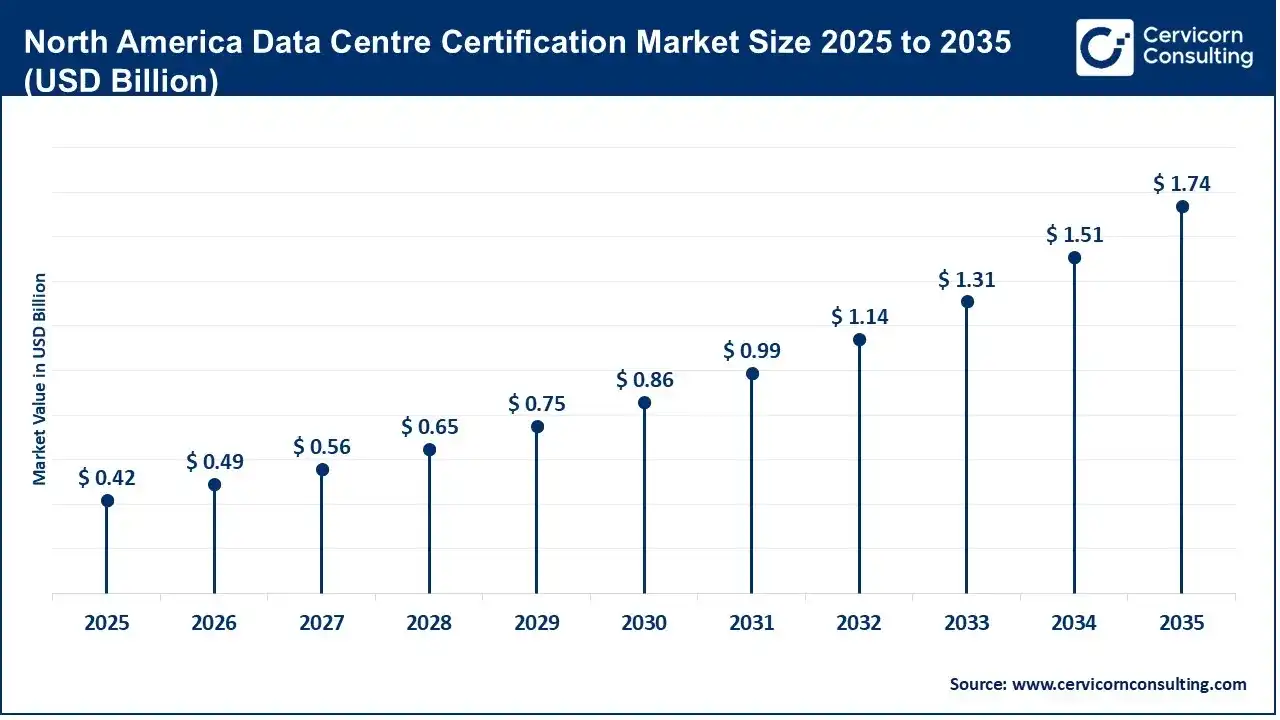
The North America data centre certification market size was valued at USD 0.42 billion in 2025 and is projected to reach USD 1.74 billion by 2035. North America dominated the market in 2025, supported by its extensive adoption of established industry standards, strong presence of hyperscale cloud operators, and highly developed data center ecosystem. The region has a large concentration of hyperscale, colocation, enterprise, and edge data centers, creating sustained demand for certifications that validate infrastructure reliability, security, energy efficiency, and operational performance.
Increasing investments in AI infrastructure and high-density computing are further encouraging operators to upgrade facilities and pursue certifications related to resilience, sustainability, energy management, and operational excellence. In addition, stringent regulatory requirements, growing emphasis on business continuity, and the need to demonstrate compliance to customers and investors continue to strengthen the role of third-party certification providers.
- United States: The United States leads the North American data center certification market due to its extensive hyperscale and colocation infrastructure, strong presence of major cloud service providers, and high adoption of internationally recognized data center standards and certification frameworks. Rapid investments in AI-focused data centers, cloud infrastructure, and energy-efficient facilities are expected to sustain certification demand across new and existing facilities.
Data Centre Certification Market Share, By Region, 2025 (%)
| Region |
Revenue Share, 2025 (%) |
| North America |
36% |
| Europe |
22% |
| Asia-Pacific |
32% |
| LAMEA |
10% |
Asia Pacific: Rapid Digitalization to Accelerate Certification Demand
The Asia-Pacific data centre certification market size was estimated at USD 0.38 billion in 2025 and is expected to hit USD 1.54 billion by 2035. Asia Pacific is expected to be the fastest-growing region during the forecast period, driven by rapid digital transformation, expanding cloud adoption, increasing AI deployment, and large-scale development of data center infrastructure. Countries across the region are attracting significant investments in hyperscale, colocation, and enterprise facilities as businesses increasingly migrate workloads to cloud and digital platforms.
Growing concerns regarding data security, operational resilience, energy consumption, and environmental sustainability are also encouraging operators to obtain certifications that demonstrate compliance with international standards. Government initiatives supporting digital infrastructure, data localization, renewable energy adoption, and sustainable data centers are creating additional opportunities for certification providers. The expansion of AI and high-performance computing infrastructure is expected to further increase demand for certifications that assess reliability, efficiency, security, and facility performance.
- China: China is a leading country in the Asia Pacific data center certification market, supported by rapid digitalization, large-scale cloud and AI infrastructure investments, and continued development of hyperscale and edge data centers. Government initiatives focused on digital infrastructure, energy efficiency, and green data centers are also encouraging operators to adopt recognized certification and compliance frameworks.
Government Initiatives
- In February 2026, Government of India: In the Union Budget 2026–2027, the Indian government proposed a tax break for qualified overseas cloud service companies using Indian data center services through 2047. The initiative aims to attract investment into India's cloud infrastructure and data center ecosystem. It is also expected to increase demand for reliable, certified, and compliant data center facilities while supporting AI infrastructure development.
- In March 2026, Ministry of Electronics and Information Technology: MeitY outlined policies promoting sustainable and energy-efficient data centers in India. The government emphasized advanced cooling technologies, high-density infrastructure, and reliable power planning to support AI and high-performance computing. These measures can encourage operators to adopt certifications related to energy, water, and operational efficiency.
- In March 2026, Ministry of Jal Shakti: The ministry highlighted groundwater extraction regulations and the water consumption of data centers. It also mentioned technologies such as immersion cooling, adiabatic cooling, and direct-to-chip liquid cooling to reduce water use. These initiatives support the growing importance of sustainability-focused data center certification.
- In September 2026, Ministry of Commerce and Industry: The ministry unveiled initiatives to ease doing business for India's data center industry, including reliable power, data-center-ready land, expedited clearances, and National Building Code 2026 criteria. These measures are expected to support new data center development while strengthening infrastructure, safety, and compliance standards.
Recent Developments
- In January 2026, BSI launched the Mark of Trust for reliable, secure, and sustainable data centers. The framework covers reliability, security, sustainability, energy, carbon, water management, and regulatory compliance.
- In February 2026, Telecommunications Industry Association (TIA) launched the Data Center Excellence (DCE) 9000 initiative. The initiative focuses on quality management for data center physical infrastructure and aims to improve quality, reliability, and consistency across the data center supply chain.
- In March 2026, NES Data Private Limited received ANSI/TIA-942-C Rated-3 certification for its constructed data center facility in Pune, India. The certification covers key infrastructure areas and demonstrates the growing adoption of independent certification among data center operators.
- In March 2026, TIA announced a new Artificial Intelligence addendum to the ANSI/TIA-942 standard. The addendum addresses infrastructure requirements associated with AI workloads and supports the development of AI-ready data center environments.
- In April 2026, TIA announced that its DCE 9000 initiative had moved into active standard drafting with four technical sub-teams. The initiative focuses on establishing common quality expectations across the data center supply chain.
- In August 2026, TIA announced continued expansion of its DCE 9000 initiative, adding 18 new member organizations and launching two program sub-teams. The development highlights increasing industry collaboration around data center quality, performance, reliability, and future certification requirements.
- In February 2026, Khazna Data Centers received Uptime Institute Tier III Certification of Design Documents for its AI-optimized QAJ01 data center in Ajman, UAE. The certification demonstrates the growing demand for resilient and AI-ready data center infrastructure.
Top Companies
- Uptime Institute
- TÜV SÜD
- TÜV Rheinland
- TÜV NORD
- BSI Group
- Bureau Veritas
- SGS SA
- Intertek Group plc
- UL Solutions
- DNV
- DEKRA
- EPI
- Schellman
- Coalfire Systems, Inc.
- ControlCase LLC
- DQS Holding GmbH
- LRQA
Segments Covered
By Certification Type
- Facility & Reliability Certifications
- Operational Certifications
- Information Security & Cybersecurity Certifications
- Sustainability & Energy Certifications
- Infrastructure Performance & System Certifications
By Infrastructure
- IT Infrastructure
- Power Infrastructure
- Cooling Infrastructure
- Racks & Enclosures
By Certification Delivery Model
- Design Phase Certification
- Construction Phase Certification
- Commissioning & Integrated Validation Certification
- Operational Certification
- Continuous Monitoring & Recertification
By Data Centre Type
- Hyperscale Data Centres
- Enterprise Data Centres
- Colocation Data Centres
By End User
- Cloud Service Providers
- BFSI
- Telecom & Network Operators
- Government & Defense
- Healthcare & Life Sciences
- Manufacturing
- Retail & E-commerce
- IT, Technology & Digital Infrastructure Providers
- Other End Users
By Region
- North America
- Europe
- Asia Pacific
- South America
- Middle East & Africa