Data Center Components Market Overview
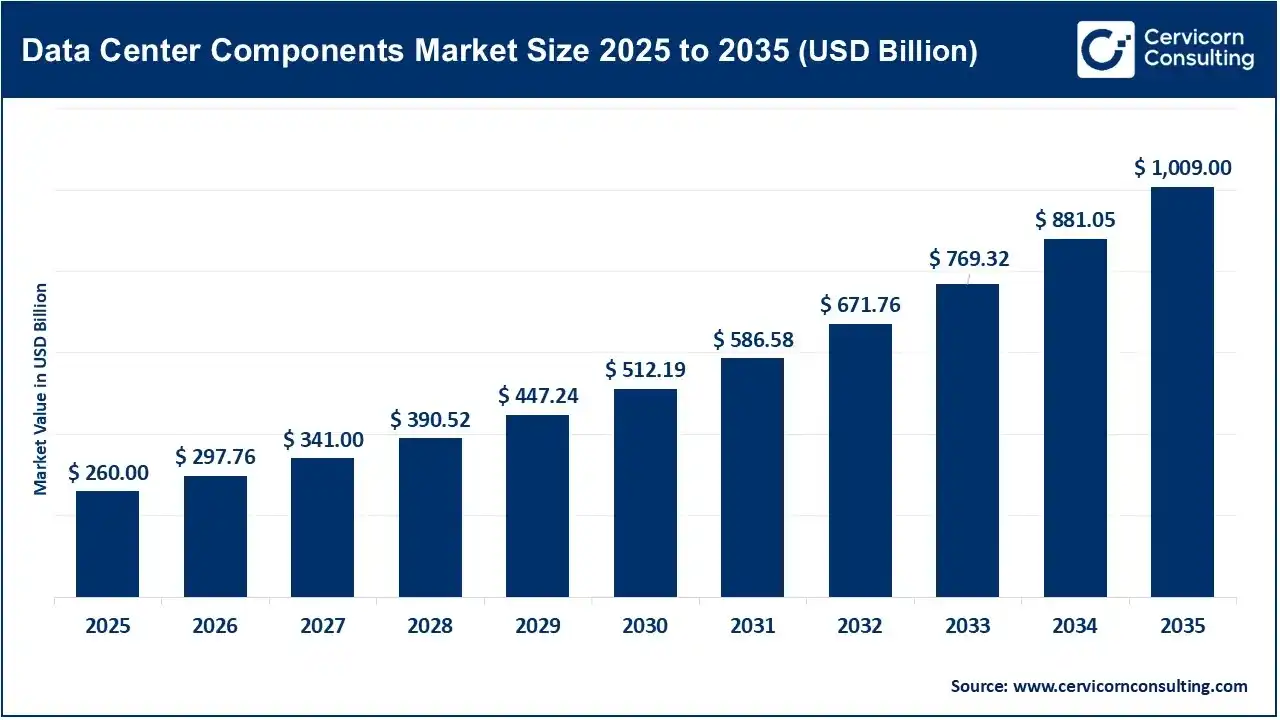
The global data center components market size was estimated at USD 260 billion in 2025 and is projected to exceed USD 1,009 billion by 2035 while expanding at a promising CAGR of 14.5% during the forecast period from 2026 to 2035. Growth trends for data center components are increasingly tilting toward high-density power infrastructure, liquid cooling solutions, next-generation networking equipment and power management components fueled by fast growth in artificial intelligence and accelerated computing workloads.
Global data centers’ electricity usage totaled about 415 Twh in 2024-roughly 1.5% of global electricity consumption-and it will jump to about 945 Twh in 2030, according to Iea. Electricity usage from accelerated servers–largely caused by the widespread adoption of artificial intelligence–will grow at an approximate 30% year over year rate.
Data Center Components Market Size and Growth
- Current Valuation (2026): USD 297.76 Billion
- Future Outlook (2035): USD 1,009 Billion
- Projected CAGR (2026 to 2035): 14.5%
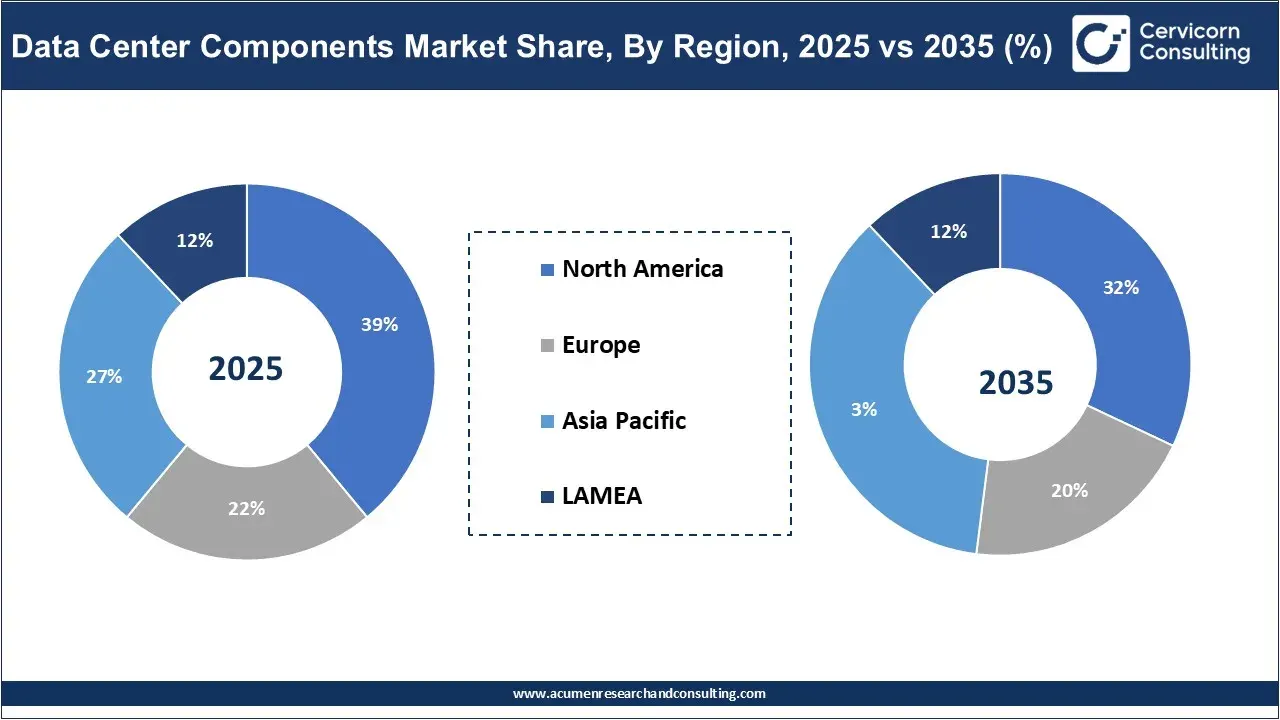
- Leading Region: North America leads the market (holding 39% revenue share)
- Fastest Growing Region: Asia Pacific is the fastest-growing market
Report Highlights
- By region, North America dominated the market in 2025, supported by its concentration of hyperscale facilities, advanced cloud infrastructure, strong AI investment, established colocation ecosystem, and presence of major technology companies.
- By region, Asia Pacific is expected to be the fastest-growing regional market during the forecast period, driven by rapid digitalization, cloud adoption, AI infrastructure investment, data localization requirements, and expanding data center capacity across India, China, Japan, Singapore, Australia, and Southeast Asia.
- By component, the power infrastructure segment dominated the market in 2025 with revenue share of 52%, driven by rising demand for reliable, redundant, and high-capacity electricity infrastructure across hyperscale, cloud, colocation, and AI data centers.
- By component, the cooling infrastructure segment is expected to register the fastest growth during the forecast period, supported by increasing AI rack densities and the growing deployment of direct-to-chip liquid cooling, coolant distribution units, heat exchangers, and other advanced thermal-management technologies.
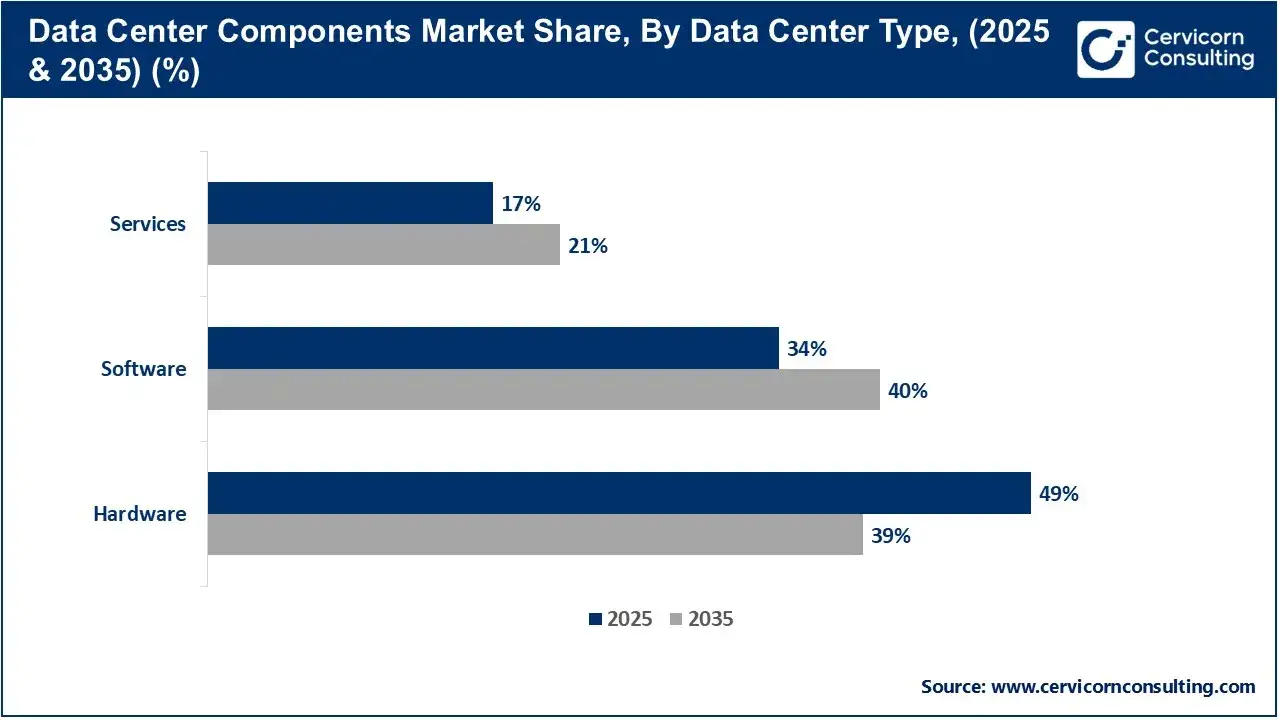
- By data center type, hyperscale data centers accounted revenue share of 40% in 2025, supported by large-scale investments from cloud service providers, technology companies, and AI infrastructure developers.
- By data center type, edge data centers are expected to witness the fastest growth during the forecast period, owing to rising demand for low-latency computing for AI inference, 5G, IoT, autonomous systems, and real-time analytics.
- By deployment, new build/greenfield data centers accounted for the leading share of the market in 2025, as AI, cloud computing, hyperscale expansion, and colocation development continue to generate demand for purpose-built infrastructure.
- By deployment, retrofit is expected to be the fastest-growing segment during the forecast period, as data center operators upgrade existing facilities with liquid cooling, higher-capacity power systems, advanced monitoring, and high-density racks to support AI workloads.
- By end user, cloud service providers dominated the market in 2025, owing to their extensive infrastructure requirements for cloud computing, enterprise applications, storage, digital services, and AI workloads.
- By end user, telecommunications providers are expected to register strong growth during the forecast period, supported by 5G deployment, edge computing, network virtualization, and increasing AI inference requirements across distributed locations.
Growth Factors & Trends
- AI Compute Growth: The rapid deployment of AI workloads is increasing demand for servers, GPUs, high-speed networking, power systems, cooling equipment, and other data center components. Global data center electricity consumption reached an estimated 415 TWh in 2024 and is projected to more than double by 2030, reflecting expanding infrastructure requirements.
- Data Center Expansion: Hyperscale, colocation, cloud, and enterprise operators are expanding data center capacity to support growing digital services and AI applications. This expansion creates recurring demand for racks, servers, storage, networking, UPS systems, cooling equipment, generators, and electrical infrastructure as newly constructed facilities require complete equipment deployments.
- Higher Rack Density: AI workloads are increasing rack power density and creating demand for advanced components capable of supporting high-performance computing environments. Uptime Institute reports that server rack densities are continuing to rise, while AI infrastructure is accelerating requirements for specialized cooling and electrical systems designed for increasingly dense computing configurations.
How Will AI Infrastructure Requirements Reshape the Data Center Components Market Through 2030?
- AI-driven server electricity demand: Electricity consumption from accelerated servers, primarily associated with AI workloads, is projected to grow by approximately 30% annually through 2030.
- Contribution of accelerated servers: AI/accelerated servers are expected to account for nearly 50% of the net increase in global data center electricity consumption through 2030, creating strong demand for high-capacity power and thermal-management components.
- Infrastructure contribution: Cooling and other physical infrastructure are expected to account for approximately 20% of the net increase in data center electricity consumption through 2030, increasing demand for cooling equipment, power distribution and energy-management systems.
- AI rack power density: Current AI systems can exceed 40 kW per rack, while some 2025-generation systems exceed 100 kW per rack. Leading-edge systems are expected to move toward hundreds of kilowatts per rack.
- 130 kW rack benchmark: NVIDIA's GB200 NVL72 rack-scale system contains 72 Blackwell GPUs and 36 Grace CPUs and has been rated at approximately 130 kW, demonstrating the scale of power infrastructure required by next-generation AI systems.
Cost Structure and Pricing Analysis
| Component Category |
Key Components |
General Indicative Price* |
| Power Infrastructure |
Transformers, switchgear, UPS, PDUs, busways |
$150–$600/kW for power distribution systems |
| Cooling Infrastructure |
Chillers, CRAH/CRAC, cooling towers, pumps |
$250–$500/kW |
| Liquid Cooling |
CDUs, cold plates, pumps, manifolds, heat exchangers |
$16,000–$50,000+ per CDU |
| Backup Power |
Diesel/gas generators, ATS, batteries, fuel systems |
$1–$3 million/MW for generator and associated backup-power infrastructure |
| Racks & Enclosures |
Standard racks, high-density racks, cabinets |
$1,000–$5,000+ per rack |
| Networking & Connectivity |
Switches, transceivers, fiber, copper cabling |
$500–$10,000+ per network switch |
Data Center Components Market Dynamics
Market Drivers
- AI Infrastructure Demand: The expansion of accelerated computing is directly increasing demand for high-performance servers, GPUs, networking equipment, power distribution, and cooling systems. IEA estimates that electricity consumption from accelerated servers will grow around 30% annually through 2030 in its base case, making AI infrastructure an important driver of component demand.
- Cloud Adoption: Growing use of cloud computing, SaaS platforms, streaming services, enterprise applications, and digital workloads is requiring operators to continuously expand computing and storage capacity. As cloud providers increase server and networking capacity, demand rises for supporting components including racks, storage systems, power equipment, cooling systems, and connectivity infrastructure.
- Power Requirements: Increasing data center electricity consumption is strengthening demand for UPS systems, power distribution units, transformers, switchgear, generators, monitoring systems, and other electrical components. Global data center electricity demand increased 17% in 2025, while AI-focused facilities experienced even faster growth, intensifying pressure to expand supporting power infrastructure.
Market Restraints
- High Capital Costs: Data center components require significant upfront investment, particularly for high-performance servers, advanced cooling, power infrastructure, and networking systems. Rising equipment costs can increase the capital expenditure required for new facilities and upgrades, potentially delaying projects or encouraging operators to extend the useful life of existing infrastructure.
- Component Shortages: Tight supply chains for transformers, advanced chips, IT equipment, and other critical infrastructure components can delay data center construction and equipment deployment. The IEA has identified tightening supply chains for energy technologies and advanced chips as a physical bottleneck affecting the pace at which data center capacity can expand.
- Power Availability: Limited access to electricity can constrain new data center development and component demand in major computing hubs. As AI facilities require significantly more power, operators increasingly face grid-connection constraints and longer infrastructure-development timelines, making electricity availability an important limitation for planned server, cooling, and electrical-equipment installations.
Market Opportunities
- Liquid Cooling: Increasing AI rack densities are creating opportunities for liquid-cooling components, including cold plates, coolant distribution systems, pumps, heat exchangers, and immersion-cooling equipment. Uptime Institute identifies rising AI power density as a factor accelerating interest in liquid cooling, particularly for high-performance computing environments with demanding thermal-management requirements.
- Efficient Power Systems: Rising electricity requirements are creating opportunities for energy-efficient UPS systems, power distribution equipment, monitoring technologies, advanced transformers, and power-management components. The U.S. Department of Energy highlights electrical systems, cooling, air management, heat recovery, and IT efficiency as important areas for improving data center energy performance.
- Optical Networking: AI clusters require high-bandwidth, low-latency connections between computing systems, creating opportunities for optical transceivers, switches, interconnects, and other high-speed networking components. The increasing scale of AI infrastructure is also encouraging development of technologies designed to improve networking efficiency, reduce latency, and manage the growing volume of data exchanged within AI clusters.
Market Challenges
- Thermal Management: High-performance AI servers generate substantially greater heat loads than conventional computing equipment, increasing the complexity of thermal management. Operators must balance cooling capacity, energy efficiency, reliability, and physical space while supporting higher rack densities. This is accelerating the transition toward liquid-based cooling technologies in demanding AI environments.
- Supply Chain Risk: Data center component manufacturers face exposure to shortages, geopolitical restrictions, logistics disruptions, and long lead times for critical equipment. Recent data center expansion has increased pressure on supplies of transformers, advanced chips, energy equipment, and other components, potentially creating delays between facility planning, equipment procurement, and operational deployment.
- Sustainability Pressure: Data center operators face increasing pressure to reduce electricity consumption, improve cooling efficiency, manage water use, and integrate lower-carbon energy sources. IEA projects global data center electricity consumption could reach approximately 950 TWh by 2030, making energy efficiency and sustainable infrastructure increasingly important considerations for component selection.
Regional Analysis
North America Data Center Components Market Trends
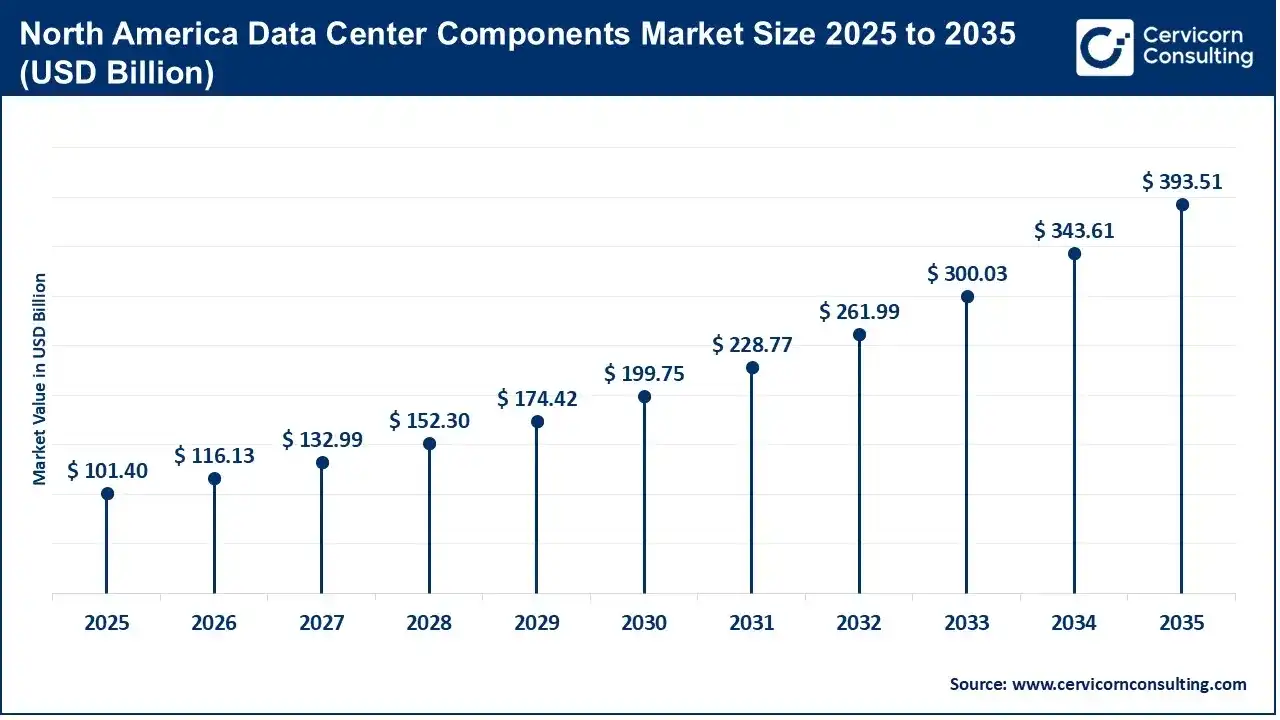
The North America data center components market size was valued at USD 101.40 billion in 2025 and is projected to exceed USD 393.51 billion by 2035. The North America market commanded a leading share in the data center components market in 2025, owing to its wide range of hyperscale environments, advanced cloud infrastructure, intensive investments in AI, robust colocation industry and the presence of large technology companies.
United States is the biggest market within the region with concentrated major data center hubs in Northern Virginia, Texas, Arizona, Georgia, Ohio, Oregon, and other developing areas. North America’s primary market data center supply increased by 36% year-on-year to 9,432 MW in 2025, with a record 2,497.6 MW of net absorption as per CBRE.
Demand for large volumes of power and cooling components from hyperscale AI operations with huge need for transformers, switchgear, UPS system, generators, busways, liquid-cooling solutions, high density racks, high speed networking has grown. But, power supply will play a limiting role.
U.S. & Canada Trends
- The U.S. also has a particularly strong AI infrastructure pipeline. Recent industry analysis indicates that the country hosts 15 of the world's 20 largest AI data centers, illustrating its current leadership in large-scale AI infrastructure
- Canada is also benefiting from cloud, AI, and digital infrastructure investment, although its market remains smaller than that of the United States. Overall, North America is expected to remain the largest regional market because of its scale, technological maturity, hyperscale concentration, and continued AI infrastructure investment.
Asia Pacific Data Center Components Market Scope
The Asia-Pacific data center components market size was estimated at USD 70.20 billion in 2025 and is expected to reach USD 272.43 billion by 2035. The fastest growing geographic market during the forecast period is expected to be Asia Pacific because of: fast digitalization, adoption of cloud and AI infrastructure; rising internet penetration; growing need for localization of data; large-scale infrastructure projects. China, India, Japan, Singapore, South Korea, Australia, Malaysia and Indonesia represent diverse although increasingly significant data center ecosystem growth trajectories.
Of the growth markets in Asia-Pacific, India is emerging strongly; its live DC IT capacity is close to 1.7GW, nearly four times that observed six years prior, with a pipeline of 1.3GW being built and 3.2GW in early development, according to a recent report based on Bloomberg NEF information.
- Driving factors of growth include: adoption of cloud computing and services; proliferation of digital services and content; establishment of AI infrastructure; data sovereignty needs; investments of local and international technology giants.
Segmental Analysis
Component Analysis
The power infrastructure segment captured a majority share in the market in 2025, owing to the soaring demand for dependable, redundant and high-capacity electricity to the various types of data center types such as hyperscale, cloud and colocation and AI in the data centers. Power infrastructure consist of various power-providing elements such as the UPS systems, transformers, power distribution units (PDUs), switchgears, busways, power shelves, backup generators etc. This segment witnessed a significant growth with an advent in AI which tends to use a lot higher wattage of compute per individual server in the racks.
Data Center Components Market Share, By Component, 2025 (%)
| Component |
Revenue Share, 2025 (%) |
Revenue Share, 2035 (%) |
| IT Infrastructure |
52% |
55% |
| Power Infrastructure |
14% |
12% |
| Cooling Infrastructure |
11% |
13% |
| Racks & Enclosures |
7% |
6% |
| Monitoring & Management Systems |
6% |
6.5% |
| Physical Security & Safety |
5% |
4% |
| Others |
5% |
3.5% |
Cooling infrastructure segment is predicted to grow at the fastest pace during the forecast period. This segment had a significant and rapidly increasing number of AI racks which require the cooling capabilities beyond the current range of conventional air based cooling. The component segment include the CRAC units, CRAH units, chillers, cooling towers, chillers, cooling towers, pumps, heat exchanges, rear-door heat exchangers, direct-to-chip liquid cooling, coolant distribution units and immersion cooling. AI accelerator is using more wattage of compute per server and will lead the redesign for thermal design along with the electrical design.
Data Center Type Analysis
Hyperscale data centers dominated the Data Center Components Market by data center type in 2025, supported by large-scale investments from cloud service providers, technology companies, and AI infrastructure developers. Hyperscale facilities require substantially larger quantities of electrical, cooling, networking, rack, and monitoring equipment than conventional enterprise facilities because they are designed to accommodate large computing populations and operate at high utilization levels. Hyperscalers data centers are also increasingly combining self-built facilities with leased capacity to accelerate infrastructure expansion.
Edge data centers are expected to be the fastest-growing data center type during the forecast period as AI inference, 5G, IoT, autonomous systems, real-time analytics, and latency-sensitive applications require computing resources closer to end users and data sources. Unlike large hyperscale facilities, edge sites are generally smaller and more geographically distributed, creating different component requirements.
Deployment Analysis
The data centre components market was by deployment in 2025 driven by new built or greenfield deployment. AI, cloud computing, the hyperscale layer and colocation build-outs are all now generating strong demand for entirely new build facilities. Greenfield gives developers a platform from which to build the systems, the power, the cooling, the networking, the rack and the building system around how today’s generation of infrastructure works, instead of trying to refactor legacy architecture.
The market’s fastest growing development segment however is expected to be retrofit as operators look to upgrade existing infrastructure for AI and high density environments. Retrofit is an affordable method by which to deliver capability that may include liquid cooling, a higher level of power capability, advanced monitoring, and higher density racks to extend the useful life of current data centre investments.
It becomes especially attractive when new power connections are unavailable, when land options or local planning consents are problematic, or when there’s a need to upgrade capacity or speed by months instead of years.
End User Analysis
Cloud service providers dominated the Data Center Components Market by end user in 2025 because cloud platforms continue to expand computing capacity to support enterprise applications, storage, digital services, AI workloads, and increasingly compute-intensive applications. Large cloud providers operate substantial infrastructure footprints and require continuous investment in power, cooling, networking, racks, backup systems, and monitoring equipment.
Telecommunications providers represent a growing end-user segment as 5G, edge computing, network virtualization, and AI inference increase the requirement for distributed computing capacity. Telecom operators require infrastructure that can operate across geographically dispersed locations, often with stricter requirements for compactness, resilience, remote management, and energy efficiency.
Global Data Center Policies and Regulatory Landscape
- Energy-efficiency regulations: Governments are tightening energy-efficiency standards for electricity and cooling efficiency, PUE, and IT equipment. In EU a data-center rating methodology is taking shape, and a minimum data-center efficiency level is on the cards.
- Mandatory energy-performance reporting: Updated EU Directive on Energy Efficiency established mandatory reporting requirements on data-centers performance on electricity consumption, emissions, and renewable energy for large EU data center operators.
- Environmental and sustainability standards: Many governments now bundle their approval of new data centers to standards on energy and renewable energy efficiency, use of renewable power, water efficiency and low-impact construction (UNEP guidelines for sustainable data-center procurement specify PUE,WUE, cooling and IT equipment efficiency levels).
- Power-grid and electricity regulation: Stricter regulations in relation to data centers are being introduced in several countries to manage grid stress and guarantee the electric power availability for large and intensive data centers projects.
Future Technology Roadmap
| Technology / Component |
2028–2030 Outlook |
Impact on Data Center Components Market |
| AI-ready high-density racks |
Racks reaching 200 kW+ become increasingly common |
Drives demand for high-capacity power distribution, racks, busways and advanced cooling |
| Direct-to-chip liquid cooling |
Becomes a mainstream thermal-management technology for high-density environments |
Accelerates demand for cold plates, CDUs, pumps and heat exchangers |
| Advanced power distribution |
Greater deployment of high-voltage and next-generation distribution architectures |
Increases demand for high-capacity electrical components |
| AI-optimized UPS and power management |
AI-enabled predictive power management and dynamic load optimization expand |
Supports demand for digital UPS, power electronics and intelligent PDUs |
| Smart transformers and digital switchgear |
More automated and digitally controlled electrical infrastructure |
Creates demand for connected electrical components |
| Advanced thermal management materials |
Wider application in high-performance AI systems |
Supports demand for specialized cooling materials and heat-transfer components |
Competitive Landscape
Strategic Partnerships, News & Product Launches
- August 2026: NVIDIA DSX AI Factories announced targeting up to 15% higher energy efficiency, 30% lower installation costs, and up to 80% lower copper use for higher-power AI data centers.
- July 2026 – Daikin and NTT DATA companies launched a joint proof of concept for an AI-based data-center cooling optimization solution designed to predict server thermal conditions and optimize cooling operations for next-generation AI infrastructure.
Segments Covered
By Component
- IT Infrastructure
- Power Infrastructure
- Cooling Infrastructure
- Racks & Enclosures
- Monitoring & Management Systems
- Physical Security & Safety
- Other Components
By Data Center Type
- Hyperscale Data Centers
- Colocation Data Centers
- Enterprise Data Centers
- Edge Data Centers
By Data Center Size
- Small Data Centers – Below 1 MW
- Medium Data Centers – 1 MW to <10 MW
- Large Data Centers – 10 MW to <50 MW
- Mega/Hyperscale Facilities – 50 MW and Above
By Rack Density
- Below 10 kW
- 10–19 kW
- 20–29 kW
- 30–49 kW
- 50–99 kW
- 100 kW and Above
By Deployment
- New Build / Greenfield
- Expansion / Brownfield
- Retrofit
By End User
- Hyperscale & Cloud Service Providers
- Colocation Providers
- Enterprises
- Telecommunications Providers
- Government & Defense
- BFSI
- Healthcare
- Retail & E-commerce
- Energy & Utilities
- Others
By Region
North America
Europe
- Germany
- U.K.
- France
- Netherlands
- Italy
- Spain
- Rest of Europe
Asia Pacific
- China
- Japan
- India
- South Korea
- Singapore
- Malaysia
- Indonesia
- Rest of Asia Pacific
Latin America
- Brazil
- Mexico
- Argentina
- Rest of Latin America
Middle East & Africa
- UAE
- Saudi Arabia
- South Africa
- Israel