CO2 Separation Membrane Market Size, Growth, Forecast 2026 to 2035
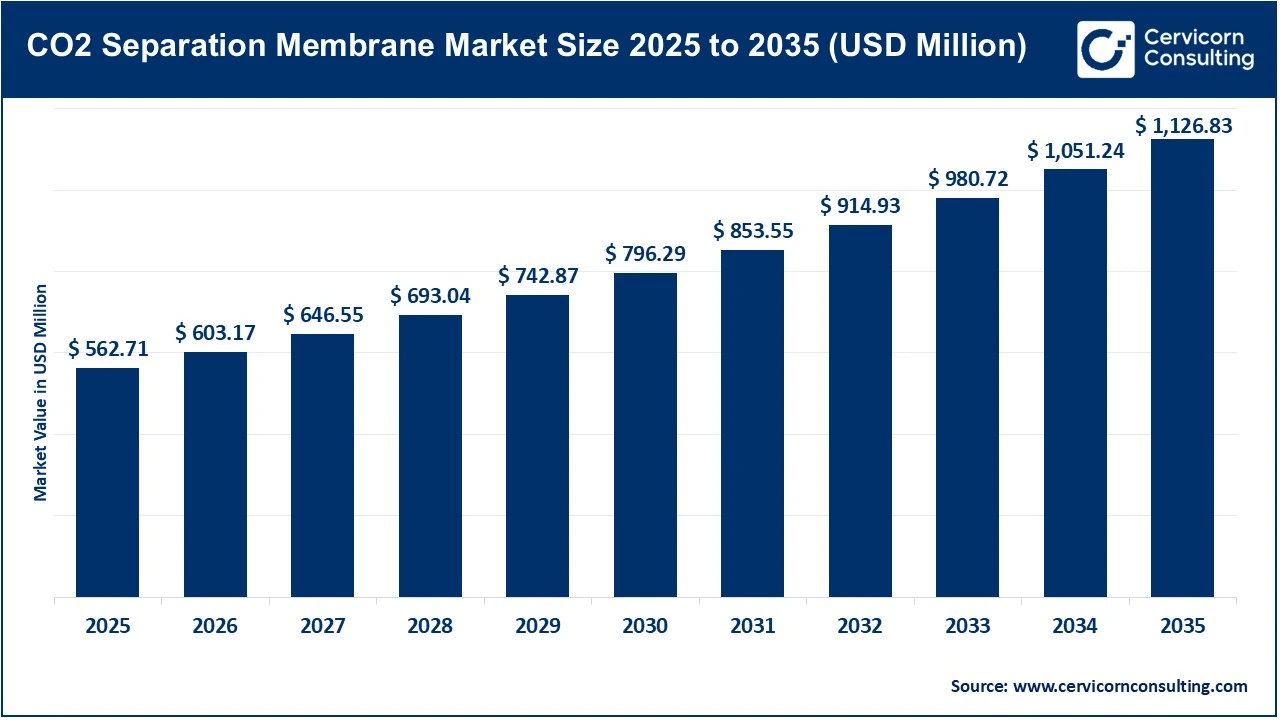
The global CO2 separation membrane market size was estimated at USD 562.71 million in 2025 and is expected to be worth around USD 1,126.83 million by 2035, expanding at a compound annual growth rate (CAGR) of 7.2% over the forecast period from 2026 to 2035. The CO2 separation membrane market is being driven primarily by the accelerating deployment of carbon capture, utilization, and storage (CCUS) projects and increasingly stringent decarbonization regulations across power generation, oil & gas, cement, steel, and chemical industries. Governments and industries are investing heavily in carbon capture infrastructure to meet net-zero commitments, creating strong demand for cost-effective gas separation technologies. According to the International Energy Agency (IEA), more than 700 CCUS projects are currently in various stages of development worldwide, while announced global CO2 capture capacity for 2030 has increased to approximately 435 million tonnes per year, reflecting rapidly expanding carbon management requirements. Membrane systems are gaining traction because they offer lower energy consumption, modular installation, and reduced operational complexity compared with conventional solvent-based capture methods.
Another major growth factor is the technological advancement of membrane materials and their expanding use in industrial gas processing applications such as natural gas sweetening, hydrogen production, biogas upgrading, and post-combustion carbon capture. Membrane-based CO2 capture is increasingly favored for industrial decarbonization because of its scalability, compact footprint, and ability to integrate with existing facilities. Recent research highlights growing adoption across high-emission sectors including power plants, cement manufacturing, and steel production, where reducing carbon intensity is becoming a strategic priority. In addition, commercially available membrane solutions for syngas and biogas purification are already established, while new-generation membranes for flue-gas treatment continue to improve selectivity and efficiency, expanding the addressable market. The broader gas separation membrane industry is also benefiting from rising demand for energy-efficient gas processing technologies and tighter emissions regulations globally.
Report Highlights
- North America dominated the market with a 46.4% share, supported by extensive carbon capture infrastructure and favorable emissions reduction policies.
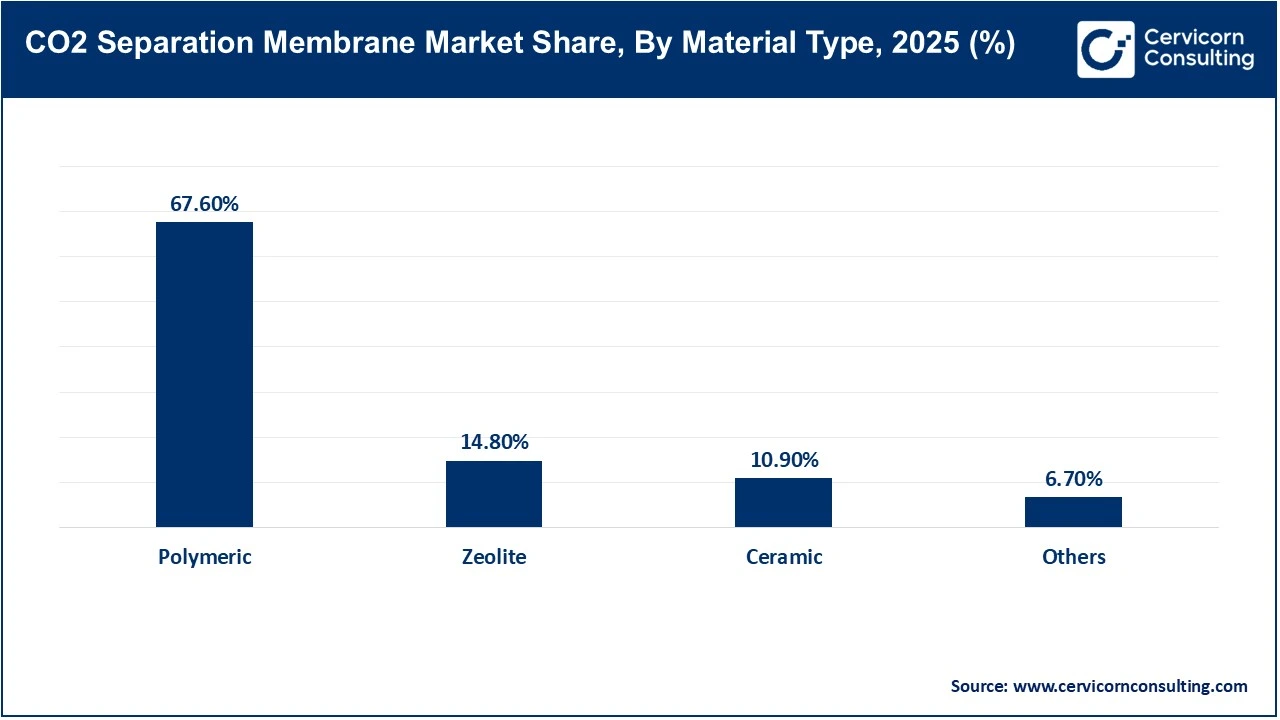
- Polymeric membranes led the material segment with a 67.6% share, driven by cost-effectiveness, scalability, and widespread industrial adoption.
- Hollow fiber modules accounted for 61.8% of market demand, owing to their compact design and superior gas separation efficiency.
- Industrial separation held the largest application share at 50.9%, supported by strong demand from gas processing and purification industries.
- The oil & gas sector captured 42.8% of total demand, driven by natural gas sweetening and hydrocarbon processing applications.
What is CO2 Separation Membrane?
A CO2 separation membrane is a specialized semi-permeable material used to selectively separate carbon dioxide (CO2) from gas mixtures based on differences in permeability and diffusivity. These membranes enable efficient CO2 capture, purification, and recovery by allowing CO2 molecules to pass through more rapidly than other gases such as methane, nitrogen, hydrogen, or oxygen. CO2 separation membranes are widely utilized as an energy-efficient alternative to conventional separation technologies such as chemical absorption and cryogenic distillation, offering advantages including lower energy consumption, modular design, smaller equipment footprint, and ease of integration into industrial processes. They play a critical role in carbon capture, utilization, and storage (CCUS), natural gas processing, hydrogen production, and various industrial gas purification applications.
Applications of CO₂ Separation Membranes
| Application |
Function of CO2 Separation Membrane |
Detailed Description |
| Carbon Capture and Storage (CCS) |
Separates CO2 from industrial flue gases before transport and storage |
Membranes capture CO2 emitted from power plants, cement facilities, and other industrial sources, enabling long-term underground storage and reducing atmospheric emissions. |
| Carbon Capture, Utilization, and Storage (CCUS) |
Captures and purifies CO2 for reuse in industrial processes |
The separated CO2 can be utilized in chemical production, synthetic fuels, building materials, and other value-added applications before permanent storage. |
| Natural Gas Sweetening |
Removes CO2 from raw natural gas streams |
High CO2 concentrations in natural gas reduce heating value and can cause pipeline corrosion. Membranes efficiently remove CO2 to meet transportation and commercial specifications. |
| Biogas Upgrading |
Separates CO2 from biogas generated from organic waste |
By removing CO2, membranes increase methane concentration, producing biomethane that can be injected into gas grids or used as a renewable fuel. |
| Hydrogen Production |
Removes CO2 from syngas and hydrogen-rich streams |
During steam methane reforming and gasification processes, membranes help purify hydrogen by separating CO2 and other impurities, supporting clean hydrogen production. |
| Power Generation |
Captures CO2 from combustion exhaust gases |
Membrane systems are deployed in coal-fired and natural gas power plants to reduce carbon emissions while maintaining operational efficiency. |
| Cement Manufacturing |
Removes CO2 from kiln and calcination emissions |
Cement production is a major source of industrial CO2 emissions. Membranes provide a lower-energy option for capturing carbon from exhaust streams. |
| Steel Production |
Captures CO2 from blast furnace and direct reduction processes |
Membrane technologies help steel manufacturers reduce carbon intensity and comply with increasingly stringent environmental regulations. |
| Food and Beverage Industry |
Produces high-purity CO2 for commercial applications |
Purified CO2 is used in beverage carbonation, food preservation, modified atmosphere packaging, and refrigeration systems. |
Stringent Environmental Mandates and ESG Goals
Stringent environmental regulations and corporate ESG commitments are accelerating demand for CO2 separation membranes by directly increasing the economic and compliance value of reducing emissions. Governments are tightening carbon policies through emissions trading systems, carbon taxes, disclosure rules, and sector-specific decarbonization mandates, making carbon capture and gas purification investments more attractive. At the same time, companies are under growing pressure from investors, customers, and supply-chain partners to demonstrate measurable emissions reductions and progress toward net-zero targets. CO2 separation membranes benefit from this trend because they offer a relatively energy-efficient, modular, and scalable option for capturing or removing CO2 in industries such as power generation, cement, steel, chemicals, hydrogen, and natural gas processing. As carbon costs rise and ESG scrutiny intensifies, membrane-based separation becomes not only an environmental solution but also a financial risk-management and competitiveness strategy.
Some related data on growth:
- Net-zero policy coverage: As of June 2024, 107 countries had adopted net-zero pledges, covering approximately 82% of global greenhouse-gas emissions.
- Carbon pricing signal: The EU Emissions Trading System recorded an average allowance price of about EUR 73 per tonne CO2e in 2025, while average prices in 2024 were around EUR 65 per tonne.
- ESG capital pressure: Global sustainable fund assets reached approximately USD 3.5 trillion by mid-2025.
- Corporate climate commitments: The Science Based Targets initiative reported a significant increase in companies committing to validated climate and net-zero targets in 2025.
- Net-zero target adoption: Around 145 countries had announced or were considering net-zero targets by late 2025, representing close to 77% of global emissions.
Recent Major Milestones
1. Norway’s Northern Lights CCS Expansion and Commercial Launch (2025)
The Northern Lights project, developed by Shell, Equinor, and TotalEnergies, reached a major milestone with the commencement of CO2 injection operations and a commitment to invest approximately NOK 7.5 billion (USD 700+ million) to expand storage capacity. The project aims to increase annual CO2 handling capacity from 1.5 million tonnes to more than 5 million tonnes per year. This development is significant for the CO2 separation membrane market because large-scale CCS networks require efficient pre-capture and gas purification technologies, creating greater demand for membrane-based CO2 separation systems across industrial facilities.
2. European Commission Support for Large-Scale Carbon Storage Infrastructure (2025)
The expansion of Northern Lights received a EUR 131 million grant from the European Commission, highlighting continued governmental support for carbon capture and storage deployment. European climate policies are increasingly directing funding toward technologies that reduce industrial emissions, including advanced membrane-based gas separation systems. Such public funding lowers project risks and accelerates the commercialization of CO2 capture technologies across hard-to-abate sectors such as cement, steel, chemicals, and power generation.
3. Stockholm Exergi–Northern Lights Long-Term CO2 Storage Agreement (2025)
A major commercial milestone was achieved when Northern Lights secured a 15-year agreement with Stockholm Exergi to transport and store approximately 900,000 tonnes of CO2 annually. Long-term carbon management contracts demonstrate growing industrial confidence in CCS value chains and create a stronger business case for CO2 capture technologies at the source. Since membrane systems are increasingly used for pre-combustion and post-combustion CO2 separation, such agreements indirectly stimulate demand for advanced membrane installations in industrial plants seeking access to storage networks.
4. Development of Advanced High-Selectivity Membrane Technologies by Research Institutions (2025–2026)
Research organizations worldwide continue to advance next-generation membrane materials with significantly improved selectivity and energy efficiency. For example, scientists at Central Salt and Marine Chemicals Research Institute (CSMCRI) and Indian Institute of Technology Gandhinagar developed ultra-selective nanopore membrane technologies that offer substantially higher separation efficiency than conventional membranes. While initially focused on industrial separations, such breakthroughs contribute directly to future CO2 separation applications by improving membrane performance, reducing operating costs, and enabling wider industrial adoption.
Regional Analysis
The CO2 separation membrane market is segmented by region into North America, Europe, Asia-Pacific, Latin America, and LAMEA. Here is a brief overview of each region:
North America CO2 Separation Membrane Market: Driven by Expanding Carbon Capture Deployment, Stringent Emission Regulations, and Strong Industrial Decarbonization Investments
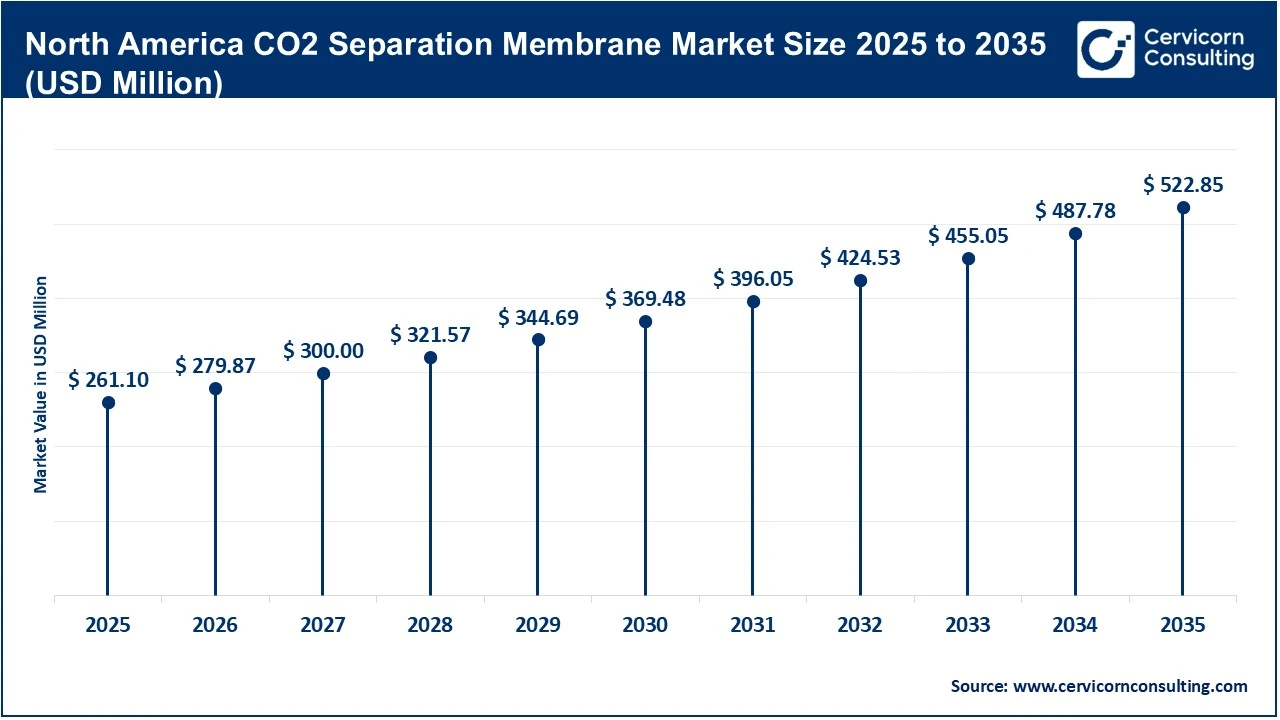
The North America CO2 separation membrane market size was valued at USD 261.10 million in 2025 and is expected to reach around USD 522.85 million by 2035.
The North America market is highly developed, supported by increasing investments in carbon capture, utilization, and storage (CCUS) projects, stringent environmental regulations, and growing adoption of low-carbon industrial technologies. The region is witnessing strong demand for membrane-based CO2 separation solutions across oil & gas, power generation, hydrogen production, chemical processing, and biogas upgrading applications. Government incentives, including carbon management funding programs and tax credits for carbon capture projects, are encouraging industries to adopt advanced separation technologies.
United States: Large-Scale Carbon Capture Investments, Industrial Decarbonization Initiatives, and Supportive Federal Incentives Continue Driving Market Expansion
- The U.S. Department of Energy has committed more than USD 12 billion toward carbon management, direct air capture, and CCUS initiatives through recent federal programs.
- The country accounts for approximately 40% of the world's operational carbon capture capacity, creating substantial demand for CO2 capture and separation technologies.
- The enhanced 45Q tax credit provides up to USD 85 per metric ton of CO2 permanently stored, improving the economics of carbon capture projects.
Canada: Expanding Carbon Pricing Frameworks, Growing CCUS Investments, and Strong Energy Sector Adoption Support Market Growth
- Canada operates one of the world's most comprehensive carbon pricing systems, with carbon prices expected to reach CAD 170 per tonne by 2030.
- The federal government introduced a Carbon Capture, Utilization, and Storage Investment Tax Credit (CCUS ITC) covering up to 50% of eligible project costs for certain capture technologies.
- Alberta and Saskatchewan host several large-scale CCUS facilities, including some of the world's largest carbon storage and enhanced oil recovery projects.
Asia-Pacific (APAC) CO2 Separation Membrane Market: Driven by Rapid Industrialization, Expanding Carbon Capture Initiatives, and Growing Clean Energy Investments
The Asia-Pacific CO2 separation membrane market size was estimated at USD 115.92 million in 2025 and is forecasted to surpass around USD 132.13 million by 2035. The Asia-Pacific market is experiencing strong growth due to increasing industrial emissions, rising investments in carbon capture and utilization technologies, and ambitious decarbonization targets across major economies. The region is home to some of the world's largest power generation, steel, cement, refining, and chemical production industries, creating substantial demand for efficient CO2 separation solutions. Governments are increasingly supporting carbon neutrality goals, hydrogen development, and CCUS deployment, while industries are adopting membrane technologies to improve energy efficiency and reduce emissions. Growing investments in natural gas processing, biogas upgrading, and clean hydrogen production are further accelerating market expansion across the region.
China: Large-Scale Decarbonization Programs, Expanding CCUS Projects, and Industrial Emissions Reduction Drive Market Leadership
- China is responsible for approximately 30% of global CO2 emissions, creating significant demand for carbon capture and gas separation technologies.
- The country has announced and developed more than 100 CCUS projects across power generation, chemicals, cement, steel, and oil & gas sectors.
- China's national emissions trading system (ETS) is the world's largest carbon market by covered emissions, encouraging industries to adopt carbon reduction technologies.
India: Rising Industrial Emissions, Growing Carbon Management Initiatives, and Expanding Clean Energy Infrastructure Support Market Growth
- India aims to achieve net-zero emissions by 2070 and reduce the emissions intensity of its GDP by 45% from 2005 levels by 2030.
- The country is among the world's largest producers of cement, steel, fertilizers, and chemicals, sectors that represent significant opportunities for CO2 capture deployment.
- The National Green Hydrogen Mission is accelerating investments in hydrogen production, creating demand for advanced gas separation and purification technologies.
Europe CO2 Separation Membrane Market: Driven by Aggressive Decarbonization Policies, Expanding Carbon Capture Infrastructure, and Strong Industrial Sustainability Commitments
The Europe CO2 separation membrane market size reached at USD 145.18 million in 2025 and is projected to hit around USD 290.72 million by 2035. The Europe market is witnessing significant growth due to stringent climate regulations, ambitious net-zero targets, and substantial investments in carbon capture, utilization, and storage (CCUS) infrastructure. The region has emerged as a global leader in industrial decarbonization, with governments and industries actively adopting advanced CO2 capture technologies to comply with emissions reduction mandates. Rising carbon prices under the European Union Emissions Trading System (EU ETS), growing deployment of hydrogen projects, and increasing demand for low-carbon manufacturing are accelerating the adoption of membrane-based CO2 separation solutions.
Germany: Industrial Decarbonization, Hydrogen Economy Development, and Carbon Capture Investments Drive Market Leadership
- Germany aims to achieve climate neutrality by 2045, creating substantial demand for carbon capture and emissions reduction technologies.
- The country is Europe's largest chemical producer and among the largest steel and industrial manufacturing hubs, generating significant opportunities for CO2 separation applications.
- Germany's National Hydrogen Strategy is accelerating investment in green and low-carbon hydrogen production, increasing demand for advanced gas separation technologies.
United Kingdom: Expanding CCUS Clusters, Net-Zero Commitments, and Government Funding Support Market Growth
- The UK has a legally binding target to achieve net-zero greenhouse gas emissions by 2050, driving adoption of carbon capture technologies.
- The government has committed billions of pounds in funding for CCUS cluster development, including projects in the Humber, Teesside, and North West England regions.
- The UK aims to capture and store 20–30 million tonnes of CO2 annually by 2030, creating significant demand for CO2 separation technologies.
CO2 Separation Membrane Market Share, By Region, 2025 (%)
| Region |
Revenue Share, 2025 (%) |
| North America |
46.4% |
| Europe |
25.8% |
| Asia-Pacific |
20.6% |
| LAMEA (Latin America, Middle East & Africa) |
7.2% |
LAMEA CO2 Separation Membrane Market: Driven by Expanding Oil & Gas Operations, Emerging Carbon Capture Investments, and Industrial Emissions Reduction Initiatives
The LAMEA CO2 separation membrane market was valued at USD 40.52 million in 2025 and is anticipated to reach around USD 81.13 million by 2035. The LAMEA market is gaining momentum due to growing industrialization, increasing focus on emissions reduction, and rising investments in carbon capture and gas processing infrastructure. The region's extensive oil & gas activities, expanding petrochemical sector, and growing natural gas production are creating significant demand for CO2 separation technologies. Governments and energy companies are increasingly exploring carbon capture, utilization, and storage (CCUS) projects to support sustainability goals while maintaining energy production. Additionally, growing investments in blue hydrogen, natural gas sweetening, and industrial decarbonization are accelerating the adoption of membrane-based CO2 separation solutions across the region.
Saudi Arabia: Large-Scale Carbon Management Programs, Hydrogen Investments, and Oil & Gas Processing Drive Market Leadership
- Saudi Arabia aims to achieve net-zero emissions by 2060, supporting investments in carbon capture and low-carbon technologies.
- The country plans to capture and utilize up to 44 million tonnes of CO2 annually by 2035 through large-scale carbon management initiatives.
- Major energy companies are investing in blue hydrogen and ammonia projects that require advanced CO2 separation and purification technologies.
Brazil: Expanding Biogas Production, Industrial Decarbonization Efforts, and Growing Carbon Capture Activities Support Market Growth
- Brazil is the largest economy in Latin America and one of the world's leading producers of biofuels and renewable energy.
- The country has committed to achieving net-zero emissions by 2050, encouraging investments in carbon management and emissions reduction technologies.
- Rapid expansion of biogas and biomethane projects is increasing demand for membrane-based CO2 removal and gas upgrading systems.
Segmental Analysis
The CO2 separation membrane market is segmented into material type, module, application, end-use, and geography.
Material Type Analysis
Polymeric membranes dominate the CO2 separation membrane market due to their cost-effectiveness, ease of manufacturing, and widespread commercial adoption across natural gas processing, biogas upgrading, and carbon capture applications. These membranes offer a favorable balance between permeability and selectivity while being easier to scale compared to ceramic and zeolite alternatives. Their flexibility in module design and compatibility with large industrial operations have made them the preferred choice for most commercial installations. Continuous advancements in polymer chemistry are further improving membrane performance and extending their application range.
Zeolite membranes are the fastest-growing material segment owing to their superior molecular sieving properties and high CO2 selectivity. Industries are increasingly exploring zeolite-based membranes for applications requiring greater separation efficiency and enhanced thermal stability. Growing investments in advanced carbon capture technologies and industrial gas purification are supporting their adoption. Additionally, ongoing research aimed at reducing manufacturing costs and improving membrane durability is making zeolite membranes more commercially attractive, particularly in high-performance applications where conventional polymeric membranes may face operational limitations.
Module Analysis
Hollow fiber modules hold the largest market share because they provide a high membrane surface area within a compact footprint, enabling efficient gas separation at lower operational costs. These modules are widely used in natural gas sweetening, hydrogen recovery, and carbon capture processes due to their scalability and ease of integration into industrial facilities. Their ability to handle large gas volumes while maintaining high separation efficiency makes them the preferred module configuration for commercial CO2 separation projects across multiple industries.
CO2 Separation Membrane Market, By Module, 2025 (%)
| Module |
Revenue Share, 2025 (%) |
| Hollow Fiber |
61.8% |
| Spiral Wound |
24.7% |
| Others |
13.5% |
Spiral wound modules are emerging as the fastest-growing segment due to their compact design, improved packing density, and growing deployment in advanced carbon capture systems. These modules offer efficient membrane utilization and are increasingly being adopted where space constraints and energy efficiency are key considerations. Technological improvements in membrane materials and module architecture are enhancing their performance, making them suitable for industrial applications requiring higher separation efficiency. Their expanding use in CCUS projects is expected to accelerate future demand.
Application Analysis
Industrial separation represents the dominant application segment because CO2 separation membranes are extensively utilized in natural gas processing, hydrogen production, chemical manufacturing, and biogas upgrading. These established industrial applications generate consistent demand for membrane technologies due to their operational efficiency and cost advantages over conventional separation methods. The need for gas purification and process optimization across multiple industries continues to support widespread membrane adoption, making industrial separation the largest revenue-generating application area within the market.
CO2 Separation Membrane Market, By Application, 2025 (%)
| Application |
Revenue Share, 2025 (%) |
| Industrial Separation |
50.9% |
| Post-combustion Capture |
28.4% |
| Pre-combustion Capture |
20.7% |
Post-combustion capture is the fastest-growing application segment, driven by increasing global efforts to reduce emissions from existing power plants and industrial facilities. Membrane technologies are gaining attention as an energy-efficient alternative to solvent-based carbon capture systems for treating flue gases. Growing regulatory pressure, net-zero commitments, and expanding carbon capture investments are accelerating adoption. As industries seek scalable and cost-effective solutions to decarbonize operations without major infrastructure modifications, demand for post-combustion membrane systems is expected to rise significantly.
End-use Analysis
The oil and gas sector remains the dominant end-use segment due to the extensive use of CO2 separation membranes in natural gas sweetening, enhanced oil recovery, and gas processing operations. Membrane systems are widely deployed to remove CO2 and other impurities from hydrocarbon streams, helping operators meet pipeline specifications and improve product quality. The industry's long-standing experience with membrane technology, combined with growing emphasis on reducing operational emissions, continues to drive substantial demand from oil and gas companies worldwide.
CO2 Separation Membrane Market, By End-use, 2025 (%)
| End-use |
Revenue Share, 2025 (%) |
| Oil & Gas |
42.8% |
| Chemicals |
21.9% |
| Power Generation |
18.3% |
| Food & Beverage |
7.6% |
| Others |
9.4% |
Power generation is the fastest-growing end-use segment as utilities increasingly invest in carbon capture technologies to comply with emissions regulations and achieve decarbonization targets. CO2 separation membranes are being evaluated and deployed for post-combustion carbon capture in both coal-fired and natural gas power plants. Their lower energy requirements, modular design, and potential for integration with existing facilities make them attractive for large-scale emission reduction initiatives. Expanding government support for CCS projects is further accelerating adoption within the power generation sector.
Top Companies
Recent Developments
- In April 2026, Evonik became the membrane technology partner for a public-private biogas upgrading project in Asia, supplying customizable SEPURAN® Green membrane systems. The collaboration expands the commercial adoption of membrane-based CO2 separation technologies in renewable gas production and industrial decarbonization projects.
- In January 2025, MTR received U.S. Department of Energy funding for an integrated carbon capture and storage demonstration project at Dry Fork Station. The initiative leverages the company's Polaris™ membrane platform to advance commercial-scale CO2 capture and accelerate adoption of membrane-based carbon management technologies.
- In October 2024, MTR announced the completion of the world’s largest membrane-based carbon capture plant utilizing its Polaris™ membrane technology. The project demonstrated large-scale commercial deployment of membrane-based CO2 capture, validating the scalability and cost-effectiveness of membrane systems for industrial decarbonization applications.
Market Segmentation
By Material Type
- Polymeric
- Zeolite
- Ceramic
- Others
By Module
- Hollow Fiber
- Spiral Wound
- Others
By Application
- Pre-combustion Capture
- Post-combustion Capture
- Industrial Separation
By End-use
- Oil & Gas
- Chemicals
- Power Generation
- Food & Beverage
- Others
By Geography
- North America
- Europe
- Asia-Pacific
- LAMEA