Blood Pressure Monitoring Devices Market Size and Growth Outlook 2026 To 2035
The global blood pressure monitoring devices market size was valued at USD 4.71 billion in 2025 and is expected to be worth around USD 11.94 billion by 2035, exhibiting at a compound annual growth rate (CAGR) of 9.7% over the forecast period from 2026 to 2035. The blood pressure monitoring devices market is expanding rapidly as more people focus on heart health and cases of hypertension continue to increase. Both hospitals and home users are driving demand, especially with the shift toward remote patient monitoring. New wearable and wireless devices, often powered by AI and connected to mobile apps, are gaining popularity because they’re easy to use and offer accurate, real-time readings. This trend is also supported by improved healthcare infrastructure, the rise of telemedicine, and government programs promoting preventive care.
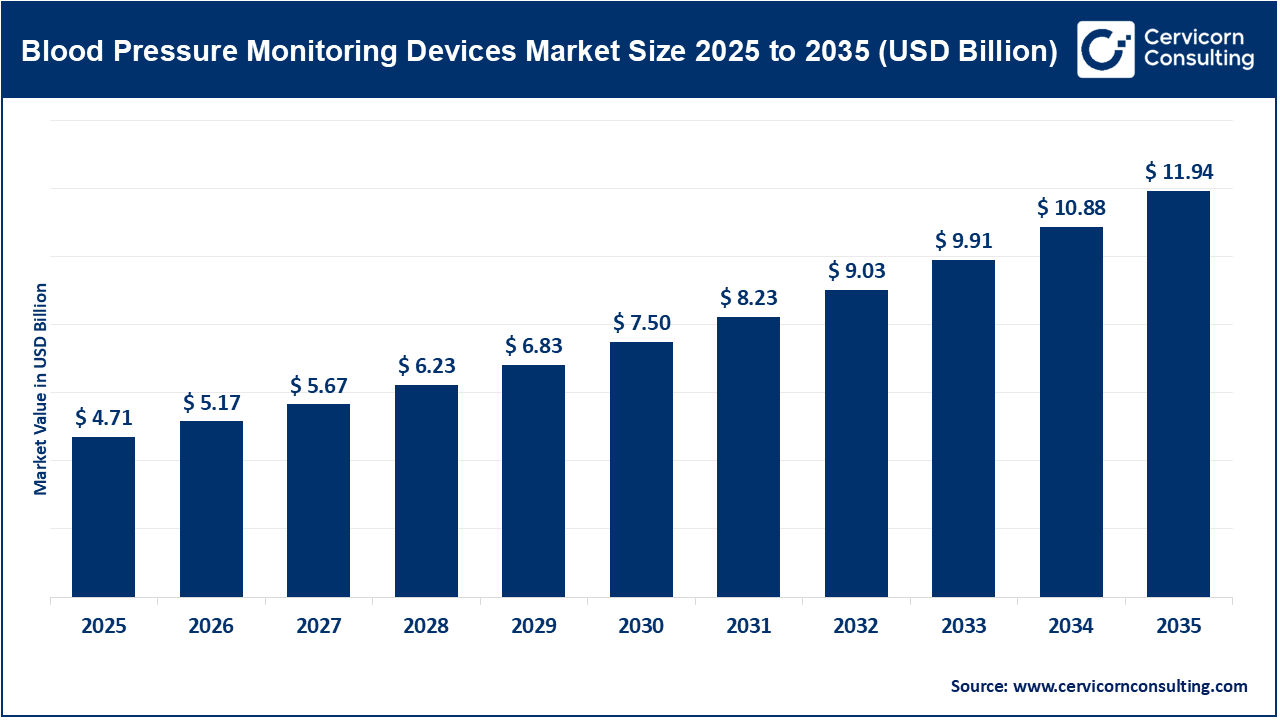
At the same time, healthcare systems worldwide face a shortage of skilled workers, especially nurses and technicians trained to operate modern monitoring equipment. This gap is expected to widen through 2030, particularly in aging countries with fewer healthcare professionals available. Despite these staffing challenges, the demand for reliable blood pressure monitoring devices will continue to grow. Lifestyle-related illnesses, increased use of digital health tools, and the expansion of remote monitoring programs will keep driving demand, likely outpacing the supply of skilled workers capable of managing the data.
Report Highlights
- Asia-Pacific dominates the market, accounting for 39% of global revenue, driven by high hypertension prevalence, expanding home healthcare, and strong demand from China and India.
- Automated blood pressure monitors lead the market, contributing 55% of total demand, with arm-type digital BP monitors holding the largest share due to clinical accuracy and ease of use.
- Wearable BP monitoring devices are the fastest-growing segment, representing 19% of the market, supported by rising adoption of smartwatches and connected health devices.
- Digital and connected technologies dominate, holding 60% market share, as remote monitoring and smartphone-integrated BP devices gain traction.
- Hospitals & clinics remain the largest end users, while home healthcare is growing rapidly due to telehealth and remote patient monitoring adoption.
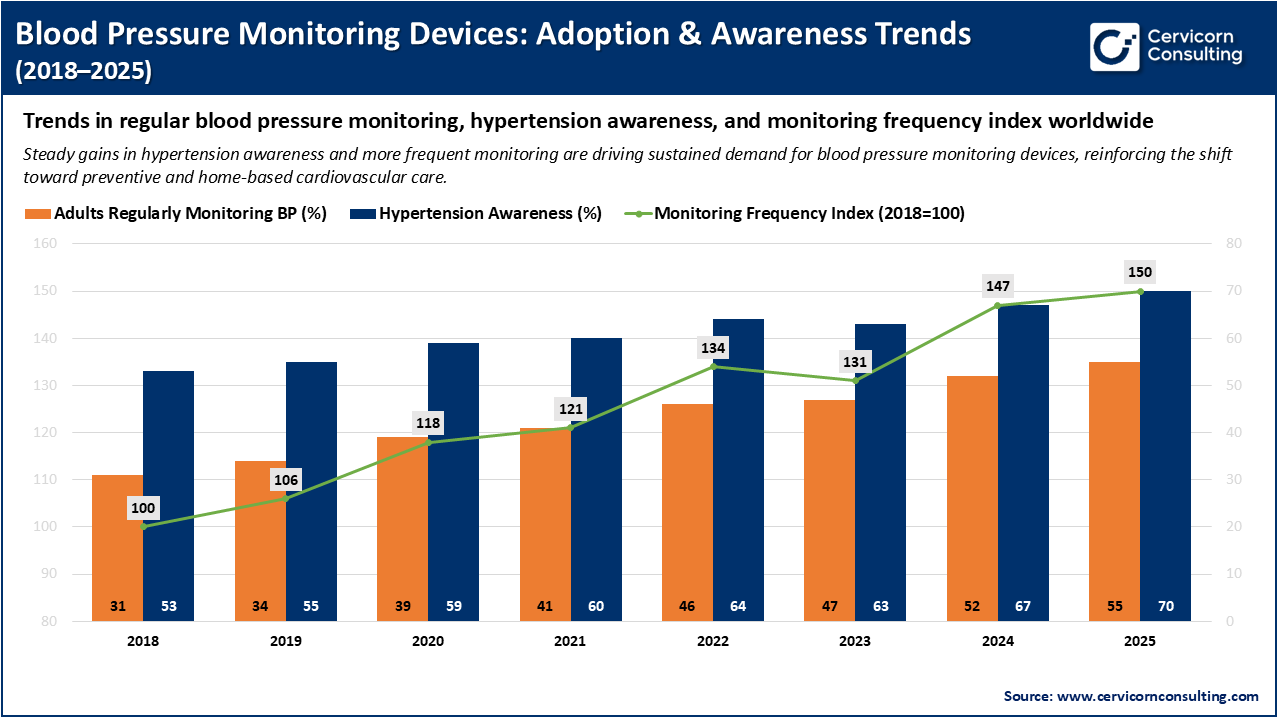
Blood Pressure Monitoring Devices: Adoption and Awareness Trends (2018–2025)
The adoption of blood pressure monitoring devices has shown a steady increase from 2018 to 2025, primarily due to rising awareness of hypertension and a notable shift toward more frequent monitoring practices. The proportion of adults who regularly monitor their blood pressure continues to grow, accompanied by improved awareness levels, which reflects a greater emphasis on preventive healthcare. Furthermore, the significant rise in the monitoring frequency index suggests that users are not only acquiring these devices but are also utilizing them more frequently. These factors together are expected to drive sustained demand for blood pressure monitoring devices in the global market.
Recent Developments of Market
- Omron Healthcare reported USD 1.2 billion in H1 2025 revenue, with strong growth in home blood pressure monitoring devices, indicating continued consumer demand and market resilience.
- Citizen Systems expanded its operations in Southeast Asia by establishing a new regional hub in Singapore to strengthen distribution channels, enhance device availability, and mitigate supply chain risks.
- A&D Medical launched an AI-powered remote monitoring platform, enabling healthcare providers and patients to track blood pressure trends, improve disease management, and support preventive care initiatives.
Recent Major Milestones
1. Wearable & Connected Devices Transform Home Healthcare Monitoring
The shift toward connected home devices and remote patient monitoring is expected to speed up in 2025 with the launch of cuffless and wearable blood pressure (BP) monitors. These devices utilise mobile connectivity along with flexible, lightweight sensors to continuously and accurately measure BP in real time as people go about their daily routines, adjusting readings based on activity level. Increasing adoption of wearable BP monitors across Asia, Europe, and the U.S. has resulted in the development of devices capable of providing highly accurate measurements during almost any activity. Consequently, they are viewed as one of the most important technological advances in BP monitoring so far.
2. AI-Enabled Predictive Analytics Enhances Clinical Decision-Making
The use of AI-powered algorithms in blood pressure monitoring devices expanded considerably in 2025 and now provides predictive analytics that assist healthcare providers in managing hypertension and detecting cardiovascular risks. Connected home-care devices have been widely adopted by healthcare organizations, creating more opportunities to enhance patient compliance and reduce hospital readmission rates. The combination of machine learning–based analytics and highly accurate monitoring hardware is one of the fastest-growing segments in the market and is projected to grow steadily through 2035.
3. Telemedicine and Remote Monitoring Drive Device Standardization
The rapid growth of telehealth services has led manufacturers to create interoperable, cloud-ready blood pressure monitors that easily connect with major telehealth platforms. These standardized connectivity protocols have enhanced device communication with electronic health records (EHRs), allowing for a smooth consultation experience between patients and clinicians and supporting the shift toward preventive healthcare. This trend is likely to remain a key driver of the global market over the next decade.
4. Sustainability and Eco-Friendly Device Manufacturing Gain Traction
Manufacturers are increasingly adopting eco-friendly production methods, including recyclable plastics, low-power components, and environmentally conscious packaging. During 2025–2026, several major companies publicly committed to reducing their products’ carbon footprint and electronic waste. Organizations that meet these sustainability standards are likely to benefit from regulatory incentives in regions like the EU and North America, providing them with a competitive advantage.
Report Scope
| Area of Focus |
Details |
| Market Size in 2026 |
USD 5.17 Billion |
| Market Size in 2035 |
USD 11.94 Billion |
| CAGR form 2026 to 2035 |
9.70% |
| Dominant Region |
Asia-Pacific |
| Key Segments |
Product Type, Technology, Distribution Channel, Application, End User, Region |
| Key Companies |
Omron Healthcare, Inc., Koninklijke Philips N.V., A&D Company, Limited, Welch Allyn, Microlife Corporation, GE HealthCare, Beurer GmbH, SunTech Medical, Withings, iHealth Labs Inc. |
Market Dynamics
Market Drivers
- Rising Demand for High-Precision and Connected Blood Pressure Devices: The demand for high-precision blood pressure monitors is increasing across hospitals, clinics, and homecare settings due to the rising prevalence of high blood pressure, cardiovascular disease, and chronic conditions worldwide. As a result, the use of wearable or cuffless devices, integration with telemedicine platforms, and availability of real-time remote monitoring solutions are driving the development of advanced, high-performance devices. Innovative advances in sensor technology and AI-powered analytics, combined with automated measurement systems, enable continuous monitoring, predictive health insights, and improved disease management, driving a growing demand for state-of-the-art blood pressure monitors.
- Rapid Expansion of Telehealth and Remote Patient Monitoring: Healthcare systems worldwide face rising patient numbers and a shortage of trained professionals capable of providing ongoing care through continuous monitoring and management of chronic diseases. As a result, there is a rapid increase in the use of automated, connected blood pressure monitors that can collect, transmit, and analyze patient data remotely. These systems help reduce the need for in-person visits, improve operational efficiency, and support adherence to treatment plans. Additionally, integration with digital health platforms, cloud-based analytics, and AI-assisted decision support further fuel the demand for advanced blood pressure monitoring technologies.
Market Restraints
- High Costs of Advanced Devices and Technological Infrastructure: The acquisition of advanced wearables or AI-enabled precise blood pressure monitoring devices can be expensive because they use complex sensors, electronic parts, and multiple integrated software systems. These manufacturers face high development costs due to integration with the Digital Health Ecosystem (e.g., eHR), regulatory compliance expenses, and time requirements; thus, smaller clinics and regions with limited resources will probably have restricted access to this technology. Additionally, the costs associated with advanced analytics, cloud connectivity, and real-time information technologies are capital-heavy, which can slow their adoption in price-sensitive markets
- Regulatory Compliance and Standardization Challenges: Precision blood pressure monitoring devices must comply with global and regional Medical Device Standards (e.g., FDA, CE, ISO 81060-2) and undergo strict clinical performance and accuracy testing. Regulatory approvals for AI-enabled or wearable blood pressure devices require extensive clinical validation by FDA or other regional agencies, which can delay market entry and increase manufacturing costs. The rapidly evolving regulatory landscape and the ongoing development of medical device regulations and data privacy laws, especially for connected health technologies, present continuous challenges for these manufacturers.
Market Opportunities
- Integration of IoT, AI, and Predictive Health Monitoring: Blood pressure equipment suppliers have a great opportunity to develop smart, connected devices that provide continuous monitoring of patients' blood pressure, heart rate, and other activity levels. IoT-enabled devices and applications can detect trends by connecting with AI-powered platforms and offer early warning signs of heart-related issues, such as hypertension or other cardiovascular diseases. Service-based business models, remote patient management programs, and increased patient engagement are emerging models for connected blood pressure devices and will shape new ways of delivering services.
- Growing Demand in Emerging Healthcare Markets: The Asia Pacific, Latin America, and Middle East/Africa regions are currently investing in healthcare growth, with notable investments in new hospitals, increased use of telemedicine, and rising interest in preventive medicine. New government health initiatives, broader acceptance of telemedicine, and the expanding middle class create a strong demand for inexpensive, accurate, and locally accessible blood pressure monitors and other medical devices that can be produced. Manufacturers need to consider this demand and find ways to expand their distribution networks and production capacity to provide affordable products that address the healthcare needs of these populations.
Market Challenges
- Shortage of Skilled Healthcare Professionals for Device Management: To properly operate, calibrate, and accurately interpret results from sophisticated blood pressure monitors, trained operators are essential. In many areas, a shortage of qualified healthcare staff results in too few operators to properly handle these devices. Additionally, if a clinician or patient uses an AI-assisted or connected device, they will need extra training on how to operate these devices, which adds costs and increases complexity in using these advanced tools.
- Supply Chain Constraints and Data Reliability Concerns: The blood pressure device industry demands the highest precision in components like sensors, microelectronics, and batteries to successfully produce and deliver devices. When any of these components are unavailable, it can cause significant delays in manufacturing or delivery due to supply chain issues, shortages, or geopolitical events. Ensuring consistent data accuracy from various devices and maintaining patient data security when using connected devices are two major challenges in this field. Manufacturers and healthcare providers face common risks, including cybersecurity threats, data integrity problems, and device malfunctions.
Blood Pressure Monitoring Devices Market Regional Analysis
The blood pressure monitoring devices market is segmented by region into North America, Europe, Asia-Pacific, and LAMEA. Here is a brief overview of each region:
Why does Asia-Pacific dominates the blood pressure monitoring devices market?
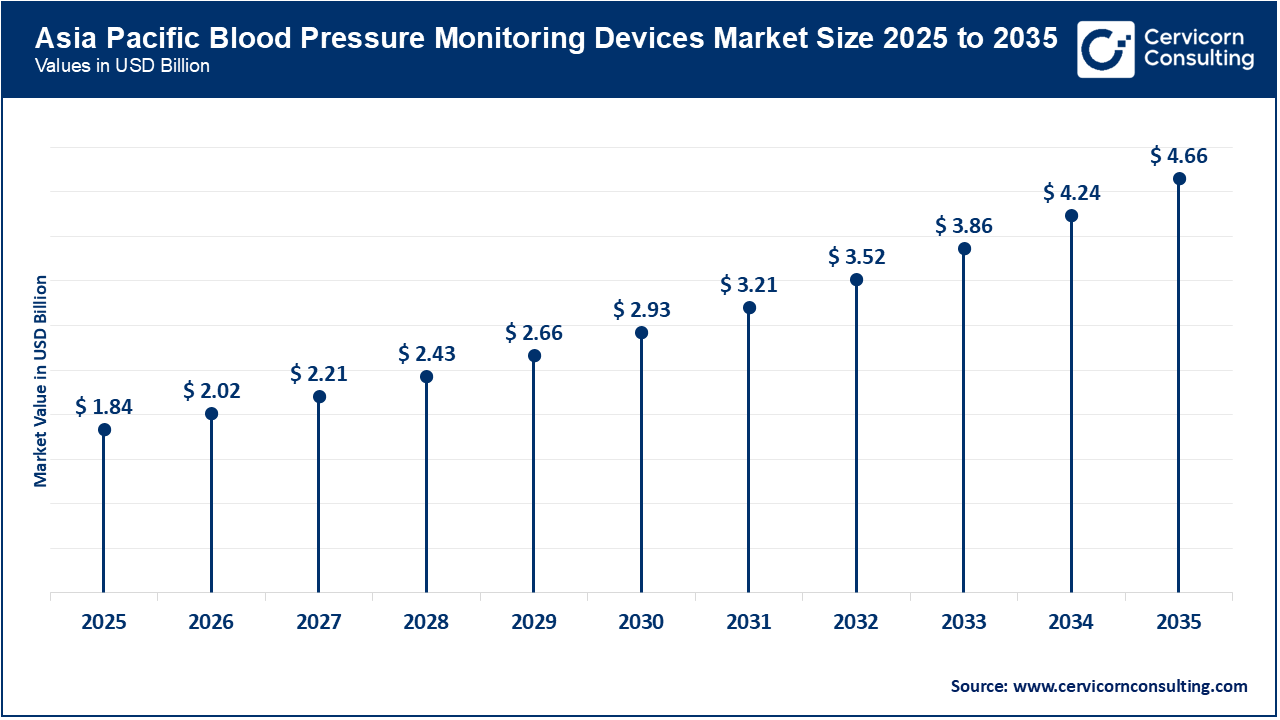
The Asia-Pacific blood pressure monitoring devices market size was valued at USD 1.84 billion in 2025 and is expected to hit around USD 4.66 billion by 2035. Asia Pacific is the largest and fastest-growing region due to rising rates of hypertension and the adoption of digital health care solutions. The region is projected to be the largest market and the fastest growing in blood pressure monitoring devices worldwide by revenue in 2025, based on available data. This growth is driven by aging populations, increasing numbers of people developing hypertension, the emergence of a middle-class, and improvements in healthcare accessibility.
Countries such as China, India, Japan, and South Korea currently have high demand for both clinical and home-based blood pressure monitoring systems. The region continues to see rapid growth in the adoption of wearable and connected blood pressure monitors due to increased smartphone use and government digital health initiatives. Additionally, ongoing investments in healthcare infrastructure and greater awareness of preventive health measures are key factors fueling market growth.
Recent Developments:
- China expanded domestic production of digital and connected blood pressure monitors to support chronic disease management programs.
- India increased adoption of home blood pressure monitoring devices through government-backed telehealth and preventive care initiatives.
North America Blood Pressure Monitoring Devices Market: Driven by Advanced Healthcare Infrastructure and Remote Patient Monitoring
The North America blood pressure monitoring devices market size was estimated at USD 1.32 billion in 2025 and is predicted to hit around USD 3.34 billion by 2035. The North American market is the largest globally for blood pressure monitors. This is because North America has a well-developed healthcare system, high health awareness, and a strong acceptance of new technology in healthcare. The USA leads this region with the highest rates of hypertension and heart disease.
Connected and smart blood pressure monitors used in maternal/childcare and remote monitoring markets are gaining popularity in North America. Growth is supported by factors such as favourable reimbursement policies for second opinions, widespread telehealth services, and a dense presence of major medical device companies.
Recent Developments:
- U.S. based healthcare providers increased adoption of connected blood pressure monitors for chronic disease and remote patient monitoring programs.
- Canada expanded home healthcare services, boosting demand for automated and wearable blood pressure monitoring devices.
What are the driving factors of Europe blood pressure monitoring devices market?
The Europe blood pressure monitoring devices market size was reached at USD 1.04 billion in 2025 and is projected to surpass around USD 2.63 billion by 2035. In Europe, the market for blood pressure monitors is still expanding but at a much slower pace. This is mainly because Europe has a higher proportion of older adults than any other region in the world and places a strong emphasis on disease prevention and the use of preventive healthcare services. The countries that drive demand for blood pressure monitors in Europe are Germany, France, the United Kingdom, and Italy. Due to the high incidence of hypertension and cardiovascular disease, these countries are at the forefront of diagnosing these conditions.
Recent Developments:
- Germany increased adoption of clinically validated digital blood pressure monitors in hospitals and outpatient clinics.
- European telehealth initiatives accelerated deployment of connected blood pressure monitoring solutions.
Blood Pressure Monitoring Devices Market Share, By Region, 2025 (%)
| Region |
Revenue Share, 2025 (%) |
| Asia-Pacific |
39% |
| North America |
28% |
| Europe |
22% |
| LAMEA |
11% |
Why LAMEA sector shows modest growth in the blood pressure monitoring devices market?
The LAMEA blood pressure monitoring devices market was valued at USD 0.52 billion in 2025 and is anticipated to reach around USD 1.31 billion by 2035. The Latin American sector shows modest growth due to improvements in its healthcare system, increased awareness of heart health, and ongoing urbanization in the region. The largest markets for this product in Latin America are in Brazil and Mexico, where expanding hospital networks are boosting the use of home healthcare devices. The overall Latin American market is much smaller than those of other developed regions. However, recent increases in government healthcare spending, along with growing demand for affordable, automatic blood pressure monitors, are likely to sustain growth in this sector.
Furthermore, the Middle East and African sectors are also expanding thanks to increased government investments to strengthen healthcare systems. The rising prevalence of lifestyle-related diseases, such as hypertension, has further contributed to this trend. In particular, Saudi Arabia, the United Arab Emirates, and South Africa currently experience high demand for this product due to expanding hospitals serving their populations and the implementation of various national health screening programs.
Recent Developments:
- Brazil expanded public healthcare screening programs, increasing demand for clinical blood pressure monitoring devices.
- Mexico saw rising adoption of home blood pressure monitors through pharmacy and e-commerce channels.
- Saudi Arabia expanded preventive healthcare and cardiovascular screening programs, increasing demand for blood pressure monitoring devices.
Blood Pressure Monitoring Devices Market Segmental Analysis
The blood pressure monitoring devices market is segmented into product type, technology, distribution channel, application, end user, and geography.
Product Type Analysis
Automated devices that measure blood pressure hold the largest share of the global market due to their reliability, speed, and ease of use. These machines are commonly found in hospitals, clinics, and home settings, making them popular among caregivers and individual consumers alike. These technologies support self-monitoring, reducing opportunities for human error and establishing clear patterns of hypertension.
Blood Pressure Monitoring Devices Market Share, By Product Type, 2025 (%)
| Product Type |
Revenue Share, 2025 (%) |
| Automated Blood Pressure Monitors |
55% |
| Manual Blood Pressure Monitors |
26% |
| Wearable Blood Pressure Monitors |
19% |
Wearable devices that measure blood pressure are currently the fastest-growing segment, driven by increased use of smartwatches and fitness trackers, as well as consumer demand for continuous personal healthcare monitoring. Additional factors contributing to the rapid growth of this segment include new technological developments in cuffless blood pressure measurement techniques.
Technology Analysis
Digital and automated blood pressure monitors are the dominant segments, generating the most revenue. Their widespread use has created demand both clinically and at home. Digital/Automated Blood Pressure monitors provide clearly displayed results, high accuracy, memory storage capacity, and ease of use; therefore, they are well suited for long-term management of elevated blood pressure (hypertension).
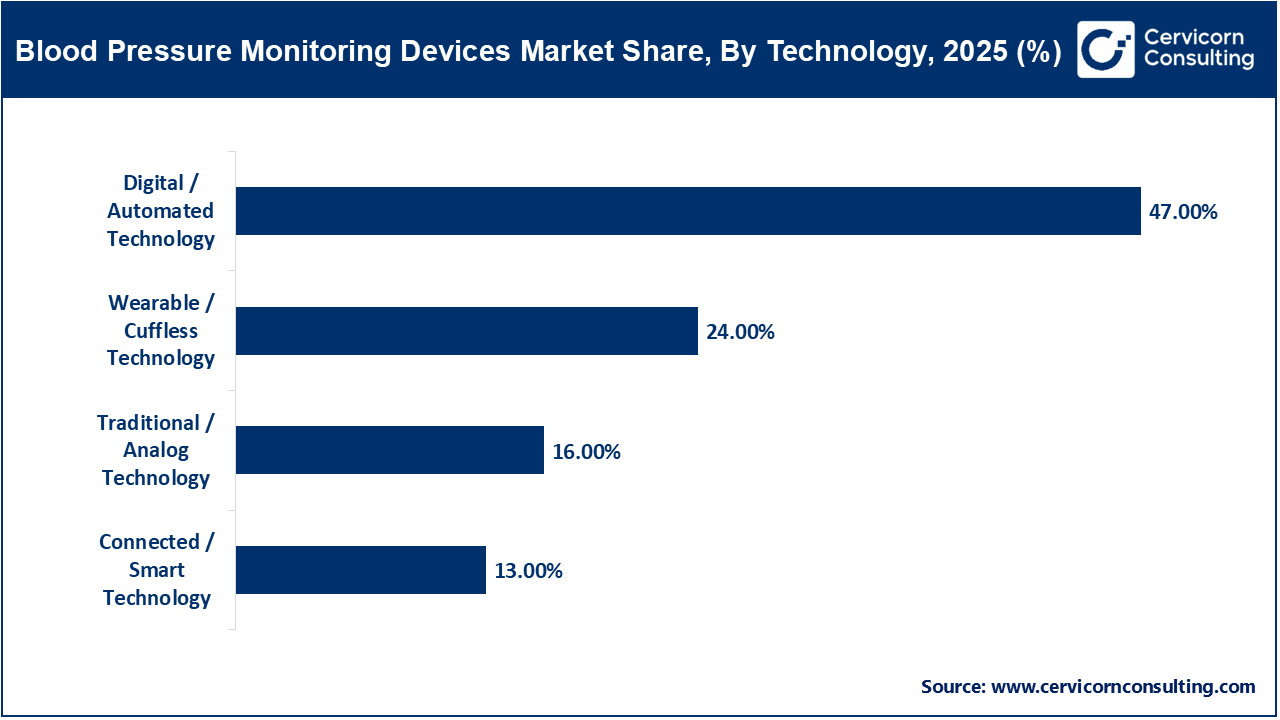
Connected Smart technology is a rapidly expanding segment of blood pressure monitors, primarily driven by the growth of telehealth, remote patient monitoring, and smartphone-integrated healthcare solutions. Connected & smart blood pressure monitors enable real-time communication between healthcare providers and patients, improving patients' ability to manage their health and overall disease management outcomes.
Distribution Channel Analysis
Retail pharmacies hold the largest market share due to their widespread presence, consumer trust, and immediate product availability. Pharmacist recommendations and over-the-counter access also boost sales through this channel.
Blood Pressure Monitoring Devices Market, By Distribution Channel, 2025 (%)
| Distribution Channel |
Revenue Share, 2025 (%) |
| Retail Pharmacies |
40% |
| Online Platforms / E-commerce |
27% |
| Hospital Pharmacies & Institutional Sales |
21% |
| Direct Sales |
8% |
| Others |
4% |
Online platforms and e-commerce are the fastest-growing segments, driven by increased digital adoption, broader product selection, competitive prices, and the convenience of home delivery. The rise of direct-to-consumer medical device brands has further sped up this growth.
Application Analysis
The clinical monitoring segment is the largest application market because taking a patient's blood pressure is a common diagnostic test in hospitals, clinics, and other locations. The large number of patients and the need for accurate, validated blood pressure readings contribute to significant ongoing demand from clinicians.
Blood Pressure Monitoring Devices Market, By Application, 2025 (%)
| Application |
Revenue Share, 2025 (%) |
| Clinical Monitoring |
42% |
| Home Monitoring |
35% |
| Remote Patient Monitoring |
14% |
| Preventive Health Screening |
6% |
| Others |
3% |
The home monitoring application segment is growing at the fastest rate due to factors like the high prevalence of hypertension, the aging population, rising healthcare costs, and increasing awareness of preventive health care among patients. More patients want to monitor their chronic conditions from home to reduce hospital visits.
End User Analysis
Hospitals and clinics comprise the largest part of the end-user segment due to the ongoing need to measure patients' blood pressure throughout the entire patient experience; from diagnosis to treatment and recovery. When using professional-grade BP monitoring devices, hospitals and clinics must ensure their devices meet accuracy and compliance standards, which drives the continued demand for clinical-grade BP monitors.
Blood Pressure Monitoring Devices Market, By End User, 2025 (%)
| End User |
Revenue Share, 2025 (%) |
| Hospitals & Clinics |
45% |
| Home Healthcare / Home Use |
33% |
| Diagnostic Centers |
11% |
| Ambulatory Surgical Centers & Outpatient Clinics |
7% |
| Telehealth / Remote Monitoring Providers |
3% |
| Others |
1% |
The home healthcare and home use segment is the fastest-growing segment, fueled by the rising preference for self-monitoring, the availability of affordable BP monitoring devices, and the expanding remote healthcare services.
Blood Pressure Monitoring Devices Market Top Companies
Recent Developments by Major Companies
Omron Healthcare
- Expanded its portfolio of connected and clinically validated blood pressure monitors for home and professional use.
- Strengthened partnerships with digital health platforms to support remote patient monitoring.
Philips Healthcare
- Enhanced integration of blood pressure monitoring devices with telehealth and hospital information systems.
- Focused on AI-enabled analytics for chronic cardiovascular disease management.
Welch Allyn (Hillrom / Baxter)
- Introduced advanced automated blood pressure monitoring solutions for hospitals and ambulatory care settings.
- Expanded presence in outpatient and home healthcare markets.
Microlife Corporation
- Invested in cuffless and wearable blood pressure monitoring technology.
- Increased penetration in emerging markets through affordable device offerings.
Market Segmentation
By Product Type
- Automated Blood Pressure Monitors
- Arm-type Digital BP Monitors
- Wrist-type Digital BP Monitors
- Ambulatory Blood Pressure Monitoring Devices
- Home Blood Pressure Monitoring Devices
- Manual Blood Pressure Monitors
- Aneroid Sphygmomanometers
- Mercury Sphygmomanometers
- Wearable Blood Pressure Monitors
- Smartwatches with BP Monitoring
- Fitness bands with BP Sensors
- Others
By Technology
- Digital / Automated Technology
- Wearable / Cuffless Technology
- Traditional / Analog Technology
- Connected / Smart Technology
By Distribution Channel
- Retail Pharmacies
- Online Platforms / E-commerce
- Hospital Pharmacies & Institutional Sales
- Direct Sales
- Others
By Application
- Clinical Monitoring
- Home Monitoring
- Remote Patient Monitoring
- Preventive Health Screening
- Others
By End User
- Hospitals & Clinics
- Home Healthcare / Home Use
- Diagnostic Centers
- Ambulatory Surgical Centers & Outpatient Clinics
- Telehealth / Remote Monitoring Providers
- Others
By Region
- North America
- Europe
- Asia-Pacific
- LAMEA