
Content
Hydrogen Buses: The $67 Billion Future of Clean Public Transport and Sustainable Cities


Hydrogen Buses Market Overview
The global hydrogen buses market is growing fast and it is expected to reach USD 67.42 billion by 2035 owing to the initiatives of governments giving money to help build hydrogen infrastructure and growing advancements in fuel cells technology.
Hydrogen buses are a solution for cities that have a lot of air pollution. They are also a way to reduce the amount of carbon in the air. Over the ten years, the technology for hydrogen fuel cells has improved a lot. Now hydrogen buses are being used in parts of the world. Europe and Asia-Pacific are the leaders in hydrogen buses market. India is also starting to use hydrogen buses. The good thing about hydrogen buses is that they can travel distances without stopping. They can also refuel quickly which is not the case with battery- buses. This makes them a good option for cities that want to reduce their carbon footprint.
Market Dynamics
Hydrogen buses use fuel cells to convert hydrogen into electricity. Compared to battery- buses hydrogen buses can travel longer distances without losing power. Compared to battery-powered electric buses, which take forever to recharge, hydrogen-driven electric buses can be re-fuelled in a matter of minutes. Governments around the world are actively encouraging (and through subsidies) the use of hydrogen-powered buses within their public transportation fleets. The European Union is doing this by making funding available through the EU's Green Deal for large scale hydrogen bus initiatives. For example, hydrogen fuel infrastructure investments have been made by countries such as Germany and the UK and many others. Additionally, several countries in the Asia-Pacific are working on establishing hydrogen-powered bus service. Hydrogen-powered buses provide an array of benefits compared to battery-powered buses; however, many barriers face the successful implementation of hydrogen bus systems when they are put into service.
The first barrier is that the initial cost of hydrogen-powered buses is higher than for battery bus. The second barrier is that most major cities do not yet have a hydrogen refuelling infrastructure; therefore, it would be very difficult, if not impossible, for many cities and municipalities to adopt hydrogen-powered buses as part of their transit fleets.
Recent Developments in the Hydrogen Bus Market (2025–2026)
| Category | Key Development & Insight | Notable Impact |
| Market Growth | Global market value reached USD 2.51 billion in 2025 and is projected to hit USD 3.48 billion by the end of 2026. | Europe saw a 426% growth in H1 2025 registrations compared to the previous year. |
| Regional Leaders | Asia-Pacific dominates with over 70% market share (led by China and South Korea); Europe is the fastest-growing secondary hub (35% projected share in 2035). | Germany remains Europe's primary testbed, hosting the E-Bus Test 2026 in Bonn to evaluate 10+ new models. |
| Infrastructure | Shift toward Green Hydrogen hubs; public refueling stations are projected to grow by 200% in key markets over the next five years. | India flagged off its first commercial hydrogen bus service in Ladakh (Leh) in June 2025. |
| Technology Innovations | Launch of high-output, compact fuel cell modules (e.g., Bosch FCPM C100) designed for 12–18 meter buses. | New composite tanks and metal hydrides are extending ranges and reducing refueling times below 15 minutes. |
| Manufacturer Moves | Solaris remains the European leader (58% market share in H1 2025). Hyundai unveiled its next-gen FCEV bus in March 2025 with higher durability. | Solaris secured a landmark order for 1,000 fuel cell engines from Ballard to power buses across Europe. |
| Pricing Trends | Average cost of a hydrogen bus remains high at USD 750k–USD 900k (vs. USD 500k for BEVs), but total cost of ownership (TCO) is improving. | Subsidies from programs like the EU Green Deal and JIVE2 are narrowing the price gap with diesel. |
Hydrogen Buses Market Trends
Rapidly developing environmentally sustainable transport systems are shaping today's hydrogen bus market for comprehensive development and transformation. Due to increasing air pollution and traffic congestion in urban communities, hydrogen buses have been identified as a viable alternative to diesel buses that are currently used in mass transit systems. In general, committing to the use of hydrogen-powered mass transit is a significant expansion of a commitment to reducing greenhouse gases and improving air quality; furthermore, hydrogen-powered public transportation is much more than a temporary trend. Because many governments and municipalities are investing in hydrogen infrastructure, the availability of hydrogen-powered buses will become more accessible to transit authorities and bus operators. In addition to the improvement of hydrogen fuel cell technology, the efficiency and performance of hydrogen-powered vehicles continue to improve, making them attractive to both operators and transit authorities. Therefore, as the mass transit industry learns more about the long-term economic and environmental benefits of a fleet of hydrogen buses, the hydrogen bus market will continue to grow. The market for hydrogen buses is impacted by economic factors in addition to environmental advantages. More public transportation companies are probably going to think about adding hydrogen buses to their fleets due to the possibility of reduced operating costs and government incentives for clean energy projects. Manufacturers, energy suppliers, and legislators seem to need to work together as the market develops to solve supply chain logistics and technology integration issues.
China-Dominated to Globally Expanding
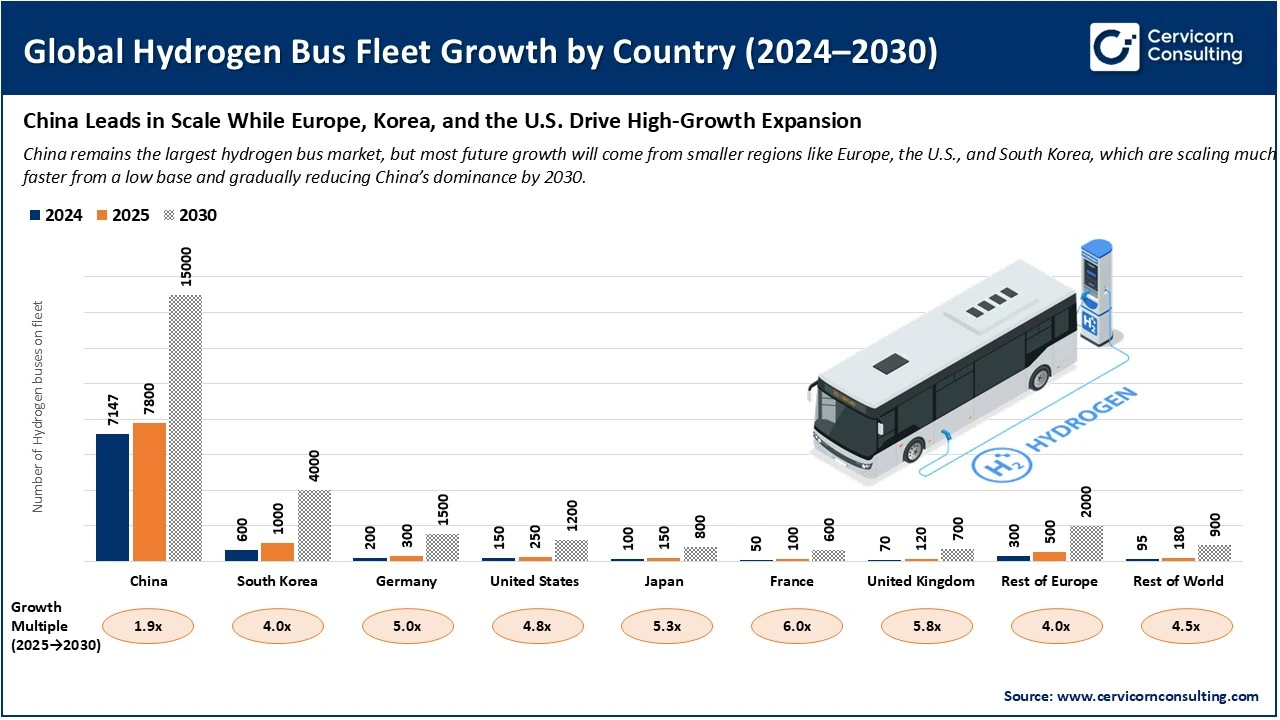
Expert Perspective (2025–2030)
1. Base Case Scenario: Structured Growth with Policy Support
Cervicorn Consulting reports that the hydrogen bus market is poised for significant growth, expanding from USD 2.51 billion in 2025 to over USD 67 billion by 2035, driven by government mandates and clean mobility investments. In this scenario, adoption increases steadily, especially in Asia-Pacific and Europe, where subsidies and hydrogen infrastructure are expanding. Hydrogen buses tend to complement battery-electric buses rather than replace them, mainly serving long-range and heavy-duty routes.
2. Optimistic Scenario: Hyper-Growth Driven by Hydrogen Economy Expansion
In a more optimistic outlook, Cervicorn Consulting foresees a CAGR of about 39–49% over the next decade, supported by rapid increases in green hydrogen production and decreasing costs. If infrastructure hurdles are overcome and investments accelerate, hydrogen buses could become a mainstream public transportation option. Widespread adoption in North America and Europe, along with Asia’s leadership, could establish hydrogen buses as a key part of zero-emission transit, especially for intercity and high-capacity routes.
3. Conservative Scenario: Growth Limited by Cost and Infrastructure Constraints
Even with positive projections, Cervicorn Consulting notes that growth relies heavily on infrastructure and cost factors. If hydrogen remains expensive and refueling networks are slow to develop, adoption could stall despite supportive policies. Under this scenario, hydrogen buses would continue to grow but mainly in pilot projects and government initiatives, while battery-electric buses would dominate urban fleets. The market would expand but at a slower pace, not reaching its full potential.
Competitive Landscape
The industry has a mix of automotive companies and smaller fuel cell companies. In Europe, the bar for hydrogen buses is being raised by a number of companies including Daimler, Solaris, and Van Hool. In Asia, the leading players in the hydrogen bus industry are Toyota, Hyundai, and Yutong, while in North America, Ballard Power Systems and New Flyer are leading the way. All of the leading companies in the hydrogen bus industry are focused on becoming leaders in hydrogen bus technology by establishing a global presence through either a joint venture or acquisition and then leading the competition in the hydrogen bus market. As an example, in 2023, Toyota Motor Corporation entered into a strategic alliance with Woven Planet Holdings Inc. to design, manufacture and implement a self-driving hydrogen fuel cell powered public transport bus. Hydrogen bus manufacturers are also creating world-class innovations in hydrogen fuel-cell technology.
Recent Developments
| Company | Date | Investment / Deal Size | Key Development / Statistics |
| Hyundai Motor Company | Oct 2025 | £500 million | Building hydrogen fuel cell plant in South Korea; capacity ~30,000 fuel cell units/year |
| Wrightbus | Apr 2025 | £25 million | Investment in zero-emission R&D including hydrogen buses and coach development |
| Irizar Group | Apr 2025 | £5 million | Hydrogen coach development with ~1,000 km range |
India’s Position
India is still in the stages of adopting hydrogen buses. It has big plans under the National Hydrogen Mission. Hydrogen is a transportation fuel made from renewable energy sources and reduces the carbon footprint of procured buses; battery powered electric buses are growing in popularity in India for intercity and long distance travel but will not be able to support heavy duty transport; thus, the hydrogen bus represents an option to use as an alternative fuel for the transportation of passengers and goods where battery powered electric buses cannot be used due to the route requirements and/or environmental conditions.
The worldwide introduction of hydrogen fuel-cell public transport will become more prevalent in urban areas by 2030; hydrogen fuel-cell buses will provide additional benefits to improving air quality and reducing greenhouse gases through the adoption of hydrogen fuel-cell buses influencing the most rapid growth and development of the hydrogen-fuel cell or hydrogen-biofuel public transportation sector.
Evaluate the growth trajectory of the hydrogen bus market with our exclusive market breakdown: +91 8983225533 | sales@cervicornconsulting.com