Automotive Software and Electronics Market Size and Growth 2026 to 2035
The global automotive software and electronics market size was valued at USD 325.43 billion in 2025 and is expected to exceed around USD 528.87 billion by 2035, exhibiting at a compound annual growth rate (CAGR) of 5% over the forecast period from 2026 to 2035. The automotive software and electronics market is experiencing substantial growth by shifting from traditional Decentralized E/E architectures, which are characterized by over 100 distributed ECUs, to centralized and zonal architectures. This change is driven by the complexity, excessive wiring harnesses, and the limits on data processing speed imposed by modern applications. Centralized and "zonal" designs streamline vehicle architecture by consolidating computing power, reducing physical complexity and vehicle weight, and enabling high-speed data communication. Zonal controllers function as local hubs for sensors and actuators, simplifying data flow to the central computing unit and supporting advanced software-defined vehicle functionalities.
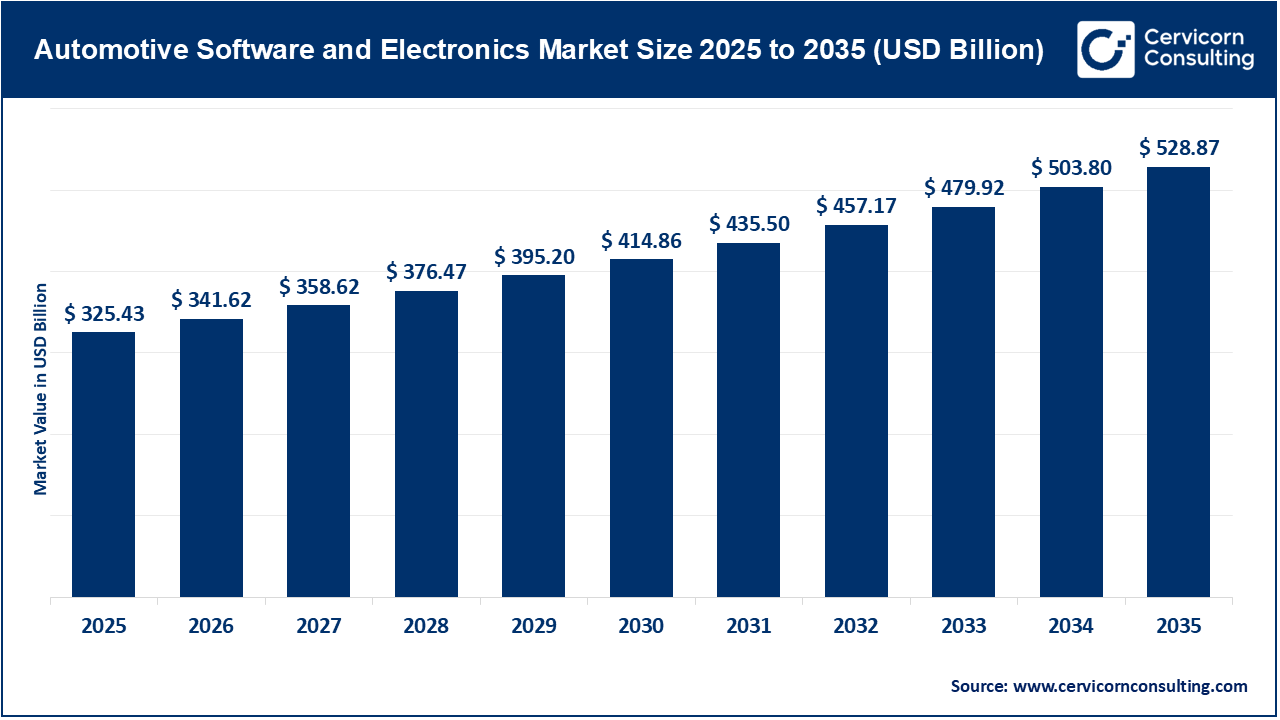
The shift is driven by changing consumer expectations and strict government regulations on emissions and safety. Consumers increasingly demand a seamless digital experience similar to their smartphone experience, which fuels the trend for customer-facing high-rate automotive infotainment systems and the adoption of AI systems tailored to the driver, owner, and passenger needs. Government regulation also fuels the need for higher-end electronics and systems that are versatile and functional across various applications. This regulatory push for advanced technology has facilitated the development of new revenue models, especially through software-as-a-service and feature-based offerings. Additionally, the evolving regulatory landscape helps solidify long-term growth plans for technological innovation within the automotive supply chain.
Report Highlights
- By Region, the Asia Pacific leads the global automotive software and electronics market with around 40% share, fueled by high vehicle production, fast EV adoption, and strong investments in automotive electronics.
- By Component, the electronic control units (ECUs) hold the largest share around 32%, as they are essential for controlling safety, powertrain, and body functions.
- By Component, the software is the fastest-growing segment with 16% share, driven by software-defined vehicles, over-the-air updates, and feature-based monetization models.
- By Sales Channels, the original equipment market (OEMs) dominates with 75% share, supported by factory-installed electronics, regulatory compliance, and integrated vehicle software systems.
- By Application, the ADAS segment has held maximum revenue share 30% in 2025.
The Shift Toward Software-Defined Vehicle (SDV) Architectures Driving Market Growth
As the automotive industry transitions from relying on multiple Electronic Control Units (ECUs) in traditional setups to adopting a Software-Defined Vehicle (SDV) architecture that uses centralized and zonal computing, the market for automotive software and electronics is undergoing a major shift. SDV helps lower complexity, costs (including wiring and configuration), and the time needed to integrate advanced technologies like advanced driver assistance systems (ADAS), connected vehicles, and infotainment systems. Additionally, SDV frameworks support over-the-air (OTA) updates, allowing OEMs to continuously improve vehicle performance, add new features, and maintain safety and security standards over the vehicle's lifetime - fueling sustained demand for automotive software and electronics solutions.
Investment Trend in Automotive Software and Electronics
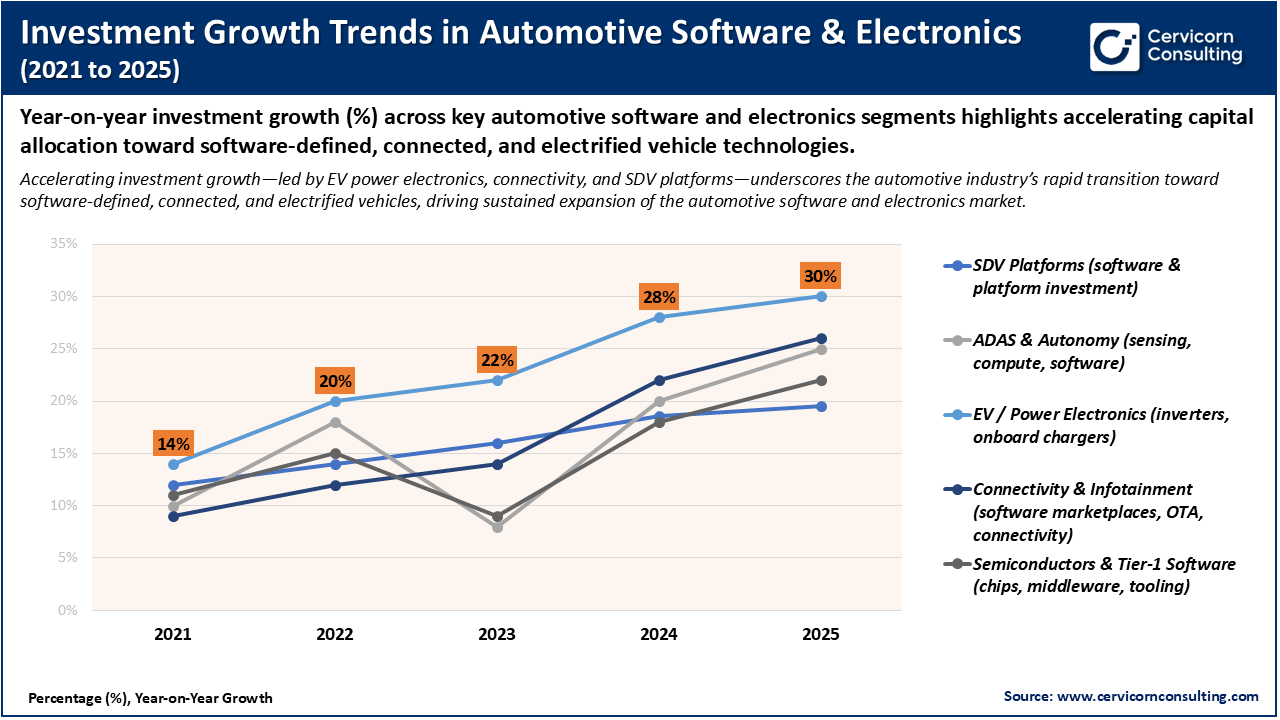
The chart indicates a consistent and significant increase in year-on-year investment growth across major automotive software and electronics segments from 2021 to 2025. This trend highlights the ongoing transformation of the industry toward software-defined, connected, and electrified vehicles. The investment in EV power electronics is leading this growth, rising from the mid-teens to approximately 30%. This reflects the substantial capital being allocated to inverters, onboard chargers, and high-voltage architectures, which are essential for the development of electric vehicles. The strong upward trends in SDV platforms and connectivity and infotainment systems show that automakers are increasingly focusing on centralized computing, over-the-air updates, and new digital revenue streams. While investments in ADAS and semiconductors experience some short-term fluctuations, both segments recover after 2023. This recovery demonstrates a renewed emphasis on advanced sensing technologies, improved computing, and a more reliable semiconductor supply. Overall, these trends indicate that software and electronics are playing a growing role in shaping automotive platforms and are expected to remain central to industry investment in the coming years.
Recent Major Milestones
1. Significant Industry Advancements and Corporate Changes
A major milestone in the automotive electronics sector involves the introduction of next-generation system-on-chip (SoC) platforms, particularly the Nvidia DRIVE Thor. This ultra-high-performance chip can achieve 2,000 TFLOPS (teraflops) of performance, enabling the integration of various functions such as infotainment, digital instrument clusters, and level 4 autonomous driving onto a single system on a chip (SoC). This milestone in performance and capacity reduces the enormous compute demands of today's AI-driven vehicles and decreases the number of standalone processors needed. These hardware advancements also support the execution of the complex "V-cycle" of systems engineering processes, which are essential for developing, testing, and deploying advanced driver assistance systems in real-world environments.
2. Government Initiatives and the Development of Safety Standards
Government regulation is a key driver of growth in the automotive software and electronics market, based on safety measures and efforts to reduce carbon emissions. The European Union's General Safety Regulations (GSR) have mandated advanced safety features in all newly manufactured and sold vehicles, including Intelligent Speed Assistance (ISA), Advanced Emergency Braking (AEB), and many others. Similarly, global regulatory initiatives aim to lower CO2 levels, targeting a 15% reduction by 2025 and a 30% reduction by 2030. These pressures are encouraging updates to engine control units (ECUs) and electrification electronics approximately every two years. Such government regulations set a baseline for advanced electronic systems, as consumers must have these features or systems to purchase vehicles and maintain market access.
3. Public and Private Partnership and Cross-Industry Work
The increasing complexity of software in modern automobiles has led to more strategic partnerships between traditional automotive manufacturers and technology companies. A key development is greater coordination between OEMs and software development teams to create proprietary operating systems (OSs). The collaboration between Volkswagen's Cariad and various technology partners highlights the challenges faced by the automaker, which has shifted its focus toward software development. This partnership is crucial for closing the "software gap" and allows automotive companies to combine Silicon Valley-level software expertise with their manufacturing strengths.
4. Investments in 5G Infrastructure and Connectivity
The implementation of 5G infrastructure and Vehicle-to-Everything technology is a disruptive element in the connectivity sector. Significant investments in smart city infrastructure enable vehicles to interact in real-time with traffic signals, pedestrians, and other vehicles, creating a smarter and more responsive ecosystem. This plays a key role in how EV and autonomous systems will achieve widespread adoption. While some barriers related to consumer acceptance will remain, the projected 70% increase in EV infrastructure over the next five years represents a major commitment from governments and industry players. These technologies form the backbone of the "connected" aspect of the software-defined vehicle (SDV), which helps the electronic market grow beyond just vehicles and into the urban environment.
Report Scope
| Area of Focus |
Details |
| Market Size in 2026 |
USD 341.62 Billion |
| Market Size in 2035 |
USD 528.87 Billion |
| CAGR 2026 to 2035 |
5% |
| Dominant Region |
Asia-Pacific |
| Key Segments |
Components, Application, Sales Channels, Region |
| Key Companies |
Robert Bosch GmbH, Continental AG, Denso Corporation, NVIDIA Corporation, Aptiv PLC, NXP Semiconductors, Infineon Technologies, Texas Instruments, Renesas Electronics, STMicroelectronics, Harman International, Siemens Digital Industries Software, BlackBerry Limited, Aumovio SE (formerly part of Continental), Black Sesame Technologies |
Market Dynamics
Market Drivers
- Growing Demand for Advanced Safety Electronics and Collision Avoidance: The Advanced Driver Assistance Systems (ADAS) continue to be the main growth driver for the automotive electronics market due to consumer demand and regulatory requirements. The integration of artificial intelligence in ADAS for real-time environmental data processing has made collision avoidance features, like automatic emergency braking (AEB) and lane-keeping assistance, standard in many passenger vehicle segments and models. Starting in 2024, changes in vehicle safety regulations, including the updated Euro NCAP requirements, will influence vehicle safety. As a result, this technology is directly linked to a decrease in vehicle-related traffic fatalities and fosters a growing market for cameras, sensors, and software algorithms.
- Rapid Electrification of Vehicle Powertrains and Battery Management: The global shift toward Battery Electric Vehicles (BEVS) is driving strong demand for advanced power electronics and improved Battery Management Systems (BMS). Electric powertrains depend on precise electronic control of energy during charging to enhance battery performance, extend range, improve thermal stability, and increase lifespan. As manufacturers focus on higher efficiencies, reduced charging times, and safety for vehicle powertrains, the need for wide-gap semiconductors and integrated power modules continues to fuel market growth, as electrification is linked to the expansion of the electronics industry.
Market Restraints
- High-Upfront Development Costs and Integration Costs for Legacy OEMs: Legacy automotive manufacturers face financial pressure as they adopt software-defined architectures. Developing proprietary software, transitioning to centralized computer power from its conventional ECU architecture, which requires multi-billion dollars of investment, is mappable against their corporate margins. These risks are based on the variable number of vehicles sold during a recession or other market disruption. At the same time, manufacturers must sustain internal combustion engine (ICE) production while increasing efforts in electric mobility and autonomous vehicle technology. These high costs create a challenging barrier to the rapid adoption of high-end electronics across all vehicle segments.
- Unstable Global Semiconductor Supply Chain and Talent Shortages: The automotive electronics market continues to recover from the disruption in the global semiconductor supply chain and recruitment challenges for specialized engineers. Manufacturers can stop producing vehicles because semiconductors are supplied by a small group of suppliers. In Addition, there is a significant gap in demand for software engineers with skills in both cloud-native development and automotive-grade safety standards, such as ISO 26262. This talent gap is constraining the speed of innovation and driving up competition to recruit more skilled people, which costs automobile manufacturers and Tier 1 suppliers more resources in software development.
Market Opportunities
- Shift towards Software-Defined Vehicle Architectures: The transition to Software-Defined Vehicle (SDV) architectures provides automakers with a transformative opportunity to separate hardware from software. SDV architecture allows updates and new features to be released via software without ongoing hardware changes, offering greater flexibility throughout the vehicle's lifecycle to respond more quickly to changing market demands or safety standards. This approach simplifies automobile manufacturing by reducing the variety of electronic components across models, which could lead to operational efficiencies and long-term cost savings.
- Emerging Markets and Low-Cost Electronic Component Integrations: Emerging markets offer a significant opportunity for adopting inexpensive electronic components because manufacturers aim to provide entry-level ADAS and connectivity features for budget-conscious consumers. Although high-end autonomous systems attract attention, there is strong demand for standardized, low-cost electronics that improve vehicle safety and efficiency in developing economies. By optimizing sensors and processing units, suppliers can tap into the growing middle-class populations in eastern Asia and Latin America, making modern vehicle features accessible through frugal innovation.
Market Challenges
- Compliance and Absence of World-Wide Compliance Standards: The lack of global compliance regarding existing automotive software and electronic protocols creates multi-dimensional regulatory environments that could take many years for manufacturers to deploy new technology in new markets. The requirements for data privacy, cyber security, and autonomous driving testing vary tremendously in different regions, which mean manufacturers must adapt their software stacks to each market. Achieving, global consensus regarding safety standards and communications protocols to unlock the full potential of connected and autonomous mobility while avoiding costly legal consequences of prohibitive compliance requirements.
- Validating and Verifying Intricate Autonomous Driving Algorithms: Verifying and validating the safety of complex autonomous driving algorithms is a significant challenge for the automotive industry. Validating the safety of an autonomous system against a skilled human driver would require billions of test miles, which is practically impossible with only physical road testing. Therefore, advanced simulation environments and digital twins must be created to test edge cases and unlikely scenarios of autonomous vehicle failures. The technological difficulty of ensuring that software can handle every plausible driving condition without failure is a major bottleneck for the autonomous driving ecosystem, especially for Level 4 and Level 5 autonomous vehicles.
Automotive Software and Electronics Market Regional Analysis
The automotive software and electronics market is segmented into North America, Europe, Asia-Pacific, and LAMEA. Here is a brief overview of each region:
Asia-Pacific Automotive Software and Electronics Market: Driven by Rapid EV Adoption and Digital Ecosystem Growth
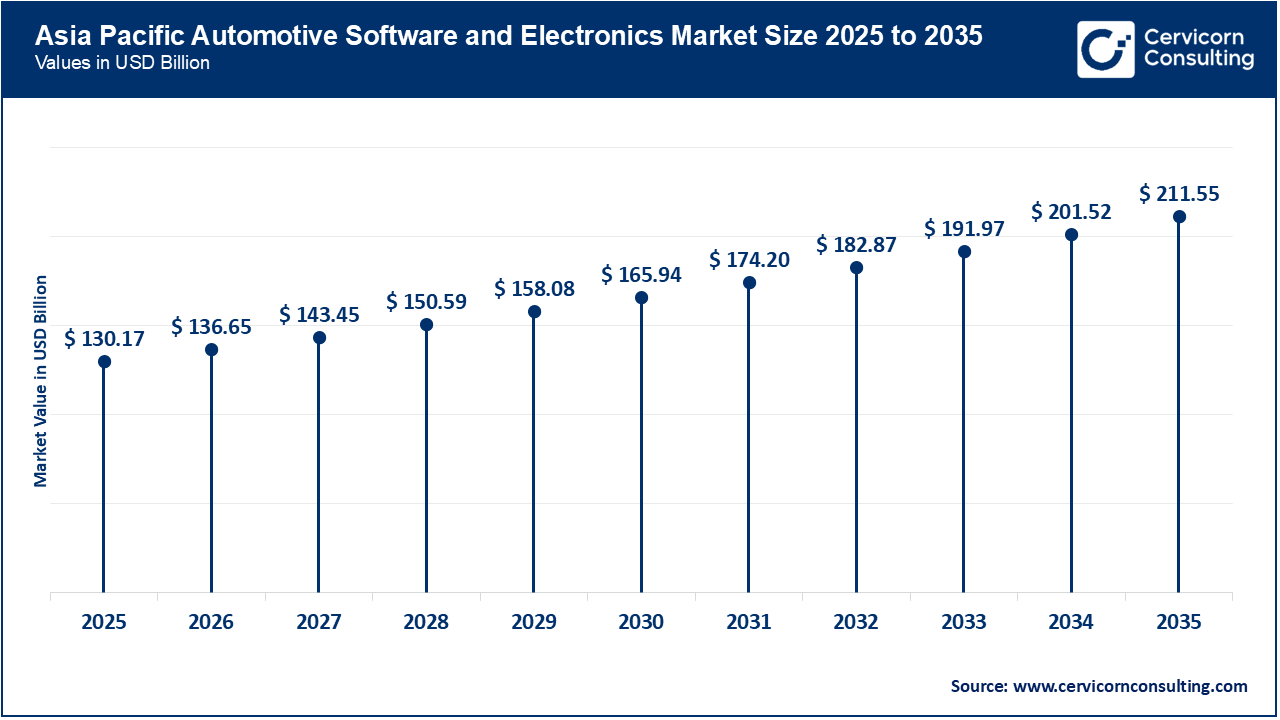
The Asia-Pacific automotive software and electronics market size was estimated at USD 130.17 billion in 2025 and is predicted to reach around USD 211.55 billion by 2035. Asia Pacific (APAC) dominates the global market, primarily driven by supportive new Energy Vehicle (NEV) policies and strong consumer demand for digitally advanced vehicles. In China, government subsidies and infrastructure investments encourage EV manufacturers to incorporate advanced software features as a key differentiator. Additionally, consumers increasingly see the vehicle as a "third living space," boosting demand for smart cockpits, multi-screen infotainment systems, and AI voice assistants to enhance on-the-go functionality.
Recent Developments:
- In Asia Pacific, Bosch and Denso expanded ECU and ADAS production in China and Japan
- NXP Semiconductors boosted automotive chip manufacturing in South Korea.
North America Automotive Software and Electronics Market: Driven by Advanced Infrastructures for Autonomous Systems and Integrated Infrastructure
The North America automotive software and electronics market size was valued at USD 97.63 billion in 2025 and is forecasted to grow around USD 158.66 billion by 2035. The North America market is driven by strong adoption of advanced software-defined vehicle technologies, including SAE Level 3 and higher autonomous driving systems and deep integration with cloud-based vehicle services. Additionally, Logistics and ride-sharing companies are accelerating their investments in multiple software solutions to improve fleet management, predictive maintenance, and autonomous delivery routes. Besides operational improvements, the National Highway Traffic Safety Administration (NHTSA) regulatory emphasis and supporting guidance have raised safety standards by promoting advanced active-safety electronics, contributing to sustained market growth.
Recent Developments:
- In North America, NVIDIA enhanced its AI computing platform for autonomous vehicles
- Intel’s Mobileye introduced advanced ADAS and self-driving solutions for major OEMs.
Europe Automotive Software and Electronics Market: Driven by Stringent Environment Regulations Driving Software-Defined Vehicle
The Europe automotive software and electronics market size was reached at USD 78.10 billion in 2025 and is projected to hit around USD 126.93 billion by 2035. The Europe is strongly influenced by strict environmental policies and rigorous safety standards. For instance, the "Fit for 55" package and Euro NCAP mandates compel legacy original equipment manufacturers (OEMs) to enhance engine management software and create more advanced active safety electronics to meet CO2 standards and ratings. Nevertheless, European luxury brands are taking the lead in Software-defined vehicles (SDVs) to counter technology companies that compete more fiercely for traditional automotive budgets, by improving telemetry operations with strong cybersecurity and high-quality coding.
Recent Developments:
- In Europe, Continental AG rolled out next-generation ADAS and zonal E/E architectures.
- Valeo launched new LiDAR and sensor technologies.
Automotive Software and Electronics Market Share, By Region, 2025 (%)
| Region |
Revenue Share, 2025 (%) |
| Asia Pacific |
40% |
| North America |
30% |
| Europe |
24% |
| LAMEA |
6% |
LAMEA Automotive Software and Electronics Market: Driven by Emerging Industrialization and Cost-Efficient Safety Electronics
The LAMEA automotive software and electronics market was valued at USD 19.53 billion in 2025 and is anticipated to reach around USD 31.73 billion by 2035. The LAMEA market is gradually developing as a market with trends toward acceptance and use of automotive electronics for automotive processes and safety-focused environments. Latin America, especially in Mexico and Brazil, is emerging as a key manufacturing hub, with major Tier 1 suppliers establishing assembly operations to produce mid-level electronic components and structures for local markets and export. In the Middle East, notably in the UAE and Saudi Arabia, there is a significant push towards smart city integration of high-end connected vehicles, which is boosting demand for telematics and GPS-based software solutions that enhance logistics efficiency and fleet safety across large regions.
Recent Developments:
- Across Latin America and MEA, Infineon increased semiconductor and sensor supply.
- Local OEMs began integrating advanced ECUs and telematics in mid-range vehicles.
Automotive Software and Electronics Market Segmental Analysis
The automotive software and electronics market is segmented into components, application, sales channels, and region.
Components Analysis
Electronic Control Units (ECUs) segment continues to dominate the market, because they are the core fundamental building blocks of vehicle electronic connectivity. The industry is moving toward the consolidation of centralization in the in-vehicle ECUs. However, many ECUs are still required for basic vehicle functions, such as powertrain, body, chassis, and utility systems. This ensures that they will still lead in revenue and shipment volume. The subsequent transition to electric and hybrid powertrains, including hydrogen fuel cell and battery management, has increased the need for specialized control units, which are critical components for the electricity propagation, range, and efficiency of the vehicle.
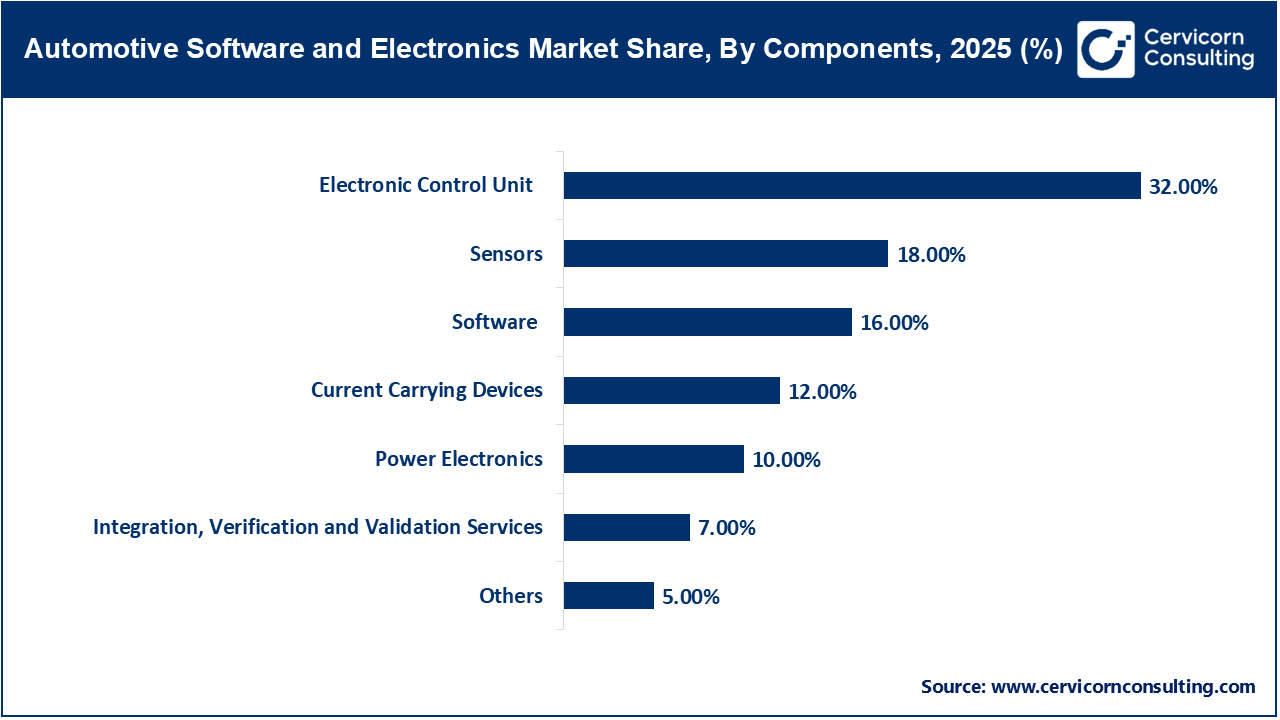
Software component is the fastest-growing segment, due to increasing demand in operating systems, middleware, and applications. Generally, software offers a higher profit margin than hardware and relies on the subscription and output revenue models that investors can find more attractive. The deployments of CI/CD in automotive engineering enable faster updates and introduce new features. The advancement of software has grown and become connected to the increase of vehicle function complexity which is now required to have millions of lines of code to run the vehicle safely and efficiently.
Application Analysis
Advanced Driver Assistance Systems (ADAS) is the largest segment of the automotive electronics market, due to its widespread adoption across both luxury and mass-market vehicle segments. As ADAS technology, such as adaptive cruise control and blind-spot monitoring, has reached a high level of maturity, large-scale OEM production has achieved significant manufacturing efficiencies. Furthermore, strong recognition of ADAS safety benefits by insurance and regulators has supported adoption. Continued advances in ADAS technologies will continue to grow with better sensor-fusion and perception using Artificial Intelligent (AI), this will increasingly be the basis for future autonomous driving (AD) capabilities.
Automotive Software and Electronics Market Share, By Application, 2025 (%)
| Application |
Revenue Share, 2025 (%) |
| ADAS |
30% |
| Safety Systems |
18% |
| Infotainment |
16% |
| Autonomous Driving |
12% |
| HMI |
8% |
| Body |
5% |
| Unexpected Services |
5% |
| Chassis |
4% |
| Powertrain |
2% |
Autonomous Driving (AD) technology is the fastest-growing segment of the market due to the rapid advances in AI and the increasing momentum toward commercial robotaxi deployment. The transition from Level 2+ combined assist to Level 3 and Level 4 autonomy will require substantially higher amounts of processor capacity, redundant sensors, and more complex software architectures. These technologies demand substantially to increase in electronic and software value per vehicle across companies.
Sales Channels Analysis
The original equipment market (OEM) remains the dominant sales channel for the automotive software and electronics market, primarily because modern electronic systems are embedded into the structural and safety architecture of the vehicle and must be installed during the manufacturing process. OEMs control the primary software stack as well as the hardware specifications, acting as gatekeepers within the automotive electronics ecosystem. This dominance is shifting toward proprietary "walled garden" ecosystems, where manufacturers want to manage both the user experience and data flow throughout the vehicle.
Automotive Software and Electronics Market Share, By Sales Channels, 2025 (%)
| Sales Channels |
Revenue Share, 2025 (%) |
| Original Equipment Market |
75% |
| Aftermarket |
25% |
The aftermarket is the fastest-growing segment in the market, mainly due to rising demand for connectivity and digital retrofitting. Car owners are upgrading their vehicles with features like smartphone integration, advanced telematics, and enhanced infotainment systems. The recovery of the aftermarket is further supported by the availability of modular electronic components that can be integrated into older cars. Additionally, aftermarket participants are leveraging vehicle connectivity to provide services through Original Equipment. Growth is driven by consumers’ desire for a continuous digital experience regardless of the vehicle's age.
Automotive Software and Electronics Market Top Companies
Recent Developments by Major Companies
- In January 2025, NVIDIA Corporation launched the mass production version of its DRIVE Thor SoC, which achieves a new unrecorded 2,000 TFLOPS (Teraflops) for centralized car computing.
- In January 2025, Aptiv PLC introduced a fully integrated "Smart Vehicle Architecture" (SVA) which reduces the physical complexity of the vehicle while consolidating multiple domain controllers into one.
- In January 2025, Infineon Technologies AG partnered with a leading EV maker to deploy its latest generation of CoolSiC MOSFETs, anticipated to achieve a 5% inverter efficiency improvement.
Market Segmentation
By Components
- Electronic Control Unit
- Sensors
- Software
- Current Carrying Devices
- Power Electronics
- Integration, Verification and Validation Services
- Others (Wiring Harness, Displays, Speakers, Board Net)
By Application
- ADAS
- Safety Systems
- Infotainment
- Autonomous Driving
- HMI
- Body
- Unexpected Services
- Chassis
- Powertrain
By Vehicle Type
- Passenger Vehicles
- Commercial Vehicles
- Electric Vehicles (EVs)
- Hybrid Vehicles
By Sales Channels
- Original Equipment Market
- Aftermarket
By Region
- North America
- APAC
- Europe
- LAMEA