Automated Cell Therapy Manufacturing Market Size and Forecast 2026 to 2035
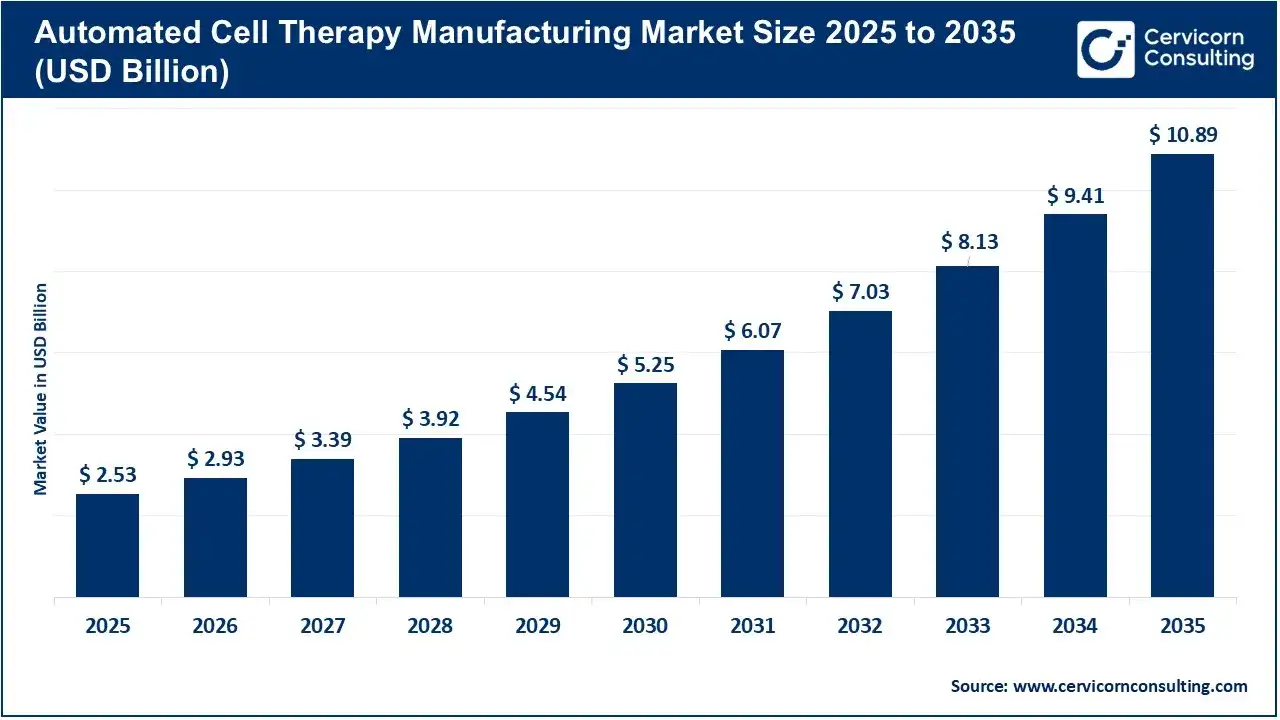
The global automated cell therapy manufacturing market size was valued at USD 2.53 billion in 2025 and is expected to reach USD 10.89 billion by 2035, growing at a CAGR of 15.72% during the forecast period from 2026 to 2035. The worldwide growth is mainly propelled by surging clinical expansion and commercial approvals for CAR-T cell therapies, TCR-T, TIL, and stem cell therapies. The expansive benefits of automated solutions, such as affordability, feasible reproducibility, and higher scalability opportunities, are supporting continuous transformations across the global industry.
- Base Year Market Size (2025): $2.53 billion
- Current Year Market Size (2026): $2.93 billion
- Estimated Year Market Size (2035): $10.89 billion
- Forecast Period CAGR (2026-2035): 15.72%
Report Highlights
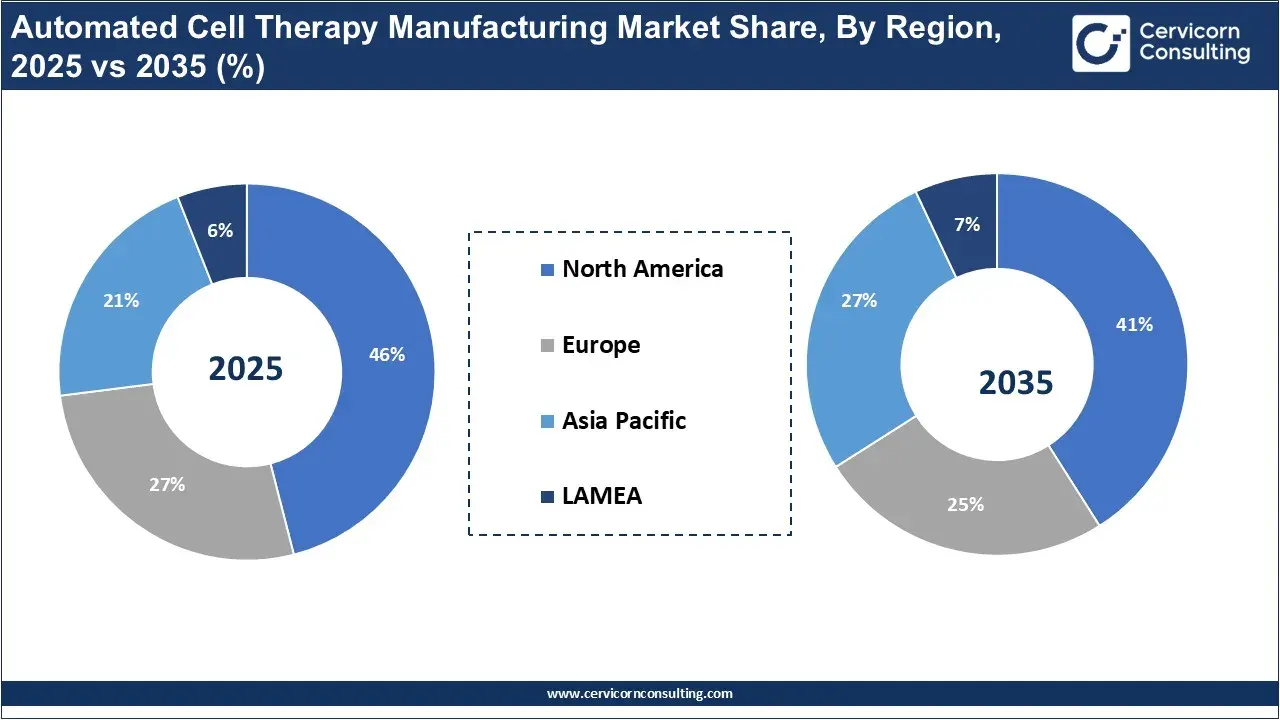
- By region, North America led the market in 2025, supported by enforcing rigorous regulatory & GMP guidelines and growing demand and development of personalised therapies.
- By component, automated platforms and instruments dominated the market in 2025 because of their lowered cross-contamination risks, compressed production expenditures, and exceptional data capture.
- By automation type, modular unit-operation systems registered dominance in 2025, fueled by the rising need for process adaptability, their substantial compatibility, and easier advances.
- By workflow step, cell collection, separation and isolation led the market in 2025, driven by increasing demand for tailored interventions and an accelerating focus on eliminating human risks during scale-up.
- By cell therapy type, CAR-T cell therapies led the market because of broadened patient demands and growing demand for decentralized approaches in production.
What is Automated Cell Therapy Manufacturing & Its Advantages?
Firstly, the automated cell therapy manufacturing market refers to the adoption of highly sophisticated instruments, closed-system consumables, robotics, and software to generate living cell therapies by substituting labor-centric manual steps with repeatable, traceable workflows. These solutions are highly prioritized across global biopharma companies due to their reduced costs and scalable production. Alongside this, automated manufacturing offers higher purity, traceability, and also supports matching regulatory frameworks. In addition, the packaging area is reshaped by the execution of closed, sterile-connectable formats, pushing automated transfer without opening the system. Moreover, the market explores innovative steps to enhance dosing, media formulations, and immobilization methods.
Latest Steps Taken in the Automated Cell Therapy Manufacturing Market
- November 2026: Innovate UK awarded £9.3 million to eight businesses that are progressing digital and automated medicines manufacturing technologies.
- November 2026: Rongu Bio closed A round of US$13.8M to strengthen off-the-shelf, umbilical cord blood-derived CAR-NK and CAR-T cell therapies.
- October 2026: Multiply Labs raised $75M to advance their robotic platform for manufacturing cell and gene therapies and other biologic medicines.
- September 2026: Ori Biotech announced a 10-year partnership worth up to $120 million to automate the production of an undisclosed, commercial-stage cell therapy employing its IRO platform.
- September 2026: Cellares and GenomeFrontier Therapeutics collaborated to assess automated manufacturing for GF-CART01, GenomeFrontier’s investigational CAR T-cell therapy, on Cellares’ Cell Shuttle platform.
Market Dynamics
Growth Drivers
- Empowering Commercial Projects: Nowadays, market players are advancing roughly 2,000 clinical trials of cell therapies across the globe, which cover CAR-T, TCR-T, TIL, NK cell, and stem cell modalities and have a high demand for validated, high-throughput platforms.
- Emphasizing Scalability: Eventual development across autologous therapies necessitates simultaneous scale-out processing of specific patient batches, whereas allogeneic therapies require scale-up to massive batch sizes. In this case, automated systems foster both models across biopharma entities, CDMOs, and decentralized or point-of-care facilities.
- Limitations of Traditional Production: Earlier use of conventional cell manufacturing was dependent on time-consuming manual steps, whereas modern closed, automated, single-use solutions are reducing human handling, batch-to-batch variability, and contamination issues.
Market Restraints
- Need for Vast CapEx: Adoption and fitting of automated instruments, closed-system platforms, bioreactors, and robotic orchestration systems requires higher upfront equipment costs, which is a key difficulty for smaller innovators or emerging industries.
- Concerns in Integration: The rollout of integrated modular instruments, bioreactors, analytics, and software is considered a technical issue, coupled with a shortage of official data formats that creates hurdles in interoperability across connected measures.
Key Opportunities
- Promoting Real-Time Biosensing: Often, research activities are looking ahead to investigating inline biosensors and Process Analytical Technology (PAT), in which real-time metabolite or stress readings pair with automated feeding, batch holds, or release testing & finally push consistency.
- AI-Powered Breakthroughs: Eminent tech giants will have a key chance in leveraging machine learning and digital twins that improve cell growth parameters, estimate batch outcomes, and validate protocols across sites.
- Reinforcing POC & Decentralized Models: Ongoing discoveries are aiming at decentralized production for CAR-T & showcasing advantages of localized automated settings that can shrink initial massive facility investments and minimize vein-to-vein delivery times.
Market Challenges
- Demonstrating Integrated Operations: Numerous industrial workflows still depend on human steps or fragmented instruments. Meanwhile, the introduction of new integrated automated modules or replacing consumables can take months of re-optimization.
- Lack of Qualified Personnel & Supply Chain: Most companies have a shortage of well-educated and trained workforce to run both bioproduction and automated solutions. Simultaneously, leaders can face prominent barriers in logistics, as therapies need strict cold-chain control and tracking approaches.
Automated Cell Therapy Manufacturing Market Regional Analysis
How did North America Dominate the Market in 2025?
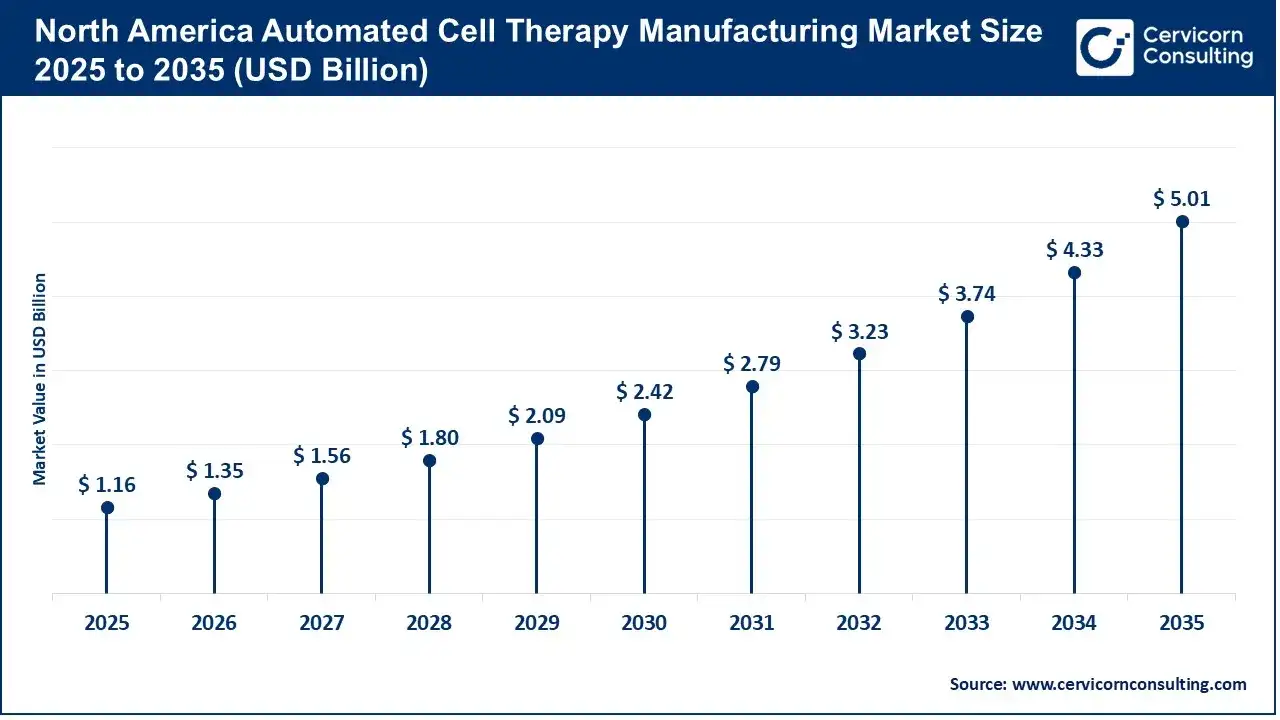
The North America automated cell therapy manufacturing market size was valued at USD 1.16 billion in 2025 and is expected to reach USD 5.01 billion by 2035. North America led with the largest share of the market in 2025, supported by accelerating cell therapy pipelines, rising commercial demand, and continuous research studies in transforming cell therapies. Along with regional Good Manufacturing Practices (GMP) requirements, the Government of Canada supported OmniaBio in empowering its facility at McMaster Innovation Park in Hamilton, Ontario, into a cell therapy ‘Intelligent Factory’, using AI and robotics. North America announced many academic-industry bioreactor landmarks, as Sartorius collaborated with McMaster University to start a new biomanufacturing lab in Canada and foster automated POC cell therapy workflows.
United States Market
- The US FDA acts as a pivotal entity in this nation, where this agency has expedited approvals for diverse pharma candidates. However, leading firms are widely investing in biopharma infrastructure and also spurring alliances with CDMOs to explore modern outsourced manufacturing approaches. Meanwhile, Cellares received the grant from the FDA's Center for Biologics Evaluation and Research (CBER) AMT designation grant for its automated Cell Shuttle cell therapy manufacturing platform in April 2025.
Which Region is Expected to be the Fastest-Growing Region in the Market?
The Asia Pacific automated cell therapy manufacturing market size was estimated at USD 0.53 billion in 2025 and is expected to reach USD 2.29 billion by 2035. Asia-Pacific is projected to grow rapidly in the automated cell therapy manufacturing market in the predicted timeframe, led by government-powered programs in production, increasing clinical studies, and a growing capacity of biotech and CDMOs. Day by day, Indian industry is actively seeking commercial-scale, vertically integrated, and closed or automated production to eliminate expenses and accelerate delivery. Key involvement of the Department of Biotechnology’s (DBT) India Biofoundry Network and translational funding via BIRAC, along with academic-industry models, is significantly raising local commercial scaling and biomanufacturing preparedness.
China Market
- China is experiencing higher market growth due to highly established regulatory updates. This mainly covers State Council Order No. 818, a statutory trajectory for clinical research and translation of new biomedical technologies, like somatic and immune cell therapies. In terms of manufacturing facility expansions, AstraZeneca planned to develop a commercial cell therapy production and supply foundation, with a new center in Shanghai to boost autologous cell therapy manufacturing and R&D.
Automated Cell Therapy Manufacturing Market Segmentation Analysis
Component Analysis
Automated Platforms and Instruments: The automated platforms and instruments segment held a dominant share of the market in 2025, fueled by their greater throughput, smaller cleanroom footprint, and rising demand for reproducibility. 2025’s advances expanded robotics solutions, including automation of cell isolation and enrichment with the GenScript CytoSinct 1000 and also used imitation learning from human studies to automate undocumented manual resuspension and mixing tasks.
Software: The software segment is projected to grow rapidly in the coming years, supported by increasing requirements for managing complex workflows, complying with cGMP guidelines, and enhancing the overall therapy yield. With the emergence of predictive process control measures, the industry is widely adopting software that connects laboratory robotics and automated equipment with AI analysis to operate iterative optimization experiments.
Automation Type Analysis
Modular Unit-Operation Systems: The modular unit-operation systems segment led with a major share of the market in 2025, due to the surging need to control process flexibility, demand for inexpensive approaches, and their key benefit of progressive enhancements. Different robotic upgrades in 2025 explored Cellular Origins’ Constellation, leveraging GMP-grade autonomous mobile robots to shift consumables and cell products between standalone third-party unit operations, implementing sterile welding, closed fluid transfers, and consumable loading under one digital control layer.
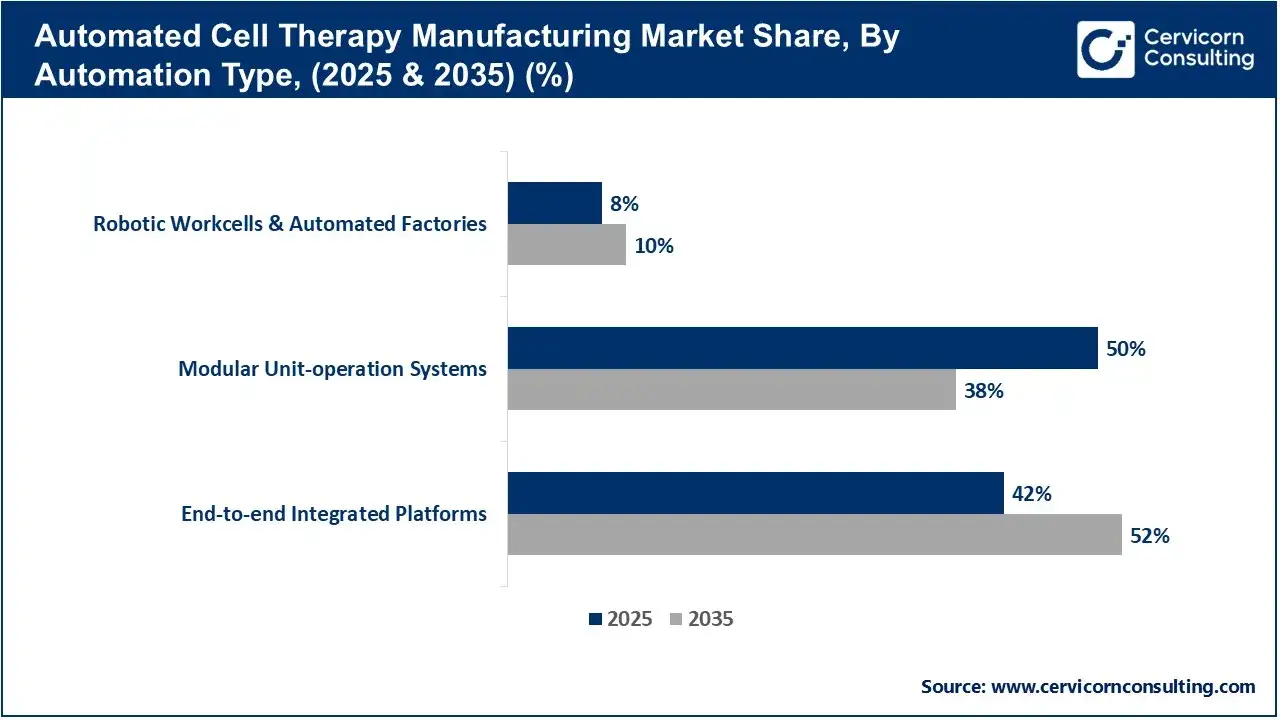
End-to-End Integrated Platforms: The end-to-end integrated platforms segment is estimated to witness rapid expansion, as they minimize contamination risks, streamline scalable production, and offer robust traceability. With continuous breakthroughs in perfusion bioreactors, leading firms have been bolstering various platforms that unify cell line development, gene editing, and differentiation into simplified, regulatory-coordinated workflows for induced pluripotent stem cell (iPSC)-derived allogeneic therapies.
Workflow Step Analysis
Cell Collection, Separation and Isolation: The cell collection, separation and isolation segment accounted for the largest share of the market in 2025, propelled by growing focus on reducing cost of goods, lowering human differences in activities, and elevating candidate quality. Automated solutions offer stronger data tracking in these steps, alongside microfluidic platforms strengthened with droplet generation, piezoelectric sorting, and spatial transcriptomics integration.
Automated Cell Therapy Manufacturing Share, By Workflow Step, 2025 & 2035 (%)
| Workflow Step |
Revenue Share, 2025 (%) |
Revenue Share, 2035 (%) |
| Cell collection processing, separation & isolation |
20% |
18% |
| Activation, Genetic Modification & Transduction |
18% |
18% |
| Cell Expansion |
30% |
28% |
| Formulation, Fill-finish & Cryopreservation |
15% |
16% |
| Quality Control & Release Testing |
9% |
12% |
| Others |
8% |
8% |
Cell Expansion and Cultivation: The cell expansion and cultivation segment is predicted to expand at the fastest rate during the forecast period, fueled by expediting demand to reduce massive manufacturing expenditures and aiming at enhancing batch-to-batch reproducibility. Emerging developments are widely supporting algorithms that evaluate real-time sensor data, imaging, cell counts, metabolite profiles, and electronic batch records to improve process metrics and anticipate quality concerns earlier.
Cell Therapy Type Analysis
CAR-T Cell Therapies: The CAR-T cell therapies segment was dominant with a major share of the market in 2025, due to surging clinical demand in hematologic cancers, groundbreaking advances in gene engineering and expedited manufacturing workflows. With ongoing goals of raising consistency and automation, the EU-funded AIDPATH project unveiled its AI-enabled, automated CAR-T manufacturing platform at University Hospital Würzburg. This solution integrated automated sampling, inline bioreactor sensors, digital twins, and hospital scheduling software to customize production and boost hospital resources.
Automated Cell Therapy Manufacturing Share, By Cell Therapy Type, 2025 & 2035 (%)
| Cell Therapy Type |
Revenue Share, 2025 (%) |
Revenue Share, 2035 (%) |
| CAR-T cell Therapies |
52% |
40% |
| TCR-T & TIL Therapies |
8% |
9% |
| NK & CAR-NK Cell Therapies |
7% |
11% |
| Stem Cell Therapies |
21% |
25% |
| Others |
12% |
15% |
NK and CAR-NK Cell Therapies: The NK and CAR-NK cell therapies segment is estimated to expand fastest in the market because of the suitable safety profile of NK cells, rising scalability of off-the-shelf products, and execution of various cell sources. Along with reversible nanoparticle cell separation, the industry is stepping into next-generation workflows, such as the CliniMACS Prodigy NK Cell Transduction Large Scale (NKCT-LS), which merges isolation, vector transduction, expansion, and harvest into a single tubing set.
Recent Launches
- November 2026: ABEC commercially introduced the ATB™-2100 Advanced Therapy Bioreactor, the latest single-use cell expansion technology to address the increasing need for scalable, reproducible, and automated manufacturing in the cell and gene therapy industry.
- October 2026: Germfree rolled out a new aseptic biopharmaceutical isolator for cell and gene therapy (CGT) manufacturing, with commercial availability scheduled in the first quarter of 2027.
- October 2026: CellFiber officially launched its Zeito™ series of cell fibre fabrication systems in Japan and the United States, as a milestone in strengthening access to its CellFiber technology for next-generation cell therapy development.
- October 2026: Bio-Techne Corporation opened a GMP manufacturing facility in Bristol, UK to highly assist cell therapy domain.
- September 2026: Bracco Imaging expanded its BubbleGen cell selection portfolio with the rollout of the BubbleGen CD3+ T Cell Selection Kit to enable new cell therapy workflows, such as a highly scalable and affordable step in manufacturing CAR-T cell therapies.
- August 2026: China's Center for Drug Evaluation (CDE) initiated a public consultation on a new cell and gene therapy (CGT) PIONEER Program, which facilitates a promised regulatory assistance pathway.
Key Players
Segments Covered
By Component
- Automated Platforms and Instruments
- Consumables and Single-Use Systems
- Software
- Services
By Automation Type
- End-to-End Integrated Platforms
- Modular Unit-Operation Systems
- Robotic Workcells
- Automated Closed-System Manufacturing
By Workflow Step
- Cell Collection, Separation and Isolation
- Cell Activation and Genetic Modification
- Cell Expansion and Cultivation
- Formulation, Fill-Finish and Cryopreservation
- Quality Control and Release Testing
By Cell Therapy Type
- CAR-T Cell Therapies
- TCR-T and TIL Therapies
- NK and CAR-NK Cell Therapies
- Stem Cell Therapies
- Other Cell Therapies
By Therapy Model
By Scale of Operation
- Preclinical & Process Development
- Clinical
- Commercial
By End User
- Pharmaceutical & Biotechnology Companies
- CDMOs
- Academic Medical Centres & Hospitals (point-of-care)
- Research Institutes
By Region
- North America
- Europe
- Asia-Pacific
- Latin America
- Middle East and Africa
