Aseptic Packaging Market Size, Growth and Forecast 2026 to 2035
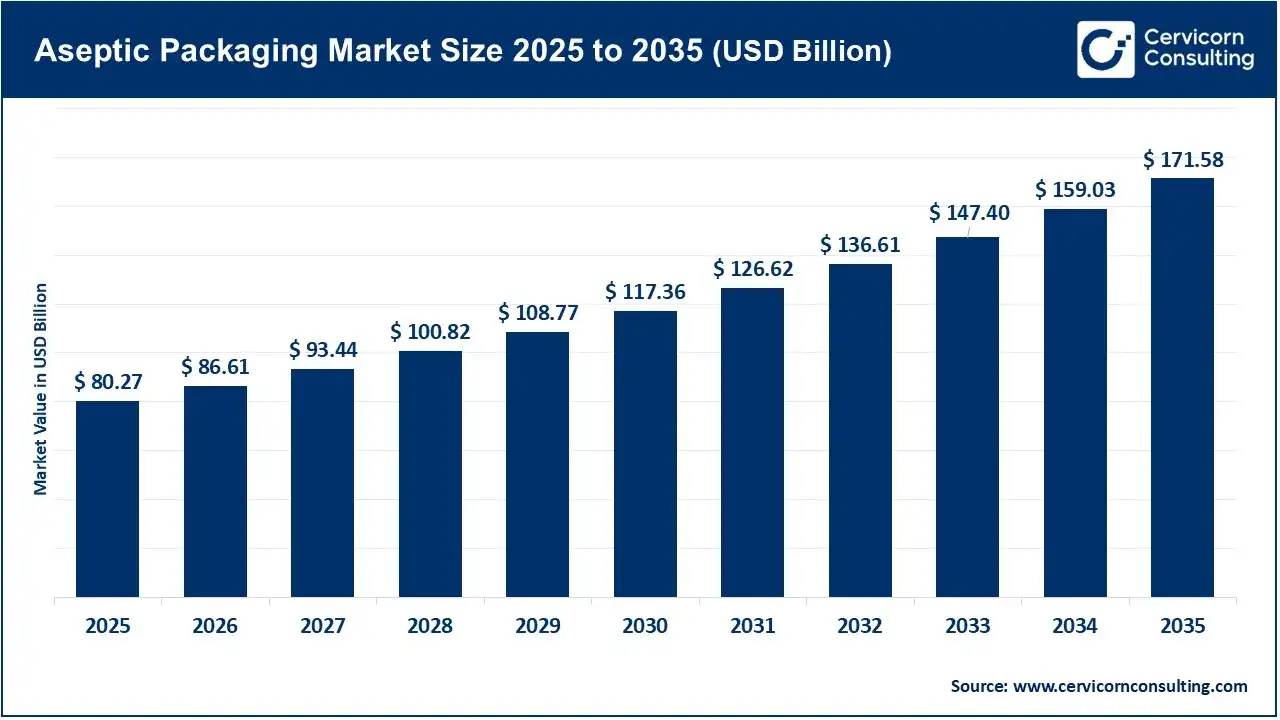
The global aseptic packaging market size was valued at USD 80.27 billion in 2025 and is projected to grow from USD 86.61 billion in 2026 to nearly USD 171.58 billion by 2035, registering a CAGR of 7.9% over the forecast period 2026 to 2035 period. The market is growing due to rising demand for shelf-stable food and beverages, increasing consumption of dairy products and plant-based products, growing pharmaceutical applications, and the need for packaging solutions that extend product shelf life without refrigeration.
Report Highlights
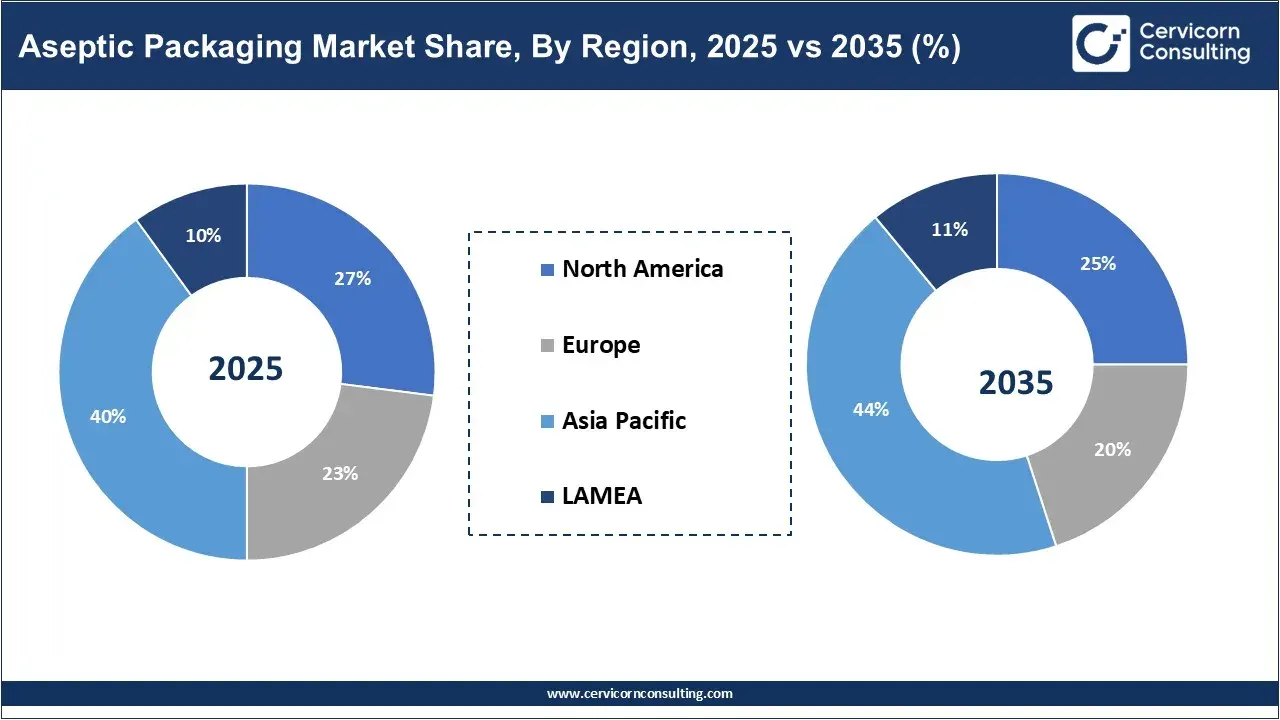
- By Region: Asia Pacific accounted for a revenue share of 40% in 2025, supported by expanding food processing, urbanization, and rising packaged-product consumption.
- By Packaging Type: Cartons dominated the market with revenue share of 41% due to their suitability for high-volume dairy and beverage packaging.
- By Material: Plastic dominated the market with revenue share of 45% because of its versatility, durability, and ease of use across multiple formats.
- By Application: Beverages dominated (revenue share 41%), driven by strong demand for shelf-stable and ready-to-drink products.
- By Packaging Format / Product Category: Liquid Food & Beverage Packaging dominated, supported by broad use across milk, juices, soups, sauces, and other liquid products.
Why Is the Aseptic Packaging Market Growing?
The aseptic packaging market is growing due to the growing demand from producers and customers for food, drink, and medicinal items that can be kept safe and useful for extended periods of time without refrigeration. Aseptic packaging helps preserve product safety and increase shelf life by combining product sterilization with sterile packaging and regulated filling conditions. Adoption is being aided by the growing demand for ready-to-drink items, dairy products, juices, plant-based beverages, and handy foods.
Recent Trends and Growth Factors
- Rising demand for shelf-stable products: Consumers are increasingly choosing food and beverages that offer longer shelf life and convenient storage. Aseptic packaging allows products such as milk, juices, soups, sauces, and plant-based beverages to be distributed without continuous refrigeration.
- Growth of ready-to-drink beverages: The increasing consumption of ready-to-drink dairy, functional, nutritional, and plant-based beverages is creating steady demand for aseptic cartons, bottles, and pouches.
- Sustainable packaging solutions: Packaging manufacturers are focusing on lightweight materials, renewable resources, recyclable structures, and reduced use of conventional barrier materials. These developments are encouraging the adoption of more sustainable aseptic packaging formats.
- Expansion of pharmaceutical applications: The increasing production of sterile drugs, biologics, injectables, and other healthcare products is creating opportunities for aseptic packaging solutions such as vials, ampoules, and prefilled syringes.
Technology Landscape
- Advanced aseptic filling: Sterilizing packaging materials and maintaining regulated sterile conditions during filling and sealing are the goals of contemporary aseptic filling systems. These solutions offer longer shelf life, lower contamination hazards, and enhance product safety for manufacturers.
- Hydrogen peroxide sterilization: In aseptic packaging systems, heat and hydrogen peroxide are frequently employed to sterilize equipment and packing materials. During filling operations, this technology aids in maintaining controlled conditions and promotes commercial sterility.
- Paper-based barrier technology: Packaging manufacturers are developing paper-based and fiber-based barrier structures to reduce reliance on conventional materials while maintaining the protection required for aseptic products. These developments are supporting the transition toward more sustainable packaging solutions.
- Automated packaging systems: Automation is being increasingly integrated into aseptic packaging lines to improve filling accuracy, process consistency, production efficiency, and quality control. Automated systems can also reduce manual intervention and support continuous monitoring.
Market Dynamics
Growth Drivers
- Rising Demand for Shelf-Stable Food and Beverage: Aseptic packaging is becoming more popular due to consumer demand for goods with longer shelf lives. Packaging that facilitates ambient distribution without constant refrigeration might be advantageous for dairy goods, juices, plant-based drinks, soups, sauces, and ready-to-drink items. This enables producers to increase product availability and lessen reliance on chilled supply lines.
- Growth of Dairy and Plant-Based Beverages: Aseptic cartons and other sterile packaging forms are in high demand due to the rising use of milk, dairy products, plant-based milk, and other alternative beverages. Aseptic solutions are being used by manufacturers more frequently to enable easy storage and broader product distribution. There is a growing need for appropriate package formats due to the introduction of new products in the plant-based and nutritious beverage categories. This market is expanding because lactose-free and alternative dairy products are becoming more and more popular.
Restraints
- High Initial Investment: Specialized filling tools, sterilizing systems, controlled production settings, and technical know-how are necessary for aseptic packaging systems. Smaller producers may find adoption challenging because of the large initial expenditure. The total cost of running aseptic production lines may also rise due to maintenance and validation requirements.
- Complex Manufacturing Processes: Strict control over product sterilization, package sterilization, filling, and sealing conditions is necessary for aseptic packing. Commercial sterility must be maintained throughout the process, which might complicate operations and call for expert staff. To avoid contamination and product losses, manufacturers must keep their process parameters constant. Operational requirements may also rise as a result of routine testing, monitoring, and equipment repair.
Key Opportunities
- Development of Sustainable Aseptic Packaging: Growing environmental concerns are giving packaging makers the chance to create aseptic packaging solutions that are lightweight, recyclable, renewable, and fibre-based. To lessen the environmental impact of traditional multilayer structures, new barrier technologies are being developed. Businesses are looking more into paper-based solutions and renewable polymers to improve packaging's sustainability image. It is anticipated that increased demand for eco-friendly products would promote ongoing investment in this field.
- Expansion of Plant-Based and Functional Beverages: Aseptic packaging companies are seeing new opportunities due to the growing demand for plant-based milk, protein drinks, nutritious beverages, and functional drinks. Reliable packaging options that offer protection and a longer shelf life are necessary for these products. Convenient packaging is becoming more and more in demand due to product innovation in the nutrition, wellness, and health sectors. Packaging appropriate for ambient distribution is becoming more and more necessary as the manufacturing of plant-based beverages grows.
Challenges
- Supply Chain Disruptions: Paperboard, plastics, metal, specialty coatings, adhesives, and other raw materials are essential to producers of aseptic packaging. Production and packaging costs can be impacted by changes in supply circumstances, transportation costs, and raw material availability. Delays in product deliveries and manufacturing schedules might also result from disruptions. To lower supply-related risks, manufacturers are concentrating more on supplier diversification and better inventory management.
- Technology Adoption: Sustainable packaging technologies and sophisticated aseptic filling systems necessitate large investments, technical know-how, and production-line adjustments. When using these technologies, smaller manufacturers may encounter operational and financial obstacles. The complexity of adopting technology may be further increased by the requirement for equipment integration and employee training. Additionally, manufacturers must guarantee that new systems adhere to the necessary safety and quality criteria.
Regional Analysis
Asia Pacific dominated the aseptic packaging market
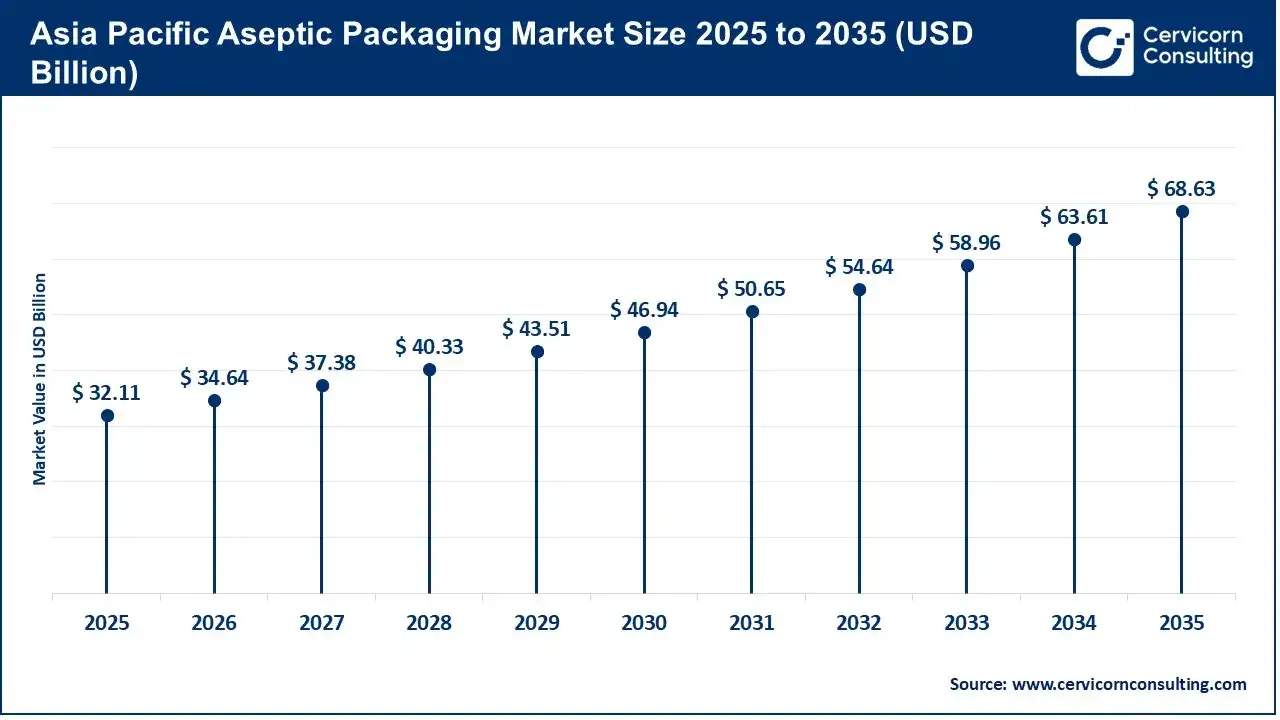
The Asia-Pacific aseptic packaging market size was valued at USD 32.11 billion in 2025 and is projected to hit USD 68.63 billion by 2035. Asia Pacific dominated the market because of its substantial food and beverage production base, expanding population, urbanization, and rising packaged goods demand. Modern retail infrastructure and increased food processing are promoting market growth. Additionally, pharmaceutical production is generating new prospects. Regional acceptance is being strengthened by the growing demand for items that are shelf-stable and handy. The regional market is being further supported by rising investments in manufacturing capacity and packaging infrastructure.
Europe is expected to grow fastest
The Europe aseptic packaging market size was estimated at USD 18.46 billion in 2025 and is expected to reach USD 39.46 billion by 2035. Europe is expected to grow fastest because of the need for sustainability, sophisticated packaging infrastructure, and the growing use of lightweight and recyclable alternatives. Manufacturers are concentrating on better recycling performance and renewable resources. Growth is being supported by strong demand for dairy, drinks, processed foods, and pharmaceuticals. More opportunities are being created by ongoing investment in low-impact packaging technology. More innovation is being encouraged throughout the region by growing consumer and government emphasis on sustainable packaging.
North America represents the third major segment
The North America aseptic packaging market size was valued at USD 21.67 billion in 2025 and is projected to surpass USD 46.33 billion by 2035. North America represents the third major segment, backed by well-established food processing, pharmaceutical production, and consumer demand for practical, long-lasting goods. Advanced packaging technologies are widely used in the area. Applications for aseptic packaging are being supported by the need for ready-to-drink beverages. Opportunities for sterile packaging solutions are also being created by the expansion of pharmaceutical manufacture. Regional adoption is being supported by growing consumer demand for packaged goods that are safe, practical, and long-lasting.
Segmental Analysis
Packaging Type Analysis
Cartons: Cartons dominated the market because they are widely used in plant-based drinks, dairy products, milk, juices, and shelf-stable goods. Demand is sustained by their lightweight design and aptitude for ambient distribution. Additionally, manufacturers are creating better carton designs with more convenient features and less material usage. The market is being further supported by the rising demand for environmentally friendly beverage packaging. Their market position is further strengthened by their well-established supply chains and compatibility with high-volume filling equipment.
Bags & Pouches: Bags & Pouches are expected to grow fastest because of their adaptable, lightweight, and practical design. Their effective use of materials can lessen the weight of packaging and the need for transportation. Beverages, liquid foods, sauces, and dairy products are using them more and more. Adoption is being aided by advancements in sealing and barrier technology. New opportunities for this market are also being created by the growing demand for packaging that is portable and simple to handle.
Aseptic Packaging Market Share, By Packaging Type, 2025 (%)
| Packaging Type |
Revenue Share, 2025 (%) |
Revenue Share, 2035 (%) |
| Cartons |
41% |
37% |
| Bags & Pouches |
21% |
22% |
| Bottles & Cans |
16% |
17% |
| Vials & Ampoules |
10% |
12% |
| Prefilled Syringes |
5% |
7% |
| Others |
7% |
5% |
Bottles & Cans: Bottles & Cans represent the third major segment, backed by their robustness, ease of handling, and application in a variety of liquid products, including dairy drinks, juices, and nutritious drinks. Applications for aseptic bottles are expanding across a number of beverage sectors. Additionally, cans offer robust product protection. There are more chances due to the growing need for portable packaging. Their wider use is being supported by ongoing innovation in recyclable and lightweight bottle and can shapes.
Material Analysis
Plastic: The plastic segment dominated the market because of its adaptability, durability, lightweight, and compatibility with various aseptic packing types. It is frequently utilized in multilayer structures, bottles, pouches, and closures. Lightweight and recyclable plastic solutions are becoming more and more popular among manufacturers. Improvements in material efficiency are also encouraging ongoing use. Because of its adaptability, plastic may be used for a variety of food, drink, and pharmaceutical packaging needs.
Paper & Paperboard: Paper & Paperboard are expected to grow fastest because there is a growing need for sustainable, lightweight, recyclable, and renewable materials. Their extensive usage in aseptic containers is fostering market growth. To improve performance, manufacturers are developing barrier technologies. Adoption is anticipated to be further strengthened by sustainability activities. Businesses are being encouraged to invest in better paper-based aseptic structures due to the growing preference for fiber-based packaging.
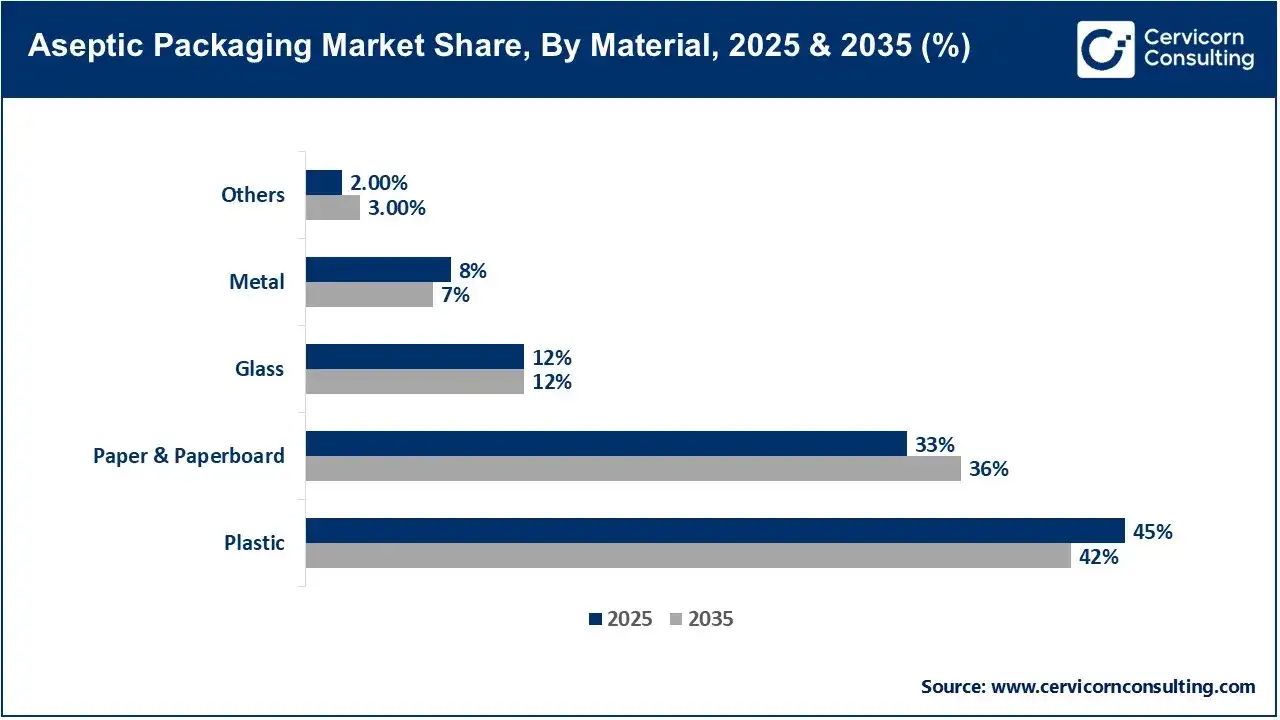
Glass: Glass represents an emerging segment, backed by its proven application in pharmaceutical packaging, excellent barrier qualities, and chemical stability. In certain aseptic applications, it offers dependable product protection. Demand is rising as pharmaceutical output increases. Glass is appropriate for delicate pharmaceutical and medical applications due to its capacity to preserve product integrity.
Application Analysis
Beverages: Beverages dominated the market because milk, juices, plant-based drinks, functional drinks, and ready-to-drink items are in high demand. Longer shelf life and ambient distribution are supported by aseptic packaging. Convenient beverage consumption and shifting lifestyles are driving market expansion. More opportunities are being created by product innovation in nutrition and health beverages. Strong demand for aseptic formats is anticipated to be sustained by the growth of ready-to-drink and functional beverage categories.
Pharmaceuticals: Pharmaceuticals are expected to grow fastest due to increasing production of sterile drugs, biologics, and injectable products. The need for contamination control is encouraging pharmaceutical manufacturers to adopt specialized aseptic packaging. Growing investment in advanced therapies is supporting demand. Increasing pharmaceutical manufacturing capacity is also creating new opportunities. The development of sensitive biologic and injectable products is further increasing the need for reliable sterile packaging.
Aseptic Packaging Market Share, By Application, 2025 (%)
| Application |
Revenue Share, 2025 (%) |
| Beverages |
41% |
| Food |
32% |
| Pharmaceuticals |
19% |
| Others |
8% |
Food: Food represents the third major segment, supported by consumer demand for processed foods, infant food, shelf-stable soups, and sauces. Distribution is made easier and shelf life is increased with aseptic packaging. Adoption is being aided by the rising need for ready-to-use, convenient food products. Additional opportunities are being created by product innovation in packaged goods. Aseptic format adoption is also being aided by the growing demand for meals that don't require refrigeration.
Packaging Format / Product Category Analysis
Liquid Food & Beverage Packaging: Liquid food & beverage packaging dominated because it is widely used in milk, juices, drinks, sauces, soups, and other liquid items. Adoption is being fueled by its capacity to sustain ambient distribution and increased shelf life. Demand is rising as food and beverage processing expands. Convenient and material-efficient formats are likewise being developed by manufacturers. Demand for this category is anticipated to be sustained by rising use of packaged liquid foods and drinks.
Sterile Pharmaceutical Packaging: Sterile pharmaceutical packaging is expected to grow fastest because of growing production of biologics, injectable formulations, and sterile medications. These goods need to be packaged to prevent contamination and preserve product integrity. Demand is rising due to the expansion of innovative therapies. Specialized packaging styles are also being supported by advancements in drug delivery technologies. The need for sterile pharmaceutical packaging is being reinforced by a growing emphasis on product safety and contamination control.
Dairy & Milk Packaging: Dairy & Milk Packaging represents an emerging segment supported by an increase in the use of shelf-stable dairy products, flavored milk, dairy beverages, and milk. Longer distribution without constant refrigeration is made possible by aseptic packing. Dairy beverage product innovation is generating new uses. Growth is also being supported by consumer demand for dairy products that are convenient and simple to store. Aseptic packaging makers are seeing an increase in prospects due to the growth of packaged dairy products in developing regions.
Recent Developments
- In April 2026, Tetra Pak and Sterilgarda Alimenti launched a 1-liter aseptic carton with a paper-based barrier, supporting more renewable packaging structures. The development reflects the industry's increasing focus on sustainable aseptic packaging.
- In June 2026, Elopak launched low-carbon aluminum for liquid packaging cartons, supporting lower-impact packaging production in Europe. The initiative highlights efforts to reduce the environmental impact of packaging materials.
- In April 2026, Tetra Pak and Drools announced a collaboration supporting Drools' entry into fresh pet food in India using aseptic packaging technology. The development expands the application of aseptic packaging beyond traditional food and beverage categories.
Government Insights
- In October 2025, Food Safety and Standards Authority of India published draft amendments covering PFAS and BPA provisions in food-contact packaging materials. The development reflects increasing attention toward packaging safety and material composition.
- In April 2025, Food Safety and Standards Authority of India issued the Food Safety and Standards (Packaging) First Amendment Regulations, 2025, covering recycled plastics in food packaging. The amendment highlights the importance of material safety and regulatory compliance.
Top Companies
Segments Covered
By Packaging Type
- Cartons
- Bags & Pouches
- Bottles & Cans
- Vials & Ampoules
- Prefilled Syringes
- Other Aseptic Formats
By Material
- Plastic
- Paper & Paperboard
- Glass
- Metal
- Other Materials
By Application
- Beverages
- Food
- Dairy Products
- Pharmaceuticals
- Other Applications
By Packaging Format / Product Category
- Liquid Food & Beverage Packaging
- Dairy & Milk Packaging
- Juice & Ready-to-Drink Beverage Packaging
- Sterile Pharmaceutical Packaging
- Clinical & Injectable Packaging
By Region
- North America
- Europe
- Asia Pacific
- Latin America
- Middle East & Africa
