AI Server Market Size and Forecast 2026 to 2035
The global AI server market size was valued at USD 185.64 billion in 2025 and is expected to exceed around USD 876.91 billion by 2035, growing at a CAGR of 16.8% during the forecast period of 2026-2035. Broader demand from cloud giants and prominent data centers and the ongoing progression of generative AI & ChatGPT, are fueling the global market growth. The notable rise in workload complexity and significant expansion of hybrid facilities are supporting the upcoming innovations.
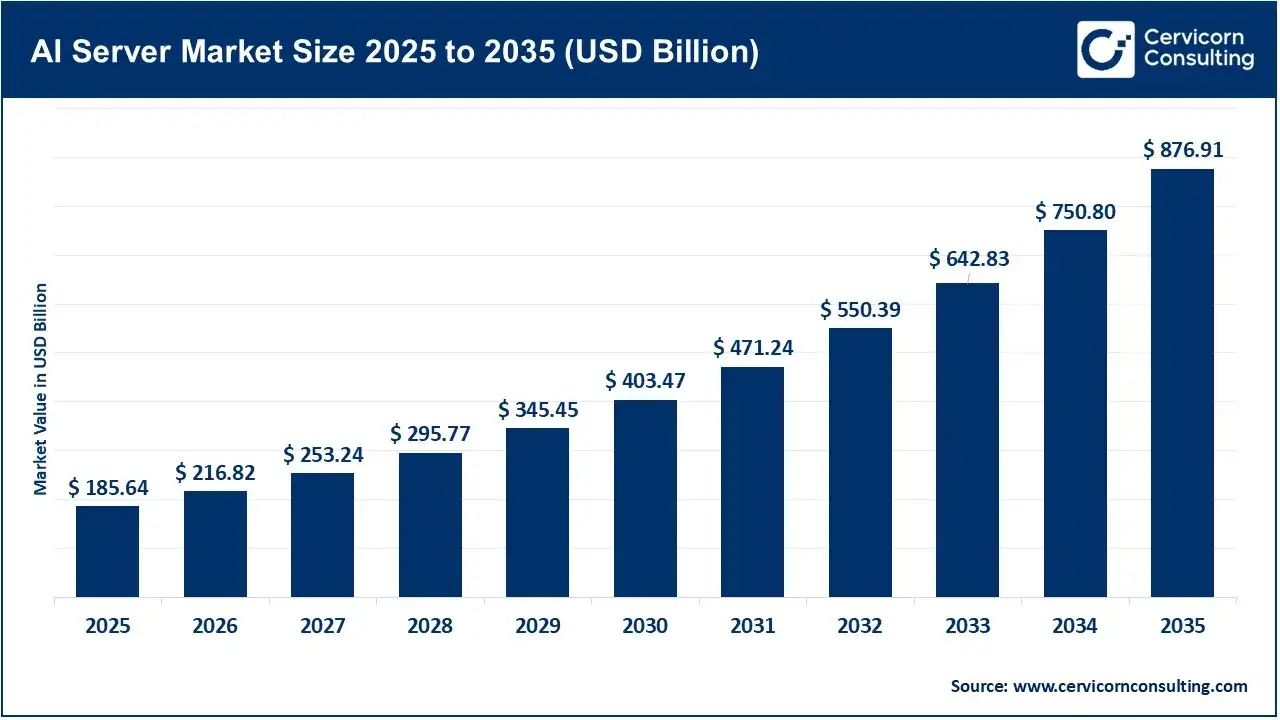
- Base Year Market Size (2025): $185.64 billion
- Current Year Market Size (2026): $216.82 billion
- Estimated Year Market Size (2035): $876.91 billion
- Forecast Period CAGR (2026-2035): 16.8%
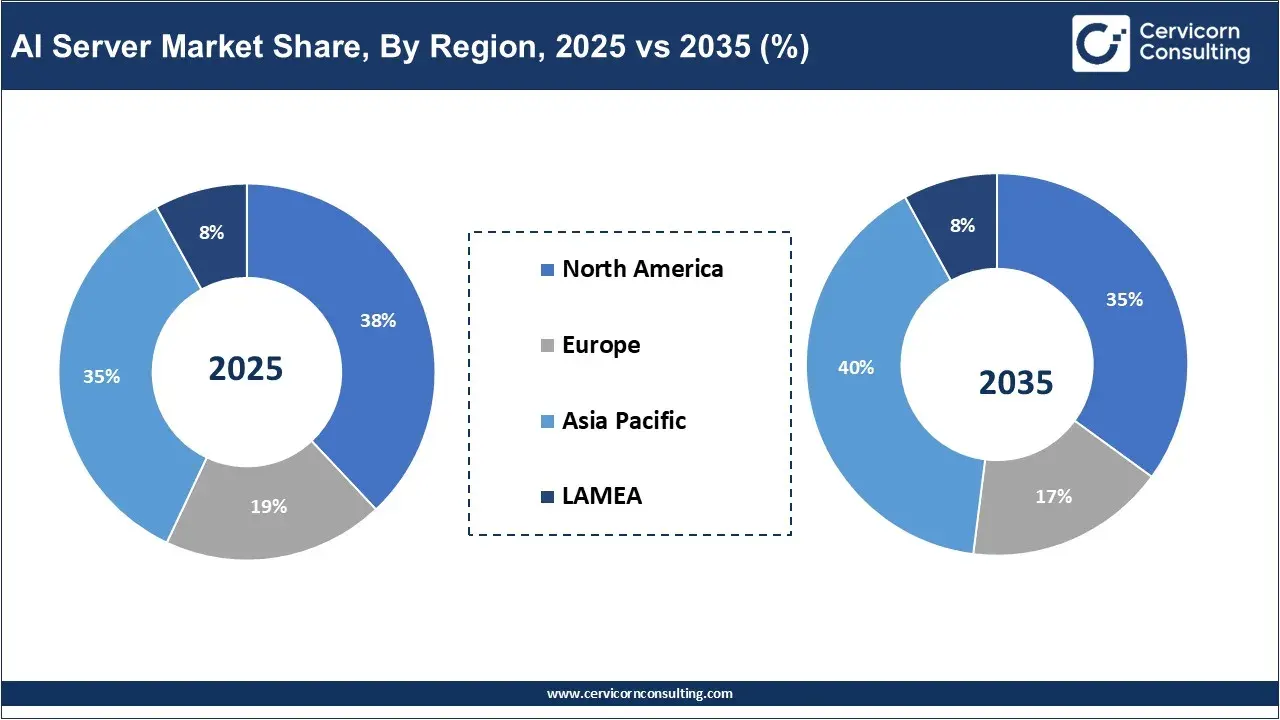
- Leading Region: North America (revenue share of 38%)
Report Highlights
- By region, North America dominated the market in 2025 with revenue share of 38%, driven by booming LLMs, gen AI, and growing heavy investments in data centers & enterprise infrastructures.
- By server type, rack-mounted AI servers registered dominance in the market in 2025 with revenue share of 78%, supported by their scalable offerings and surging demand for high rack power density.
- By processor type, GPU-based servers led the market in 2025 with revenue share of 68%, as they handle numerous parallel processes and facilitate high memory bandwidth.
- By cooling technology, air cooling was dominant in the market due to its minimal initial investments and greater compatibility with existing systems.
- By application, AI model training dominated the market in 2025 with revenue share of 32%, fueled by expansive adoption of machine learning and deep learning, and wider emphasis on enterprise customization.
What are Continuous Breakthroughs in AI Servers?
The AI server market includes a particular high performance computer system to organize, train, and operate artificial intelligence and machine learning workloads. Along with global innovations in generative AI solutions, the industry is experiencing faster scale-up of large language models for content creation, customer service automation, software development, and analytics. This further necessitates vast parallel processing and high-throughput training/inference clusters, supporting the overall market expansion. Moreover, the market implements trained AI systems to examine new data inputs and develop immediate decisions, estimations, or responses.
Recent Steps Taken by Industry Players
- November 2026: Bengaluru-based JohnAIC raised $1.9 million in a pre-seed funding round powered by Crane Venture Partners to strengthen its manufacturing, configuration, and supply capabilities for artificial intelligence (AI) servers.
- October 2026: Cybersecurity company Flexxon partnered with Tech4Biz Solutions to establish server infrastructure to protect enterprise AI systems and sensitive data.
- September 2026: Morgan State University collaborated with Google Public Sector to develop a next-generation, AI-driven research campus that preserves the high-performance computing infrastructure required to reshape the university into a premier technology hub for students, educators, and researchers.
- September 2026: Sharp Corporation joined with NVIDIA technology in Japan, focusing on highlighting the rising demand for AI infrastructure led by the penetration of generative AI.
Market Dynamics
Growth Drivers
- Rise in Models & Facilities: The global advances are enabling massive investments by cloud service providers, neoclouds, and frontier AI labs in advancing vast data center groups. Meanwhile, the market growth is driven by progression in complex models, which need larger computational power and high throughput.
- Elevating Demand for GPU-Dense Measures: To manage intense workloads, many companies are demanding specialized hardware accelerators, such as Graphics Processing Units (GPUs), Tensor Processing Units (TPUs), and Application-Specific Integrated Circuits (ASICs).
- Growing Demand for Real-Time AI Approaches: The worldwide requirement for low-latency, high-throughput inference for real-time applications spanning from autonomous driving and connected vehicles to smart manufacturing is forcing server deployments into both central data centers and edge settings.
Market Restraints
- Power Limitations: The widespread use of AI servers necessitates significantly higher power densities, which creates huge pressure on electrical grids, transformers, and utility networks.
- Accelerating Need for CapEx: The execution of specialized AI server hardware requires vast initial expenditures, coupled with balancing total cost of ownership (TCO) with rigorous enterprise and government budgets, further restricts faster scale-up.
Key Opportunities
- Aiming at Custom ASICs & Options: Global enterprise requests for proposal (RFPs) are highly demanding non-Nvidia accelerator alternatives and specialized ASICs (Application-Specific Integrated Circuits) to eliminate expenses and improve specific inference operations.
- Unveiling Liquid Cooling Measures: Industrial expansion is fostering direct-to-chip and immersion liquid cooling systems, specific thermal management, and containerized modular data centers that pre-wire power and cooling before on-site deployment.
- Exploring Hybrid Server Facilities: Another prominent chance for server developers will be to supply hybrid rack-scale systems that pair traditional CPUs, NVIDIA GPU platforms, and custom accelerators.
Market Challenges
- Arising Grid Postponements: Nowadays, nearly 50% of planned AI data center capacity faces delays or cancellations due to public electrical grid congestion, transformer limitations, and multi-year wait times for utility interconnections.
- Lack of Memory & Standard DRAM: Globally rising demand for HBM (High Bandwidth Memory) and standard DDR5 memory has raised component costs and prolonged lead times, disrupting hardware procurement strategies.
AI Server Market Regional Analysis
How did North America Dominate the Market in 2025?
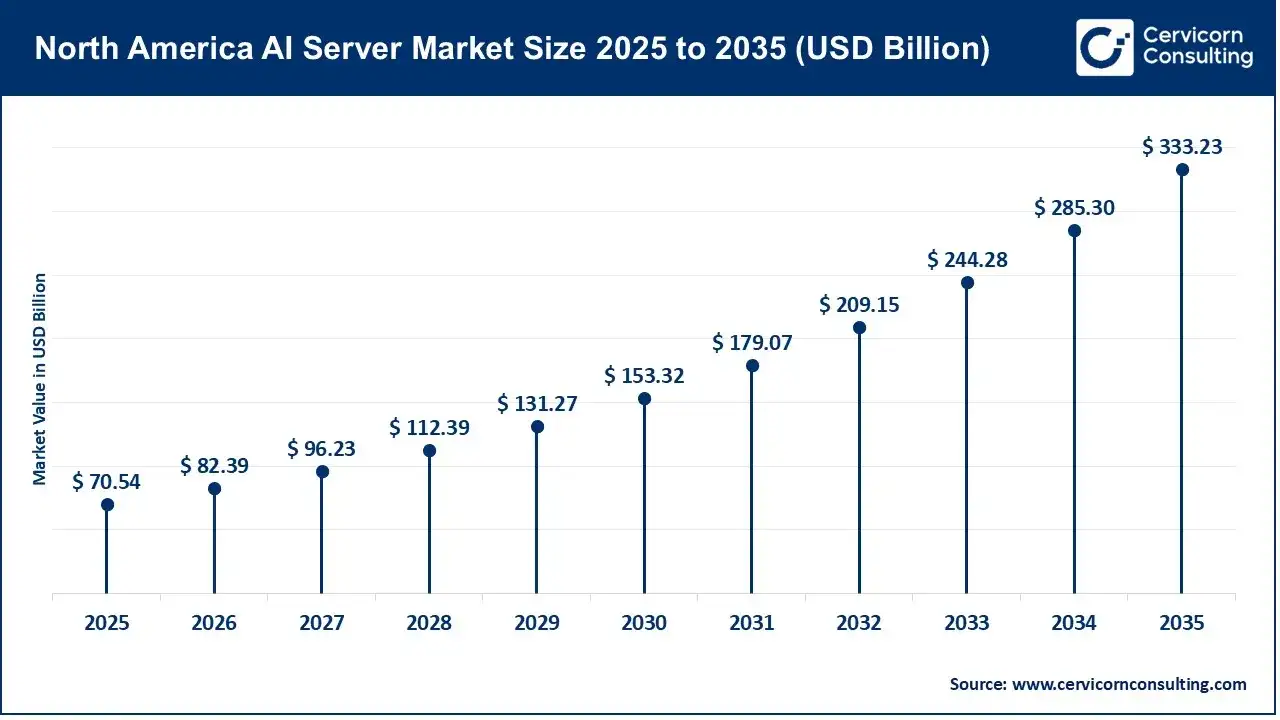
The North America AI server market size was valued at USD 70.54 billion in 2025 and is expected to reach around USD 333.23 billion by 2035. North America accounted for a major share of the market in 2025, propelled by increased hyperscale investments, broader adoption of gen AI, and emerging government support. As Canada has plenty of inexpensive hydroelectric energy and a cool climate, its government bolstered several green incentives. Alongside this, the Canadian framework executed the AI Sovereign Compute Infrastructure Program to assist domestic AI champions, industry consortia, and public research institutes, including Mila, Amii, and the Vector Institute.
United States Market
- The U.S. market registered dominance due to the presence of eminent & larger data centers and a consistent focus on custom silicon adoption. Along with local semiconductor fabrication and prominent AI regulatory facilities, the nation has eminent American server makers and tech players, like Dell Technologies, HPE, Supermicro, and Microsoft, who unveiled intense server lines to organise hundreds of GPUs per group.
Which Region is Expected to Grow Fastest in the AI Server Market?
The Asia-Pacific AI server market size was estimated at USD 64.97 billion in 2025 and is projected to hit around USD 306.92 billion by 2035. Asia-Pacific is predicted to witness rapid expansion in the coming years, fueled by developing neocloud solutions, early investments in LLMs, and different government AI missions. India’s a key goal of future Digital India is the development of specific infrastructure via the involvement of local and global operators. Recently, the BHASHINI translation platform was successfully transferred to Yotta’s sovereign Indian cloud, achieving 40% performance gains and data sovereignty. Meanwhile, Japan’s Fujitsu started commercial sales and production of made-in-Japan sovereign rack-mount servers, particularly for AI inference and AI agents.
China Market
- The existence of tech giants, widespread research activities in agentic AI inference, and growth in domestically developed processors are supporting the national market progression. Besides this, China’s abundant allocations are being boosted by systems such as the Ascend 950 SuperCluster and joint software/hardware integration with local model manufacturers, like DeepSeek.
How is Europe Noting Significant Growth in the AI Server Market?
The Europe AI server market size was accounted for USD 35.27 billion in 2025 and is expected to garner around USD 166.61 billion by 2035. Europe is projected to expand notably in the upcoming years, supported by enforcement of the EU AI Act and stringent data protection standards. Along with this, numerous European leaders across finance, healthcare, and manufacturing are buying enterprise-grade and inference-enhanced servers to run real-time applications and agentic workflows at the domestic level. Additionally, Germany’s first Industrial AI factory includes roughly 10,000 Nvidia GPUs that offer up to 0.5 ExaFLOPS of computing power for European industrial and production workloads.
UK Market
- With a focus on sovereign supercomputing capacity and public compute programs, the UK market is promoting vital commercial projects, such as Nscale's Loughton campus, which forces full grid connectivity into the 2030s. Furthermore, Global and UK hardware buyers are consistently looking to navigate high server component prices and memflation, with DRAM and specialized AI-improved server spending rising intensely.
AI Server Market Segmentation Analysis
Server Type Analysis
Rack-Mounted AI Servers: The rack-mounted AI servers segment held the largest share of the market in 2025, propelled by their scalable performance, rising movement towards accelerator-centric computing, and their broader edge AI capabilities. Recently, systems, including the NVIDIA GB200 NVL72 and the AMD-HP Helios rack, unified numerous accelerators into single, integrated racks with non-blocking, full-mesh connectivity.
AI Server Market Share, By Server Type, 2025 (%)
| Server Type |
Revenue Share, 2025 (%) |
| Rack-Mounted AI Servers |
78% |
| Blade AI Servers |
8% |
| Tower AI Servers |
3% |
| High-Density AI Server Systems |
11% |
High-Density AI Server Systems: The high-density AI server systems segment is projected to witness rapid expansion in the upcoming years, motivated by their stronger multi-core processors, high-capacity RAM, and ongoing massive investments in multi-gigawatt data centers. In the last few days, vendors have explored 800 VDC power delivery systems and high-density power supply units (PSUs) with flying-capacitor topologies and disaggregated power shelves.
Processor Type Analysis
GPU-Based Servers: The GPU-based servers segment accounted for a major share of the AI server market in 2025, driven by growing inference workloads, their long-term cost efficiency, and well-developed software ecosystems. Constant efforts have joined these servers with high-core-count, memory-dense host CPUs to omit data-preprocessing risks during larger AI agent and LLM loops.
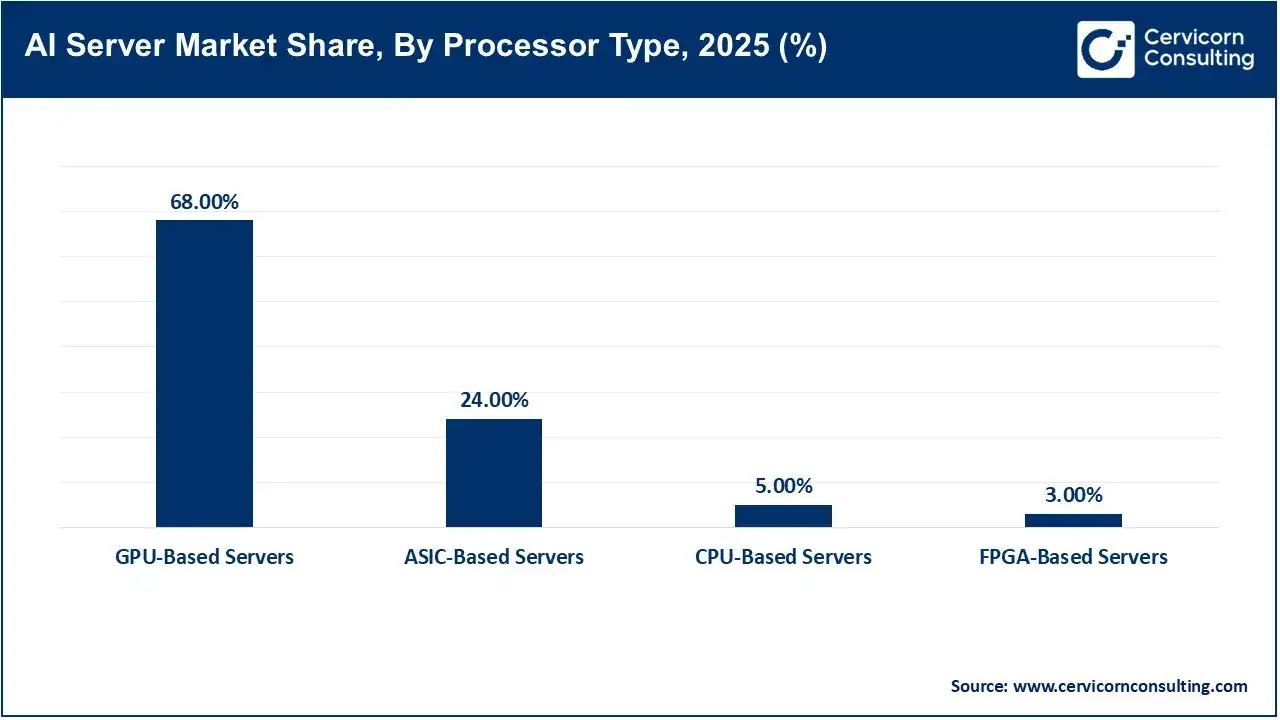
ASIC-Based Servers: The ASIC-based servers segment is anticipated to be the fastest-growing during the forecast period, due to their exceptional processing speed, substantial power savings, and requirement of minimal TCO. Nowadays, the latest ASICs are consolidating training and inference capabilities onto a single processor, lowering hardware fragmentation and allowing data centers to transition capacity toward real-time AI agents.
Cooling Technology Analysis
Air Cooling: The air cooling segment captured a dominant share of the market in 2025, supported by its reduced upfront costs, highly favourable for mid-range workloads, and streamlined operations. Along with its well-known maintenance, the market uncovered hybrid integration, rear-door heat exchangers, and transitional air-assisted systems.
AI Server Market Share, By Cooling Technology, 2025 (%)
| Cooling Technology |
Revenue Share, 2025 (%) |
| Air Cooling |
65% |
| Direct-to-Chip Liquid Cooling |
26% |
| Immersion Cooling |
3% |
| Rear-Door Heat Exchanger Cooling |
6% |
Direct-to-Chip Liquid Cooling: The direct-to-chip liquid cooling segment is estimated to expand rapidly in the predicted timeframe, fueled by its high heat absorption capacity, eliminating thermal suffocation, and enhancing space and density. According to Cervicorn experts, global pioneers have been strengthening commercial deployments of waterless, two-phase direct-to-chip systems, where a dielectric fluid boils directly inside micro-channel cold plates, converts to vapor, shifts to a heat exchanger, and recondenses in a closed loop.
Application Analysis
AI Model Training: The AI model training segment held the largest share of the market in 2025 because of surging LLMs, heavy cloud investments, and advanced GPU clusters. Considering AI servers with enterprise-grade power, thermal management, and 24/7 reliability features, the industry has deployed eighth-generation TPU training systems (TPU8T), leaning into high-diameter mesh topologies (Boardfly) and huge on-chip SRAM/HBM.
AI Server Market Share, By Application, 2025 (%)
| Application |
Revenue Share, 2025 (%) |
| AI Model Training |
32% |
| AI Inference |
29% |
| Machine Learning and Deep Learning |
17% |
| Generative AI and Large Language Models |
16% |
| High-Performance Computing |
6% |
AI Inference: The AI inference segment is projected to grow at a rapid rate during 2026-2035, driven by developing agentic AI, elevating moves towards data security & privacy, and growth model versatility. Continuous approaches are looking for mixed-architecture server racks customized to particular tasks that fragment fast, low-latency token generation from massive background batch-processing.
Latest Developments
- November 2026: SnapLogic introduced Discovery Hub, bringing its Agentic Integration and Applied AI Platform into a single catalog where teams can locate and reuse Model Context Protocol (MCP) servers and tools.
- November 2026: Masttro rolled out a Model Context Protocol server and Developer Portal, enabling eligible family offices, wealth owners, and advisors to join selected financial information with compatible external AI applications.
- November 2026: ZutaCore launched ZutaCore Z2O at Supercomputing 2026 (SC26) in Chicago, a waterless cooling architecture that operates a combined two-phase loop from ZutaCore direct-to-chip cold plates to rooftop heat rejection.
- October 2026: Infineon Technologies launched a 27 kW three-phase power supply unit (PSU) reference tailored for future AI server power architectures.
- October 2026: ASUS strengthened its AI infrastructure portfolio with the unveiling of the XA P2N-E2, a 2U NVIDIA MGX architecture-based server for agentic AI and reinforcement learning workloads.
- September 2026: Hetzner introduced the GEX45, an entry-level mature GPU server for AI inference, fine-tuning, 3D rendering, CAD, and video workloads.
- August 2026: Cerebras Systems announced a new version of its server hardware that encompasses the dinner-plate-sized chips that it says will accelerate AI chatbot queries.
- June 2026: AEWIN Technologies rolled out a new line of rack-scale artificial intelligence (AI) infrastructure and two-phase direct liquid cooling systems customized for large-scale AI and data center workloads.
Leading Players
Segments Covered
By Server Type
- Rack-Mounted AI Servers
- Blade AI Servers
- Tower AI Servers
- High-Density AI Server Systems
By Processor Type
- GPU-Based Servers
- ASIC-Based Servers
- CPU-Based Servers
- FPGA-Based Servers
By Cooling Technology
- Air Cooling
- Direct-to-Chip Liquid Cooling
- Immersion Cooling
- Rear-Door Heat Exchanger Cooling
By Application
- AI Model Training
- AI Inference
- Machine Learning and Deep Learning
- Generative AI and Large Language Models
- High-Performance Computing
By Region
- North America
- Europe
- Asia-Pacific
- Latin America
- Middle East and Africa
