AI Data Center Power Infrastructure Market Size and Growth Outlook 2026 to 2035
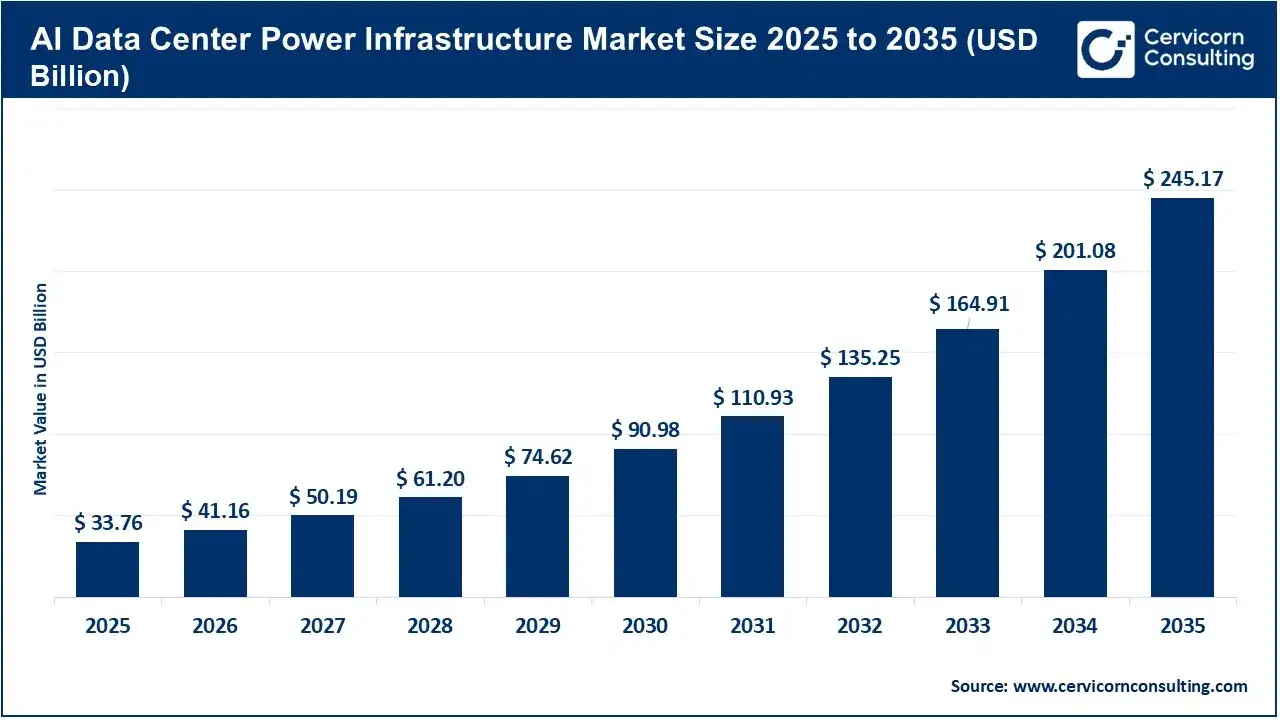
The global AI data center power infrastructure market size calculated at USD 41.16 billion in 2026 and is projected to surpass USD 245.17 billion by 2035, registering a CAGR of 22% over the forecast period 2026 to 2035. The AI data center power infrastructure market is expanding as the need for dependable, high-capacity, and energy-efficient power systems grows due to the quick uptake of artificial intelligence, machine learning, and high performance computing.
Data center operators are encouraged to upgrade power distribution, backup power, power management, and energy storage infrastructure because AI workloads necessitate significant electricity for sophisticated servers, GPUs, cooling systems, and networking equipment. Growing investments in cloud computing, hyperscale facilities, and AI-focused data centers are bolstering market expansion, and the transition to sustainable and efficient power solutions is opening up new markets for cutting-edge infrastructure technologies.
On 18 February 2026, NxtGen AI and Vertiv announced the deployment of a national-scale sovereign AI factory in India, with Vertiv providing end-to-end power and thermal infrastructure designed to support high-density AI workloads and improve energy-efficient operations. This development highlights the increasing need for advanced power infrastructure capable of supporting the growing electricity and cooling requirements of AI-focused data centers.
Market Size & Growth Projections
- Base Year Market Size (2025): $33.76 Billion
- Current Year Market Size (2026): $41.16 Billion
- Estimated Year Market Size (2035): $245.14 Billion
- Forecast Period CAGR (2026-2035): 22%
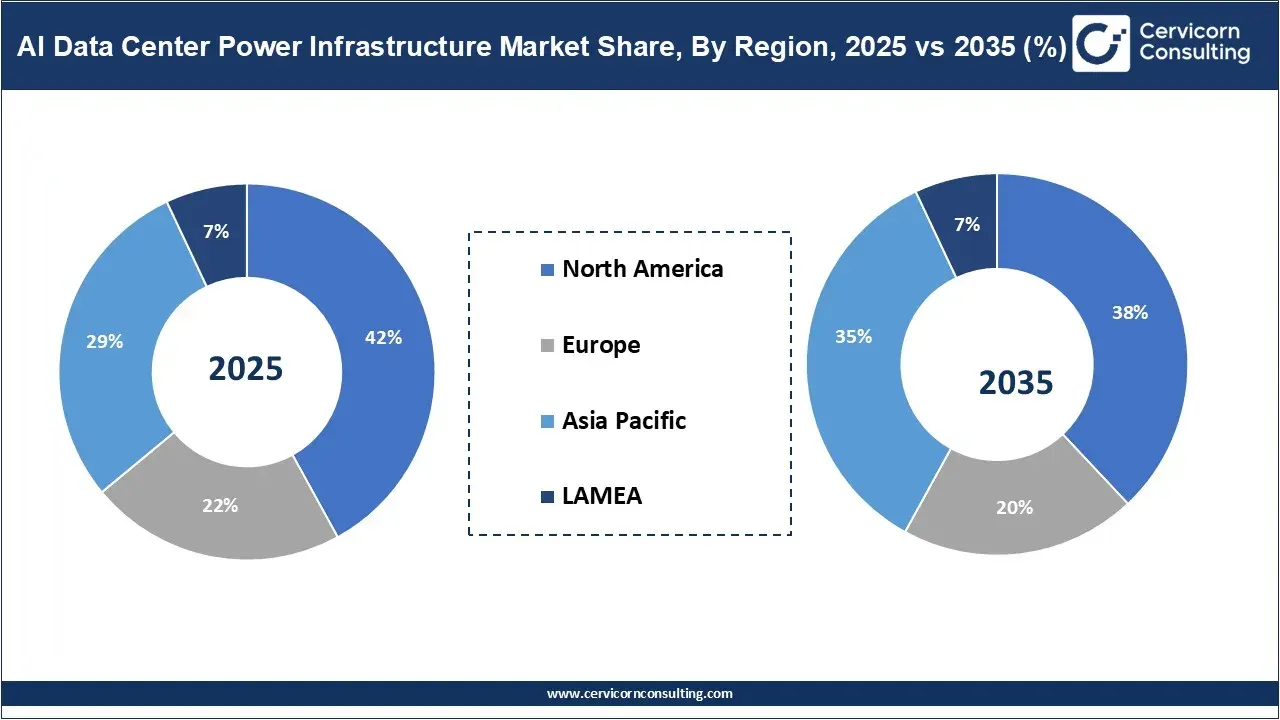
- Leading Region: North America (revenue share 42%)
Report Highlights
- By region, North America led the market in 2025 (revenue share 42%), supported by strong AI adoption, hyperscale investments, and a mature data center ecosystem.
- By region, Asia Pacific is expected to grow rapidly, driven by increasing AI adoption, cloud infrastructure investments, and expanding digitalization.
- By component, UPS systems led the market in 2025, driven by the need for reliable and uninterrupted power for high-density AI workloads.
- By component, power distribution units are expected to grow rapidly, supported by rising rack densities and increasing demand for intelligent power management.
- By power capacity, data centers above 20 MW led the market in 2025 (revenue share 38%), supported by the growing deployment of hyperscale and AI-focused facilities.
- By power capacity, 10–20 MW data centers are expected to grow rapidly, driven by expanding AI workloads and investments in medium-to-large-scale facilities.
- By power architecture, centralized power architecture led the market in 2025 (revenue share 39%), supported by its established use across large-scale data center facilities.
- By power architecture, distributed power architecture is expected to grow rapidly, driven by the need for flexible and scalable power delivery for high-density AI workloads.
- By data center type, hyperscale data centers led the market in 2025 (revenue share 35%), driven by rising AI workloads, cloud adoption, and large-scale computing requirements.
- By data center type, colocation data centers are expected to grow rapidly, supported by increasing demand for third-party AI-ready infrastructure.
- By cooling integration, air-cooled data centers led the market in 2025 (revenue share 48%), supported by their established infrastructure and widespread adoption.
- By cooling integration, liquid-cooled data centers are expected to grow rapidly, driven by increasing GPU densities and the thermal requirements of AI workloads.
- By power source, grid power led the market in 2025 (revenue share 58%), supported by its established availability and ability to supply large-scale data center operations.
- By power source, renewable energy is expected to grow rapidly, driven by rising sustainability requirements and increasing electricity demand from AI workloads.
- By deployment, new data centers led the market in 2025 (revenue share 48%), supported by the development of purpose-built AI and hyperscale facilities.
- By deployment, data center expansion is expected to grow rapidly, driven by the need to upgrade existing facilities for higher-density AI workloads.
- By facility size, large-scale data centers led the market in 2025, supported by increasing investments in high-capacity AI and cloud infrastructure.
- By facility size, mega-scale data centers are expected to grow rapidly, driven by the expansion of large AI campuses and hyperscale computing infrastructure.
Key Trends
- Growing adoption of high-density power systems: AI workloads are driving demand for power infrastructure capable of supporting high-performance GPUs and AI servers.
- Rising demand for energy storage: Advanced UPS systems and battery energy storage are increasingly being deployed to ensure reliable and uninterrupted power supply.
- Integration of renewable energy: Data center operators are increasingly adopting renewable power sources to manage rising electricity demand and sustainability goals.
- Expansion of modular power infrastructure: Scalable and modular systems are gaining traction as they allow data centers to quickly expand power capacity for growing AI workloads.
- AI-enabled power management: Intelligent monitoring and automation are being adopted to improve power distribution, energy efficiency, and infrastructure performance.
- Increasing focus on grid resilience: Data center operators are investing in resilient power infrastructure to address grid constraints, outages, and the growing electricity requirements of AI facilities.
- Adoption of liquid-cooling-compatible infrastructure: The growth of high-density AI computing is encouraging the development of power and facility infrastructure designed to operate alongside advanced liquid-cooling systems.
Market Dynamics
Driver - Powering the Next AI Boom
The fast growth of generative AI, machine learning, and high-performance computing is driving the market for AI data center power infrastructure and raising the need for dependable, large-capacity power systems. The market is expanding due to increased investments in AI-focused and hyperscale data centers, rising electricity consumption from GPU-intensive workloads, and the demand for sustainable operations, grid resilience, and energy efficiency.
In June 2026, Siemens, NVIDIA, and Fluence announced a reference architecture designed for NVIDIA AI data centers, combining medium- and low-voltage power distribution, controls, modular infrastructure, and battery energy storage. The architecture is designed to support high-density AI workloads while improving power reliability, scalability, and deployment flexibility, highlighting the growing focus on purpose-built electrical infrastructure for next-generation AI data centers.
Restraint - Power and Cost Challenges
The market for AI data center power infrastructure is constrained by the high cost of electrical system upgrades, rising electricity consumption, and limited grid capacity in some areas. Deployment and maintenance costs may also rise due to the intricacy of integrating high-density power systems with cutting-edge cooling, energy storage, and backup technologies. The development of new AI data centers may also be slowed by protracted permitting procedures, limitations on power availability, and the requirement for significant infrastructure upgrades.
In June 2026, Bloom Energy released its mid-year Data Center Power Report, highlighting that power availability remains a major constraint on AI data center expansion. The company noted that developers are increasingly considering onsite power solutions when the grid cannot meet their requirements, while rising construction costs and community concerns around electricity prices, water use, and grid reliability can further slow new data center projects.
Opportunity - Unlocking New Power Opportunities
The market for AI data center power infrastructure has a lot of potential because the demand for high-density, scalable, and energy-efficient power solutions is rising due to the rapid expansion of AI workloads. Opportunities in power distribution, energy storage, backup systems, grid integration, and intelligent power management are being created by the growth of data centers prepared for artificial intelligence. The development of integrated power and cooling infrastructure is also being aided by the increasing trend toward high-density, liquid-cooled facilities. Power technology companies and specialized suppliers are finding more opportunities in India as a result of growing investments in AI-focused data centers and related infrastructure.
In September 2026, onsemi highlighted how the shift toward megawatt-scale AI racks is increasing the need for advanced high-voltage power solutions inside data centers. The company noted that AI infrastructure is creating greater demand for technologies that can efficiently deliver, convert, and manage higher levels of power, opening opportunities for semiconductor-based power solutions across the AI data center infrastructure ecosystem.
Regional Analysis
North America dominated the AI data center power infrastructure market
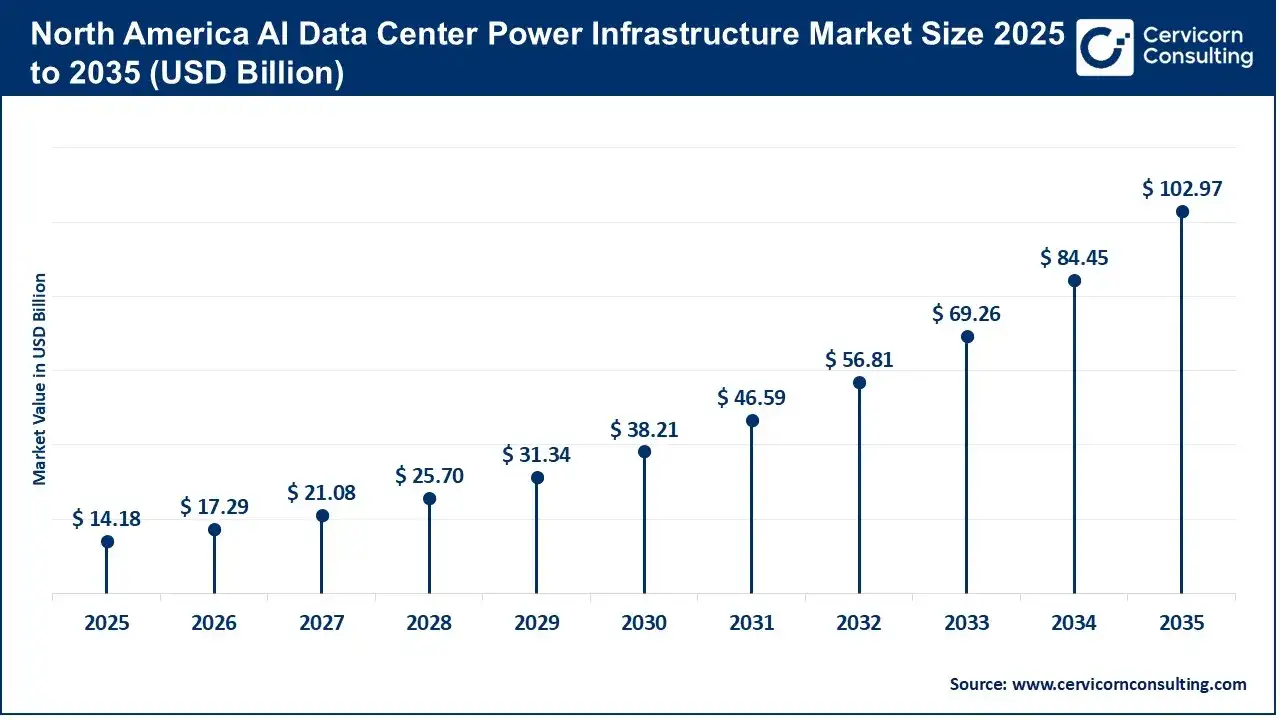
The North America AI data center power infrastructure market size was valued at USD 14.18 billion in 2025 and is expected to reach USD 102.97 billion by 2035. North America dominated the market in 2025, backed by significant AI usage, investments in hyperscale data centers, and large IT firms. The area has a substantial need for high-density computing infrastructure and a developed data center ecosystem. The need for improved power solutions is being sustained by the development of AI infrastructure. Large-scale infrastructure investments are supported by the existence of significant cloud providers and AI technology firms. Investment in energy storage and other power solutions is also being encouraged by rising power requirements.
Asia Pacific is expected to witness the fastest growth during 2026–2035
The Asia-Pacific AI data center power infrastructure market was estimated at USD 9.79 billion in 2025 and is predicted to hit USD 71.10 billion by 2035. Asia Pacific is expected to witness the fastest growth during 2026–2035, backed by growing expenditures in data centers, cloud computing, and AI. The internet infrastructure of nations like China, India, Japan, Singapore, and South Korea is growing. Power infrastructure companies are seeing tremendous prospects as a result of growing electricity demand and the construction of AI-focused facilities. The development of local AI and cloud infrastructure is receiving more and more assistance from governments and tech firms. Regional investment is anticipated to be further strengthened by rising digitalization, internet usage, and demand for localized computing.
Segmental Analysis
Component Analysis
UPS systems dominated the AI data center power infrastructure market in 2025, supported by the requirement for consistent, dependable power for high-density AI workloads. They are crucial for AI facilities because of their function in shielding delicate computer equipment from power fluctuations and disruptions. The need for sophisticated UPS solutions is being further supported by the growing deployment of GPU-based servers and mission-critical workloads. Data center operators are being encouraged to upgrade to modular and scalable UPS systems due to the increased focus on power quality and operational continuity. UPS performance is also being enhanced by the integration of energy management and intelligent monitoring features.
Power distribution units are expected to witness the fastest growth during 2026–2035 since AI racks need power distribution that is more accurate and detailed. Operators can monitor and control power consumption at the rack level with the help of intelligent and metered PDUs. More sophisticated PDU technologies are being adopted by data centers due to rising rack densities and power demands. There is a growing need for flexible distribution architectures as AI racks become more powerful. The significance of intelligent PDUs is being further increased by remote monitoring and real-time power management.
Power Capacity Analysis
Data centers with power capacity above 20 MW dominated the market in 2025 since AI racks need more accurate and detailed power distribution. PDUs that are intelligent and metered allow operators to keep an eye on and control power usage at the rack level. Data centers are adopting more sophisticated PDU technologies as a result of rising rack densities and power requirements. There is a growing need for flexible distribution architectures as AI racks become more powerful. Intelligent PDUs are becoming increasingly important due to real-time power management and remote monitoring.
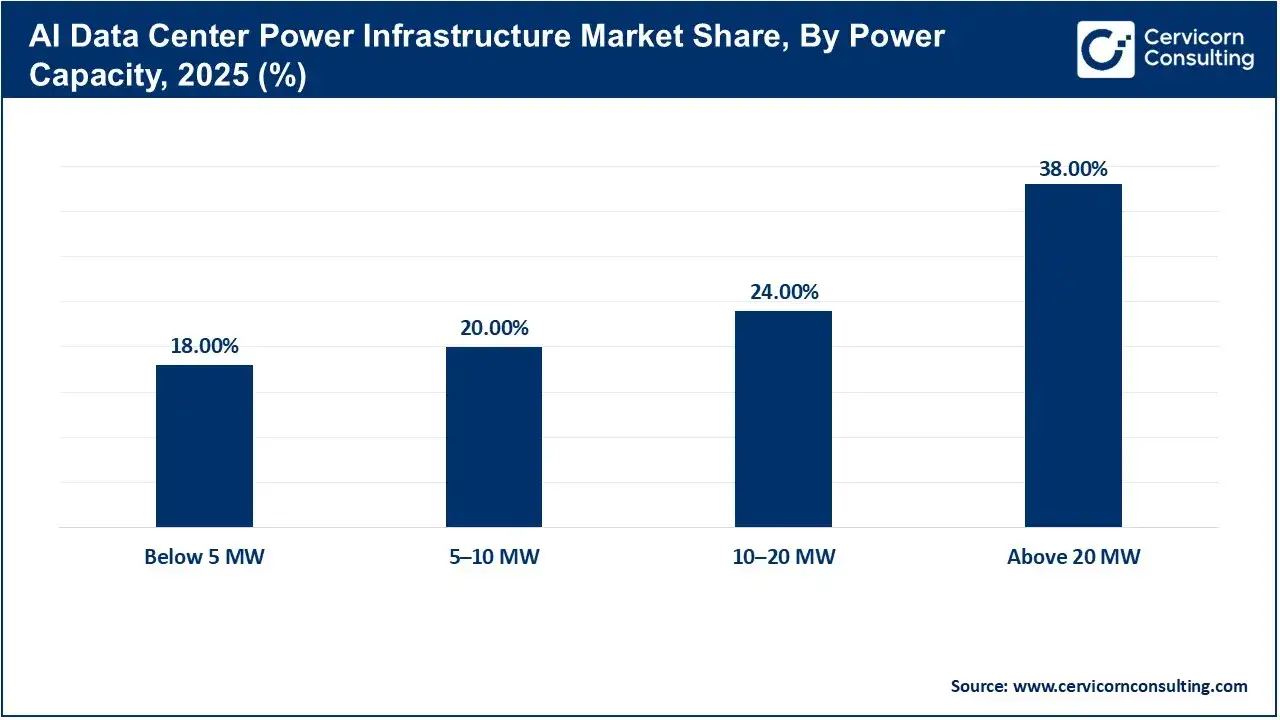
The 10–20 MW segment is expected to grow rapidly during 2026–2035 as more medium-sized establishments increase their capacity for AI computing. This capacity range supports significant AI workloads and gives data center operators scalability. Demand for infrastructure in this power range is also being driven by rising investments in regional AI facilities. Modular power systems, which can be expanded as computing requirements rise, are becoming more and more popular among operators. Facilities looking for a balance between infrastructure investment and scalability are also paying more attention to this market.
Power Architecture Analysis
Centralized power architecture held the leading position in 2025 because large-scale data centers have long used it. Electrical distribution and backup systems can be managed and controlled centrally thanks to it. Large AI facilities continue to adopt it due to its well-established infrastructure and operational familiarity. Large facilities can have easier maintenance and monitoring thanks to centralized systems. Additionally, they continue to be extensively utilized in situations where operators need uniform power management throughout several data center halls.
AI Data Center Power Infrastructure Market Share, By Power Architecture, 2025 (%)
| Power Architecture |
Revenue Share, 2025 (%) |
| Centralized Power Architecture |
39% |
| Distributed Power Architecture |
32% |
| Hybrid Power Architecture |
29% |
Distributed power architecture is expected to experience faster growth through 2035 since power delivery for AI facilities must be scalable and adaptable. Power distribution in close proximity to high-density computing loads can accommodate evolving rack configurations and increasing workloads. Operators are being motivated to investigate more adaptable power architectures by rising AI rack densities. Data centers can adapt to shifting power needs more effectively with the aid of distributed systems. As AI computing capacity grows, their modular design enables phased expansion.
Data Center Type Analysis
Hyperscale data centers dominated the market in 2025, propelled by significant investments from technology firms and cloud service providers. To support large-scale AI computing and cloud workloads, these facilities need significant power infrastructure. The ongoing growth of AI services is motivating hyperscale operators to boost power capacity. Advanced backup and energy storage systems are becoming more and more common on large hyperscale campuses. Innovation in data center power infrastructure is also being fueled by their emphasis on scalability and efficiency.
Colocation data centers are expected to grow rapidly as companies deploy AI workloads on third-party infrastructure more frequently. In order to satisfy demand from businesses that do not wish to construct specialized AI facilities, colocation providers are increasing high-density power capacity. Investment in scalable power and energy management systems is being stimulated by this trend. Higher rack power densities and AI-ready facilities are being developed by more providers. Colocation operators are also benefiting from flexible infrastructure, which enables them to serve numerous clients with varying computing needs.
End User Analysis
Cloud service providers and hyperscalers represented the leading end-user segment in 2025 due to their high needs for cloud infrastructure and AI computing. To support AI models, cloud services, and accelerated computing, these businesses are making significant investments in high-capacity data centers. Their extensive infrastructure needs lead to a high demand for sophisticated power systems. Additionally, they are making more investments in the purchase of renewable energy and energy storage. Their need for dependable and scalable infrastructure is growing as AI-as-a-service expands.
Government and defense is expected to witness strong growth during 2026–2035 as public sector organizations invest more in secure computing infrastructure and sovereign AI. Power systems that are extremely dependable and robust are necessary for mission-critical applications. Specialized data center infrastructure is becoming more in demand as national AI capabilities gain more attention. Additionally, governments are investing more in locally controlled and secure computing environments. Advanced power management systems, energy storage, and reliable backup power are necessary for these facilities.
Cooling Integration Analysis
Air-cooled data centers remained the leading segment in 2025 due to their extensive use and well-established infrastructure. They are still appropriate for many traditional computing environments and current facilities. Their widespread use across data centers is supported by their familiarity and comparatively simple deployment. Air cooling can be used in many existing facilities without requiring significant infrastructure modifications. Because of this, air cooling plays a significant role in the current power and facility ecosystem of data centers.
AI Data Center Power Infrastructure Market Share, By Cooling Integration, 2025 (%)
| Cooling Integration |
Revenue Share, 2025 (%) |
| Air-Cooled Data Centers |
48% |
| Liquid-Cooled Data Centers |
30% |
| Hybrid Cooling Systems |
22% |
Liquid-cooled data centers are expected to experience the fastest growth because GPU clusters and AI processors produce noticeably more heat. Higher rack density can be supported by liquid cooling, which also enhances thermal control. Investments in power infrastructure that is compatible with liquid cooling are thus being encouraged by the growing use of accelerated computing. A growing number of new AI facilities are being built with integrated power and liquid-cooling systems in mind. The technique is especially important for next-generation AI servers and high-density GPU clusters.
Power Source Analysis
Grid power remained the leading power source in 2025 due to its proven availability and capacity to facilitate operations in massive data centers. Utility connections are still the main source of electricity used by data centers. However, utilities are under additional pressure to offer higher-capacity and more dependable connections due to growing AI workloads. In order to increase reliability, data center operators are investing in substations, transformers, and backup power systems. Expanding AI infrastructure is becoming more and more dependent on grid upgrades and increased transmission capacity.
AI Data Center Power Infrastructure Market Share, By Power Source, 2025 (%)
| Power Source |
Revenue Share, 2025 (%) |
| Grid Power |
58% |
| Renewable Energy |
12% |
| On-Site Power Generation |
16% |
| Hybrid Power Systems |
14% |
Renewable energy is expected to grow rapidly as data center managers look for greener electrical sources to support growing AI workloads. Storage and grid power are progressively being integrated with solar, wind, and other renewable energy sources. Renewable energy integration is being further encouraged by sustainability pledges and growing electricity demand. Long-term contracts for renewable energy are emerging as a key tactic for handling significant electricity needs. Additionally, battery storage can enhance the flexibility and dependability of renewable energy for data center operations.
Deployment Analysis
New data center construction dominated the deployment segment in 2025, backed by the quick growth of hyperscale and AI-focused infrastructure. Operators may now create power infrastructure especially for high-density computing needs thanks to new projects. The construction of facilities with specific uses is being aided by rising AI investments. From the very beginning of their design, these facilities might include sophisticated UPS, switchgear, energy storage, and power distribution systems. Additionally, operators may prepare for future increases in AI workload thanks to purpose-built infrastructure.
AI Data Center Power Infrastructure Market Share, By Deployment, 2025 (%)
| Deployment |
Revenue Share, 2025 (%) |
| New Data Centers |
48% |
| Data Center Expansion |
34% |
| Data Center Modernization |
18% |
Data center expansion is expected to grow rapidly through 2035 to support AI workloads, as current facilities enhance their power infrastructure. Advanced power management technologies, backup systems, and electrical capacity are being added by operators. Additionally, this strategy enables businesses to expand their computing capability without constructing brand-new facilities. Additional substations, transformers, UPS systems, and rack-level power distribution are examples of expansion projects. As AI use extends throughout established data centers, retrofitting existing infrastructure is becoming more and more crucial.
Facility Size Analysis
Large-scale data centers held the leading position in 2025 because of rising investments in cloud and high-capacity AI infrastructure. Large-scale infrastructure for energy management, backup generation, and power distribution is needed for these facilities. They are crucial to the development of AI infrastructure because of their capacity to handle large computing workloads. Economies of scale in cooling and electricity infrastructure are also advantageous for large installations. Operators are being encouraged to construct facilities with substantial expansion potential due to growing AI workloads.
AI Data Center Power Infrastructure Market Share, By Facility Size, 2025 (%)
| Facility Size |
Revenue Share, 2025 (%) |
| Small-Scale Data Centers |
8% |
| Medium-Scale Data Centers |
17% |
| Large-Scale Data Centers |
35% |
| Mega-Scale Data Centers |
40% |
Mega-scale data centers are expected to experience strong growth when larger computing environments are needed for AI workloads. Large amounts of electricity, sophisticated power distribution, and robust backup infrastructure are needed for these installations. The need for mega-scale power systems is being further supported by the growth of sizable AI campuses. In order to enable extremely high-density AI computation, operators are increasingly planning specialized power infrastructure. The demand for mega-scale facilities is anticipated to rise further due to the expansion of AI factories and hyperscale campuses.
Government Initiatives
- In February 2026, the Government of India proposed a tax holiday until 2047 for eligible foreign cloud service providers using data center services in India. The measure is aimed at attracting long-term investment in cloud and data center infrastructure and supporting the expansion of AI-related digital infrastructure.
- In February 2026, the government highlighted the need for resilient, high-performance data centers as AI workloads increase electricity demand and create more concentrated power loads. The discussions emphasized integrated planning across grids, power generation, cooling, and data center infrastructure to support sustainable AI growth.
- In February 2026, the Ministry of Power showcased AI-focused initiatives aimed at creating a more efficient and resilient electricity sector. The initiative highlighted the use of digital technologies across power generation, transmission, and distribution, supporting the broader infrastructure needed for energy-intensive AI facilities.
- In March 2026, the government stated that electricity requirements from expanding AI and large-scale data centers are being incorporated into power-sector planning. It also highlighted the expansion of national transmission infrastructure and the development of reliable power solutions for emerging data center requirements.
- In July 2026, the government highlighted the National Electricity Plan for Transmission, which considers rising electricity demand from data centers and other emerging industries. The planned expansion of transmission infrastructure is intended to strengthen grid reliability while supporting the integration of renewable energy.
- In August 2026, the government outlined measures promoting energy efficiency and clean energy in data centers, including renewable power, efficient cooling, energy conservation, and water management. These initiatives are particularly relevant to AI data centers because high-density computing creates greater power and cooling requirements.
- In July 2026, the Union Cabinet approved the second phase of the Semicon India Programme, known as Semicon 2.0, to strengthen India's semiconductor ecosystem. The initiative can support the wider AI infrastructure supply chain by encouraging domestic development of chips and related technologies required for advanced computing systems.
Recent Developments
- In January 2026, Eaton expanded its modular data center offering through a collaboration with Flexnode, combining backup power, racks, cable management, and modular infrastructure for high-density AI and HPC workloads. The solution is designed to support faster and more scalable deployment of AI data centers. This development strengthens Eaton’s position in integrated power solutions for rapidly deployable AI facilities.
- In February 2026, Vertiv announced that it would provide complete power and thermal infrastructure for NxtGen AI’s national-scale sovereign AI factory in India. The infrastructure is designed to address the high power density and cooling requirements of NVIDIA Blackwell-based AI workloads. The project demonstrates the growing demand for purpose-built power infrastructure for sovereign AI computing facilities.
- In March 2026, Eaton introduced its Beam Rubin DSX platform in collaboration with NVIDIA, integrating power and cooling infrastructure from the grid to the AI chip. The platform is designed to enable modular and scalable deployment of high-density AI factories. The platform reflects the industry’s move toward integrated electrical and thermal infrastructure for next-generation AI systems.
- In April 2026, Vertiv and CPower announced a collaboration to integrate battery energy storage systems with virtual power plant technology. The approach enables data centers to use onsite energy assets for grid services while improving power resilience and supporting faster grid interconnection. The collaboration highlights the growing role of energy storage in managing AI data center power requirements.
- In June 2026, Meta announced an agreement with Reliance Industries for an AI-enabled data center in Jamnagar, Gujarat. The project is being supported by renewable-energy arrangements, highlighting the growing integration of AI data center infrastructure with clean power resources in India. The development demonstrates the increasing focus on combining AI computing capacity with reliable and sustainable energy supply.
Top Companies
Segments Covered
By Component
- UPS Systems
- Modular UPS
- Centralized UPS
- Distributed UPS
- Power Distribution Units
- Basic PDU
- Metered PDU
- Intelligent PDU
- Switchgear & Circuit Breakers
- Transformers
- Automatic Transfer Switches
- Busway & Busbar Systems
- Rack Power Distribution
- Generators & On-Site Power Systems
- Energy Storage Systems
- Power Monitoring & Management Systems
- Other Components
By Power Capacity
- Below 5 MW
- 5–10 MW
- 10–20 MW
- Above 20 MW
By Power Architecture
- Centralized Power Architecture
- Distributed Power Architecture
- Hybrid Power Architecture
By Data Center Type
- Hyperscale Data Centers
- Colocation Data Centers
- Enterprise Data Centers
- Edge Data Centers
- AI-Focused Data Centers
- Others
By Cooling Integration
- Air-Cooled Data Centers
- Liquid-Cooled Data Centers
- Hybrid Cooling Systems
By Power Source
- Grid Power
- Renewable Energy
- On-Site Power Generation
- Hybrid Power Systems
By Deployment
- New Data Centers
- Data Center Expansion
- Data Center Modernization
By Facility Size
- Small-Scale Data Centers
- Medium-Scale Data Centers
- Large-Scale Data Centers
- Mega-Scale Data Centers
By End User
- IT & Telecommunications
- BFSI
- Government & Defense
- Healthcare & Life Sciences
- Manufacturing
- Retail & E-commerce
- Research & Academia
- Others
By Region
- North America
- Europe
- Asia Pacific
- Latin America
- Middle East & Africa
