800G Optical Transceiver Market Size, Growth, Forecast 2026 to 2035
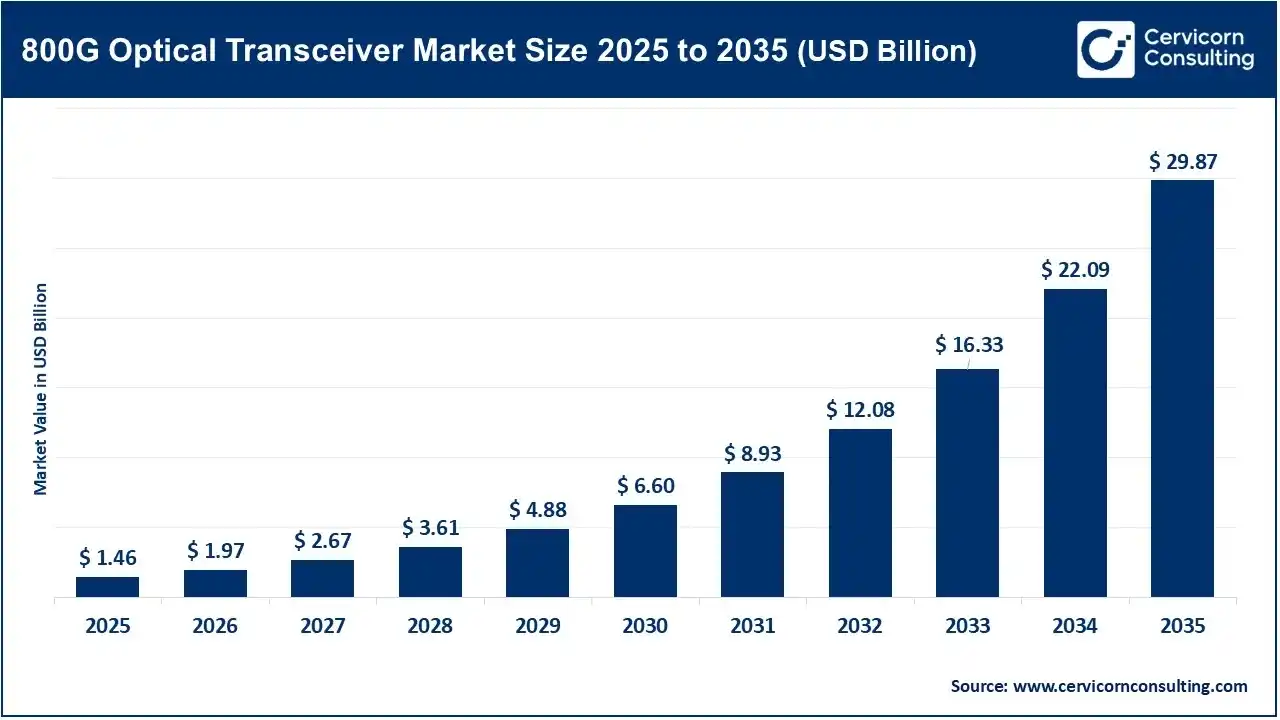
The global 800G optical transceiver market size was valued at USD 1.46 billion in 2025 and is projected to grow from USD 1.97 billion in 2026 to nearly USD 29.87 billion by 2035, registering a CAGR of 35.2% over the 2026 to 2035 period. The 800G optical transceiver market is growing rapidly due to the rising demand for high-speed, high-capacity data transmission across hyperscale data centers, cloud computing platforms, and AI-driven infrastructure. Faster interconnects between servers, switches, and data processing systems are becoming more necessary as advanced AI and machine learning workloads are deployed. Higher-speed optical connectivity solutions are also being used by data center operators and network providers due to the growth of 5G networks, edge computing, and bandwidth-intensive applications.
Report Highlights
- By region: North America dominated the market, supported by the presence of hyperscale data centers, major cloud service providers, and increasing investments in AI infrastructure.
- By form factor: 800G QSFP-DD dominated the market, supported by its compact design, interoperability, and suitability for high-density data center networking.
- By optical technology: EML-Based dominated the market, supported by its established use in high-speed optical transmission and data center networking applications.
- By reach: 100 m–500 m dominated the market, driven by demand for high-speed connectivity across data center halls and high-density networking environments.
- By application: Data center networking dominated the market, supported by the expansion of hyperscale data centers, cloud infrastructure, and high-speed Ethernet networks.
Recent Trends and Growth Factors
- AI-driven networking: Growing AI and machine learning workloads are increasing demand for high-speed connectivity between GPUs, servers, and switches. This is accelerating the adoption of 800G optical transceivers in advanced data center environments. The expansion of generative AI is further increasing the need for high-bandwidth interconnects.
- Expansion of hyperscale data centers: Hyperscale and cloud data centers are upgrading their networking infrastructure to handle growing data traffic. The shift toward higher-capacity networks is supporting demand for 800G solutions. Large-scale infrastructure investments are creating new deployment opportunities for optical transceiver manufacturers.
- Increasing cloud adoption: The growing use of cloud computing, enterprise applications, and digital services is generating higher bandwidth requirements. Cloud providers are increasingly investing in high-speed optical connectivity to support scalable infrastructure. This trend is encouraging the replacement of lower-speed transceivers with advanced solutions.
- Transition to higher-speed Ethernet: Data center networks are moving toward higher-speed Ethernet technologies to improve bandwidth and network efficiency. This transition is creating opportunities for 800G optical transceiver deployment. The need for faster server-to-switch and switch-to-switch connections is further supporting this transition.
- Focus on energy efficiency: Manufacturers are developing compact and energy-efficient transceivers to address rising power consumption in data centers. Improved power efficiency is becoming increasingly important as network speeds continue to increase. Advanced optical designs are being developed to deliver greater performance without proportionally increasing energy use.
Technology Landscape
- PAM4 Modulation Technology: Higher data speeds are made possible by PAM4, which transmits more data per signal cycle. In order to provide high-speed connectivity while preserving network efficiency, 800G transceivers frequently employ it. It is appropriate for contemporary data center networks due to its capacity to expand bandwidth without correspondingly raising signaling speed.
- Silicon Photonics: To enable quicker and more effective data transfer, silicon photonics combines optical components with silicon-based electronics. The technology is becoming more popular for applications in hyperscale data centers and artificial intelligence. Additionally, it can enhance scalability for high-density networking situations and support compact designs.
- Advanced Optical Engines: Optical engines combine lasers, modulators, detectors, and related components to improve transmission performance. Advancements in these components are helping manufacturers develop compact and efficient 800G solutions. Improved integration can also support higher port density and better overall network performance.
Market Dynamics
Drivers
- Growing AI and machine learning applications: AI workloads necessitate quicker data flow, increasing the need for high-speed 800G connections. Larger processing clusters and increased network bandwidth requirements are a result of generative AI's quick progress. This is promoting the use of cutting-edge optical technologies by data center operators. High-speed connectivity is anticipated to become even more necessary as the use of AI-based applications grows.
- Expansion of data centers: The increasing number of large-scale data centers is driving demand for high-speed optical connectivity. Cloud providers are expanding their infrastructure to accommodate growing digital workloads. Faster connections between servers, switches, and storage systems are becoming necessary as data center capacity increases. The continued deployment of hyperscale facilities is expected to further support market growth.
- Increasing data traffic: Network traffic is increasing as cloud services, streaming, online applications, and digital platforms are used more frequently. Network operators require greater bandwidth as consumers and companies generate and access more data. Large amounts of data can be transferred more quickly thanks to 800G transceivers. The current network infrastructure is under more strain due to the ongoing expansion of digital services.
Restraints
- High product cost: Due to their complex components and production requirements, 800G optical transceivers are more costly than their slower counterparts. Smaller data center operators may find adoption challenging as a result. Upgrades in companies with tight infrastructure budgets may also be delayed by the hefty initial cost. For broader adoption, cost reduction will continue to be crucial.
- Complex installation and integration: Switches, cables, and other network equipment may need to be upgraded to implement 800G technology. As a result, network upgrades become more complicated and expensive overall. Before integrating the technology into current networks, organizations might also require more testing. These specifications may cause deployment schedules to be extended.
- Limited compatibility with existing infrastructure: 800G connectivity might not be supported by older network systems. Therefore, before implementing the technology, organizations might need to improve or replace their current infrastructure. The overall cost of network upgrades may rise as a result. Adoption among users using older systems may also be slowed by compatibility issues.
Opportunities
- Growing AI data centers: The rise of AI data centers is creating opportunities for high-speed optical communication. GPUs, servers, and switches can communicate with each other thanks to 800G transceivers. Higher-capacity network connections are becoming more and more necessary as AI computing clusters grow in size. The broader implementation of 800G systems may be supported by this trend.
- Expansion of hyperscale cloud infrastructure: Major cloud and technology companies are continuously expanding their data center networks. This creates opportunities for suppliers of high-capacity optical transceivers. Growing cloud workloads require faster connections between different parts of the data center infrastructure. This can encourage additional investments in high-speed networking equipment.
- Growth of silicon photonics: The efficiency, compactness, and performance of optical transceivers can all be enhanced by developments in silicon photonics. This gives producers the chance to build more sophisticated and affordable products. Additionally, the approach can facilitate increased optical component integration. The scalability of high-speed optical solutions might be enhanced by further research.
Challenges
- Rapid technological changes: Optical networking technology is developing quickly, requiring manufacturers to continuously improve their products. Companies may face difficulties in keeping up with changing speed and performance requirements. Frequent technology upgrades can increase research and development costs. Manufacturers also need to ensure that new products remain compatible with evolving network equipment.
- Intense market competition: Several technology companies are developing high-speed optical networking solutions. Strong competition can put pressure on product pricing, innovation, and profit margins. Companies need to continuously improve product performance and reliability to remain competitive. Increasing competition may also make product differentiation more difficult.
- Quality and reliability requirements: 800G transceivers need to operate reliably in demanding data center environments. Maintaining consistent product quality and performance can be challenging as technology becomes more complex. Even small performance issues can affect high-volume data center operations. Manufacturers therefore need strict testing and quality-control processes.
Regional Analysis
North America dominated the 800G optical transceiver market
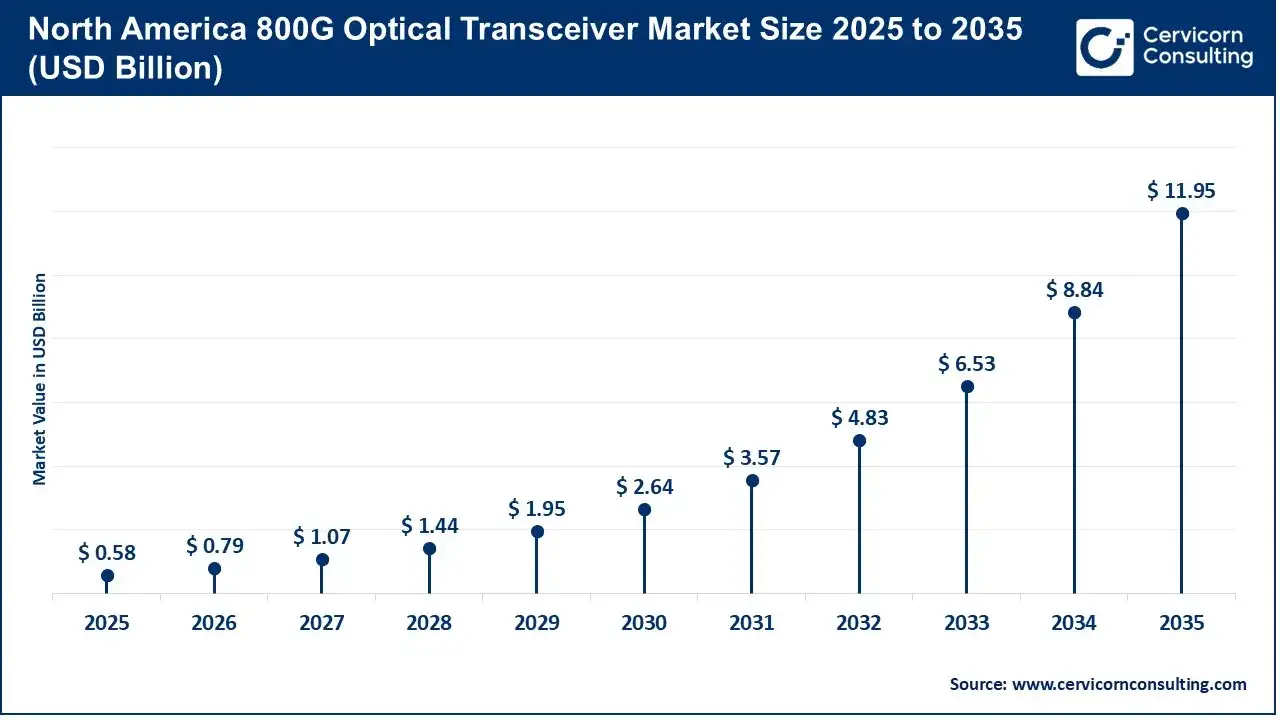
The North America 800G optical transceiver market size was valued at USD 0.58 billion in 2025 and is projected to surpass USD 11.95 billion by 2035. North America dominated the market in 2025, driven by the presence of large cloud service providers, hyperscale data centers, and AI technology businesses. Demand for high-speed optical communication is rising due to significant expenditures in AI infrastructure and high performance computing. Additionally, there is a well-established optical technology ecosystem in the area. Growth in the regional market is anticipated to be supported by ongoing data center building.
Asia-Pacific growing rapidly in the 800G optical transceiver market
The Asia-Pacific 800G optical transceiver market size was estimated at USD 0.51 billion in 2025 and is exoected to hit USD 10.45 billion by 2035. Asia-Pacific is growing rapidly in the market, driven by growing investments in AI and digital technologies, growing data center infrastructure, and growing cloud adoption. The region's nations are bolstering their computing and telecommunications infrastructures. The demand for high-speed optical networks is rising due to rising data traffic and internet usage. Expansion of hyperscale and AI-focused data centers is likely to further drive demand.
800G Optical Transceiver Market Share, By Region, 2025 (%)
| Region |
Revenue Share, 2025 (%) |
| North America |
40% |
| Europe |
18% |
| Asia-Pacific |
35% |
| LAMEA |
7% |
Europe Market Trends
The Europe 800G optical transceiver market was valued at USD 0.26 billion in 2025 and is anticipated to reach USD 5.38 billion by 2035. Europe represents an emerging segment in the 800G optical transceiver market, driven by increasing investments in cloud infrastructure, data centers, and advanced digital networks. Growing adoption of AI and high-performance computing is creating additional demand for high-bandwidth connectivity. Investments in digital infrastructure are further supporting market opportunities. Increasing focus on energy-efficient networking technologies is expected to contribute to regional growth.
Segmental Analysis
Form Factor Analysis
800G QSFP-DD: 800G QSFP-DD held the dominant position in 2025 because of its small size, wide range of interoperability, and fit for networking in high-density data centers. It has the capacity to accommodate high bandwidth. The need for QSFP-DD modules is being further supported by the growing deployment of high-speed Ethernet networks. It is anticipated that ongoing improvements from 400G to 800G networking will sustain its dominant market position.
800G OSFP: 800G OSFP is growing rapidly because it can handle demanding high-speed networking applications and has a larger thermal capacity. It is appropriate for AI and high-performance computing environments because of its bigger form size, which offers more room for heat management. Demand for OSFP modules is rising as GPU-based infrastructure is deployed more widely. The establishment of AI-focused data centers is likely to further promote segment growth.
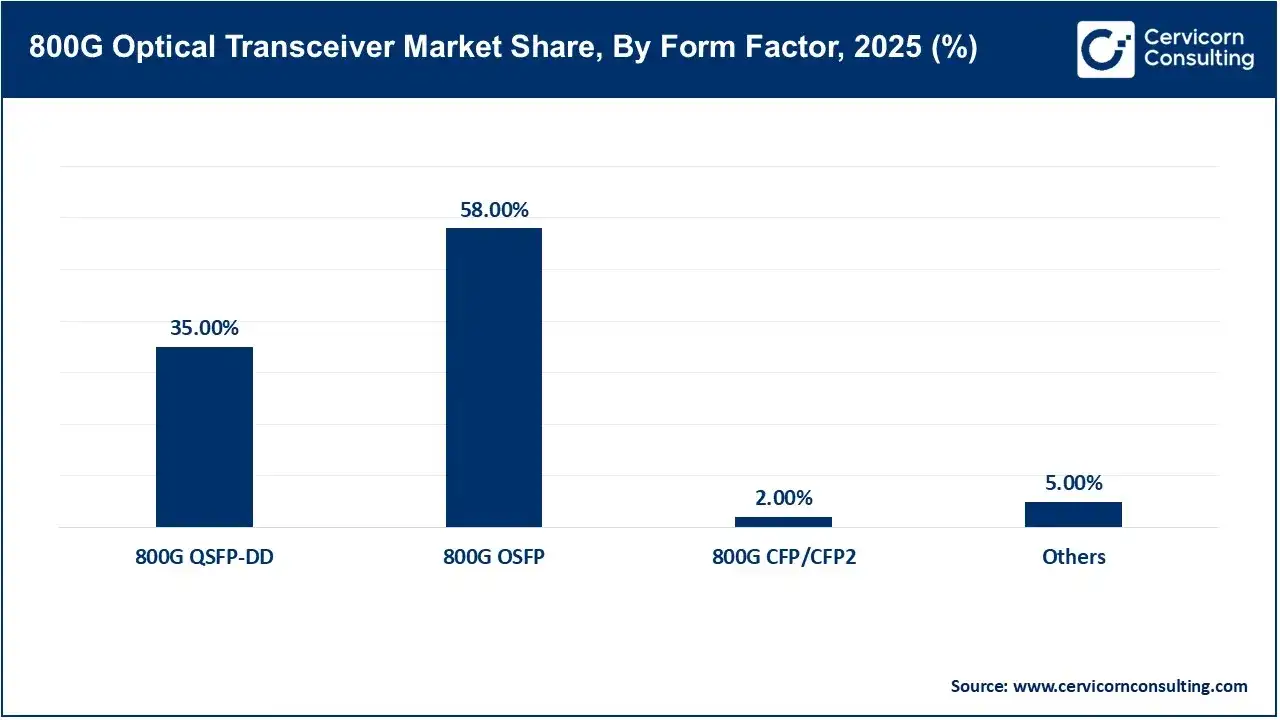
800G CFP/CFP2: 800G CFP/CFP2 represents a specialized form factor used in applications requiring high-capacity optical connectivity and longer-distance transmission. These modules are supported by their established use in telecommunications and optical networking infrastructure. Demand is influenced by upgrades to high-capacity communication networks and data center interconnects. However, adoption is comparatively limited as newer compact form factors gain greater acceptance.
Optical Technology Analysis
EML-Based: EML-based technology held the dominant position in 2025 because of its robust functionality, dependability, and fit for high-speed optical transmission. EML technology delivers effective signal transmission across numerous data center and networking applications. Its established manufacturing ecosystem is also promoting further adoption among network equipment providers. Demand for EML-based solutions is anticipated to be sustained by expanding 800G infrastructure deployment.
Silicon Photonics: Silicon photonics is growing rapidly because there is a growing need for optical platforms with greater integration, power economy, and scalability. Compact and high-performance designs are made possible by the technology's ability to incorporate optical components into silicon-based platforms. The development of data centers and increasing AI workloads are driving the use of cutting-edge optical technology. Growing 800G and next-generation optical platform development is anticipated to bolster segment expansion.
800G Optical Transceiver Market Share, By Optical Technology, 2025 (%)
| Optical Technology |
Revenue Share, 2025 (%) |
| EML-Based |
38% |
| Silicon Photonics |
32% |
| VCSEL-Based |
5% |
| DML-Based |
12% |
| Coherent Optical |
8% |
| Others |
5% |
VCSEL-Based: VCSEL-based technology is supported by its suitability for high-speed data transmission applications. It is helpful for some data center connectivity needs because of its small size and reasonably effective functioning. Opportunities for VCSEL-based optical solutions are being created by the growing demand for high-density networking. The usage of VCSEL in short-range applications may be further supported by ongoing performance improvements.
Reach Analysis
Short Reach, up to 100 m: Short Reach, up to 100 m represents an important segment in the 800G optical transceiver market in 2025, fueled by data centers' increased demand for fast connections. Communication between servers, switches, and storage systems is supported by these solutions. Increasing deployment of AI and high-performance computing infrastructure is supporting demand. Continued data center segment expansion is anticipated.
100 m–500 m: 100 m–500 m dominated the 800G optical transceiver market in 2025, driven by its suitability for connections across data center halls and high-density networking environments. The reach range provides a balance between transmission distance and performance. Increasing deployment of 800G Ethernet networks is supporting adoption. Rising data traffic and network upgrades are further contributing to segment growth.
500 m–2 km: 500 m–2 km represents an emerging segment in the 800G optical transceiver market, driven by increasing demand for higher-speed connectivity across distributed data center and networking environments. The reach range supports connections that extend beyond typical short-distance applications. The expansion of distributed computing infrastructure is creating additional opportunities for these solutions. Increasing network capacity requirements are expected to support segment growth.
Application Analysis
Data Center Networking: Data center networking dominated the 800G optical transceiver market in 2025, supported by the growing deployment of high-speed switches, servers, and storage infrastructure. Increasing data traffic is encouraging operators to upgrade networks toward 800G connectivity. Expansion of cloud computing and hyperscale data centers is further supporting demand. Ongoing investment in high-capacity networking infrastructure is expected to sustain the segment's position.
AI & Machine Learning Infrastructure: AI & machine learning infrastructure is growing rapidly in the 800G optical transceiver market, driven by data-intensive AI applications and the growing use of GPU clusters. For effective communication between networking and computing devices, AI systems need connections with high bandwidth and low latency. The need for network capacity is rising due to the development of generative AI. It is anticipated that the shift from 400G to 800G connectivity will quicken segment expansion.
Data Center Interconnect: Data center interconnect represents an emerging segment in the 800G optical transceiver market, driven by the expansion of distributed data center infrastructure. High-speed optical connectivity enables efficient communication and data transfer between facilities. Growing cloud computing and AI workloads are increasing the need for higher-capacity interconnect solutions. The adoption of longer-reach optical technologies is expected to create additional opportunities for the segment.
Recent Developments
- In March 2026, Applied Optoelectronics, Inc. (AOI) received a new volume order from a major hyperscale customer for 800G single-mode data-center transceivers. The order is intended to support network expansion for AI-driven workloads. The development highlights increasing demand for 800G connectivity as AI infrastructure expands. AOI also noted that customers are adopting 800G to improve bandwidth, power efficiency, and cost per bit.
- In March 2026, Credo Technology Group announced the general availability of its 800G 2×DR4 ZeroFlap optical transceivers for AI networks. The modules are designed to monitor optical link health and identify connectivity issues in AI clusters. The solution focuses on improving network stability and reducing disruptions. It also demonstrates the growing integration of intelligent monitoring features into high-speed optical transceivers.
- In March 2026, Linktel Technologies announced that two of its 800G optical transceivers received recognition in the 2026 Lightwave Innovation Reviews. The products include 800G OSFP FR4 10km and 800G OSFP 2LR4+ 20km modules. The transceivers use dispersion-management technology to support longer-distance connectivity. The development reflects ongoing efforts to improve signal quality and transmission distance for AI networks.
Government Initiatives
- In January 2025, Department of Telecommunications (DoT) and IIT Bombay signed an agreement to develop an optical transceiver chipset for high-bandwidth 6G wireless links under the Telecom Technology Development Fund (TTDF). The project supports indigenous development of advanced optical-transceiver technology for next-generation communication networks.
- In March 2025, Ministry of Electronics & Information Technology (MeitY) highlighted government support for photonic chip research, including Photonic Integrated Circuits based on silicon and other materials. Photonic chips are relevant to AI, data centers, optical interconnects, and high-bandwidth communication, supporting the broader ecosystem for advanced optical transceivers.
Top Companies
Segments Covered
By Form Factor
- 800G QSFP-DD
- 800G OSFP
- 800G CFP/CFP2
- Other Form Factors
By Optical Technology
- EML-Based
- Silicon Photonics
- VCSEL-Based
- DML-Based
- Coherent Optical
- Other Technologies
By Reach
- Short Reach, Up to 100 m
- 100 m–500 m
- 500 m–2 km
- 2–10 km
- More Than 10 km
By Application
- Data Center Networking
- AI & Machine Learning Infrastructure
- Data Center Interconnect
- Telecommunications
- High-Performance Computing
- Enterprise Networking
- Other Applications
By Region
- North America
- Europe
- Asia-Pacific
- Latin America
- Middle East & Africa