5G in Healthcare Market Size, Growth, Forecast 2026 to 2035
The global 5G in healthcare market size was valued at USD 91.47 billion in 2025 and is expected to surpass around USD 928.61 billion by 2035, exhibiting a compound annual growth rate (CAGR) of 26.1% over the forecast period from 2026 to 2035. The growth of the 5G in healthcare market is primarily being driven by the rapid expansion of telemedicine, remote patient monitoring, and connected medical devices. Unlike previous wireless generations, 5G offers ultra-low latency, high bandwidth, and the ability to support massive numbers of connected devices simultaneously, enabling real-time transmission of medical data, high-definition virtual consultations, and continuous monitoring of patients with chronic conditions. The increasing adoption of digital healthcare is evident in the fact that more than 70% of U.S. hospitals had integrated 5G technology by 2023 for applications such as telemedicine, remote patient monitoring, and connected healthcare devices. In addition, remote patient monitoring has emerged as one of the largest application areas within the market, reflecting the growing demand for decentralized and home-based healthcare delivery.
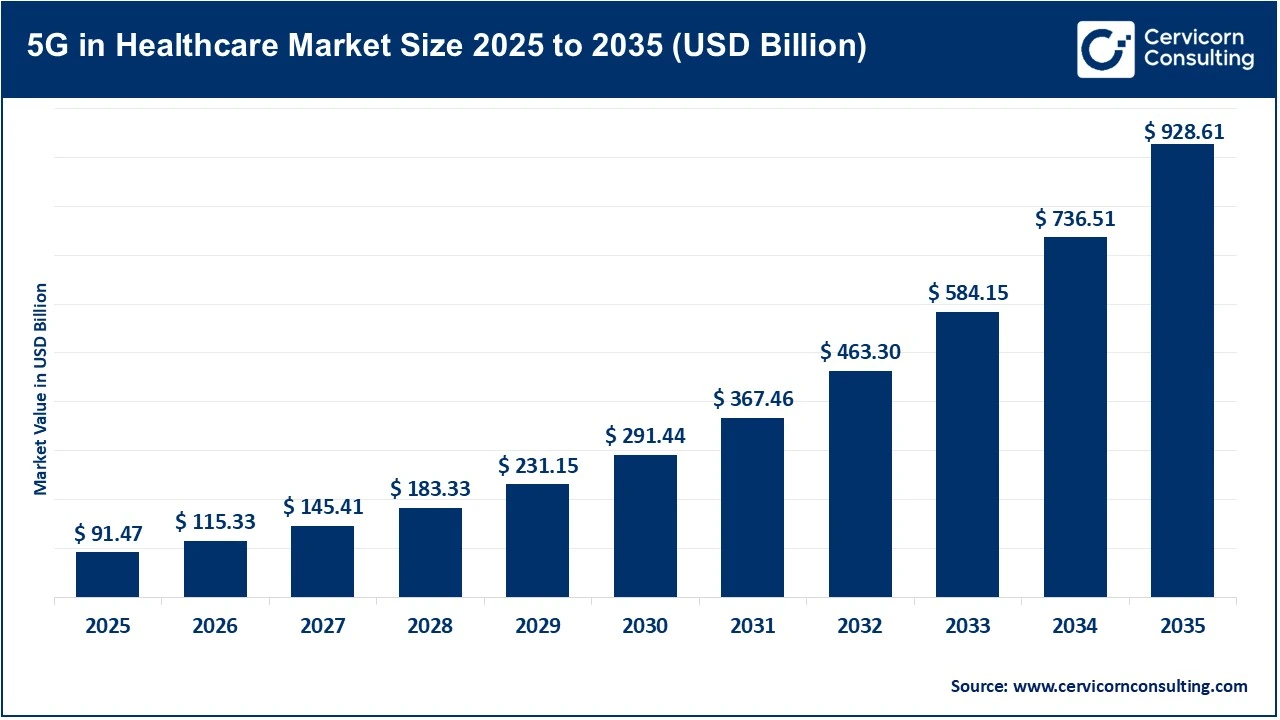
Another major growth factor is the rising use of advanced healthcare technologies such as robotic surgery, AI-enabled diagnostics, internet of medical things (IoMT) devices, and real-time medical imaging. 5G networks enable the fast and reliable transfer of large medical files and support mission-critical applications that require near-instant communication between healthcare professionals and devices. The technology is also helping healthcare providers improve emergency response capabilities, enhance patient outcomes, and extend specialist care to rural and underserved regions. Industry studies indicate that telehealth usage has increased by more than 50% in several regions, while remote healthcare adoption continues to accelerate due to growing demand for accessible and data-driven care models. Government-led healthcare digitalization initiatives and collaborations between telecom operators and healthcare organizations are further supporting market expansion worldwide.
Report Highlights
- By region, North America held 39.8% market share, driven by advanced healthcare infrastructure, widespread 5G deployment, and strong digital health adoption.
- By component, Hardware accounted for 50.1% of market revenue, supported by growing investments in connected medical devices and network infrastructure.
- By communication type, Enhanced Mobile Broadband (eMBB) captured 51.9% share, owing to increasing demand for high-bandwidth telemedicine and medical imaging applications.
- By application, Telemedicine and Virtual Consultation Services represented 34.0% market share, benefiting from rising adoption of remote healthcare delivery solutions.
- By end user, Hospitals and Surgical Centers held 45.8% share, reflecting extensive deployment of smart hospital technologies and connected healthcare systems.
What is 5G in healthcare?
5G in healthcare refers to the use of fifth-generation wireless network technology to enable faster, more reliable, and low-latency communication across healthcare systems, medical devices, and digital health platforms. By supporting real-time data transmission, high device connectivity, and enhanced network performance, 5G helps healthcare providers improve patient care, streamline hospital operations, enable remote medical services, and support advanced technologies such as artificial intelligence, robotics, and the Internet of Medical Things (IoMT). The technology plays a crucial role in accelerating digital healthcare transformation by facilitating seamless communication between patients, healthcare professionals, and connected medical equipment.
Applications of 5G in healthcare:
- Telemedicine and virtual consultations
- Remote patient monitoring
- Connected medical devices and IoMT
- Robotic and telesurgery
- Medical imaging and diagnostics
- Emergency medical services (EMS)
- Hospital asset tracking and workflow management
- Smart hospitals and connected healthcare infrastructure
- AI-powered clinical decision support
- Wearable health monitoring solutions
Telecom Providers’ Expansion of Private 5G Networks in Hospitals Accelerating Market Growth
Telecom providers are increasingly partnering with hospitals and healthcare systems to deploy private 5G networks, creating a significant growth driver for the 5G in healthcare market. Unlike public cellular networks, private 5G infrastructure offers dedicated bandwidth, enhanced security, ultra-low latency, and greater control over sensitive medical data, making it highly suitable for mission-critical healthcare applications. Hospitals are leveraging these networks to support connected medical devices, real-time patient monitoring, AI-powered diagnostics, robotic surgery, and seamless communication across clinical departments.
Telecom operators are also introducing customized healthcare connectivity solutions that integrate edge computing and IoMT platforms, enabling faster processing of large medical datasets and reducing network congestion. As healthcare organizations prioritize digital transformation, cybersecurity, and operational efficiency, the growing investment by telecom providers in private 5G deployments is expanding the adoption of advanced healthcare technologies and strengthening the overall market ecosystem.
Report Scope
| Area of Focus |
Details |
| Market Size in 2026 |
USD 115.33 Billion |
| Market Size in 2035 |
USD 928.61 Billion |
| CAGR 2026 to 2035 |
26.10% |
| DOminant Region |
North America |
| Fastest Growing Region |
Asia-Pacific |
| Key Segments |
Component, Communication Type, Application, End User, Region |
| Key Companies |
Verizon Communications, AT&T Inc., T-Mobile US Inc., Huawei Technologies Co. Ltd., Ericsson, Nokia Corporation, Cisco Systems Inc., Qualcomm Incorporated, Samsung Electronics Co. Ltd., Juniper Networks Inc., BT Group plc, Vodafone Group plc |
Recent Major Milestones
1. Verizon’s Private 5G Deployments Across Major U.S. Hospitals (2025)
Verizon expanded its healthcare footprint by deploying private 5G and neutral-host networks for major healthcare providers, including Cleveland Clinic, AdventHealth, and Tampa General Hospital. These deployments are designed to support mission-critical clinical operations, connected medical devices, digital workflows, and high-density healthcare environments where thousands of devices and users require uninterrupted connectivity. This milestone is accelerating market growth by validating the commercial viability of private 5G in healthcare and encouraging other hospitals to invest in dedicated wireless infrastructure for telemedicine, AI-enabled diagnostics, asset tracking, and smart hospital initiatives.
2. U.S. Veterans Health Administration Expands 5G-Enabled Hospital Infrastructure
The U.S. Veterans Health Administration (VHA) has continued deploying advanced 5G-enabled clinical care systems across its healthcare network, including initiatives at the Palo Alto VA Health Care System. The program focuses on integrating 5G connectivity into patient care, remote monitoring, and digital health applications to improve healthcare delivery for veterans. This government-backed effort is driving the market by demonstrating the role of 5G in large-scale public healthcare systems, reducing implementation risk for healthcare providers, and creating a blueprint for future government-funded smart hospital projects worldwide.
3. European Union-Funded 5GMHI Healthcare Network Initiative (2024)
In October 2024, the European Union advanced the 5G Mobile Healthcare Innovative Solutions (5GMHI) project, which is deploying private 5G healthcare infrastructure supported by the Connecting Europe Facility (CEF) Digital Programme. The project includes dedicated 5G networks, cloud resources, and innovation platforms for healthcare applications with a budget of approximately €8.5 million. This initiative is driving market expansion by accelerating real-world healthcare use cases, encouraging cross-border digital healthcare innovation, and increasing investments in medical-grade 5G infrastructure throughout Europe.
4. India’s Department of Telecommunications Expands the 100 5G Use Case Labs Program
India's Department of Telecommunications (DoT) has accelerated the rollout of its national "100 5G Use Case Labs" initiative, establishing advanced 5G research and testing facilities across academic institutions. These labs are designed to foster innovation in sectors including healthcare, enabling researchers, startups, and industry partners to develop next-generation telemedicine, remote diagnostics, IoMT, and smart healthcare applications. This initiative is strengthening the 5G healthcare ecosystem by creating a pipeline of new healthcare solutions, encouraging public-private collaboration, and expanding the availability of locally developed 5G-enabled medical technologies.
5G in Healthcare Market Regional Analysis
The 5G in healthcare market is segmented by region into North America, Europe, Asia-Pacific, Latin America, and LAMEA. Here is a brief overview of each region:
North America 5G in Healthcare Market: Driven by Advanced Digital Health Infrastructure, Strong Telecom Investments, and Expanding Adoption of Connected Healthcare Technologies
The North America 5G in healthcare market size was estimated at USD 36.41 billion in 2025 and is forecasted to reach around USD 369.59 billion by 2035.
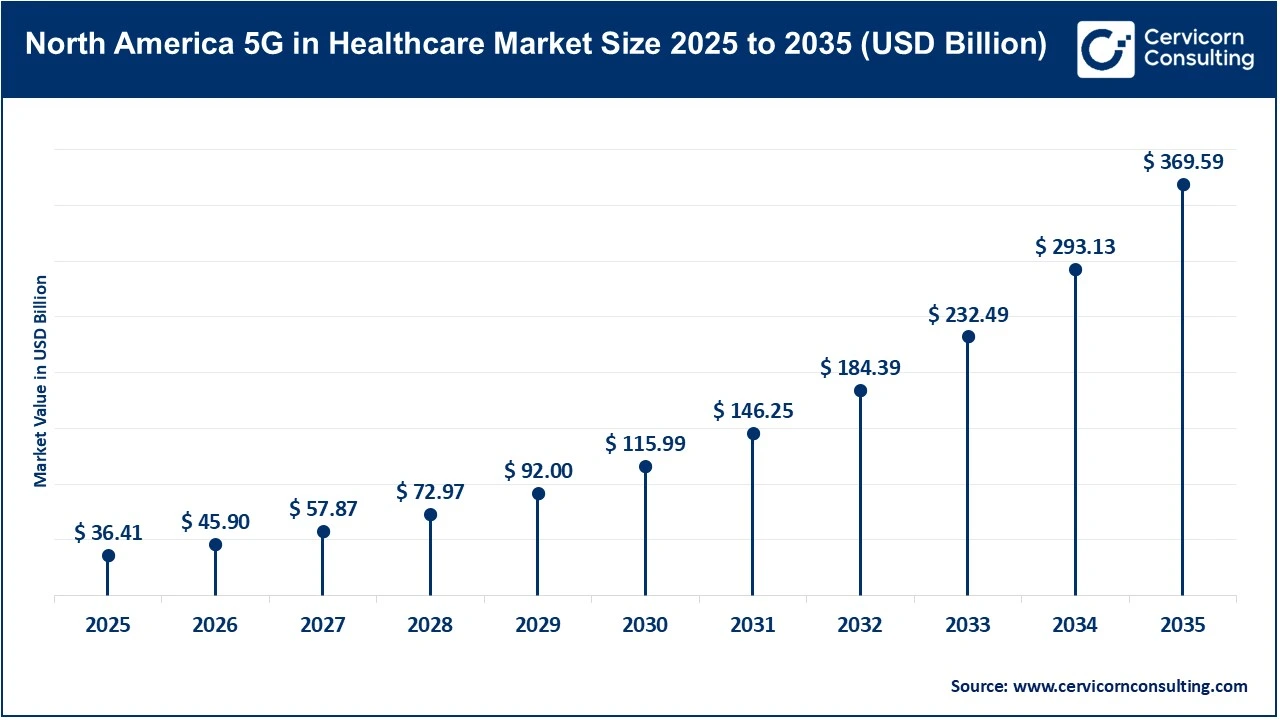
The North America market is highly advanced, supported by robust healthcare infrastructure, widespread 5G deployment, and strong investments from telecom operators, healthcare providers, and technology companies. The region is witnessing growing adoption of telemedicine, remote patient monitoring, connected medical devices, AI-enabled diagnostics, and smart hospital solutions that require high-speed, low-latency connectivity. Increasing deployment of private 5G networks across hospitals, rising healthcare digitalization initiatives, and favorable regulatory support are further accelerating market growth. Additionally, the presence of leading telecom providers, medical technology companies, and healthcare innovators continues to position North America as one of the most mature and technologically advanced 5G healthcare markets globally.
United States: Strong 5G infrastructure, private hospital network deployments, and digital healthcare innovation drive market growth
- More than 70% of U.S. hospitals had integrated 5G technology by 2023 to support telemedicine, connected medical devices, and digital healthcare services.
- Major healthcare systems such as Cleveland Clinic, AdventHealth, and Tampa General Hospital have implemented private 5G network solutions to support smart hospital operations.
- The Palo Alto VA Medical Center became the first fully 5G-enabled hospital in the United States, demonstrating growing government and institutional support for healthcare connectivity modernization.
Canada: Healthcare modernization, growing telehealth adoption, and expanding 5G coverage support market growth
- Canada continues to expand national 5G infrastructure, creating a stronger foundation for connected healthcare services and digital health innovation.
- Increasing adoption of telemedicine and virtual care solutions is driving demand for reliable, high-speed healthcare connectivity, particularly in remote and underserved communities.
Asia-Pacific 5G in Healthcare Market: Driven by Rapid 5G Rollout, Expanding Digital Health Initiatives, and Rising Demand for Connected Healthcare Services
The Asia-Pacific 5G in healthcare market size reached at USD 24.70 billion in 2025 and is predicted to surpass around USD 250.72 billion by 2035. The Asia-Pacific market is witnessing robust growth due to large-scale 5G infrastructure investments, increasing healthcare digitalization, and rising adoption of telemedicine and connected medical devices. Countries across the region are leveraging 5G technology to improve healthcare accessibility, enhance remote patient monitoring, support AI-powered diagnostics, and modernize hospital operations. The region's large population base, growing burden of chronic diseases, and government-backed smart healthcare programs are accelerating demand for advanced healthcare connectivity solutions. Furthermore, strong telecom industry participation and increasing investments in digital health ecosystems continue to position Asia-Pacific as one of the fastest-growing markets for 5G-enabled healthcare technologies.
China: Massive 5G infrastructure deployment and government-led smart healthcare initiatives drive market growth
- China had deployed more than 4.3 million 5G base stations by early 2025, representing the world's largest 5G network infrastructure.
- The country has integrated 5G-enabled telemedicine platforms across thousands of hospitals to improve healthcare access in rural and remote regions.
- Government initiatives under the "Healthy China" strategy continue to promote digital healthcare transformation and smart hospital development.
India: Government-backed digital health initiatives and expanding 5G coverage support market expansion
- India launched the 100 5G Use Case Labs initiative, promoting innovation in healthcare, telemedicine, and connected medical technologies.
- More than 750 million internet users and rapidly expanding 5G coverage are creating a strong foundation for digital healthcare services.
- The Ayushman Bharat Digital Mission is accelerating adoption of digital health records, teleconsultation services, and connected healthcare platforms.
Europe 5G in Healthcare Market: Driven by Government-Led Digital Health Initiatives, Expanding Private 5G Networks, and Growing Adoption of Smart Healthcare Solutions
The Europe 5G in healthcare market size was accounted at USD 23.32 billion in 2025 and is predicted to hit around USD 236.80 billion by 2035. The Europe market is experiencing strong growth due to increasing investments in healthcare digitalization, widespread 5G infrastructure deployment, and supportive government initiatives. The region is rapidly adopting telemedicine, remote patient monitoring, connected medical devices, AI-powered diagnostics, and smart hospital technologies that require high-speed and low-latency connectivity. The European Union is actively supporting healthcare-focused 5G projects through funding programs and cross-border digital health initiatives. Additionally, rising healthcare expenditures, aging populations, and growing demand for efficient healthcare delivery systems continue to accelerate the deployment of 5G-enabled healthcare solutions across the region.
Germany: Strong healthcare digitalization, private 5G adoption, and advanced medical technology ecosystem drive market growth
- Germany spent approximately 12.8% of GDP on healthcare in 2023, among the highest healthcare expenditure levels in Europe.
- The country has issued numerous private 5G spectrum licenses, supporting deployment of dedicated networks across healthcare and industrial facilities.
- More than 90% of hospitals have implemented electronic patient record systems and digital healthcare technologies, creating a strong foundation for 5G-enabled services.
United Kingdom: NHS digital transformation and growing telehealth adoption accelerate 5G healthcare deployment
- The NHS delivers over 1 million virtual consultations weekly across various healthcare services, supporting demand for high-performance connectivity.
- More than 80% of adults in the UK have access to 5G coverage, enabling broader adoption of connected healthcare services.
- NHS investments in digital transformation continue to expand remote patient monitoring and virtual healthcare programs.
5G in Healthcare Market Share, By Region, 2025 (%)
| Region |
Revenue Share, 2025 (%) |
| North America |
39.8% |
| Europe |
25.5% |
| Asia-Pacific |
27.0% |
| LAMEA |
7.7% |
LAMEA 5G in Healthcare Market: Driven by Expanding Digital Health Infrastructure, Increasing 5G Investments, and Growing Demand for Accessible Healthcare Services
The LAMEA 5G in healthcare market was valued at USD 7.04 billion in 2025 and is anticipated to reach around USD 71.50 billion by 2035. The LAMEA market is emerging as a promising growth region due to ongoing investments in telecommunications infrastructure, healthcare modernization programs, and expanding digital health initiatives. Governments and healthcare providers across the region are increasingly adopting telemedicine, remote patient monitoring, connected medical devices, and digital healthcare platforms to improve healthcare accessibility and address shortages of healthcare professionals. The rollout of 5G networks is enabling faster data transmission, enhanced healthcare connectivity, and improved delivery of medical services, particularly in remote and underserved areas. Furthermore, public-private partnerships, smart city projects, and national digital transformation strategies are creating favorable conditions for the adoption of 5G-enabled healthcare technologies across the region.
Brazil: Expanding 5G coverage, healthcare digitalization, and growing telemedicine adoption drive market growth
- Brazil has awarded nationwide 5G spectrum licenses and continues to expand 5G coverage across major urban and regional areas.
- The country has more than 215 million inhabitants, creating significant demand for scalable digital healthcare solutions.
- Telemedicine adoption increased substantially following regulatory approvals for permanent telehealth services.
Saudi Arabia: Vision 2030 healthcare transformation and smart hospital investments accelerate growth
- Saudi Arabia's Vision 2030 program prioritizes healthcare digitalization, smart hospitals, and advanced technology adoption.
- The Kingdom has achieved over 95% population coverage for 5G services in major urban areas through leading telecom operators.
- Government investments in digital health platforms, virtual care services, and AI-enabled healthcare systems are driving 5G healthcare adoption.
5G in Healthcare Market Segmental Analysis
The 5G in healthcare market is segmented into component, communication type, application, end user, and geography.
Component Analysis
The hardware segment dominates the 5G in healthcare market due to substantial investments in network infrastructure, connected medical devices, sensors, routers, gateways, and 5G-enabled imaging equipment. Healthcare facilities require robust hardware foundations to support high-speed connectivity, real-time data transmission, and seamless integration of Internet of Medical Things (IoMT) devices. The growing adoption of smart hospitals, remote patient monitoring systems, and connected healthcare ecosystems continues to drive demand for advanced hardware solutions. Additionally, ongoing upgrades of hospital communication networks and medical equipment further strengthen the segment’s leading market position.
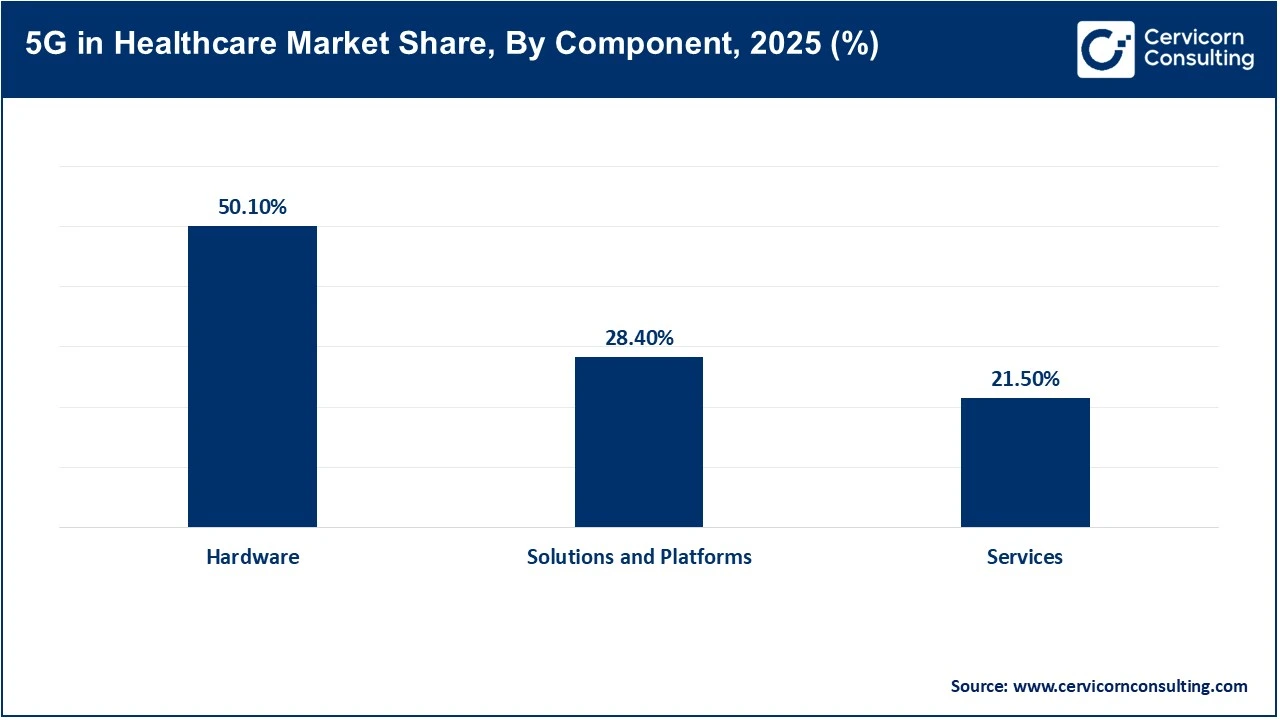
The services segment is witnessing the fastest growth as healthcare organizations increasingly rely on network deployment, integration, maintenance, cybersecurity, and managed connectivity services to implement 5G solutions effectively. As hospitals and healthcare providers adopt complex digital healthcare ecosystems, demand for specialized consulting and support services is rising significantly. Telecom operators and technology vendors are expanding healthcare-focused service portfolios to help organizations optimize network performance and ensure regulatory compliance. The rapid expansion of private 5G networks, telehealth platforms, and cloud-connected healthcare applications is further accelerating growth in this segment.
Communication Type Analysis
Enhanced Mobile Broadband (eMBB) holds the largest share of the 5G in healthcare market because it enables high-speed data transmission required for telemedicine, medical imaging, electronic health records, and video-based consultations. Healthcare institutions increasingly depend on bandwidth-intensive applications that require reliable and uninterrupted connectivity. eMBB supports the transfer of large diagnostic files such as MRI and CT scans while facilitating real-time collaboration between healthcare professionals. Its widespread deployment and compatibility with existing healthcare workflows have made eMBB the most adopted communication type across hospitals and healthcare networks globally.
5G in Healthcare Market, By Communication Type, 2025 (%)
| Communication Type |
Revenue Share, 2025 (%) |
| Enhanced Mobile Broadband (eMBB) |
51.9% |
| Ultra-Reliable Low-Latency Communication (URLLC) |
30.6% |
| Massive Machine-Type Communication (mMTC) |
17.5% |
Ultra-Reliable Low-Latency Communication (URLLC) is the fastest-growing segment due to its ability to support mission-critical healthcare applications requiring near-instantaneous communication and exceptional reliability. Emerging technologies such as robotic surgery, telesurgery, autonomous medical devices, and emergency response systems depend heavily on low-latency network performance. Healthcare providers are increasingly investing in URLLC-enabled infrastructure to improve patient outcomes and facilitate real-time clinical decision-making. As advanced digital healthcare applications become more widespread, the demand for highly reliable and low-latency communication capabilities is expected to accelerate significantly.
Application Analysis
Telemedicine and virtual consultation services represent the dominant application segment, driven by the growing demand for remote healthcare access, physician consultations, and digital patient engagement. 5G technology enhances virtual care experiences through high-definition video communication, reduced latency, and improved connectivity, enabling healthcare providers to deliver quality care regardless of geographic location. The increasing prevalence of chronic diseases, physician shortages, and patient preference for convenient healthcare services have further accelerated telemedicine adoption. Continued healthcare digitalization initiatives worldwide are expected to maintain the segment’s leadership position in the market.
5G in Healthcare Market, By Application, 2025 (%)
| Application |
Revenue Share, 2025 (%) |
| Telemedicine & Virtual Consultation Services |
34.0% |
| Remote Patient Monitoring |
19.5% |
| Connected Medical Devices |
15.2% |
| Robotic & Telesurgery |
8.3% |
| Medical Imaging & Diagnostics |
9.7% |
| Emergency Medical Services (EMS) |
4.8% |
| Hospital Asset & Workflow Management |
5.5% |
| Others |
3.0% |
Robotic and telesurgery is emerging as the fastest-growing application segment due to advancements in surgical robotics and the need for real-time remote surgical assistance. These procedures require ultra-low latency and highly reliable connectivity, making 5G an essential enabling technology. Healthcare providers are exploring robotic-assisted surgeries to improve surgical precision, reduce recovery times, and expand access to specialist expertise in remote locations. Growing investments in advanced healthcare infrastructure and increasing acceptance of technology-driven surgical procedures are contributing significantly to the rapid expansion of this segment.
End User Analysis
Hospitals and surgical centers dominate the 5G in healthcare market because they serve as primary hubs for advanced medical technologies, connected healthcare systems, and high-volume patient care services. These facilities are investing heavily in smart hospital initiatives, connected medical devices, digital imaging systems, and telehealth infrastructure to improve operational efficiency and patient outcomes. The need for seamless communication among clinical departments and real-time access to patient information further supports adoption. Additionally, large healthcare institutions typically possess the financial resources required to implement comprehensive 5G-enabled healthcare solutions.
5G in Healthcare Market, By End User, 2025 (%)
| End User |
Revenue Share, 2025 (%) |
| Hospitals & Surgical Centers |
45.8% |
| Healthcare Providers |
19.0% |
| Home Healthcare |
13.5% |
| Pharmaceutical & Biotechnology Companies |
9.0% |
| Research & Academic Institutions |
7.2% |
| Others |
5.5% |
Home healthcare is the fastest-growing end-user segment as healthcare systems increasingly shift toward patient-centric and decentralized care models. 5G connectivity enables continuous remote patient monitoring, wearable health devices, virtual consultations, and real-time transmission of health data from patients’ homes to healthcare providers. The rising prevalence of chronic diseases, aging populations, and growing demand for cost-effective healthcare services are driving adoption. Furthermore, advancements in connected medical technologies and increasing acceptance of home-based care solutions are creating significant growth opportunities for 5G-enabled home healthcare services worldwide.
5G in Healthcare Market Top Companies
Recent Developments
- In January 2025, Verizon Communications expanded private 5G deployments across major U.S. healthcare institutions, including Cleveland Clinic, AdventHealth, and Tampa General Hospital, to support connected medical devices, smart hospital operations, and advanced digital health applications. The development strengthens adoption of private 5G healthcare infrastructure and accelerates deployment of real-time patient monitoring and telemedicine solutions.
- In February 2025, AT&T Inc. expanded its healthcare connectivity portfolio through new 5G-enabled digital health initiatives focused on telemedicine, remote care delivery, and connected healthcare experiences. The development enhances healthcare network capabilities and supports broader adoption of digital healthcare services across hospitals and outpatient settings.
- In October 2025, Ericsson partnered with Verizon to showcase private 5G healthcare connectivity solutions at HLTH USA 2025, highlighting applications including telemedicine, connected medical devices, and hospital automation. The development increases awareness of healthcare-focused private 5G networks and supports broader market adoption.
Market Segmentation
By Component
- Hardware
- Solutions and Platforms
- Services
By Communication Type
- Enhanced Mobile Broadband (eMBB)
- Ultra-Reliable Low-Latency Communication (URLLC)
- Massive Machine-Type Communication (mMTC)
By Application
- Telemedicine & Virtual Consultation Services
- Remote Patient Monitoring
- Connected Medical Devices
- Robotic & Telesurgery
- Medical Imaging & Diagnostics
- Emergency Medical Services (EMS)
- Hospital Asset & Workflow Management
- Others
By End User
- Hospitals & Surgical Centers
- Healthcare Providers
- Home Healthcare
- Pharmaceutical & Biotechnology Companies
- Research & Academic Institutions
- Others
By Region
- North America
- Europe
- Asia-Pacific
- LAMEA