
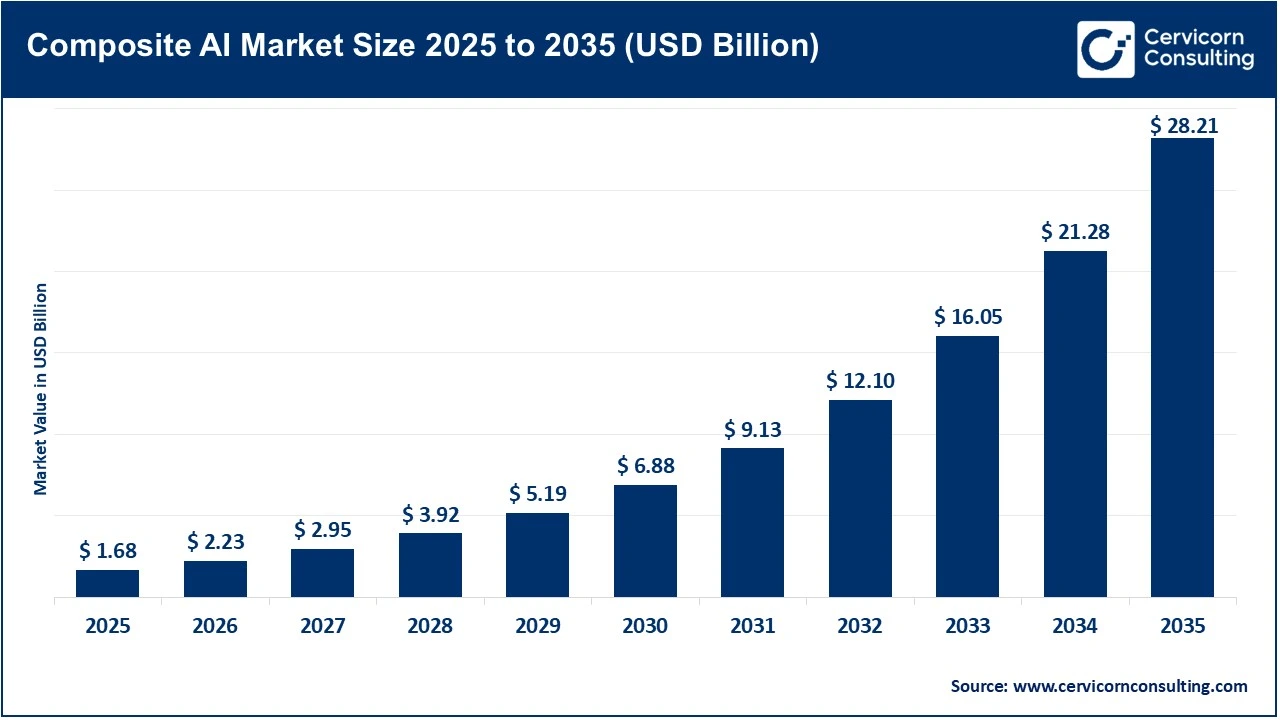
The global composite AI market size was estimated at USD 1.68 billion in 2025 and is expected to exceed around USD 28.21 billion by 2035, reflecting a compound annual growth rate (CAGR) of 32.6% over the forecast period from 2026 to 2035. The composite AI market is driven by rising demand for more accurate and explainable enterprise AI systems that combine multiple technologies such as machine learning, NLP, and knowledge graphs. The study highlights that organizations are increasingly adopting composite AI to improve decision-making in complex use cases like fraud detection, customer service, predictive maintenance, and product design. This trend is supported by broader enterprise AI adoption, with 78% of organizations using AI in at least one business function and 92% of executives planning to increase AI investments over the next three years.
Another major growth factor is the expanding use of AI across industries such as BFSI, manufacturing, healthcare, retail, and telecom, where businesses seek automation, personalization, and operational efficiency. Composite AI enables enterprises to combine prediction, reasoning, and automation in a single framework, making it valuable for large-scale production deployments. The business case is strengthening as well, with 67% of companies reporting revenue increases from AI adoption and 79% seeing cost reductions, encouraging faster investment in composite AI solutions across enterprise workflows.
Composite AI is an advanced artificial intelligence approach that combines multiple AI techniques such as machine learning, natural language processing, knowledge graphs, rule-based systems, optimization, and computer vision within a single platform or workflow to solve complex business problems more effectively than any one technique alone. Instead of relying on a standalone model, composite AI integrates prediction, reasoning, context understanding, and automation, making it particularly useful for enterprise use cases such as fraud detection, predictive maintenance, customer service, supply chain optimization, and decision intelligence. It is increasingly adopted because it improves accuracy, explainability, and scalability across complex data-driven operations.
Report Scope
| Area of Focus | Details |
| Market Size in 2026 | USD 2.23 Billion |
| Market Size in 2035 | USD 28.21 Billion |
| CAGR 2026 to 2035 | 32.60% |
| Dominant Region | North America |
| Fastest Growing Region | Asia-Pacific |
| Key Segments | Offering, Technique, Application, Vertical, Region |
| Key Companies | IBM, SAS Institute, Microsoft, Google, AWS, Salesforce, BlackSwan Technologies, Oracle, OpenText, SAP, HPE, Pega |
1. Rising demand for accurate and explainable enterprise AI
The composite AI market is gaining traction as enterprises increasingly seek AI systems that can combine machine learning, natural language processing, knowledge graphs, and rules-based logic to improve decision-making. This approach delivers better explainability and performance in complex use cases such as fraud detection, predictive maintenance, and customer service automation. According to recent AI adoption studies, 72% of organizations already use AI in at least one business function, reflecting a broad enterprise shift toward more sophisticated AI architectures capable of handling complex workflows and real-time decisions.
2. Growing adoption of AI-led automation across industries
The expansion of AI across business operations is another major driver for the composite AI market. Enterprises are using AI to automate supply chains, quality control, customer interactions, and operational planning, creating demand for platforms that integrate multiple AI techniques into one workflow. Studies show that 67% of organizations have reported revenue increases from AI adoption, while 79% have seen cost reductions, proving the business value of advanced AI systems. Composite AI supports this transition by enabling predictive, contextual, and automated decision-making at enterprise scale.
1. High implementation complexity and integration costs
A major restraint in the composite AI market is the complexity of integrating multiple AI models, data pipelines, orchestration tools, and governance layers into one system. Compared with standalone AI deployments, composite AI requires stronger technical expertise, advanced data engineering, and continuous optimization, which increases project costs and deployment time. Many organizations still struggle to move AI initiatives from pilot stage to full production because of fragmented data environments and integration challenges. This complexity can particularly slow adoption among mid-sized enterprises with limited budgets and in-house AI capabilities.
2. Data privacy, governance, and trust concerns
Composite AI systems often rely on large volumes of structured and unstructured enterprise data, raising concerns about privacy, security, bias, and regulatory compliance. These concerns are especially significant in highly regulated sectors such as healthcare, BFSI, and government, where transparency and auditability are critical. Industry surveys show that organizations continue to identify data privacy, output quality, and AI ethics as key barriers to broader AI deployment. As a result, weak governance frameworks and uncertainty around responsible AI practices can delay Composite AI implementation and limit scaling across sensitive business functions.
1. Expansion of generative AI and multimodal enterprise AI
The rise of generative AI is creating a major opportunity for the composite AI market, as enterprises increasingly need platforms that combine large language models with analytics, rules engines, optimization, and domain knowledge systems. Composite AI helps improve the reliability, contextual accuracy, and explainability of generative AI deployments in enterprise environments. Economic impact studies estimate that generative AI could contribute USD 2.6 trillion to USD 4.4 trillion annually across industries, creating strong demand for AI architectures that can orchestrate multiple models and reasoning systems together in business workflows.
2. Increasing use in industrial and operational intelligence applications
Composite AI also has strong opportunity in industrial and operational use cases where single-model AI often lacks flexibility. By combining predictive analytics, anomaly detection, contextual reasoning, and optimization, composite AI can support predictive maintenance, quality inspection, network optimization, and supply chain intelligence. AI-driven use cases in technology, media, telecom, and industrial operations are expected to unlock hundreds of billions of dollars in annual value creation, encouraging broader adoption of composite AI platforms in manufacturing, energy, transportation, and logistics environments where decision-making depends on multiple data sources and AI methods.
1. Shortage of skilled AI and data engineering talent
One of the biggest challenges in the composite AI market is the shortage of professionals who can build and manage systems involving multiple AI methods, MLOps, data engineering, and governance frameworks. Composite AI requires broader technical expertise than traditional AI deployments because it integrates prediction, reasoning, automation, and monitoring in one environment. As enterprise AI adoption accelerates, demand for AI engineers, data scientists, and AI governance specialists is rising faster than talent supply. This skill gap can extend deployment timelines, increase implementation costs, and reduce the ability of organizations to scale Composite AI projects effectively.
2. Infrastructure intensity and difficulty in proving ROI at scale
Composite AI often requires substantial computing resources, cloud infrastructure, orchestration software, and continuous model monitoring, making it expensive to scale across large organizations. While AI inference costs are declining rapidly, enterprises still face challenges related to infrastructure spending, data readiness, and ongoing maintenance. Many organizations can demonstrate value in pilot projects but struggle to achieve measurable ROI when expanding Composite AI across departments and business functions. This creates a challenge for vendors and end users alike, as success increasingly depends on balancing experimentation, governance, operational costs, and long-term performance outcomes.
The composite AI market is segmented by region into North America, Europe, Asia-Pacific, Latin America, and LAMEA. Here is a brief overview of each region:
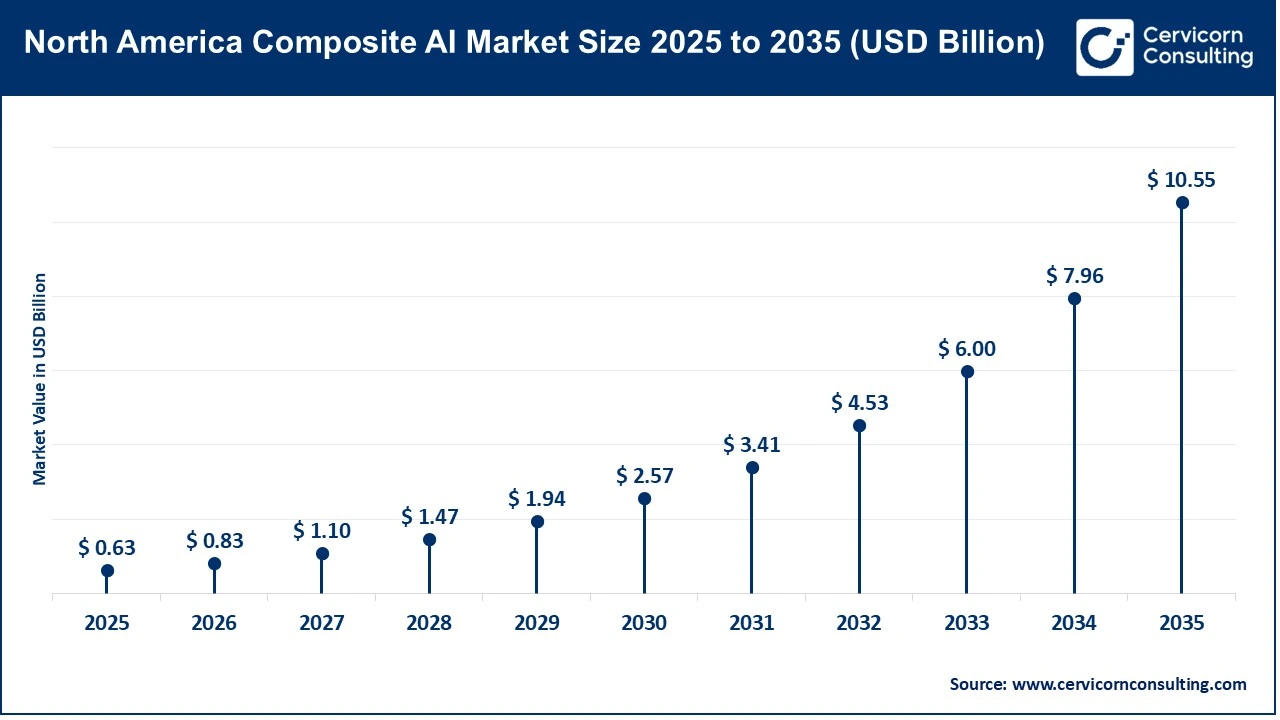
The North America composite AI market size was valued at USD 0.63 billion in 2025 and is projected to expand USD 10.55 billion by 2035.
The North America market is highly advanced, supported by strong enterprise AI adoption, mature cloud and data infrastructure, and increasing deployment of intelligent automation across industries. Organizations across BFSI, healthcare, retail, telecom, and manufacturing are increasingly adopting composite AI to combine machine learning, natural language processing, pattern recognition, and decision intelligence within a single workflow. This helps improve fraud detection, customer service, predictive maintenance, and product innovation outcomes. Rising enterprise investments in generative AI, decision automation, and responsible AI governance are further accelerating demand for composite AI platforms.
United States: Strong enterprise AI spending, large-scale digital transformation, and growing demand for explainable AI across regulated industries continue driving market expansion.
Canada: Expanding AI research capabilities, growing enterprise analytics adoption, and rising focus on responsible AI deployment support long-term market growth.
The Asia-Pacific composite AI market size was recorded at USD 0.38 billion in 2025 and is predicted to surpass around USD 6.40 billion by 2035. The Asia Pacific is emerging as one of the fastest-evolving regional markets, supported by rapid enterprise AI adoption, growing cloud and data infrastructure, and strong digital transformation across manufacturing, BFSI, healthcare, telecom, and retail sectors. Organizations across the region are increasingly deploying composite AI to combine machine learning, natural language processing, pattern recognition, and predictive analytics for use cases such as customer service, fraud detection, predictive maintenance, and intelligent operations. Rising investments in generative AI, industrial automation, and AI-enabled decision intelligence are further accelerating demand for composite AI platforms.
China: Large-scale AI industrialization, strong government-backed digital transformation, and extensive adoption of AI across manufacturing, finance, and digital commerce continue driving regional market leadership.
India: Expanding enterprise AI adoption, strong AI-ready digital economy, and growing use of AI in healthcare, BFSI, and enterprise services support long-term market growth.
The Europe composite AI market size reached at USD 0.44 billion in 2025 and is expected to hit around USD 7.45 billion by 2035. The Europe market is expanding steadily, supported by increasing enterprise adoption of AI, a strong regulatory push for trustworthy and explainable AI, and growing investment in digital transformation across manufacturing, BFSI, healthcare, telecom, and public sector operations. Organizations across the region are increasingly adopting composite AI to combine machine learning, natural language processing, predictive analytics, and decision intelligence for fraud detection, customer service, predictive maintenance, and process automation. Demand is also being reinforced by Europe’s focus on AI governance, data privacy, and digital sovereignty, which is encouraging enterprises to deploy more transparent and controllable AI systems.
Germany: Strong industrial automation capabilities, advanced manufacturing digitization, and rising enterprise AI deployment continue driving market expansion.
United Kingdom: Expanding enterprise AI commercialization, strong digital services adoption, and growing large-scale AI deployment support market growth.
Composite AI Market Share, By Region, 2025 (%)
| Region | Revenue Share, 2025 (%) |
| North America | 37.4% |
| Europe | 26.4% |
| Asia Pacific | 22.7% |
| LAMEA | 13.5% |
The LAMEA composite AI market was valued at USD 0.23 billion in 2025 and is anticipated to reach around USD 3.81 billion by 2035. The LAMEA market is emerging as a high-potential region, supported by increasing enterprise digitalization, government-led AI initiatives, and rising use of advanced analytics across banking, public services, telecom, energy, and retail. Organizations across Latin America, the Middle East, and Africa are gradually moving from isolated AI pilots toward broader AI systems that combine machine learning, natural language processing, predictive analytics, and automation within a unified workflow. Demand for composite AI is being strengthened by smart city programs, digital government modernization, financial inclusion initiatives, and the growing need for AI-powered decision intelligence in operational environments. The Middle East is currently the strongest growth engine within LAMEA, while Latin America is building momentum through wider enterprise AI adoption and digital transformation across large domestic markets.
Saudi Arabia / UAE: Strong sovereign AI investments, large-scale digital transformation strategies, and rapid enterprise adoption are accelerating regional market development.
Brazil: Rising enterprise AI penetration, expanding digital business adoption, and growing use of AI in public and private sector workflows support Latin American market growth.
The composite AI market is segmented into offering, technique, application, vertical, and geography.
The software segment holds the largest share of the composite AI market because it forms the core layer for building, training, integrating, and deploying composite AI systems across enterprise workflows. Composite AI software platforms enable orchestration of machine learning, NLP, knowledge graphs, and decision intelligence tools within a unified environment, making them central to applications such as fraud detection, customer service, predictive maintenance, and product design. Their scalability, recurring licensing model, and ability to support multi-model AI deployment across industries continue to keep software as the leading revenue-generating segment.
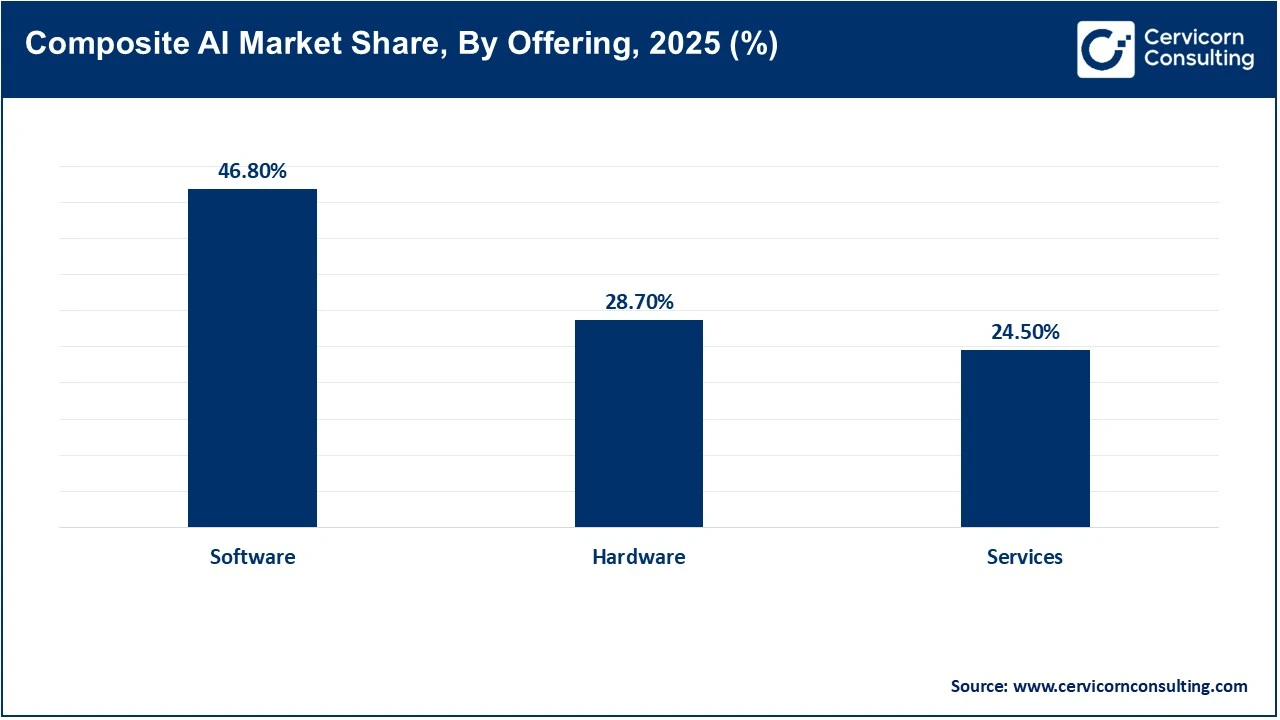
The hardware segment is expected to register the fastest growth as enterprises increasingly require stronger computing infrastructure to support large-scale AI model training, real-time inference, multimodal analytics, and edge AI workloads. Composite AI workloads often involve processing high volumes of structured and unstructured data across multiple AI techniques, increasing the need for advanced processors, accelerators, memory systems, and networking infrastructure. As organizations scale generative AI, machine learning, and real-time decision systems simultaneously, spending on AI-optimized hardware is accelerating, making hardware the fastest-growing offering segment within the composite AI market.
The data processing segment dominates the composite AI market because it acts as the foundation for preparing, organizing, integrating, and managing the large volumes of structured and unstructured data required for composite AI models. Since composite AI combines multiple techniques such as machine learning, NLP, and pattern recognition, effective data ingestion, transformation, and contextual processing are essential for accuracy and performance. Enterprises across BFSI, healthcare, telecom, and manufacturing rely heavily on data processing capabilities to clean datasets, unify data sources, and enable faster model execution, making this segment the largest contributor by technique.
Composite AI Market, By Technique, 2025 (%)
| Technique | Revenue Share, 2025 (%) |
| Data Processing | 24.1% |
| Pattern Recognition | 14.8% |
| Text Analysis / NLP | 16.9% |
| Condition Monitoring | 11.2% |
| Data Mining & Machine Learning | 22.4% |
| Proactive Mechanism | 10.6% |
The data mining & machine learning segment is projected to grow at the fastest pace because it plays a central role in extracting insights, identifying patterns, making predictions, and continuously improving decision-making across composite AI environments. These techniques help enterprises uncover hidden relationships in large datasets and power adaptive models used in customer service, fraud detection, quality control, and predictive maintenance. As organizations increasingly shift from rule-based automation to predictive and self-learning systems, demand for machine learning-driven composite AI architectures is rising rapidly, positioning this segment as the fastest-growing technique category.
The product design & development segment holds the largest market share because composite AI is increasingly used to accelerate innovation cycles, optimize product features, simulate design outcomes, and improve decision-making during development stages. By combining machine learning, simulation, data analysis, and contextual reasoning, composite AI helps enterprises reduce prototyping time, identify design flaws earlier, and personalize products based on user needs. Industries such as manufacturing, automotive, electronics, and industrial equipment are adopting composite AI to streamline R&D workflows and improve product quality, keeping product design and development the leading application segment.
Composite AI Market, By Application, 2025 (%)
| Application | Revenue Share, 2025 (%) |
| Product Design & Development | 22.8% |
| Customer Service | 21.3% |
| Quality Control | 14.2% |
| Security & Surveillance | 12.7% |
| Predictive Maintenance | 16.4% |
| Supply Chain Optimization | 12.6% |
The customer service segment is expected to witness the fastest growth due to the rapid adoption of AI-powered virtual assistants, conversational AI, intelligent recommendation systems, and automated support platforms. Composite AI strengthens customer service by combining NLP, machine learning, contextual analytics, and decision engines to improve response quality, personalization, and resolution speed. Enterprises are increasingly using these tools to manage growing customer interaction volumes across chat, email, and voice channels while reducing support costs. As customer experience becomes a strategic priority across industries, customer service is emerging as the fastest-growing application area.
The BFSI segment dominates the composite AI market because financial institutions are among the earliest adopters of advanced AI for fraud detection, credit scoring, compliance monitoring, risk management, and customer engagement. The sector generates massive volumes of transactional and behavioral data, making it highly suitable for composite AI systems that combine predictive analytics, anomaly detection, NLP, and rules-based reasoning. In addition, strict regulatory requirements and the need for real-time decision-making encourage BFSI organizations to adopt explainable and scalable AI architectures. These factors collectively make BFSI the largest vertical in the Composite AI market.
Composite AI Market Share, By Vertical, 2025 (%)
| Vertical | Revenue Share, 2025 (%) |
| BFSI | 17.9% |
| Retail & E-commerce | 11.6% |
| Healthcare & Life Sciences | 13.8% |
| IT & Telecom | 10.4% |
| Manufacturing | 12.9% |
| Government & Defense | 8.4% |
| Energy & Utilities | 7.1% |
| Transportation & Logistics | 6.4% |
| Media & Entertainment | 5.1% |
| Others | 6.4% |
The healthcare & life sciences segment is projected to grow at the highest rate due to the sector’s increasing need to analyze complex clinical, imaging, genomic, and patient-generated data through more advanced AI systems. Composite AI enables healthcare organizations to combine machine learning, NLP, knowledge-based reasoning, and predictive analytics for use cases such as diagnostics, patient monitoring, treatment planning, and operational optimization. The push toward precision medicine, digital health platforms, and AI-assisted clinical workflows is accelerating adoption. As healthcare data environments become more complex, demand for composite AI is rising quickly across this vertical.
By Offering
By Technique
By Application
By Vertical
By Geography
Chapter 1. Market Introduction and Overview
1.1 Market Definition and Scope
1.1.1 Overview of Composite AI
1.1.2 Scope of the Study
1.1.3 Research Timeframe
1.2 Research Methodology and Approach
1.2.1 Methodology Overview
1.2.2 Data Sources and Validation
1.2.3 Key Assumptions and Limitations
Chapter 2. Executive Summary
2.1 Market Highlights and Snapshot
2.2 Key Insights by Segments
2.2.1 By Technique Overview
2.2.2 By Offering Overview
2.2.3 By Application Overview
2.2.4 By Vertical Overview
2.3 Competitive Overview
Chapter 3. Global Impact Analysis
3.1 COVID 19 Impact on Composite AI Market
3.2 Russia-Ukraine Conflict: Global Market Implications
3.3 Regulatory and Policy Changes Impacting Global Markets
Chapter 4. Market Dynamics and Trends
4.1 Market Dynamics
4.1.1 Market Drivers
4.1.1.1 Rising demand for accurate and explainable enterprise AI
4.1.1.2 Growing adoption of AI-led automation across industries
4.1.2 Market Restraints
4.1.2.1 High implementation complexity and integration costs
4.1.2.2 Data privacy, governance, and trust concerns
4.1.3 Market Opportunities
4.1.3.1 Expansion of generative AI and multimodal enterprise AI
4.1.3.2 Increasing use in industrial and operational intelligence applications
4.1.4 Market Challenges
4.1.4.1 Shortage of skilled AI and data engineering talent
4.1.4.2 Infrastructure intensity and difficulty in proving ROI at scale
4.2 Market Trends
Chapter 5. Premium Insights and Analysis
5.1 Global Composite AI Market Dynamics, Impact Analysis
5.2 Porter’s Five Forces Analysis
5.2.1 Bargaining Power of Suppliers
5.2.2 Bargaining Power of Buyers
5.2.3 Threat of Substitute Products
5.2.4 Rivalry among Existing Firms
5.2.5 Threat of New Entrants
5.3 PESTEL Analysis
5.4 Value Chain Analysis
5.5 Product Pricing Analysis
5.6 Vendor Landscape
5.6.1 List of Buyers
5.6.2 List of Suppliers
Chapter 6. Composite AI Market, By Technique
6.1 Global Composite AI Market Snapshot, By Technique
6.1.1 Market Revenue (($Billion) and Growth Rate (%), 2021-2033
6.1.1.1 Data Processing
6.1.1.2 Pattern Recognition
6.1.1.3 Text Analysis / NLP
6.1.1.4 Condition Monitoring
6.1.1.5 Data Mining & Machine Learning
6.1.1.6 Proactive Mechanism
Chapter 7. Composite AI Market, By Offering
7.1 Global Composite AI Market Snapshot, By Offering
7.1.1 Market Revenue (($Billion) and Growth Rate (%), 2021-2033
7.1.1.1 Software
7.1.1.2 Hardware
7.1.1.3 Services
Chapter 8. Composite AI Market, By Application
8.1 Global Composite AI Market Snapshot, By Application
8.1.1 Market Revenue (($Billion) and Growth Rate (%), 2021-2033
8.1.1.1 Product Design & Development
8.1.1.2 Customer Service
8.1.1.3 Quality Control
8.1.1.4 Security & Surveillance
8.1.1.5 Predictive Maintenance
8.1.1.6 Supply Chain Optimization
Chapter 9. Composite AI Market, By Vertical
9.1 Global Composite AI Market Snapshot, By Vertical
9.1.1 Market Revenue (($Billion) and Growth Rate (%), 2021-2033
9.1.1.1 BFSI
9.1.1.2 Retail & E-commerce
9.1.1.3 Healthcare & Life Sciences
9.1.1.4 IT & Telecom
9.1.1.5 Manufacturing
9.1.1.6 Government & Defense
9.1.1.7 Energy & Utilities
9.1.1.8 Transportation & Logistics
9.1.1.9 Media & Entertainment
9.1.1.10 Others
Chapter 10. Composite AI Market, By Region
10.1 Overview
10.2 Composite AI Market Revenue Share, By Region 2023 (%)
10.3 Global Composite AI Market, By Region
10.3.1 Market Size and Forecast
10.4 North America
10.4.1 North America Composite AI Market Revenue, 2021-2033 ($Billion)
10.4.2 Market Size and Forecast
10.4.3 North America Composite AI Market, By Country
10.4.4 U.S.
10.4.4.1 U.S. Composite AI Market Revenue, 2021-2033 ($Billion)
10.4.4.2 Market Size and Forecast
10.4.4.3 U.S. Market Segmental Analysis
10.4.5 Canada
10.4.5.1 Canada Composite AI Market Revenue, 2021-2033 ($Billion)
10.4.5.2 Market Size and Forecast
10.4.5.3 Canada Market Segmental Analysis
10.4.6 Mexico
10.4.6.1 Mexico Composite AI Market Revenue, 2021-2033 ($Billion)
10.4.6.2 Market Size and Forecast
10.4.6.3 Mexico Market Segmental Analysis
10.5 Europe
10.5.1 Europe Composite AI Market Revenue, 2021-2033 ($Billion)
10.5.2 Market Size and Forecast
10.5.3 Europe Composite AI Market, By Country
10.5.4 UK
10.5.4.1 UK Composite AI Market Revenue, 2021-2033 ($Billion)
10.5.4.2 Market Size and Forecast
10.5.4.3 UKMarket Segmental Analysis
10.5.5 France
10.5.5.1 France Composite AI Market Revenue, 2021-2033 ($Billion)
10.5.5.2 Market Size and Forecast
10.5.5.3 FranceMarket Segmental Analysis
10.5.6 Germany
10.5.6.1 Germany Composite AI Market Revenue, 2021-2033 ($Billion)
10.5.6.2 Market Size and Forecast
10.5.6.3 GermanyMarket Segmental Analysis
10.5.7 Rest of Europe
10.5.7.1 Rest of Europe Composite AI Market Revenue, 2021-2033 ($Billion)
10.5.7.2 Market Size and Forecast
10.5.7.3 Rest of EuropeMarket Segmental Analysis
10.6 Asia Pacific
10.6.1 Asia Pacific Composite AI Market Revenue, 2021-2033 ($Billion)
10.6.2 Market Size and Forecast
10.6.3 Asia Pacific Composite AI Market, By Country
10.6.4 China
10.6.4.1 China Composite AI Market Revenue, 2021-2033 ($Billion)
10.6.4.2 Market Size and Forecast
10.6.4.3 ChinaMarket Segmental Analysis
10.6.5 Japan
10.6.5.1 Japan Composite AI Market Revenue, 2021-2033 ($Billion)
10.6.5.2 Market Size and Forecast
10.6.5.3 JapanMarket Segmental Analysis
10.6.6 India
10.6.6.1 India Composite AI Market Revenue, 2021-2033 ($Billion)
10.6.6.2 Market Size and Forecast
10.6.6.3 IndiaMarket Segmental Analysis
10.6.7 Australia
10.6.7.1 Australia Composite AI Market Revenue, 2021-2033 ($Billion)
10.6.7.2 Market Size and Forecast
10.6.7.3 AustraliaMarket Segmental Analysis
10.6.8 Rest of Asia Pacific
10.6.8.1 Rest of Asia Pacific Composite AI Market Revenue, 2021-2033 ($Billion)
10.6.8.2 Market Size and Forecast
10.6.8.3 Rest of Asia PacificMarket Segmental Analysis
10.7 LAMEA
10.7.1 LAMEA Composite AI Market Revenue, 2021-2033 ($Billion)
10.7.2 Market Size and Forecast
10.7.3 LAMEA Composite AI Market, By Country
10.7.4 GCC
10.7.4.1 GCC Composite AI Market Revenue, 2021-2033 ($Billion)
10.7.4.2 Market Size and Forecast
10.7.4.3 GCCMarket Segmental Analysis
10.7.5 Africa
10.7.5.1 Africa Composite AI Market Revenue, 2021-2033 ($Billion)
10.7.5.2 Market Size and Forecast
10.7.5.3 AfricaMarket Segmental Analysis
10.7.6 Brazil
10.7.6.1 Brazil Composite AI Market Revenue, 2021-2033 ($Billion)
10.7.6.2 Market Size and Forecast
10.7.6.3 BrazilMarket Segmental Analysis
10.7.7 Rest of LAMEA
10.7.7.1 Rest of LAMEA Composite AI Market Revenue, 2021-2033 ($Billion)
10.7.7.2 Market Size and Forecast
10.7.7.3 Rest of LAMEAMarket Segmental Analysis
Chapter 11. Competitive Landscape
11.1 Competitor Strategic Analysis
11.1.1 Top Player Positioning/Market Share Analysis
11.1.2 Top Winning Strategies, By Company, 2022-2024
11.1.3 Competitive Analysis By Revenue, 2022-2024
11.2 Recent Developments by the Market Contributors (2024)
Chapter 12. Company Profiles
12.1 IBM
12.1.1 Company Snapshot
12.1.2 Company and Business Overview
12.1.3 Financial KPIs
12.1.4 Product/Service Portfolio
12.1.5 Strategic Growth
12.1.6 Global Footprints
12.1.7 Recent Development
12.1.8 SWOT Analysis
12.2 SAS Institute
12.3 Microsoft
12.4 Google
12.5 AWS
12.6 Salesforce
12.7 BlackSwan Technologies
12.8 Oracle
12.9 OpenText
12.10 SAP
12.11 HPE
12.12 Pega