
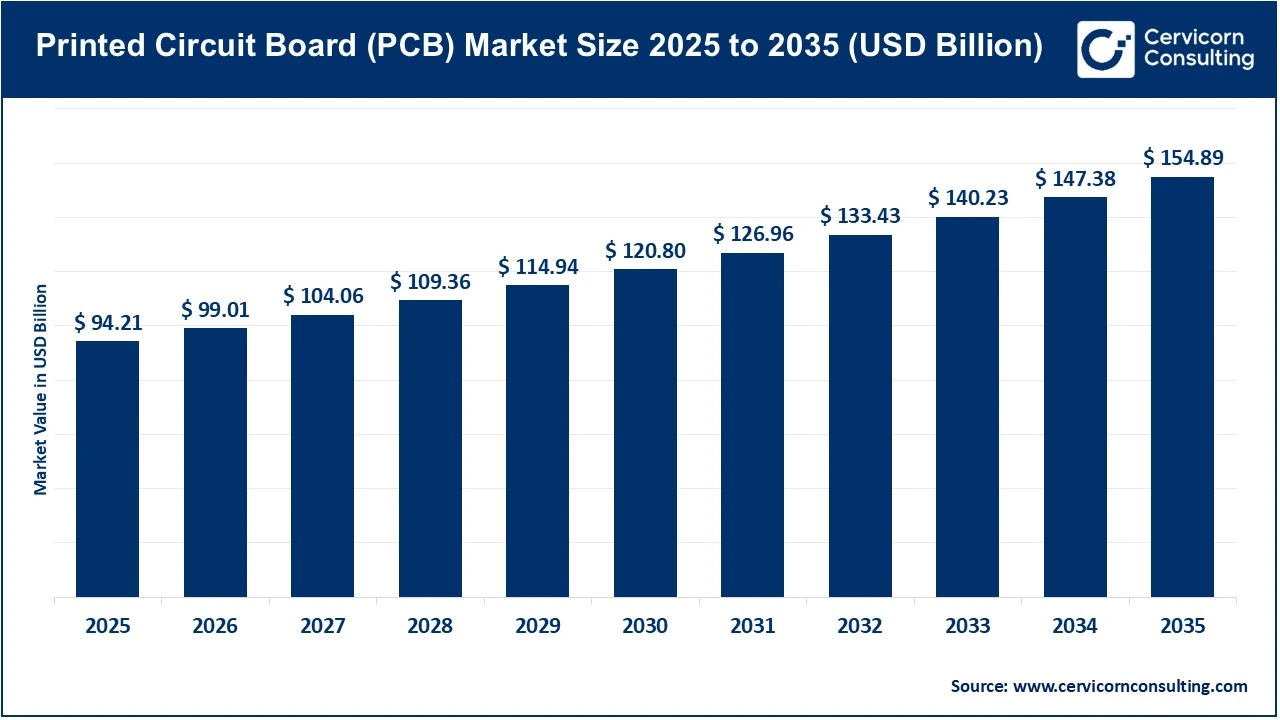
The global printed circuit board (PCB) market size reached at USD 94.21 billion in 2025 and is expected to be worth around USD 154.89 billion by 2035, exhibiting a compound annual growth rate (CAGR) of 5.1% over the forecast period from 2026 to 2035. The printed circuit board (PCB) market is primarily driven by the rapid expansion of the global electronics ecosystem and the increasing complexity of devices. PCBs are essential to nearly all electronic systems, from smartphones and computers to automotive electronics and industrial automation, making demand directly proportional to electronics production. For instance, the number of connected IoT devices is projected to rise from about 12.4 billion in 2023 to over 25 billion by 2027, significantly increasing the need for compact, multilayer, and high-density PCBs. In addition, sectors such as consumer electronics and computing dominate usage; historically, the computer industry alone accounted for around 40% of PCB consumption in shipments. The transition towards advanced technologies such as 5G infrastructure, electric vehicles, and AI servers is further accelerating demand for HDI and flexible PCBs, which support high-speed data processing and miniaturisation.
Another major growth factor is the globalised production and trade network, with Asia-Pacific acting as the manufacturing hub. China alone contributes approximately 50–55% of global PCB production, supported by large-scale infrastructure and cost advantages. On the trade side, global PCB exports exceeded 220,000 shipments between mid-2024 and mid-2025, with China, Vietnam, and South Korea accounting for nearly 88% of total exports, while Vietnam and India together accounted for over 90% of import demand. Additionally, global PCB trade value reached about $52.4 billion in 2024, reflecting steady growth in cross-border electronics supply chains. However, supply-side dynamics also influence growth shortages of key materials such as copper foil and resins, along with geopolitical disruptions, have recently driven PCB prices up by as much as 40% in 2026, highlighting both strong demand and supply constraints in the market.
Surge in AI Servers and High-Performance Computing Driving PCB Demand
The rapid expansion of AI servers and high-performance computing (HPC) systems is a major catalyst for PCB market growth, driven by the need for high-layer-count, high-density interconnect (HDI), and advanced substrate PCBs that support massive data processing and high-speed signal transmission. AI servers typically require 2–3 times more PCB content than traditional servers, driven by GPUs, accelerators, and complex networking architectures. For example, modern AI server motherboards can use 20–40+ layer PCBs, compared with 8–16 layers in standard servers, significantly increasing material usage and manufacturing complexity.
Additionally, the deployment of AI infrastructure is accelerating rapidly. Global AI server shipments are expected to grow by 20–25% annually in the near term, while hyperscale data center investments continue to rise sharply. These systems also rely heavily on IC substrates and advanced packaging, where PCB-like substrates are critical for chip interconnection, further boosting demand. As a result, the shift toward AI workloads is not only increasing PCB volumes but also pushing the market toward higher-value, technologically advanced boards, making AI and HPC among the most influential growth drivers in the industry.
Major PCB Companies and Their Recent Developments
Below are key players shaping the PCB market through capacity expansion, AI-driven demand, and advanced substrate technologies. The focus is on recent strategic and technological moves.
| Company | Major Market Development | Technological Development |
| TTM Technologies Inc. | Benefiting from strong demand in AI infrastructure and defense electronics, with 21% revenue growth in 2025 driven by high-performance applications | Expanding capabilities in high-speed, RF, and advanced multilayer PCBs for AI servers and aerospace systems |
| AT&S Austria Technologie & Systemtechnik AG | Investing in new production plants to strengthen global footprint, particularly in Europe and Asia | Focus on IC substrates and high-end HDI PCBs for AI chips and high-performance computing |
| Ibiden Co. Ltd. | Strengthening partnerships with global semiconductor players and expanding electronics business segments | Advancing IC substrate and packaging technologies critical for AI processors and advanced chips |
| Unimicron Technology Corporation | Key player in fast-growing substrate-like PCB (SLP) segment supporting mobile and computing markets | Developing SLP and advanced packaging substrates for miniaturized, high-performance devices |
| Shennan Circuits Co. Ltd. | Rapid growth among top global PCB fabricators with expansion in telecom and data center markets | Specializing in high-layer-count and high-frequency PCBs for 5G and server infrastructure |
1. Large-Scale PCB Manufacturing Investment in India (Kaynes Circuits)
A major milestone is Kaynes Circuits’ INR 4,995 crore investment to establish an advanced PCB and electronic components facility in Tamil Nadu. The plant is designed to produce high-end PCBs, including 74-layer boards, HDI, and flexible PCBs, significantly upgrading domestic manufacturing capabilities. This development is driving the market by reducing reliance on imports, strengthening local supply chains, and enabling the production of technologically advanced boards required for the AI, automotive, and telecom sectors. Such investments also create an ecosystem effect, attracting suppliers, boosting employment, and accelerating India’s position as a global electronics manufacturing hub.
2. Government-Led Localization Push (PLI & Make in India Initiatives)
Government initiatives such as the Production Linked Incentive (PLI) schemes and “Make in India” have marked a major milestone in reshaping the PCB industry. These policies are encouraging domestic manufacturing, with electronics production in India increasing significantly and consumer electronics alone accounting for around 35% of PCB demand in 2025. Additionally, incentives are helping reduce import dependence and are supporting investments in advanced PCB technologies such as HDI and flexible circuits. This is driving market growth by boosting domestic capacity, improving supply chain resilience, and increasing PCB consumption across sectors such as smartphones, EVs, and telecom infrastructure.
3. Rapid Expansion of Domestic PCB Manufacturing Targets
Another milestone is the strategic national push to scale PCB manufacturing output, with India’s domestic production expected to reach around USD 14 billion by 2029–30, contributing nearly 10% to the country’s electronics components target. This reflects a broader shift towards self-reliance and global competitiveness. The expansion is driving the PCB market by increasing production volumes, attracting foreign and domestic investment, and integrating India more deeply into global electronics trade networks, which in turn supports higher export potential and technological advancement.
4. Supply Chain Disruption Triggering Strategic Shifts (Global Industry)
A recent global milestone is the 2026 supply chain disruption caused by geopolitical tensions, which halted production of key PCB materials such as PPE resin, accounting for about 70% of global supply, and led to PCB price increases of up to 40%. This event is reshaping the market by prompting companies to diversify supply chains, localize production, and invest in alternative materials and technologies. While it creates short-term cost pressures, it is accelerating long-term structural changes, including the development of regional manufacturing hubs and innovation in material sourcing, ultimately strengthening the resilience and evolution of the PCB industry.
The Printed Circuit Board market is segmented by region into North America, Europe, Asia-Pacific, Latin America, and LAMEA. Here is a brief overview of each region:
The North America printed circuit board (PCB) market size reached at USD 5.84 billion in 2025 and is forecasted to grow around USD 9.60 billion by 2035. The North America PCB market is characterized by high-value, low-volume production, with strong demand from aerospace, defense, AI servers, and medical electronics. The region contributes less than 5–6% of global PCB production but leads in advanced applications such as RF, high-frequency, and multilayer (>20 layers) PCBs. Increasing geopolitical risks and supply chain disruptions are driving efforts toward reshoring PCB manufacturing, supported by government incentives. The rise of AI infrastructure and cloud computing is further boosting demand for complex PCBs, while imports from Asia continue to dominate volume supply. Broader industrial modernization trends also support demand growth.
United States: Leading Demand for Advanced and High-Reliability PCBs
The United States is the largest PCB market in North America, driven by advanced industries.
Canada: Industrial and Energy Sector-Driven PCB Demand
Canada’s PCB market is supported by industrial and energy applications.
The Asia-Pacific printed circuit board (PCB) market size was estimated at USD 76.50 billion in 2025 and is projected to surpass around USD 125.77 billion by 2035.
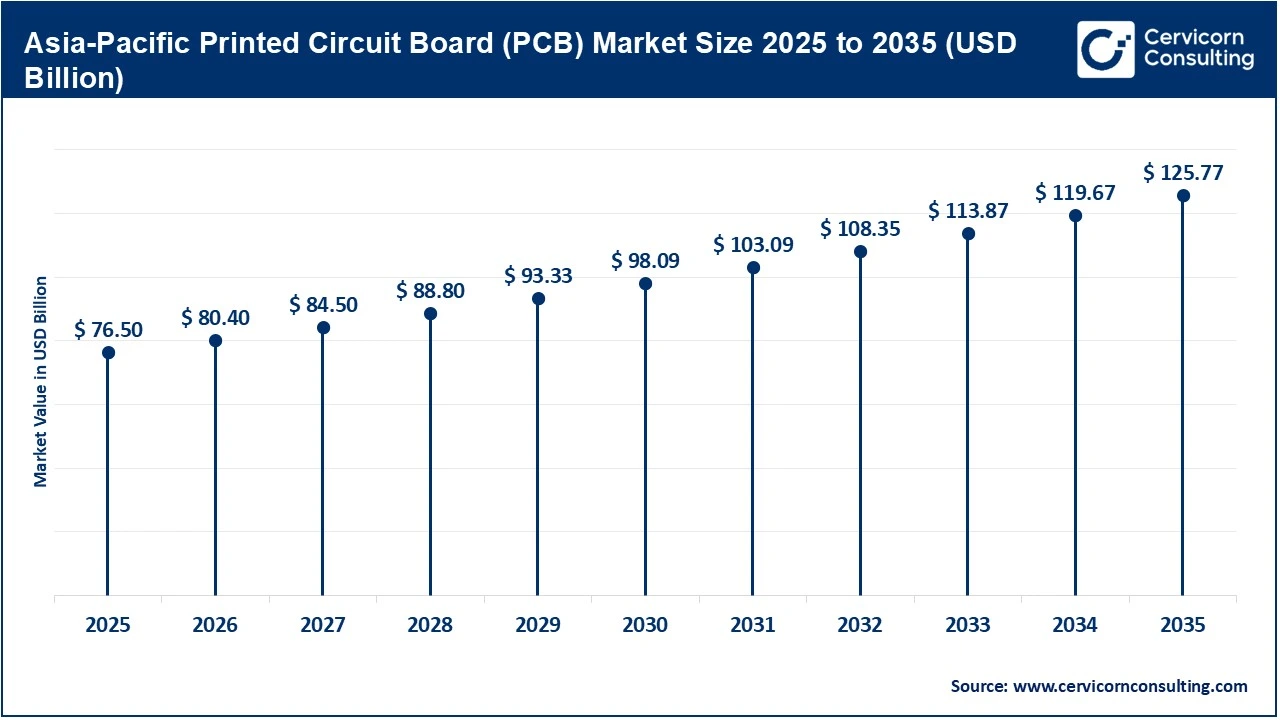
The Asia-Pacific PCB market is the largest and fastest-growing globally, driven by its dominance in electronics manufacturing and strong export ecosystem. The region accounts for ~88–90% of global PCB production and consumption, supported by integrated supply chains across raw materials, fabrication, and assembly. Countries such as China, Japan, South Korea, and Taiwan are not only manufacturing hubs but also leaders in advanced technologies like HDI PCBs and IC substrates. The rapid expansion of AI servers, 5G infrastructure, and electric vehicles (EVs) is significantly increasing demand for high-layer-count, high-performance PCBs. Additionally, emerging economies such as India and Vietnam are scaling up production through government incentives and infrastructure investments, further strengthening the region’s global leadership.
China to Lead Global PCB Market through Scale and Technology Upgradation
China dominates the PCB market with its unmatched manufacturing scale and export strength.
India: Emerging Manufacturing Hub with Policy-Driven Growth
India is rapidly developing as a PCB manufacturing destination, supported by strong government initiatives.
The Europe printed circuit board (PCB) market size was valued at USD 8.01 billion in 2025 and is expected to hit around USD 13.17 billion by 2035. Europe’s PCB market focuses on high-performance and specialized applications, particularly in automotive, aerospace, and industrial automation. The region emphasizes quality, reliability, and sustainability, supported by strict regulatory standards and the transition toward electric mobility. While Europe accounts for a smaller share of global production, it is a leader in advanced PCB technologies such as rigid-flex and high-reliability boards. Growth is driven by EV adoption, Industry 4.0 initiatives, and increasing electronic content in vehicles and industrial systems.
Germany to Lead Europe PCB Market through Automotive Electronics and Industrial Strength
Germany dominates the European PCB market due to its strong automotive and industrial ecosystem.
United Kingdom: Aerospace, Telecom, and High-Frequency PCB Demand
The UK is a key European PCB market focused on specialized applications.
Printed Circuit Board Market Share, By Region, 2025 (%)
| Region | Revenue Share, 2025 (%) |
| Asia-Pacific | 81.2% |
| Europe | 8.5% |
| North America | 6.2% |
| LAMEA | 4.1% |
The LAMEA printed circuit board market was valued at USD 3.86 billion in 2025 and is anticipated to reach around USD 6.35 billion by 2035. The LAMEA PCB market is a developing, import-dependent region, driven by telecom expansion, energy projects, and infrastructure development. The Middle East & Africa region is experiencing steady growth, highlighting its relatively small but expanding presence. The region lacks large-scale PCB manufacturing infrastructure and relies heavily on imports from Asia. However, increasing investments in smart cities, 5G networks, oil & gas, and industrial diversification are driving demand. Additionally, geopolitical factors and supply chain disruptions are pushing countries to explore localized electronics manufacturing, although progress remains gradual.
Saudi Arabia: Infrastructure Expansion and Energy Sector Driving PCB Demand
Saudi Arabia is a leading PCB market in the Middle East due to large-scale development initiatives.
South Africa: Telecom and Industrial Electronics Growth
South Africa leads PCB demand in Africa with growing adoption across sectors.
The printed circuit board market is segmented into product, laminate materials, application, and geography.
Rigid PCBs continue to dominate the market, driven by their widespread use across consumer electronics, industrial equipment, and computing systems, where cost efficiency and durability are critical. Multilayer rigid PCBs, in particular, are widely used in devices such as laptops, servers, and telecom infrastructure, accounting for a significant share of global PCB production volume. Their dominance is driven by mass production capabilities, standardised manufacturing processes, and strong demand from high-volume sectors such as smartphones and PCs, where rigid boards remain the backbone of electronic assembly.
Printed Circuit Board Market Share, By Product, 2025 (%)
| Product | Revenue Share, 2025 (%) |
| Rigid PCB (Single, Double, Multilayer) | 52.4% |
| HDI PCB | 14.8% |
| Flexible PCB | 16.3% |
| Rigid-flex PCB | 6.1% |
| IC Substrate | 8.7% |
| Others | 1.7% |
IC substrates are emerging as the fastest-growing segment, fuelled by the rapid expansion of AI processors, high-performance computing (HPC), and advanced semiconductor packaging. These substrates serve as a bridge between chips and PCBs, and their demand has surged with the growth of data centres and AI servers. Compared to traditional PCBs, IC substrates are higher value and technologically complex, with increasing adoption in advanced chipsets such as GPUs and CPUs. The shift towards chiplet architectures and advanced packaging technologies is further accelerating this segment’s growth.
FR-4 remains the dominant laminate material due to its cost-effectiveness, mechanical strength, and versatile electrical properties, making it suitable for a wide range of applications from consumer electronics to industrial systems. It accounts for the majority of PCB laminate usage globally, as it balances performance and affordability. Even with the rise of advanced materials, FR-4 continues to be the default choice for standard applications, especially in high-volume manufacturing environments.
Printed Circuit Board Market, By Laminate Materials, 2025 (%)
| Laminate Materials | Revenue Share, 2025 (%) |
| FR-4 | 64.5% |
| High-performance FR-4 | 12.6% |
| Polyimide (PI) | 10.2% |
| PET | 5.4% |
| Paper-based Laminates | 3.8% |
| Composites / Specialty Materials | 3.5% |
Polyimide (PI) is the fastest-growing material segment, driven by rising demand for flexible, high-temperature-resistant PCBs in applications such as wearables, automotive electronics, and aerospace systems. PI-based laminates are essential for flexible circuits and advanced electronics that require thermal stability and miniaturization, particularly in compact and high-performance devices. As industries move toward lightweight, flexible, and high-reliability electronics, PI adoption is accelerating rapidly.
Consumer electronics dominate the PCB market due to the massive production volumes of smartphones, laptops, tablets, and home appliances. This segment accounts for the largest share of PCB consumption, supported by continuous product upgrades, shorter replacement cycles, and growing global device penetration. The high demand for compact, multifunctional devices drives the need for multilayer and HDI PCBs, reinforcing the segment’s leading position.
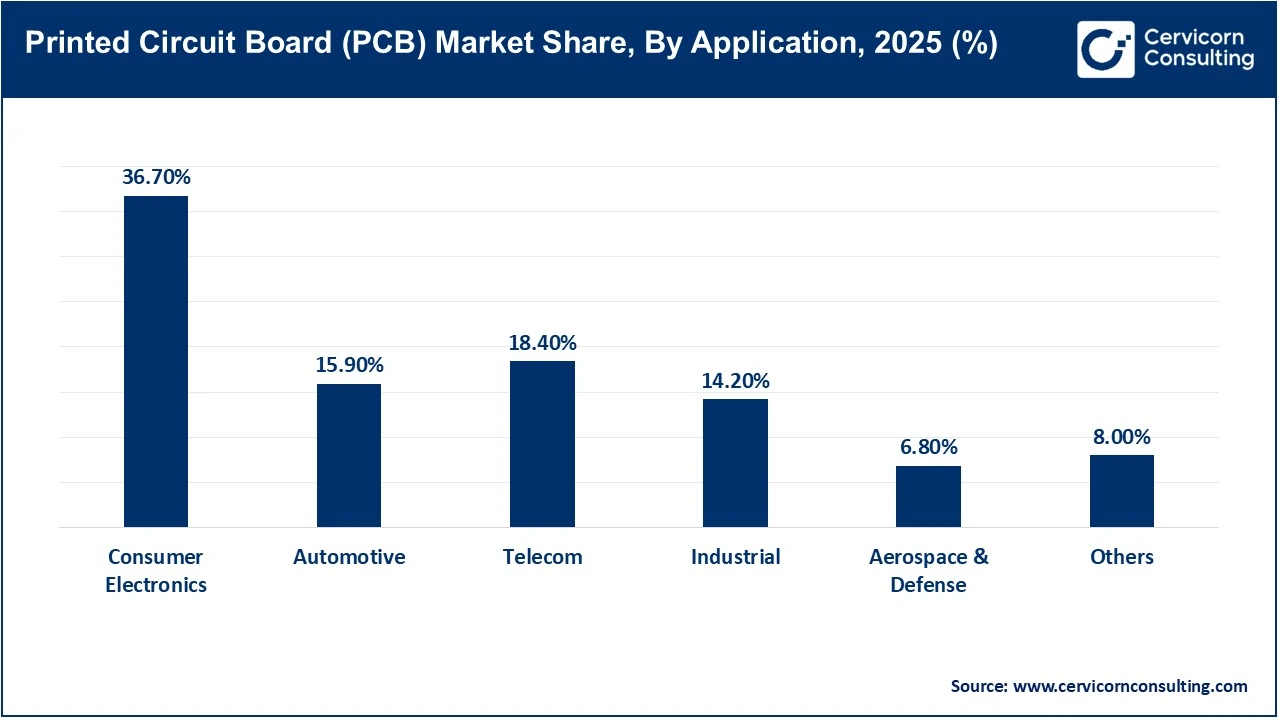
The automotive segment is the fastest growing, driven by the rapid adoption of electric vehicles (EVs), advanced driver-assistance systems (ADAS), and in-vehicle infotainment systems. Modern vehicles require significantly more electronic components than traditional ones, increasing PCB content per vehicle. Additionally, the shift toward autonomous and connected vehicles is boosting demand for high-reliability, high-performance PCBs, making automotive a key growth engine for the market.
By Product
By Laminate Materials
By Application
By Geography
Chapter 1. Market Introduction and Overview
1.1 Market Definition and Scope
1.1.1 Overview of Printed Circuit Board
1.1.2 Scope of the Study
1.1.3 Research Timeframe
1.2 Research Methodology and Approach
1.2.1 Methodology Overview
1.2.2 Data Sources and Validation
1.2.3 Key Assumptions and Limitations
Chapter 2. Executive Summary
2.1 Market Highlights and Snapshot
2.2 Key Insights by Segments
2.2.1 By Product Overview
2.2.2 By Laminate Materials Overview
2.2.3 By Application Overview
2.3 Competitive Overview
Chapter 3. Global Impact Analysis
3.1 Russia-Ukraine Conflict: Global Market Implications
3.2 Regulatory and Policy Changes Impacting Global Markets
Chapter 4. Market Dynamics and Trends
4.1 Market Dynamics
4.1.1 Market Drivers
4.1.2 Market Restraints
4.1.3 Market Opportunities
4.1.4 Market Challenges
4.2 Market Trends
Chapter 5. Premium Insights and Analysis
5.1 Global Printed Circuit Board Market Dynamics, Impact Analysis
5.2 Porter’s Five Forces Analysis
5.2.1 Bargaining Power of Suppliers
5.2.2 Bargaining Power of Buyers
5.2.3 Threat of Substitute Products
5.2.4 Rivalry among Existing Firms
5.2.5 Threat of New Entrants
5.3 PESTEL Analysis
5.4 Value Chain Analysis
5.5 Product Pricing Analysis
5.6 Vendor Landscape
5.6.1 List of Buyers
5.6.2 List of Suppliers
Chapter 6. Printed Circuit Board Market, By Product
6.1 Global Printed Circuit Board Market Snapshot, By Product
6.1.1 Market Revenue (($Billion) and Growth Rate (%), 2022-2035
6.1.1.1 Rigid PCB (Single, Double, Multilayer)
6.1.1.2 HDI PCB
6.1.1.3 Flexible PCB
6.1.1.4 Rigid-flex PCB
6.1.1.5 IC Substrate
6.1.1.6 Others
Chapter 7. Printed Circuit Board Market, By Laminate Materials
7.1 Global Printed Circuit Board Market Snapshot, By Laminate Materials
7.1.1 Market Revenue (($Billion) and Growth Rate (%), 2022-2035
7.1.1.1 FR-4
7.1.1.2 High-performance FR-4 (High Tg, halogen-free)
7.1.1.3 Polyimide (PI)
7.1.1.4 PET
7.1.1.5 Paper-based Laminates
7.1.1.6 Composites/Specialty Materials
Chapter 8. Printed Circuit Board Market, By Application
8.1 Global Printed Circuit Board Market Snapshot, By Application
8.1.1 Market Revenue (($Billion) and Growth Rate (%), 2022-2035
8.1.1.1 Consumer Electronics
8.1.1.2 Telecom
8.1.1.3 Industrial
8.1.1.4 Aerospace & Defense
8.1.1.5 Others
Chapter 9. Printed Circuit Board Market, By Region
9.1 Overview
9.2 Printed Circuit Board Market Revenue Share, By Region 2024 (%)
9.3 Global Printed Circuit Board Market, By Region
9.3.1 Market Size and Forecast
9.4 North America
9.4.1 North America Printed Circuit Board Market Revenue, 2022-2035 ($Billion)
9.4.2 Market Size and Forecast
9.4.3 North America Printed Circuit Board Market, By Country
9.4.4 U.S.
9.4.4.1 U.S. Printed Circuit Board Market Revenue, 2022-2035 ($Billion)
9.4.4.2 Market Size and Forecast
9.4.4.3 U.S. Market Segmental Analysis
9.4.5 Canada
9.4.5.1 Canada Printed Circuit Board Market Revenue, 2022-2035 ($Billion)
9.4.5.2 Market Size and Forecast
9.4.5.3 Canada Market Segmental Analysis
9.4.6 Mexico
9.4.6.1 Mexico Printed Circuit Board Market Revenue, 2022-2035 ($Billion)
9.4.6.2 Market Size and Forecast
9.4.6.3 Mexico Market Segmental Analysis
9.5 Europe
9.5.1 Europe Printed Circuit Board Market Revenue, 2022-2035 ($Billion)
9.5.2 Market Size and Forecast
9.5.3 Europe Printed Circuit Board Market, By Country
9.5.4 UK
9.5.4.1 UK Printed Circuit Board Market Revenue, 2022-2035 ($Billion)
9.5.4.2 Market Size and Forecast
9.5.4.3 UK Market Segmental Analysis
9.5.5 France
9.5.5.1 France Printed Circuit Board Market Revenue, 2022-2035 ($Billion)
9.5.5.2 Market Size and Forecast
9.5.5.3 France Market Segmental Analysis
9.5.6 Germany
9.5.6.1 Germany Printed Circuit Board Market Revenue, 2022-2035 ($Billion)
9.5.6.2 Market Size and Forecast
9.5.6.3 Germany Market Segmental Analysis
9.5.7 Rest of Europe
9.5.7.1 Rest of Europe Printed Circuit Board Market Revenue, 2022-2035 ($Billion)
9.5.7.2 Market Size and Forecast
9.5.7.3 Rest of Europe Market Segmental Analysis
9.6 Asia Pacific
9.6.1 Asia Pacific Printed Circuit Board Market Revenue, 2022-2035 ($Billion)
9.6.2 Market Size and Forecast
9.6.3 Asia Pacific Printed Circuit Board Market, By Country
9.6.4 China
9.6.4.1 China Printed Circuit Board Market Revenue, 2022-2035 ($Billion)
9.6.4.2 Market Size and Forecast
9.6.4.3 China Market Segmental Analysis
9.6.5 Japan
9.6.5.1 Japan Printed Circuit Board Market Revenue, 2022-2035 ($Billion)
9.6.5.2 Market Size and Forecast
9.6.5.3 Japan Market Segmental Analysis
9.6.6 India
9.6.6.1 India Printed Circuit Board Market Revenue, 2022-2035 ($Billion)
9.6.6.2 Market Size and Forecast
9.6.6.3 India Market Segmental Analysis
9.6.7 Australia
9.6.7.1 Australia Printed Circuit Board Market Revenue, 2022-2035 ($Billion)
9.6.7.2 Market Size and Forecast
9.6.7.3 Australia Market Segmental Analysis
9.6.8 Rest of Asia Pacific
9.6.8.1 Rest of Asia Pacific Printed Circuit Board Market Revenue, 2022-2035 ($Billion)
9.6.8.2 Market Size and Forecast
9.6.8.3 Rest of Asia Pacific Market Segmental Analysis
9.7 LAMEA
9.7.1 LAMEA Printed Circuit Board Market Revenue, 2022-2035 ($Billion)
9.7.2 Market Size and Forecast
9.7.3 LAMEA Printed Circuit Board Market, By Country
9.7.4 GCC
9.7.4.1 GCC Printed Circuit Board Market Revenue, 2022-2035 ($Billion)
9.7.4.2 Market Size and Forecast
9.7.4.3 GCC Market Segmental Analysis
9.7.5 Africa
9.7.5.1 Africa Printed Circuit Board Market Revenue, 2022-2035 ($Billion)
9.7.5.2 Market Size and Forecast
9.7.5.3 Africa Market Segmental Analysis
9.7.6 Brazil
9.7.6.1 Brazil Printed Circuit Board Market Revenue, 2022-2035 ($Billion)
9.7.6.2 Market Size and Forecast
9.7.6.3 Brazil Market Segmental Analysis
9.7.7 Rest of LAMEA
9.7.7.1 Rest of LAMEA Printed Circuit Board Market Revenue, 2022-2035 ($Billion)
9.7.7.2 Market Size and Forecast
9.7.7.3 Rest of LAMEA Market Segmental Analysis
Chapter 10. Competitive Landscape
10.1 Competitor Strategic Analysis
10.1.1 Top Player Positioning/Market Share Analysis
10.1.2 Top Winning Strategies, By Company, 2022-2024
10.1.3 Competitive Analysis By Revenue, 2022-2024
10.2 Recent Developments by the Market Contributors (2024)
Chapter 11. Company Profiles
11.1 Zhen Ding Technology Holding Limited
11.1.1 Company Snapshot
11.1.2 Company and Business Overview
11.1.3 Financial KPIs
11.1.4 Product/Service Portfolio
11.1.5 Strategic Growth
11.1.6 Global Footprints
11.1.7 Recent Development
11.1.8 SWOT Analysis
11.2 Unimicron Technology Corporation
11.3 Nippon Mektron Ltd.
11.4 TTM Technologies Inc.
11.5 AT&S Austria Technologie & Systemtechnik AG
11.6 Ibiden Co. Ltd.
11.7 Shennan Circuits Co. Ltd.
11.8 Compeq Manufacturing Co. Ltd.
11.9 Samsung Electro-Mechanics
11.10 Tripod Technology Corporation
11.11 Young Poong Electronics Co. Ltd.
11.12 Daeduck Electronics Co. Ltd.