
The global data center battery market size was valued at USD 3.38 billion in 2025, with expectations to grow USD 5.96 billion by 2035, driven by a compound annual growth rate (CAGR) of 5.9% during the forecast period from 2026 to 2035. The primary growth driver in the data center battery market is the strong demand for hyperscale digital infrastructure to support next-generation AI workloads. Generative AI clusters require power densities far higher than traditional enterprise servers, often reaching 50kW to 100kW per rack. This higher intensity drives a shift towards more robust backup systems capable of handling rapid discharge cycles. The largest hyperscale providers are spending billions on new sites, directly increasing demand for high-capacity battery systems, where even one minute of downtime can cost millions of dollars. Moreover, mature markets are not the only ones expanding their digital infrastructure. In countries such as Southeast Asia, digital transformation is accelerating, with data centers emerging as essential components of economic infrastructure.
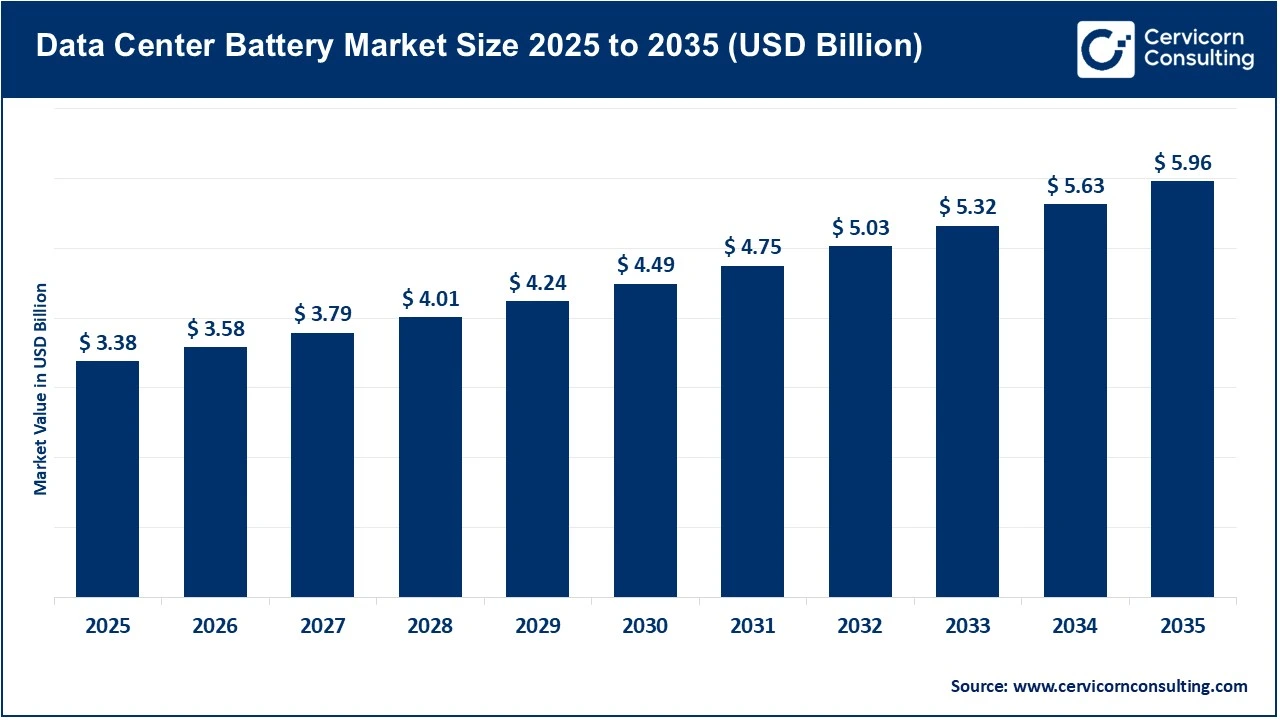
Rising demand for uninterruptible power supply in critical operations is another major growth factor for the market. As data centers become more complex, power electronics play an essential role in enabling seamless transitions between grid power and battery backup. This increased concentration of critical infrastructure requires advanced battery systems to respond immediately to grid conditions, so the growing energy elasticity of data centers does not undermine system resilience.
Incorporation of Smart Battery Management Systems (BMS)
The adoption of smart battery management systems (BMS) is a major trend in the data center battery market, driven by the growing need for improved reliability, operational efficiency, and predictive maintenance. The integration of artificial intelligence and machine learning based predictive analytics into BMS is drastically changing how operators monitor and maintain their power assets. There has been nearly a 25% increase in AI-enhanced BMS implementations in the hyperscale segment over the past 18 months. These systems can now forecast a single battery cell failure up to 48 hours in advance with 98% accuracy, significantly reducing the risk of overheating, unexpected downtime, and backup power failures during grid outages.
In addition to improving operational reliability, smart BMS platforms optimize charging and discharging cycles by continuously analyzing real-time battery health and usage data. These systems are extending the effective life of battery strings by 15% to 20% on average.
What is the Data Center Battery Market?
The data center battery market comprises the industry focused on developing, producing, and deploying battery systems that provide backup power and energy storage for data centers. These batteries are critical for maintaining uninterrupted operations during power outages, voltage fluctuations, and grid instability.
The market includes battery technologies such as lead-acid, lithium-ion, nickel-zinc, and other advanced chemistries, used in UPS systems, backup power infrastructure, and energy storage applications across hyperscale, enterprise, colocation, and edge data centers.
Report Scope
| Area of Focus | Details |
| Market Size in 2026 | USD 3.58 Billion |
| Market Size in 2035 | USD 5.96 Billion |
| CAGR 2026 to 2035 | 5.90% |
| Dominant Region | North America |
| Fastest Growing region | Asia-Pacific |
| Key Segments | Type, Battery Capacity, Data Center, Application, Region |
| Key Companies | EnerSys, Exide Technologies, East Penn Manufacturing, GS Yuasa Corporation, Samsung SDI, LG Energy Solution, Saft Groupe S.A., Panasonic Holdings Corporation, Leoch International Technology, ABB Ltd., Vertiv Holdings Co., Eaton Corporation plc, Narada Power Source Co., Ltd., Schneider Electric SE, Delta Electronics, Inc. |
1. Important Corporate Consolidation and Partnerships
Corporate consolidations and strategic partnerships are increasingly shaping the data center battery market. Industry players are focusing on collaborations to secure supply chains and enable rapid deployment of battery technology. In 2025, a major global cloud provider announces a partnership with an iron-flow battery manufacturer, marking the first long-duration backup in hyperscale. This partnership signals a shift in industry practice from 15-minute backup systems towards solutions capable of delivering 8 to 12 hours of resilience. Such partnerships are essential for scaling newer technologies, which may not yet have the long operational history of lead-acid batteries but offer strong, sustainable benefits aligned with modern ESG platforms.
2. Government Policies and Sustainability Mandates
Government policies and sustainability mandates are major growth drivers of the data center battery market. Regulatory frameworks are pushing operators to adopt cleaner, more transparent energy storage solutions. For example, the European Union’s Battery Passport initiative, which officially entered implementation in late 2024, will require data center operators to track the entire lifecycle of their power storage, from raw material sourcing to end-of-life recycling. This transparency requirement is driven by a 25% increase in the use of "secondary life batteries" for non-critical applications in European data centers. Furthermore, in the USA, a multi-billion-dollar federal program, the "Clean Energy for Data Centers", is pushing for energy storage systems (ESS) to be deployed behind the meter, with a 50% increase in these systems since the program's start.
3. Advances in High-Density Battery Chemistry
Advancements in high-density battery chemistry for data centers mark a major milestone in the market. In 2025, the first commercial sodium-ion battery rack was deployed in a Tier III facility, marking an important milestone for the industry. Sodium-ion batteries cost 20–30% less than Lithium Iron Phosphate (LFP) cells, making them an attractive option for cost-conscious colocation providers. At the same time, Nickel-Zinc (NiZn) battery technology is gaining traction due to its balance of safety, performance, and power density, especially in high-density AI data center environments.
4. Upgrading Infrastructure and Global Expansion
The rapid expansion of digital infrastructure in emerging economies is creating significant opportunities for battery deployment in data centers. In regions such as Southeast Asia and parts of Africa, large battery arrays coupled with on-site solar generation are being installed to address grid instability. As a result, there has been a year-on-year increase of over 22% in "hybrid" data centers, which utilize batteries as both an uninterruptible power supply (UPS) to provide backup power and an energy storage system (ESS) to store energy for later use. These projects are often modular, with containerized battery solutions first demonstrated in the market because they can be deployed and scaled rapidly as demand for data increases.
The data center battery market is segmented by region into North America, Europe, Asia-Pacific, and LAMEA. Here is a brief overview of each region:
The Asia-Pacific data center battery market size was worth USD 0.81 billion in 2025 and is expected to reach USD 1.43 billion by 2035. Asia-Pacific dominates the global market, driven by strong investments in digital infrastructure, the expansion of hyperscale facilities, and accelerating cloud adoption. Countries such as China, India, and Southeast Asian nations are rapidly expanding their data center capacity due to ongoing digital transformation initiatives and rising demand for data storage and processing capabilities. Government-backed infrastructure programmes, including China’s long-term data center development strategies, are further strengthening regional market growth.
China: Leadership in Manufacturing and Domestic Demand
China is the leading data center battery market due to its essential role in the battery supply chain and its aggressive domestic infrastructure goals.
India: Accelerating Digitalization and Government Initiatives
India has experienced an exponential buildout of capacity, driven by its "Digital India" initiative and a data center investment regulatory regime described as favourable.
The North America data center battery market size was valued at USD 1.39 billion in 2025 and is projected to surpass USD 2.44 billion by 2035.
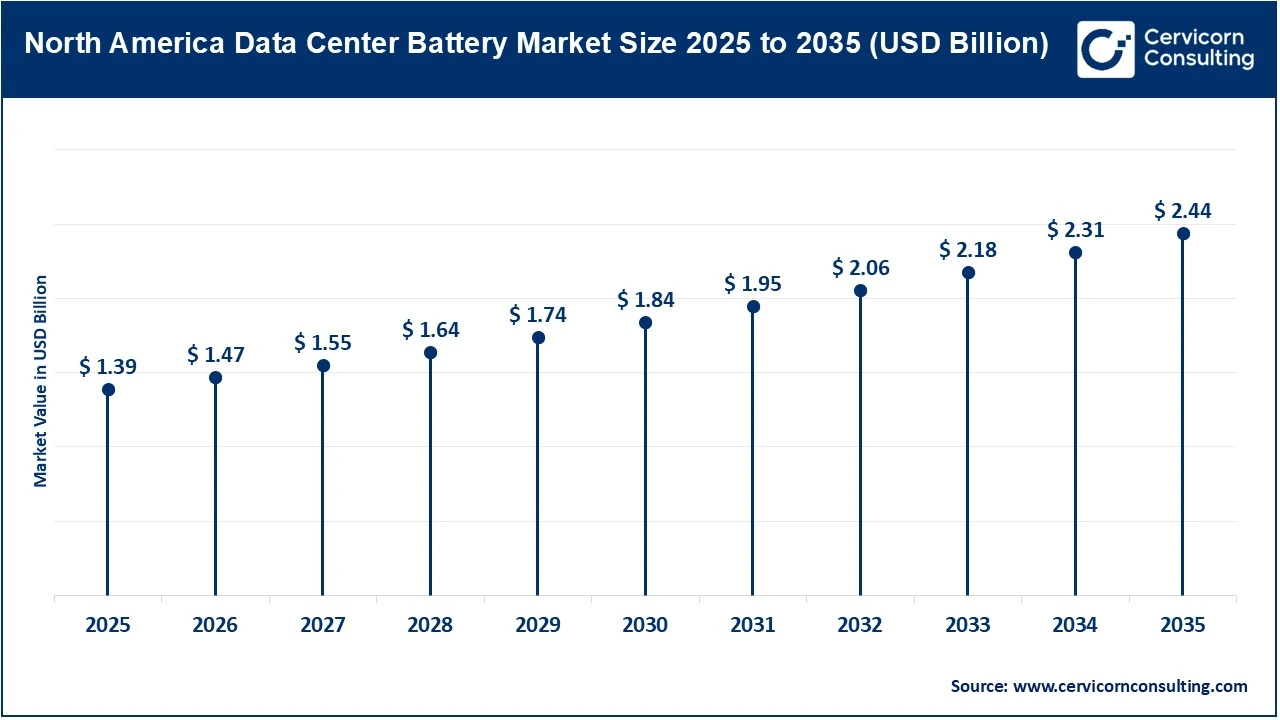
The North American market is home to the largest concentration of hyperscale facilities and strong investments in AI-ready infrastructure. The region benefits from federal requirements such as the Inflation Reduction Act (IRA), which provides tax credits for onshore battery manufacturing and renewable energy. In 2025, industry newsletters reported that major U.S. utilities began requiring new large data centers to include on-site energy storage to mitigate the effects of higher demand on ageing power grids. As a result, North American operators have become early adopters of high-discharge Lithium-ion and Nickel-Zinc systems that maximise power density within existing facilities.
United States: Innovation Hub and Hyperscale Concentration
The US is the global innovation hub for data center technology, with a focus on high-density, AI-ready power architectures.
Canada: Cold Weather Benefits with Renewable Power Access
Canada is leveraging its hydroelectric power resources and naturally cold climate to position itself as a sustainable and cost-efficient destination for data center development.
The Europe data center battery market size reached USD 0.88 billion in 2025 and is expected to hit USD 1.55 billion by 2035. The European market is marked by the strongest sustainability regulations and the growing integration of renewable energy into data center operations. Policies such as the "European Green Deal" and battery regulations require operators to meet carbon neutrality targets by 2030, supporting the adoption of LFP chemistries and grid-interactive UPS systems. More than 70% of new European data center construction now incorporates renewable energy, which requires Battery Energy Storage Systems (BESS) to manage the intermittency of wind and solar power. Additionally, the region's high electricity prices have made energy efficiency a top priority, driving demand for batteries capable of providing frequency containment reserve (FCR) services.
United Kingdom: Focus on Energy Efficiency and Green Data Centers
The UK is at the forefront of integrating data center energy storage into the national grid to enhance frequency response and overall grid reliability.
Germany: Environmental Standards & Industry Demand
Germany has emerged as Europe's first major testbed for hydrogen-powered data centres, driven by its national hydrogen strategy and rising energy costs.
Data Center Battery Market Share, By Region, 2025 (%)
| Region | Revenue Share, 2025 (%) |
| North America | 41% |
| Europe | 26% |
| Asia Pacific | 24% |
| LAMEA | 9% |
The LAMEA data center battery market was valued at USD 0.30 billion in 2025 and is expected to reach USD 0.54 billion by 2035. The LAMEA data center battery market is undergoing a significant shift as emerging digital economies invest heavily in digital sovereignty and connectivity projects. In the Middle East, particularly the UAE and Saudi Arabia, sovereign wealth funds are supporting large "Smart City" projects that rely on advanced data centers. In Latin America, Brazil has become a major regional hub, attracting investment from global cloud companies. Additionally, the LAMEA data center battery sector is expected to grow at a CAGR of 12% through 2028, supported by upgraded infrastructure and a shift from legacy lead-acid to more reliable lithium-based solutions to support growing digital populations.
Brazil: Growth Engine of Latin America, Connectivity Projects
Brazil serves as the primary gateway for digital investment in South America, with a rapidly expanding market centered on São Paulo.
United Arab Emirates: Smart City Development and Strategic Investments
The United Arab Emirates is leveraging its energy resources to develop next-generation, world-class AI data centers as part of its transition to a knowledge-based economy.
The data center battery market is segmented into type, battery capacity, data center, application, and region.
The lead-acid battery segment currently dominates the data center battery market, primarily due to its long-standing reliability, well-established global recycling infrastructure, and relatively low upfront capital costs. Despite the emergence of advanced battery technologies, valve-regulated lead-acid (VRLA) batteries remain the preferred choice for many enterprise operators because of their proven performance and familiarity. This preference is especially strong among conservative organizations and in regions where recycling systems for newer chemistries such as lithium-ion or nickel-zinc are not yet widely available.
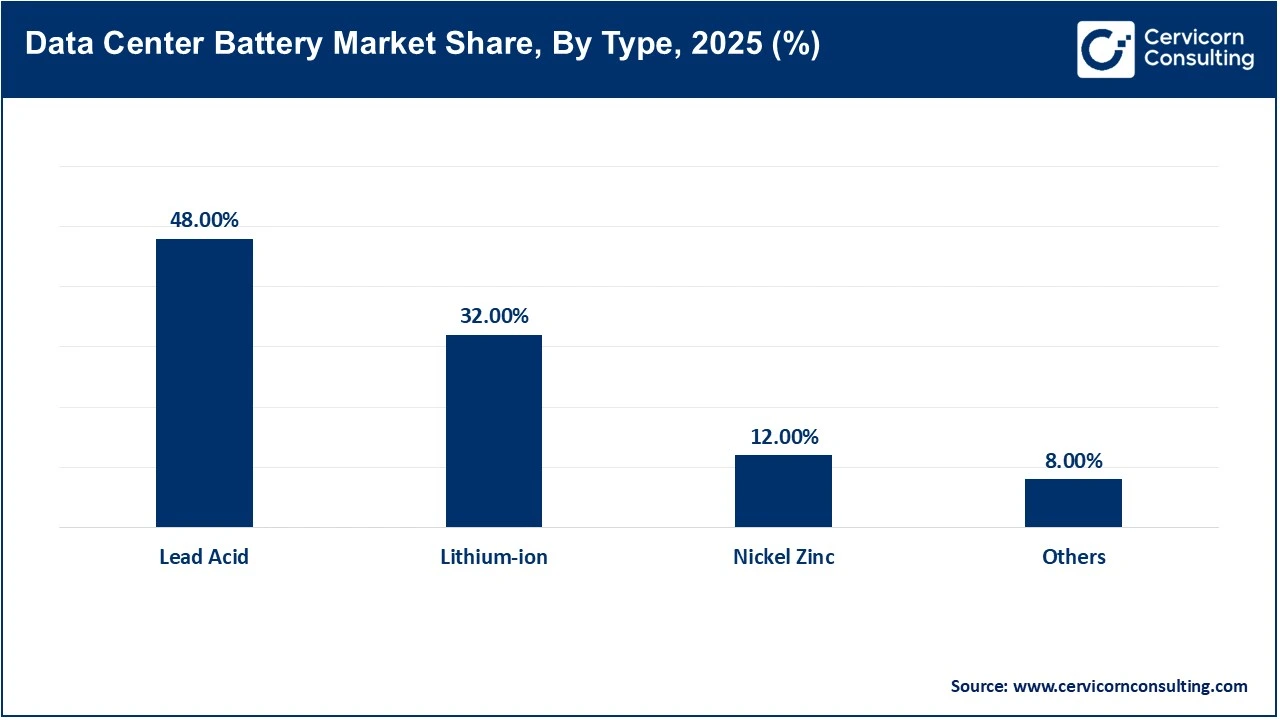
Nickel-zinc is the fastest-growing battery type in the market due to its ability to meet the growing demand for high power density and improved safety in high-density AI environments. NiZn batteries are non-flammable and occupy less space than traditional lead-acid systems, making them well-suited for high-density installations. In addition, they offer a longer operational lifespan—typically between 10 and 15 years—which reduces replacement frequency and maintenance requirements.
The above 1 MWh segment holds the largest market share, largely due to the expansion of hyperscale and campus data center projects. Facilities with total power demand exceeding 100 MW require large battery banks to ensure backup duration and provide peak-shaving capabilities. Larger battery systems also benefit from economies of scale, as they are more efficient to monitor and to manage internal thermal loads, ultimately reducing the cost per kWh of the energy storage system.
Data Center Battery Market Share, By Battery Capacity, 2025 (%)
| Battery Capacity | Revenue Share, 2025 (%) |
| (Above 1 MWh) | 45% |
| (100 kWh - 1 MWh) | 33% |
| (Below 100 kWh) | 22% |
The 100 kWh to 1 MWh segment is experiencing the fastest growth during the forecast period, driven by rising adoption of modular and prefabricated data center designs. Prefab and modular designs offer a "pay-as-you-grow" approach, allowing operators to deploy mid-range battery modules as they fill server racks, rather than incurring a large upfront capital cost for a multi-MW installed battery system. This is particularly important for colocation providers and regional data centers, where tenant growth and changing power systems are requirements.
Hyperscale data centers account for the largest share of the market due to their extensive infrastructure footprint and the centralized nature of global cloud services. Major operators such as Amazon Web Services, Microsoft, and Google continue to invest heavily in large-scale battery installations to meet growing energy requirements and maintain uninterrupted operations. The segment is characterised by the concentration of data centers in these geographic clusters, where hyperscale operators leverage higher-capacity battery systems to address potential power-delivery constraints and ensure full availability.
Data Center Battery Market Share, By Data Center, 2025 (%)
| Data Center | Revenue Share, 2025 (%) |
| Hyperscale Data Centers | 41% |
| Enterprise Data Centers | 27% |
| Colocation Data Centers | 21% |
| Edge Data Centers | 11% |
Edge data centers are the fastest-growing category in the market because the rapid adoption of applications such as autonomous vehicles, IoT, and real-time AI requires local processing to minimize latency. Unlike traditional centralised facilities, edge data centers are often deployed in remote or space-constrained environments, where compact, efficient, and low-maintenance battery systems are essential. This trend is increasing demand for advanced battery technologies capable of operating over wider temperature ranges while maintaining performance in decentralized infrastructure.
Uninterruptible Power Supply (UPS) applications represent the largest segment of the market, as preventing data loss during a power flicker (even for milliseconds) is the most fundamental requirement of any data center. All data center facilities, of any size and location, must have a UPS within the data center structure that bridges the gap between a power failure and the activation of backup generators. UPS will always be the primary application for battery deployment because of the ongoing need for high reliability and the increasingly precision-sensitive nature of modern IT hardware to power quality conditions.
Data Center Battery Market Share, By Application, 2025 (%)
| Application | Revenue Share, 2025 (%) |
| Uninterruptible Power Supply (UPS) | 51% |
| Backup Power Systems | 24% |
| Energy Storage Systems (ESS) | 15% |
| Peak Shaving and Load Balancing | 10% |
Energy Storage Systems (ESS) are the fastest-growing application for the market, due to their ability to reduce energy demands from AI, support sustainability goals, and provide grid-interactive services beyond traditional backup power. Use of ESS enables "peak shaving" of power consumption by discharging stored battery energy when grid-based power prices skyrocket, or "load shifting," which can help dramatically reduce overall fixed operational expenses in the data center. Additionally, ESS enables data centers to participate in grid-balancing services, such as frequency regulation, to create an additional stream of income for the operator.
By Type
By Battery Capacity
By Data Center
By Application
By Region
Chapter 1. Market Introduction and Overview
1.1 Market Definition and Scope
1.1.1 Overview of Data Center Battery
1.1.2 Scope of the Study
1.1.3 Research Timeframe
1.2 Research Methodology and Approach
1.2.1 Methodology Overview
1.2.2 Data Sources and Validation
1.2.3 Key Assumptions and Limitations
Chapter 2. Executive Summary
2.1 Market Highlights and Snapshot
2.2 Key Insights by Segments
2.2.1 By Type Overview
2.2.2 By Battery Capacity Overview
2.2.3 By Data Center Overview
2.2.4 By Application Overview
2.3 Competitive Overview
Chapter 3. Global Impact Analysis
3.1 Russia-Ukraine Conflict: Global Market Implications
3.2 Regulatory and Policy Changes Impacting Global Markets
Chapter 4. Market Dynamics and Trends
4.1 Market Dynamics
4.1.1 Market Drivers
4.1.2 Market Restraints
4.1.3 Market Opportunities
4.1.4 Market Challenges
4.2 Market Trends
Chapter 5. Premium Insights and Analysis
5.1 Global Data Center Battery Market Dynamics, Impact Analysis
5.2 Porter’s Five Forces Analysis
5.2.1 Bargaining Power of Suppliers
5.2.2 Bargaining Power of Buyers
5.2.3 Threat of Substitute Products
5.2.4 Rivalry among Existing Firms
5.2.5 Threat of New Entrants
5.3 PESTEL Analysis
5.4 Value Chain Analysis
5.5 Product Pricing Analysis
5.6 Vendor Landscape
5.6.1 List of Buyers
5.6.2 List of Suppliers
Chapter 6. Data Center Battery Market, By Type
6.1 Global Data Center Battery Market Snapshot, By Type
6.1.1 Market Revenue (($Billion) and Growth Rate (%), 2022-2035
6.1.1.1 Lead Acid
6.1.1.2 Lithium-ion
6.1.1.3 Nickel Zinc
6.1.1.4 Others
Chapter 7. Data Center Battery Market, By Battery Capacity
7.1 Global Data Center Battery Market Snapshot, By Battery Capacity
7.1.1 Market Revenue (($Billion) and Growth Rate (%), 2022-2035
7.1.1.1 (Above 1 MWh)
7.1.1.2 (100 kWh - 1 MWh)
7.1.1.3 (Below 100 kWh)
Chapter 8. Data Center Battery Market, By Data Center
8.1 Global Data Center Battery Market Snapshot, By Data Center
8.1.1 Market Revenue (($Billion) and Growth Rate (%), 2022-2035
8.1.1.1 Hyperscale Data Centers
8.1.1.2 Enterprise Data Centers
8.1.1.3 Colocation Data Centers
8.1.1.4 Edge Data Centers
Chapter 9. Data Center Battery Market, By Application
9.1 Global Data Center Battery Market Snapshot, By Application
9.1.1 Market Revenue (($Billion) and Growth Rate (%), 2022-2035
9.1.1.1 Uninterruptible Power Supply (UPS)
9.1.1.2 Backup Power Systems
9.1.1.3 Energy Storage Systems (ESS)
9.1.1.4 Peak Shaving and Load Balancing
Chapter 10. Data Center Battery Market, By Region
10.1 Overview
10.2 Data Center Battery Market Revenue Share, By Region 2024 (%)
10.3 Global Data Center Battery Market, By Region
10.3.1 Market Size and Forecast
10.4 North America
10.4.1 North America Data Center Battery Market Revenue, 2022-2035 ($Billion)
10.4.2 Market Size and Forecast
10.4.3 North America Data Center Battery Market, By Country
10.4.4 U.S.
10.4.4.1 U.S. Data Center Battery Market Revenue, 2022-2035 ($Billion)
10.4.4.2 Market Size and Forecast
10.4.4.3 U.S. Market Segmental Analysis
10.4.5 Canada
10.4.5.1 Canada Data Center Battery Market Revenue, 2022-2035 ($Billion)
10.4.5.2 Market Size and Forecast
10.4.5.3 Canada Market Segmental Analysis
10.4.6 Mexico
10.4.6.1 Mexico Data Center Battery Market Revenue, 2022-2035 ($Billion)
10.4.6.2 Market Size and Forecast
10.4.6.3 Mexico Market Segmental Analysis
10.5 Europe
10.5.1 Europe Data Center Battery Market Revenue, 2022-2035 ($Billion)
10.5.2 Market Size and Forecast
10.5.3 Europe Data Center Battery Market, By Country
10.5.4 UK
10.5.4.1 UK Data Center Battery Market Revenue, 2022-2035 ($Billion)
10.5.4.2 Market Size and Forecast
10.5.4.3 UK Market Segmental Analysis
10.5.5 France
10.5.5.1 France Data Center Battery Market Revenue, 2022-2035 ($Billion)
10.5.5.2 Market Size and Forecast
10.5.5.3 France Market Segmental Analysis
10.5.6 Germany
10.5.6.1 Germany Data Center Battery Market Revenue, 2022-2035 ($Billion)
10.5.6.2 Market Size and Forecast
10.5.6.3 Germany Market Segmental Analysis
10.5.7 Rest of Europe
10.5.7.1 Rest of Europe Data Center Battery Market Revenue, 2022-2035 ($Billion)
10.5.7.2 Market Size and Forecast
10.5.7.3 Rest of Europe Market Segmental Analysis
10.6 Asia Pacific
10.6.1 Asia Pacific Data Center Battery Market Revenue, 2022-2035 ($Billion)
10.6.2 Market Size and Forecast
10.6.3 Asia Pacific Data Center Battery Market, By Country
10.6.4 China
10.6.4.1 China Data Center Battery Market Revenue, 2022-2035 ($Billion)
10.6.4.2 Market Size and Forecast
10.6.4.3 China Market Segmental Analysis
10.6.5 Japan
10.6.5.1 Japan Data Center Battery Market Revenue, 2022-2035 ($Billion)
10.6.5.2 Market Size and Forecast
10.6.5.3 Japan Market Segmental Analysis
10.6.6 India
10.6.6.1 India Data Center Battery Market Revenue, 2022-2035 ($Billion)
10.6.6.2 Market Size and Forecast
10.6.6.3 India Market Segmental Analysis
10.6.7 Australia
10.6.7.1 Australia Data Center Battery Market Revenue, 2022-2035 ($Billion)
10.6.7.2 Market Size and Forecast
10.6.7.3 Australia Market Segmental Analysis
10.6.8 Rest of Asia Pacific
10.6.8.1 Rest of Asia Pacific Data Center Battery Market Revenue, 2022-2035 ($Billion)
10.6.8.2 Market Size and Forecast
10.6.8.3 Rest of Asia Pacific Market Segmental Analysis
10.7 LAMEA
10.7.1 LAMEA Data Center Battery Market Revenue, 2022-2035 ($Billion)
10.7.2 Market Size and Forecast
10.7.3 LAMEA Data Center Battery Market, By Country
10.7.4 GCC
10.7.4.1 GCC Data Center Battery Market Revenue, 2022-2035 ($Billion)
10.7.4.2 Market Size and Forecast
10.7.4.3 GCC Market Segmental Analysis
10.7.5 Africa
10.7.5.1 Africa Data Center Battery Market Revenue, 2022-2035 ($Billion)
10.7.5.2 Market Size and Forecast
10.7.5.3 Africa Market Segmental Analysis
10.7.6 Brazil
10.7.6.1 Brazil Data Center Battery Market Revenue, 2022-2035 ($Billion)
10.7.6.2 Market Size and Forecast
10.7.6.3 Brazil Market Segmental Analysis
10.7.7 Rest of LAMEA
10.7.7.1 Rest of LAMEA Data Center Battery Market Revenue, 2022-2035 ($Billion)
10.7.7.2 Market Size and Forecast
10.7.7.3 Rest of LAMEA Market Segmental Analysis
Chapter 11. Competitive Landscape
11.1 Competitor Strategic Analysis
11.1.1 Top Player Positioning/Market Share Analysis
11.1.2 Top Winning Strategies, By Company, 2022-2024
11.1.3 Competitive Analysis By Revenue, 2022-2024
11.2 Recent Developments by the Market Contributors (2024)
Chapter 12. Company Profiles
12.1 EnerSys
12.1.1 Company Snapshot
12.1.2 Company and Business Overview
12.1.3 Financial KPIs
12.1.4 Product/Service Portfolio
12.1.5 Strategic Growth
12.1.6 Global Footprints
12.1.7 Recent Development
12.1.8 SWOT Analysis
12.2 Exide Technologies
12.3 East Penn Manufacturing
12.4 Samsung SDI
12.5 LG Energy Solution
12.6 Saft Groupe S.A.
12.7 Panasonic Holdings Corporation
12.8 Leoch International Technology
12.9 ABB Ltd.
12.10 Vertiv Holdings Co.
12.11 Eaton Corporation plc
12.12 Narada Power Source Co., Ltd.
12.13 Schneider Electric SE
12.14 Delta Electronics, Inc.