
The global AI EDA market size was valued at USD 3.41 billion in 2025 and is expected to be worth around USD 30.35 billion by 2035, exhibiting a compound annual growth rate (CAGR) of 24.5% over the forecast period from 2026 to 2035. The growth of the AI Electronic Design Automation (EDA) market is primarily driven by the increasing complexity of advanced semiconductor nodes and system-on-chip designs. The industry has recently entered the sub-3nm era, and as it moves towards 2nm and beyond, both the number and complexity of design rules have increased significantly. This has rendered manual verification and conventional rule-based tools increasingly ineffective. In 2024, the design costs for a single 3nm chip have crossed USD 600 million, highlighting the growing financial challenges of modern chip development. As a result, organizations are increasingly adopting AI-powered EDA solutions to reduce costs, enhance error detection, and enable self-optimizing design workflows capable of handling the high transistor density of next-generation chips. Furthermore, the adoption of heterogeneous integration and 3D-IC packaging requires advanced AI to simultaneously manage thermal, mechanical, and electrical interdependencies.
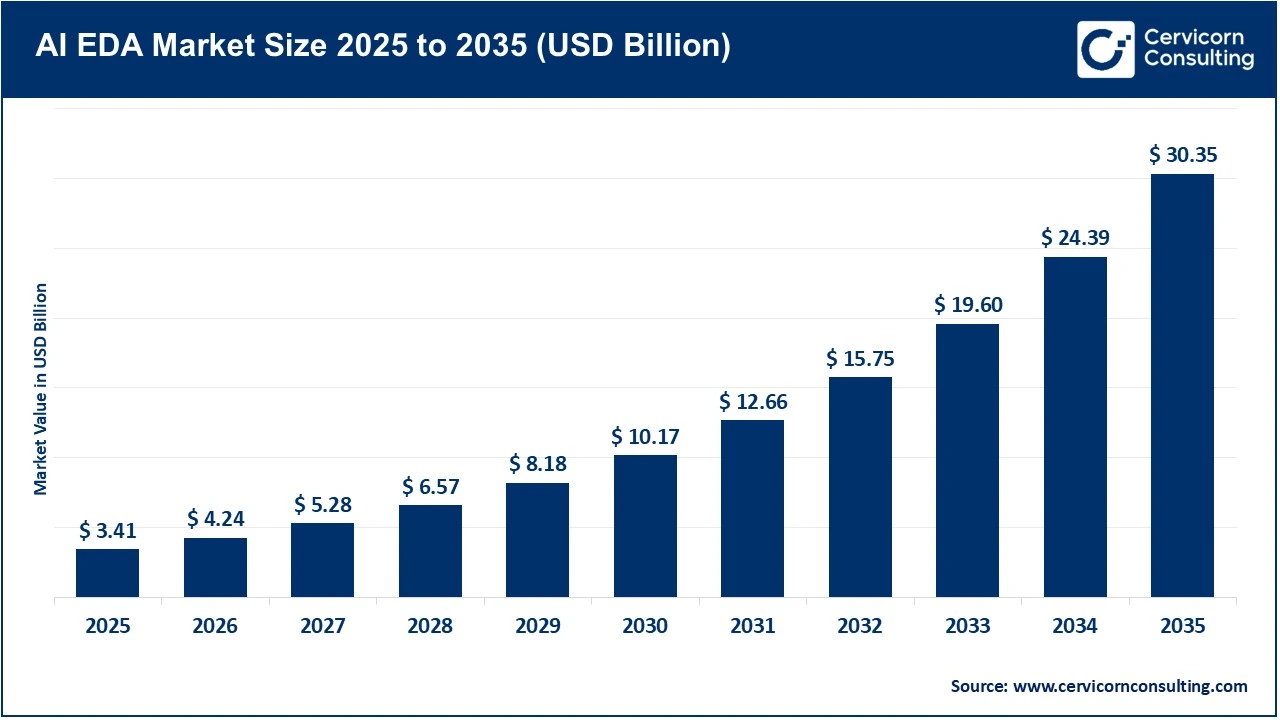
The growing importance of power, performance, and area (PPA) optimization in chip design is a significant driver of market growth. In sectors such as high-performance computing and mobile devices, PPA optimization has become a critical factor in a competitive landscape. AI serves as a "force multiplier" for engineering teams that are struggling with the widening gap between chip complexity and the limited availability of skilled VLSI engineers. AI-enabled engineering tools can improve a single engineer's productivity by 2 to 3x, significantly enhancing design efficiency. Moreover, these tools automate repetitive and time-consuming tasks, allowing engineers to focus on innovation and architectural development.
Generative AI and Large Language Model Integration into Design Automation
The integration of generative AI and large language models (LLMs) into design automation is emerging as a significant trend in the EDA market. A major development is the concept of a "Chip-GPT," where engineers use natural language to generate hardware description code, such as Verilog or VHDL. This transition is enabling rapid hardware prototyping while lowering the barrier to entry for complex hardware design. In 2026, over 25% of leading semiconductor firms are utilizing LLM-based assistants in their design flow, reducing the initial coding phase by nearly 40% and minimizing syntax-related errors while improving overall code quality.
These LLM solutions are trained on large amounts of open-source and proprietary hardware description repositories, enabling them to provide optimized code structures and even highlight potential coding security threats or bugs during coding. As a result, engineers can achieve greater efficiency and accuracy during the development process. Additionally, the speed of the AI-assisted authoring standard approach for design projects allows senior architects to spend more time on system-level innovations while delegating low-level coding activities to AI agents.
What is the impact of AI on the EDA market?
AI is transforming the EDA market by improving design efficiency, shortening development cycles, and optimizing overall semiconductor performance. It enables faster decision-making and improves accuracy across the chip design and manufacturing lifecycle.
The following are key AI impacts on the market:
Report Scope
| Area of Focus | Details |
| Market Size in 2026 | USD 3.96 Billion |
| Market Size in 2035 | USD 37.59 Billion |
| CAGR 2026 to 2035 | 28.50% |
| Top-performing Region | North America |
| Leading Growth Region | Asia-Pacific |
| Key Segments | Product Category, Deployment Mode, Application, End User, Region |
| Key Companies | Synopsys, Inc., Cadence Design Systems, Inc., Siemens Digital Industries Software, Keysight Technologies, Ansys, Inc., Zuken Inc., Altium Limited, Empyrean Technology, Silvaco Group, Aldec, Inc., AgniSys, Inc., PrimisAI, Celus GmbH, Circuit Mind Limited, Quilter AI |
1. Significant Corporate Technology Advances and Product Releases
Technological advancements and new product launches by leading corporations continue to be major growth drivers in the AI EDA market. Integrating GPU-accelerated computational lithography into a standard EDA flow marks a major step forward in manufacturing. The introduction of NVIDIA’s CuLitho, adopted by leading semiconductor foundries such as TSMC, is a significant breakthrough in 2024 and is progressing toward commercial production in 2025. This innovation has demonstrated a substantial reduction in optical proximity correction (OPC) processing time, from weeks to days, saving millions in operational costs and improving time to market for high-volume manufacturing at 2nm nodes. CuLitho represents a transformative shift that enables AI not just for design but also as part of the manufacturing solution.
2. Strategic Mergers, Acquisitions, and Partnership Ecosystems
Strategic Mergers, Acquisitions, and Partnership Ecosystems are significant drivers of market growth. A partnership between leading players such as Synopsys and Ansys represents a strategic move to combine systems analysis with traditional EDA tools, marking a significant milestone in "Silicon-to-System" design. This merger is expected to drive a 20% increase in platform tool usage and enable engineers to design and qualify thermal, mechanical, and electrical aspects, with a shared AI engine across those domains, so the design is completed in the final system environment. Moreover, such collaborations are increasingly important for tackling the growing complexity of modern chip designs, particularly with the emergence of 3D-ICs and chiplet-based architectures.
3. Government Initiatives and National Semiconductor Policy Support
Government-led initiatives and semiconductor policies are playing an essential role in driving growth in the AI EDA market. Programs such as the U.S. CHIPS Act, along with similar initiatives in Europe and Asia, have funded national AI-EDA clusters to advocate for domestic chip security. By early 2026, the market showed that these sovereign endeavours had invested over USD 5 billion in localized EDA development to compete against the "Big Three" model. Moreover, they have established specialized EDA AI design segments to meet the needs of national security and critical infrastructure.
4. Advances in AI-Enabled Verification and Hardware Security Protocols
Advances in AI-Enabled Verification technologies and Hardware Security Protocols mark another major milestone in the market. A leading EDA vendor recently announced the “Zero-Bug” verification milestone for 2026, in which AI-based verification tools identified up to 99.9% of corner-case bugs in complex system-on-chip (SoC) designs before initial simulation. As a result, the industry has shifted from "testing for bugs" to "preventing bugs by construction." Additionally, AI is increasingly used to enhance hardware security by detecting potential vulnerabilities such as backdoors or hardware Trojans. This is particularly important as semiconductor chips increasingly form the foundation of critical infrastructure and autonomous systems, where robust security is essential.
The AI EDA Market is segmented by region into North America, Europe, Asia-Pacific, and LAMEA. Here is a brief overview of each region:
The Asia-Pacific AI EDA market size was valued at USD 0.95 billion in 2025 and is forecasted to reach around USD 8.50 billion by 2035. Asia Pacific is the fastest-growing region, owing to its status as a global hub for semiconductor manufacturing. Government support is critical to this growth, with regional investments in semiconductor self-sufficiency expected to exceed USD 200 billion by 2030. Countries such as China, South Korea, and Taiwan are actively integrating AI into chip design processes to manage the increasing complexity of both advanced and mature nodes.
China is Dominating Global Capacity through the Domestic Ecosystem
China is rapidly developing a domestically sourced AI EDA toolchain to achieve supply chain resiliency and international trade determinations.
India to Become an Emerging Global Hub for Chip Design and Engineering Talent
India is rapidly transitioning from a back-office support center for global firms to a key hub for advanced chip design and engineering talent.
The North America AI EDA market size was estimated at USD 1.36 billion in 2025 and is anticipated to surpass around USD 12.14 billion by 2035.
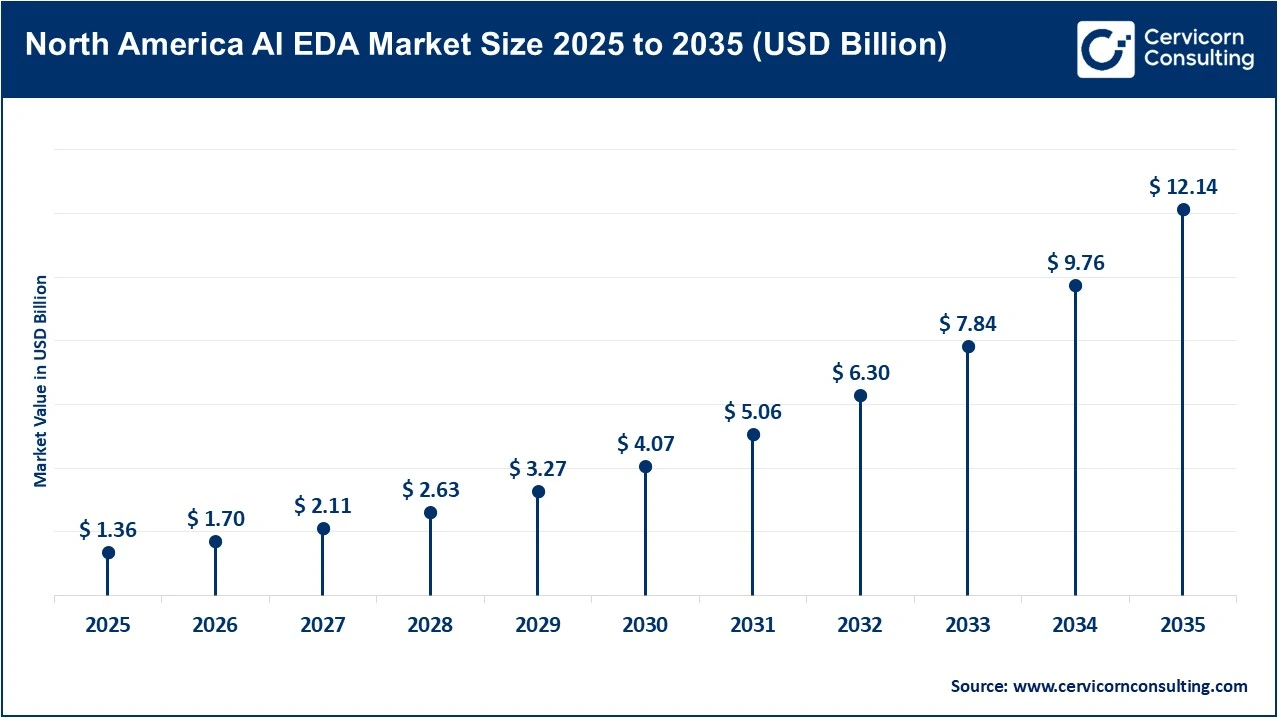
North America continues to dominate the AI EDA market, supported by its strong foundation in innovation and advanced computing. The region is home to leading EDA vendors and major hyperscale technology companies, making it a global centre for semiconductor design and AI research. The principal area of activity in the region is the rapid shift to "Cloud-Native EDA" and custom AI accelerator design. Currently, US-based companies account for over 70% of the global EDA market, and their R&D spending on integrating AI will grow 25% annually. Increasing demand for "Sovereign Silicon" requires custom chips to be designed by non-semiconductor companies such as Google, Amazon, and Microsoft to support their vast AI data centres. Additionally, industry leaders like NVIDIA play an essential role, as their strategic decisions about AI hardware tools are used to design the next generations of processors.
United States to Maintain Edge through EDA Software Development
The US is focused on the "high ground" of sub-3nm design and on Generative AI being used in the earliest stages of design.
Canada to Leverage Academic Research in Deep Learning to Hardware Design
Canada is using its world-leading academic AI research ecosystem to drive new deep learning applications into physical design.
The Europe AI EDA market size was valued at USD 0.82 billion in 2025 and is projected to reach around USD 7.28 billion by 2035. In Europe, the adoption of AI EDA is largely driven by its strong presence in the automotive and industrial sectors. The rapid shift towards Electric Vehicles (EVs) and autonomous driving technologies has significantly increased demand for complex, safety-critical automotive semiconductors. The application of AI EDA is estimated to reduce the design cycle for automotive-grade chips by 40%, enabling European manufacturers to keep pace with rapidly evolving software-defined vehicles. The European Chips Act also supports these areas by encouraging "Sovereign Silicon" initiatives to optimise local ecosystems and support energy-efficient edge AI, while reducing European dependence on foreign design ecosystems.
United Kingdom to Drive Innovation in AI-Specific Processor Architectures
The UK is leveraging its long-standing strength in processor IP (Intellectual Property) to lead in the design of AI-specific hardware, using AI-based tools.
Germany to Advance AI EDA in Next-Generation Automotive Systems
Germany is the leader in AI-driven EDA applications in the automotive sector, particularly in functional safety and power electronics.
AI EDA Market Share, By Region, 2025 (%)
| Region | Revenue Share, 2025 (%) |
| North America | 40% |
| Asia Pacific | 28% |
| Europe | 24% |
| LAMEA | 8% |
The LAMEA AI EDA market was valued at USD 0.27 billion in 2025 and is anticipated to hit around USD 2.43 billion by 2035. The LAMEA region currently holds a smaller market share but is expected to grow steadily, driven by rising investments in digital infrastructure and the expansion of emerging consumer electronics markets. In the Middle East, countries such as the UAE and Saudi Arabia are moving towards high-tech economies, adopting AI-driven semiconductor design as a core component of national economic diversification and security. Venture capital flows to semiconductor startups in the region have increased by 20% recently. In Latin America, countries such as Brazil are also leveraging AI EDA to strengthen localised chip design capabilities, particularly for telecommunications systems and IoT applications, supporting region-specific technological needs.
Brazil is Focusing on local chip designs to Serve its Telecommunications Regions
Brazil is establishing a foothold in AI-based design for IoT and telecommunications to meet the unique needs of the South American market.
The United Arab Emirates is actively advancing toward a high-tech economy through strategic investments in artificial intelligence
The UAE is positioning itself as a global hub for AI computing, supported by substantial investments across the semiconductor value chain.
The AI EDA market is segmented into product category, deployment mode, application, end-user, and region.
Integrated Circuit (IC) Physical Design and Verification is the leading product category in the market, driven by the critical need to ensure error-free designs before tape-out. With advanced nodes such as 3nm integrating billions of transistors, physical verification tools play a vital role in ensuring manufacturability and design accuracy. These tools are not only among the most widely used but also the most expensive, reflecting their importance. This leadership is sustained by the high cost of failure; one bug in a high-end chip can cost several hundred million dollars, making these tools essential to large semiconductor players.
AI EDA Market Share, By Product Category, 2025 (%)
| Product Category | Revenue Share, 2025 (%) |
| Integrated Circuit (IC) Physical Design & Verification | 38% |
| Computer-Aided Engineering (CAE) | 30% |
| Printed Circuit Board (PCB) & Multi-Chip Module (MCM) | 20% |
| Services | 12% |
Computer-Aided Engineering (CAE) is the fastest-growing product category in the market, primarily because of the increasing adoption of AI to simulate technologies that enable designers to evaluate chip performance under real-world conditions, such as extreme temperatures in automotive systems or high workloads in data centres. In addition, the increasing importance of system-level design has led to greater demand for reliability, so the CAE segment is highly required. Moreover, AI-based thermal and electromagnetic simulation tools for CAE purposes are increasing by 20% year-on-year, as companies prioritise system-level integrity over component-level function.
On-premises deployment is the dominant mode in the market, primarily due to the high sensitivity of semiconductor Intellectual Property (IP). Leading industry players such as Apple, Samsung, and Intel prefer to host their design environments on secure, internal infrastructure to minimise the risk of data breaches and IP theft.
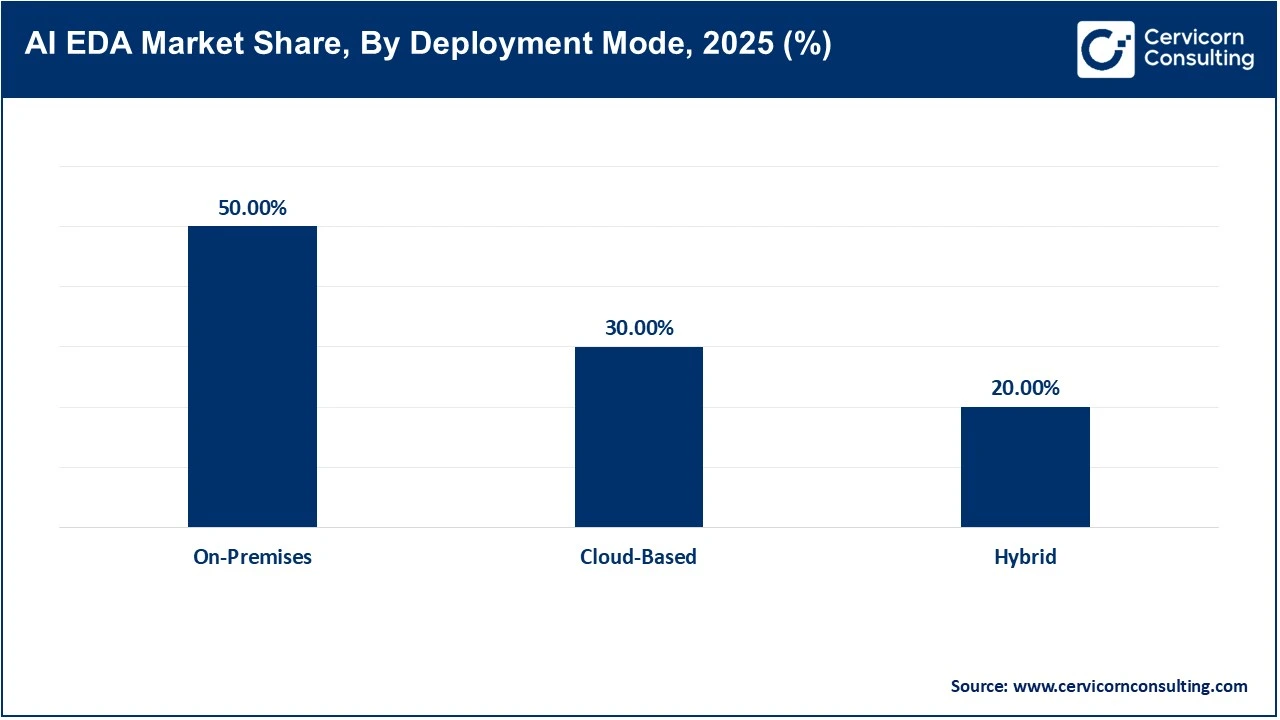
Cloud-based deployment is the fastest-growing mode in the market, mainly due to its ability to democratise chip design and provide scalable computing resources. Cloud platforms enable startups and smaller design teams to access high-performance tools without significant upfront infrastructure investment. The adoption of cloud-based EDA is increasing at a significantly faster rate than traditional on-premises solutions. Major providers such as Amazon Web Services and Microsoft Azure are offering “Silicon-as-a-Service” environments that provide ready-to-use AI-integration design tools, enabling small teams to scale compute needs to compete with larger industry players.
Microprocessors and Controllers account for the largest share of the market, primarily because they power modern electronic devices such as smartphones, wearables, and IoT systems. In 2025, microprocessors will be driven by the insatiable demand for on-device AI computing, where processing capabilities are embedded directly within devices. As a result, the need for efficient, high-performance chip design continues to fuel demand for EDA tools in this segment.
AI EDA Market Share, By Application, 2025 (%)
| Application | Revenue Share, 2025 (%) |
| Microprocessors & Controllers | 45% |
| Memory Management Units | 25% |
| Other Applications | 30% |
Memory Management Units (MMUs) are the fastest-growing application in the market, primarily because of the "Memory Wall" in AI training. With large and complex AI models, systems have shifted from computing power to data throughput. To address these challenges, designers are leveraging AI-driven EDA tools to optimize memory architectures and manage large-scale data processing requirements. This is particularly relevant for applications involving large language models (LLMs) and real-time data processing, where efficient memory handling is essential.
Consumer Electronics is the dominant end user of the market, supported by high-volume production and rapid device replacement cycles for smartphones, personal computers, and gaming consoles. In 2025, demand for AI-enabled chipsets has increased significantly, with growth of up to 12% driven by the adoption of on-device AI capabilities. As consumers increasingly expect advanced features, including local AI processing, the scale and volume of this market continue to sustain its leading position.
AI EDA Market Share, By End-user, 2025 (%)
| End-user | Revenue Share, 2025 (%) |
| Consumer Electronics | 30% |
| Automotive | 18% |
| Aerospace & Defense | 15% |
| Healthcare | 12% |
| Telecom & Data Centers | 10% |
| Industrial | 8% |
| Other End Uses | 7% |
Automotive is the fastest-growing end-use sector of the market, primarily due to the shift from traditional automobiles to Software-Defined Vehicles (SDVs) and autonomous vehicles. The design of automotive-grade chips must meet stringent safety and reliability standards, such as ISO 26262. Additionally, the automotive sector has begun requiring AI EDA tools for validation. They may also begin to design their own custom silicon to differentiate vehicle performance and safety features in the future.
By Product Category
By Deployment Mode
By Application
By End User
By Region
Chapter 1. Market Introduction and Overview
1.1 Market Definition and Scope
1.1.1 Overview of AI EDA
1.1.2 Scope of the Study
1.1.3 Research Timeframe
1.2 Research Methodology and Approach
1.2.1 Methodology Overview
1.2.2 Data Sources and Validation
1.2.3 Key Assumptions and Limitations
Chapter 2. Executive Summary
2.1 Market Highlights and Snapshot
2.2 Key Insights by Segments
2.2.1 By Product Category Overview
2.2.2 By Deployment Mode Overview
2.2.3 By Application Overview
2.2.4 By End User Overview
2.3 Competitive Overview
Chapter 3. Global Impact Analysis
3.1 Russia-Ukraine Conflict: Global Market Implications
3.2 Regulatory and Policy Changes Impacting Global Markets
Chapter 4. Market Dynamics and Trends
4.1 Market Dynamics
4.1.1 Market Drivers
4.1.2 Market Restraints
4.1.3 Market Opportunities
4.1.4 Market Challenges
4.2 Market Trends
Chapter 5. Premium Insights and Analysis
5.1 Global AI EDA Market Dynamics, Impact Analysis
5.2 Porter’s Five Forces Analysis
5.2.1 Bargaining Power of Suppliers
5.2.2 Bargaining Power of Buyers
5.2.3 Threat of Substitute Products
5.2.4 Rivalry among Existing Firms
5.2.5 Threat of New Entrants
5.3 PESTEL Analysis
5.4 Value Chain Analysis
5.5 Product Pricing Analysis
5.6 Vendor Landscape
5.6.1 List of Buyers
5.6.2 List of Suppliers
Chapter 6. AI EDA Market, By Product Category
6.1 Global AI EDA Market Snapshot, By Product Category
6.1.1 Market Revenue (($Billion) and Growth Rate (%), 2022-2035
6.1.1.1 Integrated Circuit (IC) Physical Design & Verification
6.1.1.2 Computer-Aided Engineering (CAE)
6.1.1.3 Printed Circuit Board (PCB) & Multi-Chip Module (MCM)
6.1.1.4 Services
Chapter 7. AI EDA Market, By Deployment Mode
7.1 Global AI EDA Market Snapshot, By Deployment Mode
7.1.1 Market Revenue (($Billion) and Growth Rate (%), 2022-2035
7.1.1.1 On-Premises
7.1.1.2 Cloud-Based
7.1.1.3 Hybrid
Chapter 8. AI EDA Market, By Application
8.1 Global AI EDA Market Snapshot, By Application
8.1.1 Market Revenue (($Billion) and Growth Rate (%), 2022-2035
8.1.1.1 Microprocessors & Controllers
8.1.1.2 Memory Management Units
8.1.1.3 Other Applications
Chapter 9. AI EDA Market, By End User
9.1 Global AI EDA Market Snapshot, By End User
9.1.1 Market Revenue (($Billion) and Growth Rate (%), 2022-2035
9.1.1.1 Consumer Electronics
9.1.1.2 Automotive
9.1.1.3 Aerospace & Defense
9.1.1.4 Healthcare
9.1.1.5 Telecom & Data Centers
9.1.1.6 Industrial
9.1.1.7 Other End Uses
Chapter 10. AI EDA Market, By Region
10.1 Overview
10.2 AI EDA Market Revenue Share, By Region 2024 (%)
10.3 Global AI EDA Market, By Region
10.3.1 Market Size and Forecast
10.4 North America
10.4.1 North America AI EDA Market Revenue, 2022-2035 ($Billion)
10.4.2 Market Size and Forecast
10.4.3 North America AI EDA Market, By Country
10.4.4 U.S.
10.4.4.1 U.S. AI EDA Market Revenue, 2022-2035 ($Billion)
10.4.4.2 Market Size and Forecast
10.4.4.3 U.S. Market Segmental Analysis
10.4.5 Canada
10.4.5.1 Canada AI EDA Market Revenue, 2022-2035 ($Billion)
10.4.5.2 Market Size and Forecast
10.4.5.3 Canada Market Segmental Analysis
10.4.6 Mexico
10.4.6.1 Mexico AI EDA Market Revenue, 2022-2035 ($Billion)
10.4.6.2 Market Size and Forecast
10.4.6.3 Mexico Market Segmental Analysis
10.5 Europe
10.5.1 Europe AI EDA Market Revenue, 2022-2035 ($Billion)
10.5.2 Market Size and Forecast
10.5.3 Europe AI EDA Market, By Country
10.5.4 UK
10.5.4.1 UK AI EDA Market Revenue, 2022-2035 ($Billion)
10.5.4.2 Market Size and Forecast
10.5.4.3 UK Market Segmental Analysis
10.5.5 France
10.5.5.1 France AI EDA Market Revenue, 2022-2035 ($Billion)
10.5.5.2 Market Size and Forecast
10.5.5.3 France Market Segmental Analysis
10.5.6 Germany
10.5.6.1 Germany AI EDA Market Revenue, 2022-2035 ($Billion)
10.5.6.2 Market Size and Forecast
10.5.6.3 Germany Market Segmental Analysis
10.5.7 Rest of Europe
10.5.7.1 Rest of Europe AI EDA Market Revenue, 2022-2035 ($Billion)
10.5.7.2 Market Size and Forecast
10.5.7.3 Rest of Europe Market Segmental Analysis
10.6 Asia Pacific
10.6.1 Asia Pacific AI EDA Market Revenue, 2022-2035 ($Billion)
10.6.2 Market Size and Forecast
10.6.3 Asia Pacific AI EDA Market, By Country
10.6.4 China
10.6.4.1 China AI EDA Market Revenue, 2022-2035 ($Billion)
10.6.4.2 Market Size and Forecast
10.6.4.3 China Market Segmental Analysis
10.6.5 Japan
10.6.5.1 Japan AI EDA Market Revenue, 2022-2035 ($Billion)
10.6.5.2 Market Size and Forecast
10.6.5.3 Japan Market Segmental Analysis
10.6.6 India
10.6.6.1 India AI EDA Market Revenue, 2022-2035 ($Billion)
10.6.6.2 Market Size and Forecast
10.6.6.3 India Market Segmental Analysis
10.6.7 Australia
10.6.7.1 Australia AI EDA Market Revenue, 2022-2035 ($Billion)
10.6.7.2 Market Size and Forecast
10.6.7.3 Australia Market Segmental Analysis
10.6.8 Rest of Asia Pacific
10.6.8.1 Rest of Asia Pacific AI EDA Market Revenue, 2022-2035 ($Billion)
10.6.8.2 Market Size and Forecast
10.6.8.3 Rest of Asia Pacific Market Segmental Analysis
10.7 LAMEA
10.7.1 LAMEA AI EDA Market Revenue, 2022-2035 ($Billion)
10.7.2 Market Size and Forecast
10.7.3 LAMEA AI EDA Market, By Country
10.7.4 GCC
10.7.4.1 GCC AI EDA Market Revenue, 2022-2035 ($Billion)
10.7.4.2 Market Size and Forecast
10.7.4.3 GCC Market Segmental Analysis
10.7.5 Africa
10.7.5.1 Africa AI EDA Market Revenue, 2022-2035 ($Billion)
10.7.5.2 Market Size and Forecast
10.7.5.3 Africa Market Segmental Analysis
10.7.6 Brazil
10.7.6.1 Brazil AI EDA Market Revenue, 2022-2035 ($Billion)
10.7.6.2 Market Size and Forecast
10.7.6.3 Brazil Market Segmental Analysis
10.7.7 Rest of LAMEA
10.7.7.1 Rest of LAMEA AI EDA Market Revenue, 2022-2035 ($Billion)
10.7.7.2 Market Size and Forecast
10.7.7.3 Rest of LAMEA Market Segmental Analysis
Chapter 11. Competitive Landscape
11.1 Competitor Strategic Analysis
11.1.1 Top Player Positioning/Market Share Analysis
11.1.2 Top Winning Strategies, By Company, 2022-2024
11.1.3 Competitive Analysis By Revenue, 2022-2024
11.2 Recent Developments by the Market Contributors (2024)
Chapter 12. Company Profiles
12.1 Synopsys, Inc.
12.1.1 Company Snapshot
12.1.2 Company and Business Overview
12.1.3 Financial KPIs
12.1.4 Product/Service Portfolio
12.1.5 Strategic Growth
12.1.6 Global Footprints
12.1.7 Recent Development
12.1.8 SWOT Analysis
12.2 Cadence Design Systems, Inc.
12.3 Siemens Digital Industries Software
12.4 Keysight Technologies
12.5 Ansys, Inc.
12.6 Zuken Inc.
12.7 Empyrean Technology
12.8 Altium Limited
12.9 Silvaco Group
12.10 Aldec, Inc.
12.11 AgniSys, Inc.
12.12 PrimisAI
12.13 Celus GmbH
12.14 Circuit Mind Limited
12.15 Quilter AI