
The global industrial AI market size reached at USD 37.45 billion in 2025 and is expected to be worth around USD 202.66 billion by 2035, exhibiting a compound annual growth rate (CAGR) of 18.4% over the forecast period from 2026 to 2035. The industry AI market growth is mainly driven by increased adoption of predictive maintenance solutions, which provide the most measurable and immediate returns on investment (ROI) for industrial organizations. Machine learning algorithms are employed in predictive maintenance to analyze data sources such as vibration data, thermography, and acoustic patterns. These advanced analytics capabilities support the industry's shift from "fail and fix" maintenance strategies to a more proactive approach of "predict and prevent." There is a strong economic case for predictive maintenance decision support systems that is highly convincing. Unplanned equipment downtime continues to cost global manufacturing organisations billions of dollars each year. By adopting AI-enabled predictive maintenance solutions, organizations can reduce maintenance costs by 10% to 40%, and decrease equipment downtime by 20% to 50%.
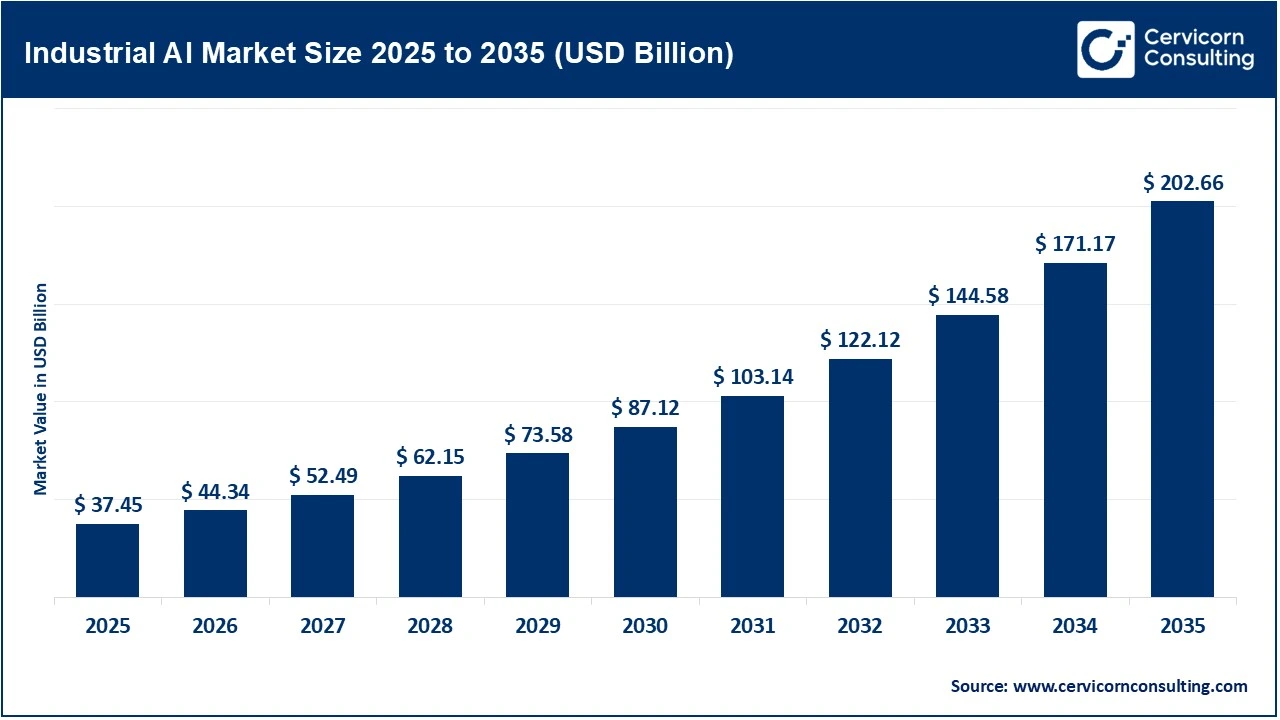
The rapid growth of the Internet of Things (IoT) is another major factor in market expansion. Connected sensors and industrial devices have generated enormous volumes of data, which serve as the "fuel" for industrial AI models. The integration of big data analytics with IoT infrastructure enables real-time monitoring and optimization of complex industrial systems. Organizations with higher levels of analytics maturity tend to outperform others in profitability and process efficiency.
The Rise of Generative AI in Industrial Engineering and Manufacturing
The adoption of generative artificial intelligence is significantly transforming the product development lifecycle, emerging as a major trend in the Industrial AI market. This shift is gradually changing the role of the industrial engineer, moving them from drafter to curator. Engineers can input specific constraints, such as material strength, weight, and cost, and generative algorithms will develop and generate thousands of design iterations that optimize performance in ways a human designer might not consider. In industries like aerospace, this trend is already used for material design, where reducing part weight by a small percentage greatly impacts fuel costs.
Beyond product design, generative AI is also transforming business processes, decision-making, and customer engagement across industries. In manufacturing, advanced AI models such as Large Language Models (LLMs) are used to synthesize maintenance manuals and provide real-time troubleshooting to technicians. Moreover, integrating generative models into simulation workflows creates "synthetic data" to train other AI models.
The Growing Impact of Industrial AI Across Industries and Product Lifecycles
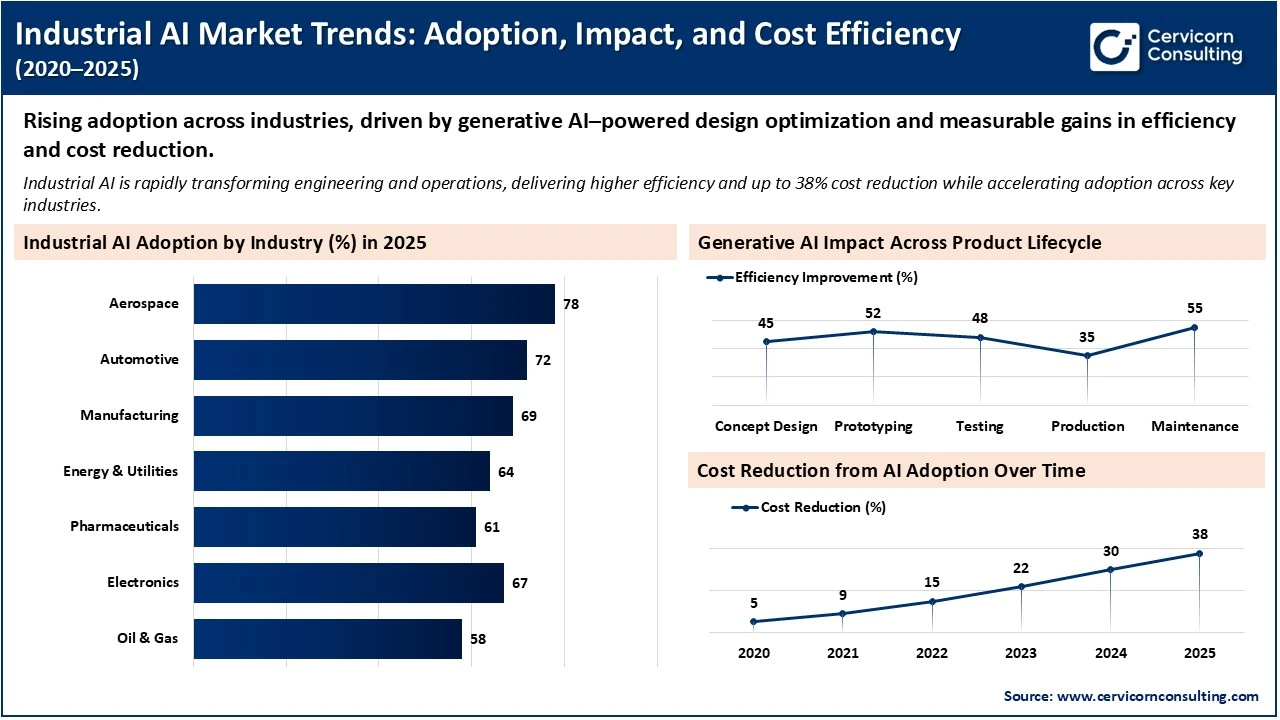
The adoption of Industrial AI is becoming increasingly prominent across various sectors, as shown in the image. The left chart indicates that industries such as aerospace, automotive, and manufacturing are integrating AI technologies at a significant rate, reflecting a broad shift towards advanced digital solutions. The top-right chart shows that generative AI is driving notable efficiency gains across the product lifecycle, particularly in the prototyping and maintenance stages. Additionally, the bottom-right chart shows a steady increase in cost savings, projected to reach nearly 40% by 2025. These trends suggest that Industrial AI is playing a crucial role in driving innovation, optimizing design processes, and delivering measurable economic benefits. As a result, the integration of Industrial AI is expected to become a key factor in maintaining competitiveness within modern industries.
What is the Impact of Industry 4.0 and Smart Manufacturing Initiatives on Industrial AI adoption?
Industry 4.0 is acting as a foundational framework for Industrial AI deployment by enabling connected equipment, real-time data exchange, and autonomous decision-making in manufacturing environments. Governments globally are developing policies to speed this transition, as they view industrial AI as part of national competitiveness. These policies may include tax incentives, research grants, and supporting "smart factory" lighthouse projects.
Report Scope
| Area of Focus | Details |
| Market Size in 2026 | USD 44.34 Billion |
| Market Size in 2035 | USD 202.66 Billion |
| CAGR 2026 to 2035 | 18.40% |
| Dominant Region | North America |
| Fastest Growing Region | Asia-Pacific |
| Key Segments | Offering, Deployment, Technology, Application, End-use Industry, Region |
| Key Companies | IBM, Intel, Siemens, Microsoft, Cisco, General Electric, Rockwell Automation, Oracle, SAP, Dell Technologies, Amazon, Bosch, Google, Huawei, Nvidia |
1. Corporate Milestones and Product Advances
One of the most significant milestones in the industrial AI market is the launch of the "Industrial Copilot" by Siemens and Microsoft. This collaborative offering is the first Large Language Model (LLMs) deployed at a significant scale in factory automation, enabling engineers to generate complex automation code using natural language. The partnership led to a 10% increase in the market valuation for the software segment in 2025. By lowering the technical barriers to entry for complex programming and helping to accelerate digital transformation, especially among mid-sized manufacturing companies.
2. National Government Programs and Policy Framework
The government program continues to play a crucial role in shaping the industrial AI market by promoting regulatory clarity and market stability. For Example, the EU AI Act, which established the world's first comprehensive legal framework associated with "High-Risk AI" applications in manufacturing. This milestone increases compliance costs by 15% for early adopters. The regulation has created a more stable and predictable market for long-term investment. By specifying data privacy and algorithmic transparency guidelines, the Act helped build higher levels of trust among industrial stakeholders.
3. Strategic Mergers and Larger-scale Infrastructure Investments
The strategic partnership and investment by large-scale industry serve as major growth drivers for the Industry AI market. The implementation of the US "Chips and Science Act" has led to the establishment of multiple AI-specific semiconductor manufacturing plants opened in the United States during 2025 and early 2026. This development has helped stabilize the supply chain for industrial AI hardware that previously faced delays. As a result, lead times for AI-enabled sensors and advanced processing units have reportedly decreased by up to 40%. This domestic manufacturing capacity protects critical AI-transformation hardware from geopolitical uncertainties.
4. Global Expansion Milestones and Market Adoption Successes
The global market expansion and development trends are transforming the industry. NVIDIA’s expansion of the "Omniverse" for Industrial Digital Twins has revolutionised how factories are designed and commissioned. By releasing specialized industrial APIs, NVIDIA has enabled the creation of physics-accurate simulations of entire production lines. Companies are using digital twins technologies to cut factory commissioning time by up to 30%. This milestone has been especially significant in the aerospace and automotive industries, where high costs of design errors make simulation capabilities a crucial strategic advantage.
The Industrial AI market is segmented by region into North America, Europe, Asia-Pacific, and LAMEA. Here is a brief overview of each region:
The Asia-Pacific Industrial AI market size was estimated at USD 9.36 billion in 2025 and is projected to garner around USD 50.67 billion by 2035. Asia-Pacific is the fastest-growing region in the market due to rapid industrialization and government digital initiatives. Countries such as China, India, and Southeast Asia are investing heavily in large-scale smart factory programs to address labor shortages and rising operational costs. China's "New Industrialization" policy has enabled the filing of over 1 million Industrial AI patents, indicating a heavy focus on research and development. Meanwhile, India's "Make in India" digital initiative is attracting foreign investment into AI-based electronics and electric vehicle manufacturing. The region's reliance on high-volume manufacturing will further establish it as the main testing ground for 5G-integrated industrial private networks and autonomous robotics.
China to Expand Industrial Robotics and AI Deployment
China continues to lead global industrial AI deployment, driven by its strong focus on robotics and automation technologies.
India to Drive Industrial AI Adoption through Digital Manufacturing Expansion
India is witnessing rapid adoption of Industrial AI as manufacturers focus on operational efficiency and global competitiveness.
The North America Industrial AI market size was valued at USD 14.98 billion in 2025 and is projected to surpass around USD 81.06 billion by 2035.
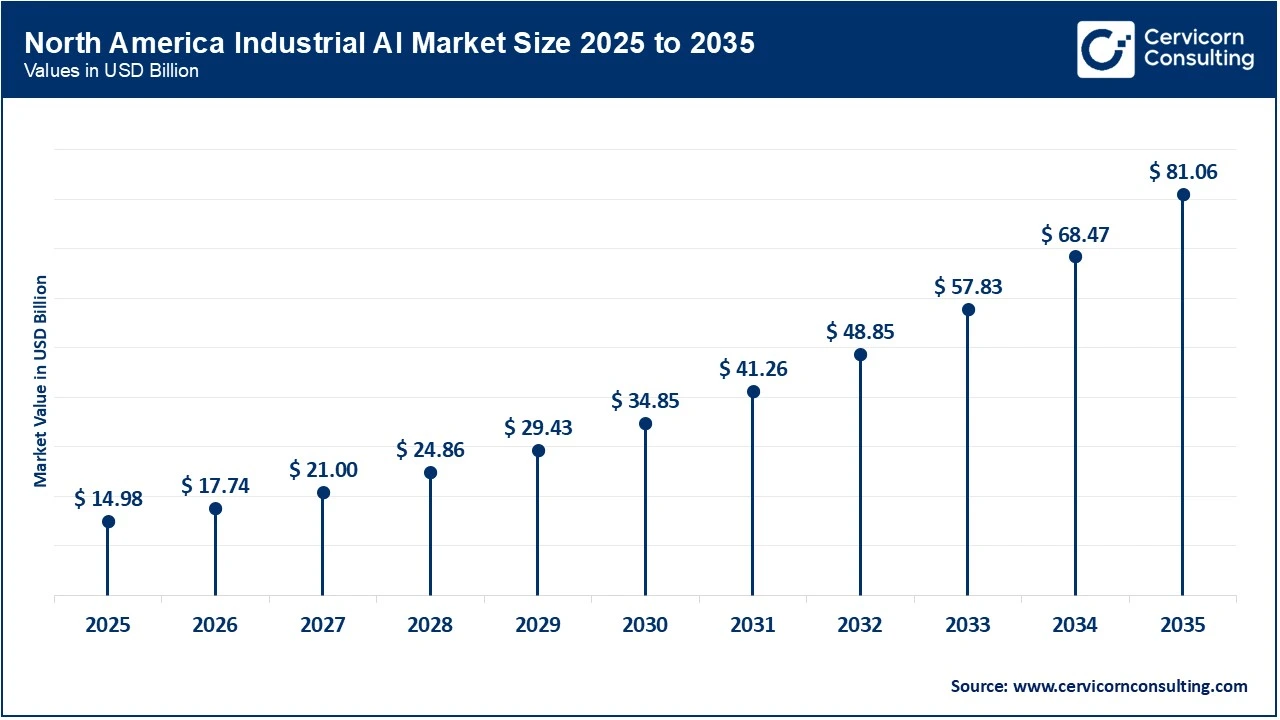
North America dominates the market mainly due to its advanced technological infrastructure and early adoption of Industry 4.0. The region's leadership is supported by a strong venture capital ecosystem and government policies, such as the "Chips and Science Act," which have spurred rapid investment in semiconductor and AI infrastructure domestically. Moreover, collaboration between leading technology innovators and major cloud service providers facilitates quick scaling of "AI Factories," especially in aerospace, defense, and automotive markets, where low latency and precision are essential.
United States to Expand Industrial Automation with AI-Enabled Robotics
Industrial automation adoption is accelerating as companies integrate advanced robotics into factory operations.
Canada to Expand Industrial AI Adoption through Smart Manufacturing Investments
Canada is steadily strengthening Industrial AI deployment through automation upgrades and digital manufacturing programs.
The Europe Industrial AI market size was accounted for USD 10.49 billion in 2025 and is forecasted to hit around USD 56.74 billion by 2035. Europe market growth is driven by a high concentration of automotive manufacturing and strict industrial standards, with a growing focus on "Industry 5.0" principles around people-centric AI and sustainability. Policy frameworks such as the European Green Deal are encouraging for manufacturers to deploy AI solutions to reduce their carbon footprint and enhance energy efficiency. The EU AI Act provides a comprehensive regulatory framework for "Trustworthy AI" that many European companies will leverage as a competitive advantage in safety-critical industries such as chemicals and heavy equipment.
European Union to Launch Large-Scale AI Investment Program
The European Union is accelerating Industrial AI adoption through major funding initiatives aimed at strengthening global competitiveness.
Germany to Strengthen Industry 4.0 Leadership through Automation Funding
Germany is advancing Industrial AI adoption through long-term government programs supporting smart manufacturing transformation.
Industrial AI market Share, By Region, 2025 (%)
| Region | Revenue Share, 2025 (%) |
| North America | 40% |
| Europe | 28% |
| Asia Pacific | 25% |
| LAMEA | 7% |
The LAMEA Industrial AI market was valued at USD 2.62 billion in 2025 and is anticipated to reach around USD 14.19 billion by 2035. The LAMEA region is experiencing rapid industrial modernization and digital transformation efforts. In many markets, AI is enabling “digital leapfrogging,” allowing industries to adopt advanced technologies to improve resource extraction and modernize infrastructure for economic diversification. In the Middle East, artificial intelligence plays a central role in national "Vision" plans, where it is used to manage smart cities and industrial areas. In Latin America, the focus is on generating production efficiencies at a global supply chain shift towards nearshoring models.
UAE to Expand Industrial AI Adoption through Smart Manufacturing and Data-Centre Infrastructure
The United Arab Emirates is rapidly transforming its manufacturing sector through AI integration, industrial policy reforms, and strategic technology partnerships.
Saudi Arabia to Position Itself as a Regional Industrial AI Powerhouse
Saudi Arabia is accelerating Industrial AI adoption through national digital transformation initiatives aligned with economic diversification goals.
The Industrial AI market is segmented into offering, deployment, technology, application, end-use industry, and region.
Software holds the largest share of the Industry AI market, primarily due to the high value and strong profit margins associated with proprietary AI algorithms and analytics platforms. Software solutions such as analytical platforms and Software-as-a-Service (SaaS) models help companies to generate recurring revenue through licensing and subscription-based business models. In industrial settings, software functions as the "brain" of operations by turning raw operational data into actionable insights that support generating high-value operational decisions from raw data.
Industrial AI market Share, By Offering, 2025 (%)
| Offering | Revenue Share, 2025 (%) |
| Software | 65% |
| Hardware | 35% |
Hardware is the fastest-growing segment in the market, mainly driven by rising demand for AI-optimized processing technologies. Increasing adoption of Neural Processing Units (NPUs) and high-performance Graphics Processing Units (GPUs) is necessary for running the increasingly complex models at the edge. As industrial operations need real-time processing at the edge, demand is also growing for specialized sensors, Edge Gateway(s), and industrial PC hardware.
Cloud deployment is dominating the Industrial AI market mainly because it offers scalability, operational flexibility, and lower capital expenditure. Large manufacturers compile data from various global sites into the cloud, enabling enterprise-level benchmarking through machine learning and deep learning models that need significant computational power. The cloud acts as a centralized "single source of truth" for the global supply chain, making it a smart choice for large-scale transformation.
Industrial AI market Share, By Deployment, 2025 (%)
| Deployment | Revenue Share, 2025 (%) |
| Cloud-based | 80% |
| On-premises | 20% |
On-premises are the fastest-growing deployment models in the market because manufacturers want to reduce risks related to data latency and cybersecurity. Many industrial players, especially in defense, aerospace, and pharmaceuticals, are hesitant to move sensitive proprietary data to the public cloud. Additionally, on-premises industrial AI deployments are expanding 5% faster than cloud-based solutions throughout 2024 and 2025.
Deep Learning (DL) is a dominant technology segment in the Industrial AI market, serving as the foundation for advanced use cases such as image recognition, complex predictive modeling, and autonomous robotics. These systems are essential for decoding unstructured data from high-resolution cameras and acoustic sensors, which are used in quality inspection and machinery health monitoring. DL offers the opportunity to detect complex patterns within massive datasets, enabling the evolution of a "Self-Healing" factory environment, where AI systems make autonomous adjustments to plant parameters to enhance performance.
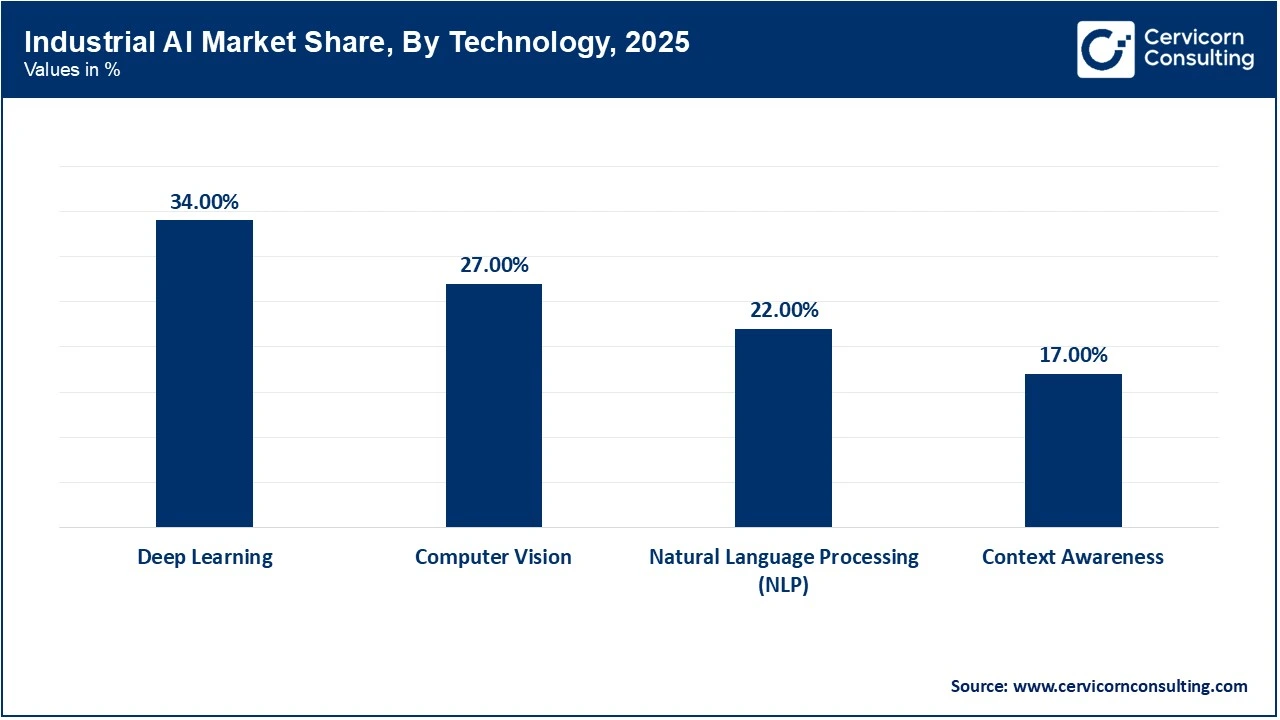
Natural Language Processing (NLP) is the fastest-growing technology segment, primarily driven by the rapid adoption of "Conversational AI" and voice assistants on the shop floor. NLP technology allows technicians and operators to interact with machines using natural language commands, access maintenance documentation, and generate issue reports via natural language, significantly improving efficiency and safety. This technology is transforming the human-machine interface and democratizing control of complex industrial systems in a workforce increasingly connected to digital technologies.
Predictive Maintenance & Machinery Inspection is a leading application in the market, mainly because it addresses one of the most important industry issues, unplanned equipment downtime. By using artificial intelligence algorithms to predict when a component might fail, companies can plan maintenance during scheduled shutdowns, saving billions of dollars in lost production. This use is well established in heavy industries like oil and gas, mining, and power generation, where a single machine failure can have catastrophic consequences.
Industrial AI market Share, By Application, 2025 (%)
| Application | Revenue Share, 2025 (%) |
| Predictive Maintenance & Machinery Inspection | 32% |
| Quality Control | 22% |
| Production Planning | 15% |
| Material Movement | 13% |
| Field Services | 10% |
| Others | 8% |
The quality control application is the fastest-growing segment of the market, mainly driven by high-speed computer vision and deep learning technology. Modern AI control systems can detect microscopic defects in products at high speeds on assembly lines with a level of precision beyond human capability. As manufacturing tolerances become tighter and consumer expectations shift toward zero-defect products, the need for automated AI inspection systems continues to grow across all manufacturing sectors.
The automobile sector is the leading end-user segment, primarily due to its early use of robotics automation and its complex, data-rich supply chains. Automobile manufacturers have been pioneers in applying AI throughout the product lifecycle, including generative design, prototyping, autonomous assembly, and predictive supply chain management. The industry's ongoing shift towards electric and autonomous vehicles continues to drive significant capital investment in AI technology.
Industrial AI market Share, By End-use Industry, 2025 (%)
| End-use Industry | Revenue Share, 2025 (%) |
| Automobile | 24% |
| Energy & Power | 18% |
| Heavy Metals & Machine Manufacturing | 16% |
| Food & Beverages | 14% |
| Pharmaceuticals | 12% |
| Others | 16% |
Pharmaceuticals are the fastest-growing end-use industry in the market, driven by the need to accelerate drug manufacturing and support personalized medicine development. The pharmaceutical industry employs AI to optimise chemical processes, ensure regulatory compliance and cleanroom standards, and manage the logistics of temperature-sensitive biologics. The adoption of "Digital Twin" technologies enables manufacturing to simulate production runs and reduce waste while ensuring maximum product safety and efficacy.
By Offering
By Deployment
By Technology
By Application
By End-use Industry
By Region
Chapter 1. Market Introduction and Overview
1.1 Market Definition and Scope
1.1.1 Overview of Industrial AI
1.1.2 Scope of the Study
1.1.3 Research Timeframe
1.2 Research Methodology and Approach
1.2.1 Methodology Overview
1.2.2 Data Sources and Validation
1.2.3 Key Assumptions and Limitations
Chapter 2. Executive Summary
2.1 Market Highlights and Snapshot
2.2 Key Insights by Segments
2.2.1 By Offering Overview
2.2.2 By Technology Overview
2.2.3 By Deployment Overview
2.2.4 By End User Overview
2.2.5 By Application Overview
2.3 Competitive Overview
Chapter 3. Global Impact Analysis
3.1 Russia-Ukraine Conflict: Global Market Implications
3.2 Regulatory and Policy Changes Impacting Global Markets
Chapter 4. Market Dynamics and Trends
4.1 Market Dynamics
4.1.1 Market Drivers
4.1.2 Market Restraints
4.1.3 Market Opportunities
4.1.4 Market Challenges
4.2 Market Trends
Chapter 5. Premium Insights and Analysis
5.1 Global Industrial AI Market Dynamics, Impact Analysis
5.2 Porter’s Five Forces Analysis
5.2.1 Bargaining Power of Suppliers
5.2.2 Bargaining Power of Buyers
5.2.3 Threat of Substitute Products
5.2.4 Rivalry among Existing Firms
5.2.5 Threat of New Entrants
5.3 PESTEL Analysis
5.4 Value Chain Analysis
5.5 Product Pricing Analysis
5.6 Vendor Landscape
5.6.1 List of Buyers
5.6.2 List of Suppliers
Chapter 6. Industrial AI Market, By Offering
6.1 Global Industrial AI Market Snapshot, By Offering
6.1.1 Market Revenue (($Billion) and Growth Rate (%), 2022-2035
6.1.1.1 Software
6.1.1.2 Hardware
Chapter 7. Industrial AI Market, By Technology
7.1 Global Industrial AI Market Snapshot, By Technology
7.1.1 Market Revenue (($Billion) and Growth Rate (%), 2022-2035
7.1.1.1 Deep Learning
7.1.1.2 Computer Vision
7.1.1.3 Natural Language Processing (NLP)
7.1.1.4 Context Awareness
Chapter 8. Industrial AI Market, By Deployment
8.1 Global Industrial AI Market Snapshot, By Deployment
8.1.1 Market Revenue (($Billion) and Growth Rate (%), 2022-2035
8.1.1.1 Cloud-based
8.1.1.2 On-premises
Chapter 9. Industrial AI Market, By End-use Industry
9.1 Global Industrial AI Market Snapshot, By End-use Industry
9.1.1 Market Revenue (($Billion) and Growth Rate (%), 2022-2035
9.1.1.1 Automobile
9.1.1.2 Energy & Power
9.1.1.3 Heavy Metals & Machine Manufacturing
9.1.1.4 Food & Beverages
9.1.1.5 Pharmaceuticals
9.1.1.6 Others
Chapter 10. Industrial AI Market, By Application
10.1 Global Industrial AI Market Snapshot, By Application
10.1.1 Market Revenue (($Billion) and Growth Rate (%), 2022-2035
10.1.1.1 Predictive Maintenance & Machinery Inspection
10.1.1.2 Quality Control
10.1.1.3 Production Planning
10.1.1.4 Material Movement
10.1.1.5 Field Services
10.1.1.6 Others
Chapter 11. Industrial AI Market, By Region
11.1 Overview
11.2 Industrial AI Market Revenue Share, By Region 2024 (%)
11.3 Global Industrial AI Market, By Region
11.3.1 Market Size and Forecast
11.4 North America
11.4.1 North America Industrial AI Market Revenue, 2022-2035 ($Billion)
11.4.2 Market Size and Forecast
11.4.3 North America Industrial AI Market, By Country
11.4.4 U.S.
11.4.4.1 U.S. Industrial AI Market Revenue, 2022-2035 ($Billion)
11.4.4.2 Market Size and Forecast
11.4.4.3 U.S. Market Segmental Analysis
11.4.5 Canada
11.4.5.1 Canada Industrial AI Market Revenue, 2022-2035 ($Billion)
11.4.5.2 Market Size and Forecast
11.4.5.3 Canada Market Segmental Analysis
11.4.6 Mexico
11.4.6.1 Mexico Industrial AI Market Revenue, 2022-2035 ($Billion)
11.4.6.2 Market Size and Forecast
11.4.6.3 Mexico Market Segmental Analysis
11.5 Europe
11.5.1 Europe Industrial AI Market Revenue, 2022-2035 ($Billion)
11.5.2 Market Size and Forecast
11.5.3 Europe Industrial AI Market, By Country
11.5.4 UK
11.5.4.1 UK Industrial AI Market Revenue, 2022-2035 ($Billion)
11.5.4.2 Market Size and Forecast
11.5.4.3 UK Market Segmental Analysis
11.5.5 France
11.5.5.1 France Industrial AI Market Revenue, 2022-2035 ($Billion)
11.5.5.2 Market Size and Forecast
11.5.5.3 France Market Segmental Analysis
11.5.6 Germany
11.5.6.1 Germany Industrial AI Market Revenue, 2022-2035 ($Billion)
11.5.6.2 Market Size and Forecast
11.5.6.3 Germany Market Segmental Analysis
11.5.7 Rest of Europe
11.5.7.1 Rest of Europe Industrial AI Market Revenue, 2022-2035 ($Billion)
11.5.7.2 Market Size and Forecast
11.5.7.3 Rest of Europe Market Segmental Analysis
11.6 Asia Pacific
11.6.1 Asia Pacific Industrial AI Market Revenue, 2022-2035 ($Billion)
11.6.2 Market Size and Forecast
11.6.3 Asia Pacific Industrial AI Market, By Country
11.6.4 China
11.6.4.1 China Industrial AI Market Revenue, 2022-2035 ($Billion)
11.6.4.2 Market Size and Forecast
11.6.4.3 China Market Segmental Analysis
11.6.5 Japan
11.6.5.1 Japan Industrial AI Market Revenue, 2022-2035 ($Billion)
11.6.5.2 Market Size and Forecast
11.6.5.3 Japan Market Segmental Analysis
11.6.6 India
11.6.6.1 India Industrial AI Market Revenue, 2022-2035 ($Billion)
11.6.6.2 Market Size and Forecast
11.6.6.3 India Market Segmental Analysis
11.6.7 Australia
11.6.7.1 Australia Industrial AI Market Revenue, 2022-2035 ($Billion)
11.6.7.2 Market Size and Forecast
11.6.7.3 Australia Market Segmental Analysis
11.6.8 Rest of Asia Pacific
11.6.8.1 Rest of Asia Pacific Industrial AI Market Revenue, 2022-2035 ($Billion)
11.6.8.2 Market Size and Forecast
11.6.8.3 Rest of Asia Pacific Market Segmental Analysis
11.7 LAMEA
11.7.1 LAMEA Industrial AI Market Revenue, 2022-2035 ($Billion)
11.7.2 Market Size and Forecast
11.7.3 LAMEA Industrial AI Market, By Country
11.7.4 GCC
11.7.4.1 GCC Industrial AI Market Revenue, 2022-2035 ($Billion)
11.7.4.2 Market Size and Forecast
11.7.4.3 GCC Market Segmental Analysis
11.7.5 Africa
11.7.5.1 Africa Industrial AI Market Revenue, 2022-2035 ($Billion)
11.7.5.2 Market Size and Forecast
11.7.5.3 Africa Market Segmental Analysis
11.7.6 Brazil
11.7.6.1 Brazil Industrial AI Market Revenue, 2022-2035 ($Billion)
11.7.6.2 Market Size and Forecast
11.7.6.3 Brazil Market Segmental Analysis
11.7.7 Rest of LAMEA
11.7.7.1 Rest of LAMEA Industrial AI Market Revenue, 2022-2035 ($Billion)
11.7.7.2 Market Size and Forecast
11.7.7.3 Rest of LAMEA Market Segmental Analysis
Chapter 12. Competitive Landscape
12.1 Competitor Strategic Analysis
12.1.1 Top Player Positioning/Market Share Analysis
12.1.2 Top Winning Strategies, By Company, 2022-2024
12.1.3 Competitive Analysis By Revenue, 2022-2024
12.2 Recent Developments by the Market Contributors (2024)
Chapter 13. Company Profiles
13.1 IBM
13.1.1 Company Snapshot
13.1.2 Company and Business Overview
13.1.3 Financial KPIs
13.1.4 Product/Service Portfolio
13.1.5 Strategic Growth
13.1.6 Global Footprints
13.1.7 Recent Development
13.1.8 SWOT Analysis
13.2 Intel
13.3 Siemens
13.4 Microsoft
13.5 Cisco
13.6 General Electric
13.7 Rockwell Automation
13.8 Oracle
13.9 SAP
13.10 Dell Technologies
13.11 Amazon
13.12 Bosch
13.13 Google
13.14 Huawei
13.15 Nvidia