
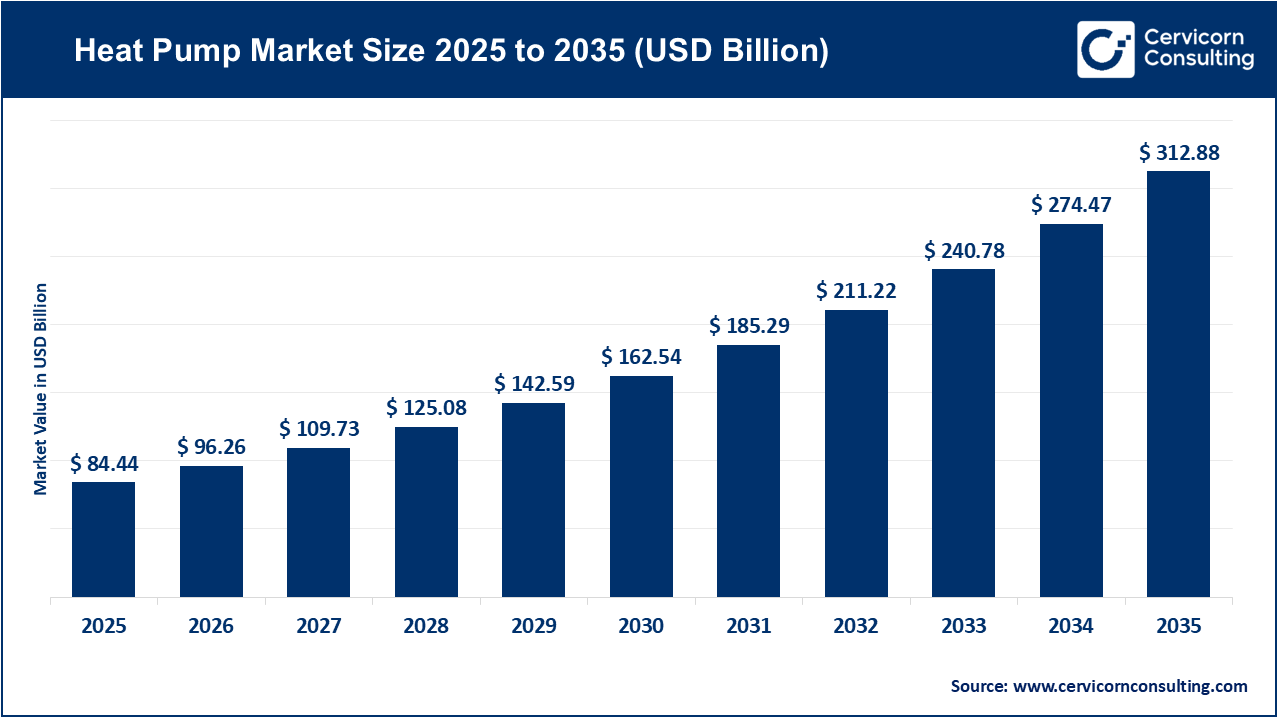
The global heat pump market size was reached at USD 84.44 billion in 2025 and is expected to be worth around USD 312.88 billion by 2035, exhibiting a compound annual growth rate (CAGR) of 14% over the forecast period from 2026 to 2035. The heat pump market growth is significantly driven by the strong alignment of international climate policy and national decarbonization strategies. Under the Paris Agreement, countries are actively working toward limiting global warming to 1.5°C, making the decarbonization of space and water heating an essential goal. Heat pumps are the dominant technology in this ongoing transition, enabling the use of increasingly low-carbon electricity grids to meet thermal energy needs. Governments worldwide are integrating "Net Zero" targets into their policies, resulting in strict building codes and energy performance standards that favour heat pump technology over gas or oil boilers. For example, the European Union aims to deploy nearly 60 million heat pumps by 2030 under the REPowerEU plan.
Beyond environmental concerns, energy security also drives market growth. The vulnerability of global supply chains and fluctuations in fossil fuel prices have encouraged countries to strategically electrify their economies. This is achieved by using heat pumps to harness domestic renewable energy sources such as wind and solar for heating buildings. Consequently, rising demand for heat pumps is boosting domestic manufacturing and supply chain resilience, laying a stronger foundation for market expansion.
Policy-Driven Decarbonization and Electrification Trends
Policy-driven decarbonization and electrification are significant growth drivers for the heat pumps markets. Governments are increasingly introducing strict policy mandates to reduce dependency on fossil fuels and promote electric heating solutions. In the European Union, regulatory frameworks such as the Energy Performance of Buildings Directive (EPBD) and Energy Efficiency Directive (EED) are primary drivers for HVAC optimization performance. For example, strict renewable integration, like in Germany, reports 40% higher adoption rates than regions with less implementation of such policies. In the US, policies such as the Inflation Reduction Act (IRA) provide financial incentives, such as tax credits up to USD 2,000 for residential installations of heat pumps.
How does the “spark spread” impact heat pump economically & how can embrace the Spark Gap?
The concept of "spark spread" refers to the price of electricity compared to the price of natural gas, indicating the cost advantage of electricity over a gas boiler. The heat pump must be efficient enough (COP) to offset the higher price of electricity per energy unit. In markets, electricity is four times more expensive than natural gas. A heat pump would need to have a COP of at least 4.0 to be economically comparable to a boiler. These solutions support policy efforts to rebalance energy taxes, shifting the burden from electricity to carbon-intensive fuels, thus making electrification more economically viable.
Key insights regarding the Spark Gap
Invest in Renewable Energy:
Incentivize Electrification:
Heat pump for Home sizing: Tons, British Thermal Units (BTUs), square footage & ductwork
| Home size (sq. ft.) | Unit Size (tons) | Unit Size (BTUs) |
| 1,200 sq. ft. | 2-ton heat pump | 24,000 BTUs |
| 1,800 sq. ft. | 3-ton heat pump | 36,000 BTUs |
| 2,400 sq. ft. | 4-ton heat pump | 48,000 BTUs |
| 3,000 sq. ft. | 5-ton heat pump | 60,000 BTUs |
1. The European Union Heat Pump Action Plan Implementation
The European Union is a major driver of heat pump adoption due to its energy transition under the REPowerEU plan, which aims to install at least 30 million heat pumps by 2030. This plan builds on the Energy Performance of Buildings Directive (EPBD), promoting the development of nearly zero-energy buildings and supporting advanced technologies such as phase change materials (PCM) to enhance HVAC systems in meeting climate goals. Additionally, the EU has accelerated the phase-out of stand-alone fossil fuel boilers by 2029 and introduced financing options to help reduce the risk of high costs for customers.
2. Potential Effects of the U.S. Inflation Reduction Act (IRA) and Federal Tax Credits
The Inflation Reduction Act (IRA) and Federal Tax Credits constitute a key policy framework promoting heat pump adoption in the United States. The legislation offers a substantial production tax credit for clean energy technologies, including heat pumps and clean hydrogen. The IRA also enables homeowners to qualify for tax credits covering up to 30% of the installation cost of a heat pump, with a maximum cap of USD 2000. Meanwhile, the Defense Production Act has been invoked to boost domestic manufacturing of heat pumps to achieve energy sovereignty. Additionally, the IRA assigns federal sites and national laboratories the task of developing new sustainability plans focused on reducing emissions and improving climate resilience through electrified heating technologies.
3. Increasing Global Manufacturing Capacity and Gigafactory Development
The rapid expansion of manufacturing capacity is playing an essential role in supporting the growth of the heat pumps market. During 2024-2025, companies such as Daikin and Bosch announced multi-billion-dollar investments in new production facilities across regions including Poland, Germany, and the United States. As a result, the global manufacturing capacity for heat pumps has increased by over 20%, with the construction of new facilities that feature high levels of automation to produce next-generation units of natural refrigerants such as CO2. The expansion of capacity is not only driven by rising demand but also by the need to localize supply chains, reduce logistical costs, and lower carbon footprints associated with transporting large HVAC systems.
4. Regulatory Mandates to Phase out Fossil Fuel Boilers
Governments' regulatory mandates to phase out fossil fuel-based heating systems are increasing the adoption of heat pumps. For example, in Germany, the Building Energy Act requires new heating systems in new-build areas to use at least 65% renewable energy sources, effectively prioritizing heat pumps and district heating solutions. Similarly, regions in countries like the United Kingdom and several U.S. states, such as New York and California, are implementing restrictions on gas connections in new home construction. These regulations are driving a faster transition toward electric and sustainable heating technologies, while requiring manufacturers to focus their innovation and product development on cleaner, electric-efficient solutions.
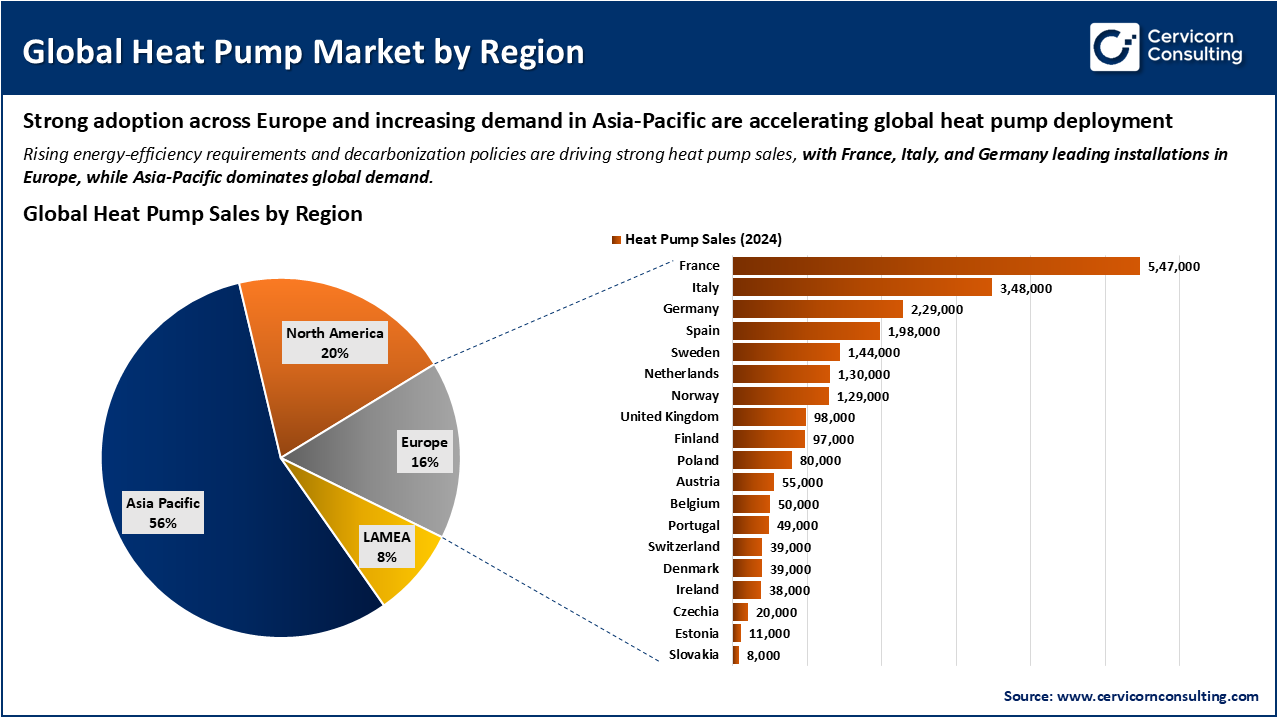
The heat pump market is segmented by region into North America, Europe, Asia-Pacific, and LAMEA. Here is a brief overview of each region
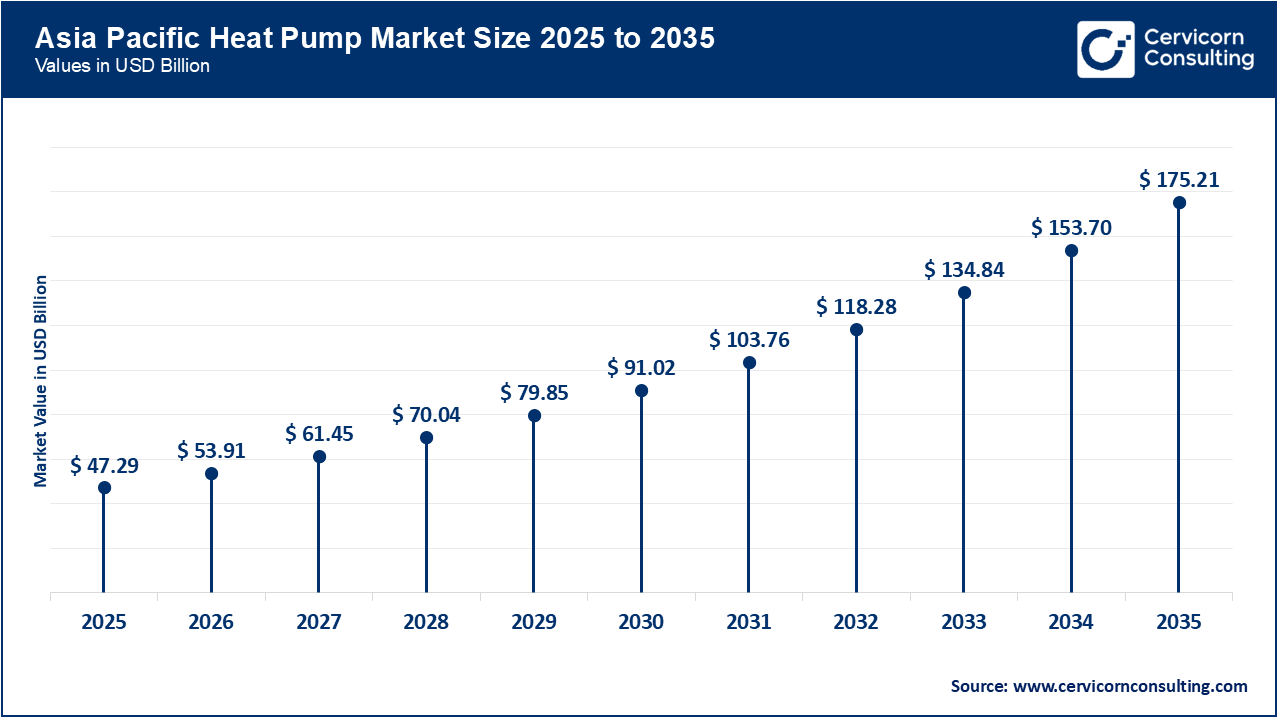
The Asia-Pacific heat pump market size was valued at USD 47.29 billion in 2025 and is expected to surpass around USD 175.21 billion by 2035. The Asia-Pacific region dominates the market, supported by its strong industrial leadership and large-scale manufacturing capabilities. In China, the "Coal-to-Electricity" initiative has shifted over 10 million households away from combustion systems. In 2024, the APAC market grew by 9.5% based on expectations of humanitarian transitions driven by an urbanizing and expanding middle class in India and Southeast Asia that needs energy-efficient heating and cooling solutions. The region's leadership is further strengthened by a robust supply chain for compressors and electronic expansion. Moreover, Japan continues to hold market leadership in technology, with a 12% increase in sales of "EcoCute" CO2-based heat pump water heaters.
China, Japan, and India Heat Pump Market: Key Data Points
The North America heat pump market size was reached at USD 16.89 billion in 2025 and is expected to hit around USD 62.58 billion by 2035, driven by the increasing shift toward residential electrification and the replacement of central air conditioning systems with reversible heat pumps. At the same time, rural northern communities, where 26% of households spend over 10% of their income on energy costs, face unique challenges. In these regions, heating heavily relies on fossil fuels, with heat pumps accounting for only 4.6%, mainly due to asset barriers and energy burdens. To address these gaps, federal and state policies are increasingly focused on equitable electrification, including improving air-tight insulation in housing and supporting heat pumps that meet efficiency standards in sub-zero temperatures typical of countries such as the northern U.S. and Canada.
U.S and Canada Heat Pump Market: A Quantitative Perspective
Heat Pump Market Share, By Region, 2025 (%)
| Region | Revenue Share, 2025 (%) |
| Asia Pacific | 56% |
| North America | 20% |
| Europe | 16% |
| LAMEA | 8% |
The Europe heat pump market size was estimated at USD 13.51 billion in 2025 and is forecasted to grow around USD 50.06 billion by 2035. Europe remains the global leader in the policy-driven heat pump market, with strong regulatory support for decarbonization. The European Commission introduced the RePowerEU plan, which aims to install 30 million additional heat pumps by 2030. Europe has short-term growth due to fluctuations in electricity prices, but the long-term outlook for heat pumps is supported by the F_Gas regulation (2024), which facilitates a transition to new natural refrigerants at an accelerated pace. Europe also leads in air-to-water technology and district heating integration, with Germany, France, and Poland as the primary growth centers.
Government energy security concerns and climate commitments are likely to make heat pumps the main method for decarbonising space and water heating. As the proven technology of choice for this purpose, global heat pump capacity is projected to rise from 1,000 GW in 2021 to nearly 2,600 GW by 2030, increasing their share of total building heating needs from oneâ€tenth to nearly oneâ€fifth. Consequently, demand for natural gas will decrease by 80 billion cubic metres (bcm), heating oil usage will drop by 1 million barrels per day, and coal consumption will decline by 55 million tons of coal equivalent.
Germany and Nordic: Market Highlights
Europe Country heat pumps sales by 2024
| Country | 2024 Sales | Change in sales on 2023 (%) | Stock end 2024 |
| Germany | 229,200 | -48% | 2,274,000 |
| France | 546,900 | -24% | 6,554,200 |
| Norway | 128,600 | -11% | 1,691,400 |
| UK | 98,300 | +56% | 544,600 |
| Italy | 348,400 | -4% | 4,199,000 |
| Spain | 198,000 | -6% | 1,698,700 |
The LAMEA heat pump market was valued at USD 6.76 billion in 2025 and is anticipated to reach around USD 25.03 billion by 2035. The LAMEA region is the fastest-growing market with a lower starting point. The drivers include higher levels of industrialization in Brazil and Mexico, where multinational companies are installing industrial heat pumps to meet global carbon-neutrality commitments. In the Middle East, the commercial focus is on "Cooling-First" heat pumps that recover waste heat from air conditioning to provide "free" hot water for the hospitality and healthcare sectors. Additionally, inquiries for commercial heat pumps increased by 15% in the GCC countries as energy prices become municipally deregulated, creating a favorable financial outlook for high-efficiency electrification in large-scale infrastructure projects.
Brazil, UAEs of the Heat Pump Market: Recent developments
Statistics and Recent Development News Summary
| Category | Key Development | Impact Level |
| Regional Leadership | China has roughly a 40% share of global production and consumption. | High |
| Policy Update | The 2024 EU F-Gas Regulation will phase out high-GWP refrigerants. | Critical |
| Efficiency Milestone | Generation-3 units have produced COP of 5.0+ at standard 7°C ambient air. | Medium |
| R&D Investment | Around USD 5 billion is earmarked globally for cold-climate performance and R290. | High |
| Grid Integration | 60% of new NA installations will be smart-connected by 2027. | High |
The heat pump market is segmented into type, technology, refrigerant, capacity, end user, application, and region.
The non-reversible segment holds the dominant share of the global heat pump market, due to its ability to provide heating and produce domestic hot water. This type of heat pump is widely adopted as a direct replacement for gas or oil boilers. In European regulatory frameworks, such as subsidies and regulations, were originally built around "heating-only" solutions to address winter peak demand. Additionally, non-reversible units are easier to design and more cost-effective to manufacture than reversible units, making them the default choice for mass-market residential retrofits where cooling functionality is not required.
Heat Pump Market Share, By Type, 2025 (%)
| Type | Revenue Share, 2025 (%) |
| Non-reversible | 72% |
| Reversible | 28% |
Reversible heat pumps represent the fastest-growing segment of the market, primarily driven by the dual functionality of providing heating and cooling capabilities by reversing the refrigerant flow. In the North American and Southern European geographic market, reversible heat pumps have shifted from a luxury to a consumer comfort for heating and cooling in one unit. From an economic perspective, the growth of reversible systems is driven by capital efficiency, while consumers rely on a single integrated system to maintain HVAC units for independent performance.
Air Source Heat Pumps hold the largest share of the market because of their low upfront costs, ease of installation, and small unit footprint. Today's heat pumps can reduce electricity use for heating by 75% compared to electric heating such as furnaces and baseboard heaters. Air source heat pumps do not require major groundworks or access to water bodies, making them particularly suitable for urban, high-density housing environments. In addition, the industry's conversion to variable-speed inverters introduced significant improvements in ASHPs' ability to operate in sub-zero temperatures, which had historically been an important technical roadblock for the technology.
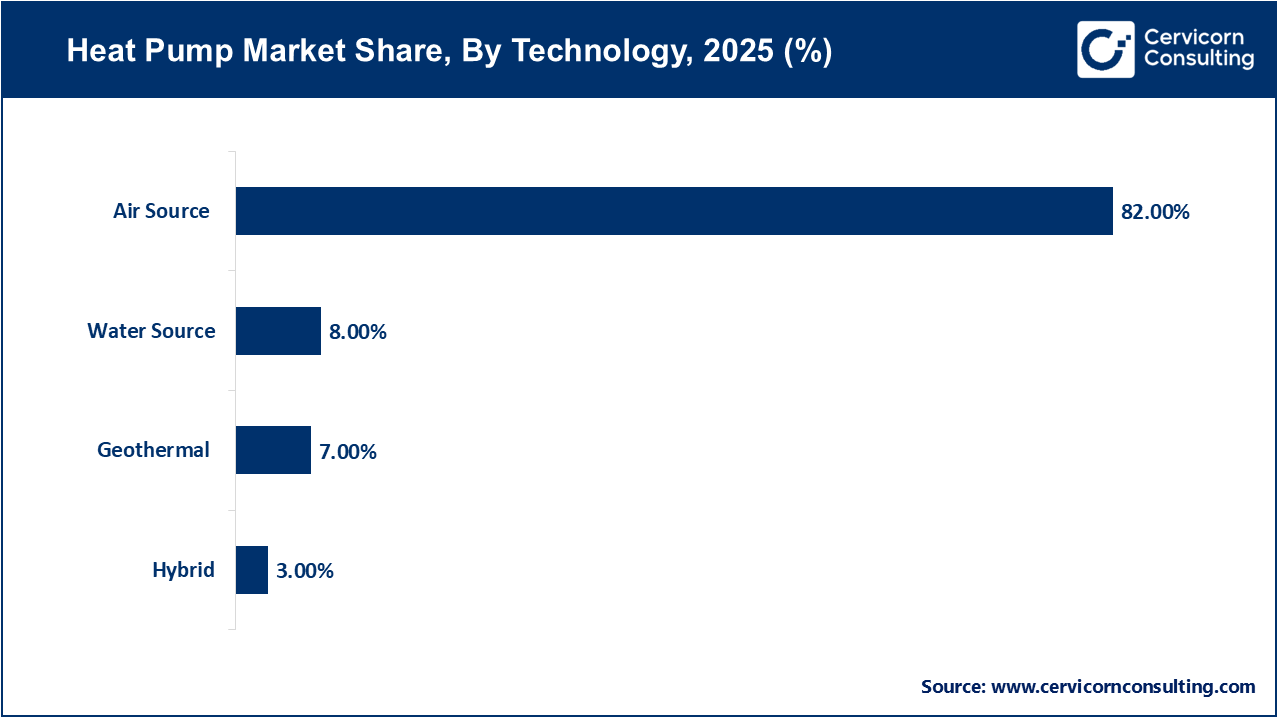
Geothermal heat pumps are the fastest-growing technology, due to their higher efficiency by transferring heat between the house and the underground temperature as a heat source. High-efficiency geothermal heat pumps, like ENERGY STAR-certified models, use 60% less energy than standard models and fit in various homes. Ground source heat pumps typically achieve the highest Seasonal Coefficient of Performance (SCOP) scores, often exceeding 4.5 or even reaching 5.0 in optimized conditions. However, the high upfront costs and installation have limited their utility in the marketplace. This technology requires either vertical boreholes or horizontal ground loops, which, as a consideration for installation, requires more land area and specialized equipment to drill into the ground.
R410A refrigerant has been the dominant in the market because of its stable thermodynamic properties and A1 non-flammable classification. Its reliability and widespread compatibility with existing systems have supported its long-standing use across residential and commercial applications. However, R410A has a relatively high Global Warming Potential (GWP) of around 2,088, leading to the phase-down under international agreements such as the Kigali Amendment. As a result, the industry transitioned toward lower-GWP refrigerants, such as R32, which offer improved efficiency but carry mild flammability characteristics.
Heat Pump Market Share, By Refrigerant, 2025 (%)
| Refrigerant | Revenue Share, 2025 (%) |
| R410A | 50% |
| R407C | 18% |
| R744 | 12% |
| Others | 20% |
R407C is the fastest-growing refrigerant segment in the market, due to its high-temperature applications and its replacement for older R22 units. This technology can deliver higher temperatures and matches industrial processes, whereas existing buildings require radiator systems. In addition, the market is slowly transitioning to next-generation refrigerants such as R32, R290 (propane), and CO2 (R744), which demonstrate a lower GWP and improved efficiency.
Up to 10 kW capacity segment is currently leading the global market, mainly driven by strong demand for the single-family residential sector. This segment is relevant in regions with the construction of high-efficiency, well-insulated new homes, where the lower thermal load is sufficient for heating and hot water needs. In countries across European and Asian markets, the 5 kW to 8 kW range is still sufficient to provide heating and domestic hot water for a typical family home. Additionally, the large scale of manufacturing has enabled economies of scale, making it the most affordable entry point for consumers transitioning away from fossil-fuel-based boilers.
Heat Pump Market Share, By Capacity, 2025 (%)
| Capacity | Revenue Share, 2025 (%) |
| Up to 10 kW | 45% |
| 10 -20 kW | 35% |
| Above 30 KW | 20% |
10 to 20 kW is currently the fastest-growing segment of the heat pump market, driven by rising demand for larger residential homes and light commercial applications. This growth is partially due to a retrofit market narrative, with older, less-insulated housing stock in regions of the world that require higher thermal output to maintain comfort during peak winter months. The movement toward "hybrid" systems, in which a heat pump is integrated with an existing boiler, is contributing to increased adoption in this capacity range.
Residential is the largest segment of the heat pump market, mainly due to the significant majority of installations. This leading segment is supported by government incentives, growing social trends toward sustainability, and increasing demand for energy-efficient heating solutions. Residential applications focus on space heating, domestic hot water, and, increasingly, space cooling. The energy crisis of 2021-22 increase adoption of heat pumps, which was a direct response to the volatility of natural gas prices.
Heat Pump Market Share, By End User, 2025 (%)
| End User | Revenue Share, 2025 (%) |
| Residential | 84% |
| Commercial | 10% |
| Industrial | 6% |
Industry is the fastest End user of the market due to the need to decarbonise process heat in sectors such as food and beverage, paper, and chemicals. These applications require much higher temperatures, often above 100 °C, than residential requirements. Growth in the industrial segment is being driven by corporate ESG (Environmental, Social, and Governance) commitments and carbon pricing. Additionally, the role of Advanced AI is transformative in the industrial energy sector, as it may optimize heat pumps in complex energy conversion systems and improve efficiency for the entire plant, and waste reduction.
Heating applications are the leading segment of the market, mainly due to the growing demand for heat pump systems that provide both heating and cooling. As a result, rising global temperatures and increasing heat waves occur during the summer. Most manufacturers provide "all-in-one" indoor units for the residential market that contain the water tank, pumps, and electronics in a single indoor appliance. These products are being marketed as simple to install in a single appliance.
Heat Pump Market Share, By Application, 2025 (%)
| Application | Revenue Share, 2025 (%) |
| Heating | 70% |
| Heating & Cooling | 30% |
Heating and Cooling segment is the fastest-growing application segment of the market, due to the warming of global temperatures and the associated increased consumer preferences for summer comfort, diminishing the attractiveness of affordable and standalone heating systems. The growth of dual-purpose heating and cooling systems is also a potential reflection of the movement toward "Integrated Energy," where, in those situations, the heat pump is a flexible load that responds to grid signals for cooling during peak renewable solar generation and for heating during lower-demand periods.
By Type
By Technology
By Refrigerant
By Capacity
By End User
By Application
By Region
Chapter 1. Market Introduction and Overview
1.1 Market Definition and Scope
1.1.1 Overview of Heat Pump
1.1.2 Scope of the Study
1.1.3 Research Timeframe
1.2 Research Methodology and Approach
1.2.1 Methodology Overview
1.2.2 Data Sources and Validation
1.2.3 Key Assumptions and Limitations
Chapter 2. Executive Summary
2.1 Market Highlights and Snapshot
2.2 Key Insights by Segments
2.2.1 By Type Overview
2.2.2 By Technology Overview
2.2.3 By Refrigerant Overview
2.2.4 By Capacity Overview
2.2.5 By End User Overview
2.2.6 By Application Overview
2.3 Competitive Overview
Chapter 3. Global Impact Analysis
3.1 Russia-Ukraine Conflict: Global Market Implications
3.2 Regulatory and Policy Changes Impacting Global Markets
Chapter 4. Market Dynamics and Trends
4.1 Market Dynamics
4.1.1 Market Drivers
4.1.2 Market Restraints
4.1.3 Market Opportunities
4.1.4 Market Challenges
4.2 Market Trends
Chapter 5. Premium Insights and Analysis
5.1 Global Heat Pump Market Dynamics, Impact Analysis
5.2 Porter’s Five Forces Analysis
5.2.1 Bargaining Power of Suppliers
5.2.2 Bargaining Power of Buyers
5.2.3 Threat of Substitute Products
5.2.4 Rivalry among Existing Firms
5.2.5 Threat of New Entrants
5.3 PESTEL Analysis
5.4 Value Chain Analysis
5.5 Product Pricing Analysis
5.6 Vendor Landscape
5.6.1 List of Buyers
5.6.2 List of Suppliers
Chapter 6. Heat Pump Market, By Type
6.1 Global Heat Pump Market Snapshot, By Type
6.1.1 Market Revenue (($Billion) and Growth Rate (%), 2022-2035
6.1.1.1 Non-reversible
6.1.1.2 Reversible
Chapter 7. Heat Pump Market, By Technology
7.1 Global Heat Pump Market Snapshot, By Technology
7.1.1 Market Revenue (($Billion) and Growth Rate (%), 2022-2035
7.1.1.1 Air Source
7.1.1.2 Water Source
7.1.1.3 Geothermal
7.1.1.4 Hybrid
Chapter 8. Heat Pump Market, By Refrigerant
8.1 Global Heat Pump Market Snapshot, By Refrigerant
8.1.1 Market Revenue (($Billion) and Growth Rate (%), 2022-2035
8.1.1.1 R410A
8.1.1.2 R407C
8.1.1.3 R744
8.1.1.4 Others
Chapter 9. Heat Pump Market, By Capacity
9.1 Global Heat Pump Market Snapshot, By Capacity
9.1.1 Market Revenue (($Billion) and Growth Rate (%), 2022-2035
9.1.1.1 Up to 10 kW
9.1.1.2 10 -20 kW
9.1.1.3 Above 30 KW
Chapter 10. Heat Pump Market, By End User
10.1 Global Heat Pump Market Snapshot, By End User
10.1.1 Market Revenue (($Billion) and Growth Rate (%), 2022-2035
10.1.1.1 Residential
10.1.1.2 Commercial
10.1.1.3 Industrial
Chapter 11. Heat Pump Market, By Application
11.1 Global Heat Pump Market Snapshot, By Application
11.1.1 Market Revenue (($Billion) and Growth Rate (%), 2022-2035
11.1.1.1 Heating
11.1.1.2 Heating & Cooling
Chapter 12. Heat Pump Market, By Region
12.1 Overview
12.2 Heat Pump Market Revenue Share, By Region 2024 (%)
12.3 Global Heat Pump Market, By Region
12.3.1 Market Size and Forecast
12.4 North America
12.4.1 North America Heat Pump Market Revenue, 2022-2035 ($Billion)
12.4.2 Market Size and Forecast
12.4.3 North America Heat Pump Market, By Country
12.4.4 U.S.
12.4.4.1 U.S. Heat Pump Market Revenue, 2022-2035 ($Billion)
12.4.4.2 Market Size and Forecast
12.4.4.3 U.S. Market Segmental Analysis
12.4.5 Canada
12.4.5.1 Canada Heat Pump Market Revenue, 2022-2035 ($Billion)
12.4.5.2 Market Size and Forecast
12.4.5.3 Canada Market Segmental Analysis
12.4.6 Mexico
12.4.6.1 Mexico Heat Pump Market Revenue, 2022-2035 ($Billion)
12.4.6.2 Market Size and Forecast
12.4.6.3 Mexico Market Segmental Analysis
12.5 Europe
12.5.1 Europe Heat Pump Market Revenue, 2022-2035 ($Billion)
12.5.2 Market Size and Forecast
12.5.3 Europe Heat Pump Market, By Country
12.5.4 UK
12.5.4.1 UK Heat Pump Market Revenue, 2022-2035 ($Billion)
12.5.4.2 Market Size and Forecast
12.5.4.3 UK Market Segmental Analysis
12.5.5 France
12.5.5.1 France Heat Pump Market Revenue, 2022-2035 ($Billion)
12.5.5.2 Market Size and Forecast
12.5.5.3 France Market Segmental Analysis
12.5.6 Germany
12.5.6.1 Germany Heat Pump Market Revenue, 2022-2035 ($Billion)
12.5.6.2 Market Size and Forecast
12.5.6.3 Germany Market Segmental Analysis
12.5.7 Rest of Europe
12.5.7.1 Rest of Europe Heat Pump Market Revenue, 2022-2035 ($Billion)
12.5.7.2 Market Size and Forecast
12.5.7.3 Rest of Europe Market Segmental Analysis
12.6 Asia Pacific
12.6.1 Asia Pacific Heat Pump Market Revenue, 2022-2035 ($Billion)
12.6.2 Market Size and Forecast
12.6.3 Asia Pacific Heat Pump Market, By Country
12.6.4 China
12.6.4.1 China Heat Pump Market Revenue, 2022-2035 ($Billion)
12.6.4.2 Market Size and Forecast
12.6.4.3 China Market Segmental Analysis
12.6.5 Japan
12.6.5.1 Japan Heat Pump Market Revenue, 2022-2035 ($Billion)
12.6.5.2 Market Size and Forecast
12.6.5.3 Japan Market Segmental Analysis
12.6.6 India
12.6.6.1 India Heat Pump Market Revenue, 2022-2035 ($Billion)
12.6.6.2 Market Size and Forecast
12.6.6.3 India Market Segmental Analysis
12.6.7 Australia
12.6.7.1 Australia Heat Pump Market Revenue, 2022-2035 ($Billion)
12.6.7.2 Market Size and Forecast
12.6.7.3 Australia Market Segmental Analysis
12.6.8 Rest of Asia Pacific
12.6.8.1 Rest of Asia Pacific Heat Pump Market Revenue, 2022-2035 ($Billion)
12.6.8.2 Market Size and Forecast
12.6.8.3 Rest of Asia Pacific Market Segmental Analysis
12.7 LAMEA
12.7.1 LAMEA Heat Pump Market Revenue, 2022-2035 ($Billion)
12.7.2 Market Size and Forecast
12.7.3 LAMEA Heat Pump Market, By Country
12.7.4 GCC
12.7.4.1 GCC Heat Pump Market Revenue, 2022-2035 ($Billion)
12.7.4.2 Market Size and Forecast
12.7.4.3 GCC Market Segmental Analysis
12.7.5 Africa
12.7.5.1 Africa Heat Pump Market Revenue, 2022-2035 ($Billion)
12.7.5.2 Market Size and Forecast
12.7.5.3 Africa Market Segmental Analysis
12.7.6 Brazil
12.7.6.1 Brazil Heat Pump Market Revenue, 2022-2035 ($Billion)
12.7.6.2 Market Size and Forecast
12.7.6.3 Brazil Market Segmental Analysis
12.7.7 Rest of LAMEA
12.7.7.1 Rest of LAMEA Heat Pump Market Revenue, 2022-2035 ($Billion)
12.7.7.2 Market Size and Forecast
12.7.7.3 Rest of LAMEA Market Segmental Analysis
Chapter 13. Competitive Landscape
13.1 Competitor Strategic Analysis
13.1.1 Top Player Positioning/Market Share Analysis
13.1.2 Top Winning Strategies, By Company, 2022-2024
13.1.3 Competitive Analysis By Revenue, 2022-2024
13.2 Recent Developments by the Market Contributors (2024)
Chapter 14. Company Profiles
14.1 Samsung
14.1.1 Company Snapshot
14.1.2 Company and Business Overview
14.1.3 Financial KPIs
14.1.4 Product/Service Portfolio
14.1.5 Strategic Growth
14.1.6 Global Footprints
14.1.7 Recent Development
14.1.8 SWOT Analysis
14.2 Carrier
14.3 Panasonic Holdings Corporation
14.4 Rheem Manufacturing Company
14.5 HAIER(GENERAL ELECTRIC)
14.6 Danfoss
14.7 Fujitsu
14.8 LG Electronics, Inc.
14.9 Daikin Industries, Ltd
14.10 Robert Bosch GmbH
14.11 Lennox International
14.12 Johnson Controls, Inc.
14.13 Midea Group
14.14 Hitachi, Ltd.
14.15 Ingersoll Rand Plc.